Tex-Mex Recipes
Beef and Cheese Enchiladas
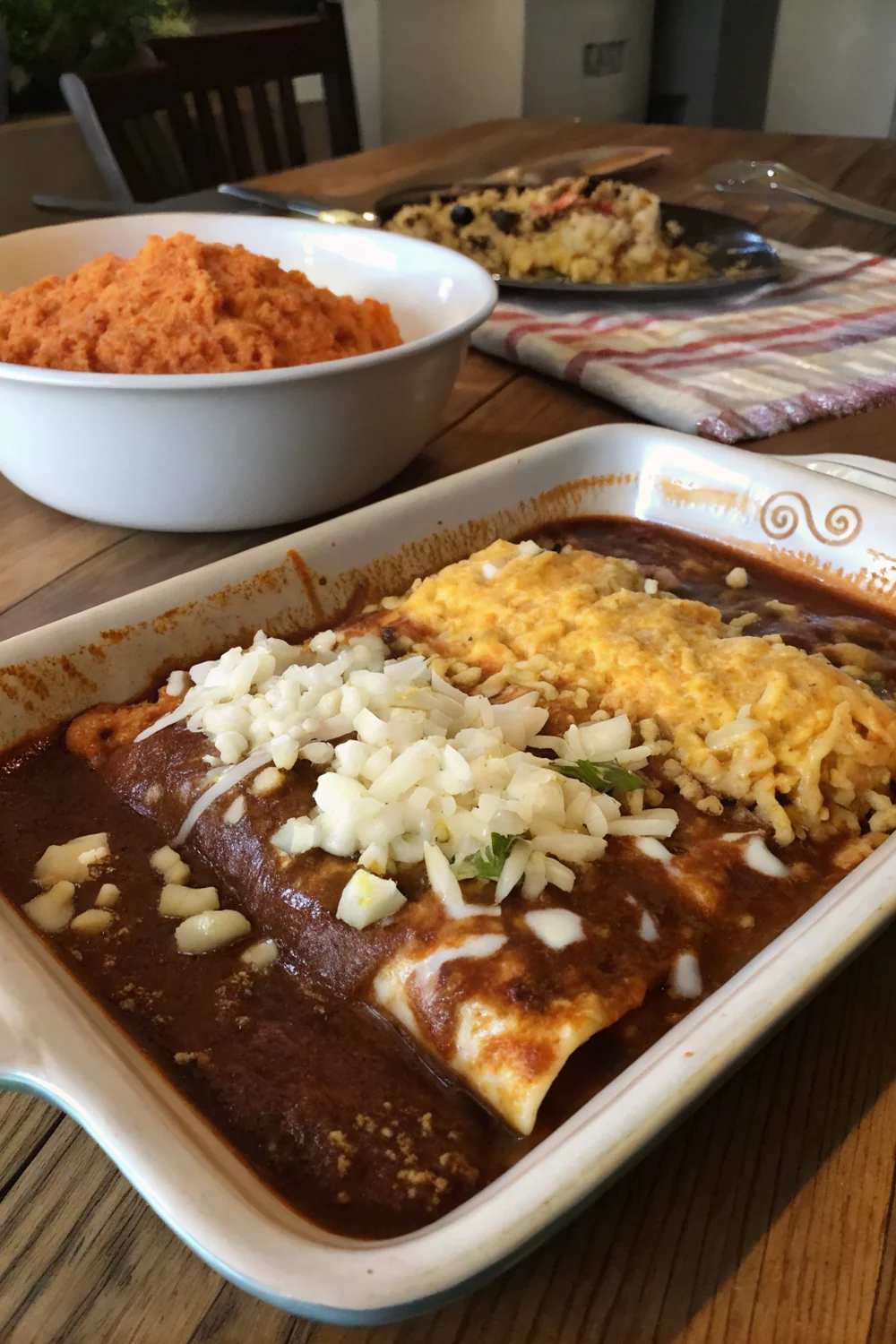
Chef Mia's Tex-Mex beef and cheese enchiladas: corn tortillas, yellow cheddar, ground beef, real chili gravy from a roux. The San Antonio plate.
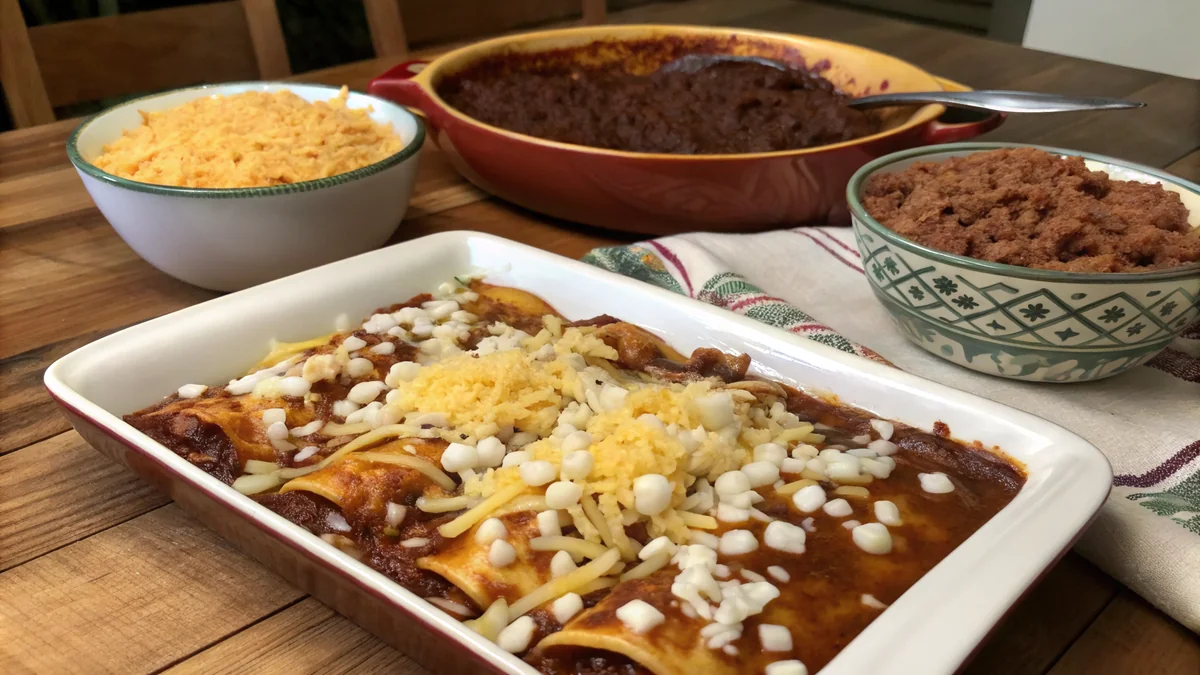
Quick answer: Tex-Mex beef and cheese enchiladas are different from Mexican enchiladas in three specific ways: the sauce is a chili gravy made from a flour-and-fat roux with chili powder and beef broth (no tomato), the cheese is yellow cheddar rather than Oaxaca or queso fresco, and the topping is finely diced raw white onion rather than crema or cilantro. To make them at home, brown ground beef with cumin and onion, soften corn tortillas in warm oil, fill, roll seam-side down in a baking dish, ladle chili gravy over the top, blanket with shredded yellow cheddar, and bake at 350F for 18-20 minutes until bubbling. Top with raw onion and serve with refried beans and Spanish rice.
There is a specific plate in San Antonio that I judge every Tex-Mex restaurant by: three rolled enchiladas covered in a thin, dark chili gravy, blanketed with melted yellow cheese, dusted with finely chopped white onion, and served alongside refried beans and Spanish rice. Some places call it the Number 1 plate. Others call it the combo or the regular. What it should be called is the standard - because if a Tex-Mex restaurant cannot make a plate of beef and cheese enchiladas correctly, nothing else on the menu will be reliable either.
What makes Tex-Mex enchiladas Tex-Mex and not Mexican is mostly the sauce. Mexican enchiladas use a chile-based sauce: dried chiles soaked, blended with broth, often with tomato, sometimes with chocolate. Tex-Mex enchiladas use a chili gravy: a flour-and-lard roux toasted with chili powder and cumin, whisked with beef broth into something closer to a savory brown sauce than to a Mexican mole. There is no tomato in a true chili gravy. The cheese is yellow because yellow cheddar was what immigrant Tejano families could get at the country store in the 1880s and 1890s, and the tradition stuck. The raw white onion on top is the move that announces this is Tex-Mex - put it there or do not bother. The same chili-gravy crowd usually wants fajitas next, and my Pappasito's fajita marinade is the one I reach for.
Why Tex-Mex Enchiladas Are Different from Mexican Enchiladas
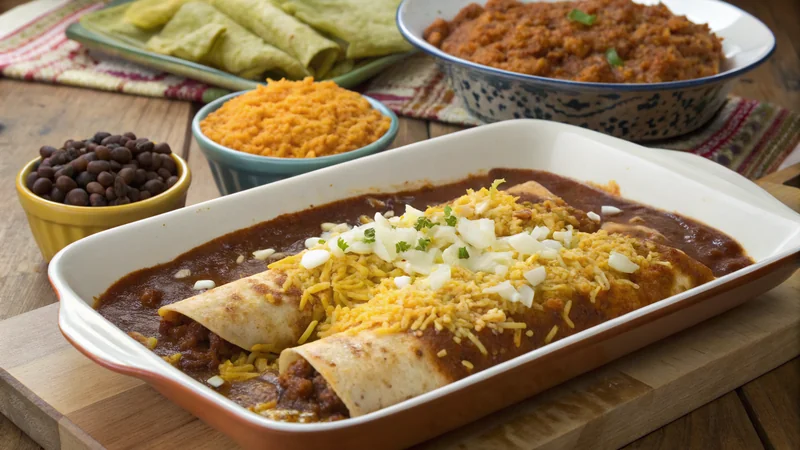
The biggest source of confusion in American Mexican-food cooking is that Tex-Mex enchiladas and Mexican enchiladas are different dishes that share a name. Mexican enchiladas come in many regional styles: enchiladas rojas (red, with dried chile sauce), enchiladas verdes (green, with tomatillo and serrano), enchiladas suizas (cream and Swiss-style cheese), enchiladas mineras (potato and chorizo). The sauces are chile-and-broth based, often with tomato or tomatillo. The cheese is typically Oaxaca, queso fresco, or cotija. The garnish is crema, cilantro, or sliced onion in vinegar.
Tex-Mex enchiladas evolved separately. Tejano cooks in the 1800s adapted the dish to what was available in country stores: yellow cheddar instead of Mexican cheeses (because that is what shipped to West Texas), a flour-roux gravy instead of a chile-blender sauce (because home cooks already knew how to make a roux from Czech and German neighbors), and chili powder rather than dried chiles (because chili powder was already sold pre-mixed by Gebhardt's after 1894). Three generations later, this became its own canon: chili gravy, yellow cheese, raw onion. That is the San Antonio plate.
Both styles are legitimate, but they are not interchangeable. If you order beef and cheese enchiladas in Mexico City, you will get a chile-rojo sauce on Oaxaca cheese with a slice of cotija on top. If you order them at a 60-year-old San Antonio restaurant on the south side, you will get yellow cheese, brown chili gravy, and finely diced white onion. This recipe is the second one.
The Chili Gravy: A Tex-Mex Roux
Chili gravy is the signature element. It is technically a French roux-based sauce flavored with American Southwest spices and beef broth - which is itself a quiet symbol of how Tex-Mex evolved as a fusion cuisine. The roux is the body, beef broth is the liquid, chili powder and cumin are the flavor, and there is no tomato.
The roux is blond, not dark. Cook the flour and lard together just until the color of light peanut butter, about 3-4 minutes. A blond roux still has thickening power; a dark roux (the kind used in Cajun gumbos) has lost most of its starch and would leave the gravy thin. The blond roux gives you a gravy that coats a tortilla without being claggy.
Lard is traditional and gives the best flavor. Vegetable oil works fine and is easier to find. Bacon fat is excellent if you have it. Butter works but burns more easily and is not quite right for the savory profile. Avoid olive oil - the green note clashes with the chili powder.
Toasting the chili powder in the hot fat for 30-60 seconds before adding broth is the move that separates a flat-tasting gravy from a layered one. Underdone, the gravy tastes like dry chili powder. Overdone, the chili powder burns and turns bitter. The right window is short - watch closely and add the broth as soon as the spices are fragrant.
Choosing Your Chili Powder
American chili powder is a blend, not a single chile. Gebhardt's Eagle Brand Chili Powder (made in San Antonio since 1896) is the Texas canonical choice and contains ancho chiles, cumin, garlic, oregano, and salt. Mexene is the second-most-common Texas brand. Both are available at HEB, online, and at any Texas grocery.
If you cannot find Gebhardt's or Mexene, McCormick chili powder is a serviceable substitute. Avoid "hot" or "spicy" labeled blends - they throw off the seasoning balance because most are heavier on cayenne. Avoid Mexican-marketed pure ancho or pasilla powders - they are single-chile products and require you to add cumin, garlic, and oregano separately.
Some advanced Tex-Mex cooks build their own blend: 2 parts ancho powder, 1 part cumin, 1/2 part garlic powder, 1/4 part Mexican oregano, pinch of cayenne. This is the move if you cannot get Gebhardt's; the result is more controllable and slightly fresher than the pre-made blends.
Whatever you use, taste your chili powder before adding it to the gravy. Old chili powder loses its punch within a year. If the powder smells dusty rather than warm and rich, replace it.
Corn vs Flour Tortillas
Corn tortillas are the traditional choice for Tex-Mex enchiladas, and there is a structural reason: corn tortillas hold up to wet sauce without dissolving. Flour tortillas absorb gravy and turn into a soggy paste within minutes of saucing. If a Tex-Mex menu lists "flour enchiladas," they are technically not enchiladas - they are something closer to a gravy-covered burrito.
Use 6-inch yellow or white corn tortillas. Brand matters less than freshness - even cheap corn tortillas work if they are fresh. If you have access to handmade tortillas from a tortilleria (San Antonio has many), use those. Mission and La Banderita are both acceptable supermarket choices.
Soften every tortilla in warm oil before rolling. This is the step most home cooks skip and most home cooks regret. Cold or microwaved tortillas crack at the fold every time. Five seconds per side in 350F oil makes the tortilla flexible without crisping it. Stack on paper towels and use immediately.
An alternative softening method: dip each tortilla in the warm chili gravy itself for 3-5 seconds before filling. This adds flavor and skips the oil step. The downside is the gravy gets muddier as you go - it works but is not as clean.
The Cheese Question
Yellow cheddar is the Tex-Mex standard, period. Medium cheddar is the most common choice; sharp cheddar can overpower the gravy; mild cheddar is a little flat. Many Texan cooks use a 50/50 blend of cheddar and Monterey Jack for melt quality - the jack melts smoother, the cheddar carries the flavor. That is a legitimate move.
Velveeta or American cheese was traditional in many San Antonio restaurants for the melt quality - the texture is silky, never grainy, and the cheese stays melted longer between bites. If you want the old-school dineraria diner taste, use 1 cup of Velveeta cubed plus 2 cups of shredded yellow cheddar. The Velveeta gives the gravy that classic restaurant texture.
Avoid white cheese (Oaxaca, mozzarella, queso fresco). They are correct for Mexican enchiladas but wrong for Tex-Mex. The visual signature of a Tex-Mex enchilada is the yellow blanket of cheese on top - a white cheese makes it look Italian.
Always shred your own cheese from a block. Pre-shredded bagged cheese is coated in cellulose to prevent clumping in the bag, and that coating prevents smooth melting in the oven. Shred 8 ounces in 30 seconds with a box grater. The improvement in texture is worth the minute.
Building the Beef Filling
80/20 ground beef is the Texas standard - 80 percent lean, 20 percent fat. Leaner ground beef (90/10 or 93/7) ends up dry in the filling. Fattier (70/30) leaves a greasy slick on top of the assembled enchiladas. 80/20 is the sweet spot.
Season simply: cumin, salt, pepper, chili powder, and the diced onion and garlic. The chili gravy is doing the heavy seasoning, so the beef filling should be supportive, not loud. Avoid taco seasoning packets - they are cumin-and-paprika heavy and clash with the gravy's own chili powder.
No tomato in the filling. Some recipes call for tomato sauce or diced tomatoes in the meat. That is the move for Mexican enchiladas, not Tex-Mex. Adding tomato to the beef makes the filling read as taco meat, not enchilada filling, and it competes with the brown gravy on top.
Drain excess fat after browning if the pan has more than a thin coating. Pour off into a heatproof container; do not pour down the sink. The fat will solidify and clog drains.
Step-by-Step Assembly
Set up a workstation with all components ready: warm gravy, cooked beef, shredded cheese, oil-softened tortillas in a stack, baking dish with 1/2 cup gravy already spread on the bottom, finely diced raw onion in a small bowl. Assembling enchiladas is a quick rhythm and stops working if you have to interrupt to grate cheese mid-fill.
Place a softened tortilla on a plate. Spoon 2-3 tablespoons of beef filling down the center, leaving 1/2 inch from each end. Add a heaping tablespoon of shredded cheese on top of the beef. Roll tightly, finishing seam-side down in the baking dish.
Pack the rolled enchiladas snugly in the dish. They should be touching, not crowded. Twelve 6-inch enchiladas typically fit in a 9x13-inch dish in two rows of six.
Pour the remaining gravy evenly over the top, making sure every inch of every tortilla is covered. Any exposed tortilla edge will dry out and crisp during the bake. Pour at the center of each enchilada, not at the edges of the dish, to ensure even coverage. Top with the remaining shredded cheese, edge to edge.
The Bake
350F (175C) for 18-22 minutes uncovered. The signs of done are: cheese fully melted with no white spots, gravy bubbling visibly along the edges of the dish, and the top of the cheese with a few golden-brown speckles.
Do not over-bake. The goal is hot and bubbly, not crisped. Over-baked enchiladas have a dry crusty top, the cheese has separated and gone greasy, and the gravy reduces to a paste at the edges. Pull at 18 minutes and check; add 2-3 minutes if needed.
If you want more cheese browning on top but the bake time is up, switch on the broiler for 1-2 minutes. Watch closely - the cheese can go from golden to charred in 30 seconds.
Rest the dish for 5 minutes out of the oven before serving. This lets the gravy reset and prevents the enchiladas from sliding apart on the plate.
Mistakes to Avoid
Skipping the tortilla softening. Cold or microwaved tortillas crack when rolled. The 30 seconds in warm oil is the difference between intact enchiladas and broken enchiladas.
Using flour tortillas. They dissolve under chili gravy. Use corn for any Tex-Mex enchilada.
Using pre-shredded bagged cheese. The cellulose coating prevents smooth melting. Shred from a block - 30 seconds with a box grater.
Adding tomato to the gravy or filling. Tex-Mex chili gravy has no tomato. Tomato turns it into a Mexican-style red enchilada sauce, which is a different dish.
Forgetting the raw onion. The finely diced raw white onion on top is the Tex-Mex signature. Without it, the plate looks unfinished.
Using sharp cheddar or sweet cheddar. Medium yellow cheddar (or 50/50 cheddar-jack) is the right intensity. Sharp dominates the gravy, mild disappears under it.
Troubleshooting
Gravy is too thick. Whisk in 1/4 cup of warm beef broth at a time until pourable. Always warm the liquid first; cold broth added to hot gravy can break the emulsion.
Gravy is too thin. Simmer uncovered for 5 more minutes to reduce. If still thin, mix 1 teaspoon flour with 1 tablespoon cold water, whisk into the simmering gravy, cook 2 minutes.
Tortillas tear when rolling. Either they were not softened enough, or they are old. Soften in oil for 8-10 seconds per side instead of 5. Or buy fresh tortillas.
Filling is dry. Add 2 tablespoons of warm chili gravy to the beef filling before assembly. The gravy moistens the beef without changing the flavor.
Cheese is greasy or separated on top. Over-baked. Pull at 18 minutes, broil briefly if needed. Use freshly shredded cheese, not pre-bagged.
Gravy tastes flat. The chili powder is old, or you skipped the toasting step. Add a fresh pinch of chili powder and a tiny pinch of salt, simmer 2 minutes, taste again.
Variations
Cheese-only enchiladas. Skip the beef. Fill each tortilla with 2 heaping tablespoons of shredded cheese. The plate is lighter and the chili gravy carries more of the flavor. This is also the cheaper plate, traditionally ordered as the Number 2.
Bean and beef enchiladas. Replace half the beef with refried beans. Mix a heaping cup of refried beans into the cooked beef, stir to combine. The result is a softer, richer filling that is also more filling per enchilada.
Sour cream chicken enchiladas. A different style entirely - poached shredded chicken filled into tortillas, topped with a sour cream and green chile sauce instead of chili gravy, baked with Monterey Jack. Lighter, creamier, the Sunday-supper version.
Green chile enchiladas (also called enchiladas verdes Tex-Mex style). Replace the chili gravy with a sauce made from roasted Hatch green chiles, garlic, and chicken broth. Top with white Monterey Jack instead of yellow cheese. Hatch chile season (August-September) is the traditional time.
Smaller portions for kids or appetizers. Use 4-inch tortillas (sometimes called street-taco size). Fill with 1 tablespoon beef and 1 teaspoon cheese, roll, sauce, bake. Yields 18-20 mini enchiladas, perfect for parties.
What to Serve With Enchiladas
Refried beans (frijoles refritos) and Spanish rice are the two non-negotiable sides. Together they form the Tex-Mex Number 1 plate. Make refried beans from canned pintos: rinse, mash with bacon fat or lard in a skillet, season with salt, cumin, and a pinch of garlic powder. Spanish rice (arroz rojo) is rice browned in fat, simmered with chicken broth, tomato sauce, and onion.
Add pico de gallo (diced tomato, white onion, jalapeno, cilantro, lime, salt) and a small bowl of guacamole on the side. The cool and acidic pico cuts through the rich gravy and cheese.
Drinks: a cold Mexican lager (Modelo Especial, Tecate, Pacifico) is canonical. A margarita on the rocks with salt is for celebrations. Iced tea with lemon is the family-table choice.
For a full Tex-Mex meal beyond enchiladas, see the Ultimate Tex-Mex Recipes Guide. Pair with smoked chorizo queso as a starter, fresh buttery tortillas, or finish with sweet potato cheesecake pie.
Storage and Reheating
Refrigerate leftover enchiladas, covered, for up to 4 days. They actually taste better on day two - the gravy has soaked into the tortillas and the flavors have integrated.
Reheat in a 325F oven, covered with foil, for 15-20 minutes. The covered foil traps steam and re-soft the tortillas. Microwaving works in a pinch but the tortillas turn rubbery - 90 seconds covered with a damp paper towel is the technique.
Freeze uncooked, fully assembled, for up to 3 months. Thaw overnight in the fridge before baking; add 5-7 minutes to the bake time if going from cold. Do not freeze cooked enchiladas - the texture suffers more than uncooked ones.
Make-ahead: assemble the enchiladas through the gravy-and-cheese topping step, cover with foil, refrigerate up to 24 hours. Bake straight from the fridge, adding 5-8 minutes to the bake time.
Beef and Cheese Enchiladas Recipe
Ingredients
- For the chili gravy:
- 1/4 cup (55 g) lard, or 1/4 cup (60 ml) vegetable oil
- 1/4 cup (32 g) all-purpose flour
- 2 tablespoons chili powder, Gebhardt's or Mexene preferred
- 1 teaspoon ground cumin
- 1/2 teaspoon garlic powder
- 1/4 teaspoon dried Mexican oregano
- 1/2 teaspoon kosher salt
- 1/4 teaspoon freshly ground black pepper
- 2 cups (475 ml) beef broth, warm
- For the beef filling:
- 1 lb (450 g) 80/20 ground beef
- 1 medium yellow onion, finely diced
- 2 cloves garlic, minced
- 1 teaspoon ground cumin
- 1 teaspoon kosher salt
- 1/2 teaspoon freshly ground black pepper
- 1/2 teaspoon chili powder
- For assembly:
- 12 corn tortillas, 6-inch (yellow or white)
- 1/4 cup (60 ml) vegetable oil, for softening tortillas
- 3 cups (340 g) shredded yellow cheddar cheese (medium, not sharp)
- 1/2 small white onion, very finely diced (for topping)
- Optional: chopped fresh cilantro, sour cream, lime wedges, sliced jalapenos
Instructions
- Make the roux. In a 3-quart saucepan over medium heat, melt the lard or warm the oil until it shimmers. Whisk in the flour. Cook, whisking constantly, for 3-4 minutes until the roux is the color of light peanut butter. This is a blond roux - do not let it darken to chocolate brown or it will taste burnt.
- Toast the chili powder. Add the chili powder, cumin, garlic powder, oregano, salt, and pepper to the roux. Whisk for 30-60 seconds until the spices are fragrant and the mixture looks like a thick, dark paste. This step is the difference between a chili gravy that tastes alive and one that tastes muddy. Do not skip; do not rush past 30 seconds.
- Whisk in the broth. Slowly pour in the warm beef broth, whisking constantly to prevent lumps. The mixture will look broken at first, then smooth out as you whisk. Bring to a gentle boil over medium heat, whisking, until the gravy thickens to coat the back of a spoon - about 5-7 minutes. Reduce heat and simmer 5 more minutes for the flavors to settle. The finished gravy should be the color of a darker beef gravy, with no visible flour streaks. Hold warm.
- Brown the beef filling. While the gravy simmers, heat a 12-inch skillet over medium-high heat. Add the ground beef and break it up with a wooden spoon. Cook 3-4 minutes until the beef releases its fat and starts to brown. Add the diced onion, cook 2 minutes until softening. Add the minced garlic, cumin, salt, pepper, and chili powder. Cook 2-3 more minutes, stirring, until the onion is translucent and the beef is fully cooked. Drain excess fat if there is more than a thin coating in the pan. Hold warm.
- Soften the tortillas. Heat 1/4 cup of vegetable oil in a small skillet over medium heat until shimmering but not smoking. Working one at a time, dip each corn tortilla in the warm oil for 5-10 seconds per side - just long enough to soften it without crisping. Drain on paper towels. The tortilla should be flexible enough to roll without cracking. This step is non-negotiable - cold or microwaved tortillas crack the moment you fold them.
- Assemble and roll. Preheat oven to 350F (175C). Spread 1/2 cup of the chili gravy in the bottom of a 9x13-inch baking dish. Working one at a time, place a softened tortilla on a plate, spoon 2-3 tablespoons of the beef filling and a heaping tablespoon of shredded cheese down the center, and roll tightly. Place seam-side down in the baking dish. Repeat with all 12 tortillas, fitting them snugly in the dish.
- Sauce and top. Pour the remaining chili gravy evenly over the rolled enchiladas, making sure every tortilla is fully covered - any exposed tortilla edge will dry out and crisp. Sprinkle the remaining shredded cheddar cheese evenly across the top, all the way to the edges of the dish.
- Bake. Bake uncovered for 18-22 minutes, until the cheese is fully melted, the gravy is bubbling along the edges, and the top has a few golden-brown spots. Do not over-bake; the goal is hot and bubbly, not crisped. If the cheese is melted but you want more browning on top, run under the broiler for 1-2 minutes (watch carefully).
- Garnish and serve. Remove from oven, let rest 5 minutes. Sprinkle the finely diced raw white onion across the top - this is the Tex-Mex signature, do not skip. Garnish with optional chopped cilantro, a side of sour cream, lime wedges, or sliced jalapenos. Serve hot with refried beans and Spanish rice.
Frequently Asked Questions
Why use yellow cheese in Tex-Mex enchiladas?
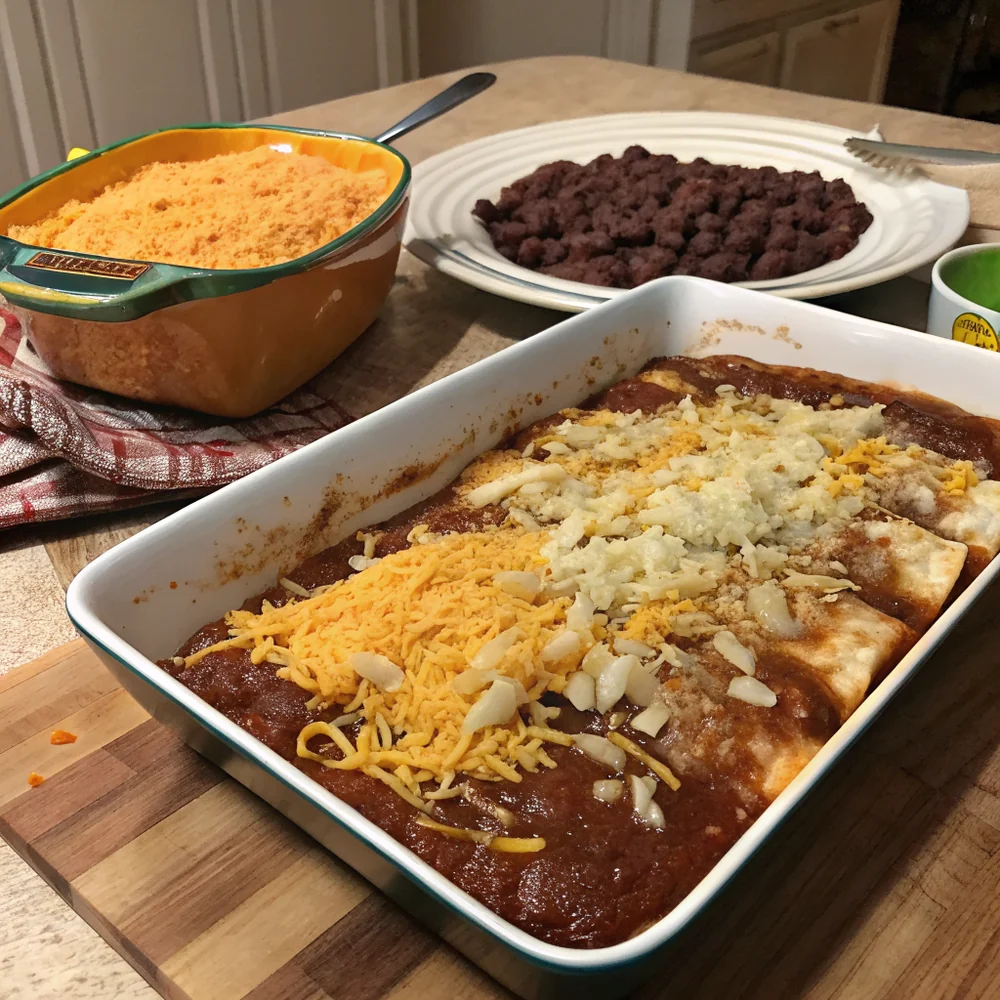
Yellow cheddar is the Tex-Mex standard for historical reasons - it was the cheese that shipped to Texas country stores in the 1800s and 1890s. It is the visual signature of the dish. White cheese (Oaxaca, queso fresco, mozzarella) is correct for Mexican enchiladas but wrong for Tex-Mex. Use medium yellow cheddar, freshly shredded from a block.
Can I make the chili gravy ahead?
Yes. The gravy keeps in the fridge for up to 5 days, or in the freezer for 3 months. Reheat gently over low heat, whisking, until smooth. If it is too thick after refrigerating, whisk in warm broth a tablespoon at a time until pourable.
Why do my tortillas crack when rolling?
They were not softened first. Cold or microwaved corn tortillas crack the moment you fold them. Heat 1/4 cup of vegetable oil in a small skillet, dip each tortilla 5-10 seconds per side until flexible, drain on paper towels, then roll. Or dip in warm chili gravy for 3-5 seconds as a faster method.
Can I freeze enchiladas?
Yes - freeze uncooked, fully assembled in the baking dish, covered tightly with foil and plastic wrap, for up to 3 months. Thaw overnight in the fridge, add 5-7 minutes to the bake time. Do not freeze cooked enchiladas; the texture suffers more after thawing.
What is the difference between Mexican and Tex-Mex enchiladas?
Three main differences: the sauce (Mexican uses a chile-and-broth blend, often with tomato; Tex-Mex uses a flour-roux chili gravy without tomato), the cheese (Mexican uses Oaxaca, queso fresco, or cotija; Tex-Mex uses yellow cheddar), and the topping (Mexican uses crema, cilantro, or pickled onion; Tex-Mex uses finely diced raw white onion).
Can I use store-bought enchilada sauce?
Store-bought red enchilada sauce makes Mexican-style enchiladas, not Tex-Mex. There is no shelf-stable equivalent of real Tex-Mex chili gravy. Old El Paso enchilada sauce is closest in color but tomato-based, which puts it in Mexican territory. Make the chili gravy from the recipe; it takes 15 minutes.
Should I use red sauce or chili gravy?
Both are valid for different dishes. Chili gravy is the Tex-Mex tradition - brown, savory, no tomato. Red sauce is Mexican tradition - red, chile-forward, often with tomato. If you order beef and cheese enchiladas at a Tex-Mex restaurant, you should expect chili gravy. If you want red sauce, order enchiladas rojas at a Mexican (not Tex-Mex) restaurant.