Texas Desserts
Honey Lavender Ice Cream
Chef Mia's honey lavender ice cream: Fredericksburg dried lavender, Texas wildflower honey, custard base. Sophisticated Hill Country summer dessert.

Quick answer: Honey lavender ice cream infuses dried culinary lavender into a heavy cream and honey custard base, then strains the lavender out for a clean, perfumed flavor without the floral grit. Use Texas wildflower honey for local depth and Fredericksburg-grown dried culinary lavender for the regional signature. Heat cream + lavender + honey to just below simmer, infuse 30 minutes off heat, temper into egg yolks, cook to nappe, chill 4+ hours, churn 25 minutes, freeze 4+ hours until firm. The result is a pale lavender-tinted ice cream with a subtle floral note balanced by the warm honey sweetness.
Fredericksburg in late May and early June smells like lavender. The Hill Country town, settled by German immigrants in the 1840s, hosts about a dozen working lavender farms within a 20-mile radius - the largest concentration of lavender agriculture in Texas. The local farms sell dried lavender bunches, lavender-scented soaps and candles, and increasingly, culinary-grade dried lavender for cooking and baking. The annual Fredericksburg Lavender Festival in late May draws thousands of visitors who come to pick lavender stems, drink lavender lemonade, and see the purple fields in bloom.
I started making honey lavender ice cream after a summer trip to Fredericksburg about ten years ago, where I picked up a 4-ounce bag of culinary-grade dried lavender from Becker Vineyards' lavender garden. The vendor told me to use it sparingly in baked goods and to try it in ice cream. That same week I bought a quart of Texas wildflower honey from a local apiary in Hye, infused the cream with the lavender, made the ice cream, and discovered that the combination - honey + lavender + cream - is one of the great regional Texas dessert flavors that almost nobody outside the Hill Country knows about.
The recipe below uses a custard base (egg yolks for richness and a smoother churn) and infuses the lavender during the cream-warming step, then strains the lavender out before the egg-tempering. The strained version is the right move - whole lavender buds in finished ice cream feel gritty in the mouth and bury the more subtle floral note. The total active time is about 40 minutes, plus 4-6 hours of chilling, churning, and freezing. Make this for a sophisticated dinner party dessert, for an afternoon tea, or as the dessert flight companion to butter pecan ice cream sandwiches - the two flavors complement each other beautifully on a single Texas-summer dessert plate.
Fredericksburg Lavender Season (Hill Country Lavender Farms)
The Fredericksburg lavender industry started in the early 2000s when a few local landowners began experimenting with cultivars suited to the Texas Hill Country climate. The combination of well-drained limestone soil, hot dry summers, and mild winters turns out to be ideal for lavender (originally a Mediterranean plant). By 2010 there were a dozen lavender farms operating commercially within 20 miles of Fredericksburg; today the lavender festival in late May draws over 10,000 visitors annually.
The major lavender farms to know: Becker Vineyards (also a winery, with a small lavender garden adjacent to the vineyard), Hill Country Lavender (the largest and best-known, family-owned since 2003), Texas Hill Country Lavender Farm, and Wimberley Valley Lavender (closer to Wimberley than Fredericksburg). Each farm sells dried lavender bunches, culinary-grade lavender buds, lavender essential oil, and lavender-scented soaps and candles. The culinary-grade buds are what you want for ice cream, baking, and cooking applications.
Culinary-grade lavender is different from craft-store potpourri lavender. Culinary lavender is grown without pesticides, harvested at the right stage of bud maturity (just before full bloom, when the volatile oils are most concentrated), and dried in conditions that preserve the floral aroma without developing dusty or musty notes. Potpourri lavender is often dried for longer at higher temperatures, producing a stronger smell but a less pleasant taste. Use only culinary-grade lavender for ice cream; the difference is meaningful.
If you cannot get to Fredericksburg, culinary-grade lavender from reputable online sources works well. Mountain Rose Herbs, Frontier Coop, and Penzeys Spices all sell culinary-grade dried lavender. The Provence variety (Lavandula x intermedia 'Provence') is the canonical culinary lavender; it has the right balance of floral aroma without bitter undertones. Avoid English lavender (Lavandula angustifolia) for cooking - it's more medicinal and bitter.
Lavender season in Fredericksburg runs late April through early July. Peak bloom is mid-May to mid-June. Visit during peak for the full visual experience; buy dried lavender year-round at Hill Country specialty stores like Texas Specialty Foods, Hill Country General Store, or directly from the farms via mail order.
Texas Wildflower Honey Sources
The honey component of this recipe is structurally important - honey provides about 1/3 of the sweetening and contributes its own complex flavor that pairs beautifully with lavender. Texas wildflower honey is the right local choice. Texas has a substantial commercial beekeeping industry, with apiaries producing honey from a wide range of flowering plants - mesquite blossoms, citrus blossoms in the Rio Grande Valley, wildflowers in the Hill Country, and cotton blossoms across the central Texas plains.
Wildflower honey from Hill Country apiaries is the canonical pairing for lavender. The bees that produce Hill Country wildflower honey work the same fields as the lavender grows in - bluebonnets, Indian paintbrush, prairie verbena, mountain laurel, prickly pear blossoms, native sage. The resulting honey carries a complex floral profile with a slight herbal undertone that complements lavender beautifully. Round Rock Honey (Round Rock, Texas), BeeWeaver Honey Farm (Navasota, Texas), and Wimberley Valley Bee Co. (Wimberley) all produce excellent Texas wildflower honey.
The honey color matters. Texas wildflower honey ranges from pale gold to medium amber depending on the harvest season. Spring honey is paler and more delicate; summer and fall honey is darker and more robust. For this ice cream recipe, medium amber honey (typical summer Hill Country wildflower) is the sweet spot - rich enough to flavor the cream, not so dark it muddles the lavender note.
Avoid clover honey for this recipe. Clover honey (the standard supermarket honey) is too neutral; it provides sweetness but no flavor complexity. Manuka honey is too medicinal-strong. Avocado honey is excellent but expensive. The Texas wildflower honey at $10-15 per quart is the right price-and-flavor sweet spot.
If you absolutely cannot find Texas honey, any quality wildflower honey from a reputable apiary works. Avoid commercial supermarket honey blends labeled simply 'honey' - they are often diluted with corn syrup or come from a mix of unknown sources.
The Infusion Method (Cream + Lavender + Honey, Low and Slow)
The infusion technique is the key to flavorful honey lavender ice cream. The lavender's volatile oils need time to extract into the cream; rushing this step produces a thin, weakly-flavored ice cream. The 30-minute off-heat infusion is the right duration - long enough for thorough extraction, short enough to avoid bitter over-extraction.
Start the infusion by warming the cream + milk + honey + dried lavender to just below simmer (about 180F on a thermometer; small bubbles forming at the edges of the saucepan). Do NOT boil - boiling drives off some of the lavender volatiles and can cause the dairy to scorch. Once warm, remove from heat, cover, and let stand 30 minutes off heat.
The 30-minute window is calibrated. At 15 minutes, the lavender flavor is faint and underdeveloped. At 30 minutes, the flavor is balanced and floral without bitterness. At 45+ minutes, the bitter compounds in lavender start to extract, producing a slightly soapy taste that is not what you want. Set a timer; don't go over.
Strain through cheesecloth-lined sieve. The cheesecloth catches even the finest lavender bud particles, preventing texture issues in the finished ice cream. Press gently on the lavender to extract retained cream, but don't squeeze hard - aggressive pressing forces bitter compounds through the strainer along with the cream. Discard the strained lavender; it has given everything it can.
The strained cream should be uniformly pale tan with a clear floral aroma. If it smells faintly soapy, the infusion went too long; if it smells barely floral, the infusion was too short or the lavender quality was poor. Adjust on subsequent batches based on your specific lavender's potency.
Custard Base vs No-Egg Method
Two paths for honey lavender ice cream: the custard base (with egg yolks, the method in this recipe) and the no-egg method (cream + sugar + flavorings, churned without custard cooking). The custard base produces richer, smoother ice cream with better texture and flavor density. The no-egg method is faster and simpler but yields a slightly icier, less rich result. Both are legitimate.
The custard base recipe in this method uses 5 egg yolks for 3 cups of dairy (cream + milk). This is a moderately rich custard - some Italian gelato-style recipes use up to 12 yolks per quart for ultra-rich texture. The 5-yolk ratio produces ice cream that is rich enough to feel custard-based but not so rich it competes with the lavender flavor.
The egg yolks do three things: (1) emulsify the fat from the cream, producing a smoother texture; (2) add proteins that bind water during freezing, reducing ice crystal formation; (3) contribute richness and a slightly eggy flavor that complements the lavender. The cooking step (cooking the custard to 180F) is essential for both food safety (eliminating salmonella risk from raw egg yolks) and for the proteins to denature properly.
If you want the no-egg version: skip the eggs and sugar; replace with 1 cup whipped cream + 14 oz can sweetened condensed milk + the lavender-infused cream. Combine, then churn. The result is a Philadelphia-style ice cream (no eggs) - faster, slightly icier, but still excellent. This is the right method for kitchens without thermometer skills or for cooks who don't want to deal with the egg-tempering step.
The Churn, the Freeze, and the Serve
Churning honey lavender ice cream is the same as any other custard-based ice cream. Pour cold custard into your ice cream maker. Churn 25-30 minutes per manufacturer instructions until the mixture is thick and looks like soft-serve - holds a peak when scooped, the consistency of frozen yogurt. Don't over-churn; over-churning produces buttery, grainy ice cream as the cream fat starts to separate. For serving, the pairing I push hardest is a scoop softening on a warm slice of lemon blueberry pound cake - floral cream against sharp glaze, the whole Hill Country summer in one bowl.
The 4-hour minimum freeze post-churn is when the texture stabilizes. Soft-serve straight from the churner is delicious but melts in 5 minutes; the freeze hardens the ice cream to scoopable consistency. The 24-hour freeze is even better - the lavender flavor continues to develop and meld with the dairy during the rest.
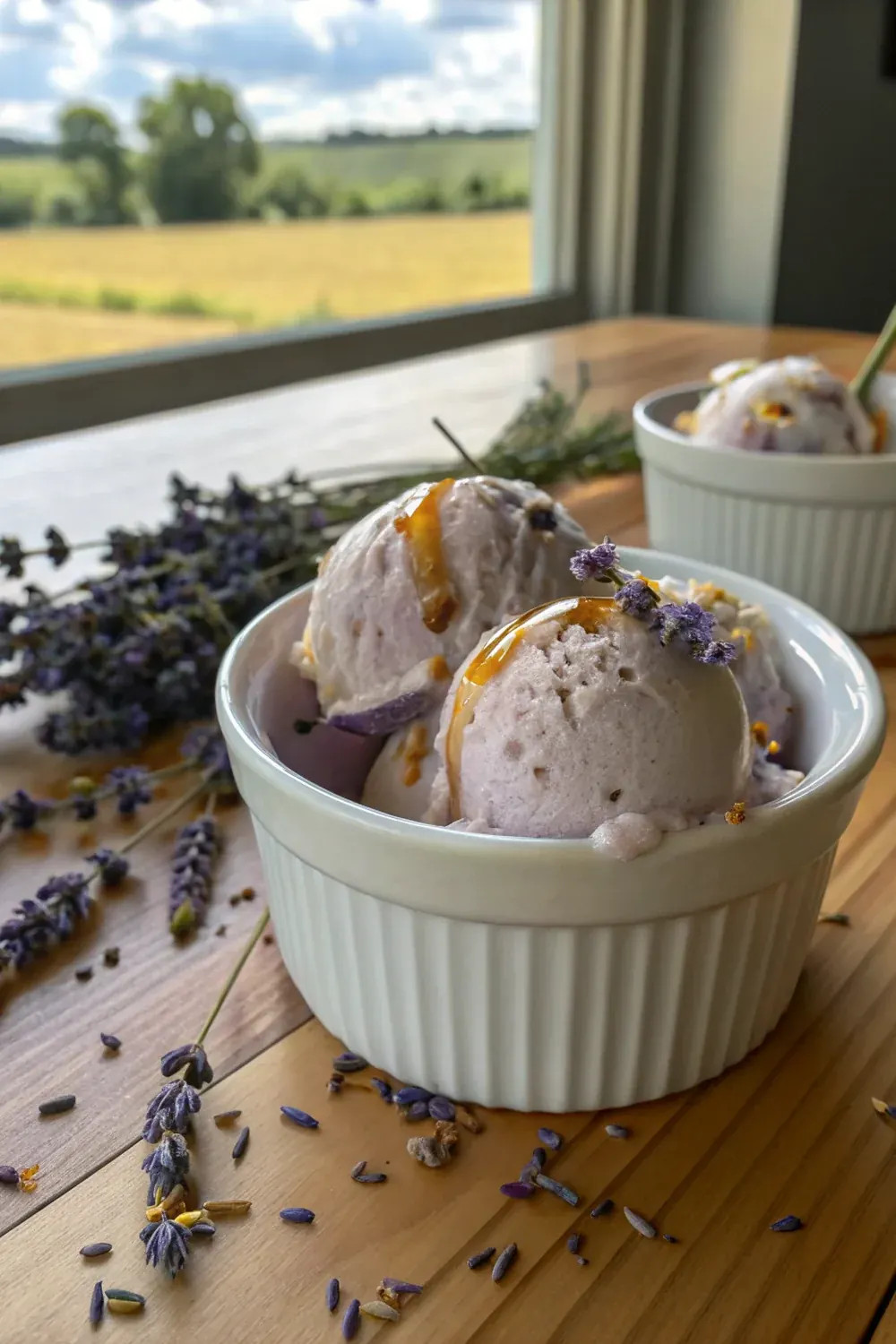
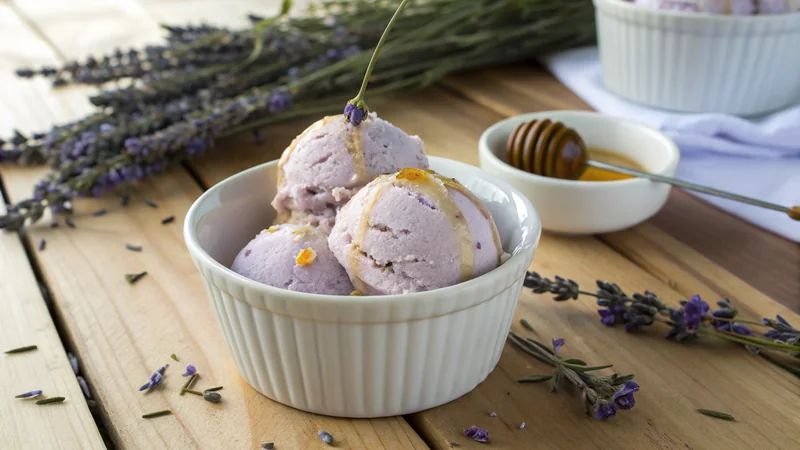
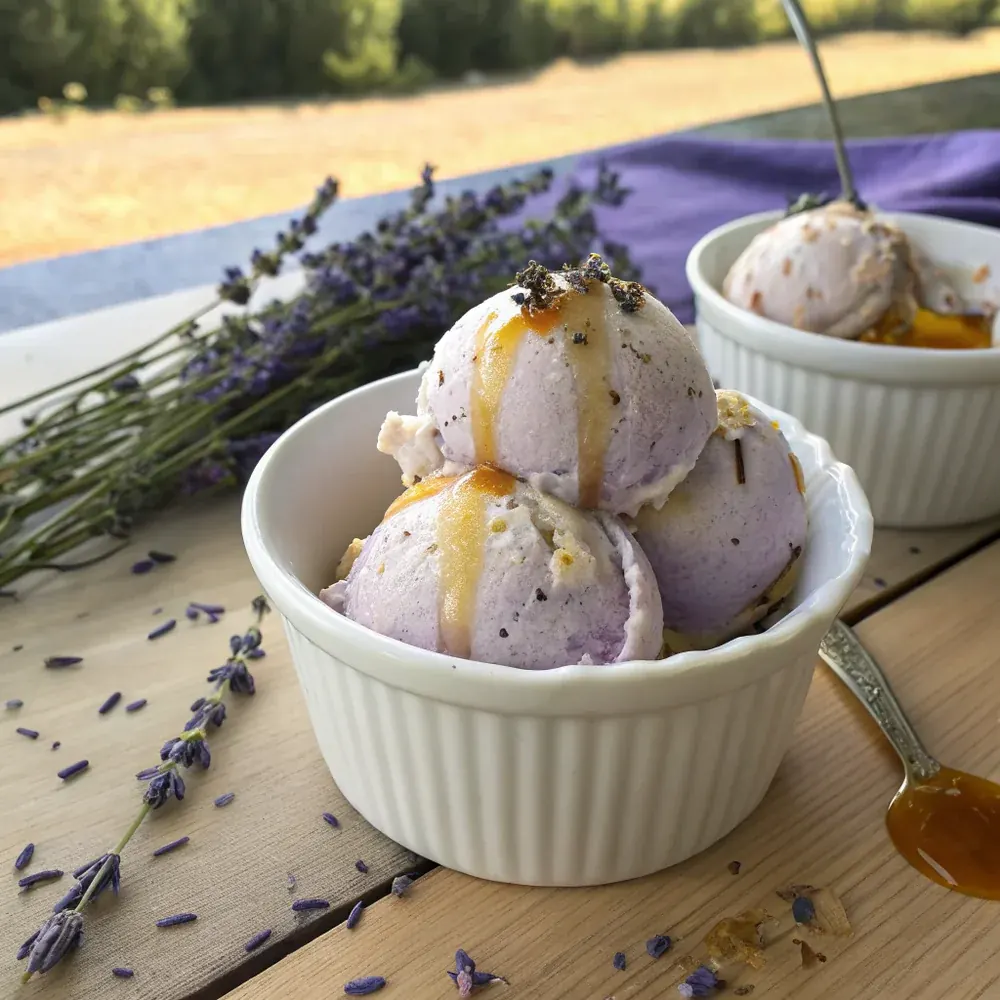
Serve in small bowls (1/2 cup portions) - this ice cream is rich, and small portions are more elegant than large ones. Drizzle each scoop with a small amount of additional Texas wildflower honey - the contrast between the cold ice cream and room-temperature honey is part of the experience. Garnish with fresh lavender sprigs (if available from your garden or a farmer's market) or a small sprinkle of dried lavender buds (just for visual emphasis - too much dried lavender as garnish is gritty).
Pair with: shortbread cookies, fresh peaches in summer, chocolate-dipped fruit, butter pecan ice cream sandwich on a tasting plate (see butter pecan ice cream sandwiches), or simply on its own with honey. Avoid pairing with chocolate-heavy desserts; chocolate competes with the lavender. For broader Texas dessert context, see the Ultimate Texas Desserts Guide.
Storage: 2-3 weeks in a sealed container in standard freezer. The texture is best in the first week; after that, ice crystals start to develop and the texture degrades slightly. The flavor is stable for 3-4 weeks but the texture is the limiting factor.
Honey Lavender Ice Cream Recipe
Ingredients
- 2 cups (480 ml) heavy cream
- 1 cup (240 ml) whole milk
- 1/2 cup (120 ml) Texas wildflower honey (Round Rock Honey, BeeWeaver, or local apiary)
- 2 tablespoons culinary-grade dried lavender buds (Fredericksburg or any reputable culinary brand)
- 5 large egg yolks
- 1/4 cup (50 g) granulated sugar
- 1/4 teaspoon kosher salt
- 1 teaspoon pure vanilla extract
- Pinch of pale violet food-grade color (optional, for visual emphasis)
- TO SERVE: extra honey for drizzling, fresh lavender sprigs for garnish
Instructions
- Infuse cream with lavender and honey. In a heavy saucepan, combine heavy cream, whole milk, honey, and dried lavender buds. Heat over medium until just below simmer (small bubbles forming at edges; do not boil). Remove from heat. Cover and let infuse 30 minutes off heat. The cream will absorb the lavender's volatile oils during this rest, picking up the floral note without becoming bitter from over-extraction.
- Strain out the lavender. After 30 minutes, strain the cream mixture through a fine mesh sieve lined with cheesecloth into a clean bowl. Press gently on the lavender buds to extract as much cream as possible. Discard the lavender. The strained cream should be uniformly pale tan with a faint floral aroma. Return the strained cream to the saucepan and warm gently to about 160F (just hot to the touch).
- Temper into egg yolks. In a separate bowl, whisk egg yolks, sugar, and salt until pale yellow and slightly thickened, about 60 seconds. Slowly drizzle the warm lavender-honey cream into the yolks, whisking constantly to prevent scrambling. Pour the entire mixture back into the saucepan.
- Cook to nappe stage. Cook over medium-low heat, stirring constantly with a wooden spoon, for 6-8 minutes until the custard coats the back of the spoon and a finger drawn through leaves a clean line (180F on a thermometer). Do not boil; the custard will scramble. Remove from heat. Stir in vanilla extract and the optional violet food-grade color (1-2 drops at most for a subtle tint).
- Chill the custard. Strain the custard one more time through a fine mesh sieve into a clean bowl. Cover the surface directly with plastic wrap (touching the custard) to prevent skin formation. Refrigerate at least 4 hours, ideally overnight. Cold custard churns better than warm; this rest is essential for proper texture.
- Churn the ice cream. Pour the cold custard into your ice cream maker. Churn 25-30 minutes per manufacturer instructions until the mixture is thick and looks like soft-serve. The ice cream should be pale tan with a hint of lavender tint (or pale violet if you used food coloring). The texture should hold a peak when scooped from the bowl.
- Freeze 4+ hours until firm. Transfer the soft-serve ice cream to a freezer-safe container. Smooth the top, cover. Freeze at least 4 hours, ideally 24, until the ice cream is fully scoopable. The 24-hour freeze is when the texture stabilizes and the lavender flavor melds with the dairy.
- Serve with honey drizzle and lavender garnish. Scoop into small bowls, drizzle with extra Texas wildflower honey, garnish with fresh lavender sprigs (if available) or a small sprinkle of dried lavender buds. The garnish is decorative; the flavor is in the ice cream itself. Serve as a sophisticated dinner party dessert, with afternoon tea, or as part of a dessert flight alongside <a href='https://www.texanrecipes.com/butter-pecan-ice-cream-sandwiches/'>butter pecan ice cream sandwiches</a>.
Frequently Asked Questions
Where can I buy culinary-grade dried lavender?
Best sources: Fredericksburg lavender farms (Hill Country Lavender, Becker Vineyards) for Texas-grown; Mountain Rose Herbs, Frontier Coop, and Penzeys Spices for online national distribution. Use only culinary-grade lavender (not potpourri or essential-oil grade) - the difference in flavor quality is significant. Provence variety (Lavandula x intermedia 'Provence') is the canonical culinary lavender.
How strong should the lavender flavor be?
Subtle, not perfumey. The finished ice cream should taste like vanilla-honey ice cream with a clear floral note in the background. If your ice cream tastes like soap or bath products, you've over-extracted (infusion went too long or used too much lavender). Reduce to 1.5 tablespoons of lavender for next batch and infuse 25 minutes instead of 30. The right balance is unmistakable when you hit it.
Can I use fresh lavender instead of dried?
Yes, but use 4 tablespoons of fresh lavender flowers (about 2 tablespoons of dried equivalent strength). Fresh lavender has more water content, which thins the cream slightly. Otherwise the technique is identical. Pick lavender from your own garden or from a culinary-grade source - never use ornamental lavender from a non-edible flower garden, which may have been treated with pesticides.
Why is my ice cream not lavender-colored?
Steeped lavender produces only a faint cream tint, not a strong purple color. The pale lavender appearance in commercial honey lavender ice creams comes from food-grade violet color or natural pigments like blueberry or red cabbage extract. For this recipe, the natural color is faint. If you want a more visually emphatic purple tint, add 1-2 drops of food-grade violet color along with the vanilla in step 4. Don't add more - subtle is correct for sophisticated ice cream.
Can I make honey lavender ice cream dairy-free?
Yes - replace the heavy cream + whole milk with 3 cups of canned full-fat coconut milk (the rich kind, not lite). Replace the egg yolks + sugar with 1/2 cup of brown sugar + 1 tbsp cornstarch (whisked into the warm coconut milk to thicken). The result is a coconut-honey-lavender ice cream with a different but excellent flavor profile. Vegan-adapted, dairy-free, naturally gluten-free.
How long does honey lavender ice cream keep?
2-3 weeks in a sealed freezer container at standard freezer temperature. The texture is best in week 1; ice crystals start to form and the texture coarsens in week 2-3. The flavor is stable for up to 4 weeks but the texture is the limiting factor. Don't make more than you can eat in 2 weeks.
Can I infuse other herbs along with the lavender?
Yes - the infusion method works with other complementary herbs. Try 1 tbsp lavender + 4 fresh basil leaves (lavender-basil is excellent). 1 tbsp lavender + 1 tsp fennel seeds (lavender-fennel is sophisticated). 1 tbsp lavender + 1 chamomile tea bag (calming). Avoid combinations with strong-flavored herbs like rosemary or thyme - they overpower the lavender.
What if I don't have an ice cream maker?
Use the no-churn method: whip 2 cups heavy cream to soft peaks. Fold in 1 14-oz can sweetened condensed milk + the lavender-infused cream (skip the egg yolk step entirely; mix the lavender cream directly with whipped cream + condensed milk). Freeze in a loaf pan 6 hours minimum. Texture is icier than churned ice cream but still excellent. Total time: 30 minutes active + 6 hours freeze.