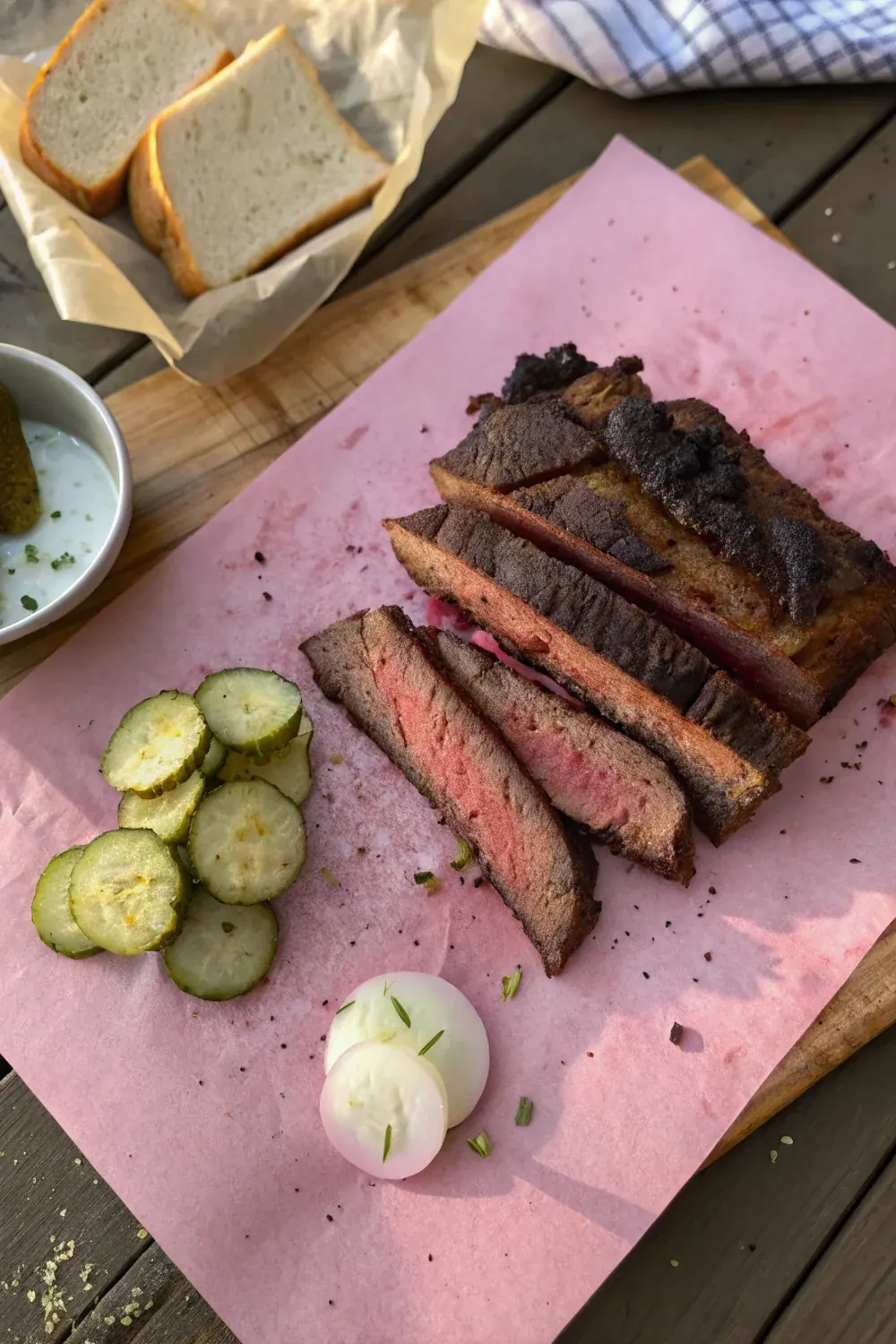
Texas BBQ
Smoked Beef Ribs
Chef Mia's Texas smoked dino ribs: beef plate ribs (cut 123A), salt-pepper rub, post oak at 250F to 203F internal. What they are and how long to smoke.
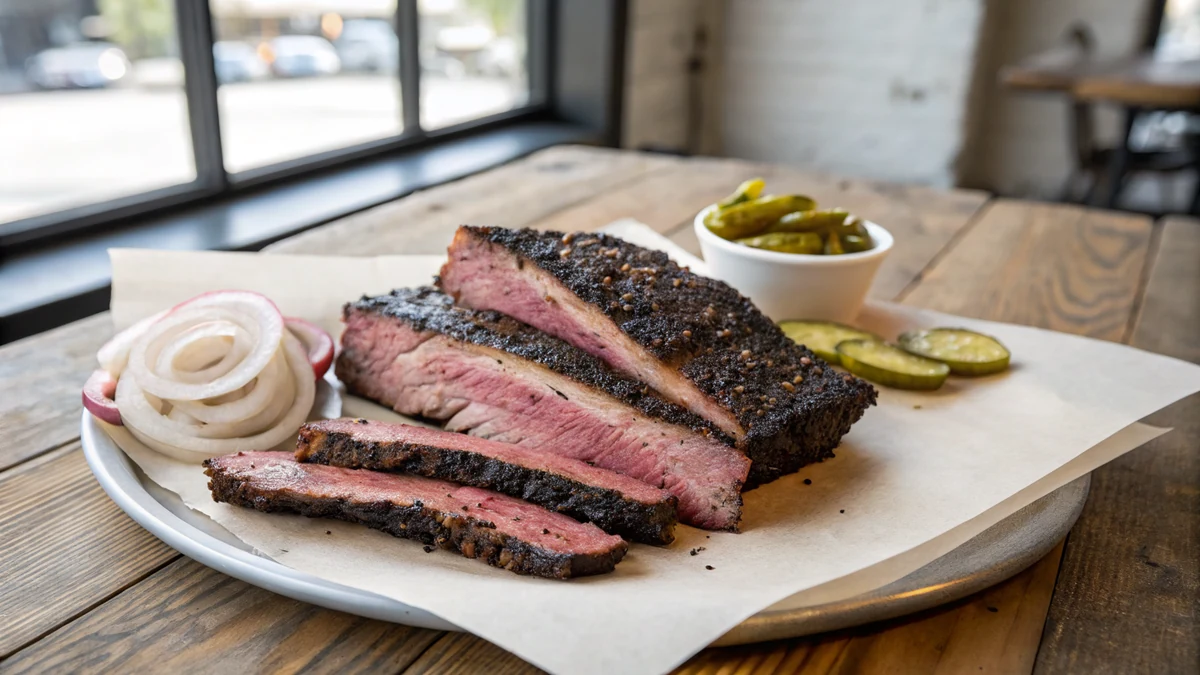
Quick answer: Texas smoked beef ribs - the dino ribs of Texas BBQ - are thick beef plate ribs (cut 123A) with substantial meat, taken from the chuck plate area of the steer between the brisket and the flank. Trim the silver skin off the back, season generously with kosher salt and 16-mesh black pepper (no other rub needed), smoke fat-side up at 250F over post oak for 7-9 hours until probe-tender at 200-205F internal, or plan on 9-11 hours if you run the pit at 225F. The meat shrinks back from the bones and the surface is deeply mahogany with a visible smoke ring. Rest 30 minutes before slicing between bones and serving on butcher paper Lockhart-style.
If you've eaten at Goldee's BBQ in Fort Worth, Snow's BBQ in Lexington, or Franklin Barbecue in Austin, you've encountered Texas-style smoked beef ribs. They are rich, well-marbled beef ribs cut from the chuck plate area of the steer, with thick mahogany bark sitting on tender meat under post oak smoke. They are the most photographed piece of meat in modern Texas BBQ. Most folks know them as dino beef ribs - the prehistoric-looking bones that show up all over your feed - and they are also the peak of Texas BBQ after brisket, the cut that separates serious pit masters from casual ones.
The technique is straightforward: salt and pepper, post oak smoke, low-and-slow at 250F, probe-test for doneness. The hard part is sourcing - good plate ribs from a butcher who knows what you mean. Once you have them, the smoke does most of the work over 7-9 hours. The result is meat that's beefier than brisket, more luxurious than the smaller smoked beef short ribs you find at the grocery store, and so tender that the bone slides cleanly out of the meat with a fork. This is the Texas BBQ that converts skeptics.
What Are Dino Ribs?
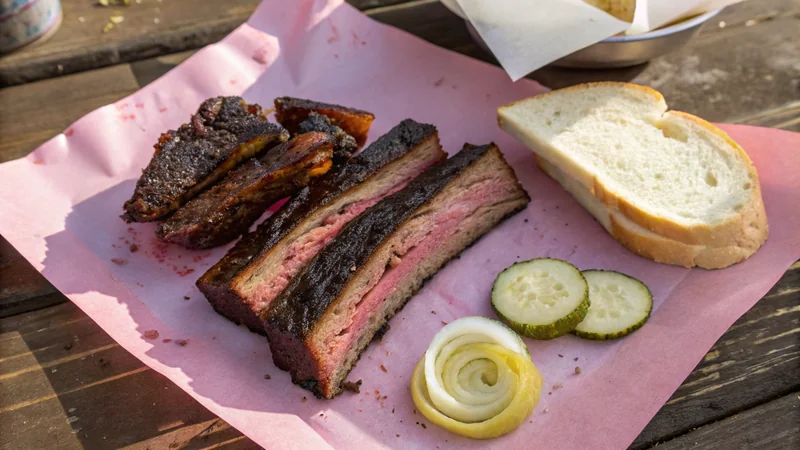
Dino ribs are beef plate short ribs - the meaty three-bone rack cut from the lower chuck and plate section of the steer, between the brisket and the flank. The butcher name is the beef plate rib, IMPS/NAMP cut 123A. Each bone runs 8 to 12 inches long with two to three inches of beef sitting on top, and that long bone under a thick meat cap is exactly what earns the prehistoric, brontosaurus-bone look the nickname plays on.
So where do dino ribs come from on the cow? The same forequarter region as the brisket, just up and behind it, which is why they eat beefier and richer than the thin back ribs that sit near the ribeye. If a butcher hands you a small two-pound rack, that is back ribs, not dino ribs - the real thing is a five to seven pound slab. For the leaner back-rib version done low and slow, I keep a separate beef back ribs recipe; this page is the big plate-cut dino bone.
How long does it take to smoke dino ribs? At 250F over post oak, a three-bone plate rack runs 7 to 9 hours to probe-tender at 203F internal. If you prefer the lower 225F that most folks use for brisket, plan on 9 to 11 hours instead, since the cooler pit drags the stall out longer. Either way you are cooking to feel and internal temperature, not the clock - the probe should slide between the bones like it is going into warm peanut butter. The full step-by-step, rub ratio, and rest are below.
Plate Ribs vs Back Ribs vs Short Ribs
The cut name confusion is real. Beef ribs come in three main forms with very different cooking characteristics. If you are still deciding between beef and pork in the first place, my beef vs pork ribs comparison covers the flavor, size, and cooking differences. And if deer season filled the freezer instead, my smoked venison ribs run this same smoke-first spirit on wild bones.
Plate ribs (this recipe) come from the lower chuck/plate section of the steer - between the brisket and the flank. They are 3 bones in a row, each 8-12 inches long, with 2-3 inches of meat on top. Total weight 5-7 lb per 3-bone rack. The Texas BBQ canonical cut.
Back ribs come from the upper rib section - the same area that gives ribeye steaks. The bones are smaller, the meat is thinner. A back rib rack is about 2-3 lb. They cook in 4-5 hours instead of 7-9. Acceptable Texas BBQ but less impressive than plate ribs.
Chuck short ribs (sometimes called English-cut or flanken-cut) come from the chuck section but are cut differently - either crosswise into 3-inch pieces or lengthwise across the bones. They cook faster (4-5 hours), are cheaper, and are excellent for braising or shorter smokes. Different dish than plate ribs. And when the butcher breaks down a plate like this one, the strips carved from between the bones get sold as beef finger ribs - all this same intercostal richness at a fraction of the price.
When you order from a butcher, ask for 'beef plate ribs, 3-bone section, IMPS #123A.' At supermarkets, plate ribs sometimes appear as '3-bone short ribs' but verify by looking - the bones should be 8-12 inches long with thick meat caps.
Why They're Called Dino Beef Ribs
Walk into a Texas BBQ joint and order the dino beef ribs and everyone knows exactly what you mean: the giant, prehistoric-looking plate ribs with a bone the length of your forearm. The nickname caught on in the 2010s when Aaron Franklin and the Fort Worth and Lexington pit masters started putting them on the menu, and the resemblance to a brontosaurus bone off a cartoon was too good to ignore.
I use 'dino beef ribs' and 'dino bones' interchangeably, and so does most of Texas. The 'beef' part matters - pork ribs never get this treatment. It's the beef plate rib's 8-to-12-inch bone and thick meat cap that earn the dinosaur comparison. When you pull a finished rack off the smoker and the bone has shrunk back to expose two inches of clean bone handle, the name makes sense instantly.
So if you searched for smoked dino beef ribs and landed here, you are in the right place. Dino beef ribs, dino bones, Texas plate ribs - same cut, same recipe, same salt-pepper-and-post-oak method below.
The Goldee's, Snow's, Franklin Trinity
Three Texas BBQ destinations have made the dino bone famous. Goldee's BBQ in Fort Worth (founded 2017, ranked #1 in Texas Monthly's Top 50 in 2021) serves them as a Friday-only special. Snow's BBQ in Lexington (population 1,200, on the Texas BBQ trail) serves them on Saturdays only. Franklin Barbecue in Austin started featuring them in the 2010s as Aaron Franklin's signature beef rib.
Each pit's preparation differs slightly. Goldee's adds a touch of garlic powder to the salt-pepper rub. Snow's runs straight salt-pepper, often with the gentlest oak smoke profile. Franklin uses a heavier post oak smoke and a slightly higher cooking temperature. All three produce dino bones that taste recognizably Texan and unmistakably their own.
This recipe leans toward the Snow's-Franklin canonical version. Salt and pepper only (or salt-pepper-garlic for Goldee's-style), post oak smoke, 250F, no wrap. The result is the cleanest expression of beef-and-smoke that the dino bone delivers.
Salt and Pepper Are Enough
The Texas plate rib seasoning canon is salt and 16-mesh black pepper. That's it. No paprika, no chili powder, no brown sugar, no garlic (the Goldee's exception). The cut is so beefy and the smoke is so dominant that additional seasoning gets in the way.
16-mesh black pepper is the specific Texas BBQ standard. The pepper kernels are coarsely ground (16 mesh = particles passing through a 16-hole-per-inch sieve), giving visible flecks on the meat surface. Fine-ground pepper looks like dust and has less visual presence. Buy from a Texas BBQ supplier (Texas Iron, Smokin' Texas, or specialty grinders) for true 16-mesh.
Kosher salt by weight, not volume. Diamond Crystal kosher salt is the chef's standard - lighter, less salty per teaspoon than Morton's. If using Morton's, reduce the volume by about 25 percent (3 tablespoons instead of 1/4 cup).
Apply generously. The cut is large; the rub coats both sides liberally. About 60-70% black pepper visible, 30-40% salt visible. The rub builds the bark during the long smoke.
Post Oak at 250F
Post oak is the canonical wood. Pecan is an acceptable substitute - slightly sweeter, very Texan. Avoid mesquite for plate ribs (the long cook turns mesquite acrid).
250F is the right cooking temperature - slightly higher than the 225F used for brisket. The plate rib mass is denser than brisket, and the slightly higher heat helps push through the long cook in 7-9 hours instead of 12+. Higher temps (275F+) cook too fast and don't give time for deep smoke penetration.
Maintain steady 250F for the entire cook. Stick burners require fire management every 30-45 minutes; pellet grills hold steady automatically; kamados hold steady once dialed in. Temperature swings of 20-30F are acceptable; sustained drops below 220F or above 285F throw the cook off.
Add wood chunks every 60-90 minutes for the first 5-6 hours. After hour 6, the meat has absorbed most of the smoke it will. Continued wood addition past that just produces more smoke without flavor benefit.
To Wrap or Not to Wrap
Two schools of thought exist on plate ribs. The Snow's-Franklin school: don't wrap. The ribs cook unwrapped for the full 7-9 hours, develop maximum bark, and end with a slightly crispier texture and deeper smoke flavor. This is the canonical Texas approach, and my no-wrap smoked ribs method is the full playbook for that school - spritz schedule, stall strategy, and all. Cooking on ceramic? Beef ribs on the Big Green Egg run the naked route with the humidity already built into the machine.
The Goldee's-modernist school: wrap in pink butcher paper at hour 5 (around 175F internal). The wrap pushes through the stall faster, finishes the cook in 7-8 hours total, and produces a slightly more tender (some say juicier) result. Many Texas competition pit masters now use this approach. Planning a cook around guests? My brisket smoking time calculator runs the same stall-and-wrap logic and works backward from your serve time.
Both are valid. The unwrapped version is more traditional and more bark-forward. The wrapped version is faster and more forgiving for new pit masters. This recipe defaults to unwrapped for canonical Texas-rib character; wrap if it's your first time and you want a wider doneness window.
If wrapping, use pink butcher paper (peach paper), not aluminum foil. Foil softens the bark and creates the Texas crutch effect. Butcher paper traps moisture while preserving bark texture.
Probe-Tender at 203F
Plate ribs pull when probe-tender at 200-205F internal. The probe-feel matters more than the exact temperature. Insert a probe thermometer into the thickest part of the meat between two bones, parallel to the bones, avoiding the bone itself. The probe should slide in with zero resistance, like sliding into warm peanut butter.
If at 203F the probe still meets resistance, give it another 30 minutes. Some plate ribs need 207F. The collagen needs the full breakdown to give the silky pull-apart-from-bone texture.
The bone-shrink test confirms doneness. A done plate rib has bones that have shrunk back from the meat by about 1/2 inch - the bone end is exposed. Under-done ribs have bones flush with the meat surface.
The wiggle test: grab one bone with tongs and try to pull it. A done plate rib bone slides cleanly out of the meat with light pressure. An under-done rib bone is stuck.
Rest, Slice, Serve Lockhart-Style
Rest the rib rack 30-60 minutes in a faux Cambro (empty cooler with lid closed). Longer rest than individual short ribs because the larger mass holds more heat. The juices redistribute, the meat finishes settling, the texture becomes its best.
Slice between bones with a sharp knife. Each individual rib is one serving for a heavy eater or 1.5 servings for normal appetite. The 3-bone rack feeds 4-6 people depending on portions.
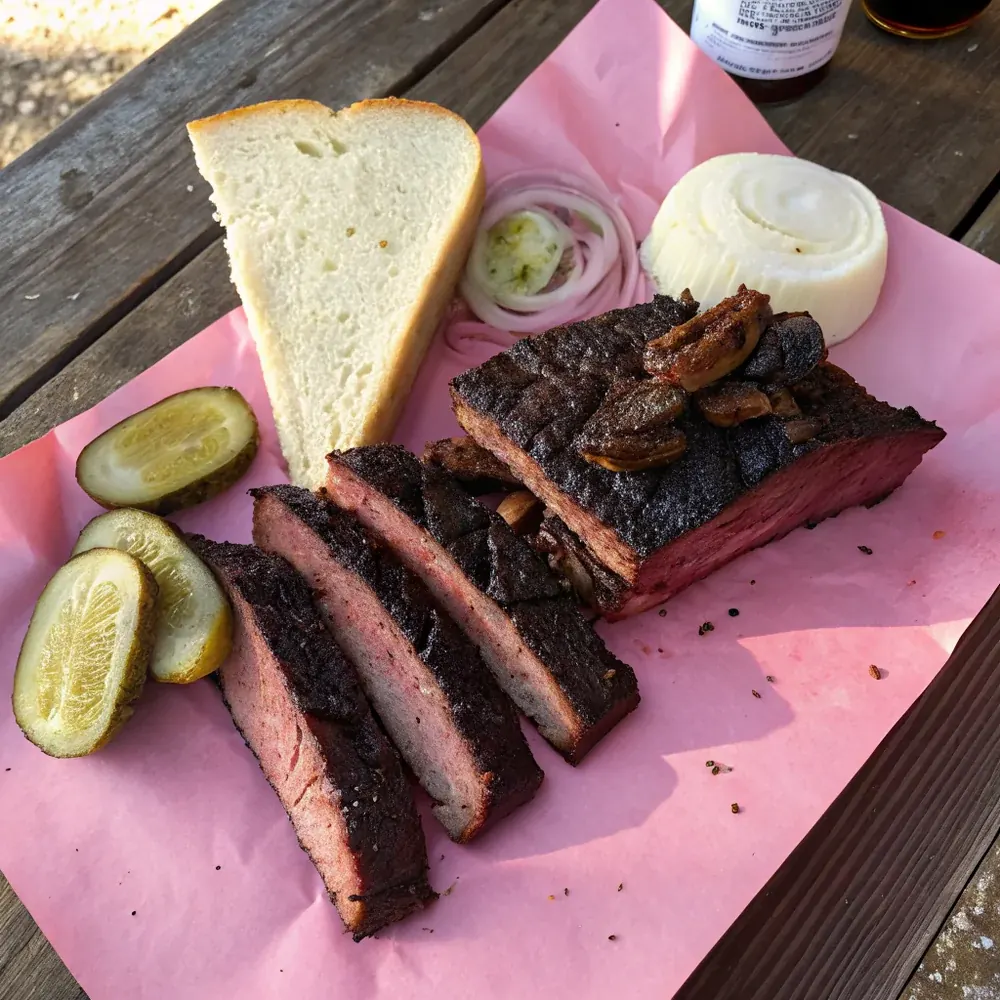
Serve on butcher paper Lockhart-style. White bread, dill pickle slices, sliced raw white onion, yellow mustard, BBQ sauce on the side. No fork required for the eating - pick up the rib by the bone, eat the meat off, gnaw the bone for the bark caps. Texas BBQ at its most primal.
Drinks: iced tea (sweet or unsweet), Lone Star or Mexican lager, lemonade. The ribs are rich; you don't want a heavy beer fighting them.
Leftovers: refrigerate sliced ribs in foil with a splash of beef broth, up to 4 days. Reheat in a 300F oven wrapped in foil for 12-15 minutes. Pulled rib meat (chopped from leftover bones) makes excellent tacos or chili the next day. And while Central Texas serves ribs sauceless, a little homemade Texas barbecue sauce on the side is always welcome.
Smoked Beef Ribs Recipe
Ingredients
- 1 beef plate rib section (5-7 lb / 2.3-3.2 kg, 3-bone)
- 1/3 cup (75 g) coarse 16-mesh black pepper
- 1/4 cup (50 g) kosher salt (Diamond Crystal preferred; if Morton's, use 3 tablespoons)
- Optional: 1 tablespoon garlic powder (Goldee's-style addition; not Lockhart canonical)
- For serving:
- Soft white sandwich bread, dill pickle slices, sliced raw white onion
- Yellow mustard and Texas BBQ sauce, served on the side
- Equipment:
- Smoker capable of steady 250F (offset stick burner, kamado, or pellet grill)
- Post oak (or pecan) chunks/splits, well seasoned
- Pink butcher paper (24-inch wide roll)
- Instant-read thermometer
- Cooler (faux Cambro) for resting
Instructions
- Source the right cut. Plate ribs come from the lower chuck/plate area, not the back rib section. They are 3 bones in a row, each 8-12 inches long, with 2-3 inches of meat above the bone. Total weight 5-7 lb for a 3-bone rack. Ask your butcher for IMPS/NAMP #123A or 'beef plate ribs.' At Costco, they sometimes appear as '3-bone short ribs' in the meat case. Don't accept back ribs (smaller, less meat) or chuck short ribs (different shape) as substitutes.
- Trim the silver skin. Pull the silver skin (membrane) off the back of the rib bones using a butter knife to lift one corner, then grip with paper towel and pull. The membrane comes off in one large sheet. Removing it lets smoke penetrate the back of the bones and prevents the membrane from going chewy. Trim any large external fat patches over 1/4 inch thick - the rib has plenty of internal fat for moisture.
- Apply the salt and pepper. Mix kosher salt and 16-mesh black pepper in a 1:1 ratio by weight (so visually about 60% black pepper, 40% salt because pepper is fluffier). Coat both sides of the rib generously - aim for full coverage with no bare meat showing through. Press the rub into the meat. The Goldee's-style addition of 1 tablespoon garlic powder is acceptable; the Snow's-Franklin canonical version is salt and pepper only.
- Set up the smoker for 250F. Preheat the smoker to 250F (121C). Use post oak as the primary wood - 4-5 chunks at the start, then 1-2 chunks every 60-90 minutes for the first 5-6 hours. The fire should produce thin blue smoke. Place a water pan in the smoker if available - the moisture stabilizes temperature and prevents the bark from drying.
- Smoke fat-side up, bones down. Place the rib rack on the grate fat-side up, bones down. The fat caps render during smoking and baste the meat from above. Insert a probe thermometer into the thickest part of one rib, parallel to the bone, avoiding the bone itself. Close the lid. Smoke at a steady 250F, no peeking for the first 4 hours.
- Watch the bark develop. Around hour 4-5, the bark should be deep mahogany - very dark brown, almost black at the edges, with the salt-pepper rub fully integrated into a crust. The internal temperature is climbing toward 165F (the stall threshold). Don't wrap yet - beef plate ribs benefit from extended smoke exposure for the bark.
- Wrap or no wrap. Two valid approaches. Snow's-Franklin canonical: don't wrap. The ribs cook the full 7-9 hours unwrapped, develop maximum bark, and end with a crispier texture. Goldee's-style: wrap in pink butcher paper at hour 5 (around 175F internal) to push through the stall faster and finish in 7-8 hours total. This recipe defaults to no-wrap for canonical Texas plate ribs; wrap if you're new to long smokes and want a more forgiving approach.
- Probe-test at 200F. When internal temperature hits 200F, start probe-testing every 30 minutes. The probe should slide into the meat between bones with no resistance, like sliding into warm peanut butter. The bone should also pull cleanly out of the meat with a slight wiggle. Most plate ribs hit probe-tender at 203-205F internal.
- Rest 30-60 minutes in faux Cambro. Pull the rib rack off the smoker. Wrap in butcher paper if not already wrapped. Place in an empty cooler with the lid closed. Rest 30-60 minutes - longer than for individual short ribs because the larger plate-rib mass holds more heat. The juices redistribute and the meat finishes settling.
- Slice between bones. Place the rested rib on a cutting board. Use a sharp knife to slice between bones, separating into individual ribs. The bones should release cleanly. Each rib is enough to feed 1-2 people; the 3-bone section feeds 4-6. Serve on butcher paper Lockhart-style with white bread, dill pickles, raw onion, yellow mustard, and BBQ sauce on the side.
Frequently Asked Questions
How big should a 3-bone plate rib be?
5-7 lb total for a 3-bone rack. Each bone is 8-12 inches long with 2-3 inches of meat on top. Smaller racks (under 4 lb) usually mean back ribs (different cut, faster cook). Larger racks (over 8 lb) come from very large steer and are rare. The 5-7 lb range is the standard Texas plate rib.
Where can I buy beef plate ribs?
Best options: a butcher who specializes in BBQ cuts (Texas favorites: Slovacek's in Snook, Burns Original BBQ in Houston, Texas Iron Smokehouse Supply for mail order). Costco wholesale stores sometimes have them as '3-bone short ribs.' H-E-B and Whole Foods occasionally stock them on weekends. If your local store doesn't have them, order from Snake River Farms or Porter Road online.
Why are beef plate ribs called dino bones?
The visual association with prehistoric dinosaur bones - 12-inch long, thick, exposed at one end after cooking. The nickname became popular in the 2010s when Aaron Franklin and other Texas pit masters started featuring them as a signature item. The term is now standard in Texas BBQ shorthand.
How do plate ribs differ from chuck short ribs?
Plate ribs come from the lower plate section, are 3 bones in a row, each 8-12 inches long, weighing 5-7 lb total. Chuck short ribs come from the chuck section, are typically cross-cut into 3-inch pieces (English-cut) or thinly cross-bone (flanken-cut), and weigh 2-4 lb total per package. Both are excellent; plate ribs are the canonical Texas BBQ cut.
Can I cook plate ribs in less than 8 hours?
Possible but with quality compromise. Cook at 275F for 6 hours instead of 250F for 8 hours. The faster cook produces less smoke penetration and a thinner smoke ring. The meat is still tender but lacks the depth of an 8-hour smoke. For best result, plan the full window.
How long do you smoke dino ribs at 225F?
Budget 9 to 11 hours for a three-bone plate rack at 225F, versus 7 to 9 hours at 250F. The lower temperature deepens the smoke ring and gives a touch more bark, but it also stretches the stall, so the meat can sit at 165-175F internal for a couple of hours before climbing again. Do not rush it - pull the dino ribs when the probe slides in with no resistance, usually 203-205F, regardless of the clock.
Do I need a stick burner offset smoker?
No. Plate ribs work on any smoker that holds steady 250F: pellet grills (Traeger, Yoder), kamados (Big Green Egg, Kamado Joe), drum smokers, or kettle grills set up for indirect cooking. The offset stick burner is the canonical Texas BBQ tool but the smoke profile and the ribs are the same on any well-maintained smoker.
What if my probe finds resistance at 203F?
Give it another 30 minutes and re-test. Some plate ribs need 205-207F to fully break down collagen. The temperature is a guide; the probe-feel is the truth. Probe-tender means smooth glide with no resistance, not a specific number on the thermometer. Under-done ribs are the most common BBQ mistake; trust the probe.
How much do plate ribs cost?
Beef plate ribs run $8-15 per pound at retail in Texas (2026 prices). A 6 lb rack costs $48-90. Premium brands (Snake River Farms American Wagyu) run $20-25 per pound. Costco wholesale is the budget option at $7-9 per pound. Plate ribs are more expensive per pound than brisket but yield more usable meat per pound (less trimming, less render loss).