Southern Comfort Food
Texas Chili
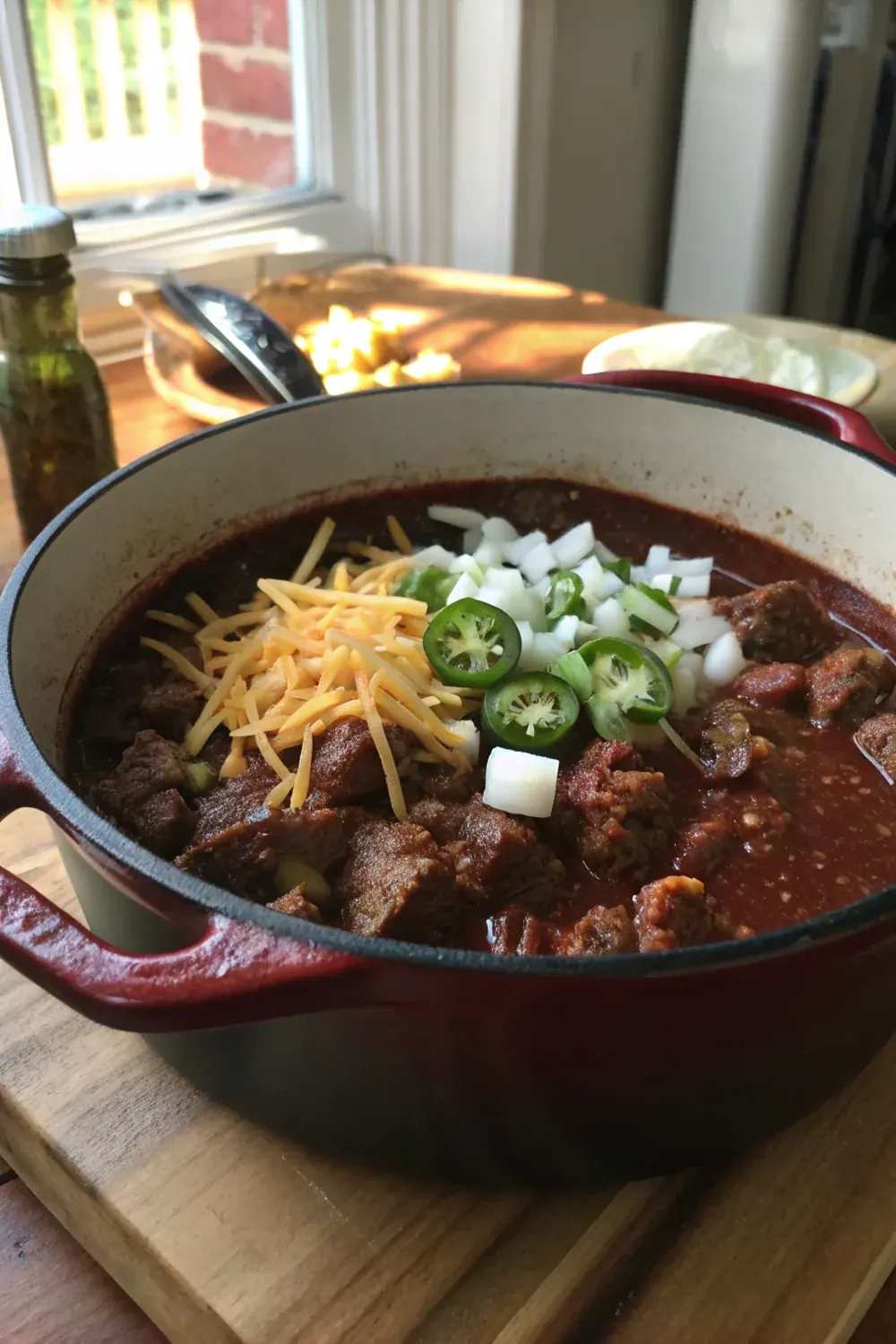
Chef Mia's Texas chili: cubed chuck, toasted ancho-guajillo-arbol chiles, beef stock, no beans. The Terlingua Cookoff competition style done at home in 3 hours.
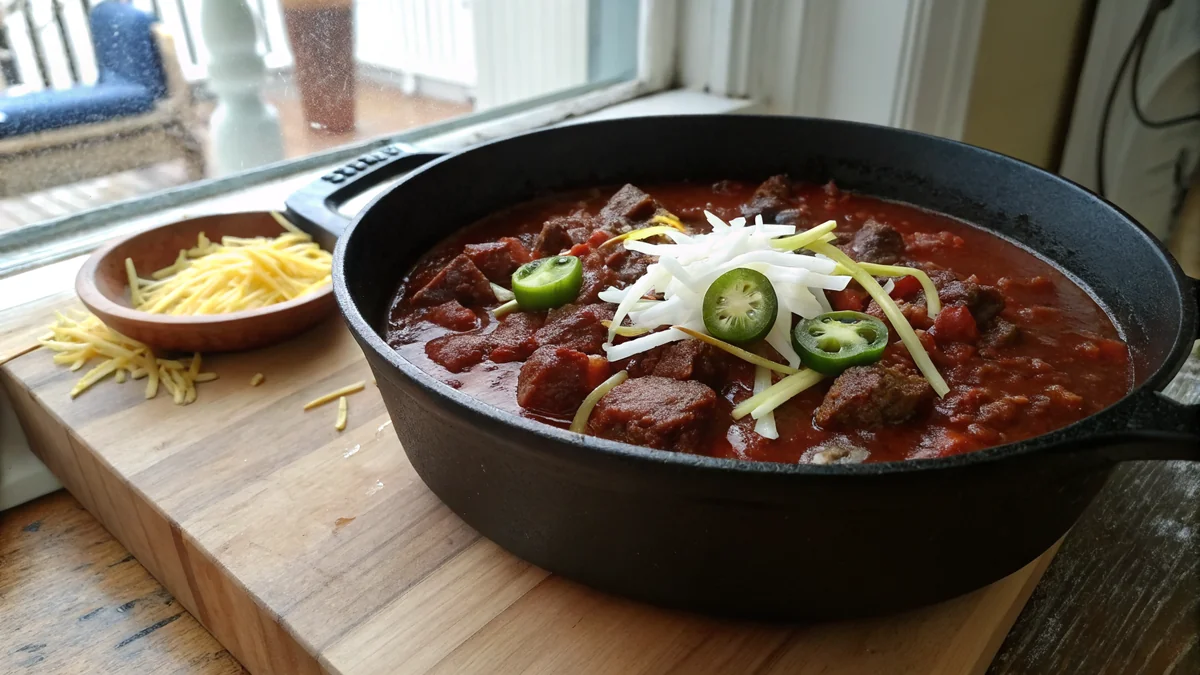
Quick answer: Texas chili follows the Terlingua Cookoff rules: no beans, cubed beef chuck instead of ground, dried chiles instead of chili powder. Toast 4 ancho + 2 guajillo + 1 chile de arbol in a dry skillet, soak in hot beef broth, blend into a paste with garlic, cumin, and Mexican oregano. Brown 2 lb of cubed chuck in lard or beef tallow, combine with paste and broth, simmer 2-3 hours until fork-tender. Thicken with masa harina, finish with cider vinegar. Serve over cornbread with raw onion, sliced jalapeno, and cheddar.
Texas chili is its own thing. It is not the bean-and-ground-beef stew that gets called chili in the Midwest. It is not the cumin-heavy Cincinnati version served over spaghetti. It is the original chili con carne that came out of San Antonio chili queens in the 1880s, refined through a century of cattle drives and Hill Country ranches, and codified in 1967 when Frank X. Tolbert organized the first Original Terlingua International Frank X. Tolbert-Wick Fowler Memorial Championship Chili Cookoff in Terlingua, Texas. The Terlingua rules are clear and uncompromising: no beans, cubed meat, dried chiles.
This recipe respects those rules. It is the chili you would make at a backyard cookoff on a fall Saturday, the one a Texas grandmother would serve over cornbread on a winter Sunday. Three hours of mostly hands-off simmering, six dollars of beef chuck, a handful of dried chiles from H-E-B, and you produce a chili that tastes like Texas itself - smoky, earthy, deeply beefy, with a chile heat that builds slowly over each spoonful. For the strict competition version that follows the cookoff rulebook to the letter, see my Terlingua Texas chili.
Why Texas Chili Has No Beans
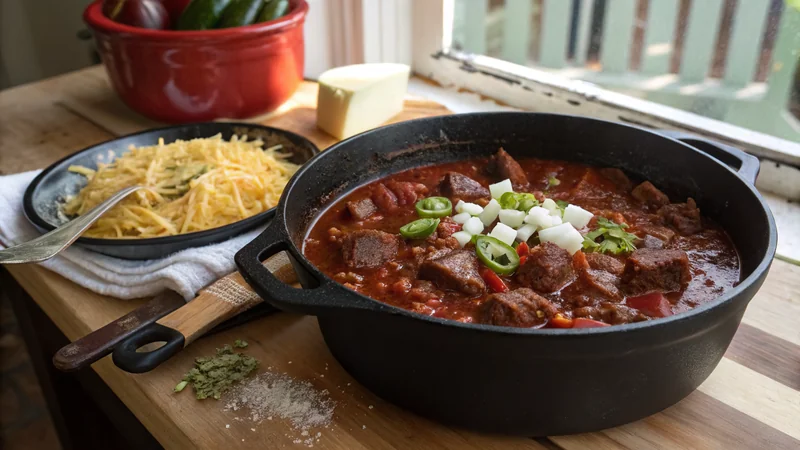
The Original Terlingua International Frank X. Tolbert-Wick Fowler Memorial Championship Chili Cookoff has been held in Terlingua, Texas every November since 1967. The cookoff has rules. The most famous is rule 8: no beans. Adding beans disqualifies an entry instantly. The same rule applies at the CASI World Championship and the CCCC International Chili Cookoff.
The historical reasoning: Texas chili descended from the trail-cook chili-con-carne of the 1860s and 1870s. Trail cooks fed cowboys cubed beef simmered in lard with dried chiles, garlic, and cumin. Beans were sometimes available, sometimes not, but they were never integral to the dish. The 20th-century purist movement codified the no-bean rule.
The functional argument: beans absorb spice and dilute the deep beefy flavor that makes Texas chili distinctive. Without beans, every spoonful is meat and sauce, with no neutral starch buffer. The chili tastes more concentrated, more about the meat, more about the chiles.
If you want beans, serve them on the side as a garnish, never in the chili itself. Pinto beans cooked separately with bacon and chipotle pair beautifully with Texas chili - just don't combine them in the pot.
Cubed, Not Ground
Texas chili uses cubed beef, not ground. The cubes should be 1/2-inch dice - larger and they take too long to become tender; smaller and they shred into ground-meat texture during the simmer. The same cube-don't-grind rule is why venison chili works so well at deer camp - my deer camp venison recipes run the identical logic on backstrap and shoulder.
Beef chuck is the canonical cut. It has the right balance of meat-to-fat (about 18 percent fat), strong beef flavor, and the connective tissue that breaks down to gelatin during the long simmer, giving the chili its silky body. Brisket flat is an excellent alternative if you have it.
Avoid lean cuts (sirloin, round, eye of round). They turn dry and stringy during the long cook. The chili needs the fat for both flavor and texture.
Some Texan home cooks use a coarse grind from the butcher (1/4-inch grind plate) as a compromise - more texture than ground beef, less work than cubing. The Terlingua cookoff rules require true cubed meat for competition; for home cooking either is acceptable.
Cube the beef yourself if you can. Pre-cubed stew meat from the supermarket is often cut from random cuts and varies wildly. Buy a 2.5-3 lb chuck roast and cube it at home with a sharp knife - 8 minutes of work, much better quality control.
Dried Chiles, Not Chili Powder
Dried chiles are the difference between Texas chili and Midwest chili. The dried chiles - ancho, guajillo, and chile de arbol - are toasted, soaked, and blended into a paste that becomes the foundation of the chili. Chili powder (the pre-mixed spice blend) is acceptable but produces a flatter chili that lacks the layered chile complexity.
Ancho chiles are the dried Poblano peppers. They are mild, slightly fruity, with raisin and prune notes. They provide the deep red color and the body of the chile paste. 4 anchos is the canonical amount for a 6-8 serving batch.
Guajillo chiles are sharper and brighter than ancho - tangy, slightly tomato-like, with a clean spicy note. 2 guajillos add complexity and prevent the paste from becoming one-dimensional.
Chile de arbol is the heat. Small, thin, very spicy. 1 chile gives mild heat; 2 give traditional Terlingua heat (medium-spicy); 3 enter serious territory. Adjust to taste.
Buy chiles dried, not powdered. Walking through H-E-B's Hispanic foods aisle, you can buy whole dried chiles by the bag or by the ounce. Stored airtight, dried chiles keep 12-18 months. Powdered versions go stale faster and lose complexity.
Toasting and Soaking the Chiles
The two-step chile preparation - toast then soak - is what unlocks the depth that makes the chili taste like proper Texas chili. Skipping either step gives a chili that tastes like ground spice powder.
Toasting: heat a dry cast iron skillet (no oil) over medium heat. Place the stemmed seeded chiles in the pan. Press flat with a spatula. Toast 30-45 seconds per side until fragrant and slightly pliable. The chiles should not blacken - black means burned, which makes the chili bitter. Smell tells you when they're ready: warm, smoky, earthy.
Soaking: pour hot beef broth over the toasted chiles. The hot liquid extracts the chile flavor faster than cold soaking. 20 minutes is the right window - long enough to soften, short enough to preserve fresh chile aromatics.
Use the soaking broth as part of the chili liquid. Discarding it loses 30 percent of the chile flavor that has leached into the liquid during the soak.
If the chiles are very dry and brittle, the toast time can drop to 20 seconds per side. Old dry chiles burn faster.
Three-Hour Simmer Window
The simmer is what transforms cubed chuck and chile paste into chili. The connective tissue in the chuck slowly breaks down to gelatin, the chile paste integrates with the broth and beef, the flavors deepen.
Two and a half hours is the minimum. Three hours is the canonical target. Past three hours, the meat starts breaking down into shreds (not bad, just different texture).
Maintain a gentle simmer - small bubbles rising, not a rolling boil. A vigorous boil toughens the meat and reduces the broth too fast. The lid should be slightly vented (offset by 1/2 inch) to let some moisture escape during the cook.
Stir every 20-30 minutes to prevent sticking on the bottom. The thickening from collagen breakdown can scorch on a thin Dutch oven bottom. Stir from the bottom up with a wooden spoon.
Do not lift the lid frequently. Each lid lift loses 30-40F of temperature and resets the simmer. Stir, cover, walk away.
Masa Harina: The Texas Thickener
Masa harina is the corn flour used to make tortillas. It is the canonical Texas chili thickener - a thin slurry of masa harina and water stirred into the simmering chili 8-10 minutes before serving. It thickens the chili, adds a subtle corn note that pairs with the dried chiles, and gives the finished chili its characteristic body.
Use Maseca brand masa harina (the standard at H-E-B and most US supermarkets in the Hispanic foods aisle). 1 1/2 tablespoons is the right amount for a 6-8 serving batch.
All-purpose flour is the alternative thickener if you don't have masa harina. 2 tablespoons gives equivalent thickening but lacks the corn flavor that masa adds.
Cornstarch can substitute (1 tablespoon mixed with 2 tablespoons cool water) but gives a slightly glossy commercial-looking finish. Masa or flour is preferred for the rustic Texan look.
Mix the masa or flour with cool liquid before adding to the chili. Adding dry powder directly creates lumps that don't dissolve.
Apple Cider Vinegar Finish
The 1 tablespoon of apple cider vinegar added at the very end is the most important final touch. It brightens the deep heavy flavors of the chili, adds a subtle tang that lifts the meat and chile, and balances the richness. Without it, the chili tastes one-dimensional - rich but flat.
Add the vinegar after pulling the chili off heat, not during the simmer. Cooking the vinegar evaporates its volatile aromatics. Adding it at the end preserves the bright top note.
Apple cider vinegar is the Texas canonical choice. White vinegar is too sharp; red wine vinegar is too fruity; balsamic is too sweet. Apple cider vinegar's gentle apple note pairs perfectly with the smoky chiles.
If you don't have apple cider vinegar, fresh lime juice works as a substitute (1 tablespoon, squeezed at the end). The acidity is similar; the flavor profile is slightly different but acceptable.
Texas Chili Recipe
Ingredients
- For the chile paste:
- 4 dried ancho chiles, stemmed and seeded
- 2 dried guajillo chiles, stemmed and seeded
- 1-2 dried chiles de arbol, stemmed (1 = mild, 2 = traditional Terlingua heat)
- 4 cups (950 ml) low-sodium beef broth, divided
- 2 tablespoons tomato paste
- 5 garlic cloves, smashed
- 1 1/2 tablespoons ground cumin
- 1 tablespoon Mexican oregano (or regular oregano + 1 pinch ground cumin)
- 1 1/2 teaspoons kosher salt, plus more to taste
- For the chili:
- 2 1/2 lb (1.1 kg) beef chuck, cut into 1/2-inch cubes
- 3 tablespoons rendered beef tallow or lard (or vegetable oil)
- 1 large yellow onion, diced
- 2 tablespoons all-purpose flour or 1 1/2 tablespoons masa harina
- 1 cup (240 ml) Mexican lager beer (Modelo Especial or Tecate; optional)
- 1 tablespoon apple cider vinegar, for finish
- For garnish: chopped white onion, sliced fresh jalapeno, shredded sharp cheddar, sour cream, lime wedges, cornbread on the side
Instructions
- Toast the dried chiles. Heat a dry cast iron skillet over medium heat. Place the stemmed and seeded ancho, guajillo, and chile de arbol on the skillet. Toast 30-45 seconds per side, pressing flat with a spatula. The chiles should become fragrant and slightly pliable - do not let them blacken or they go bitter. Transfer toasted chiles to a bowl.
- Soak the chiles. Bring 2 cups of beef broth to a near-simmer in a saucepan. Pour the hot broth over the toasted chiles. Press them down with a spoon to submerge fully. Soak 20 minutes until completely soft and pliable. The soaking liquid is part of the chile paste - do not discard it.
- Blend the chile paste. Transfer the soaked chiles and their soaking broth to a blender. Add the tomato paste, smashed garlic, cumin, Mexican oregano, and salt. Blend on high for 60-90 seconds until smooth and uniformly red. The paste should be thick like a smoothie. Strain through a fine-mesh sieve back into the bowl if you want a perfectly smooth chili (most home cooks skip this; specks of skin are fine).
- Brown the beef cubes. Pat the beef cubes dry with paper towels (wet meat steams instead of browning). Heat 2 tablespoons of beef tallow or lard in a 5-quart Dutch oven over medium-high heat. Working in 3 batches to avoid crowding, brown the beef cubes 4-5 minutes per batch, until deeply browned on at least two sides. Transfer browned cubes to a bowl. Add more fat between batches if the pot looks dry.
- Build the chili base. Add the remaining 1 tablespoon of fat plus the diced onion to the same pot. Cook 5-6 minutes until softened and beginning to brown. Scrape the browned bits from the pot bottom - they are flavor. Return the browned beef and any accumulated juices to the pot.
- Combine paste and liquid. Pour in the chile paste and the remaining 2 cups of beef broth. Add the Mexican lager if using - it deepens the flavor and adds slight bitterness that balances the richness. Stir well to combine. The liquid should just cover the meat; add a splash more broth if needed.
- Simmer 2-3 hours. Bring the chili to a gentle simmer over medium heat. Reduce heat to low, cover loosely (vent slightly to allow some reduction), and simmer 2-3 hours, stirring every 20-30 minutes to prevent sticking. The beef should be fork-tender but still hold its shape. If the chili looks dry during the simmer, add 1/2 cup of broth at a time.
- Thicken with flour or masa. In a small bowl, whisk the flour or masa harina with 1/4 cup of cool broth or water until smooth (no lumps). Stir into the simmering chili. Cook 8-10 more minutes until the chili thickens slightly to a coating consistency - it should ribbon off a spoon, not run thin. Masa harina is the canonical Texas thickener - it adds a subtle corn note that complements the dried chiles.
- Finish with vinegar and salt. Pull the chili off heat. Stir in the apple cider vinegar - it brightens the deep red flavor and gives the chili the lift it needs after a long cook. Taste and adjust salt; chili at this stage often needs another 1/2 to 1 teaspoon. Let rest 10 minutes off heat before serving.
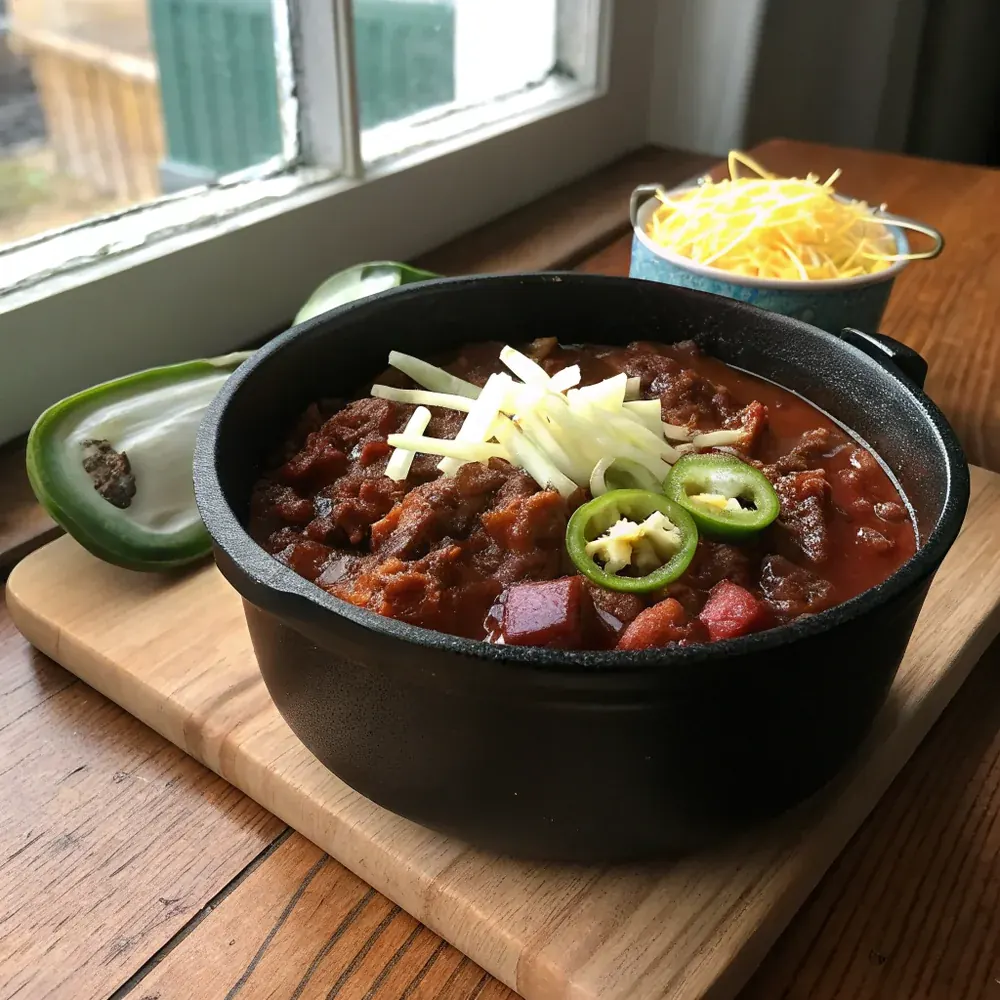
- Serve with garnishes. Ladle into bowls. Garnish each bowl with a generous spoonful of chopped white onion, 3-4 sliced jalapeno coins, a small pile of shredded sharp cheddar, and a wedge of lime. Sour cream is optional - some Texan purists skip it. Serve with cornbread, oyster crackers, or warm flour tortillas alongside.
Frequently Asked Questions
Why does Texas chili not have beans?
The Terlingua Cookoff rules and historical Texas chili tradition both reject beans. The dish descended from cowboy trail cooking that used cubed beef and dried chiles without bean filler. Beans absorb spice and dilute the deep beefy flavor. If you want beans, serve them on the side as a separate dish, never in the chili pot.
Can I use chili powder instead of dried chiles?
Possible but not authentic. Use 3 tablespoons of pure ancho chili powder + 1 tablespoon of regular chili powder + 1 teaspoon of cayenne. The result is acceptable but flatter than the dried chile version. The toasted-soaked-blended dried chile process gives complexity that pre-mixed powder cannot match.
Can I make Texas chili in a slow cooker?
Yes. Brown the beef and onions in a skillet (the slow cooker cannot brown), transfer to a slow cooker with the chile paste and broth. Cook on LOW for 6-8 hours. Stovetop gives slightly more depth, but slow cooker is a valid weekday option. Add the masa thickener and vinegar in the last 30 minutes.
How long does Texas chili keep?
Refrigerated 5 days, frozen 3 months. The flavor genuinely improves on day two and three as the spices and meat juices integrate. Many Texas families make a double batch on Sunday for chili dinners through Tuesday and Wednesday. Reheat gently with a splash of broth to thin if it thickens past your liking.
What is the difference between Texas chili and chili con carne?
Modern Texas chili is technically a chili con carne (Spanish for 'chili with meat'). The terms are often used interchangeably. The Terlingua-rules version is sometimes called Texas Bowl of Red - dark deep red color, no beans, cubed beef, dried chiles. Outside Texas, chili con carne usually refers to a milder version that may include beans and tomatoes.
Can I add tomatoes?
Texas competition chili (Terlingua rules) typically excludes tomatoes. Many home cooks include 2 tablespoons of tomato paste or 1 cup of crushed tomatoes for added body and acidity. Tomato paste is acceptable in the canonical version (this recipe uses 2 tablespoons in the chile paste). Avoid canned diced tomatoes - they dilute the chile flavor and shift the dish toward Midwest chili.
What cut of beef works best?
Beef chuck is canonical. Brisket flat is excellent if you have leftovers from a smoke. Avoid lean cuts (sirloin, round) - they go dry and stringy. Mix of cuts works: half chuck, half brisket trim. The fat is essential to flavor and texture; aim for cuts with visible marbling.
Can I make this less spicy?
Yes. Reduce the chile de arbol to 1 (or omit entirely for very mild heat). Reduce or omit the cayenne. The ancho and guajillo themselves are quite mild - the heat comes from the arbol. The chili will still have proper chili flavor without heat. For people who want extra heat at the table, serve with sliced fresh jalapenos and your favorite hot sauce.