Texas BBQ
Texas Hot Links
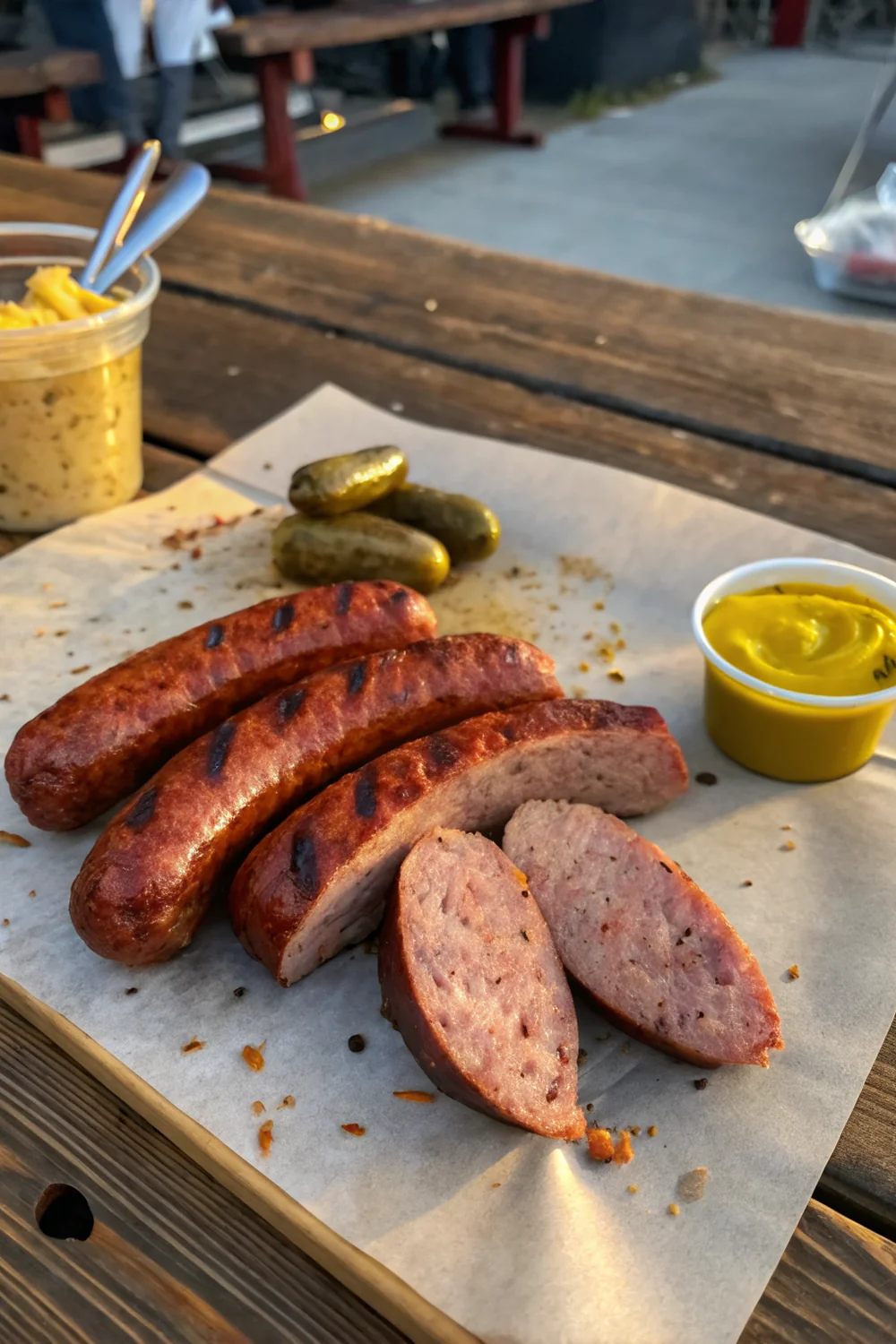
Chef Mia's Texas hot links: 70/30 beef-pork blend, cayenne and smoked paprika, natural hog casings, post oak smoke. The Lockhart classic.
Quick answer: Texas hot links are a coarse-ground beef-and-pork sausage flavored with cayenne, smoked paprika, garlic, and Mexican oregano, stuffed into 32-mm natural hog casings, hung to bloom 2 hours, then smoked at 200-225F over post oak until the internal temperature hits 160F (about 3-4 hours). Slice on the bias and serve with crackers, dill pickles, raw white onion, and yellow mustard - butcher paper, no plate, the Lockhart way.
If you have ever eaten at Smitty's, Kreuz Market, or Black's BBQ in Lockhart, you have eaten Texas hot links. They are the orange-red, juicy, peppery sausage that comes off the pit alongside brisket and ribs. The casing snaps when you bite into it. The interior is coarse, well-seasoned, with visible flecks of cayenne and oregano. The smoke runs deep into the center.
These three Lockhart smokehouses each guard their hot link recipe like state secret. The closest you can get without working in a Lockhart pit is making them at home with quality beef and pork, a spice blend that respects the tradition, and proper casings. This recipe is that home version. Three to four hours of smoking, two pounds of meat, and you have what some people drive ninety minutes from Austin to taste. And when the sausage pilgrimage keeps rolling south, my guide to the best BBQ in San Antonio covers the twelve joints worth the detour.
The Lockhart Trinity
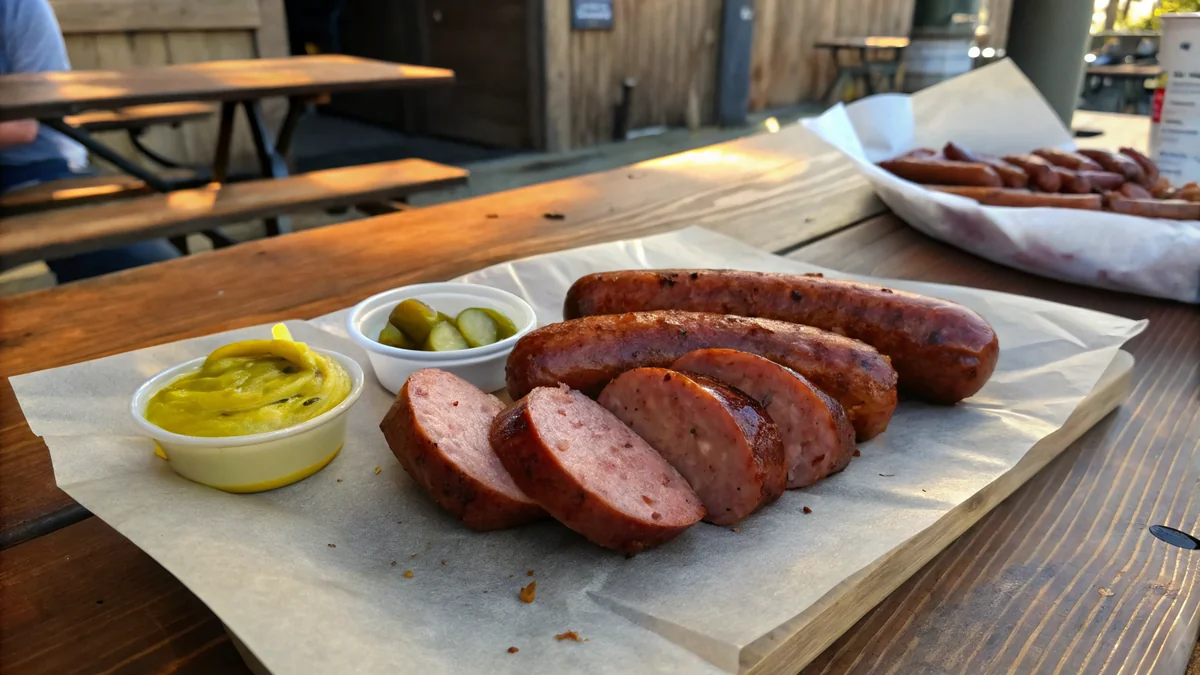
Lockhart, Texas (population about 14,000, 30 miles southeast of Austin) is the official Barbecue Capital of Texas, designated by the state legislature in 2003. Three smokehouses define the town: Smitty's Market, Kreuz Market, and Black's BBQ. All three serve hot links as part of the standard pit platter alongside brisket and beef ribs.
Each shop's hot link is slightly different. Kreuz's tend to be peppery and direct. Smitty's run a touch fattier and more aromatic. Black's lean lightly sweeter with a deeper smoke. The recipes are guarded, but the common DNA is clear: 70/30 beef-pork, cayenne forward, smoked paprika, natural casings, post oak smoke at 200-225F.
This recipe approximates the common ground between the three. Adjust cayenne up for Smitty's-style heat, down for Black's milder profile. The result is recognizable as a Lockhart-style hot link to anyone who has eaten there, while being your own.
70/30 Beef-Pork Ratio
The blend matters. Pure beef gives a dense dry sausage with poor casing snap. Pure pork gives a soft sausage that lacks the beef richness Texas BBQ demands. The 70/30 beef-pork ratio is the canonical Texas hot link blend - enough beef for body and color, enough pork for fat and juiciness.
Beef chuck is the right cut for the beef portion. It is well-marbled (about 18 percent fat), with strong beef flavor, and grinds cleanly. Brisket trim works equally well if you have it - many Texan home cooks who smoke brisket regularly save the trim specifically for sausage.
Pork shoulder (Boston butt) is the right cut for the pork portion. It is fattier than the beef chuck (around 25-28 percent fat), with good flavor and moisture. Pork belly is too fatty (over 50 percent fat) for this recipe; pork loin is too lean and gives a dry sausage.
Final fat content should sit around 22-25 percent. Lower than 18 percent gives a dry sausage; higher than 30 percent renders too much fat during smoking and the sausage shrinks. Ask the butcher for cuts with visible marbling.
Natural Hog Casings
Natural hog casings are made from cleaned and salted pig intestines. They produce the snap that synthetic or collagen casings cannot match. Order from butcher supply websites (LEM, Sausage Maker, Walton's Inc.) - 32-mm diameter is the right size for hot links. Cost: about $15 for enough to make 25 lb of sausage; freeze the unused portion in salt for next time.
Soaking is important. Casings are stored in heavy salt; soaking for 30 minutes in lukewarm water rehydrates them and removes excess salt. Rinse internally by running water through each length - removes any internal debris and shows up any tears.
Stuffing without overstuffing is the key technique. The casing should feel firm but not balloon-tight. Overstuffed casings split during smoking, especially at the seam where the meat meets the casing. If a casing feels too tight, prick it with a needle in 1-2 places - the air pocket releases and prevents splitting.
Synthetic collagen casings are an alternative but not recommended for traditional Texas hot links. They lack the snap and they soften during smoking instead of crisping. Use natural for this recipe; save collagen for breakfast sausages.
Post Oak: The Texas Wood
Post oak (Quercus stellata) is the canonical Texas BBQ wood. It is what every Lockhart pit, every Aaron Franklin barbecue master, every Texas Monthly top-50 BBQ joint uses. The smoke is clean, mild, slightly sweet, with no bitter aftertaste even on long cooks.
Post oak grows wild across Central Texas. Harvested as cordwood, split into 4-6 inch chunks, seasoned for at least 6-12 months before use. Green wood produces creosote and acrid smoke; properly seasoned wood produces the thin blue smoke that imparts deep flavor without bitterness.
If you cannot get post oak locally, alternatives in order of preference: pecan (slightly sweeter, very Texan), white oak (similar profile, slightly stronger), red oak (acceptable but more bitter), hickory (good but more pronounced flavor than the canon).
Avoid mesquite for sausages. Mesquite is excellent for steaks (short cook time, intense flavor) but for 3-4 hour cooks it turns acrid and overpowering. Save mesquite for grilling fajitas; use post oak for hot links.
The Bloom Step
Hanging the freshly stuffed sausages for 2 hours at room temperature (or 4-6 hours refrigerated) before smoking is the bloom step. It seems optional but it is essential. Three things happen during the bloom: the casing dries and tightens, the surface reaches an even temperature, and the meat color deepens to the classic Texas hot link red.
Skipping the bloom gives a paler sausage with a slightly soggy casing. The smoke does not adhere as well. The flavor is acceptable but the visual cue everyone recognizes as a proper Texas hot link is lost.
Hanging hardware: a clean wooden dowel, a stainless rod, or a string stretched between two cabinet handles. The sausages should hang freely without touching each other or anything else - air circulation matters.
If your kitchen is warmer than 75F, refrigerate the bloom instead. The 4-6 hour fridge bloom achieves the same effect at safer temperatures.
160F Internal, Not 165F
Texas hot links pull at 160F internal temperature, not 165F. The 5F difference matters. At 160F, the sausage is fully cooked, food-safe, and juicy. At 165F, the casing splits and significant fat renders out, leaving a dry sausage.
Use an instant-read thermometer in the thickest part of one or two sausages mid-cook (after 2.5 hours) to track. Internal temperature climbs steadily from raw to 130F over the first 90 minutes, then slows from 130F to 160F over the next 90 minutes as moisture evaporates and the sausage cooks through.
Pull at 160F, rest 10 minutes uncovered. The internal temperature continues climbing 3-5 degrees during rest (carryover heat) but the sausage stays juicy. Cutting immediately means the juices run out onto the cutting board.
If smoking on an offset where some sausages cook faster than others, pull each sausage individually as it hits 160F rather than waiting for the whole batch. Sausages closer to the firebox cook faster and benefit from being pulled first.
Service: Butcher Paper, No Plate
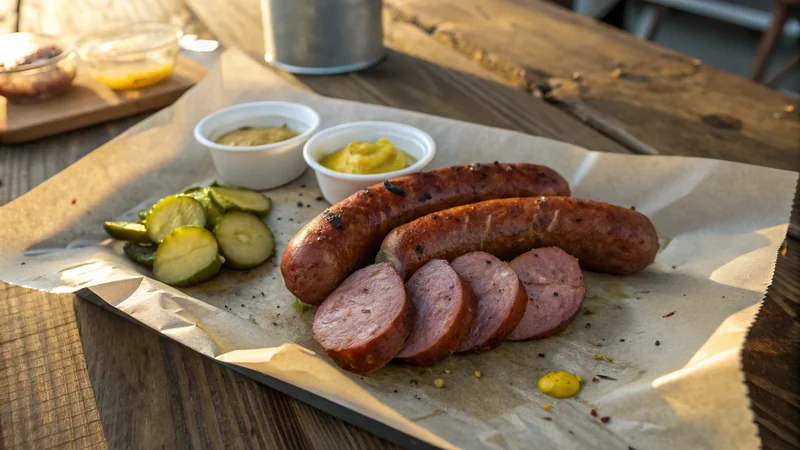
The Lockhart-style service is butcher paper, no plate. The pit master pulls the sausage off the smoker, slices on the bias, and slides it directly onto a sheet of pink butcher paper alongside brisket, ribs, and a slice of white bread. The paper absorbs grease, doubles as a placemat, and goes straight in the trash.
Sides at the smokehouse table are minimal. Yellow mustard, white onion (sliced thick), dill pickles. That is it. No coleslaw, no potato salad, no beans on the meat plate (those go in a separate side bowl if you order them). The simplicity is intentional - the meat is the star.
Drinks at the table: ice tea (sweet or unsweet) or Lone Star beer. Nothing fancy. The meat is rich; you do not want a flavored drink fighting it.
At home, recreate the experience by serving on butcher paper laid directly on a wooden cutting board. Skip plates. Provide white onion slices, dill pickles, yellow mustard, white bread (the cheap fluffy kind, not artisan sourdough). Stand around the kitchen island; do not sit at the formal dining table. This is hand food, eaten with friends, with grease on the fingers.
Feeding a bigger crowd than butcher paper covers? My Texas BBQ sides roundup maps the full table, beans to pickles, and a skillet of smoked chorizo queso rides along on the pit while the links finish. If sausage day becomes a habit, the broader smoked sausage method covers the store-bought shortcut, and leftover links are outstanding sliced into a pot of cowboy stew.
Texas Hot Links Recipe
Ingredients
- For the meat blend (yields 12 sausages, ~3 lb total):
- 2 lb (900 g) beef chuck, 70% lean, well-marbled
- 1 lb (450 g) pork shoulder, with visible fat
- For the spice blend:
- 2 1/2 teaspoons fine kosher salt (or 3 teaspoons coarse)
- 2 teaspoons cayenne pepper (adjust to heat tolerance: 1 tsp = mild, 2 tsp = traditional, 3 tsp = Lockhart hot)
- 1 1/2 tablespoons smoked paprika (Spanish pimenton)
- 1 tablespoon coarse ground black pepper
- 2 teaspoons garlic powder (or 6 fresh cloves, finely minced)
- 1 1/2 teaspoons Mexican oregano (or regular oregano + 1 pinch cumin)
- 1 teaspoon ground coriander
- 1 teaspoon onion powder
- 1 teaspoon ground cumin
- 1/2 teaspoon ground white pepper
- 1/2 cup (120 ml) ice water
- 1 tablespoon apple cider vinegar (helps bind, brightens flavor)
- Equipment:
- 32-mm natural hog casings (about 6 ft, soaked 30 min before stuffing)
- Meat grinder with 1/4-inch coarse plate
- Sausage stuffer (or grinder attachment)
- Smoker capable of 200-225F (offset, kamado, or kettle work)
Instructions
- Chill everything. Place the beef chuck, pork shoulder, grinder parts, and bowl in the freezer 30-40 minutes before grinding. The meat should be 28-32F (very firm but not frozen) when ground - cold meat grinds cleanly without smearing the fat into a paste. Smeared fat gives a mealy sausage texture instead of the coarse-juicy bite the Lockhart style demands.
- Cube and grind. Cut the chilled beef and pork into 1-inch cubes. Combine in a large bowl and mix briefly so the two meats run through the grinder together. Grind through the 1/4-inch coarse plate into a chilled bowl set on ice. Coarse plate is essential - finer grinds give a hot dog texture rather than a Lockhart-style sausage. Keep the bowl on ice throughout.
- Mix the spice blend. In a small bowl, whisk salt, cayenne, smoked paprika, black pepper, garlic powder, Mexican oregano, coriander, onion powder, cumin, and white pepper. Whisking distributes the spices evenly so no bite gets a clump of cayenne while another bite tastes flat. The blend should look brick-orange from the smoked paprika and cayenne combined.
- Bind the meat. Add the spice blend, ice water, and apple cider vinegar to the ground meat. Using your hands (wear gloves; the cayenne is hot on cuts) or a stand mixer with the paddle attachment, mix on low for 2-3 minutes until the meat develops a tacky binding consistency. The meat should hold its shape when pinched between thumb and finger - this is the myosin protein activated, which gives the sausage its juicy snap.
- Test-fry a small patty. Pinch off a 2-tablespoon piece, flatten into a small patty, and fry in a dry skillet over medium heat for 90 seconds per side until cooked through. Taste. Adjust the bulk batch: more salt if flat, more cayenne if not hot enough, more vinegar if dull. This step is non-skippable - tasting raw meat is unsafe and the cooked patty is the only reliable read.
- Soak and rinse casings. Place the natural hog casings in lukewarm water for 30 minutes to rehydrate. Run cool water through each casing by attaching one end to the kitchen faucet (gentle stream, slow). This rinses internal salt and removes any debris. Drain on a clean towel. Casings should be supple and slightly translucent.
- Stuff the casings. Slide the entire length of casing onto the stuffer's funnel. Tie a knot at the far end. Feed the meat blend through the stuffer at low speed; do not overstuff - the casing should be firm but not balloon-tight. As meat fills, twist into 6-inch links by pinching the casing every 6 inches and rotating 3-4 times in alternating directions. Aim for 12 links.
- Hang and bloom 2 hours. Hang the linked sausages from a rod or string in a cool kitchen (60-70F) for 2 hours, or in the refrigerator for 4-6 hours. The casing dries slightly and the interior color deepens. This bloom step is what gives the finished sausage its proper red color and the casing its snap. Skipping it gives a paler, less classically Texas appearance.
- Smoke at 200-225F. Set up the smoker for indirect cooking at 200-225F. Use post oak chunks or splits; pecan also works. Place the sausages directly on the grate, leaving 1 inch between each. Smoke for 3-4 hours, maintaining steady temperature. The internal temperature should hit 160F (71C) at the thickest point. Rotate halfway through if the smoker has hot spots.
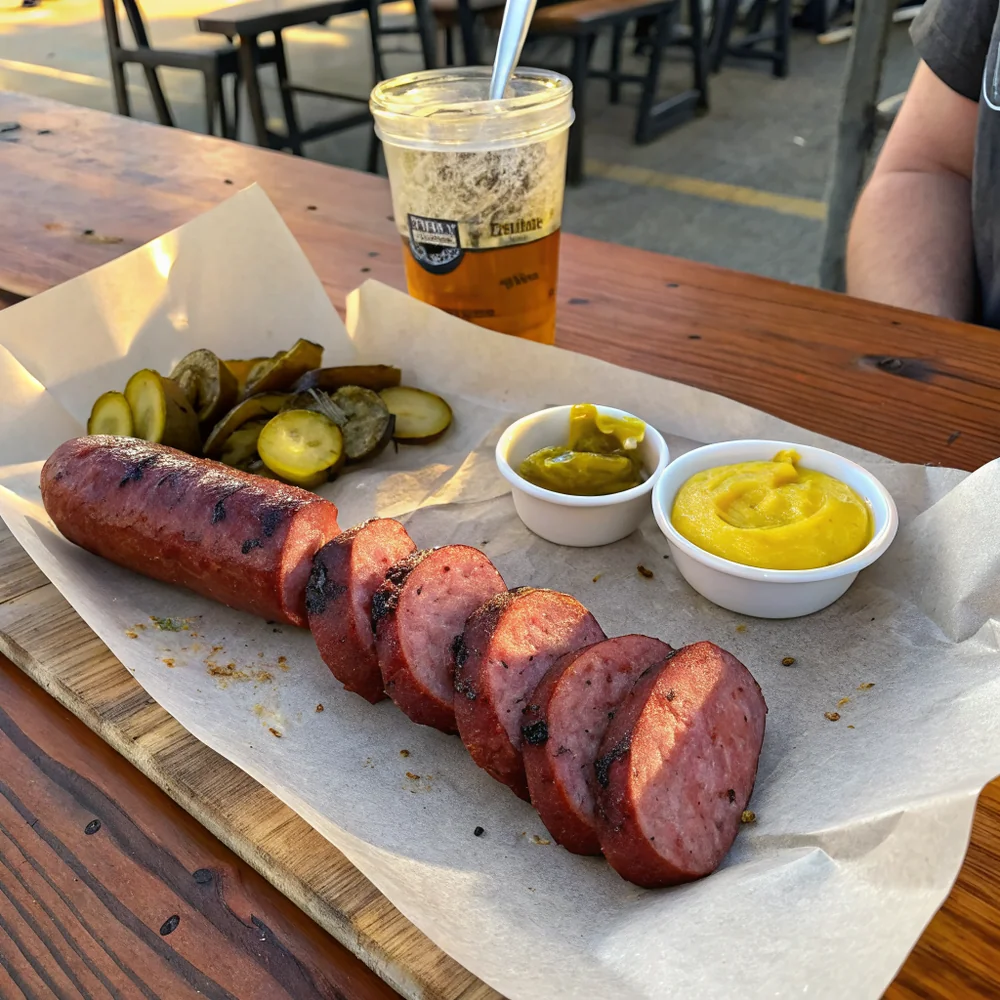
- Rest and serve. Pull the sausages at 160F internal. Rest 10 minutes uncovered on a cutting board - the juices redistribute and the casing tightens slightly. Slice on the bias 1/4-inch thick. Serve on butcher paper with white bread, raw white onion slices, dill pickles, and yellow mustard. Lockhart style: no plate, no fork, just butcher paper and your hands.
Frequently Asked Questions
How spicy are Texas hot links supposed to be?
Moderately hot, not blistering. The traditional Lockhart blend is around 2 teaspoons of cayenne per 3 pounds of meat - enough for a clear pepper kick but not so much that the heat overpowers the smoke and meat. Smitty's runs hotter (3+ tsp), Black's milder (1.5 tsp). Adjust to your tolerance; this recipe lands at the canonical middle.
Can I make these without a smoker?
Not authentically. The smoke is essential to Texas hot links - without it, you have a spicy beef-pork sausage but not a hot link. Possible workarounds: oven-smoke with wood chips in a foil pouch (the result is acceptable but less deep) or finish poached sausages in a kamado or kettle grill set up for indirect smoking. The traditional smoker remains the gold standard.
Do I need a meat grinder, or can I buy ground meat?
A grinder gives the best result. Coarse-grind from store-bought 80/20 ground beef and ground pork is acceptable but lacks the texture of fresh-ground. The 1/4-inch grind is essential - finer grinds give a hot dog texture. If buying pre-ground, ask the butcher for coarse grind specifically.
Can I use beef brisket trim instead of chuck?
Yes, and many Texan home cooks do this. Beef brisket trim (the fat and meat trimmed from a packer brisket before smoking) makes excellent hot link meat - it has the right beef-fat ratio and the same flavor profile. Save the trim in the freezer when you trim a brisket, accumulate enough for a sausage batch.
How long do hot links keep?
Refrigerated, smoked Texas hot links keep 5-6 days in a covered container. The flavor concentrates after day 2 as the spices integrate. Reheat by slicing and warming in a dry skillet 3 minutes per side, or wrap and oven-warm at 300F for 10 minutes. Microwave reheating gives rubbery casings; avoid.
Can I freeze raw or cooked hot links?
Both freeze well. Freeze raw stuffed-but-uncooked links on a sheet pan 2 hours, then transfer to zip-top freezer bags - keep up to 3 months. Smoke from frozen by adding 30-45 minutes to the smoke time. Freeze fully cooked smoked hot links similarly; thaw overnight and reheat as above.
What's the difference between Texas hot links and Cajun andouille?
Texas hot links are coarse-ground, beef-pork, cayenne-forward, smoked at 200-225F over post oak. Cajun andouille is also coarse-ground but pork-only, smoked hotter (250-300F) and longer over pecan and sugarcane, with a stronger smoke flavor and more onion. Both are excellent; they belong to different culinary traditions.
Where can I buy good casings without ordering online?
Some local butcher shops sell natural casings to home cooks. Call ahead. In Texas: Burns Original BBQ in Houston, Centennial Sausage in San Antonio, and most family-run butcher shops in the Hill Country (Wiederstein's in Walburg, Granzin Meat Market in New Braunfels). Otherwise online (LEM, Sausage Maker, Walton's Inc.) ships fast.