Southern Comfort Food
Venison Chili
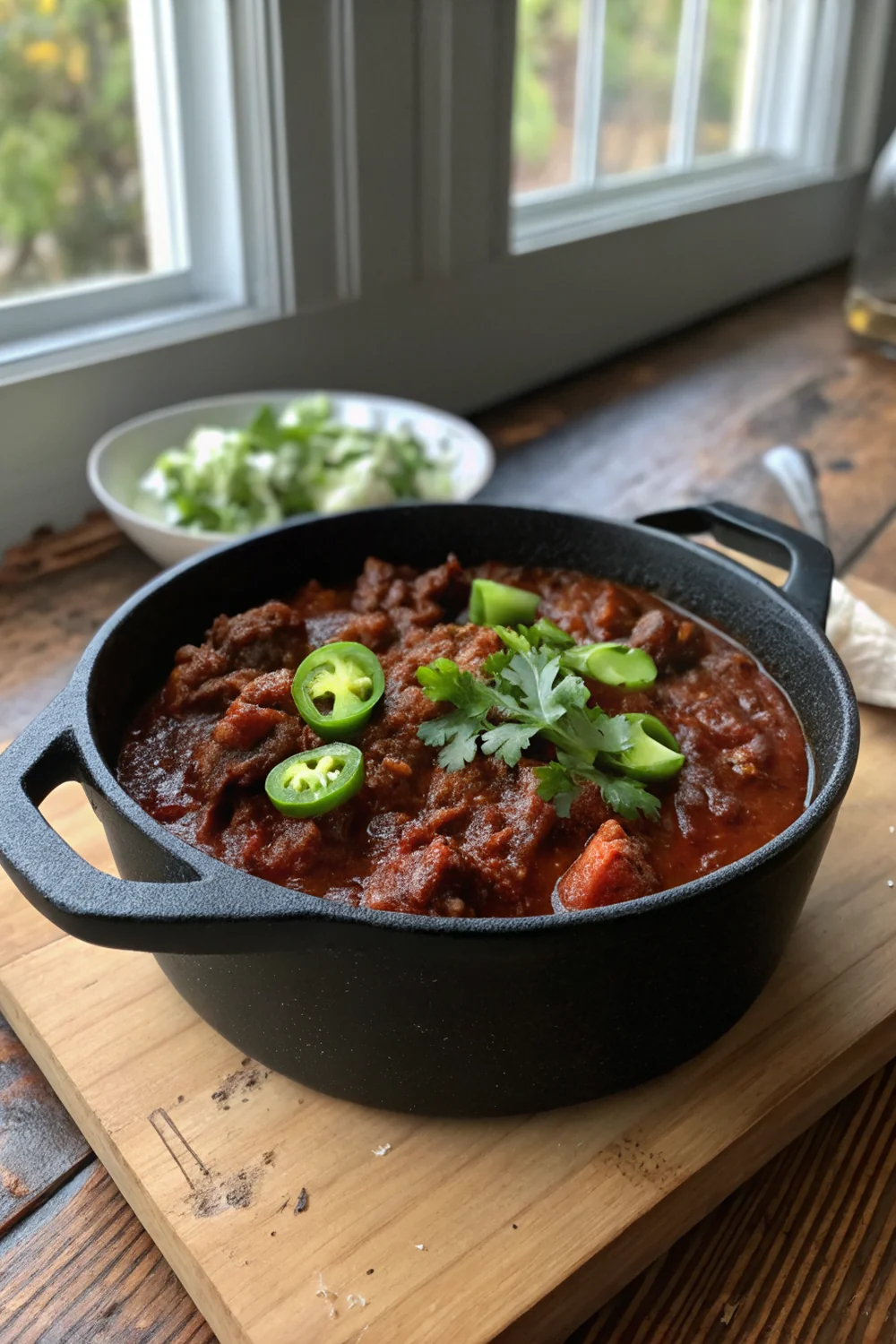
Chef Mia's Texas venison chili: toasted ancho-guajillo chile blend, cubed deer meat, beef stock, no beans. The hunter's chili the Texas way.
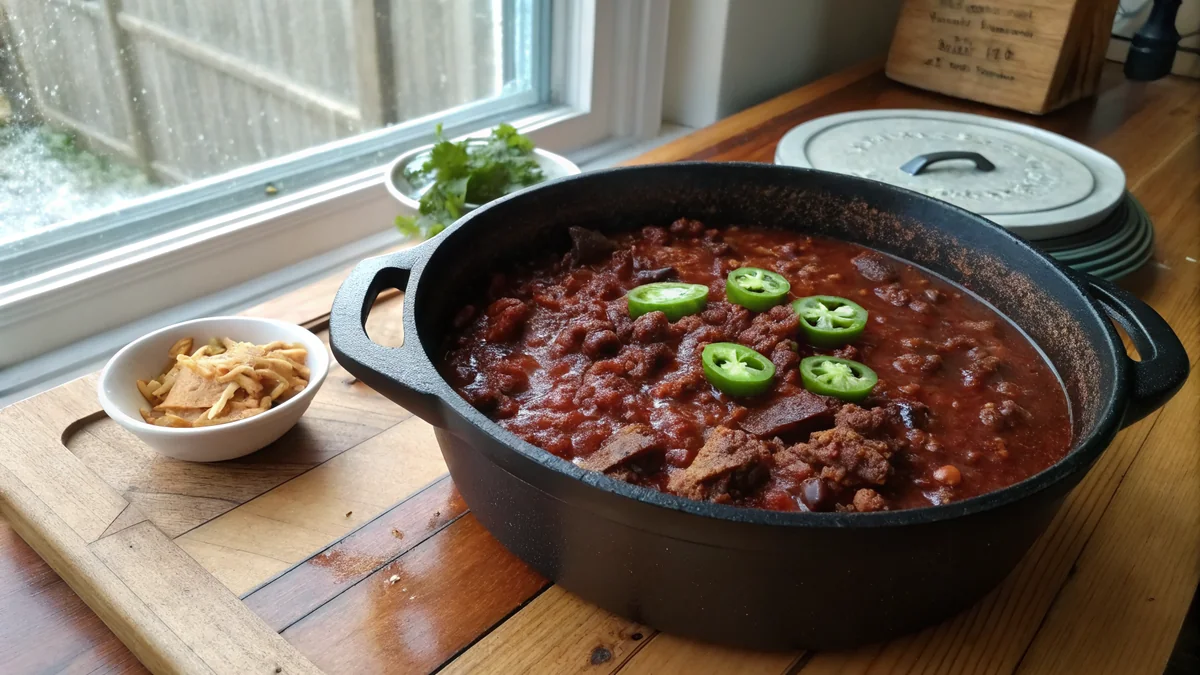
Quick answer: Texas venison chili follows the strict Terlingua cookoff rules: no beans, no filler, cubed meat instead of ground. Toast 6 dried chiles (4 anchos, 2 guajillos) in a dry skillet, soak in hot beef broth, blend into a smooth red paste. Brown 2 lb of cubed venison shoulder with diced onion in bacon fat (venison is lean and needs added fat). Combine paste, meat, broth, and aromatics, simmer 2-3 hours until fork-tender. Thicken with masa harina; finish with cider vinegar and salt. Serve over cornbread with raw onion.
Texas chili is famously bean-free. The state cookoff at Terlingua bans them outright. The reasoning is historical and stubborn: Texas chili descended from the trail-cook chili-con-carne of the 1860s and 1880s, which used dried chiles, beef, lard, and cumin - no beans, no tomatoes in pure form. Modern Texas chili usually includes tomato paste, but beans remain a deal-breaker for purists. Add them and you have made stew, not chili.
Venison is the variation that opens up after deer season. Texas hunting culture is enormous - over 700,000 active deer hunters in the state - and a freezer full of venison shoulder and trim becomes the chili problem to solve every November and December. Venison is lean (3-5% fat compared to 20% for beef chuck), so it needs added fat (bacon, beef tallow, or chuck mixed in) and a gentler simmer than beef chili. Done right, venison chili tastes deeper, gamier, and more interesting than beef. Done wrong, it tastes like dry meat in red broth.
The Texas Chili Rules: No Beans
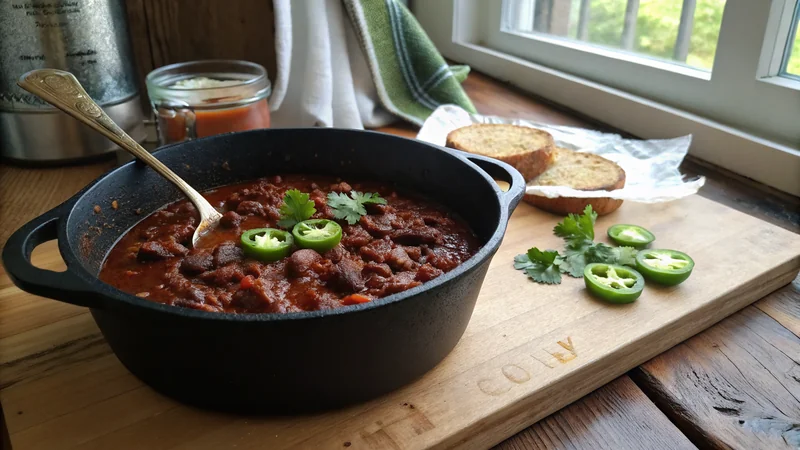
The Original Terlingua International Frank X. Tolbert-Wick Fowler Memorial Championship Chili Cookoff has been held in Terlingua, Texas every November since 1967. The cookoff has rules. The most famous is rule 8: no beans. Adding beans disqualifies an entry instantly. The same rule applies at the CASI World Championship and the CCCC International Chili Cookoff.
The historical reasoning: Texas chili descended from the trail-cook chili-con-carne of the 1860s and 1870s. Trail cooks fed cowboys cubed beef simmered in lard with dried chiles, garlic, and cumin. Beans were sometimes available, sometimes not, but they were never integral to the dish. The 20th-century purist movement codified the no-bean rule into law.
If you grew up adding beans to chili (a perfectly valid choice in Indiana, Ohio, or Cincinnati), this recipe will feel incomplete. The advice is to try it once without beans. The texture and flavor profile are different - meatier, denser, more intense. If you still want beans after, serve a separate bowl of pinto or kidney beans on the side and let people add them. That is the Texas compromise.
Cubed vs Ground
Texas chili uses cubed meat or coarse-ground chili meat (sometimes labeled "chili grind") - never standard ground beef or venison. The texture difference is substantial: cubes give you meaty bites that you can chase around the bowl with a spoon; ground meat gives you a paste that fills the bowl uniformly.
The cookoff standard is 1/2-inch cubes. Smaller cubes (1/4-inch) become indistinguishable from coarse-ground after a 3-hour simmer. Larger cubes (3/4-inch+) take longer to break down and can stay tough on a 2-hour simmer.
Coarse-ground chili meat is the practical home alternative. Ask a butcher to grind the venison shoulder once through the largest plate (7-9 mm). The texture is more rustic than cubed but more meaty than fine-ground. Fine-ground works in a pinch but the chili comes out closer to a Cincinnati style.
Choosing Venison Cuts
Venison shoulder is the right cut for chili. It is lean but well-marbled with connective tissue that breaks down beautifully over a 2-3 hour simmer. The texture comes out tender but distinct - the meat does not shred apart the way over-braised beef chuck can. And while the shoulder goes to the pot, do not let the processor keep the rack: my smoked venison ribs claim the cut most hunters leave behind, with the same deer-season logic as this chili.
Other usable cuts: neck (excellent, similar to shoulder), shanks (cubed off the bone), trim from a butchering session (mixed pieces from various muscles). Avoid backstrap and tenderloin - they are too lean and dry out in a long cook. Save those cuts for grilling or quick searing.
Frozen venison from last season works as well as fresh. Thaw overnight in the fridge before cubing. Vacuum-sealed venison from a hunt processor can sit in the freezer 6-12 months without quality loss; longer than that and freezer burn starts affecting flavor.
Game flavor varies by what the deer ate. Venison from oak-mast country (acorn-fed) tends to be milder and richer. Cedar-country venison can be slightly stronger. Both work; the flavor differences are subtle and the chile paste covers any meaningful gaminess.
Those same tougher cuts are what make this the definitive hunting camp pot: it holds all day on low, reheats better than it started, and feeds ten from one vessel. My deer camp recipes guide covers the rest of the camp menu and, more importantly, the cooler and field care plan that decides how the venison tastes before it ever reaches a pot.
The Lean Meat Problem: Added Fat
Venison runs 3-5% fat. Beef chuck runs 20%. The fat differential matters in a chili because fat carries flavor, prevents the meat from drying out, and provides the silky mouthfeel that long-simmered chili is supposed to have.
The solution is added fat. The classic Texas hunter move is bacon: 4 oz of chopped bacon rendered at the start of the cook gives you 2-3 tablespoons of bacon fat plus a smoky flavor base, and the rendered bacon goes back into the chili at the end as a textural element.
Alternative fats: beef tallow (rendered beef fat, available at butcher shops or rendered from brisket trim), lard (excellent and traditional), or 1/2 lb of beef chuck cubed and mixed with the venison. The chuck route gives you a beef-venison hybrid chili that some hunters prefer for the richer texture.
Without added fat, venison chili comes out lean and one-dimensional. With added fat, it comes out luxurious. The bacon route is the easiest and most flavorful for first-time venison chili cooks.
The Chile Blend
Three dried chiles do most of the work in a Texas chili: ancho, guajillo, and (optional) chile de arbol.
Ancho is the dried form of the poblano - large, dark brown-red, and fruity-sweet with raisin and chocolate notes. It provides the body of the chili. Use 4 anchos for an 8-serving pot.
Guajillo is bright red, smaller, and provides acidity and red color. Mild heat. Use 2 guajillos. The combination of ancho + guajillo is the canonical Texas chili paste.
Chile de arbol is small, thin, and very hot - 15,000-30,000 Scoville. One or two chiles de arbol add heat without changing the flavor profile. Skip them if you want a mild family chili.
Buy dried chiles from a Mexican grocery, an HEB Hispanic aisle, or online (Rancho Gordo and Diaspora Co are reliable). Avoid 5-year-old dusty bags from generic supermarkets - dried chiles lose potency over time and the chili will taste flat.
Toasting and Blending
Toasting dried chiles in a dry skillet for 30-60 seconds per side awakens their oils and deepens the flavor. Press them flat with a spatula. They should become fragrant and slightly pliable. Watch carefully - over-toasted chiles taste burnt and bitter, and there is no recovery.
Soaking in hot beef broth for 15-20 minutes rehydrates the chiles and creates the soaking liquid that becomes part of the chile paste. Use the soaking broth - do not pour it down the drain.
Blending until smooth takes 60-90 seconds in a standard blender. The paste should look like a thick smoothie. If you have an immersion blender, you can blend directly in the bowl. Add tomato paste, garlic, and spices to the blender for a single integrated paste.
Straining through a fine-mesh sieve gives a perfectly smooth chili - the move at competition level. Most home cooks skip this; small specks of chile skin in the bowl are fine and even welcome.
Mistakes to Avoid
Adding beans. Texas chili has no beans. If you cannot live without them, serve a separate bowl of pinto or kidney beans on the side.
Skipping the bacon or other added fat. Venison is lean. Without added fat, the chili tastes dry and one-dimensional.
Using ground beef chili powder instead of toasted whole chiles. Pre-mixed chili powder is fine for weeknight chili; for a competition-style Texas chili, toasted dried chiles are the move. The flavor depth is different.
Burning the chiles during toasting. 30-60 seconds per side. They should become fragrant, not blackened. Burnt chiles give a bitter chili with no fix.
Skipping the masa thickener. The chili stays thin. Masa harina (corn flour, not cornstarch) is the canonical thickener and adds a subtle corn note that ties the dish together.
Skipping the vinegar at the end. A flat-tasting chili is usually missing acid. The cider vinegar at the end is non-negotiable; it brightens the whole pot.
Troubleshooting
Chili tastes flat. Almost always salt or acid. Add 1/2 teaspoon salt, taste. If still flat, add 1 teaspoon more cider vinegar. The end-of-cook adjustment is where chili gets its identity.
Meat is tough after 2 hours. Simmer another 30-45 minutes. Venison shoulder needs 2.5-3 hours minimum to fully break down. Larger cubes need longer.
Chili is too thin. Whisk masa harina with cool water and add. Or remove the lid and simmer uncovered for 15-20 minutes to reduce.
Chili is too thick. Stir in 1/2 cup of warm broth at a time until pourable. Always warm liquid; cold liquid into hot chili can break the texture.
Chili tastes bitter. The chiles were over-toasted, or the chili powder was old. Add 1 tablespoon brown sugar and a pinch of salt to balance. Next time, watch the toast more carefully.
Game flavor is too strong. Add 1 more tablespoon of tomato paste and 1 teaspoon of brown sugar to balance. Some venison from cedar-country tastes stronger; the tomato and sugar mute the gaminess without erasing it.
Variations
Beef-venison hybrid. Use 1 lb venison shoulder + 1 lb beef chuck, both cubed. The chuck provides extra fat and richer texture; the venison provides the gaminess that makes hunter chili distinctive. Best of both worlds.
Coffee chili. Add 1 tablespoon of finely ground espresso to the chile paste. The bitter coffee note deepens the venison and is a popular West Texas competition twist.
Chocolate chili. Add 1 oz of unsweetened dark chocolate (chopped) to the simmering chili. Pulls the ancho's natural chocolate notes forward. Mexican-leaning Texas style.
Spicier (Pecos River style). Use 3 chiles de arbol instead of 1, add 1/4 teaspoon cayenne. The Big Bend region of Texas leans hotter; this version is for chili-heads.
Slow cooker. Brown the bacon and venison in a skillet, transfer to a slow cooker with the chile paste and broth. Cook on LOW for 6-8 hours. Slightly less depth than stovetop but a viable weekday option.
Venison Chili Recipe
Ingredients
- 2 lb (900 g) venison shoulder, cut into 1/2-inch cubes (or coarse-ground)
- 4 oz (113 g) bacon, chopped (the fat venison needs)
- 1 large yellow onion, diced
- 4 cloves garlic, minced
- 4 dried ancho chiles, stemmed and seeded
- 2 dried guajillo chiles, stemmed and seeded
- 1-2 chiles de arbol, stemmed (optional, for heat)
- 4 cups (950 ml) low-sodium beef broth, divided
- 2 tablespoons tomato paste
- 1 tablespoon ground cumin
- 1 teaspoon Mexican oregano
- 1 teaspoon kosher salt, plus more to taste
- 1 tablespoon masa harina (or 2 tablespoons cornmeal) for thickening
- 1 tablespoon apple cider vinegar, for finish
- For garnish: chopped white onion, cilantro, sliced jalapeno, lime wedges, shredded sharp cheddar, cornbread on the side
Instructions
- Render the bacon. In a heavy 5-quart Dutch oven over medium heat, cook the chopped bacon until crisp and the fat has rendered, about 6-8 minutes. Remove the bacon with a slotted spoon and set aside; leave the rendered fat in the pot. The bacon fat is the cooking medium for the venison and the flavor base for the whole chili.
- Toast the chiles. While the bacon renders, heat a dry cast iron skillet over medium heat. Toast the stemmed and seeded ancho, guajillo, and chile de arbol (if using) for 30-60 seconds per side, pressing flat with a spatula. The chiles should become fragrant and slightly pliable - do not let them blacken or they go bitter. Transfer to a bowl.
- Soak the chiles. Pour 2 cups of hot beef broth over the toasted chiles. Press them down with a spoon to submerge. Soak 15-20 minutes until completely soft. The soaking liquid is part of the chile paste - do not discard it.
- Blend the chile paste. Transfer the soaked chiles and their soaking broth to a blender. Add the tomato paste, cumin, Mexican oregano, garlic, and 1 teaspoon salt. Blend until smooth and uniformly red - 60-90 seconds. The paste should be thick like a smoothie. Strain through a fine-mesh sieve back into the bowl if you want a perfectly smooth chili (most home cooks skip this; specks of skin are fine).
- Brown the venison. Pat the venison cubes dry with paper towels (wet meat steams instead of browning). Working in 2-3 batches to avoid crowding the pot, brown the cubes in the bacon fat over medium-high heat for 4-5 minutes per batch, until deeply browned on at least two sides. Transfer browned cubes to a bowl as you work. Add a tablespoon of additional fat (bacon fat, lard, or oil) between batches if the pot looks dry.
- Build the chili base. Add the diced onion to the same pot and cook 4-5 minutes until softened and beginning to brown. Scrape the browned bits from the pot bottom - they are flavor. Return the venison and reserved bacon to the pot. Pour in the chile paste and the remaining 2 cups of beef broth. Stir to combine.
- Simmer 2-3 hours. Bring the chili to a gentle simmer over medium heat. Reduce heat to low, cover loosely (vent slightly to allow some reduction), and simmer 2-3 hours, stirring every 20-30 minutes to prevent sticking. The venison should be fork-tender but still hold its shape. If the chili looks dry during the simmer, add 1/2 cup of broth at a time.
- Thicken with masa. In a small bowl, whisk the masa harina with 1/4 cup of cool broth or water until smooth (no lumps). Stir into the simmering chili. Cook 5-10 more minutes until the chili thickens slightly to a coating consistency - it should ribbon off a spoon, not run thin. Masa thickens, adds a subtle corn note, and is the canonical Texas thickener.
- Finish with vinegar and salt. Pull the chili off heat. Stir in the apple cider vinegar - it brightens the deep red flavor and gives the chili the lift it needs after a long cook. Taste and adjust salt; chili at this stage often needs another 1/2 to 1 teaspoon. Let rest 10 minutes off heat before serving. Garnish each bowl with chopped white onion, cilantro, sliced jalapeno, and a wedge of lime. Serve with cornbread.
Frequently Asked Questions
Why no beans in Texas chili?
Historical and cultural. Texas chili descended from 1860s-1870s trail-cook chili-con-carne, which used cubed beef simmered with dried chiles, lard, and cumin - no beans. The Original Terlingua International Chili Cookoff (since 1967) bans beans outright; adding them disqualifies an entry. If you must have beans, serve them on the side.
Can I substitute beef for venison?
Yes. Use 2 lb of cubed beef chuck instead of venison + bacon. Skip the bacon (chuck has enough fat). The result is a classic Texas beef chili - which is what most cookoffs use anyway. Venison adds gaminess; beef gives a deeper, fattier texture.
Where do I get dried anchos and guajillos?
Mexican groceries, the Hispanic aisle at HEB or Walmart, or online (Rancho Gordo, Diaspora Co, La Tienda). Avoid generic supermarket dried chiles older than a year - they lose potency. Fresh dried chiles should look glossy and pliable, not dusty and brittle.
How long does venison chili keep?
Refrigerated 4-5 days, frozen 3 months. Like most chilis, the flavor genuinely improves on day two and three as the spices integrate. Make on Saturday for Sunday dinner whenever possible.
Can I use ground venison instead of cubed?
Yes. Coarse-ground (chili grind, 7-9 mm) is the closest substitute and recommended. Standard ground venison works but the texture is less Texan and more chili-mac-like. If using ground, brown 5-6 minutes total instead of in batches; reduce simmer to 90 minutes.
Why use masa harina to thicken?
Masa harina is corn flour treated with limewater (the corn used for tortillas). It thickens the chili and adds a subtle corn note that ties the dish to its Mexican-Texan roots. Cornstarch works in a pinch but tastes flat. Flour gives a gravy-like consistency that is wrong for chili.
Can I make venison chili in a slow cooker?
Yes. Brown the bacon and venison in a skillet (the slow cooker cannot brown), transfer to a slow cooker with the chile paste and broth. Cook on LOW for 6-8 hours. Stovetop gives slightly more depth, but slow cooker is a valid weekday option for hunters with full-time jobs.