Texas BBQ
Texas BBQ Brisket
Chef Mia's Central Texas brisket: 12-14 lb packer, salt-and-pepper rub, post oak smoke at 250F, butcher paper wrap, probe-tender at 203F. Full pit-master method.
Quick answer: To smoke a Central Texas brisket, trim a 12-14 lb packer to a 1/4-inch fat cap, rub it with equal parts kosher salt and 16-mesh coarse black pepper, and smoke fat-side up at 250F over post oak for 10-14 hours. Wrap in pink butcher paper around 170F internal, pull when a probe slides into the flat with no resistance (usually 203F), and rest at least one hour in a faux Cambro before slicing against the grain.
I spent the better part of three years driving every Saturday from San Antonio out to Lockhart, the official Barbecue Capital of Texas, just to watch how the pit masters at Black's, Kreuz Market, and Smitty's handled their meat. None of them talked much. They didn't have to. The pit told the story: post oak coals breathing slow, briskets fat-side up under a thin blue haze, butcher paper stacked next to the slicer.
The version I'm giving you is the one I make at home in a 22-inch offset smoker that's a fraction of the size of those legendary pits. It still works because Texas brisket is not about equipment - it's about patience, salt, pepper, and reading the meat instead of the clock. By the time you've made it three or four times, you'll feel the moment to wrap and the moment to pull. Until then, this recipe walks you through every checkpoint a Lockhart pit master would expect.
Why Central Texas Brisket Is Different
Most online brisket recipes teach Kansas City style: sweet rub, mop sauce, and a finish in the oven. Central Texas style is the opposite. The rub is salt and 16-mesh coarse black pepper, with garlic powder if you want the so-called Aaron Franklin trinity. The wood is post oak, sometimes white oak, almost never mesquite for a long cook (mesquite turns acrid past four hours). The sauce, if there is any, comes on the side, and most of the legendary spots in Lockhart do not bother.
This style traces back to the German and Czech butchers who settled the Hill Country in the 1800s. They came with smoke chambers and a European tradition of curing tough cuts with salt and time. When their shops became BBQ joints - Smitty's Market started as Kreuz Market in 1900 - the style was already set: simple seasoning, hardwood smoke, slow heat, butcher paper instead of plates.
What makes the result distinctive is that there is nowhere for a mistake to hide. With no sugar in the rub, you cannot mask under-rendered bark. With no sauce, you cannot rescue a dry flat. With no foil, you cannot shortcut the cook. Every pit master I have watched judged a brisket the same way: how it slices, how the bark looks, and how it tastes plain on butcher paper before any pickle or onion comes near it.
Choosing the Brisket: Cut, Grade, and Weight
Look for a whole packer brisket, sometimes labeled IMPS 120 or NAMP 120. A packer includes both the flat (the lean rectangular muscle) and the point (the thicker, fattier muscle that sits on top), separated by a layer of seam fat. Flat-only briskets are easier to find at standard grocery stores but they cook up drier and lose the marbling story; the point is where most of the magic happens.
USDA Choice is the sweet spot for home cooking - good marbling without paying a Prime premium. Prime is worth it if you can find it at Costco or a butcher you trust; the extra intramuscular fat protects the flat from drying out during the long cook. Wagyu or American Wagyu briskets are an indulgence; they cook a little faster because of the higher fat content and need watching.
Weight matters because cook time scales with the thickest dimension, not just total weight. A 12-14 lb packer is the practical sweet spot for a home offset or pellet smoker - big enough to feed a small crowd, small enough to fit on a 22-inch grate. Anything under 10 lb has usually been over-trimmed at the store and will dry out. Anything over 16 lb runs into pit space limits and an awkward cook time of 16-18 hours.
The Salt-and-Pepper Rub
Central Texas brisket lives or dies on three things: salt, pepper, and patience. The classic Lockhart rub is 50/50 kosher salt and 16-mesh coarse black pepper, by volume. Aaron Franklin added equal parts garlic powder and called it a trinity, and that is what most Texas-style home cooks use today.
The mesh size on the pepper matters more than people expect. 16-mesh is the coarse butcher grind that holds up under a long cook without burning to dust. Standard table-grind pepper turns bitter and disappears into the bark. If your grocery store does not carry 16-mesh, look for it online or at a restaurant supply store; one bag will last most of a year.
Salt brand matters too. Diamond Crystal kosher salt is roughly half as dense as Morton's by volume, so if you only have Morton's, cut the salt by half. Sea salt is too irregular for an even cure across the surface. Avoid table salt - the iodine taste comes through after 12 hours of smoke. A flake-style finishing salt at the table is fine but it is not the rub.
Trimming the Brisket
Trimming is the first place most home cooks lose ten dollars worth of meat. The goal is to leave a 1/4-inch (6 mm) fat cap on the top of the brisket - thick enough to render and baste the meat, thin enough that smoke can still penetrate the surface. Anything thicker insulates the meat from the smoke and leaves a soft, ungratifying layer of fat between the bark and the flat.
Flip the brisket fat-side down and remove any silver skin from the lean side. Then look for the deckle - the hard wedge of fat that sits between the point and flat at one end. Cut it back so the surface is smooth. Square off the thin edge of the flat so it does not dry out and finish before the rest of the brisket is done.
Save your trimmings. After the cook, you can render them down into beef tallow on the stove. A spoon of warm tallow brushed over the slices is a Goldee's-style finishing touch and one of the easiest upgrades in BBQ.
Setting Up the Smoker
Any indirect cooker can produce a great brisket: stick burner, kettle with snake method, kamado, pellet smoker, or even a bullet smoker. The non-negotiable is steady, indirect heat at 225-275F. I aim for 250F because it gives a forgiving margin and finishes in 10-14 hours, which fits a Saturday cook starting before sunrise.
Wood choice is post oak country. Post oak burns clean, low-resin, and gives the savory baseline flavor most people associate with Texas BBQ. White oak and red oak are reasonable substitutes. Hickory is bolder and works if you mix it with oak. Mesquite past four hours turns acrid - use it only for short cooks like steak. Pecan is sweet and works for desserts and chicken but it underwhelms on a 13-hour brisket.
Set up for thin blue smoke. White, billowing smoke is unburnt fuel and it tastes like a chimney. If you see white smoke, your fire is starved for oxygen. Open the intake, let the wood reach combustion, and only add chunks once the existing fire is burning cleanly. The smoke should look almost invisible, with a faint blue tint near the stack.
The Smoke: First 4-6 Hours
Place the brisket fat-side up on the grate. The fat cap renders down through the meat as it melts, and the top is the side most exposed to direct heat in most smokers. If your smoker runs hotter on one side, point the thicker point end toward the firebox - the point is fattier and can take more heat than the lean flat.
Close the lid and walk away for 90 minutes. Opening the lid drops the chamber temperature by 25-50F and resets the cook. After the first 90 minutes, you can spritz with apple cider vinegar diluted 50/50 with water every 30-45 minutes if the surface is drying out. Spritzing is optional - it slows the cook slightly and softens the bark, but it helps the smoke ring develop on outdoor smokers in dry climates.
By hour 4-6, the surface should be deep mahogany, almost black-brown, and feel firm to the touch. The internal temperature should be approaching 160-170F. This is when most of the visible bark has set, and most of the smoke flavor has been absorbed. After this point, additional smoke contributes diminishing returns; what the meat needs now is heat and time.
The Stall and the Wrap
Around 160-170F internal, the brisket will hit the stall - a plateau of one to three hours where the temperature barely moves. This is evaporative cooling. Moisture rising from the meat carries away heat at almost exactly the rate the smoker is putting it in. The stall is normal, expected, and the moment when most of the bark sets and the smoke flavor locks in.
Do not raise the smoker temp during the stall. Trying to push through with extra heat dries out the bark and toughens the flat. The right move is to wrap. Around 170-175F internal, with the bark passing the fingernail test - you can drag a fingernail across without lifting it - tear off a 30 x 24 inch sheet of pink butcher paper.
Set the brisket fat-side down in the center. Fold the long sides over tight, then tuck the short ends like wrapping a burrito. Place seam-side down on the grate. Pink butcher paper holds moisture without trapping steam, so it preserves bark texture much better than aluminum foil. Foil works in a pinch but it produces a softer, pot-roast-style bark that no Lockhart pit master would tolerate.
Probe-Tender, Not Number
From wrap to finish is usually another 1.5-3 hours, but the variance between briskets is enormous. Two same-weight briskets from the same store can finish 90 minutes apart. Forget the temperature target and probe.
Insert a thin thermometer probe or a wooden chopstick into the thickest part of the flat. If it slides in like soft butter, with zero resistance, in three or four different spots, the brisket is done. If it catches anywhere, give it 20 more minutes and probe again. Probe-tender usually corresponds to 200-205F internal, but you may hit it at 198F on a small brisket or 207F on a fatty Prime.
When you pull at probe-tender, the meat is fully rendered. When you pull at a number, you might be done, you might not. The pit masters who win Texas Monthly's Top 50 list every few years all use the same answer: probe-tender, every time.
Resting in a Faux Cambro
Restaurants use insulated holding cabinets called Cambros to rest cooked meat. At home, a clean cooler with two bath towels does the same job and is called a faux Cambro. Wrap the brisket-still-in-paper in a couple of towels and set it in the cooler, lid closed, for at least one hour, ideally two to four.
Resting is not a polite suggestion. During the cook, juices and rendered fat get pushed toward the center of the meat. If you slice immediately, those juices run out onto the cutting board and the slices come out dry. A 60-90 minute rest at 150F internal lets juices redistribute, collagen finish breaking down, and bark firm up just enough to slice cleanly. A longer four-hour rest is even better and is how the famous spots hold their briskets between morning service and lunch.
If your brisket finishes at 11pm and dinner is the next day, you can rest it down to about 145F, then refrigerate overnight. Reheat gently the next day in a 250F oven, still wrapped, until it is back to 150F internal. It will taste nearly identical to a fresh cook.
Slicing Against the Grain
The grain on a brisket runs in two different directions because the point and the flat are two different muscles. The flat's grain runs roughly in line with the long axis of the brisket. The point's grain runs roughly 90 degrees to the flat's grain. If you try to slice the whole packer in one direction, half the slices will be against the grain and half with it - and the with-grain ones will be unpleasantly chewy.
Set the rested brisket fat-side up on a large board. Find the seam of fat between the point and flat. Slide a sharp knife along the seam and separate the two muscles. Set the point aside.
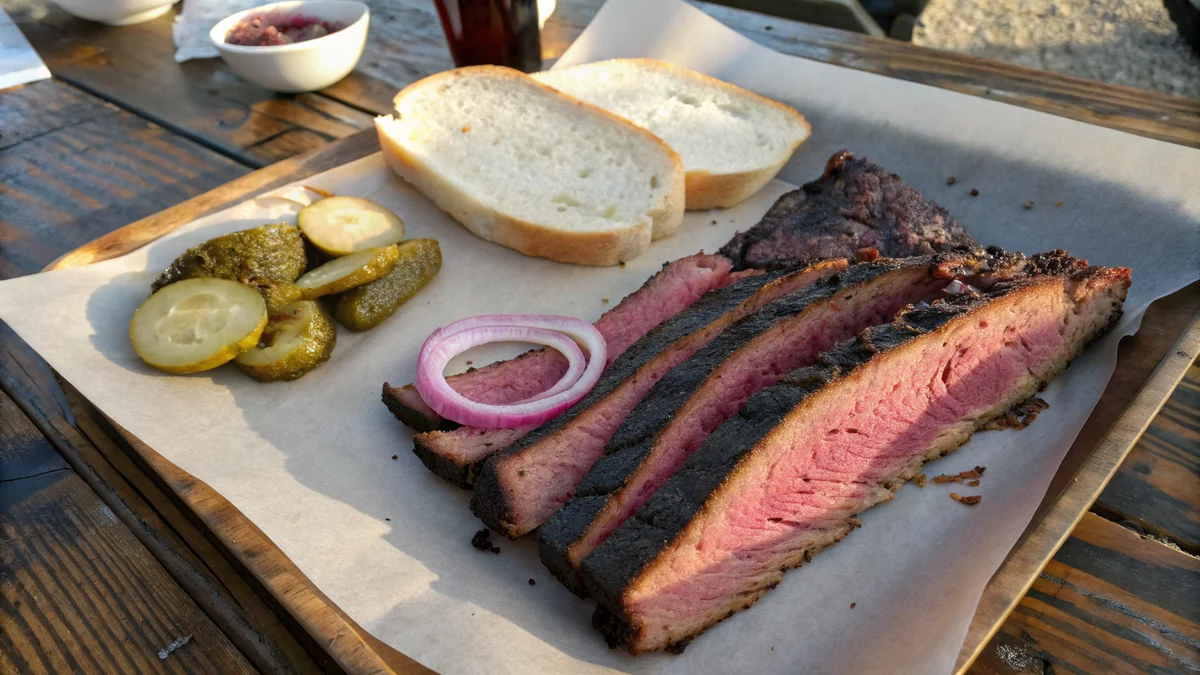
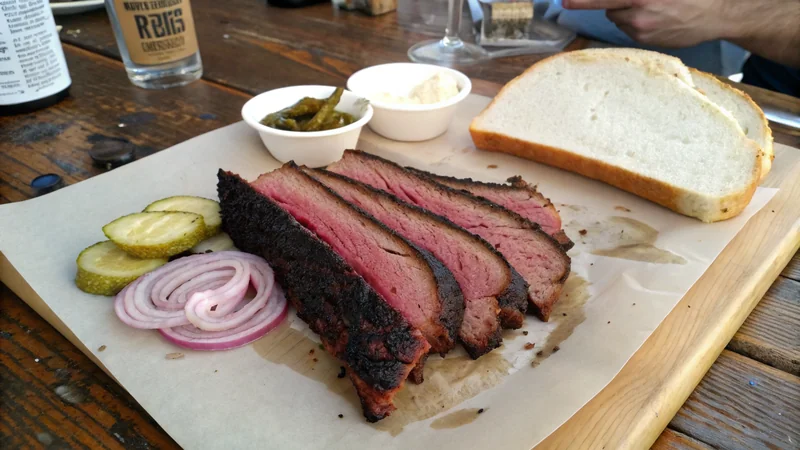
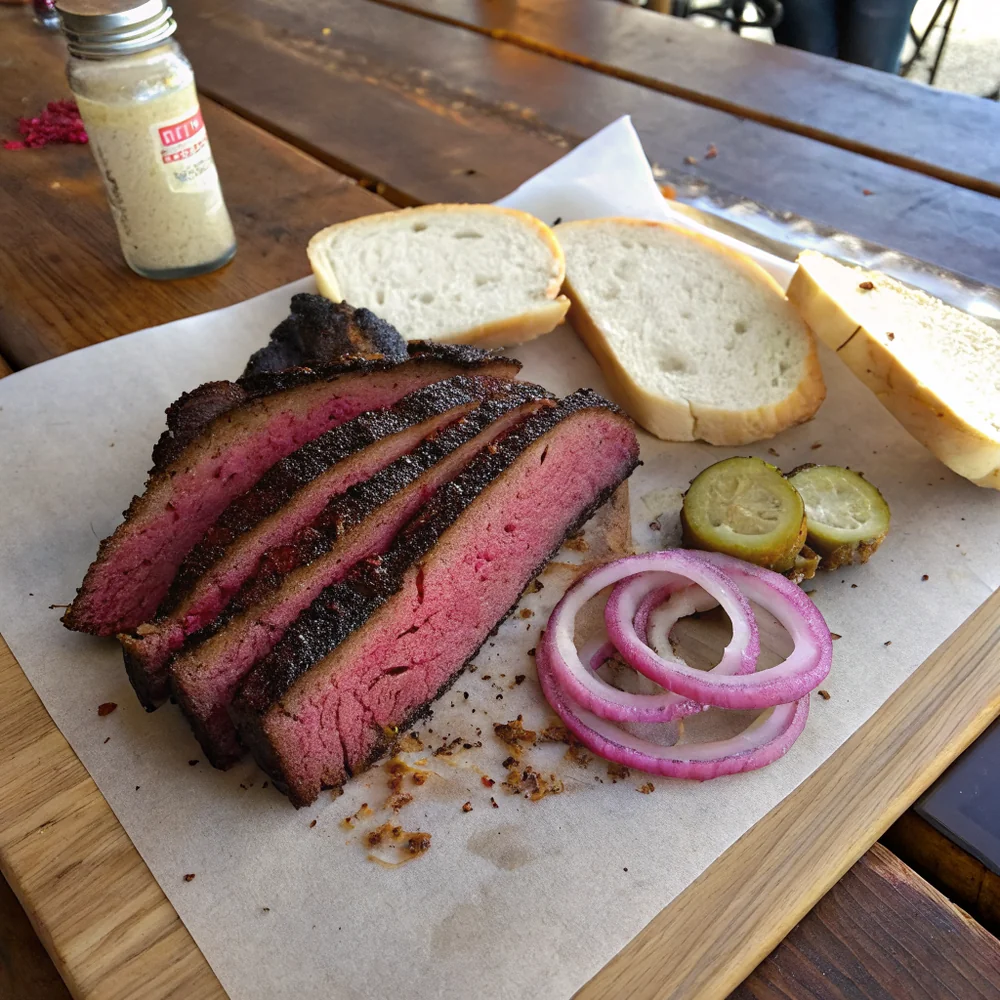
Slice the flat against its grain at the thickness of a #2 pencil - about 1/4 inch (6 mm). Each slice should pass the bend test: hold a slice up by one end and bend it into a U; it should hold its shape briefly, then break cleanly. If it falls apart, it is over-rested or over-cooked. If it does not bend at all, it is under-cooked or sliced too thick.
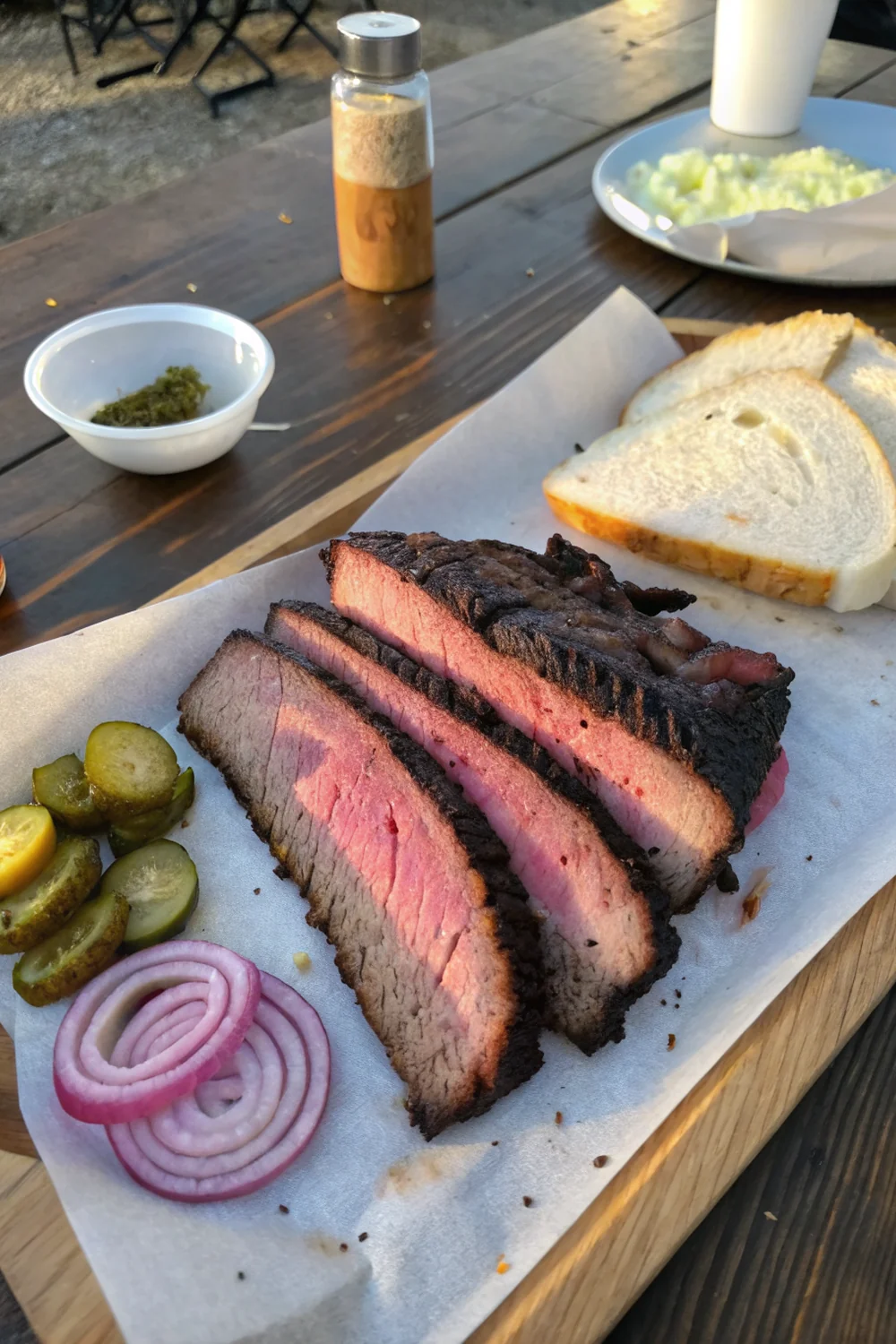
Rotate the point 90 degrees and slice it the same way, or cube it into 1-inch pieces, toss with a little BBQ sauce, and return to the smoker for 30-45 minutes for burnt ends. Serve slices on butcher paper with white bread, dill pickles, and raw yellow onion. That is the table.
Chef Mia's Kitchen Notes
When I first started smoking briskets at home in San Antonio, I tried to do everything I had read online: spritzing every 15 minutes, opening the lid to check, panicking at the stall. The brisket I produced was fine, but it was not a Lockhart brisket. The thing that finally moved my cooks from fine to genuinely good was learning to leave the meat alone.
My rule now is: trust the rub, trust the smoke, trust the wrap, and trust the rest. If I find myself opening the lid more than four times in a 13-hour cook, I tell myself out loud that the brisket is fine and I make a coffee. That habit, more than any new gadget, made the difference.
The other rule is: always cook two briskets if you have the room. A 12 lb and a 14 lb. The bigger one feeds the table, the smaller one becomes lunch all week - chopped beef sandwiches, breakfast tacos with eggs and tortilla, brisket chili. Texas brisket leftovers are arguably better than the first night.
Mistakes to Avoid
Do not skip the trim. An untrimmed brisket smokes unevenly, hides a thick layer of unrendered fat between the bark and the meat, and produces dry slices on the thin edge of the flat. The trim takes 20 minutes and is the single most important step a beginner gets wrong.
Do not season more than four hours ahead. Salt has time to draw moisture to the surface, then re-absorb it - the dry brine effect that helps a steak does not help a brisket the same way over a long smoke. A 30-45 minute rest after seasoning is plenty. Overnight salting can produce a hammy, cured texture you do not want in a slow-smoked Texas brisket.
Do not raise the smoker temp to push through the stall. The stall is when the bark sets. Cranking the heat to 300F dries out the surface and toughens the flat. The fix is to wrap, not to push.
Do not slice immediately. A brisket that has not rested at least 60 minutes will bleed onto the cutting board and the slices will be dry, even when the cook was perfect.
Do not slice with the grain. This is the most common mistake at the table after a long cook. Spend the extra 30 seconds to find the seam, separate the point and flat, and rotate as needed before slicing.
Troubleshooting
The flat is dry but the point is good. The flat finished before the point because the point is fattier and protects itself. Next time, point the thicker end at the firebox, or pull the brisket 5-10F earlier. For the current cook, brush dry slices with warm beef tallow or pan juices and serve quickly.
No smoke ring. A smoke ring is a chemistry effect where nitric oxide from the wood reacts with myoglobin in the meat. Pellet smokers and electric smokers produce less of it because they burn cleaner. Spritzing during the first 4 hours and starting with cold meat both increase the ring. The smoke ring does not affect taste; it is a cosmetic signature.
Bark is soft and grey, not mahogany. The smoker was probably running too cool, or the chamber had too much steam. Next time, run at 250F not 225F, and skip the water pan. Open the vents to make sure the fire is breathing cleanly.
Probe-tender but the slices fall apart. Over-rested or over-cooked. Pull the brisket five minutes earlier next time, and shorten the rest to one hour. Slices should bend, not crumble.
Variations
No-wrap (texas crutch-free). Smoke the entire cook unwrapped at 250F. The bark will be thicker and more peppery; the flat may run a little drier. This is the old-school approach used by some Lockhart pit masters who think paper is a shortcut. Plan for 14-16 hours instead of 12.
Hot-and-fast at 275F. Same method, slightly higher chamber temp. Cuts cook time to 8-10 hours total. The bark sets faster and the smoke ring is a little smaller, but the result is hard to distinguish from a 250F cook in a blind taste test.
Oven-finish backup plan. If your fire dies in the middle of the night, wrap the brisket and finish in a 250F oven. The oven cannot impart smoke, but by hour 6 the brisket has absorbed nearly all the smoke flavor it will ever absorb. The oven finish is invisible to the eater.
Burnt ends. After resting, cube the point into 1-inch pieces. Toss with BBQ sauce and a little brown sugar. Return to the smoker at 250F in a foil pan for 30-45 minutes until caramelized. Serve as a separate course or appetizer.
Storage and Reheating
Refrigerate sliced brisket in a shallow airtight container with a few tablespoons of pan juices for up to four days. Whole, unsliced brisket keeps a day longer if it is wrapped tightly in butcher paper inside a plastic bag.
To reheat, the gold standard is sous vide: bag with juices, hold at 150F for 45 minutes. The result is nearly indistinguishable from fresh. Without sous vide, wrap slices in foil with a splash of beef stock or pan juices, set in a 275F oven for 20-25 minutes, and check that the center is at 150F internal. Avoid microwaving slices unless the slices are thin and you are reheating quickly.
Freeze whole or in slices, vacuum-sealed if possible, for up to three months. Thaw overnight in the fridge, then reheat as above. Texture holds up well in the freezer because brisket is mostly collagen and fat, both of which freeze cleanly.
For food safety basics on internal temperatures and reheating, I keep FoodSafety.gov internal temperature guidance bookmarked.
What to Serve With Texas BBQ Brisket
Serve brisket on butcher paper, family-style, with white bread (Mrs Baird's is canon in Texas), dill pickles, raw yellow onion sliced thin, and BBQ sauce on the side. That is the Lockhart counter and you cannot improve on it.
If you want a fuller plate, classic sides are Texas BBQ potato salad, ranch-style pinto beans, jalapeno cheddar Texas cornbread, and coleslaw. Skip mac and cheese if you are going for an authentic Lockhart spread; it is more of a Memphis or Carolina addition.
For sauce, use Chef Mia's Texas BBQ sauce on the side - never on the meat. The sauce is a tool for pickier eaters and for sandwiches. Brisket dressed in sauce is a sign someone does not trust the cook.
Brisket leftovers are golden. Slice thin for chopped beef sandwiches, dice into chili the next day, fold into breakfast tacos with scrambled eggs and a flour tortilla, or layer into mac and cheese for a crowd. For more BBQ ideas, see the Ultimate Texas BBQ Guide.
Texas BBQ Brisket Recipe
Ingredients
- 1 whole packer brisket, 12 to 14 lb (5.5-6.4 kg), USDA Choice or Prime
- 4 tablespoons (60 g) kosher salt, Diamond Crystal preferred
- 4 tablespoons (32 g) 16-mesh coarse black pepper
- 1 tablespoon garlic powder (optional - the Aaron Franklin trinity)
- 2 tablespoons yellow mustard, as a binder (optional)
- Post oak chunks or splits, about 4-6 lb total for the cook
- 1 large sheet pink butcher paper, unwaxed (about 30 x 24 inches)
- 2 cups water, for the smoker water pan if you use one
- Beef tallow (about 2 tablespoons, optional, for slicing finish)
- To serve: white bread, dill pickles, raw yellow onion, BBQ sauce on the side
Instructions
- Trim the brisket. Pull the brisket from the fridge and pat dry. Set it fat-side up on a large board. Trim the fat cap evenly to 1/4 inch (6 mm) thick using a sharp boning knife - thinner spots will burn, thicker spots will not render. Flip and remove any silver skin and the hard deckle fat between the point and flat. Square off the thin edge of the flat so it does not dry out. Trimming should take 15-20 minutes and remove about 1.5-2 lb of fat. Save the trimmings if you want to render tallow later.
- Apply the rub. Mix the kosher salt, coarse black pepper, and garlic powder if using. Spread mustard thin over the entire surface as a binder - it will not flavor the meat once smoked, but it helps the rub stick during a long cook. Apply the rub generously on every surface, top, bottom, and sides, until the meat is evenly coated. About 1 tablespoon of rub per pound is the right load. Let the brisket rest at room temperature for 30-45 minutes while the smoker comes up to temperature.
- Set the smoker to 250F. Light the firebox with charcoal or a small wood fire and bring the cooking chamber to a steady 250F (121C). Once stable, add post oak chunks or splits. Aim for a thin, almost invisible blue smoke - not white billowing smoke, which carries creosote and tastes acrid. If you have a water pan, fill it now; the steam stabilizes the temperature and softens the bark slightly.
- Smoke fat-side up for the first 4-6 hours. Place the brisket fat-side up on the grate, with the thicker point end closer to the firebox if your smoker has hot spots. Close the lid. Do not open it for the first 90 minutes - the bark needs uninterrupted heat to set. After that, you can spritz with apple cider vinegar mixed 50/50 with water every 30-45 minutes if the surface looks dry. The bark should turn deep mahogany over 4-6 hours.
- Push through the stall. Around hour 4-6, the internal temperature will plateau between 160F and 170F (71-77C) for one to three hours. This is the stall, caused by evaporative cooling on the surface. Do not raise the smoker temperature. The stall is when the bark sets and most of the smoke flavor is absorbed. Just hold steady and trust the process.
- Wrap in pink butcher paper at 170F internal. When the internal temp hits 170-175F (77-79C) and the bark passes the fingernail test - you can drag a fingernail across without the bark coming off - it is time to wrap. Tear off a sheet of pink butcher paper roughly 30 x 24 inches. Set the brisket fat-side down in the center, fold the long sides over tight, then tuck the short ends like a burrito. Return seam-side down to the smoker. Paper holds moisture without softening the bark the way foil does.
- Cook to probe-tender. Continue at 250F. After about 1.5-3 more hours, start probing the thickest part of the flat with a thin thermometer or a chopstick. Internal temperature is a guideline (usually 200-205F / 93-96C), but probe-tenderness is the real signal: the probe should slide in like soft butter, with no resistance, in multiple spots. If it sticks even slightly, give it another 20 minutes and try again. Some briskets are done at 200F, some need 207F. Trust the feel, not the number.
- Rest at least 1 hour, ideally 2-4. Pull the wrapped brisket and place it in a faux Cambro: an empty cooler lined with a few towels, with another towel on top. Close the lid. Let it rest for at least one hour, ideally two to four. Internal temp will drop from around 200F down to 150F (66C) before slicing. The rest is non-negotiable. It is when juices redistribute, collagen finishes breaking down, and the bark firms up. A poorly rested brisket can be tough even when it was probe-tender at the pull.
- Slice against the grain. Unwrap on a large board (save the juices). Identify the seam of fat between the point (the thicker, fattier muscle) and the flat (the leaner rectangular muscle). The grain runs in different directions in each, which is why you separate them before slicing. Trim the seam, set the point aside. Slice the flat against the grain at the thickness of a #2 pencil, about 1/4 inch (6 mm). Rotate the point 90 degrees and slice or cube it - it can be served as is, or returned to the smoker as burnt ends. Brush slices with reserved juices or warmed beef tallow if desired. Serve immediately on butcher paper with white bread, pickles, and raw onion.
Frequently Asked Questions
What temperature do I pull a Texas brisket at?
Probe-tender beats any number, but it usually corresponds to 200-205F (93-96C) internal in the thickest part of the flat. Some briskets are done at 198F, some need 207F. Insert a thin probe in three or four spots; if it slides in like soft butter with no resistance anywhere, it is done.
Why does my brisket stall at 165F?
The stall is evaporative cooling. Moisture rising from the surface carries away heat at almost exactly the rate the smoker is putting it in. It is normal, lasts one to three hours, and is when the bark sets and most of the smoke flavor locks in. Wrapping in pink butcher paper around 170F gets you through it without losing bark.
Can I smoke a brisket in the oven?
You can finish one in the oven, but you cannot start one there - you need real wood smoke for the first 6 hours to build the bark and smoke ring. After hour 6, the meat absorbs little additional smoke, so an oven finish at 250F is essentially invisible if your fire dies.
How long does brisket take per pound at 250F?
Plan for roughly 1 to 1.25 hours per pound at 250F, including the wrap. A 12 lb brisket usually finishes in 12-14 hours; a 14 lb brisket in 14-16 hours. Always start checking probe-tenderness 1.5 hours before your earliest expected finish - briskets vary.
Why post oak and not mesquite?
Mesquite burns hot and produces an aggressive, almost medicinal smoke that turns acrid after about four hours. Post oak burns clean and slow with a savory, neutral profile that complements beef without overpowering it. Central Texas pit masters use post oak for everything that cooks longer than four hours.
Do I have to use butcher paper to wrap?
No, but butcher paper produces the best bark texture. Aluminum foil works in a pinch but softens the bark into a pot-roast finish; many old-school Lockhart cooks skip wrapping entirely and accept a longer cook with a thicker bark. Pink butcher paper (unwaxed) is the modern standard pioneered by Aaron Franklin.
How do I reheat brisket without drying it out?
Sous vide is the gold standard - bag with juices, hold at 150F for 45 minutes, and slices come back nearly identical to fresh. Without sous vide, wrap slices in foil with a splash of beef stock, set in a 275F oven for 20-25 minutes, and check that the center hits 150F internal. Avoid the microwave for thick slices.
Can I freeze leftover brisket?
Yes - vacuum-seal sliced or whole brisket with a few tablespoons of pan juices, freeze for up to three months. Thaw overnight in the fridge, then reheat in foil in a 275F oven or in a sous vide at 150F. Texture holds up well because brisket is mostly collagen and fat, both of which freeze cleanly.