Southern Comfort Food
Authentic Texas Cornbread
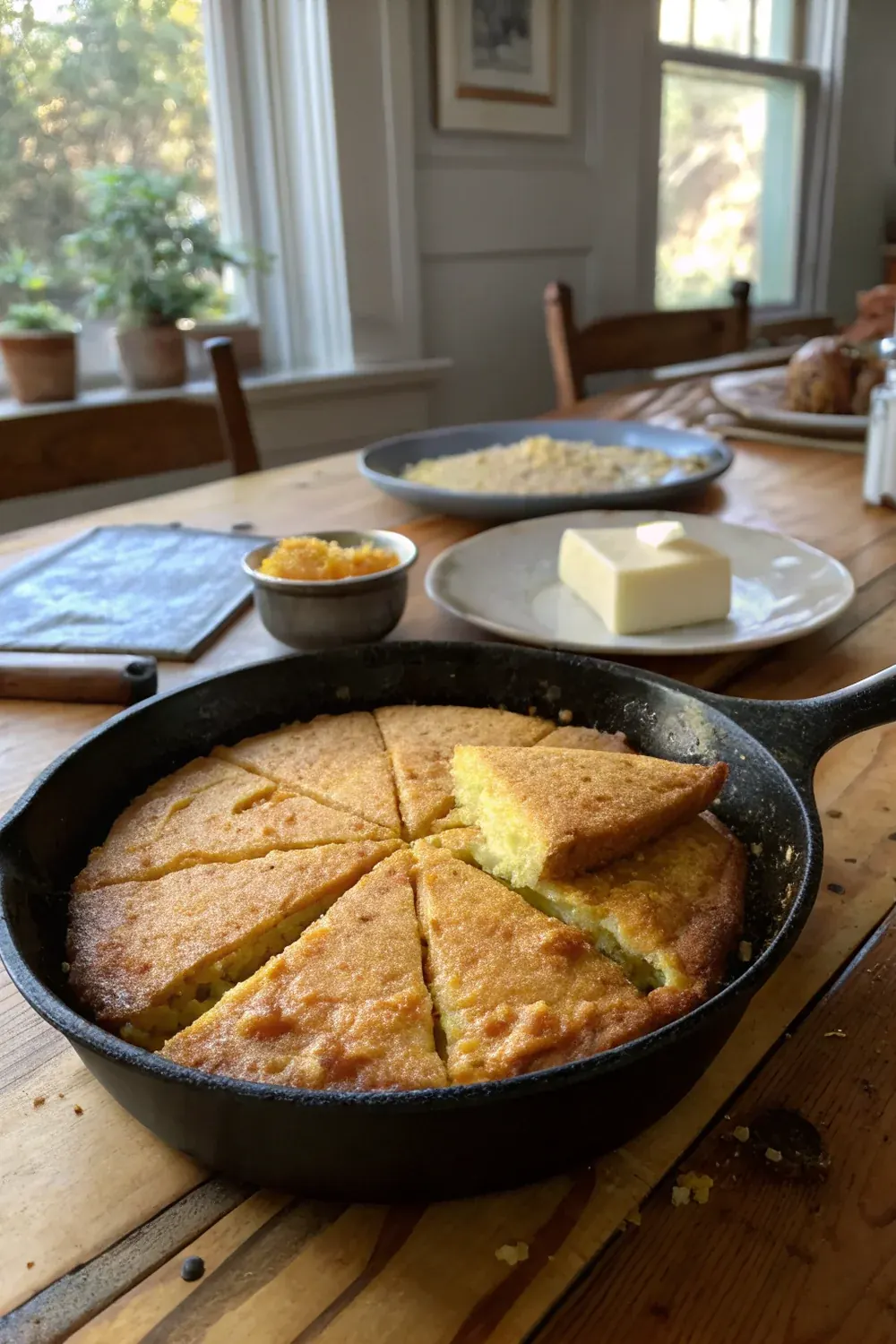
Chef Mia's authentic Texas cornbread: yellow cornmeal, buttermilk, cast iron skillet preheated with bacon fat at 425F for the crackly bottom crust.
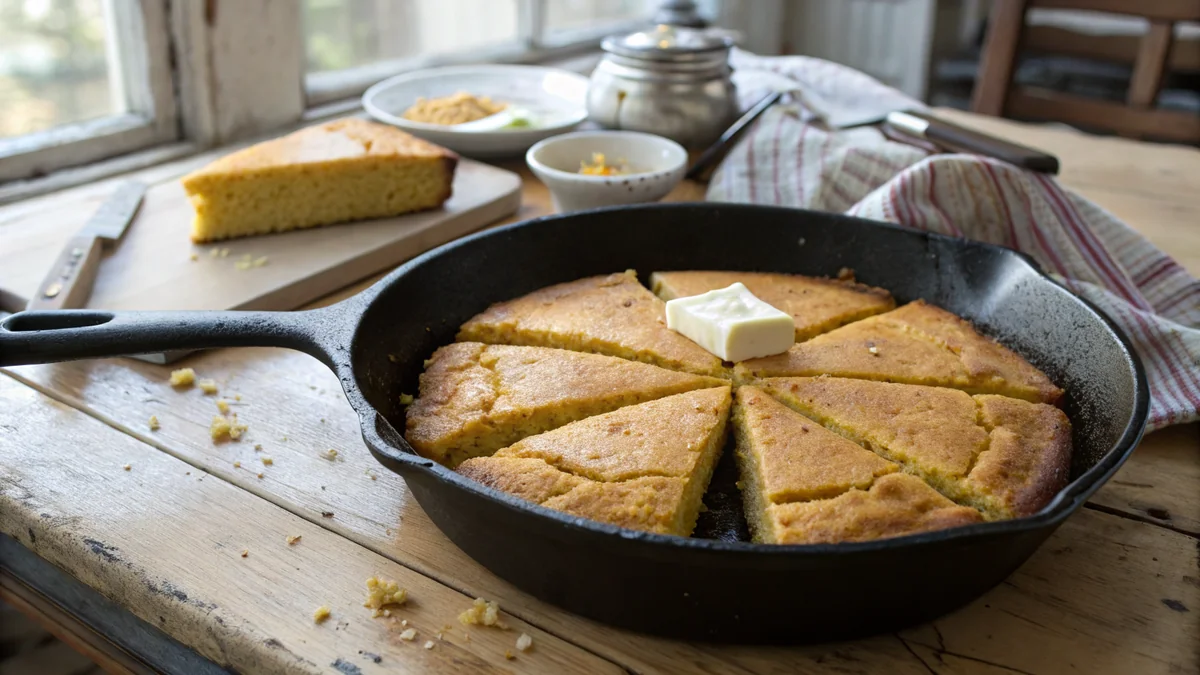
Quick answer: Authentic Texas cornbread is built on yellow cornmeal, full-fat buttermilk, eggs, and a screaming hot cast iron skillet greased with bacon fat. Preheat the skillet at 425F (220C) for 10 minutes, pour the batter into the sizzling fat, and bake 18-22 minutes until the top is golden and the edges pull away from the pan. The crackly bottom crust is the signature, and it only happens when the skillet is hot enough to make the batter sizzle on contact. Texas-style is a touch less sweet than the East Texas or Southern version - 1-2 tablespoons of sugar at most, never half a cup.
Cornbread in the South splits along regional lines that look small on paper and matter enormously at a family table. White cornmeal vs yellow. Sugar vs no sugar. Flour added vs flour banned. Cake pan vs skillet. The Mason-Dixon line for cornbread runs through the Texas-Oklahoma border, and Texas falls firmly on the yellow-cornmeal-and-cast-iron side. Sugar is a contested middle ground - some old Texas families say none, ever, and a generation later a few tablespoons crept in. This recipe acknowledges both schools and lets you choose.
What unites Texas cornbread regardless of the sugar question is the cast iron skillet preheated screaming hot with bacon fat or shortening, then the cold batter poured into the sizzling fat. The shock makes the bottom crackle and crisp into something that tastes more like a thin pretzel than a quick bread. That bottom crust is the line between a family-table Texas cornbread and a generic muffin-mix cornbread. If you skip it, the cornbread is fine. If you do not, the cornbread is special. A well-seasoned 10- or 12-inch skillet is the one tool this recipe genuinely depends on; if yours needs replacing, see Chef Mia's best cast iron skillets for Texas cooking buying guide.
Why Texas Cornbread Is Different from Southern Cornbread
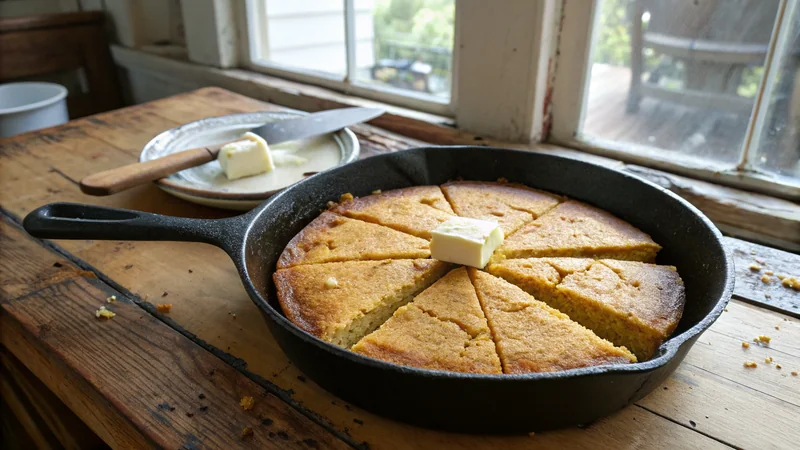
Cornbread in the American South divides along an almost geological line. Deep South cornbread (Mississippi, Alabama, Georgia) leans on white cornmeal, no sugar, no flour, and a little less buttermilk - producing a dense, savory, gritty cornbread that pairs with collard greens and pot likker. East Texas cornbread (the piney woods, Tyler, Lufkin) leans into more sugar and a softer, cake-ier crumb, closer to what most people across America picture when they hear cornbread.
Central and West Texas cornbread sits in the middle. Yellow cornmeal because Mexican corn-tradition Texas grew yellow corn, not white. A small amount of sugar (1-2 tablespoons, not 1/2 cup) because Texas farm tables wanted some sweetness but not dessert. A cast iron skillet preheated screaming hot because that is how rural Texas kitchens have made cornbread for 150 years, on a wood-burning stove in the 1880s and on a gas range today.
The result is cornbread that holds its own next to chili, brisket, beans, and stewed greens without disappearing under the heavier flavors. It is grainy enough to taste like corn, tender enough to slice cleanly, and sweet enough that kids eat it without complaint.
Yellow vs White Cornmeal
White cornmeal is the Deep South canon. Yellow cornmeal is the Texas canon. The functional difference is small - white cornmeal is slightly sweeter and softer; yellow is slightly more flavorful and grainier - but the regional distinction is real, and a Texas cornbread made with white cornmeal feels off to anyone who grew up with the yellow version.
Medium grind is the standard. Fine grind (corn flour) gives a too-soft cake-like crumb. Coarse grind (polenta) gives an overly gritty result that does not hold together. Quaker, Bob's Red Mill, and Indian Head are all medium-grind options at most grocery stores. Stone-ground cornmeal from a local mill (Homestead Gristmill in Texas, Anson Mills in South Carolina) is a meaningful upgrade if you can find it - the flavor is fresher and the texture more interesting.
Storage matters: cornmeal goes rancid faster than wheat flour because of the oils in the corn. Refrigerate or freeze cornmeal if you do not use a bag within 6 weeks. A rancid cornmeal will give the cornbread a bitter, soapy aftertaste that is unmistakable.
The Sugar Debate
There is no resolved answer to how much sugar belongs in Texas cornbread. The strict no-sugar camp says cornbread is a savory bread, sugar makes it cake, and ancestors who survived the Great Depression did not have sugar to spare anyway. The few-spoons camp says a tablespoon or two helps the corn flavor without making the bread sweet. The half-cup camp is making cake, not cornbread.
This recipe defaults to 2 tablespoons - in the middle of what most central Texas families do today. If you want the strict version, omit the sugar entirely. If you want the East Texas version, double to 4 tablespoons. Beyond 4 tablespoons, you are in cake territory and the texture suffers (more sugar means more browning and softer crumb, both of which take cornbread away from its essential character).
Honey or molasses can substitute for granulated sugar at 1:1. Both give a slightly more complex sweetness. Honey makes the cornbread browner; molasses gives a dark, almost gingerbread note. Both are non-traditional but pleasant.
The Cast Iron Skillet: Essential
A 10-inch cast iron skillet is non-negotiable for Texas cornbread. Cast iron retains heat in a way that ceramic, glass, and aluminum cannot - and the residual heat after the skillet leaves the oven is what crisps the bottom crust during the 5-minute rest. A glass pie dish or aluminum cake pan will produce edible cornbread but the texture will not be Texas.
Pre-seasoning matters. A well-seasoned skillet gives a slick non-stick surface that releases the cornbread cleanly in one piece. A new or under-seasoned skillet may grab; if so, butter the skillet generously after preheating before adding the bacon fat.
The skillet must be screaming hot when the batter goes in. Cold-skillet cornbread is a different dish - softer, browner-bottom, no real crust. The 425F preheat for 15 minutes is the minimum. If you have time, preheat for 20.
Size flexibility: a 9-inch skillet works (cornbread will be slightly taller, increase bake time by 2-3 minutes). A 12-inch skillet works (cornbread will be flatter, reduce bake time by 2-3 minutes). Avoid anything smaller than 9 inches; the cornbread overflows.
Buttermilk Over Milk
Buttermilk is the second non-negotiable ingredient. The acidity of buttermilk reacts with the baking soda to produce lift; regular milk does not have enough acid to do the same job. Cornbread made with milk plus baking powder rises but lacks the tangy depth that buttermilk gives.
Use full-fat cultured buttermilk if available (often sold in the refrigerated section as "old-fashioned" or "churned"). Low-fat buttermilk works but produces a slightly less rich cornbread. Avoid powdered buttermilk substitutes - the flavor is flat.
If you do not have buttermilk, the substitute is 1 1/4 cups whole milk + 1 tablespoon white vinegar or lemon juice, stirred and rested for 5 minutes until curdled. This is a real and acceptable substitute, though slightly thinner than true buttermilk.
Yogurt thinned with milk (1/2 cup plain Greek yogurt + 3/4 cup milk) is also a reasonable substitute. Avoid replacing buttermilk with kefir or sour cream - both throw off the texture.
The Hot Fat Trick
The single move that separates Texas cornbread from generic cornbread is adding fat to a screaming hot skillet immediately before pouring the batter. The bacon fat hits the 425F skillet and starts smoking within 5 seconds. The batter goes in fast, sizzles, and the bottom crust starts forming before the cornbread has even reached the oven.
Bacon fat is the canonical fat. Save bacon drippings in a jar in the fridge - they keep for weeks - and use them for cornbread, fried eggs, sauteed greens, and anything that benefits from a porky savory note. If you do not eat bacon, vegetable shortening (Crisco) is the historical alternative; lard works well; clarified butter is the upscale option.
Avoid butter for the skillet step (use it in the batter instead). Butter has a low smoke point and will burn before the batter goes in, leaving a bitter base. Bacon fat and shortening can take 425F without burning.
Speed matters. The skillet should not sit on the stovetop while you fumble for the batter. Have the batter ready, the spatula ready, and a heatproof surface to set the hot skillet on. The fat goes in, swirls once, batter pours, skillet returns to oven - all in under 30 seconds.
Mistakes to Avoid
Cold skillet. The biggest miss. Cold skillet means no bottom crust, soft pale bread, no Texas character. Always preheat the skillet for at least 15 minutes at 425F.
Over-mixing the batter. Cornbread comes out tough when the batter is whisked smooth. Fold 8-10 strokes, leave lumps, stop. Gluten development is bad in cornbread.
Using regular milk instead of buttermilk. The cornbread will rise weakly and taste flat. Use real buttermilk or a vinegar-curdled milk substitute.
White cornmeal in a Texas recipe. Functionally fine but tastes wrong. Yellow cornmeal is the Texas canon.
Half a cup of sugar. Now you have made corn cake, not cornbread. 1-2 tablespoons max for Texas style. East Texas folks may push to 4 tablespoons.
Over-baking. Cornbread goes from moist to dry in 3 minutes after the toothpick comes out clean. Pull at 18-20 minutes if your oven runs hot; a few crumbs on the toothpick is fine.
Troubleshooting
Cornbread is dry and crumbly. Over-baked or under-fatted. Pull 2-3 minutes earlier next time, and check that you used the full 1/4 cup of fat in the batter plus 2-3 tablespoons in the skillet.
Bottom is pale and soft. Skillet was not hot enough. Preheat for 20 minutes next time, not 15. Make sure the fat sizzles on contact.
Top is dark, center is wet. Oven runs hot, or the skillet was too small (cornbread too thick). Lower the oven to 400F next time and bake 22-25 minutes. Or use a wider skillet.
Cornbread sticks to the skillet. Skillet was under-seasoned or under-greased. Season the skillet between cooks (rub with oil and bake at 400F for an hour). Or add an extra tablespoon of fat to the skillet step.
Cornbread tastes flat or chemical. Old baking powder or baking soda. Replace anything older than 6 months; both lose potency. Old cornmeal can also taste rancid - smell it before using; it should smell sweet and faintly nutty.
Variations
Jalapeno cheddar cornbread. Fold 1/2 cup of shredded sharp cheddar and 2 tablespoons of finely diced jalapeno (seeded) into the batter just before pouring. The classic Texas chili-night side.
Bacon and corn cornbread. Cook 4 strips of bacon, crumble them, and fold into the batter with 1/2 cup of frozen corn kernels. Use the rendered bacon fat for the skillet. This is the heartiest version and works as a meal with a salad.
Sweet Northern-style cornbread. Increase sugar to 1/3 cup, add 1/4 cup of melted butter on top of the warm cornbread. The result is closer to corn cake - softer, sweeter, and more of a dessert than a side. Not Texas, but a useful variation.
Skillet cornbread with creamed corn. Fold 1 cup of canned creamed corn into the batter (reduce buttermilk by 1/4 cup). The result is more moist and corn-forward, a Texas farmhouse variation.
Cornbread muffins. Pour the batter into a hot well-greased 12-cup muffin tin (preheated like the skillet). Bake at 425F for 14-16 minutes. Yields 12 muffins, perfect for buffets and church potlucks.
What to Serve With Texas Cornbread
Cornbread is the universal Texas side. The non-negotiable pairings: a bowl of chili, a plate of pinto beans, or a tray of smoked brisket with sides. Cornbread soaks up sauce and pot liquor, balances richness with grain, and disappears fast. When the fryer is out instead of the oven, nearly the same batter, stiffened with a little more flour and flavored with grated onion, becomes hush puppies, the fried cousin that belongs next to catfish rather than chili; the two are made from the same corn and are not interchangeable.
Slather with butter while still warm. The bottom crust pairs especially well with cold salted butter that melts on contact. A drizzle of honey on top - controversial, but acceptable - turns cornbread into a near-dessert.
Sweet-tea pairs naturally. Cold beer (a light lager) pairs with the savory version. A tall glass of buttermilk with cornbread is the old farmhouse pairing - your great-grandparents drank that combination, and it still works.
For a complete BBQ table, see the Ultimate Texas BBQ Guide. For Southern-style menus, the Ultimate Southern Comfort Food Guide has companion recipes.
Storage and Reheating
Room temperature: 24 hours, loosely covered with a clean kitchen towel. Cornbread is best fresh; day-two cornbread is acceptable but loses the bottom crust crispness.
Refrigerate: up to 4 days in an airtight container. The texture firms up cold. Reheat to revive.
Reheat: wrap individual wedges in foil and heat in a 350F oven for 8-10 minutes. Or microwave on a damp paper towel for 30 seconds (less ideal - the bottom goes soft).
Freeze: up to 2 months. Wrap individual wedges in plastic wrap then foil, freeze. Thaw at room temperature for 1 hour, then reheat in foil at 350F. Works well for leftover cornbread bound for a chili or beans dinner the following week.
Cornbread crumbs are useful: dry leftover cornbread on a sheet pan at 200F for 30 minutes, blitz in a food processor, freeze. Use as a stuffing base, breading for chicken, or topping for casseroles. For the buttery version with crisp brown edges, see my cast iron skillet cornbread.
Authentic Texas Cornbread Recipe
Ingredients
- 1 1/2 cups (210 g) yellow cornmeal, medium grind (Quaker, Bob's Red Mill, or stone-ground)
- 1/2 cup (65 g) all-purpose flour (optional, for tenderness; skip for purist)
- 2 tablespoons granulated sugar (optional; reduce to 1 tablespoon or omit for pure Texas)
- 1 1/2 teaspoons baking powder
- 1/2 teaspoon baking soda
- 1 teaspoon kosher salt
- 1 1/4 cups (300 ml) full-fat buttermilk, well shaken
- 2 large eggs, room temperature
- 1/4 cup (60 ml) bacon fat or unsalted butter, melted (plus extra for the skillet)
- 2-3 tablespoons bacon fat or vegetable shortening (for greasing the hot skillet)
Instructions
- Preheat the oven and skillet. Place a 10-inch cast iron skillet in the oven. Preheat to 425F (220C). Let the skillet heat in the oven for the entire preheat time plus 5 more minutes - at least 15 minutes total. The skillet must be hot enough that fat sizzles violently when added. This is the most important step in the recipe.
- Whisk the dry ingredients. In a large bowl, whisk together the cornmeal, flour (if using), sugar (if using), baking powder, baking soda, and salt until evenly combined. Look for no visible streaks of any single ingredient.
- Whisk the wet ingredients. In a medium bowl, whisk the buttermilk, eggs, and 1/4 cup of melted bacon fat or butter until smooth and uniformly yellow. Eggs should be fully incorporated; no streaks of white visible.
- Combine wet and dry. Pour the wet mixture into the dry. Fold together with a rubber spatula in 8-10 strokes - just until no dry flour streaks remain. Lumps are fine and expected. Do not over-mix; over-mixed cornbread comes out tough and dense.
- Add fat to the hot skillet. Carefully remove the hot skillet from the oven (use thick mitts - it is dangerous hot). Add 2-3 tablespoons of bacon fat or shortening to the skillet. It should melt and start smoking within 5 seconds. Swirl the fat to coat the bottom and sides of the skillet.
- Pour batter into sizzling fat. Immediately pour all the batter into the hot skillet. The batter should sizzle loudly when it hits the fat - this is the sound of the bottom crust forming. Smooth the top with the spatula in one or two passes. Do not let the skillet sit between fat-add and batter-pour; speed is part of the technique.
- Bake 18-22 minutes. Return the skillet to the 425F oven. Bake 18-22 minutes, until the top is deep golden, the edges pull away from the skillet sides slightly, and a toothpick inserted in the center comes out clean or with a few dry crumbs. Do not over-bake; cornbread goes from done to dry in 3 minutes.
- Rest in the skillet 5 minutes. Pull the skillet from the oven and let the cornbread rest in the pan for 5 minutes. The carryover heat finishes the bottom crust. After 5 minutes, run a knife around the edge to release, then either serve straight from the skillet (Texas family-table style) or invert onto a board to show off the crackly bottom (party style).
Frequently Asked Questions
Should Texas cornbread be sweet?
Lightly. Texas style is 1-2 tablespoons of sugar in the whole batter, not the 1/3 to 1/2 cup that Northern or East Texas versions use. Strict no-sugar Texans omit it entirely. More than 4 tablespoons crosses the line into corn cake.
Why use a cast iron skillet?
Cast iron retains heat in a way that other materials cannot, and the screaming-hot skillet is what creates the crackly bottom crust that defines Texas cornbread. Glass, ceramic, and aluminum pans give a soft pale bottom even with the same batter.
Can I make cornbread without buttermilk?
Yes - 1 1/4 cups whole milk + 1 tablespoon white vinegar or lemon juice, stirred and rested for 5 minutes until curdled, is a real substitute. Powdered buttermilk substitutes are flat in flavor; avoid them. Yogurt thinned with milk also works.
Why does my cornbread come out crumbly?
Either over-baked or under-fatted. Pull at 18-20 minutes when the toothpick has a few dry crumbs - it continues to set as it cools. Use the full 1/4 cup of fat in the batter, not less. Adding flour (1/2 cup) also reduces crumbliness if your house style is on the dryer side.
Can I make cornbread ahead?
Yes, but cornbread is best fresh. Bake up to 24 hours ahead, store at room temperature wrapped in a clean kitchen towel. Reheat in a 350F oven wrapped in foil for 8-10 minutes to revive the bottom crust crispness.
Yellow or white cornmeal for Texas cornbread?
Yellow. Texas grew yellow corn (Mexican corn-tradition heritage), and yellow cornmeal is the Texas canon. White cornmeal is the Deep South canon (Mississippi, Alabama). Functionally similar; regionally distinct.
Can I freeze cornbread?
Yes, up to 2 months. Wrap individual wedges in plastic wrap then foil, freeze. Thaw at room temperature for an hour, reheat in foil at 350F for 8-10 minutes. Texture holds up well because cornbread is mostly cornmeal, butter, and buttermilk - all freeze cleanly.