Tex-Mex Recipes
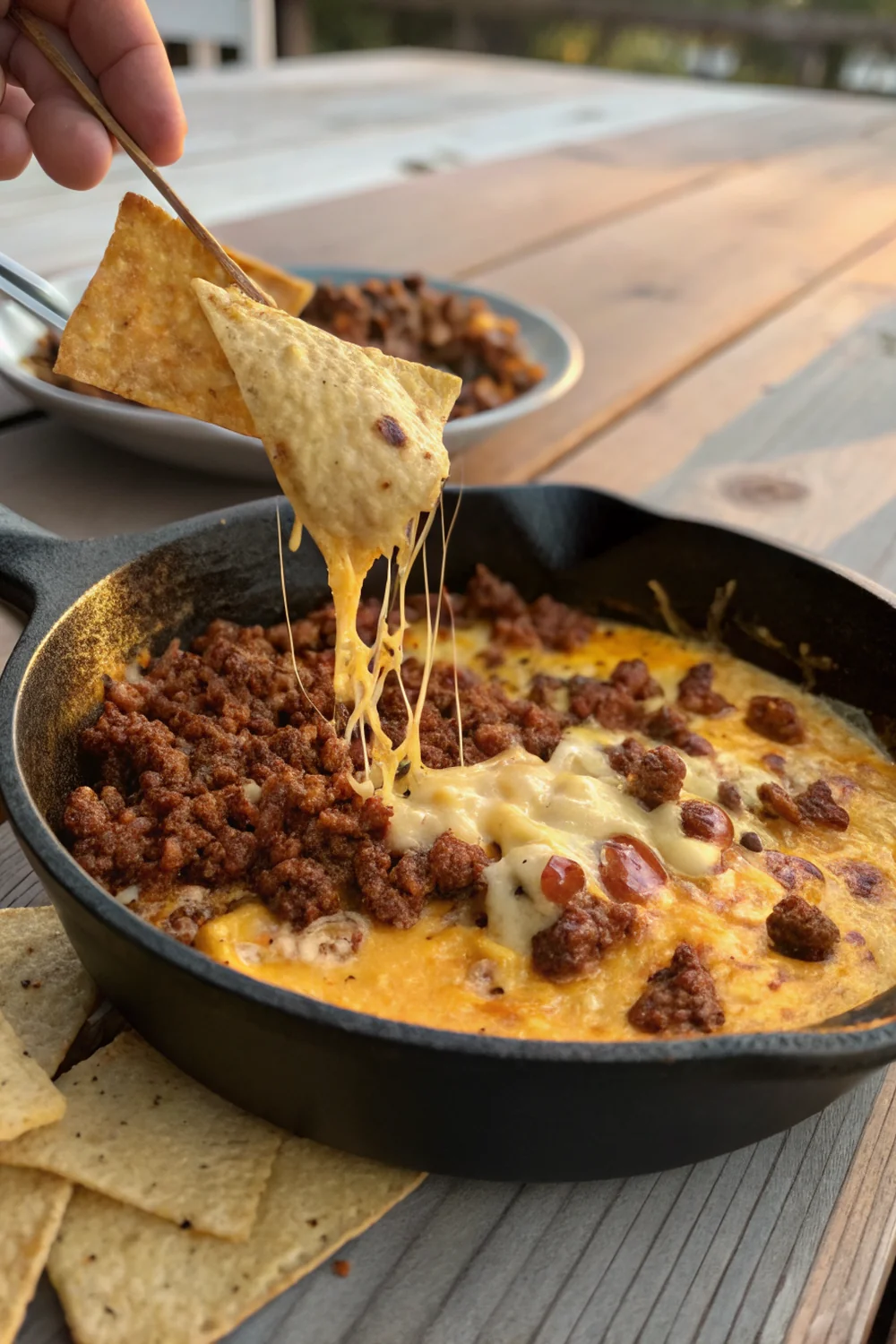
Smoked Chorizo Queso
Chef Mia's smoked chorizo queso: Mexican chorizo, Velveeta + Monterey Jack, Rotel, real wood smoke or smoked paprika. The Tex-Mex appetizer that disappears first.
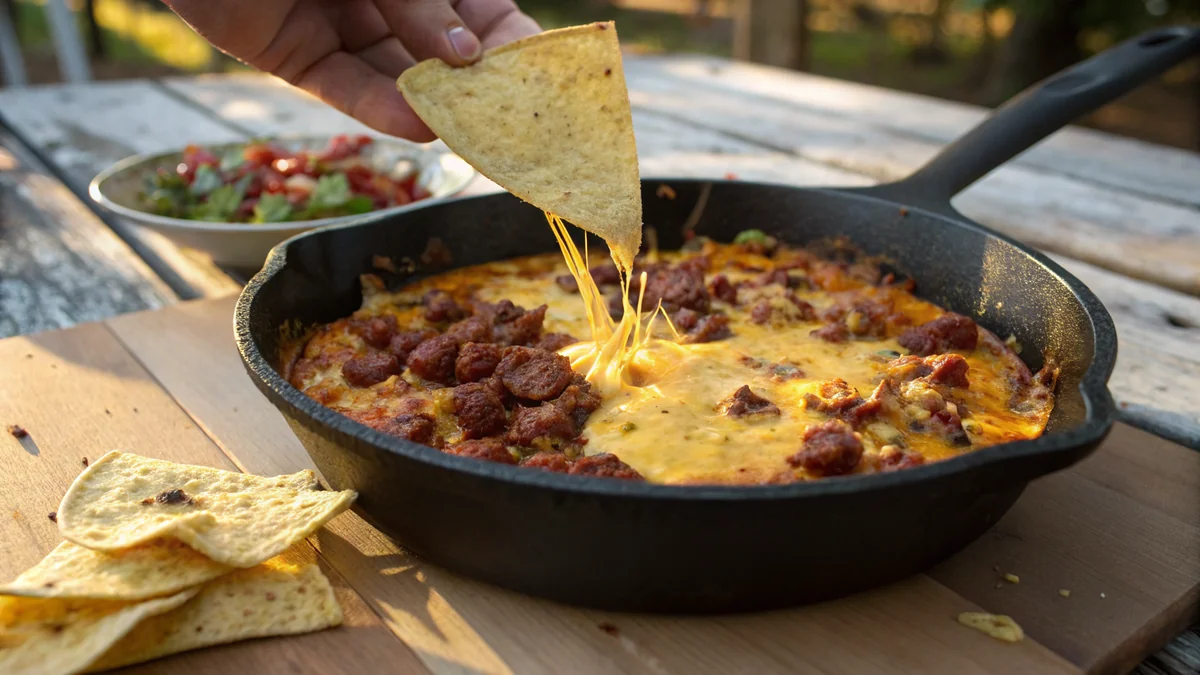
Quick answer: The Tex-Mex queso most Texans grew up on starts with Mexican chorizo (raw, ground, not the cured Spanish version), browned to release its red oil, then folded into a melted base of cubed Velveeta and freshly shredded Monterey Jack thinned with whole milk. Add a drained can of Rotel tomatoes with green chiles, a teaspoon of smoked paprika for the smoke note (or 20 minutes on a pellet smoker for the real thing), warm aromatics, and serve in a small cast iron skillet with thick tortilla chips. Done right, the bowl empties in 10 minutes.
Texas queso has nothing to do with Spanish queso fundido and only loosely resembles Mexican chile con queso. It is a Tex-Mex invention - a warm, pourable, dippable cheese sauce designed for the chip-and-dip table at a Texas family gathering. Every Texas teenager who has ever taken a date out for Tex-Mex remembers a queso that arrived first, in a small white ceramic bowl over a tea light. That memory is the target.
What separates a great queso from a depressing one is the chorizo, the cheese choice, and a small smoky note that ties the bowl to the smokehouse outside. The chorizo question is non-negotiable: Mexican chorizo, the raw ground kind, never the Spanish cured kind. The cheese question is more controversial. Velveeta has been the Tex-Mex canon since the 1950s, and the people who grew up in Houston, San Antonio, or El Paso will defend it. The smoke question is where I add a Chef Mia twist - either a teaspoon of Spanish pimenton in the pot, or 20 minutes on the pellet smoker before serving. Both work.
Why Tex-Mex Queso Is Different from Mexican Queso Fundido
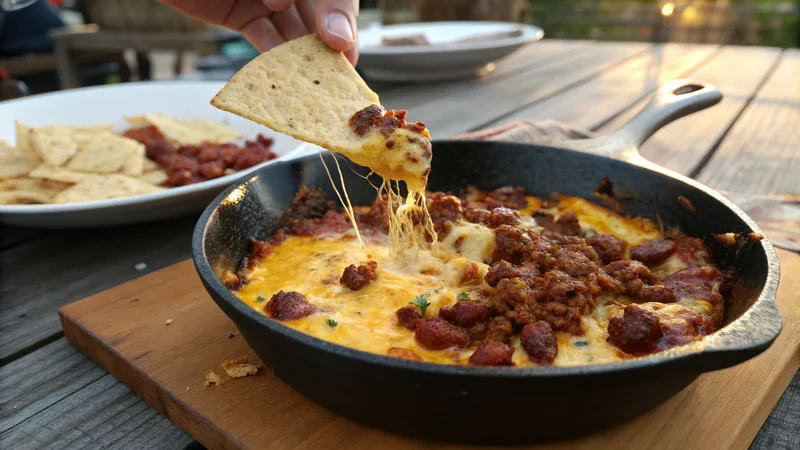
Most American food culture treats "queso" as a single thing, but two related dishes share the name. Mexican queso fundido is a baked or broiled dish - traditionally Oaxaca or asadero cheese melted in a clay cazuela, sometimes topped with chorizo or rajas, served with warm flour tortillas to scoop into rolls. The cheese is stretchy and pulls in long strings; the tortilla is a wrapper, not a chip.
Tex-Mex queso, also called chile con queso, is a chip dip. It is poured, not scooped. The cheese is melted into a sauce thinned with milk or evaporated milk, often built on processed cheese for melt stability, with chiles, tomatoes, and sometimes meat folded in. It is meant to stay liquid for the duration of a meal, which is why processed cheese matters: aged cheeses break and go grainy when held warm for 30+ minutes; emulsified cheeses like Velveeta hold smooth for hours.
Both styles are legitimate. This recipe is firmly in the Tex-Mex camp, with one Mexican-style upgrade: real freshly shredded Monterey Jack added on top of the Velveeta base, which gives the queso more flavor without losing the melt stability that Velveeta provides.
Mexican Chorizo Is Not Spanish Chorizo
There are two completely different products called "chorizo" sold in American grocery stores, and they are not interchangeable. Mexican chorizo is raw, soft, ground sausage with bright red color from chile and paprika. It cooks in a pan in 5-6 minutes and renders a vivid orange-red oil. It is sold in plastic casings or in bulk tubes, refrigerated. Brands: Cacique, La Banderita, Don Juan.
Spanish chorizo is fully cured, firm, sliceable, smoked, and ready to eat from the package. It is a different texture and flavor entirely - more like a soft salami with a smoke note. Spanish chorizo would not work in this recipe because it does not render oil or break down into queso properly. If you only have Spanish chorizo at home, save it for charcuterie and buy Mexican chorizo for the queso.
Look for Mexican chorizo in the refrigerated meat case, often near the breakfast sausage or in the Hispanic section. Quality varies - the cheap brands are mostly filler with red dye. Look for chorizo with a recognizable spice list (paprika, vinegar, garlic, oregano) and meat as the first ingredient.
If you want to skip the meat or cannot find Mexican chorizo, ground beef seasoned with 1 tablespoon chili powder + 1 teaspoon smoked paprika + 1 teaspoon vinegar approximates the flavor adequately. Vegetarian chorizo (Soyrizo, Cacique soy chorizo) works well because the queso's other ingredients carry the dish.
The Velveeta Question
Velveeta is the Tex-Mex queso canon, and there is no point pretending otherwise. Mid-century Texas restaurants standardized on Velveeta because it melts smooth, holds smooth at warm temperatures for hours, and never breaks. Every Tex-Mex restaurant from El Paso to Houston that serves queso at a tableside warmer is using Velveeta or a similar processed cheese, even when the menu says otherwise.
The Velveeta resistance comes from outside Texas - the food-purist argument that processed cheese is inferior to aged cheese. The argument is technically correct on flavor but misses the point on function. Aged cheddar in a queso scenario will melt smoothly for 5 minutes, then break into oily pools and grainy curds as the dish sits at the dip table. Velveeta holds for the entire meal. This is the choice.
If you absolutely refuse Velveeta, the closest substitute is white American cheese sliced thick from a deli counter (Boar's Head American is a good choice). White American is essentially the same product as Velveeta - sodium-citrate-stabilized processed cheese - just with a different color profile. Use 16 oz of deli-sliced white American in place of the Velveeta block.
The recipe also works with a 50/50 split of Velveeta and shredded Oaxaca cheese for a more authentic Mexican-leaning queso. Reduce milk by 1/4 cup since Oaxaca releases more moisture than Jack.
The Smoke: Smoked Paprika or Real Smoke
The "smoked" in smoked chorizo queso comes from one of two sources. The easiest is smoked paprika - a teaspoon of Spanish pimenton bloomed in the chorizo oil gives the queso a smoke note that approximates a real smoker. Use sweet pimenton (pimenton dulce) for a friendly smoke note, bittersweet (agridulce) for more depth, or hot (picante) for both heat and smoke.
The serious move is to actually smoke the queso. After the queso comes together in the pan, transfer it to a heatproof aluminum half-pan and place on a pellet smoker or offset smoker at 225F over post oak, pecan, or apple wood for 20-30 minutes uncovered. Stir every 10 minutes. The cheese develops a thin smoke skin on top, which you stir back in, and the whole dish picks up real campfire smoke.
This is a Texas competition-BBQ move and worth the effort if you have a pellet smoker on for a brisket cook anyway. The smoke time is short enough that you can do it while the brisket rests in the faux Cambro.
Liquid smoke is the cheating option. A few drops in the pan during the milk-and-cheese stage approximates real smoke without the smoker. Use sparingly - more than 1/4 teaspoon tastes artificial. Wright's hickory or mesquite are the common brands.
The Rotel Argument
Rotel is a brand of canned diced tomatoes with green chiles that has been the Tex-Mex queso shortcut since the 1950s. It is canon in Texas; substituting it with fresh tomatoes and chiles works but tastes different. The brand-specific seasoning, the sodium level, and the chile content of Rotel are part of the dish's identity.
Drain the can lightly - keep about 2 tablespoons of liquid for moisture, pour off the rest. Including all the canning liquid makes the queso watery. Avoid the "Rotel Original" if you have access to milder versions - Texans usually go with Original or Hot.
Fresh substitute (if Rotel is unavailable or you prefer scratch): 1 cup of diced fresh tomatoes (Roma works) + 2 tablespoons of diced fresh jalapeno + 1/4 teaspoon of salt + 2 tablespoons of water. Cook 2-3 minutes longer in the pan to break down the fresh tomatoes.
Other tomato-and-chile blends work: Muir Glen fire-roasted tomatoes with green chiles, Hatch (the brand) chile-and-tomato cans, or homemade roasted tomato salsa. Each adjusts the flavor slightly but the dish stays in the queso family.
Step-by-Step Method
The whole queso comes together in 30 minutes in one pan. The keys are: brown the chorizo properly to render the oil, do not drain it, bloom the spices in the hot fat for depth, simmer (not boil) the milk, and add the cheese in batches.
Use a heavy-bottomed cast iron skillet or 3-quart saucepan. The cast iron retains heat well and helps the queso stay warm at the table. A thin saucepan loses heat fast and the queso firms up between dips.
Cheese added too fast breaks. The Velveeta should disappear into the milk completely before the next batch joins it. The Monterey Jack is more forgiving but should still be added a handful at a time.
If the finished queso looks too thick, the fix is always more warm milk - one tablespoon at a time, whisked in. Cold milk shocks the cheese and can cause separation. Warm the milk in the microwave for 15 seconds before adding.
Mistakes to Avoid
Do not boil the queso. Hard boiling breaks the cheese emulsion and gives a grainy, oily mess. Keep the heat at gentle simmer or lower from the moment cheese hits the pan.
Do not skip browning the chorizo properly. Pale chorizo gives pale flavor. Look for crisp browned edges and the orange oil before adding aromatics.
Do not use pre-shredded bagged Monterey Jack. The cellulose coating prevents smooth melting. Shred from a block.
Do not drain the chorizo oil. The oil carries paprika, garlic, and the chorizo's fat-soluble flavor. Pour it off and the queso tastes like flavored cheese sauce, not Tex-Mex queso.
Do not add cold cheese to a hot pan. Let the Velveeta come to room temperature for 10 minutes (or microwave on 30 percent power for 30 seconds) so it melts smoothly without seizing.
Do not over-stir during the smoke step. If you stir constantly while the queso is on the smoker, you stir away the smoke skin that forms on top. Stir every 10 minutes, not constantly.
Troubleshooting
Queso is grainy or broken. The cheese got too hot. Pull off heat immediately, whisk in 1-2 tablespoons of cold whole milk, and stir vigorously. The milk lowers the temperature and helps re-emulsify the sauce. If still broken, blend in a small handful of fresh shredded jack and stir until smooth.
Queso is too thick. Add warm milk one tablespoon at a time, whisking, until pourable. Always warm the liquid; cold liquid shocks the cheese.
Queso is too thin. Simmer uncovered on low heat for 5 more minutes to reduce, stirring occasionally. Or whisk in another 4-6 ounces of cubed Velveeta.
Queso is bland. Almost always a salt issue - chorizo is salted but Velveeta is not as salty as you might expect. Add 1/4 teaspoon kosher salt at a time and taste. A squeeze of lime juice also brightens a flat queso instantly.
Chorizo released too much oil. Pour off about half the visible oil before adding aromatics. Some oil is the point; a lake of it is not. Fattier chorizo brands need this step more than leaner ones.
Variations
White queso (queso blanco). Replace Velveeta with white American cheese (Boar's Head, deli-sliced thick), and the Monterey Jack with Pepper Jack. Skip the Rotel; use 1/2 cup of diced fresh tomatoes plus 2 diced jalapenos. The result is a paler, milder queso popular at TexMex chain restaurants.
Smoked brisket queso. Skip the chorizo. Fold 1 cup of chopped smoked brisket into the finished queso. This is the Saturday-after-the-cook move when you have leftover brisket and a craving. Pair with fresh-cooked brisket for a complete BBQ table.
Beef queso. Replace chorizo with 8 oz of 80/20 ground beef seasoned with 1 tablespoon chili powder, 1 teaspoon cumin, 1/2 teaspoon salt. Brown as you would the chorizo. Less spicy and milder than the chorizo version - better for kids' parties.
Vegetarian queso. Skip the meat entirely. Compensate with 1 cup of sauteed mushrooms (cremini or portobello), 1 cup of corn kernels, and an extra teaspoon of smoked paprika. The result is a smokier, more vegetal queso that holds its own.
Slow cooker queso. All ingredients in a slow cooker on low for 90 minutes, stirring every 20 minutes. Brown the chorizo first in a skillet. The slow cooker is the right move for a party where the queso needs to stay warm for 3-4 hours.
Serving and Pairings
Serve hot with thick restaurant-style tortilla chips. Thin chips break in the queso and you end up scooping cheese with broken chip dust. The right chip is yellow corn, fried (not baked), and at least 2 mm thick. On Cibolo Street in San Antonio, On the Border style chips are the standard.
Squeeze fresh lime over the queso just before serving. The acid brightens the heavy cheese and chorizo notes - no Tex-Mex restaurant skips this step.
Pair with: a cold Mexican lager (Modelo Especial, Pacifico, Tecate), a margarita on the rocks with salt, or an iced tea with lemon. Avoid red wine; the tannins clash with the chile and dairy.
For a full Tex-Mex spread, serve queso as the first course followed by beef and cheese enchiladas with refried beans and Spanish rice. For more queso ideas and Tex-Mex appetizers, see the Ultimate Tex-Mex Recipes Guide.
Storage and Reheating
Refrigerate leftover queso in an airtight container for up to 4 days. The cheese firms up cold but reheats smoothly with a splash of milk.
Reheat slowly: in a saucepan over low heat with 2 tablespoons of milk, stirring every 30 seconds. Or microwave in 30-second bursts at 50 percent power, stirring between each. High microwave power breaks the cheese.
Freeze: not recommended. Velveeta queso changes texture badly after freezing - it goes grainy and the chorizo oil separates. The dish is fast enough to make fresh that freezing is rarely worth it.
Hold for parties: keep warm in a small slow cooker on the lowest setting, stirring every 20 minutes. Add a tablespoon of milk every hour to maintain consistency. Will hold smoothly for 3-4 hours.
Smoked Chorizo Queso Recipe
Ingredients
- 8 oz (225 g) Mexican chorizo, casings removed (NOT Spanish chorizo)
- 16 oz (450 g) Velveeta, cut into 1/2-inch cubes
- 8 oz (225 g) Monterey Jack cheese, freshly shredded from a block
- 1 (10 oz / 285 g) can Rotel diced tomatoes with green chiles, drained slightly
- 1 cup (240 ml) whole milk, plus more as needed
- 1 small yellow onion, finely diced (about 1/2 cup)
- 2 cloves garlic, minced
- 1 jalapeno, seeded and minced (optional, for heat)
- 1 teaspoon smoked paprika (Spanish pimenton)
- 1/2 teaspoon ground cumin
- 1/4 teaspoon kosher salt, plus more to taste
- For garnish: 2 tablespoons chopped fresh cilantro, 2 tablespoons finely diced white onion
- To serve: thick restaurant-style tortilla chips, lime wedges
Instructions
- Brown the chorizo. In a 10-inch cast iron skillet or heavy saucepan over medium-high heat, add the chorizo with casings removed. Break up with a wooden spoon and cook 5-6 minutes until the chorizo is fully cooked, the fat has rendered out, and the meat has crisp edges. The pan will look orange-red from the chorizo oil - this is correct, do not drain it. The oil carries most of the flavor.
- Soften the aromatics. Lower heat to medium. Add the diced onion to the chorizo and its oil. Cook 3-4 minutes until the onion is translucent. Add the minced garlic and jalapeno (if using). Cook another 30 seconds until fragrant, stirring to prevent the garlic from burning.
- Bloom the spices and add tomatoes. Add the smoked paprika, cumin, and salt directly to the pan. Stir for 20-30 seconds to bloom the spices in the warm fat - this is the move that gives the queso depth instead of flat seasoning. Pour in the slightly drained Rotel (keep about 2 tablespoons of the can liquid for moisture) and stir to combine. Cook 1-2 minutes until the tomato liquid mostly evaporates.
- Add milk and start the cheese. Pour in the whole milk and bring to a gentle simmer over medium-low heat. The mixture should bubble lazily, not boil hard - high heat breaks the cheese sauce. Add the cubed Velveeta in three batches, stirring constantly with a wooden spoon or silicone spatula, waiting for each batch to fully melt before adding the next.
- Whisk in the Monterey Jack. Once the Velveeta is fully melted and smooth, add the freshly shredded Monterey Jack a handful at a time, stirring between each addition. The Jack adds a slightly stretchier, more flavorful note than Velveeta alone. If the queso looks too thick, whisk in additional warm milk one tablespoon at a time until pourable. The right consistency is just thicker than heavy cream - it should ribbon off a spoon, not plop.
- Optional: real wood smoke. For genuine smoked queso (the Texas competition-BBQ move): pour the finished queso into a heatproof aluminum pan, set on a pellet smoker or offset smoker at 225F (107C) over post oak or pecan, and smoke uncovered for 20-30 minutes, stirring every 10 minutes. The cheese surface develops a thin smoke skin and the entire bowl takes on real campfire smoke. Pull and stir to incorporate. This step is optional but worth it for game-day cooks.
- Garnish and serve. Transfer to a small cast iron skillet or warm serving bowl. Top with chopped cilantro and finely diced white onion. Serve immediately with thick restaurant-style tortilla chips, lime wedges, and a cold Mexican lager. The queso is best within 30-45 minutes of finishing - it firms up as it cools. Reheat with a splash of milk if needed.
Frequently Asked Questions
Is Velveeta really authentic Tex-Mex queso?
Yes. Velveeta has been the Tex-Mex queso standard since the 1950s for its melt stability. Tex-Mex restaurants from El Paso to Houston use Velveeta or similar processed cheese in their queso, even when the menu says otherwise. Aged cheeses break and go grainy when held warm; Velveeta holds smooth for hours. White American cheese (deli-sliced) is the closest substitute.
Can I make queso without Rotel?
Yes. Substitute 1 cup of diced fresh tomatoes (Roma) + 2 tablespoons of diced fresh jalapeno + 1/4 teaspoon salt + 2 tablespoons water. Cook 2-3 minutes longer to break down the fresh tomato. The flavor is fresher but less Tex-Mex-canonical.
What is the difference between queso and queso fundido?
Queso (Tex-Mex chile con queso) is a pourable cheese sauce served as a chip dip, made with Velveeta or processed cheese for melt stability. Queso fundido (Mexican) is baked or broiled cheese (Oaxaca, asadero) served with warm flour tortillas for scooping. Different dishes, same name.
Why does my queso break or get grainy?
Cheese got too hot. Always keep the heat at gentle simmer or lower once cheese hits the pan. If the queso breaks, pull off heat, whisk in 1-2 tablespoons of cold milk, and stir vigorously - this often re-emulsifies the sauce. Pre-shredded bagged cheese also causes graininess; always shred from a block.
Can I make queso ahead?
Yes - make up to 24 hours ahead, refrigerate, reheat slowly with a splash of milk. The flavors actually integrate overnight. For parties, hold warm in a small slow cooker on the lowest setting, stirring every 20 minutes.
Should I use Mexican or Spanish chorizo?
Mexican chorizo only. It is raw, soft, ground sausage that browns in 5-6 minutes and renders a flavorful orange-red oil. Spanish chorizo is cured, firm, sliceable, and does not render the same way - it is for charcuterie, not for queso.
Can I make queso in a slow cooker?
Yes. Brown the chorizo first in a skillet (the slow cooker cannot brown meat). Add all ingredients to a slow cooker on low for 90 minutes, stirring every 20 minutes. The slow cooker is ideal for parties where queso needs to stay warm for 3-4 hours.