Texas Desserts
Texas Christmas Trifle
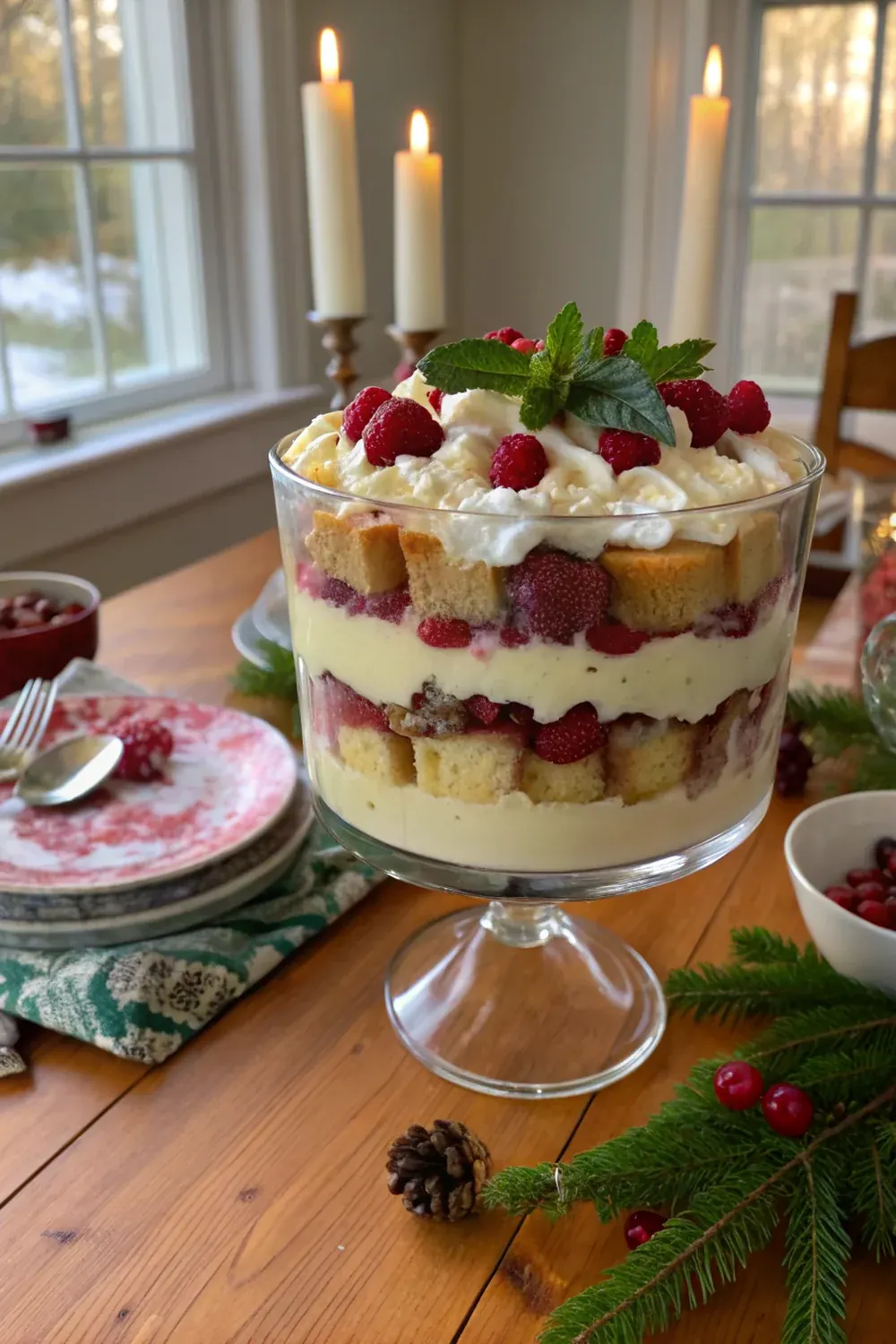
Chef Mia's Texas Christmas trifle: pound cake, bourbon-soaked berries, vanilla custard, whipped cream layers in a glass bowl. The holiday showstopper.
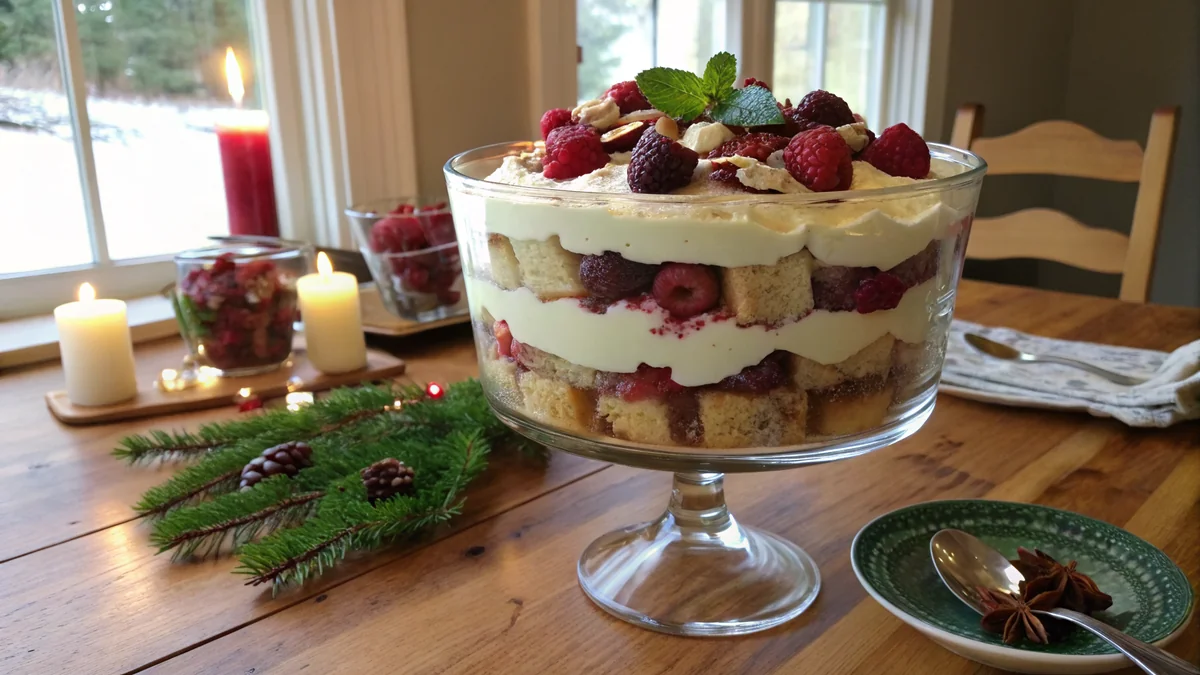
Quick answer: A Texas Christmas trifle layers golden pound cake cubes, bourbon-soaked cranberries and raspberries, homemade vanilla custard, and fresh whipped cream into a tall glass bowl, then chills 4 hours minimum (ideally overnight) so the layers meld and the pound cake absorbs the berry-bourbon syrup. The result is a 12-16 person dessert that goes together in 1 hour of active prep, looks dramatic on a holiday table, and travels well to gatherings. Bourbon Texas distilleries (Garrison Brothers, Balcones, Still Austin) bring an authentic local twist to the British original.
Every Christmas Eve from when I was about ten until I left for college, my Aunt Lou hosted the family gathering at her house in Houston. She had a tall crystal trifle bowl that came out exactly once a year, on December 24th, and it always held the trifle she had assembled the day before. That bowl was the centerpiece of the dessert table - more elaborate than the pies, more striking than the cookies, more anticipated than the candy. The whole family knew what was coming, and the kids would crowd around to watch her spoon the first scoop out of the bowl, exposing the layers from the side.
Aunt Lou's trifle was a Texas adaptation of the British classic. The traditional English Christmas trifle uses sherry-soaked sponge cake, fruit jam, custard, and whipped cream. Aunt Lou used pound cake instead of sponge cake (sturdier, more flavorful), bourbon instead of sherry (this was Texas, not Bristol), and fresh berries instead of jam (cranberries from the Thanksgiving leftovers, raspberries from the holiday produce section). The custard was always homemade. The whipped cream was always fresh. The bowl came out at exactly 7pm on Christmas Eve, after dinner.
The recipe below is Aunt Lou's, with my own minor adjustments after twenty Christmas Eves of making and eating it. I have added a touch of orange zest to the custard. I use Garrison Brothers Texas bourbon now (it didn't exist when she started making the trifle), and I sometimes substitute Balcones Texas Single Malt if I am feeling fancy. The total active prep time is about an hour - half of that is making the custard, which is the only step that requires actual cooking technique. The chill time is 4 hours minimum, ideally overnight. Make this on December 23rd; serve it on Christmas Eve. Your family will remember it long after the turkey and the candy are forgotten.
What Is a Trifle? (Brief History)
A trifle is an English layered dessert dating back to the late 1500s, originally made by layering pieces of stale cake, fortified wine (sherry or madeira), fruit, custard, and whipped cream in a glass bowl. The name comes from an Old French word meaning a thing of little importance, which is a deeply unfair characterization of what is actually one of the great showpiece desserts of the Western culinary tradition. The English Christmas trifle is the canonical version that crossed over to American holiday cooking via colonial-era cookbooks.
The Texas adaptation arrived sometime in the 19th century along with English settlers and their cookbooks. By the 20th century, Texas Christmas trifles had evolved away from sherry toward bourbon (more available, more aligned with Texas drinking culture) and toward fresh berries instead of jam (Texas berries are excellent in winter via Mexican imports). The pound cake substitution for sponge cake is also a Texas move - sponge cake is fragile and doesn't hold up to the bourbon soak the way pound cake does.
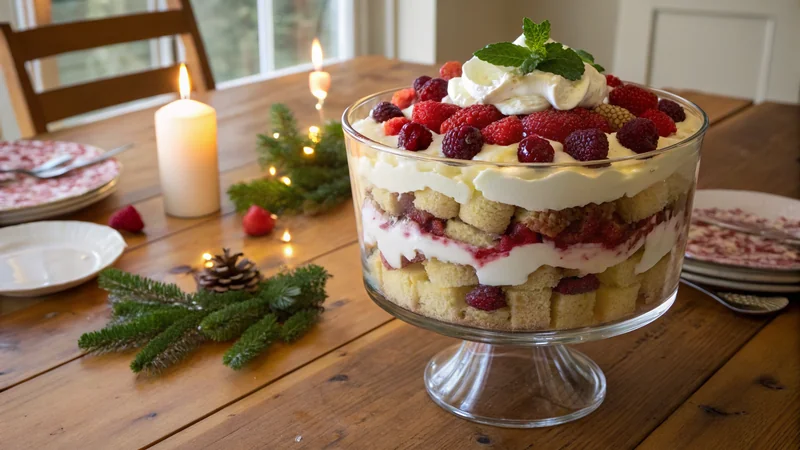
The visual character of the trifle is its main appeal. Unlike most desserts, which look complete only when sliced or scooped, a trifle is presented in a glass bowl that reveals the entire layered structure to the diner. The aesthetics are a major part of the experience - the alternating bands of golden cake, red berries, cream custard, and white whipped cream are deliberately constructed for visual impact. Buy a tall, clear glass trifle bowl if you make this dessert more than once; a regular bowl works in a pinch but the visual impact is reduced.
Trifles travel well, which is why they became a Christmas tradition. They can be made the day before, transported covered in their bowl, and served straight from the same vessel. The 24-hour chill actually improves the flavor as the bourbon and custard meld. This is one of those rare desserts where ahead-of-time prep is mandatory rather than optional, which makes it ideal for holiday gatherings where the host has many other things to do.
Texas Twist: Bourbon-Soaked Berries
The traditional English trifle uses sherry to soak the cake and macerate the fruit. Texas trifles use bourbon. The substitution works for two reasons: bourbon's deeper, oakier flavor profile pairs better with the rich pound cake (sponge cake is too delicate to handle bourbon), and bourbon is more authentic to a Texas household than sherry, which is a niche import.
Texas distilleries have proliferated dramatically in the last 15 years, and you now have several excellent local options for the bourbon component. Garrison Brothers Distillery in Hye, Texas (Hill Country, between Austin and Fredericksburg) makes outstanding bourbon - their Small Batch is the everyday choice, their Cowboy Bourbon is the special-occasion bottle. Balcones Distilling in Waco makes Texas Single Malt and a corn whiskey called True Blue that work beautifully in trifle. Still Austin in South Austin makes Cask Strength and Bottled-In-Bond bourbons. Any of these elevate the trifle from generic to specifically Texan.
If you don't have access to a Texas bourbon, any quality bourbon works. Buffalo Trace, Maker's Mark, Woodford Reserve - all are excellent. Avoid the bottom-shelf bourbons (Jim Beam, Heaven Hill bottom shelf) for trifle; the harshness comes through in the macerated syrup. The bourbon should taste like something you would drink neat in a glass.
The macerating ratio is 1/2 cup of bourbon to 3 cups of fresh berries (cranberries + raspberries). This produces enough alcohol to flavor the berries and create a syrup, but not so much that the dish becomes overtly boozy. Most of the alcohol cooks off slightly during the overnight chill (alcohol vaporizes faster than water at room temp; at fridge temp the loss is slower but still real). The final dessert is mildly alcoholic but not overwhelming - safe for most adults at a holiday table, but not for children.
For an alcohol-free version, replace the bourbon with 1/2 cup of pomegranate juice + 1 tablespoon of orange juice + 1/2 teaspoon of vanilla extract. The flavor profile shifts toward fruity-bright instead of oaky-warm, but the maceration and syrup formation work similarly. This is the version for kid-friendly trifle or a non-drinking household.
The Vanilla Custard from Scratch
Homemade vanilla custard is the centerpiece flavor of the trifle. Boxed instant pudding is a common shortcut but produces a flatter, less complex flavor that conflicts with the bourbon-berry layer. The 30 minutes of active stovetop time for from-scratch custard is worth the upgrade. The technique is straightforward: warm milk, infuse with vanilla, temper into yolks, cook to thickness, strain. Six egg yolks for 3 cups of milk is the right ratio.
Use a real vanilla bean if possible. Split the bean lengthwise with a paring knife and scrape the seeds (the tiny black specks) into the warm milk. Add the entire pod to infuse 15 minutes; remove the pod before adding the egg yolk mixture. Vanilla bean produces noticeably more aromatic custard than vanilla extract, with visible specks throughout that signal homemade quality. If vanilla beans are unavailable (about $5-8 each, sold at most grocery stores in the spice aisle), 2 teaspoons of pure vanilla extract is an acceptable substitute - add it after the custard cooks (extracts contain alcohol that evaporates if added too early).
Tempering is the critical technique. Pouring hot milk directly into raw egg yolks scrambles them; you need to gradually warm the yolks by drizzling the hot milk in slowly while whisking constantly. The yolks acclimate to the temperature without cooking. After tempering, the entire mixture goes back into the saucepan and cooks on the stovetop until thickened. The cornstarch in the recipe stabilizes the custard during the heat phase and prevents scrambling.
Strain the cooked custard through a fine mesh sieve before chilling. The straining removes the vanilla pod (if used), any small bits of cooked egg, and any starchy lumps. The result is a perfectly smooth, glossy custard that distributes evenly through the trifle layers. Cover the surface directly with plastic wrap (touching the custard, not floating above) to prevent a skin from forming during the chill.
Chill the custard at least 2 hours before assembling the trifle, ideally overnight alongside the macerating berries. Cold custard layers hold their shape against the pound cake; warm custard would melt down through the cake and ruin the layered effect.
Layering Strategy and the 4-Hour Chill
The trifle is built in 9 layers across 3 stacks: pound cake, berries, custard / pound cake, berries, custard / pound cake, berries, custard. Each stack is about 1/3 of the total ingredients - a third of the pound cake cubes, a third of the macerated berries, a third of the cold custard. The visual goal is three distinct golden-red-cream stripes visible against the glass bowl wall.
Pound cake placement matters. Distribute the cubes in a single even layer; don't pile them up. The bourbon syrup needs to penetrate evenly, and uneven cake distribution creates dry pockets. About 5-6 cups of cubed cake distributes across 9 layers without crowding any single layer.
Berry distribution is similarly even. Spoon the macerated berries with a slotted spoon initially, then add 1-2 tablespoons of the bourbon syrup on top of the berries to soak the cake below. The syrup is the flavor amplifier; the berries are the textural and visual element. Save the last 2 tablespoons of syrup for any pound cake cubes that look dry as you assemble.
Custard pours easily once cold. Spoon or pour over the berries, smoothing with the back of the spoon into a flat layer. The custard will sink slightly into the berry layer below; this is fine and creates a nice flavor meld. Don't try to keep the custard perfectly separated from the berries - the layers are decorative, not structural.
The 4-hour chill is when the trifle becomes itself. The pound cake absorbs the bourbon syrup completely, becoming wet-cake-tender. The custard sets fully and creates clean cross-sectional layers when scooped. The berries release more juice into the cake. The whipped cream firms up. Without this chill, the trifle is just an assembled mess; with this chill, it becomes the dessert it is supposed to be. 24 hours is even better than 4 - the flavors meld more completely and the texture stabilizes further.
The Glass Bowl, Garnish, and Make-Ahead Strategy
A trifle bowl is the right vessel for this dessert. The traditional English trifle bowl is tall (about 8-10 inches), clear glass (no etching or decoration), with straight or slightly flared sides and a 3-4 quart capacity. Williams Sonoma, Crate and Barrel, and Anchor Hocking all make excellent trifle bowls in the $30-50 range. For occasional use, a tall clear glass bowl from any kitchen store works as a substitute.
Avoid colored or etched glass bowls. The whole point of a trifle is the visual layered effect, and a bowl with decoration competes with the food. Clear glass shows the layers cleanly. A pedestal stand under the bowl raises it dramatically for table display - rent a cake stand from the cake-decorating section if you don't own one.
Garnish at the moment of serving, not earlier. Fresh mint sprigs, raspberries, orange or lemon zest curls, and pomegranate arils are the classic combination - red and green for Christmas. The garnish should be fresh-cut and added within 30 minutes of serving. Anything earlier and the garnish wilts on top of the cold whipped cream.
Make-ahead is the trifle's superpower. Day -2: macerate the berries (overnight). Day -1: make the custard, cube the pound cake, assemble the entire trifle including whipped cream topping. Day 0: garnish 30 minutes before serving and bring to the table. The 24-hour chill is the optimal flavor window. The trifle holds 36-48 hours without quality loss; past 48 hours the pound cake starts to disintegrate and the layers blur.
For travel: assemble in the bowl at home, cover loosely with plastic wrap propped on toothpicks (so the wrap doesn't touch the whipped cream), transport in a cooler or fridge. The trifle holds 4-6 hours at potluck temperatures. Garnish at the destination, not at home. For broader Texas dessert context, see the Ultimate Texas Desserts Guide or pair with Texas Christmas candy for a complete holiday dessert spread.
Texas Christmas Trifle Recipe
Ingredients
- FOR THE TRIFLE BASE:
- 1 store-bought or homemade pound cake (about 1 lb / 450 g), cut into 1-inch cubes
- 1.5 cups (180 g) fresh or frozen cranberries
- 1.5 cups (180 g) fresh raspberries
- 1/2 cup (120 ml) Texas bourbon (Garrison Brothers, Balcones, or Still Austin)
- 1/3 cup (66 g) granulated sugar
- 1 tablespoon orange zest
- FOR THE VANILLA CUSTARD:
- 3 cups (720 ml) whole milk
- 1 vanilla bean, split lengthwise (or 2 teaspoons pure vanilla extract)
- 6 large egg yolks
- 3/4 cup (150 g) granulated sugar
- 1/4 cup (32 g) cornstarch
- 1/4 teaspoon kosher salt
- 2 tablespoons (28 g) unsalted butter
- FOR THE WHIPPED CREAM TOPPING:
- 2 cups (480 ml) heavy whipping cream, very cold
- 1/4 cup (32 g) powdered sugar
- 1 teaspoon pure vanilla extract
- TO GARNISH:
- Fresh mint sprigs, additional raspberries, lemon or orange zest curls, pomegranate arils (optional)
- Equipment: 1 trifle bowl (3-4 quart capacity, tall and clear) or large glass bowl
Instructions
- Macerate the bourbon berries (overnight or 4h). In a medium bowl, combine the cranberries, raspberries, bourbon, sugar, and orange zest. Stir gently. Cover and refrigerate at least 4 hours, ideally overnight. The berries will release their juice, the sugar will dissolve, and the cranberries will soften from the alcohol. After the macerating period, the berries should be plump and surrounded by a deep red bourbon syrup. This is the flavor heart of the trifle.
- Make the vanilla custard. In a heavy saucepan, combine the milk and split vanilla bean (scrape seeds in with the pod). Heat over medium until just steaming. Remove from heat and let infuse 15 minutes. In a separate bowl, whisk the egg yolks, sugar, cornstarch, and salt until smooth and pale yellow. Slowly drizzle the warm milk into the yolk mixture, whisking constantly to prevent scrambling. Pour the entire mixture back into the saucepan.
- Cook the custard to thickness. Set the saucepan over medium heat. Whisk constantly for 6-8 minutes until the custard thickens noticeably and starts to bubble at the edges. Continue whisking 60 more seconds after the first bubbles - this fully cooks out the cornstarch starchy taste. Remove from heat. Whisk in the butter until melted. Strain through a fine mesh sieve into a clean bowl to remove the vanilla pod and any cooked egg bits. Cover the surface with plastic wrap touching the custard (prevents skin) and refrigerate at least 2 hours until cold.
- Cube the pound cake. If using store-bought pound cake (Sara Lee, Entenmann's, or a bakery loaf), cut into 1-inch cubes. About 1 pound of pound cake yields 5-6 cups of cubes. If using homemade pound cake, bake the day before, cool fully, then cube. Set the cubes in a large bowl. They should look uniform - the cube size matters for the layer visibility.
- Whip the cream. In a chilled metal bowl, beat the cold heavy cream with the powdered sugar and vanilla extract using an electric mixer on medium-high speed. Whip 2-3 minutes until soft-medium peaks form - the cream should hold a peak that flops over slightly when you lift the beaters. Don't overwhip; over-whipped cream turns grainy. Refrigerate until ready to assemble.
- Assemble layer 1: pound cake + bourbon syrup drizzle. Place a third of the pound cake cubes in the bottom of the trifle bowl in an even layer. Drain about 2 tablespoons of the bourbon syrup from the macerated berries (using a slotted spoon, leaving the berries in the bowl). Drizzle the syrup over the pound cake. The cubes will absorb the bourbon-flavored liquid and become tender; this is the trifle's signature wet-cake texture.
- Layer 2: bourbon berries. Spoon a third of the macerated berries (cranberries + raspberries with their syrup) over the soaked pound cake. Distribute evenly across the surface. The red color should be visible against the bowl's glass walls; this is the visual signature of a Christmas trifle.
- Layer 3: vanilla custard. Pour or spoon a third of the cold vanilla custard over the berries, smoothing into an even layer. The custard will sink slightly into the berry layer below; that is fine and creates a nice meld of flavors. The custard layer should appear as a creamy yellow band against the bowl wall.
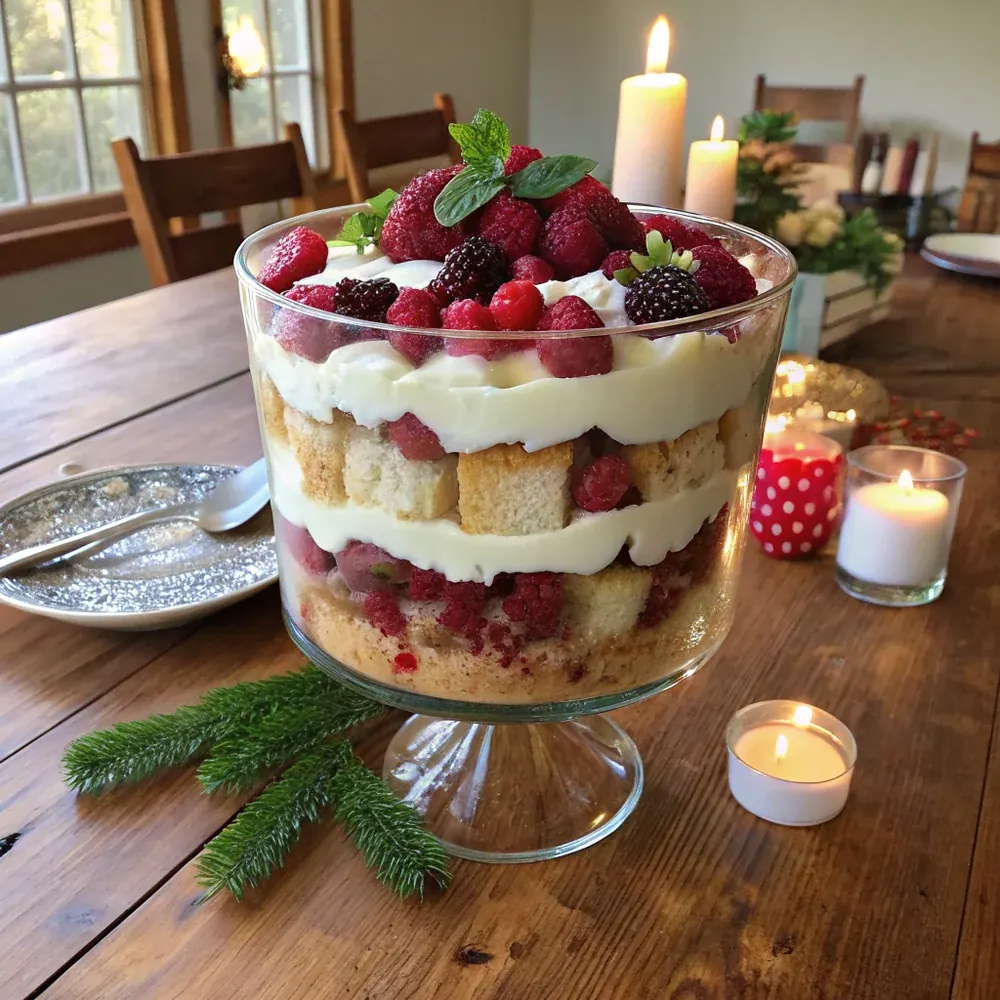
- Repeat layers 2 more times. Repeat the entire stack two more times: pound cake + bourbon syrup drizzle, then berries, then custard. End with the third custard layer at the top. The trifle bowl should be 80-90% full at this point. The visible layers from the side should show three distinct stripes of pound cake (golden), berries (red), and custard (cream) - 9 layers total in 3 stacks.
- Top with whipped cream and chill 4h. Spread the whipped cream over the top custard layer in a billowy mound. Cover the trifle loosely with plastic wrap and refrigerate at least 4 hours, ideally overnight. The chill time lets the layers meld, the pound cake fully absorb the bourbon syrup, and the custard set firmly. Just before serving, garnish the top with fresh mint sprigs, additional raspberries, lemon or orange zest curls, and optional pomegranate arils. Serve in glass dessert bowls so guests can see the layered cross-section.
Frequently Asked Questions
Can I make Texas Christmas trifle ahead?
Yes - the trifle is one of the great make-ahead desserts. Assemble fully (including the whipped cream topping) up to 24 hours ahead. The 24-hour chill actually improves the flavor as the bourbon-berry-custard layers meld. Hold up to 48 hours total in the fridge before quality starts to decline. Garnish the top with fresh mint and berries 30 minutes before serving.
Do I have to use bourbon? Can I make this alcohol-free?
You can make it alcohol-free. Replace the 1/2 cup bourbon with 1/2 cup pomegranate juice + 1 tablespoon orange juice + 1/2 teaspoon vanilla extract. The flavor profile shifts toward fruity-bright instead of oaky-warm, but the maceration works similarly. The recipe still tastes excellent without alcohol; the bourbon adds depth but isn't structurally essential.
Can I use sponge cake or angel food cake instead of pound cake?
Pound cake is recommended because it's sturdier and holds up to the bourbon soak without falling apart. Sponge cake works but disintegrates more (the layers blur instead of staying distinct). Angel food cake is too light and absorbs syrup too quickly, ending up mushy. If you want the original English-style trifle, use sponge cake; for a Texas adaptation, stick with pound cake (Sara Lee, Entenmann's, or a bakery loaf).
What's the best Texas bourbon for trifle?
Garrison Brothers Small Batch (Hye, Texas) is the gold standard - rich, oaky, with the right depth for trifle. Balcones Texas Single Malt or True Blue corn whiskey work as alternatives. Still Austin Cask Strength is the upmarket choice. For widely available options: Buffalo Trace, Maker's Mark, Woodford Reserve. Avoid bottom-shelf bourbons - the harshness comes through in the macerated syrup.
Can I use frozen berries?
Yes - frozen cranberries and raspberries work fine. Thaw at room temperature for 30 minutes before macerating, then drain off any excess liquid. The frozen-then-thawed berries release more juice during maceration than fresh berries, which actually helps the bourbon syrup form more quickly. The texture is slightly softer than fresh after the soak; flavor is essentially identical.
How long can the trifle sit at room temperature?
Up to 2 hours for serving. Beyond that, the whipped cream starts to weep and the custard loses its set. Keep refrigerated until 30 minutes before serving for best texture. If the room is warm (75F+), reduce the room-temperature time to 1 hour. Store leftovers covered in the fridge for up to 2 days; the texture degrades but flavor remains good.
Why is my trifle layers looking blurry instead of distinct?
Two likely causes: (1) the custard was warm when assembled (it sank into the cake and berries instead of forming a separate layer); (2) the trifle was assembled and chilled less than 4 hours (the layers haven't had time to set). Solution: chill the custard at least 2 hours before assembling, then refrigerate the assembled trifle at least 4 hours before serving. The layers should look distinct after a full overnight rest.
Can I serve trifle in individual glass cups instead of one bowl?
Yes - assemble the same layers in 12 small clear glass cups or wine glasses for individual servings. Use about 1/3 cup pound cake, 2 tablespoons berries with syrup, 3 tablespoons custard per cup, repeated 2 times, topped with whipped cream. Refrigerate 4 hours. The individual format is ideal for plated dinner service or for transport. The visual impact is similar to the bowl version, just at smaller scale.