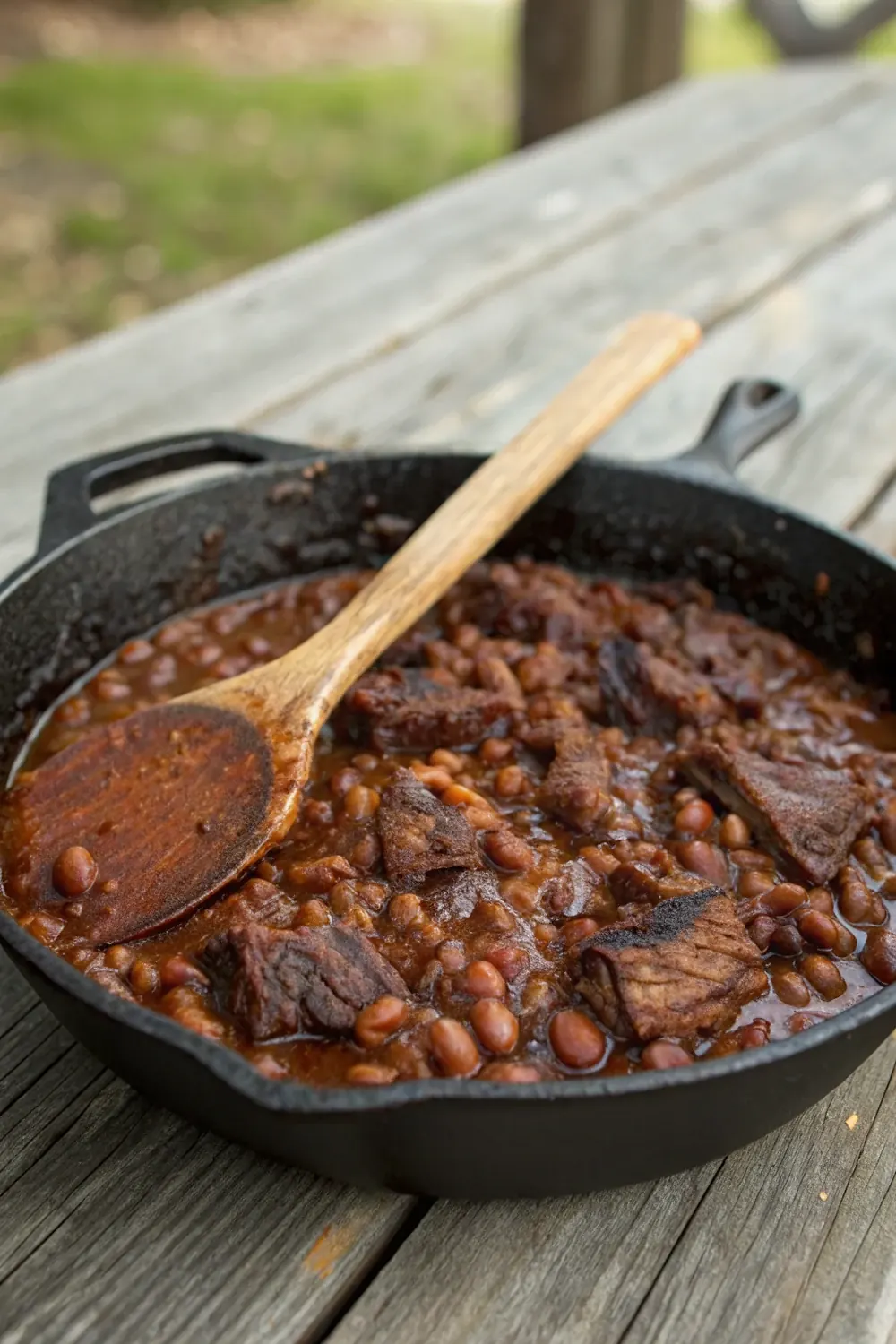
Texas BBQ
Texas BBQ Baked Beans
Texas BBQ baked beans with chopped smoked brisket, molasses, ancho, mustard, vinegar. Lockhart pit style, slow-baked in cast iron, 3 hours.
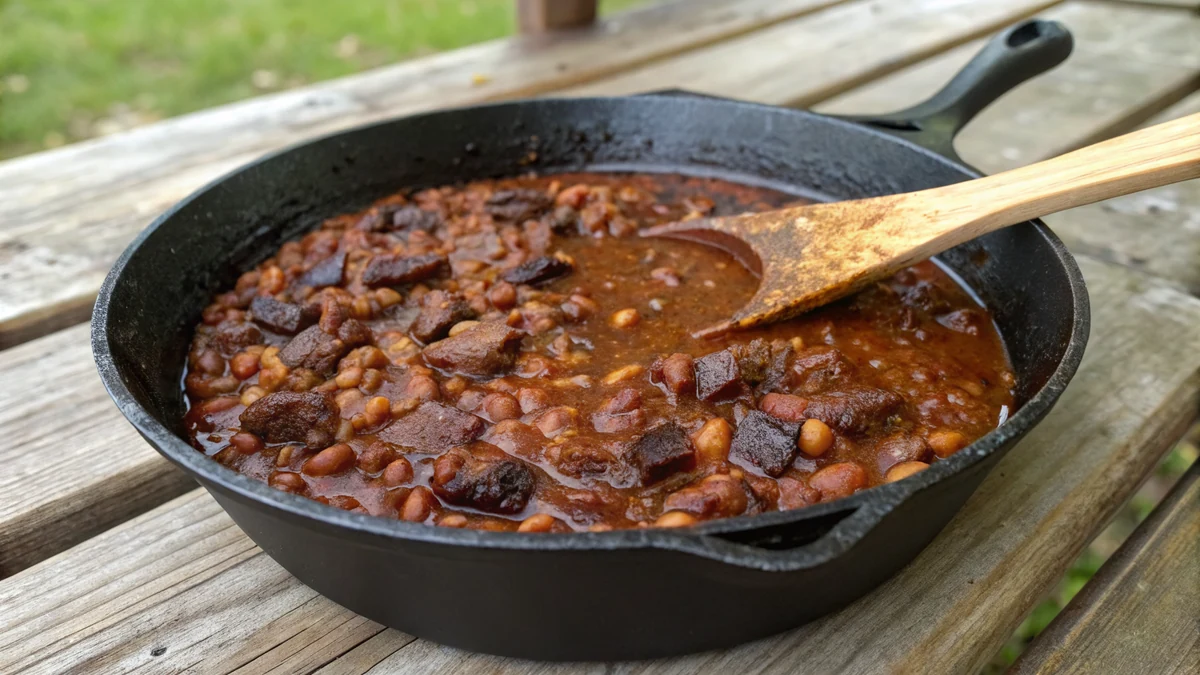
Quick answer: Texas BBQ baked beans are pinto beans (not navy) slow-baked in cast iron with chopped smoked brisket, molasses, dark brown sugar, ancho chile, yellow mustard, and apple cider vinegar until the top forms a dark, crusty bark and the beans stay tender and saucy. The cowboy chuck wagon tradition meets the Hill Country pit tradition (Goldee's, Snow's, every Lockhart joint serves them). Total time 3 hours, serves 8.
I learned to make BBQ baked beans the way most Texans learn anything about barbecue, by watching a pit cook in Lockhart move a foil pan around the pit while a brisket finished overhead. The pan sat under the brisket, catching the drip, and every time the cook walked past he stirred the beans with the same long spoon he used for the sauce mop. Pinto beans, chopped brisket trimmings, a little ancho, a little molasses, a little vinegar, and the dark fat dripping from the brisket above. By the time the brisket came off, the beans had a crust on top like the bark on the meat. That is the dish. Not Boston, not Bush's, not anything you grew up eating from a can.
The cowboy chuck wagon tradition started this on the Goodnight-Loving and Chisholm trails in the 1860s, when pinto beans were a staple of the trail diet because they kept dry and cooked over a campfire in a cast iron Dutch oven. The Hill Country pit tradition picked up the dish a century later (Black's, Kreuz, Smitty's, Goldee's in Brady, Snow's in Lexington with Tootsie Tomanetz on the pit), and modern Texas BBQ joints serve them as the canonical side. The recipe below is for the home cook with a 12-inch cast iron skillet, leftover smoked brisket trimmings (or HEB pre-smoked brisket if you do not pit-cook), and a willingness to bake for two and a half hours. Total time 3 hours.
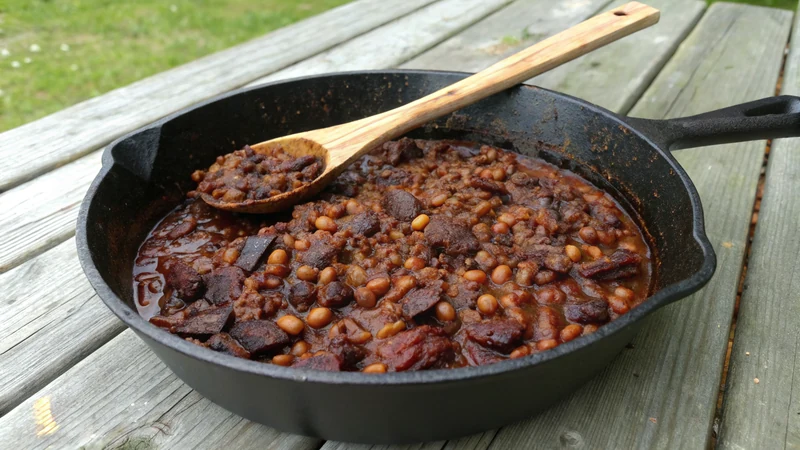
Chuck Wagon Origin and Texas BBQ-Side Tradition
Texas BBQ baked beans descend from two cooking traditions that converged in the 20th century. The first is the chuck wagon tradition of the Texas cattle drives, which ran from roughly 1866 (the first Goodnight-Loving Trail drive) through the 1880s. Charles Goodnight invented the modern chuck wagon, and the cook (the cocinero, shortened to "coosie") made beans almost every day because pinto beans kept dry, traveled well, and cooked over a mesquite fire in a Dutch oven half-buried in coals.
The trail-drive bean was simple: pintos, water, salt pork or bacon, sometimes a chile, sometimes molasses if the wagon carried it. The technique was a low slow cook in a covered Dutch oven over coals, with hot coals piled on the lid for top heat. That trail-drive pot is the ancestor of the modern skillet dish I write up separately as cowboy beans, which uses ground beef, bacon, and canned beans in under an hour; what is on this page went the other way, toward the pit and a three-hour bake. Chuck wagon competitions (the Western Heritage Classic in Abilene, the National Chuckwagon Cook-off in Dublin) keep the tradition alive every year.
The second tradition is the Hill Country and Lockhart pit tradition, which emerged from German and Czech butcher shops in Lockhart, Luling, and Taylor that started smoking unsold cuts. Black's (1932), Kreuz Market (1900), and Smitty's all serve baked beans as a canonical side. Modern joints like Goldee's in Brady, Franklin Barbecue in Austin, and Snow's BBQ in Lexington (where Tootsie Tomanetz works the pit on Saturdays) have refined the dish. The Lockhart bean is the chuck wagon bean with brisket trimmings and a sweeter sauce.
Why Pinto Beans (Not Navy, Not Kidney)
The bean choice is non-negotiable. Pinto beans are the canonical Texas bean, used by every BBQ joint and every chuck wagon cook from the 1860s forward. Pintos are a medium-size beige-and-brown speckled bean that turn pinkish-brown when cooked. They have a creamy, slightly earthy flavor that holds up to molasses and ancho without disappearing. They also grow reliably across Texas, New Mexico, and northern Mexico, which is why they became the trail-drive staple.
Navy beans are the New England Boston choice, and they are wrong for Texas. Smaller, whiter, with a more delicate flavor that gets overwhelmed by molasses and brisket. The texture is also softer; navy beans mush after 3 hours of baking, where pintos hold their shape. If you walk into a Lockhart pit-house and see navy beans on the menu, something has gone wrong.
Kidney beans are also not correct. Firmer than pintos, more vegetal in flavor, and the deep red color clashes with the mahogany sauce. Kidney beans belong in chili (and even there, the chili-purist Texas crowd will tell you no beans at all). HEB Hill Country Fare dried pintos are excellent and cheap; Camellia is also good. Avoid canned pintos; the texture is too soft.
The Soak: Overnight vs Quick
Soaking dried pintos is recommended but not strictly required. Soaking does three things: shortens the cook time (unsoaked beans take 2-3 hours to simmer tender; soaked beans take 60-75 minutes), makes the beans more digestible by leaching out some of the oligosaccharides that cause gas, and makes the bean texture more uniform with fewer split skins.
Overnight soak. Cover the dried beans with 2 quarts of cold water in a pot and let sit at room temperature for 8-12 hours. The beans roughly double in volume and yield slightly when pressed. Drain and rinse before cooking. This is the most predictable method.
Quick soak. When you forgot to soak overnight, bring the beans and water to a boil for 2 minutes, then turn off the heat, cover, and let sit for 1 hour. Drain and rinse. The texture is slightly less uniform but close. No soak. Simmer stage stretches to 2-3 hours instead of 60-75 minutes and skins are more likely to split. The total recipe stretches to 4-5 hours instead of 3.
Texas vs Boston Baked Beans (The Contrast)
Boston baked beans and Texas BBQ baked beans share a name and a baking method but almost nothing else. Boston baked beans use small navy beans, salt pork (cured fatback), molasses, dark brown sugar, dry mustard, and sometimes onion. The flavor is sweet, slightly sharp, pork-forward. Texture is soft and creamy, almost a baked-bean puree. The dish descends from Puritan and Native American Wabanaki bean cookery, baked in a brick oven for many hours.
Texas BBQ baked beans use pinto beans (not navy), bacon and chopped smoked brisket (not salt pork), molasses plus brown sugar, but also yellow mustard, apple cider vinegar, ketchup, ancho chile powder, smoked paprika, cumin, and Worcestershire. The flavor is sweet-tangy-smoky, with the vinegar and ancho doing work that no Boston bean would recognize. Texture is firmer and the brisket adds smoke and meaty texture that salt pork does not. No maple syrup, no salt pork.
The two dishes share the slow oven bake and the molasses base. Everything else, the bean, the meat, the spices, the acid, the texture, is different. A Texan ordering baked beans expects pintos with brisket and ancho. A New Englander expects navies with salt pork and maple. Serving the wrong one is a quiet way to identify yourself as not from there.
The Brisket Integration
The chopped smoked brisket is what makes these beans Texan rather than generic Southern. Most home cooks do not pit-smoke a brisket every weekend and end up with leftover trimmings sitting in the fridge. If you pit-cooked a brisket recently, save the burnt edges, the fat-cap trimmings, and any end pieces that did not slice cleanly. The bark and fat carry the most concentrated flavor; 8 oz of trimmings will out-flavor 16 oz of evenly-sliced brisket.
If you do not pit-cook, HEB sells pre-smoked brisket in the meat section (the smokehouse brisket SKU varies by store). Chop 8 oz into 1/2-inch pieces and use as is. Texas BBQ brisket trimmings are the canonical choice. Burnt ends also work; they are already saucy and add concentrated bark flavor.
The brisket goes in at the sauce-and-bean combine stage (step 5), not earlier. Adding it earlier risks overcooking the meat into stringy texture. Combining at step 5 and then baking 2.5 hours covered plus 30 minutes uncovered gives the brisket time to share its smoke and fat with the beans without breaking down. For a more pronounced brisket presence, save 2 oz and stir in during the last 30 minutes uncovered, so some pieces stay distinctly meaty.
Sauce Balance: Sweet, Tangy, Smoky
The sauce is built on three pillars. Sweet comes from dark brown sugar (1/2 cup) and unsulphured molasses (1/3 cup). The brown sugar is upfront sweet; the molasses is deeper, slightly bitter, and gives the sauce its mahogany color. Use unsulphured (Grandma's, Brer Rabbit) rather than blackstrap; blackstrap is too bitter.
Tangy comes from apple cider vinegar (1/4 cup) and yellow mustard (1/4 cup). The vinegar cuts through the sweet and brightens the entire sauce; without it, the dish is cloying. Yellow mustard is a Texas BBQ tradition; pitmasters like Aaron Franklin use it in their sauces. The combination pulls the sauce out of dessert territory and into savory.
Smoky comes from three sources: the chopped smoked brisket (post oak smoke from the original cook), the bacon (pork-fat smoke), and the ancho chile powder plus smoked paprika (chile-smoke complexity). Some Texans add liquid smoke; I do not. If you used real smoked brisket and good ancho, you do not need it. Taste the sauce before the beans go in; you should taste sweet first, then tang, then smoke.
Cast Iron vs Dutch Oven
12-inch cast iron skillet is my preferred vessel. The wide shallow shape gives a large surface area for the crusty top to form during the uncovered finish, which means more bark per bean. The skillet also looks great on a picnic table or kitchen counter. The downside is no lid; cover with foil for the 2-hour covered bake.
5-quart enameled or seasoned Dutch oven works equally well and has a built-in lid. The disadvantage is that the deeper, narrower shape gives less surface area for the crust. If you use a Dutch oven, bake uncovered for 40 minutes (instead of 30) to give the top time to crust. Le Creuset, Lodge, and Staub all make 5-quart Dutch ovens that are perfect for this.
Avoid stainless steel or aluminum bakeware. The metal does not retain heat as well as cast iron, the bottom can scorch the sugar, and the bake is uneven. Avoid glass or ceramic for the same reason; they are slower to heat and the bottom stays too cool while the top crusts. Cast iron, ideally; enameled cast iron, also great.
Baking Strategy: Covered Low Then Uncovered Hot
The two-stage bake is the secret to the texture, and skipping the second stage is the most common home-cook mistake. Stage 1: 300F covered for 2 hours. The covered bake at low temperature lets the beans absorb the sauce without losing moisture. The beans go from tender to fully sauce-soaked, the sauce concentrates slightly, and the brisket releases its smoke and fat into the surrounding sauce. This is where the dish becomes a unified pot of beans.
Stage 2: 350F uncovered for 30 minutes. This is where the crust forms. The top layer of beans dries slightly, the sauce around the edges of the skillet caramelizes, and the surface develops a glossy dark mahogany crust that mimics the bark on a brisket. Without this stage, you have stewed beans, which is fine but not the same dish.
Some pit cooks push the second stage further: 375F for 20 minutes, or a brief broil. For a more pronounced crust, broil for 1-2 minutes at the end (watch closely; the sugar burns fast). For a softer top, stop at 30 minutes. Resting for 10 minutes after the oven is part of the strategy; the sauce thickens and the top sets as the skillet cools.
Hill Country Kitchen Notes
I keep a container of brisket trimmings in the freezer for exactly this dish. Every time I pit-cook a brisket, I save the burnt edges, the fat-cap trimmings, and odd-shaped end pieces in a quart-size freezer bag. They keep for 3 months, and when I want BBQ baked beans, I pull out 8 oz, thaw, and chop. This is the way every Hill Country pit cook treats their beans; the beans are the second life of the brisket trimmings.
I use HEB Hill Country Fare dried pintos because they are reliably fresh, cheap (about $1.50 a pound), and cook predictably. Camellia is also excellent (a New Orleans brand widely stocked in Texas). Avoid bulk-bin dried beans of unknown age; old pintos take twice as long to cook and never get fully tender.
On the molasses: unsulphured Grandma's (the green-and-red label) is what my mother used and what I still use. Brer Rabbit Mild is also fine. Avoid blackstrap; it is too bitter and turns the sauce muddy. On the ancho: McCormick or HEB Primo Picks both work, but the best ancho is from any Mexican grocery; freshness matters.
Mistakes to Avoid
Using navy beans instead of pintos. Navy beans turn this into Boston baked beans, not Texas. Pintos are non-negotiable.
Skipping the soak entirely. Unsoaked pintos take 2-3 hours to simmer tender, adding 90 minutes to your cook time. Soak overnight or quick-soak.
Using canned pinto beans as a shortcut. Canned pintos are too soft and fall apart during the 2.5-hour bake. Use dried.
Adding salt to the simmering pot. Salt before tender slows cooking and produces tough skins. Salt at the sauce stage.
Skipping the uncovered finish. The covered-only bake produces stewed beans, not BBQ baked beans. The 350F finish creates the crusty top.
Using blackstrap molasses. Blackstrap is too bitter and muddies the sauce. Use unsulphured Grandma's or Brer Rabbit.
Overcooking the brisket. Adding chopped brisket too early turns the meat stringy. Add at the combine stage (step 5).
Forgetting the acid. Without the apple cider vinegar and yellow mustard, the dish is cloyingly sweet. The acid is what makes it Texan.
Variations
Vegetarian smoked-paprika version. Skip the bacon and brisket. Use 4 tablespoons olive oil for sauteing the onion, and increase the smoked paprika to 1 tablespoon plus 1 teaspoon of liquid smoke (hickory or mesquite) for the smoke layer. The dish loses meaty texture but gains a deeper smoky-sweet character.
Jalapeno-loaded version. Add 2 large fresh jalapenos (seeded and diced) with the onion at the saute stage, plus 1/4 cup of pickled jalapeno juice in place of half the apple cider vinegar. Top the finished beans with sliced fresh jalapeno before serving. San Antonio and Rio Grande Valley joints often serve a spicier version like this.
Pinto-pinto-and-pinto. Use 1 lb dried pintos plus 1 cup of cooked black-eyed peas plus 1 cup of cooked Anasazi or borlotti beans for a multi-bean Texas-Southwestern hybrid. The texture variety is interesting; cook time stays the same.
Burnt-ends edition. Replace chopped brisket with 8 oz of Texas BBQ burnt ends, which are already saucy and concentrated. Reduce brown sugar to 1/3 cup. The result is a richer, more candy-bark forward bean.
Ranch beans (Mexican-leaning). Skip the molasses and brown sugar. Replace with 1 can (14 oz) of fire-roasted tomatoes, 2 chipotles in adobo (chopped), and 1 teaspoon Mexican oregano. The result is closer to my charro beans, a different West Texas and Rio Grande Valley tradition that uses the same pinto base but stays brothy instead of baking down. For the tangy canned-style pot, see my ranch style beans instead.
Brisket sandwich pairing. Make these beans the day you make a cornbread brisket sandwich; the beans go on the side and the leftover sandwich filling can go in the beans the next day.
What to Serve With Texas BBQ Baked Beans
BBQ baked beans are a side dish, not a main. The classic Lockhart tray: sliced brisket (fatty), pork ribs, hot links or sausage, white bread or saltines, sliced raw onion, dill pickle chips, and baked beans. Add potato salad or coleslaw for a third side. Serve on butcher paper, no plates. At a backyard cookout the same trinity holds around a thick Texas hamburger - beans on the side, pickles and onion already on the bun.
For a backyard cookout, pair the beans with Texas BBQ brisket as the centerpiece, plus grilled hot links, white bread, sliced jalapenos, and pickles. Add a vinegary cucumber-onion salad for something cold and acidic to balance the richness. For tailgates, the beans travel well in the cast iron with a foil cover; reheat on a side burner or serve at room temperature.
For drinks, Lone Star, Shiner Bock, and Pearl are the canonical Texas beers. Lone Star is the cheap honest option; Shiner Bock is the slightly nicer one; Pearl is the San Antonio classic. For a cocktail, a Ranch Water (Topo Chico, lime, blanco tequila) is the modern Hill Country choice. For non-alcoholic, sweet tea or Big Red. Also see Texas BBQ burnt ends for another canonical side. These beans were born to sit next to a mound of Texas pulled pork or a coil of smoky Texas hot links on a paper plate.
Texas BBQ Baked Beans Recipe
Ingredients
- For the bean base:
- 1 lb (450 g) dried pinto beans (about 2 1/4 cups dry), HEB Hill Country Fare or Camellia brand
- 2 quarts water for soaking, plus 6 cups for simmering
- 1 large yellow onion, diced (about 1 1/2 cups)
- 4 cloves garlic, minced
- 4 oz (115 g) thick-cut bacon, diced (about 4 slices)
- For the smoke and brisket:
- 8 oz (225 g) chopped smoked brisket, including some fat cap and bark trimmings (leftover or store-bought)
- 2 tablespoons rendered brisket fat or bacon drippings
- 1 tablespoon ancho chile powder
- 1 teaspoon smoked paprika
- 1/2 teaspoon ground black pepper
- For the sauce:
- 1/2 cup dark brown sugar, packed
- 1/3 cup unsulphured molasses (Grandma's or Brer Rabbit, not blackstrap)
- 1/4 cup yellow mustard (French's)
- 1/4 cup apple cider vinegar
- 1/4 cup ketchup
- 2 tablespoons Worcestershire sauce
- 1 tablespoon kosher salt (adjust to taste; brisket adds salt)
- 1 teaspoon ground cumin
- 1/2 teaspoon cayenne (optional, for heat)
- Equipment:
- 12-inch cast iron skillet (or 5-quart Dutch oven)
- Heavy-bottom pot for the initial bean simmer
- Aluminum foil for the covered bake stage
Instructions
- Soak the pinto beans overnight. Place the dried pinto beans in a large bowl or pot and cover with 2 quarts of cold water. Soak at room temperature for 8-12 hours (overnight is easiest). The beans will roughly double in volume. Drain and rinse before cooking. If you forgot to soak overnight, use the quick-soak method: bring the beans and water to a boil for 2 minutes, remove from heat, cover, and let sit for 1 hour, then drain and rinse.
- Simmer the beans to tender. Place the drained beans in a heavy-bottom pot with 6 cups of fresh water. Bring to a boil, then reduce to a low simmer. Skim any foam that rises in the first 10 minutes. Simmer uncovered for 60-75 minutes, until just tender (a bean should crush easily between your fingers but still hold its shape). Do not add salt during this stage; salt before tender slows the cooking. Drain, reserving 2 cups of the bean cooking liquid (pot liquor) for the sauce. The beans will cook another 2 hours in the oven.
- Render the bacon and onion. Heat your 12-inch cast iron skillet over medium heat. Add the diced bacon and cook for 6-8 minutes, stirring occasionally, until browned and the fat is rendered. Add the diced yellow onion and cook for 5-6 minutes more, until translucent and starting to caramelize at the edges. Add the minced garlic and cook 30 seconds until fragrant. Do not drain the bacon fat; the rendered fat is part of the sauce. If you have rendered brisket fat, add 2 tablespoons now for a deeper smoke layer.
- Build the BBQ sauce in the skillet. Reduce the heat to medium-low. Add the dark brown sugar, molasses, yellow mustard, apple cider vinegar, ketchup, and Worcestershire sauce to the skillet with the bacon and onion. Stir until the sugar dissolves and the sauce begins to bubble, about 2-3 minutes. Add the ancho chile powder, smoked paprika, ground cumin, cayenne (if using), and ground black pepper. Stir to combine. The sauce should look glossy, dark mahogany, and smell sweet-tangy-smoky. Taste and adjust; you want a clear sweet-acid balance with the molasses and vinegar both present.
- Combine the beans, brisket, and sauce. Add the cooked, drained pinto beans to the skillet, along with the chopped smoked brisket (including any fat cap and bark trimmings, which carry the most flavor). Pour in 1 1/2 cups of the reserved bean cooking liquid. Stir gently to coat every bean in sauce. The mixture should be soupy at this stage; the beans will absorb most of the liquid in the oven. If it looks dry, add the remaining 1/2 cup of bean liquor. Add the kosher salt, taste, and adjust. Remember the brisket and bacon both add salt; start with 1 tablespoon and add more later if needed.
- Transfer to the oven, covered. Preheat your oven to 300F (150C). If you started in a Dutch oven instead of cast iron, the same vessel goes in the oven. Cover the skillet tightly with aluminum foil (or the Dutch oven lid). Place on the middle rack and bake at 300F for 2 hours. The low covered bake is what gives the beans their tender, sauce-soaked texture. Do not stir during this stage; you want the beans to settle into the sauce and absorb it slowly. The kitchen will smell like a Hill Country smokehouse by the 90-minute mark.
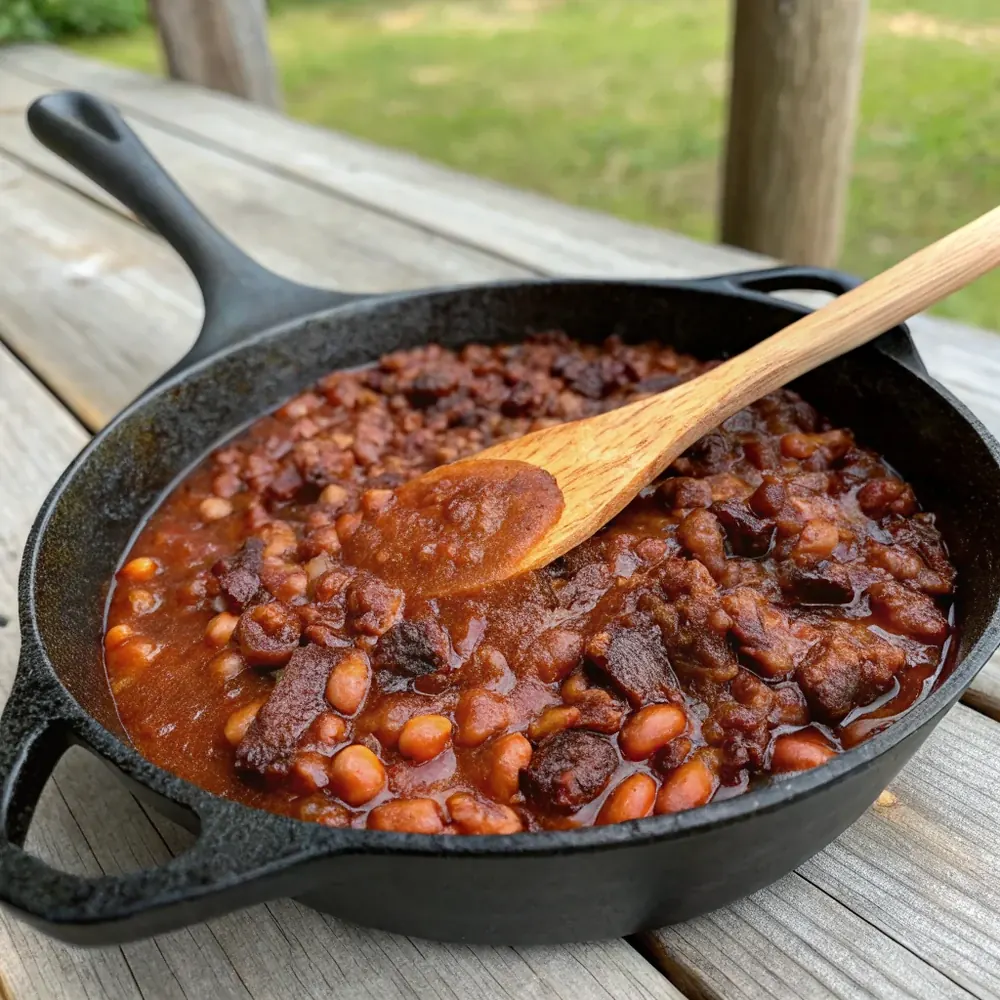
- Uncover and finish at 350F for the crusty top. After 2 hours covered, remove the foil and increase the oven temperature to 350F (175C). Bake uncovered for 30 minutes, until the top forms a dark, glossy, slightly cracked crust. The sauce around the edges of the skillet will reduce and caramelize, and the top layer of beans will dry slightly while the underneath stays saucy. This is the bark of the dish, and it is the difference between Texas BBQ baked beans and the canned-bean side at a chain restaurant. If your top is not crusting after 30 minutes, broil for 1-2 minutes to finish (watch closely so it does not burn).
- Rest 10 minutes and serve. Pull the skillet from the oven and rest on a heatproof trivet for 10 minutes. The sauce continues to thicken as the beans cool slightly, and the rest also helps the flavors marry. Serve directly from the cast iron, the way every Texas BBQ joint serves them. A 12-inch skillet yields about 8 generous side servings. Pair with brisket, white bread, sliced raw onion, dill pickle chips, and a Lone Star or Shiner Bock. Leftovers keep in the fridge for 4-5 days; reheat in the oven at 325F for 20 minutes (microwave is fine but loses the crust).
Frequently Asked Questions
What kind of beans are used in Texas BBQ baked beans?
Pinto beans, always. Pinto beans are the canonical Texas bean, used by every Hill Country and Lockhart BBQ joint and by every chuck wagon cook from the 1860s forward. Pintos are creamy, slightly earthy, and hold their shape during the long oven bake. Navy beans (the Boston baked-bean choice) are wrong for Texas; they are too small, too white, and turn mushy after 3 hours of baking. Kidney beans also do not work; they belong in chili. Use HEB Hill Country Fare or Camellia dried pintos.
Can I use canned pinto beans to save time?
Not recommended. Canned pintos are pre-cooked to a soft texture that falls apart during the 2.5-hour bake, leaving mushy beans and broken sauce. Dried pintos with an overnight or 1-hour quick soak are the right choice. If you absolutely must use canned, use 4 cans of unseasoned pintos (drained), skip the simmer stage, and bake covered for only 1 hour at 300F instead of 2.
Do I have to soak the beans overnight?
Soaking is recommended but not strictly required. Overnight soak (8-12 hours in cold water) is the easiest and most predictable method. Quick soak (boil for 2 minutes, then sit covered for 1 hour) works when you forgot to plan ahead and produces a slightly less uniform texture. No soak adds 90 minutes to the simmer stage (2-3 hours instead of 60-75 minutes) and produces more split skins. Soaking also reduces the gas-causing oligosaccharides, which is worth the planning.
What kind of brisket do I use for these beans?
Leftover smoked brisket trimmings are ideal. Burnt edges, fat-cap trimmings, and end pieces from a pit-cooked brisket carry the most concentrated post-oak smoke and bark flavor. If you do not pit-cook, HEB sells pre-smoked brisket that works fine; chop 8 oz into 1/2-inch pieces. You can also use leftover Texas BBQ burnt ends (reduce the brown sugar to 1/3 cup since burnt ends carry their own sweetness).
How are Texas BBQ baked beans different from Boston baked beans?
Almost everything except the slow oven bake. Texas uses pinto beans (not navy), bacon and chopped smoked brisket (not salt pork), molasses plus brown sugar, yellow mustard, apple cider vinegar, ketchup, ancho chile, smoked paprika, cumin, and Worcestershire. Flavor is sweet-tangy-smoky; texture is firmer. Boston uses navy beans, salt pork, molasses, brown sugar, dry mustard, sometimes maple; flavor is sweet and pork-forward, texture is creamy-soft. Different bean, different meat, different spices, different acid.
Can I make these beans without an oven, on the stovetop only?
Yes, with adjustments. After step 5, keep the skillet or Dutch oven on the stovetop over very low heat. Cover and simmer for 2 hours, stirring every 20 minutes to prevent the bottom from scorching. Then uncover and simmer 30 minutes more, stirring occasionally, to reduce the sauce. The crusty top will not form on the stovetop; you sacrifice that for stove-only convenience. The flavor is still excellent, just without the oven-bark on top.
How do I store and reheat leftover BBQ baked beans?
Leftovers keep in an airtight container in the fridge for 4-5 days. The flavor actually improves on day 2 as the molasses, ancho, and brisket smoke meld. To reheat, the oven method is best: 325F for 20 minutes covered (add a splash of water if the beans look dry). Microwave works for individual portions but loses the crusty top texture. Beans also freeze well for up to 3 months; thaw overnight before reheating. Excellent on day 2 over cornbread or with breakfast eggs.