Texas BBQ
Cornbread Brisket Sandwich
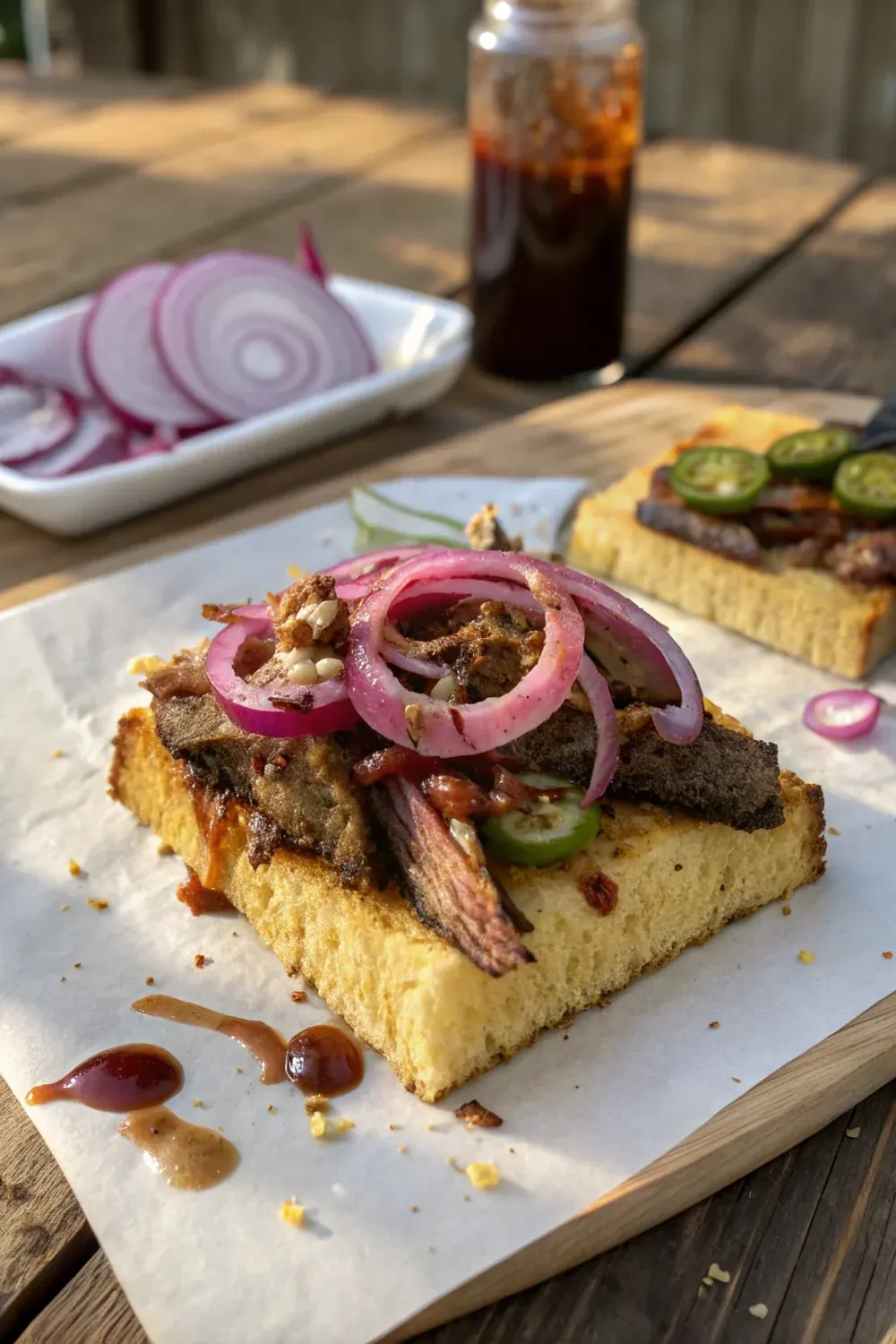
Chef Mia's cornbread brisket sandwich: jalapeno cornbread slabs, smoked brisket, pickled red onion, BBQ sauce drizzle. Texas BBQ leftovers, upgraded.
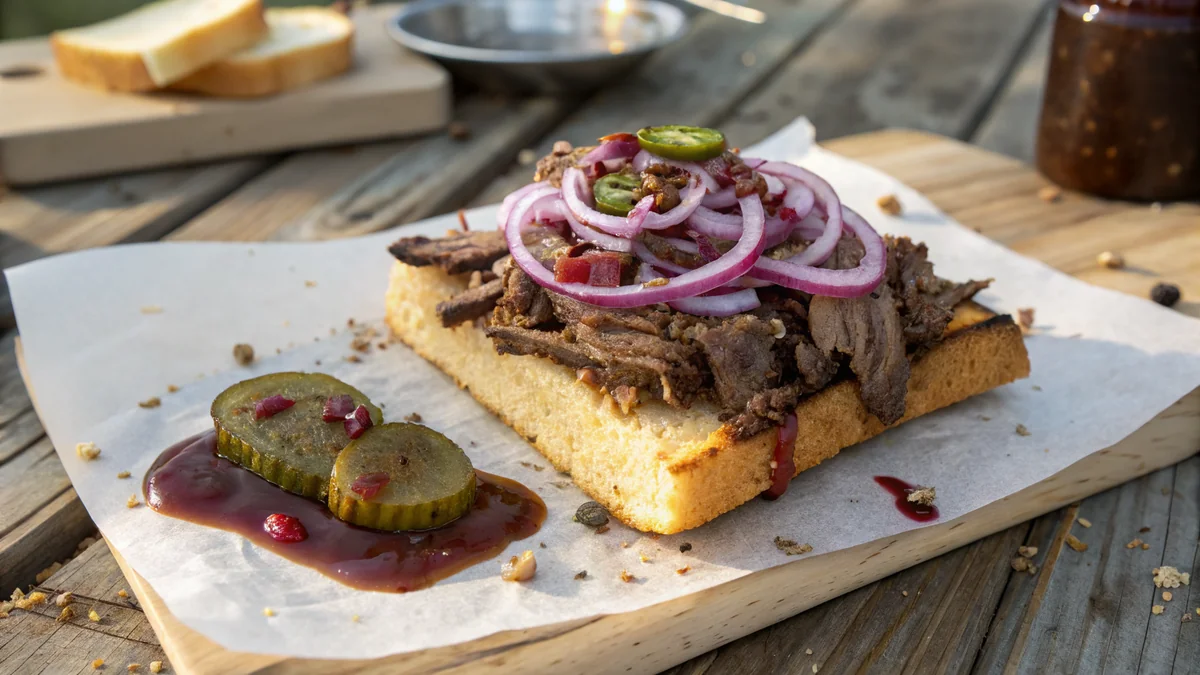
Quick answer: A cornbread brisket sandwich layers chopped or sliced smoked brisket between two thick slabs of jalapeno-cheddar cornbread, finished with pickled red onion, slaw, and a thin Texas BBQ sauce drizzle. The cornbread acts as a sturdier, more flavorful base than a soft bun - it stands up to fatty brisket without going soggy. Build it open-face for elegance, or close it and call it a sandwich. Either way, it is the best second life Texas brisket leftovers ever had.
The first time I had a cornbread brisket sandwich, I was at a Sunday pop-up in East Austin run by a chef who had grown up cooking line at Franklin BBQ before going independent. He had a stack of 1.5-inch jalapeno cornbread slabs cooling on the counter, a half pan of leftover Saturday brisket, and a quart of pickled red onions. He chopped the brisket coarse, layered it between two cornbread slabs, drizzled thin BBQ sauce, topped with onions, and handed it to me on butcher paper. I ate it standing up, in the parking lot, in about four minutes. I have been chasing that sandwich ever since.
What makes the combination work is the cornbread. A standard hamburger bun absorbs grease and turns to mush under chopped brisket. A buttery, crusty piece of cornbread does the opposite - it stays structured because of its fat content, soaks up the juice as a feature instead of a bug, and adds its own flavor instead of just carrying the meat. The Tex-Mex jalapeno-cheddar version doubles down with sharp cheese and pepper heat that cuts through the brisket fat.
This is fundamentally a leftovers recipe. If you have already smoked a brisket - even a flat-only - and you have a half pan of cornbread from the same weekend, the sandwich comes together in 25 minutes. If you are starting from scratch, follow the cross-links to Chef Mia's Central Texas brisket and Texas cornbread first; the sandwich is the third meal in that arc. It is the answer to the Monday-after-BBQ lunch problem and one of the best ways to stretch Saturday brisket through Tuesday.
The Genesis: Monday-After-BBQ Genius
Texas BBQ is a weekend project. You wake up Saturday morning, you light a fire, you cook for 12 hours, you eat at 6pm with your family or your neighbors, and you go to bed full. Sunday you eat brisket again with breakfast tacos. Monday you have half a flat in the fridge and you face the same question every BBQ household faces: what do I do with this that isn't another plate of brisket and white bread?
The cornbread brisket sandwich is one of the best answers. It uses what you already have - cooked brisket, day-old cornbread, a jar of pickled onions, a half-bottle of BBQ sauce - and turns it into something that feels like a different meal. The chef who ran the East Austin pop-up I mentioned in the intro told me he stopped serving fresh brisket sandwiches once he started making the cornbread version: customers requested the cornbread plate by name even when fresh brisket was available off the smoker. That is high praise for a leftovers dish.
The conceptual genius is that cornbread does what bread can't. Bread soaks juice and turns to paste. Cornbread, with its higher fat content and crumb structure, stays sturdy under the brisket's grease and adds its own flavor. The contrast of sharp cheddar and jalapeno against fatty brisket and acidic pickled onion is why the sandwich works.
The Cornbread Base: Jalapeno-Cheddar, Cut Thick
Not all cornbread works for this sandwich. You need a cornbread that is on the structural side - drier than typical sweet cornbread, more crumb than crumble, with enough fat to crisp on the griddle without falling apart. The Tex-Mex jalapeno-cheddar style hits the brief perfectly. Sharp cheddar adds salt and umami; pickled or fresh jalapeno adds heat that cuts through the brisket fat; corn meal gives the texture you need to hold together under chopped meat.
Skillet-baked cornbread is the right vehicle. A standard 10-inch cast iron pan baked at 400F for 25 minutes gives you a 1.5 to 2-inch deep cornbread with a crusty crown and a tight crumb. Cut the pan into 8 squares of 4 inches by 4 inches. Each square is one half of a sandwich.
If your cornbread is on the sweet side (more sugar, more milk, softer crumb), it can still work but you need to griddle the slabs longer - 3 minutes per side - to drive off some moisture and crisp the surface enough to hold up. Avoid cake-style cornbread entirely; it falls apart on first bite. Use the savory recipe at Texas cornbread for best results, or cast iron skillet cornbread as the alternative.
Day-old cornbread is actually better than fresh. A 24-hour rest tightens the crumb, dries the surface slightly, and makes the slabs hold up better on the griddle. If your cornbread is fresh out of the oven, let it cool fully and rest at room temperature wrapped loosely in a clean towel for at least an hour before cutting.
The Brisket Layer: Chopped vs Sliced
There are two schools on the brisket layer for this sandwich, and both have legitimate Texas precedent. Chopped brisket distributes evenly across the cornbread, picks up sauce and pickled onion in every bite, and is the version most pop-up vendors serve. The brisket fat melts into the cornbread crumb for a richer mouthful. Chopping also lets you mix flat and point in proportions you can't get from a single slice - leaner edges of flat with juicy point.
Sliced brisket is the steakhouse version. Take 1/4-inch slices from a rested brisket flat, fan them across the cornbread slab, and you get a more elegant presentation. The pink smoke ring shows clearly. The bite is meatier, with longer fibers to chew. Sliced is the way to go if you have beautiful, freshly-rested brisket and want to show it off.
Chopped is the way to go for actual leftovers, when the brisket has been refrigerated and reheated. Slicing fridge-cold brisket against the grain is fiddly; chopping is forgiving. Plus, chopping mixes the flat and point so you don't end up with all-flat slices that have lost moisture in the fridge.
Whichever you choose, warm the brisket gently before assembly. Cold brisket on hot cornbread is a temperature crime; the brisket cools the cornbread, the fat congeals, the sandwich is sad. Cover and warm in a low skillet with a tablespoon of stock or pan juices for 4-5 minutes. The fat re-renders, the meat softens, and the assembled sandwich tastes like it was made fresh from the smoker.
The Finish: Sauce, Slaw, Onion, Heat
Four toppings make this sandwich: sauce, slaw, pickled onion, and pickled jalapeno. Each one has a job. The sauce adds glaze and acidity. The slaw adds crunch and cool. The pickled onion adds bright acid and color contrast. The jalapeno adds heat. Skipping any one of them is fine - the sandwich still works at 75% strength - but together they form a complete bite.
The sauce should be thinned. Standard Texas BBQ sauce is already thinner than Kansas City style, but for sandwiches you want it pourable. A 1:1 sauce-to-water ratio is too thin; about 8 parts sauce to 1 part water is the right balance - it drizzles in a ribbon, picks up sheen on the brisket, and pools slightly on the cornbread without flooding it. Warm the sauce slightly so it spreads.
The slaw is more about crunch than dressing. Use a vinegar-mayo slaw with 2 parts mayo to 1 part vinegar, mixed at least 20 minutes ahead so the cabbage softens. Drain off any standing liquid before topping the sandwich. A wet slaw soaks the cornbread; a barely-dressed slaw provides the textural pop you need.
Pickled onions are non-negotiable in my book. They cut through the brisket fat better than any other element on the plate. Quick-pickled in apple cider vinegar with a little sugar and salt, ready in 30 minutes, hold two weeks in the fridge. The fuchsia color is also the visual signature of the sandwich.
Pickled jalapeno slices are the optional heat. If your jalapeno cornbread is already spicy, you can skip them. If you want the full bite, layer 3 or 4 slices on top.
Open-Face vs Closed: The Texas Tradition
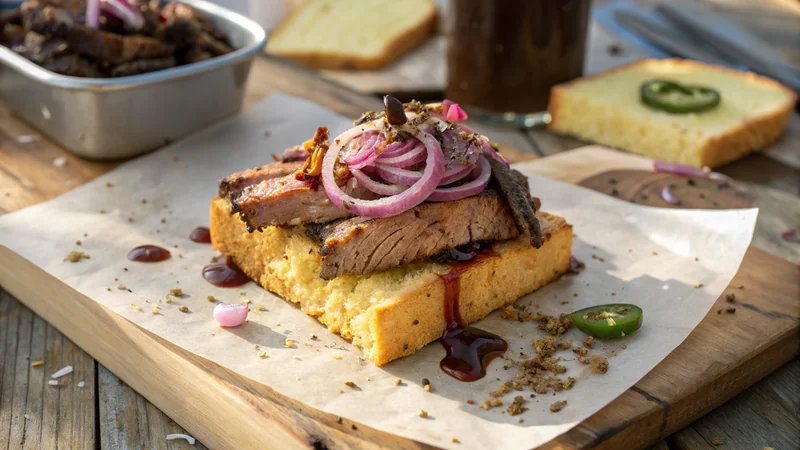
Open-face is how the East Austin pop-up served this dish, and it is the way I serve it at home: one cornbread slab on the bottom, brisket and toppings on top, no second slab. The argument for open-face is that it shows off the layers, lets the cornbread stay crisp, and is easier to eat with a fork than a closed double-decker. Plus it photographs better.
Closed sandwiches are the version you take to a tailgate. Two griddled cornbread slabs around the brisket, pressed lightly, sliced on the diagonal. The cornbread holds together better than any bun, the toppings are sealed in, and you can eat it standing up. The trade-off is that the inside of the bottom slab gets juicy from the brisket, but cornbread handles juice gracefully where bread does not.
There is no right answer. Open-face is the platonic ideal; closed is the practical version. Many Texas BBQ joints split the difference - they serve open-face on a tin tray with a fork, and you can pick up half-and-half or fold it closed to eat with your hands. Either approach is honest cowboy eating.
If you go closed, slice the sandwich on the diagonal with a serrated bread knife. The cornbread will compress slightly under the knife - that is fine - and the cross-section shows the smoke ring of the brisket against the gold of the cornbread. Photogenic.
Make-Ahead and Variations
Most components can be prepped 24 hours ahead. The cornbread is actually better day-old. The pickled red onions need 30 minutes minimum and keep two weeks. The slaw can be made up to 4 hours ahead. The thinned BBQ sauce can sit at room temperature for 30 minutes or refrigerated overnight. What cannot be made ahead is the assembled sandwich - it must be built within 8 minutes of eating, or the cornbread starts to go.
Variation: chopped beef sandwich style. Skip the slaw and pickled onion. Pile chopped brisket high, drizzle BBQ sauce, top with raw white onion slices and dill pickle chips. This is the traditional Lockhart chopped beef sandwich on cornbread instead of bread. Pure Texas, no garnish.
Variation: smoked sausage instead of brisket. Slice Texas hot links on the bias and griddle the slices. Layer with the same toppings. Faster (no need to rewarm) and a great option if you don't have brisket.
Variation: open-face brisket benedict. Top the cornbread with chopped brisket, then a poached egg, then hollandaise. Texas BBQ for brunch. Slightly outrageous, totally legal.
Variation: sweet-and-savory. Add a thin smear of homemade pepper jelly or peach jam on the cornbread before the brisket. The sweet-savory contrast is a Hill Country move and works beautifully with smoky meat.
Cornbread Brisket Sandwich Recipe
Ingredients
- 8 thick slabs jalapeno-cheddar cornbread, 1.5 inches thick (about 4-inch x 4-inch squares - see cross-link for the cornbread recipe)
- 1.5 lb (680 g) cooked smoked brisket, chopped or sliced thin (about 6 oz / 170 g per sandwich)
- 1/2 cup (120 ml) Texas BBQ sauce, thinned with 1 tablespoon water if very thick
- 1 cup pickled red onions (about 1 medium onion, sliced thin, soaked 30 minutes in 1/2 cup apple cider vinegar + 2 tsp sugar + 1 tsp salt)
- 1 cup coleslaw (cabbage + carrot + 2 tbsp mayo + 1 tbsp apple cider vinegar + salt + pepper - prepared 30 min ahead)
- 1/4 cup pickled jalapeno slices, drained
- 2 tablespoons (28 g) unsalted butter, softened, for griddling the cornbread
- Flake sea salt, for finishing
- Optional: yellow mustard, dill pickle chips, hot sauce on the side
Instructions
- Prepare the pickled red onion. If you don't have a jar already, slice 1 medium red onion as thin as you can - a mandoline at the 2 mm setting is ideal. Pack into a glass jar. Heat 1/2 cup apple cider vinegar with 2 teaspoons sugar and 1 teaspoon kosher salt until warm and dissolved. Pour over the onions. Let sit 30 minutes at room temperature. Will keep two weeks in the fridge. The onions soften, turn fuchsia, and lose their bite while keeping their crunch.
- Make the slaw. Toss 2 cups shredded green cabbage with 1/2 cup grated carrot, 2 tablespoons mayonnaise, 1 tablespoon apple cider vinegar, 1/2 teaspoon kosher salt, and a few grinds of black pepper. Let sit at least 20 minutes - the cabbage softens and the dressing distributes. Drain off excess liquid before assembling. Sturdy slaw beats wet slaw every time on a sandwich.
- Cut and griddle the cornbread. Cut the cornbread pan into 8 squares, each about 4 inches x 4 inches and 1.5 inches thick. Heat a 12-inch cast iron skillet over medium heat. Spread the soft butter on one side of each cornbread slab. Griddle butter-side down for 2-3 minutes until the surface turns deep golden brown and the edges crisp. Flip, butter the second side in the pan, griddle another 2 minutes. The slab should sound hollow when tapped and feel slightly firm at the edges. Set on a wire rack.
- Warm the brisket. If brisket is fridge-cold, warm it gently in a covered skillet over low heat with 2 tablespoons of beef stock or pan juices, stirring every minute, for 4-5 minutes until heated through but not steaming. Or wrap in foil and warm in a 300F oven for 8-10 minutes. The goal is hot enough to melt the fat but not so hot you dry it out. Chop brisket into rough 1/2-inch pieces if not already chopped, or keep whole slices for an open-face sliced sandwich.
- Thin the BBQ sauce. Texas BBQ sauce is already thinner than Kansas City style, but for sandwiches you want it thinner still - it should drizzle, not blob. Whisk 1/2 cup of <a href='https://www.texanrecipes.com/texas-bbq-sauce/'>Texas BBQ sauce</a> with 1 tablespoon of water until pourable. Warm slightly in a small saucepan if the kitchen is cold. The sauce should run off a spoon in a thin ribbon, not a thick drop.
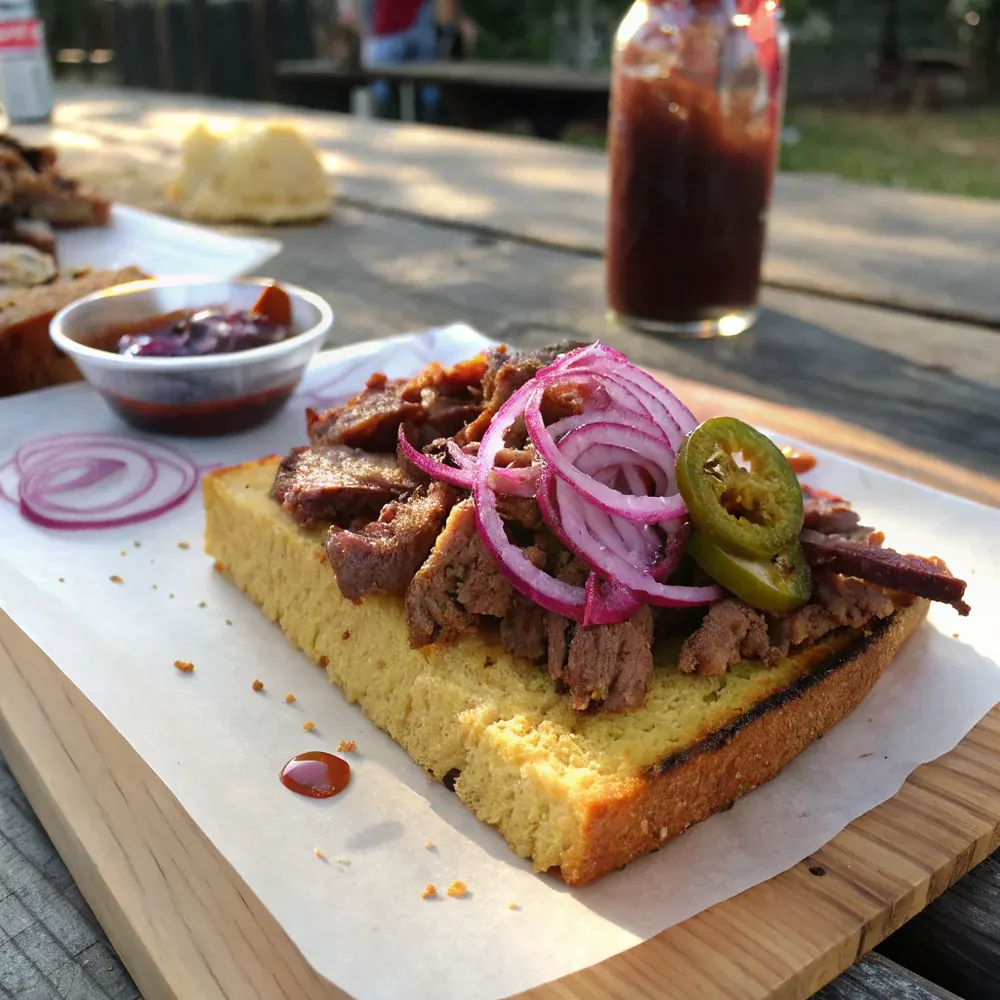
- Build the open-face sandwich. Place a griddled cornbread slab on each plate, butter-side up. Pile 6 oz (170 g) chopped brisket onto each slab, mounding it generously. Drizzle 2 tablespoons thinned BBQ sauce over the brisket in a zigzag. Top with 2 tablespoons pickled red onion, 1 tablespoon slaw, and a few pickled jalapeno slices. Sprinkle flake salt across the top.
- Optional: close it for travel. If you want a closed sandwich (easier to eat standing up, easier to wrap for a tailgate), set a second griddled cornbread slab on top, butter-side down. Press lightly. Slice in half on the diagonal with a serrated knife. The cornbread will hold the structure better than any bun, but the open-face version shows off the layers and is the steakhouse-grade presentation.
- Serve immediately. Cornbread sandwiches don't keep - the cornbread starts absorbing brisket juice on contact and gets soggy after about 8 minutes. Build right before serving. Put the BBQ sauce, hot sauce, and yellow mustard on the table for diners to add their own. Serve with dill pickle chips and a side of <a href='https://www.texanrecipes.com/texas-bbq-potato-salad-recipe/'>Texas BBQ potato salad</a> if you want the full plate.
Frequently Asked Questions
Can I use a hamburger bun instead of cornbread?
Technically yes, but you lose the entire point of the sandwich. Cornbread holds up to fatty chopped brisket without going soggy and adds its own flavor (sharp cheddar, jalapeno heat, corn). A bun absorbs the brisket grease, turns to mush in 2 minutes, and contributes nothing flavor-wise. If you must use bread, toast a thick brioche bun and butter both sides - it's a passable substitute, but cornbread is the recipe.
How do I keep the cornbread from getting soggy?
Three tricks: (1) griddle the slabs in butter to crisp the surfaces - the seared crust resists moisture; (2) use day-old cornbread, which has tighter crumb than fresh; (3) build the sandwich and eat it within 8 minutes. Cornbread can handle moderate brisket juice gracefully - that's why it works - but it is not designed to sit assembled for an hour.
Can I make cornbread brisket sandwiches ahead for a party?
Prep all the components ahead, but assemble within 10 minutes of serving. Set up a build station: griddled cornbread slabs (warm in a 200F oven), warmed chopped brisket in a chafing dish, ramekins of thinned BBQ sauce, pickled red onions, slaw, and jalapenos. Let guests build their own. Pre-built sandwiches sitting on a tray for 30 minutes are sad sandwiches.
What if I don't have leftover brisket?
You have three options: (1) smoke a brisket - follow the brisket recipe the day before; (2) buy 1.5 lb of high-quality smoked brisket from a Texas BBQ joint and bring it home; (3) substitute with a 4-hour smoked chuck roast or a slow-cooker chopped beef. The cornbread sandwich format works with any tender, smoky beef.
Can I use store-bought cornbread?
Possible but not recommended. Most store-bought cornbread is too sweet, too soft, and falls apart on the griddle. If you must, look for a savory cornbread (no/low sugar, has sharp cheddar baked in) and let it sit overnight to firm up before cutting and griddling. The 25 minutes it takes to bake your own cornbread from scratch is worth it for this sandwich.
What sauce works best on a cornbread brisket sandwich?
A thin Texas-style BBQ sauce - vinegar-forward, savory, slightly sweet. Avoid Kansas City style (too thick, too sweet) and Carolina mustard sauce (clashes with the cheddar in the cornbread). Chef Mia's Texas BBQ sauce thinned with 1 tablespoon of water per 1/2 cup is the move. Drizzle, don't pour.
Can I make this sandwich gluten-free?
Cornbread can easily be made gluten-free with a 1:1 GF flour blend in place of any wheat flour, and most cornbread recipes use mostly cornmeal anyway. The brisket, sauce, slaw, and pickles are naturally GF (check sauce labels for Worcestershire variants). Build the sandwich exactly as written with GF cornbread, and you have a fully GF Texas BBQ plate.
How spicy is this sandwich?
Medium heat by default - jalapeno cornbread brings mild heat, pickled jalapenos bring more, but neither is fiery. If you want it spicier, double the pickled jalapenos or add a dash of hot Texas BBQ sauce. If you want it milder, use a plain (no-jalapeno) cornbread base and skip the jalapeno slices on top - the sandwich is still excellent without them.