Texas BBQ
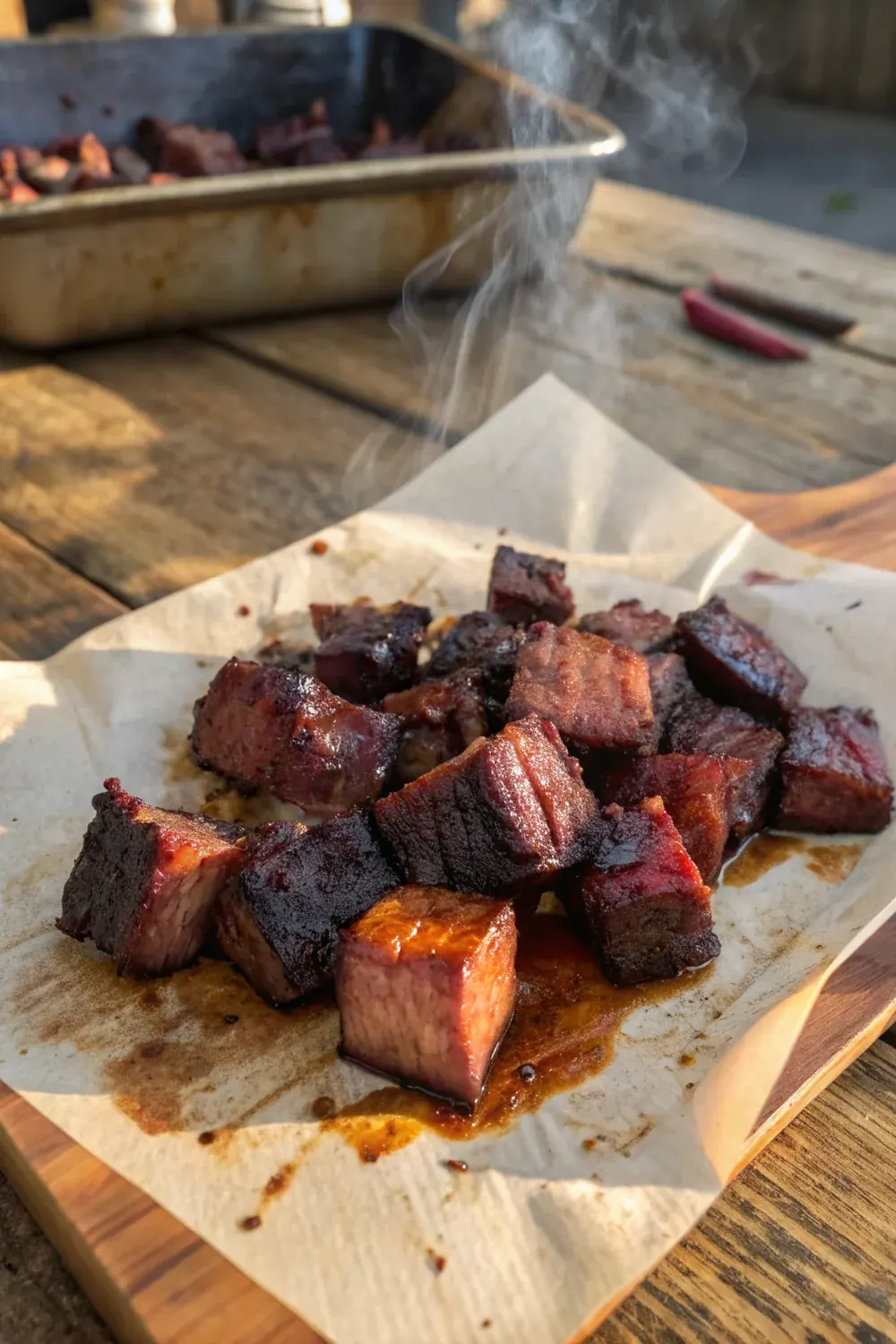
Texas BBQ Burnt Ends
Burnt ends from brisket point, double-smoked with sweet sauce glaze. The Texas BBQ pit master's secret money cut, the candy of barbecue.
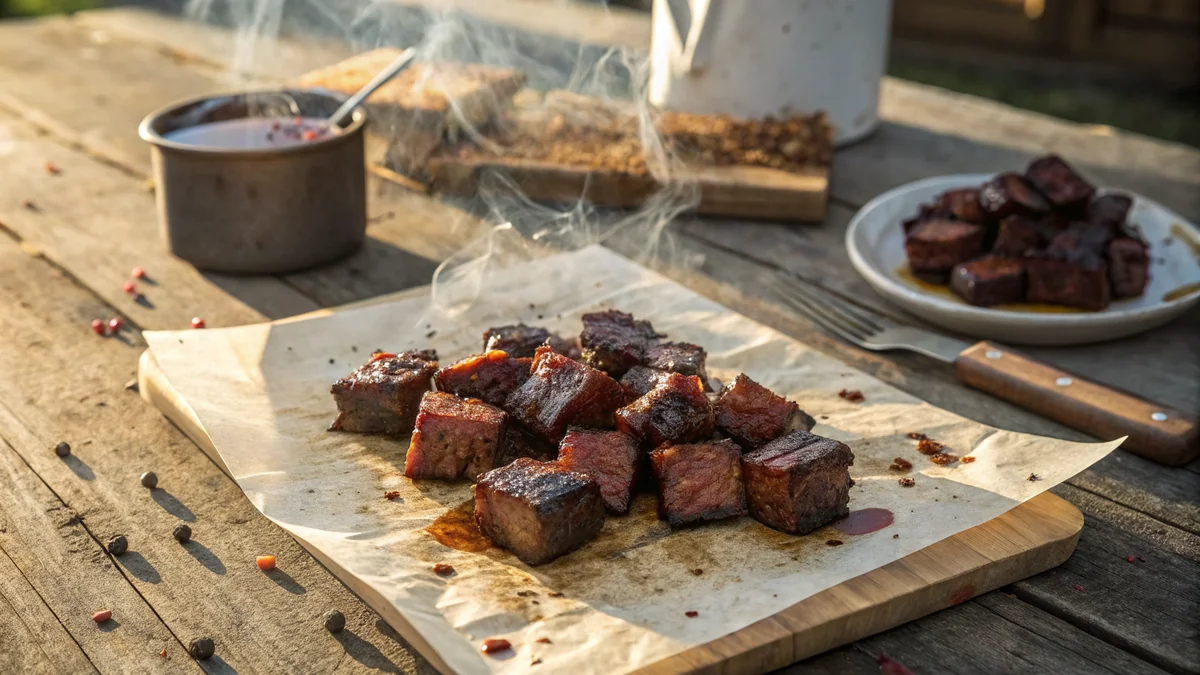
Quick answer: Burnt ends are 1.5-inch cubes cut from the fatty point of a smoked brisket, tossed in a glaze of BBQ sauce, brown sugar, butter, and honey, then returned to the smoker for 90 minutes to 2 hours at 250F until the cubes are deeply caramelized, glossy, and probe-tender. They originated as Kansas City pit-master scraps but have been fully adopted into Texas BBQ as the candy of the brisket cook. Each cube is a small bite of bark, smoke, sweet glaze, and rendered fat. Plan 4-6 hours of total cook time after the brisket comes off the smoker.
The first time I tasted real burnt ends was at a counter in Lockhart, watching a pit master named Charlie chop the point off a finished brisket with an old fillet knife and tell me, perfectly serious, that twenty years earlier the same pit master would have thrown that point in the trash. Burnt ends were originally what the pit boss kept for himself. They were the trim, the over-rendered fat-cap pieces, the corners that did not fit a clean slice. Some pit master in Kansas City started cubing them, hitting them with sauce, and selling them as a separate dish, and now there is no more profitable cut on a brisket pit anywhere in America. Charlie called them "the money cut."
Texas BBQ adopted burnt ends late, and Texas BBQ adopted them on its own terms. The Kansas City original is a sweet, almost candy-like preparation - heavy sugar, heavy sauce, sticky finish. The Texas version, the one I learned from Charlie and from a few hours watching the team at Goldee's outside Fort Worth, is more restrained: a little sauce, a little sugar, a lot of butter, and the bark from a salt-and-pepper brisket as the foundation. The result is closer to a glazed steak cube than a candy. Aaron Franklin runs his own version at Franklin Barbecue, and you can taste the discipline. The recipe below splits the difference, leaning Texas, with enough sweetness to honor the Kansas City origin.
What Are Burnt Ends? Point vs Flat
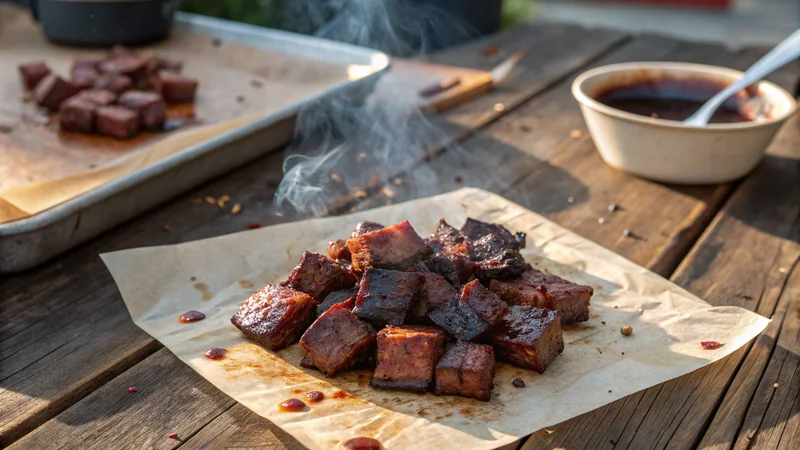
A whole packer brisket has two muscles separated by a layer of seam fat: the flat (the lean rectangular muscle, what most American grocery stores call "brisket") and the point (the thicker, fattier triangular muscle that sits on top). The two muscles cook differently because they have different fat content. The point is somewhere around 25-30% intramuscular fat; the flat is closer to 8-10%. That fat differential is why the point can be cubed and double-smoked into burnt ends, while the flat is best sliced and served straight.
Burnt ends are made exclusively from the point. The cubes from the point have enough rendered fat to stay moist through a second smoke, enough collagen to break down further into a custardy texture, and enough bark surface area per piece to caramelize aggressively in the glaze. You cannot make real burnt ends from a flat - the lean meat dries out in the second smoke and turns into beef jerky cubes.
Some pit masters cube the trim from the point edges and the flat-point seam together, blending them. The result is acceptable but not pure. The canonical Texas burnt end is point-only, 1.5-inch cubes, double-smoked, glazed.
Texas vs Kansas City Style
Burnt ends originated in Kansas City. The story most often told is that Arthur Bryant in the 1970s started saving the point trimmings, cubing them, and giving them to customers waiting in line. Calvin Trillin wrote about Bryant's burnt ends in The New Yorker in 1972 and the cut went national. Today's KC-style burnt ends are sweet, sticky, candy-like - heavy on brown sugar, heavy on sauce, glossy with corn syrup glaze.
Texas BBQ adopted burnt ends late and adapted them to Texas sensibilities. The Texas version starts with a salt-and-pepper brisket (not a sweet KC rub), uses less sugar in the glaze, leans on butter for richness instead of sweetness, and is served alongside the brisket as a counter offering rather than a separate menu item. Aaron Franklin in Austin and Goldee's outside Fort Worth both serve burnt ends in this leaner Texas style.
The recipe below leans Texas-restrained but borrows the warm-glazed-candy feel from Kansas City. If you want to push fully KC, double the brown sugar and the honey and add 2 tablespoons of corn syrup to the glaze. If you want to push fully Texas-purist, halve the brown sugar and skip the honey entirely, leaning on butter and sauce alone for the glaze.
Separating the Point from the Flat
If you are working from a fully smoked whole brisket, the separation is the first step. Set the rested brisket fat-side up on a large cutting board. Find the seam of fat that runs between the point (the thicker, more triangular muscle) and the flat (the rectangular muscle below). The seam is about 1/4 to 1/2 inch thick.
Slide a sharp boning knife along the seam, working from one end of the brisket to the other. The two muscles will separate easily once you have started the cut - they are held together by fat, not connective tissue, so the work is more about following the seam than cutting through anything tough. Take your time and stay against the grain of the fat layer.
Once separated, you have two pieces: the flat to slice and serve, and the point to cube for burnt ends. Trim any large hanging fat from the point exterior but keep the bark intact - the bark is the foundation of the burnt end's flavor. The point should weigh 4-5 lb for a 12-14 lb whole brisket.
Cubing the Point
Cube the point into 1.5-inch (4 cm) cubes, as uniform as possible. Smaller cubes (1 inch) over-render in the second smoke and turn into shrunken flavor pebbles. Larger cubes (2 inches) do not develop enough caramelization on the surface and the glaze cannot penetrate. The 1.5-inch cube is the canonical size at every Texas BBQ joint that serves burnt ends.
Use a sharp chef's knife (10-inch is comfortable) and cut on a board large enough to hold the whole point. Work in straight cuts across both axes, like cubing a watermelon. The bark layer will resist slightly - press firmly through it. Do not saw, which can shred the meat below the bark.
You should get 30-40 cubes from a 4-5 lb point. Some cubes will be more bark-heavy and others more interior-heavy; that is correct and expected. The variation is part of why burnt ends are interesting to eat. Discard any cube that is more than 70% fat with no meat - those will not glaze properly and turn into chewy fat lumps.
The Sweet Glaze
The glaze is what transforms cubes of brisket point into burnt ends. The four key components: BBQ sauce (sweet and acidic base), brown sugar (caramelization and depth), butter (fat richness and emulsification), and honey (additional caramelization at higher temperatures than brown sugar alone). The Kansas City glaze pushes the sweetness; the Texas glaze pulls back.
Use a thin Texas-style BBQ sauce as the base, not a thick KC-style sauce. Chef Mia's Texas BBQ sauce is the canonical pairing. A thick sauce coats the cubes too heavily and prevents the proper bark-to-glaze fusion. The glaze should be loose enough to pool slightly in the foil pan during the cook.
Build the glaze directly in the foil pan with the cubes. Pour the sauce, brown sugar, honey, vinegar, salt, pepper, and cayenne over the cubes; scatter the cubed butter on top. Toss gently to coat - do not break the bark. As the pan heats, the butter melts and emulsifies the sauce; the brown sugar dissolves; the honey starts to caramelize. By minute 30 you have a glossy, mahogany pool of glaze coating every cube.
The Double-Smoke Method
The defining technique of burnt ends is the double smoke. The first smoke happens during the original brisket cook (10-14 hours at 250F), where the point develops its bark and renders most of its fat. The second smoke happens after cubing and glazing (90-120 minutes at 250F), where the glaze caramelizes onto the bark, the cubes shrink and concentrate, and the surface develops the lacquered-candy finish that defines burnt ends.
Use post oak for the second smoke - the same wood that smoked the original brisket. Switching woods (mesquite, hickory) introduces flavor inconsistencies. The second smoke is shorter and the cubes are smaller, so the smoke does not need to be as heavy as the first smoke; a single chunk of oak in the firebox is enough.
The cubes do not need to be wrapped during the second smoke. They are already past the stall and they need exposure to air for the glaze to caramelize. Smoke them in an open foil pan (or cast iron skillet, my preference) so the heat circulates around them and the glaze reduces to the right thickness.
The Bark Strategy
Bark is the dark, dense, peppery crust that forms on the exterior of a smoked brisket during the long cook. It is the most flavor-dense part of the meat - intensified salt, intensified pepper, intensified Maillard reactions, and absorbed smoke. Burnt ends live or die on the bark; without good bark, you have cubed brisket point, not burnt ends.
To preserve bark during cubing, work gently and avoid sawing motions. Use a sharp knife and press through the bark layer in single cuts. Do not crush the cubes when tossing with the glaze - use two large spoons or gloved hands and a folding motion, not a stirring motion.
If your bark is thin (which can happen with a wrapped brisket cook or a glass-pan oven finish), the second smoke will help build it. The cubes will develop additional bark from the second exposure to smoke and the glaze caramelization. By the end of the 90-120 minute second smoke, even thin-barked cubes will have a substantial crust.
Probe-Tender at the Second Smoke End
The cubes are done when they are probe-tender, the same standard as a brisket. Insert a thin probe or chopstick into a sample cube; it should slide in like soft butter with zero resistance. The internal temperature will be 205-210F (96-99C), which is slightly higher than a finished brisket because the cubes have been re-cooked.
The visual cues are as reliable as the probe test. The cubes should look glossy and lacquered, with a deep mahogany color several shades darker than they went in. The glaze in the pan should have reduced to a thick syrup that pools rather than runs. A toothpick lifted from a cube should drip viscous glaze, not runny sauce.
If the cubes are not yet probe-tender at the 2-hour mark, give them 15-20 more minutes. If they are over-rendered (the cubes have collapsed into shreds), pull immediately and accept the loss - over-rendered burnt ends are still delicious, they just look less like cubes.
Serving Suggestions
Pure Texas serving. Pile the cubes on butcher paper with white bread, dill pickles, sliced raw white onion, and toothpicks. Each cube is a one-bite snack. Serve alongside the rest of the brisket, ribs, or sausage.
Burnt end sliders. Split slider buns, layer 3-4 cubes per bun with a slice of pickle and a drizzle of additional BBQ sauce. Top with thin-sliced raw onion. The slider format is what KC joints sell at the counter.
Burnt ends on mac and cheese. Top a serving of cheesy BBQ supper or any rich mac and cheese with 5-6 burnt end cubes. The richness of the mac matches the richness of the cubes; the contrast is the appeal.
Burnt ends with baked beans. Stir 1 cup of cubes into a pan of cowboy-style baked beans for the last 30 minutes of the bean cook. The cubes flavor the beans; the beans absorb the rendered burnt-end fat. Texas potluck classic.
Burnt ends as a starter. Serve a small mound on toothpicks as the appetizer course before the main brisket plate. Two or three cubes per person, no need for bread or sides.
Chef Mia's Kitchen Notes
Charlie at Lockhart told me the most important thing about burnt ends is to start with bark. "If you don't have bark, you don't have burnt ends. You have cubed pot roast." Every step before the second smoke is in service of preserving the bark from the original cook. Be gentle with the knife, gentle with the toss, gentle with the pan transfer.
I have started doing my burnt ends in a 12-inch cast iron skillet instead of a foil pan. The cast iron holds heat better, develops a deeper sear on the bottom of the cubes, and produces a slightly more concentrated glaze. The downside is more cleanup - the foil pan is a single-use disposable. For a special-occasion cook, use cast iron; for a weekly cook, use foil.
Burnt ends keep well refrigerated for 4 days. Reheat in a 250F oven, covered, for 15 minutes. Do not microwave - the glaze breaks. Leftover burnt ends in scrambled eggs the next morning is one of the best brisket leftovers in the Texas catalog.
Mistakes to Avoid
Using the flat instead of the point. The lean flat dries out in the second smoke. Burnt ends are point-only.
Cubes too small. Anything under 1.5 inches over-renders. Stay at 1.5 inches.
Crushing the bark. Tossing aggressively with a spoon shreds the bark and ruins the texture. Toss gently or fold with two spoons.
Thick BBQ sauce. KC-style thick sauce coats too heavily and prevents proper caramelization. Use a thin Texas sauce.
Skipping the butter. The butter emulsifies the glaze and adds richness. Without it, the glaze breaks and the cubes look greasy.
Re-smoking too long. 2 hours is the maximum for the second smoke. Past that, the cubes shrink to half-size and the glaze burns.
Variations
Pork burnt ends. Replace the brisket point with pork belly cubes. Smoke the pork belly initially for 3 hours at 250F, then cube and second-smoke as above. Pork burnt ends are a popular KC variant; the texture is silkier and the glaze adheres differently.
Spicy burnt ends. Add 1 tablespoon of finely chopped chipotle in adobo to the glaze, plus an extra 1/2 teaspoon of cayenne. The chipotle smoke layer pairs with the post oak from the second smoke.
Bourbon burnt ends. Add 1/4 cup of bourbon to the glaze when you build it. The bourbon evaporates during the second smoke, leaving a slight oak-and-vanilla note in the glaze. Wild Turkey 101 or Buffalo Trace are reliable choices.
Maple-coffee burnt ends. Replace the honey with 3 tablespoons of pure maple syrup and add 1 teaspoon of finely ground espresso to the glaze. The result is darker, more savory, and more grown-up than the standard sweet glaze.
Mini burnt-end ribs. Apply the same glaze method to a rack of smoked beef ribs cut into individual ribs after the smoke. The ribs glaze beautifully and serve as a heavier alternative to the cubed format.
What to Serve With Texas BBQ Burnt Ends
Burnt ends are richer than sliced brisket, and the right sides are the ones that cut richness rather than match it. Pickles (dill, bread-and-butter, or pickled jalapenos) are the canonical Lockhart accompaniment. Raw white onion, sliced thin, adds a sharp counterpoint. White bread (Mrs Baird's) is the table.
If you are building a full BBQ plate, pair the burnt ends with sliced brisket from the same cook for the side-by-side comparison, plus Texas BBQ potato salad and ranch-style pinto beans, with a tray of Texas twinkies as the starter off the same smoke. Boneless beef short ribs are a related richness and can crowd the plate; serve burnt ends on a separate occasion if you want them to shine.
For sauces, set out Chef Mia's Texas BBQ sauce on the side, but burnt ends are already glazed and rarely need additional sauce. For more BBQ ideas, see the Texas BBQ category and the Ultimate Texas BBQ Guide. Burnt ends and pulled pork are the two crowd-pleasers I lean on for a backyard spread.
Texas BBQ Burnt Ends Recipe
Ingredients
- 1 fully smoked brisket point (about 4-5 lb / 1.8-2.3 kg), still warm or freshly rested - use the point separated from a <a href='https://www.texanrecipes.com/texas-bbq-brisket/'>Texas BBQ brisket</a>
- For the sweet glaze:
- 1 cup (240 ml) <a href='https://www.texanrecipes.com/texas-bbq-sauce/'>Texas BBQ sauce</a>, or any thin Texas-style sauce
- 1/3 cup (75 g) packed dark brown sugar
- 4 tablespoons (60 g) unsalted butter, cubed
- 3 tablespoons honey
- 1 tablespoon apple cider vinegar
- 1 teaspoon coarse 16-mesh black pepper
- 1/2 teaspoon kosher salt
- 1/4 teaspoon cayenne pepper (optional)
- Equipment:
- Disposable foil half-pan (12 x 9 inches) or a cast iron skillet
- Sharp boning knife or large chef's knife
- Post oak chunks or splits, 1-2 lb for the second smoke
- Pink butcher paper for serving
Instructions
- Start with a fully cooked brisket point. Begin with a brisket that has finished smoking and rested 60+ minutes. The point should be probe-tender (200-205F internal) and fully rendered. If you are doing burnt ends as a planned secondary cook, separate the point from the flat at the end of the brisket rest. If you are using a saved-from-yesterday brisket, warm the point gently in a 250F oven wrapped in foil for 30 minutes before cubing.
- Separate the point from the flat. Set the rested brisket fat-side up on a large board. Identify the seam of fat that runs between the point (the thicker, fattier muscle on top) and the flat (the leaner rectangular muscle below). Slide a sharp boning knife along the seam and gently pull the two muscles apart. Trim any large external fat pieces but keep the bark intact - the bark is the heart of the burnt end.
- Cube the point into 1.5-inch pieces. Cut the point into uniform 1.5-inch cubes, working in straight lines across both axes. Uniform size matters - smaller cubes will over-render in the second smoke; larger cubes will not develop enough caramelization. You should get 30-40 cubes from a 4-5 lb point. Set the cubes in a single layer in a disposable foil pan.
- Heat the smoker to 250F. Light the smoker and bring the chamber to a steady 250F (121C) with a few chunks of post oak generating thin blue smoke. If you are doing this immediately after the brisket cook, the smoker is already running. If you are doing it as a separate cook, plan 30-45 minutes to bring the chamber up to temperature.
- Build the glaze in the foil pan. Pour the BBQ sauce, brown sugar, honey, apple cider vinegar, salt, pepper, and cayenne directly into the foil pan with the cubes. Scatter the cubed butter over the top. Toss gently with two large spoons or your hands until the cubes are evenly coated. Avoid breaking the bark - work gently.
- Smoke the cubes uncovered for 60 minutes. Place the foil pan on the smoker grate. Smoke at 250F uncovered for 60 minutes. The butter and brown sugar will melt into the sauce, the honey will caramelize on the surface of the cubes, and a glossy mahogany lacquer will start to develop. Stir gently at the 30-minute mark to coat any cubes that are not yet glazed.
- Continue 30-60 more minutes until tacky-glossy. Continue smoking for another 30-60 minutes. The glaze should reduce by about half and become tacky and glossy on the cubes. The internal temperature of the cubes should hold at 205-210F (96-99C). The bark should be even darker than when the cubes went in. Pull when the cubes look like glossy candy and a single cube tests probe-tender with no resistance.
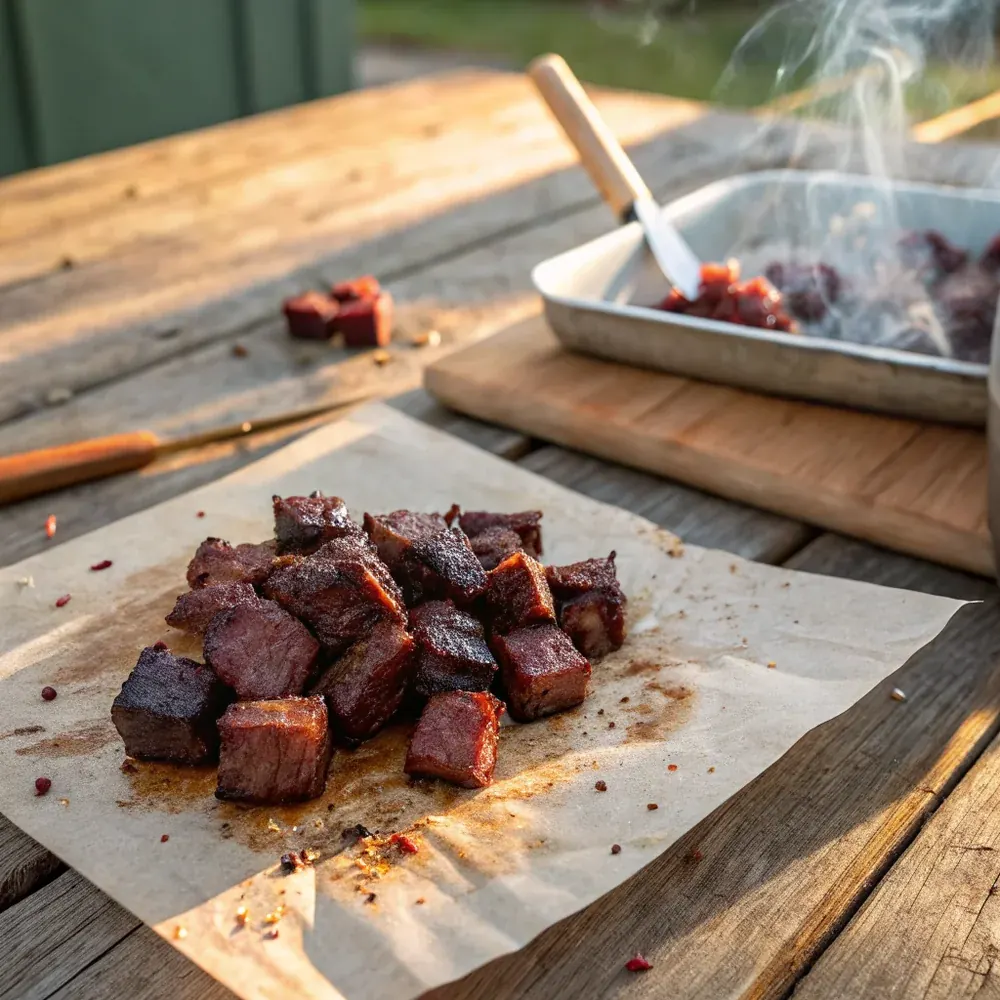
- Rest 10 minutes and serve. Pull the foil pan from the smoker and let the cubes rest 10 minutes uncovered. The glaze will continue to set as the cubes cool slightly. Transfer to a serving platter or directly onto pink butcher paper. Serve with white bread, dill pickles, raw white onion, and toothpicks. Each cube is a single bite.
Frequently Asked Questions
What part of the brisket are burnt ends made from?
Burnt ends are made exclusively from the brisket point - the thicker, fattier triangular muscle that sits on top of the flat. The point has 25-30% intramuscular fat, which is what allows it to be cubed and double-smoked without drying out. The leaner flat (8-10% fat) cannot be used for burnt ends; it dries out in the second smoke.
How long do burnt ends take to cook?
After the brisket finishes its initial cook, plan 90 minutes to 2 hours for the second smoke. Total time from raw brisket to finished burnt ends is 14-18 hours: 10-14 hours for the brisket cook, 60+ minutes rest, 30 minutes to cube and glaze, and 90-120 minutes for the second smoke. You can do the second smoke immediately after the brisket rest, or save the point and do burnt ends the next day.
What temperature do I cook burnt ends at?
250F (121C) for the second smoke, the same as a Texas brisket. Higher temperatures (275F and up) caramelize the glaze too fast and risk burning the sugar. Lower temperatures (225F) extend the cook beyond 2 hours and over-render the cubes. 250F is the canonical Texas BBQ temperature and it works for everything brisket-related.
Are burnt ends from Texas or Kansas City?
Originally Kansas City, attributed to Arthur Bryant in the 1970s and popularized by a Calvin Trillin New Yorker piece in 1972. Texas adopted burnt ends later and adapted them - less sugar, more butter, served alongside the brisket on butcher paper rather than as a separate menu item. Both styles are valid; Texas-style burnt ends are leaner, less candy-like, and more brisket-forward.
Can I make burnt ends without smoking a whole brisket?
Sort of. You can buy a whole brisket point separately at a good butcher (sometimes labeled "deckle" or "brisket point"). Smoke the point alone for 10-12 hours at 250F until probe-tender, rest, then cube and second-smoke. The result is genuine burnt ends without a 12-pound whole packer. Costco and HEB sometimes carry separated brisket points at a premium.
Can I make burnt ends in the oven?
Partially. The first cook (the original brisket smoke) needs real wood smoke - no shortcut. The second cook (the glaze caramelization) can be done in a 250F oven if your smoker is unavailable. The result is genuinely good - the cubes have already absorbed all the smoke they need from the first cook, and the second cook is mostly about the glaze. The flavor is 90% as good as smoker-second-cook.
How do I know when burnt ends are done?
Probe-tender is the same standard as a finished brisket. A thin probe or chopstick should slide into a sample cube with zero resistance. Internal temperature is 205-210F. Visual cues: deeply mahogany cubes, glossy lacquered surface, glaze in the pan reduced to a thick syrup that pools. Pull when all three signs align; do not extend the cook past 2 hours.
Can I freeze burnt ends?
Yes - vacuum-seal the cooked cubes with a few tablespoons of glaze, freeze up to 2 months. Thaw overnight in the fridge, then reheat in a 275F oven covered for 15-20 minutes. The texture holds up well; the glaze may look slightly cloudy when first thawed but recrystallizes into glossy when reheated. Avoid microwave reheats - the glaze breaks and the cubes get rubbery.