Texas Desserts
Texas King Cake
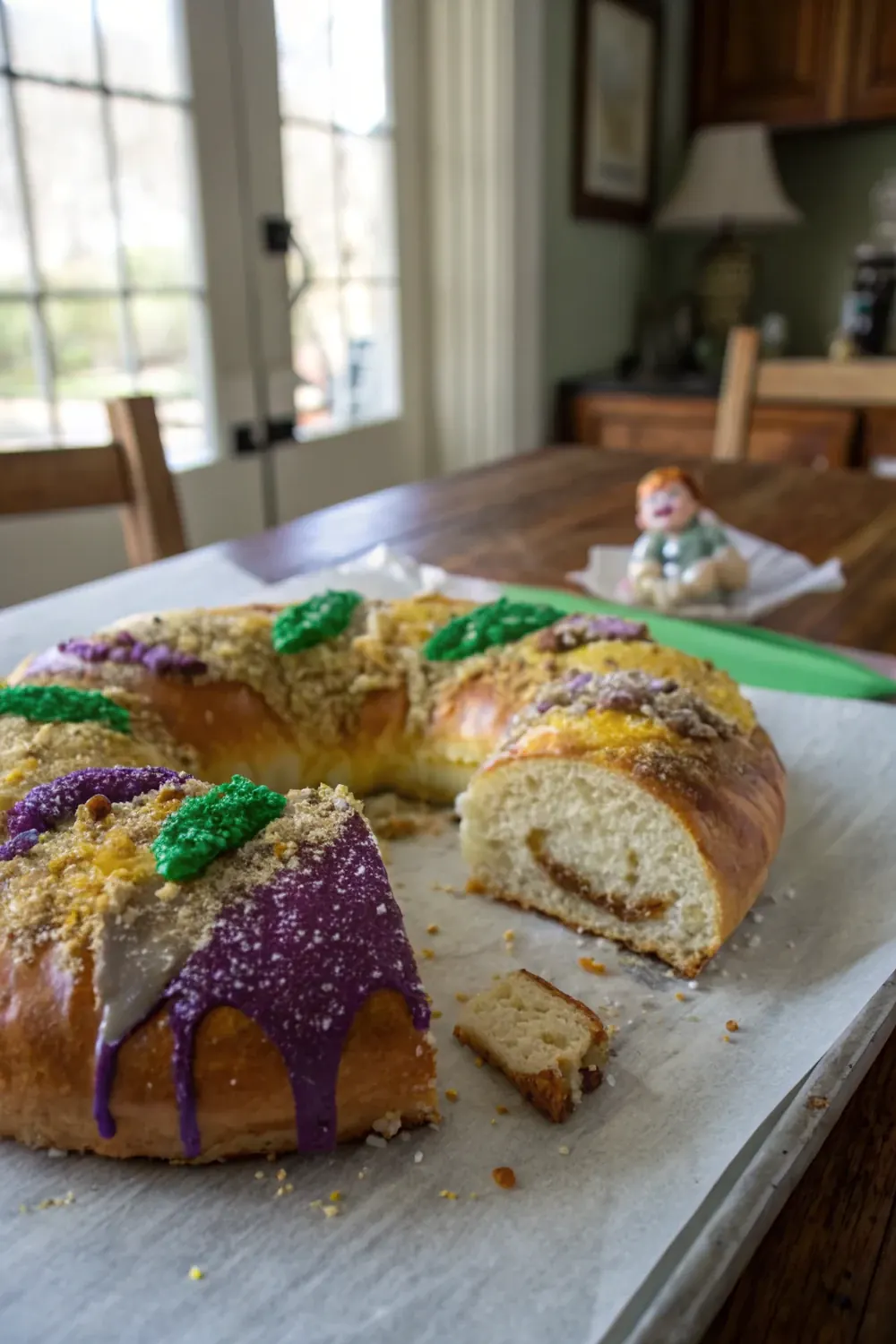
Texas king cake with brioche dough, cinnamon swirl, cream cheese filling, and purple-green-gold sugar. The Mardi Gras ring cake, Hill Country style.
Quick answer: Texas king cake is a brioche-style ring cake adopted from New Orleans Mardi Gras tradition by the Texas Cajun Triangle (Beaumont, Port Arthur, Orange) and now baked across Houston and the Hill Country. The dough is enriched with butter, eggs, and milk, rolled flat, spread with a cinnamon-brown-sugar swirl and cream cheese filling, shaped into a ring, proofed, baked, and topped with simple icing and purple, green, and gold sanding sugars. A small plastic baby is hidden inside after baking. Total time about 3 hours including two rises.
The first king cake I ever ate came from Rao's Bakery in Beaumont, sent to my grandmother by a cousin who had moved across the Sabine River into Louisiana and wanted to remind us that Mardi Gras was a Texas holiday too. The cake arrived in a pink box with a plastic baby taped to the lid, and the purple, green, and gold sugars on top had bled a little where the icing was still tacky. I was eight years old and I thought it was the most beautiful thing I had ever seen. We cut it into thick wedges at the kitchen table in Houston, and my aunt found the baby on her second slice and announced, in the tradition, that she was buying next year's cake.
King cake is New Orleans by birth and Texas by adoption. The Cajun Triangle (Beaumont, Port Arthur, Orange) has baked king cakes for generations because so many Louisiana families crossed into Southeast Texas during the oil boom. From there the cake migrated west to Houston, then up to Dallas, and now you can buy a respectable king cake at Central Market or HEB any week between Twelfth Night (January 6) and Fat Tuesday. This recipe is the Texas version: a brioche-style ring with a cream-cheese-and-cinnamon swirl, the Randazzo's-style filling that became the Texas standard, and the purple-green-gold sugar topping that means justice, faith, and power. Total time about 3 hours including two rises.
New Orleans Origin and Texas Adoption
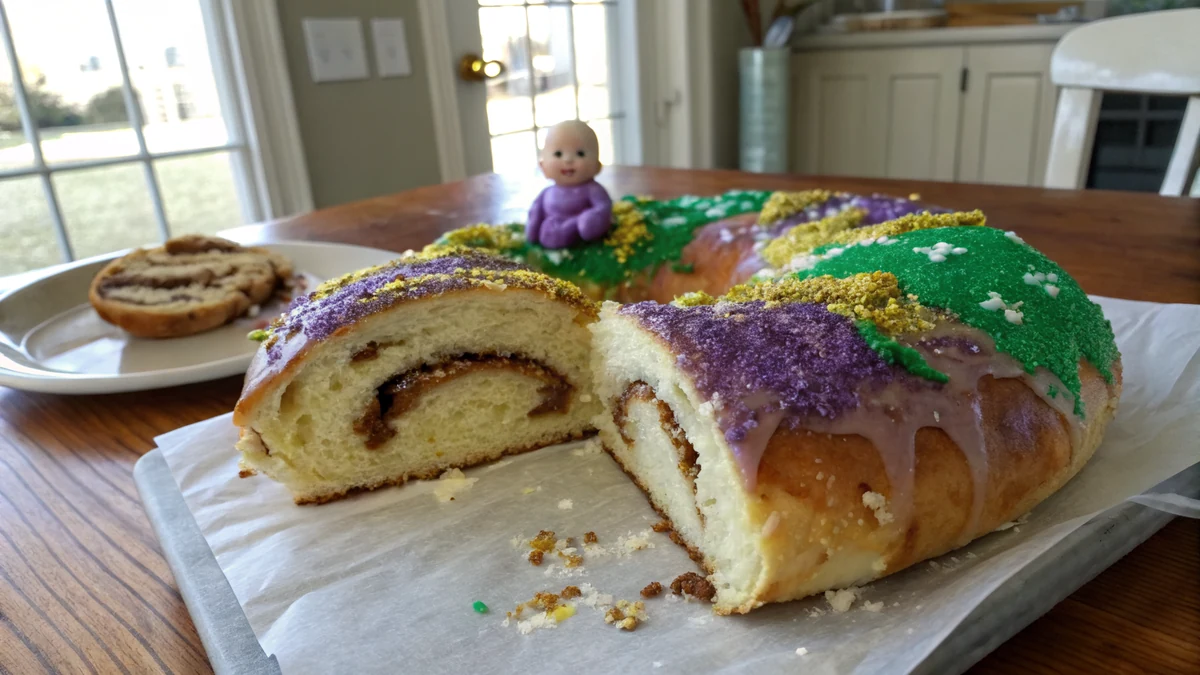
King cake is a French Catholic tradition that arrived in New Orleans with French and Creole settlers and became locked to the Carnival season, which runs from Twelfth Night (January 6, the feast of the Epiphany) through Mardi Gras (Fat Tuesday, the day before Ash Wednesday). The cake is named for the three kings of the Epiphany story, and the tradition of hiding a small token (originally a dried fava bean, later a porcelain figurine, and now almost always a plastic baby) goes back to the Roman feast of Saturnalia, transposed onto the Christian calendar.
Texas adopted king cake through the Cajun Triangle. Beaumont, Port Arthur, and Orange sit close enough to the Louisiana border that families have moved back and forth for more than a century, especially during the oil boom that pulled Cajun workers into Texas refineries. Bakeries like Rao's in Beaumont and Patrana's in Port Arthur built their February business around king cakes and shipped boxes to Houston, Dallas, and the Hill Country. Randazzo's of Metairie, Louisiana popularized the cream-cheese filling that became the Texas standard in the 1980s, and now most Texas king cakes carry that filling rather than the plain Old World original.
Today you can buy a king cake from Texas trash pie-level dessert counters at HEB, Central Market, and Fiesta from early January through Fat Tuesday. But baking one at home is a Hill Country and Houston tradition that returns every year, and the homemade version is always better than the supermarket box.
Texas King Cake vs Louisiana King Cake
The Louisiana king cake (the New Orleans-Metairie version) is the parent recipe. It is a brioche-leaning ring cake, often plain (no filling), iced with a thin glaze, and topped with the three Mardi Gras sugars. The Randazzo's bakery innovation in the 1980s added a cream cheese filling, which spread quickly through Louisiana and into Texas. By the late 1990s the cream-cheese version was the dominant style in both states, and now plain king cakes are a minority choice.
The Texas version diverges in three small but meaningful ways. First, the dough is slightly less sweet and slightly more enriched, leaning toward a Texas-style breakfast brioche rather than the lighter French original. Second, the cinnamon swirl is heavier and uses brown sugar rather than white, a Tex-Cajun adjustment that pulls the cake toward a coffee-cake flavor profile. Third, the icing is thicker and the sugars are heavier-handed, because Texas bakers like a visual punch. The cake holds together beautifully and travels well, which matters when you are driving a king cake from Beaumont to Houston for a Mardi Gras party.
The two cakes are siblings, not twins. A Louisiana baker would recognize the Texas version immediately; a Texas baker would politely note that the Louisiana version is a touch underdressed. Both are correct, both are delicious, and both deserve a slice with chicory coffee.
The Brioche Dough
King cake dough is essentially a brioche, an enriched dough heavy on butter, eggs, and milk. The bread flour is non-negotiable, all-purpose flour does not have enough gluten to support the butter without going slack. The protein content of bread flour (around 12 to 13 percent) gives the cake its signature pull-apart-but-tender crumb, somewhere between a cinnamon roll and a coffee cake.
Add the butter only after the dough has come together, and add it slowly, one piece at a time. Adding all the butter at once breaks the gluten structure and the dough never recovers. The mixer does the work; what you are looking for is a dough that pulls cleanly from the sides of the bowl after about 10 minutes of kneading, with a tacky-but-not-sticky finish. If the dough feels wet and slumps, knead longer, do not add flour.
The first rise is slow because the high butter and egg content slows yeast activity. In a Texas summer kitchen at 80F you might get away with 1 hour; in a January kitchen at 68F you may need closer to 2 hours. The dough should double in volume and a finger-press should leave a slow-filling indent. A patient rise produces a cake that is light and airy; a rushed rise produces a dense brick.
The Cream Cheese Filling and Cinnamon Swirl
The cream cheese filling is the Randazzo's-style innovation that defined modern Texas king cake. Use full-fat block cream cheese (Philadelphia is the canonical brand), softened to room temperature. The egg yolk binds it so it does not weep out of the cake during baking, and the powdered sugar sweetens without making the filling grainy. Do not use whipped cream cheese or low-fat cream cheese; the texture and structure are wrong.
The cinnamon swirl is brown-sugar-forward, which is a Tex-Cajun adjustment. Light brown sugar gives a deeper molasses note than white sugar; dark brown sugar would be too aggressive and overwhelm the cream cheese. Soft butter binds the swirl into a paste that spreads evenly and does not tear the dough. Two tablespoons of cinnamon sounds like a lot but the swirl needs to register clearly through the dough and the icing.
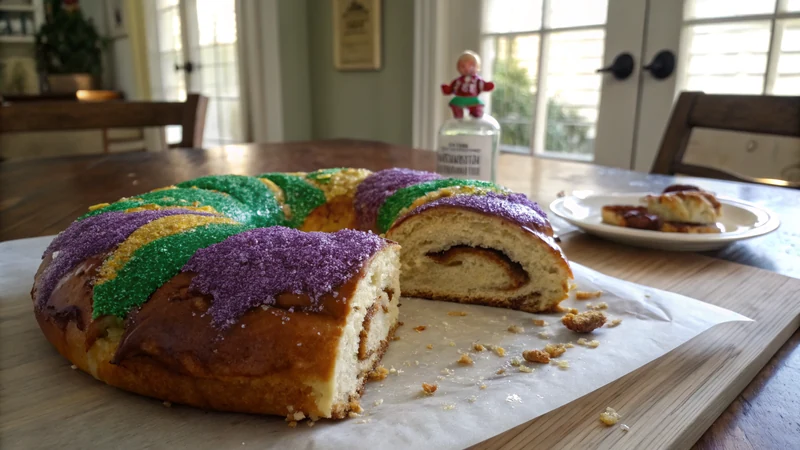
Spread the swirl first, then dollop the cream cheese on top. The two layers blend slightly during rolling, which is what gives the finished cake its marbled cinnamon-and-cream-cheese spiral. If you swap the order (cream cheese first, then cinnamon paste on top) the cinnamon tears the cream cheese layer and the swirl looks muddied.
Shaping the Ring
King cakes are oval, not round. The oval shape is a New Orleans tradition that distinguishes king cake from a standard ring cake or wreath bread, and Texas bakeries follow the convention. After rolling the dough into a 24-inch log, lay it on the parchment-lined sheet pan in a long curve, then bring the two ends together to form an oval roughly 12 inches across at the widest point and 9 inches across at the narrowest.
Seal the joint carefully. Pinch the two ends together and tuck one end inside the other for a clean seam, then turn the joint underneath the cake so the top of the ring shows no break. A poorly sealed joint will burst open during baking and leak filling onto the sheet pan. A small leak is forgivable (the bakery in Beaumont calls it the cake's signature), but a wide split looks sloppy.
Some bakers (especially home bakers) make a slightly smaller ring on a pizza stone or pizza pan rather than a half sheet pan. The smaller ring concentrates the filling and produces a slightly taller cake. The half-sheet method gives a wider flatter ring with more surface for icing and sugars. Both are correct; pick what fits your oven.
The Two Rises
The first rise (1 to 1 1/2 hours) develops flavor and structure. The dough doubles in volume and the gluten relaxes enough to roll out without snapping back. Skipping or shortening the first rise produces a tight, bready, dense cake that does not have the airy brioche crumb you want.
The second rise (45 minutes to 1 hour) is shorter because the shaped dough is already full of active yeast. Watch for visual puff rather than strict timing. The cake should look about 1 1/2 times its shaped size, with a slightly springy surface that holds a soft press. Over-proofing is the bigger risk here; an over-proofed king cake will collapse during baking and look deflated when iced.
If your kitchen is cold (a Hill Country January is often 60 to 65F indoors), use the oven-with-light trick. Turn the oven light on (the bulb provides about 5 to 8 degrees of warmth), place the dough inside with the oven off, and the proofing temperature stays around 75F. Or place the dough on top of a warm refrigerator. Brioche dough hates a cold rise.
Baking and Doneness
Bake at 350F. Higher temperatures brown the top before the inside is cooked through, lower temperatures dry the cake out. The 350F sweet spot gives you a deep golden top and a fully baked interior in 28 to 35 minutes for a 12-inch ring.
Doneness is best judged by internal temperature. An instant-read thermometer pushed into the thickest part of the ring should read 190 to 195F. The traditional toothpick test does not work well here because of the filling; you may hit cream cheese and think the cake is underdone. Trust the thermometer.
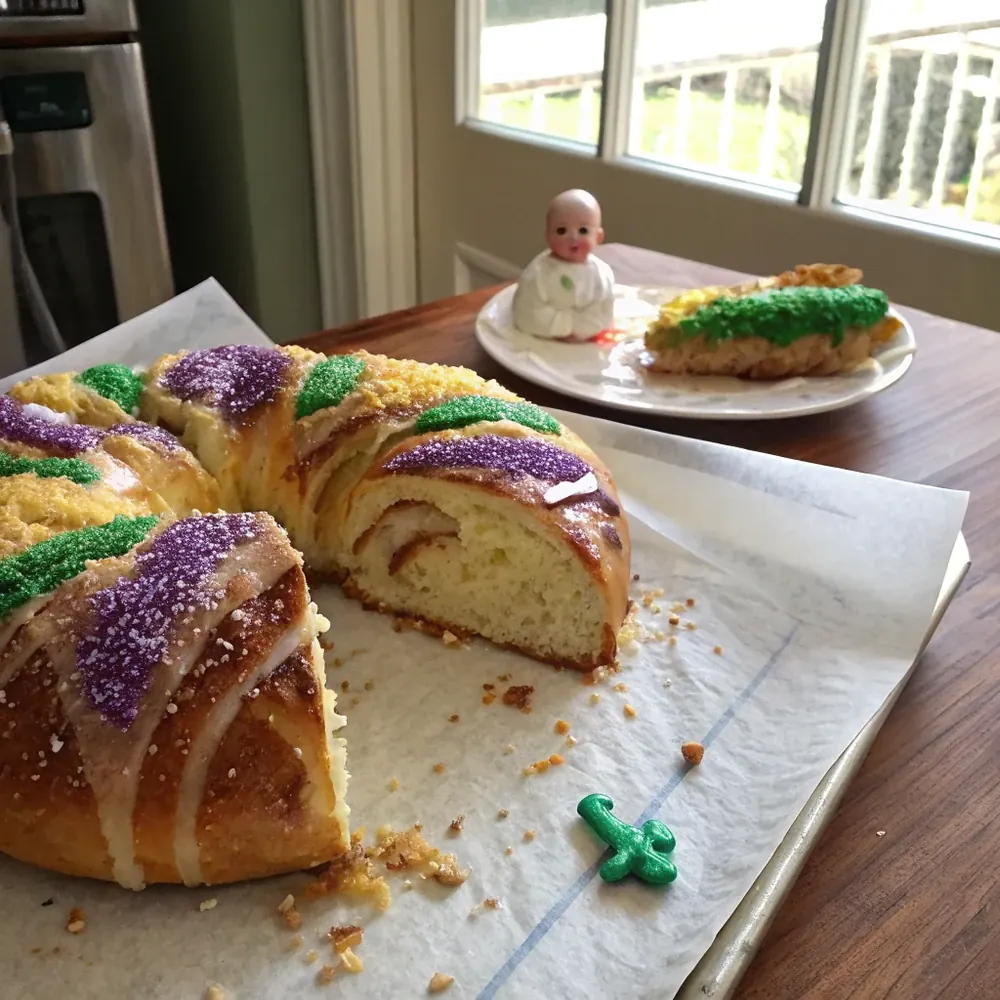
Some filling will seep out at the seams and pool on the parchment. This is normal. The dark caramelized leaks taste like brown-butter-cinnamon and are arguably the best bite of the whole cake. Cool the cake on the sheet pan for 15 minutes (it is fragile when hot) before transferring to a wire rack. Trying to move it earlier will tear the bottom and lose filling.
Icing, Sugars, and the Three Colors
The Mardi Gras colors were chosen by Rex, the King of Carnival, in 1872, and the official symbolism was assigned in 1892. Purple stands for justice, green for faith, and gold for power. The three sugars are arranged in alternating bands around the oval ring, repeating two or three times, never blended together. The visual effect is what makes a king cake recognizable from across the room.
The icing is a simple powdered sugar glaze, thick enough to coat the cake but thin enough to drizzle from a spoon. Almond extract is a traditional addition (about 1/4 teaspoon) that gives the icing a subtle marzipan note and is what most New Orleans bakeries use. Skip the almond if you have allergies in the room or simply prefer vanilla. The icing should be applied while the cake is fully cool, not warm; a warm cake melts the icing into a thin runny glaze that runs straight off.
Sprinkle the sanding sugars while the icing is still wet (within 5 minutes of pouring). The sugars stick best to wet icing; if you wait until the icing has set, the sugars roll right off. Sanding sugars are coarse decorating sugars sold at HEB, Central Market, Walmart, or any cake-decorating supply. If you cannot find purple, you can mix red and blue sanding sugars; if you cannot find gold, yellow sanding sugar works fine.
The Plastic Baby Tradition
The most famous king cake tradition is the small plastic baby hidden inside. Whoever finds the baby in their slice is crowned king or queen for the day and is responsible for buying or baking next year's king cake. Some Texas families add a twist: the finder also hosts the next year's Mardi Gras party. It is a tradition that perpetuates itself, which is part of the charm.
The baby was originally a dried fava bean, in keeping with the Roman Saturnalia origin, then a porcelain figurine, and starting in the 1940s a small plastic doll. Bakeries used to bake the baby inside the cake but liability concerns and FDA guidance now strongly recommend hiding it after baking. Push the baby up into the cooled cake from the underside, where the icing will not show the entry point. Tell every guest that the cake contains a small plastic figurine before you serve, especially if young children are eating.
If you do not have a plastic baby, a dried fava bean is the historical original and works well. Some Texas families use a pecan half (a Texan adjustment that nods toward the Hill Country), and others hide a small piece of foil-wrapped chocolate. The exact token is less important than the tradition, find it, you buy next year.
Chef Mia's Kitchen Notes
I bake king cakes from Twelfth Night through Fat Tuesday every year, and I have learned a few things the hard way. First, do not skip the second rise. The first time I rushed the proof to get the cake into the oven before company arrived, the cake collapsed and the icing pooled into a sad puddle on the platter. The 45 to 60 minutes is not optional.
Second, the dough freezes beautifully after the first rise. Punch it down, wrap it tightly in plastic, and freeze for up to 1 month. Thaw overnight in the refrigerator, then bring to room temperature and proceed with rolling and filling. This trick lets me bake fresh king cakes on Fat Tuesday without spending the morning kneading.
Third, sanding sugars dry out and clump after about a year in the pantry. Mardi Gras supplies hit Texas store shelves around late December every year, that is when to buy. I keep my purple, green, and gold sugars in a cool dark drawer and replace them annually. For a full Texas dessert spread, I serve king cake alongside Texas pecan pie when guests want a richer second option.
Mistakes to Avoid
All-purpose flour instead of bread flour. The cake will be tender but slumpy, with no chew. Bread flour is essential for the brioche structure.
Cold butter or cold eggs. Cold butter does not emulsify into the dough, and cold eggs slow the yeast. Bring everything to room temperature first.
Skipping the second rise. An under-proofed cake bakes dense and the icing sits flat. The 45 to 60 minute second rise is non-negotiable.
Baking the plastic baby inside. The baby can melt, warp, or release plasticizers into the cake. Hide it after baking from underneath.
Icing a warm cake. Warm cake melts the icing into a thin runny glaze that runs off the sides. Cool the cake completely first.
Sprinkling sugars on dry icing. The sugars need wet icing to stick. Decorate within 5 minutes of pouring the icing.
Over-proofing. An over-proofed shaped ring collapses in the oven and the cake looks deflated. Watch for 1 1/2 times the original size, not double.
Variations
Praline king cake. Add 3/4 cup of chopped toasted pecans to the cinnamon swirl for a Texas-pecan twist. Drizzle a thin caramel layer over the icing for a praline-king-cake hybrid that nods to the Cajun Triangle.
Cream cheese only (no cinnamon). Skip the cinnamon swirl and use a double batch of the cream cheese filling. The result is a lighter, milder cake that lets the brioche flavor shine. Common in plain Louisiana versions.
Bourbon-pecan king cake. Add 2 tablespoons of bourbon to the cream cheese filling and 1/2 cup of toasted pecans to the cinnamon swirl. The bourbon evaporates during baking but leaves a vanilla-caramel depth.
Chocolate king cake. Replace the cinnamon swirl with a chocolate-hazelnut spread (Nutella works) and skip the cream cheese. A non-traditional variant that has shown up at Houston bakeries in recent years.
Three Kings Day cake (rosca de reyes). The Mexican-Texan cousin, also a ring cake, served on January 6 instead of Mardi Gras, decorated with candied fruit instead of sugars. Common in Tex-Mex households across San Antonio and the Rio Grande Valley.
Mini king cakes. Divide the dough into 6 portions, roll each into a small log, and shape mini ovals about 4 inches across. Bake at 350F for 18 to 22 minutes. Perfect for a Mardi Gras party platter.
What to Serve With King Cake
King cake is a brunch and afternoon dessert, not a dinner finisher. The traditional Mardi Gras pairing is chicory coffee (Cafe du Monde is the canonical New Orleans brand, available at HEB and Central Market in Texas) or a strong dark roast with a splash of cream. The bitter coffee balances the sweet icing and cuts through the cream cheese richness.
For a full Mardi Gras spread, pair king cake with savory Cajun-Texan dishes earlier in the meal. Texas Christmas trifle works as a second dessert option for a holiday-style sweet table, especially if you are doing a Twelfth Night party rather than Fat Tuesday. The flavor profiles are close cousins, both rich and creamy with a slight tang.
For drinks, hurricanes (the New Orleans cocktail) and Sazeracs are the canonical Mardi Gras options, but a cold glass of milk works beautifully for an afternoon slice. For a kid-friendly party, hot chocolate with a touch of cinnamon plays well off the cake's cinnamon swirl. Read more about Mardi Gras food traditions in Texas Monthly's food coverage, which tracks the Cajun-Triangle bakeries that ship king cakes across the state every February.
Texas King Cake Recipe
Ingredients
- For the brioche dough:
- 4 cups (500 g / 17.5 oz) bread flour, plus extra for dusting
- 1/2 cup (100 g / 3.5 oz) granulated sugar
- 2 1/4 teaspoons (1 packet / 7 g) instant yeast
- 1 teaspoon fine sea salt
- 1/2 teaspoon ground nutmeg
- 1/2 cup (120 ml) whole milk, warmed to 110F
- 4 large eggs, room temperature
- 1 teaspoon pure vanilla extract
- 1/2 cup (115 g / 4 oz) unsalted butter, softened and cut into pieces
- For the cream cheese filling:
- 8 oz (225 g) cream cheese, full-fat block style, softened
- 1/3 cup (40 g) powdered sugar
- 1 large egg yolk
- 1 teaspoon vanilla extract
- Pinch of fine sea salt
- For the cinnamon swirl:
- 1/2 cup (110 g) packed light brown sugar
- 2 tablespoons ground cinnamon
- 3 tablespoons unsalted butter, softened
- Pinch of fine sea salt
- For the egg wash and icing:
- 1 large egg, beaten with 1 tablespoon milk
- 2 cups (240 g) powdered sugar, sifted
- 3 to 4 tablespoons whole milk
- 1/2 teaspoon vanilla extract
- 1/4 teaspoon almond extract (optional, traditional)
- For decoration:
- Purple sanding sugar (about 3 tablespoons)
- Green sanding sugar (about 3 tablespoons)
- Gold or yellow sanding sugar (about 3 tablespoons)
- 1 small plastic king cake baby (food-safe), or 1 dried fava bean as a traditional substitute
- Equipment:
- Stand mixer with dough hook (a hand mix is possible but slower)
- Half sheet pan lined with parchment paper
- Bench scraper or sharp pizza cutter
- Instant-read thermometer
Instructions
- Mix and knead the dough. In the bowl of a stand mixer, whisk together the bread flour, sugar, instant yeast, salt, and nutmeg. Add the warmed milk, eggs, and vanilla. Mix on low with the dough hook for 2 minutes until a shaggy dough forms. With the mixer running on medium-low, add the softened butter one piece at a time, waiting for each piece to be absorbed before adding the next. Continue kneading for 8 to 10 minutes until the dough is smooth, elastic, and pulls cleanly from the sides of the bowl. The dough should feel tacky but not sticky.
- First rise. Transfer the dough to a lightly buttered large bowl and turn it once to coat. Cover tightly with plastic wrap or a clean kitchen towel. Let rise in a warm spot (75 to 80F is ideal, on top of the refrigerator works in a Texas kitchen) for 1 to 1 1/2 hours, until doubled in volume. The dough is ready when a finger pressed gently into the surface leaves an indent that fills back slowly. Do not rush this rise; brioche needs the time to develop its butter-and-egg structure.
- Make the fillings. While the dough rises, prepare both fillings. For the cream cheese filling, beat the softened cream cheese with the powdered sugar until smooth, then beat in the egg yolk, vanilla, and salt. Refrigerate until the dough is ready. For the cinnamon swirl, combine the brown sugar, cinnamon, softened butter, and salt in a small bowl with a fork until you have a thick spreadable paste. Set aside at room temperature. Both fillings should be soft and spreadable when the dough is rolled out, not cold and stiff.
- Roll and fill the dough. Turn the risen dough onto a lightly floured surface and gently press out the gas. Roll the dough into a rectangle about 24 inches long and 12 inches wide, with the long side facing you. Spread the cinnamon-brown-sugar paste evenly over the entire surface, leaving a 1-inch border along the top long edge. Drop the cream cheese filling in dollops over the cinnamon layer and gently spread it into a thin even layer using a small offset spatula. Do not worry about perfection, the swirl will hide any unevenness.
- Roll into a log and form the ring. Starting at the long edge nearest you, roll the dough away from you into a tight log, keeping the seam along the bottom and pinching to seal the long edge. The log should be roughly 24 inches long. Carefully transfer the log seam-side-down to a parchment-lined half sheet pan, then bring the two ends together to form an oval ring (king cakes are traditionally oval, not perfectly round). Pinch the ends firmly to seal, tucking one end inside the other for a clean joint. The ring will be about 12 inches across.
- Second rise. Cover the shaped ring loosely with plastic wrap or a clean kitchen towel and let rise in a warm spot for 45 minutes to 1 hour, until visibly puffed and about 1 1/2 times the original size. Around the 30-minute mark, position a rack in the center of the oven and preheat to 350F. The second rise is shorter than the first because the shaped dough still has plenty of yeast activity. Do not over-proof, an over-proofed king cake collapses in the oven.
- Egg wash and bake. Brush the surface of the proofed ring evenly with the egg wash, getting into all the cracks and folds for a glossy golden top. Bake at 350F for 28 to 35 minutes, rotating the pan halfway through, until the top is deep golden brown and the internal temperature reads 190 to 195F on an instant-read thermometer in the thickest part. If the top is browning too fast around the 20-minute mark, tent loosely with foil. Some filling may seep out, that is normal and delicious. Cool on the pan for 15 minutes, then transfer carefully to a wire rack to cool completely.
- Hide the baby, ice, and decorate. Once the cake is fully cool, push the small plastic baby up into the cake from the underside (never bake it inside, it can melt or warp). Whisk the powdered sugar with 3 tablespoons of milk, the vanilla, and the almond extract until thick but pourable, adding more milk a teaspoon at a time as needed. Drizzle the icing generously over the cake in a back-and-forth pattern. While the icing is still wet, sprinkle the sanding sugars in alternating bands of purple, green, and gold around the ring. Each color repeats two or three times around the oval. Let the icing set for 20 minutes before slicing.
Frequently Asked Questions
What is the difference between a Texas king cake and a Louisiana king cake?
The Louisiana (New Orleans-Metairie) king cake is the parent recipe, a brioche ring cake topped with a thin glaze and the three Mardi Gras sugars. The Texas version, popularized by the Cajun Triangle bakeries in Beaumont and Port Arthur, uses a slightly less sweet and more enriched dough, a brown-sugar cinnamon swirl rather than white-sugar, a heavier cream cheese filling (the Randazzo's-style innovation), thicker icing, and heavier-handed sanding sugars. The two are siblings, not twins. Both are delicious.
Why is there a plastic baby in king cake?
The hidden token is a tradition that goes back to Roman Saturnalia (a dried fava bean) and was transposed onto the Christian Epiphany feast day. Whoever finds the baby in their slice is crowned king or queen for the day and is responsible for buying or baking next year's king cake. The token has evolved from fava bean to porcelain figurine to plastic baby. Modern food-safety guidance recommends hiding the baby after baking by pushing it up into the cooled cake from underneath, never baking it inside.
Can I make king cake without a stand mixer?
Yes, but it is harder. Brioche dough is heavily enriched and the butter needs slow incorporation, which a stand mixer with a dough hook does effortlessly. By hand, you would mix the shaggy dough, then slap-and-fold knead on a lightly floured counter for 15 to 20 minutes, gradually working in the softened butter a piece at a time. The technique is similar to French baker fraisage. The result is the same; the labor is just longer. A bread machine on the dough cycle also works.
Can I make king cake ahead?
Yes, in two ways. The dough can be made through the first rise, punched down, wrapped tightly, and refrigerated for up to 24 hours. Pull it out, let it warm for 30 minutes, and proceed with rolling and filling. Or freeze the dough after the first rise for up to 1 month, thaw overnight in the refrigerator, then proceed. The fully baked and iced cake stays good at room temperature, covered, for 2 to 3 days; the icing softens slightly but the cake holds up well. Do not freeze the iced cake, the sugars bleed.
Where do I find a plastic king cake baby in Texas?
HEB, Central Market, and Fiesta carry plastic king cake babies in the cake-decorating aisle from late December through Fat Tuesday. Walmart and Hobby Lobby also stock them in the same season. If you cannot find one, order online (Amazon and Etsy both carry food-safe plastic babies in bulk), or use the historical original, a dried fava bean, which works fine and never melts. Some Texas families substitute a pecan half as a Hill Country adaptation.
Why did my king cake come out dense?
Almost always one of three problems. First, under-proofed dough, the first rise needs the full 1 to 1 1/2 hours, especially in a cold kitchen. Second, all-purpose flour instead of bread flour, the lower protein cannot support the butter and the dough goes slack. Third, cold butter or cold eggs, which slow the yeast and break the emulsion. Fix all three and the cake comes out light and airy. The internal temperature at doneness should read 190 to 195F; under-baked cake also reads dense.
What sanding sugar colors do I need and where do I buy them?
Three colors: purple (justice), green (faith), and gold or yellow (power). HEB, Central Market, Walmart, Michaels, and Hobby Lobby all carry sanding sugars in cake-decorating aisles, and the colors hit shelves around late December every year for Mardi Gras. Online options include Wilton, India Tree, and SugarFlair. If you cannot find purple sugar, mix equal parts red and blue sanding sugar. If you cannot find gold, plain yellow works. Buy fresh sugars annually, they clump after a year.