Texas Desserts
Texas Pecan Pie
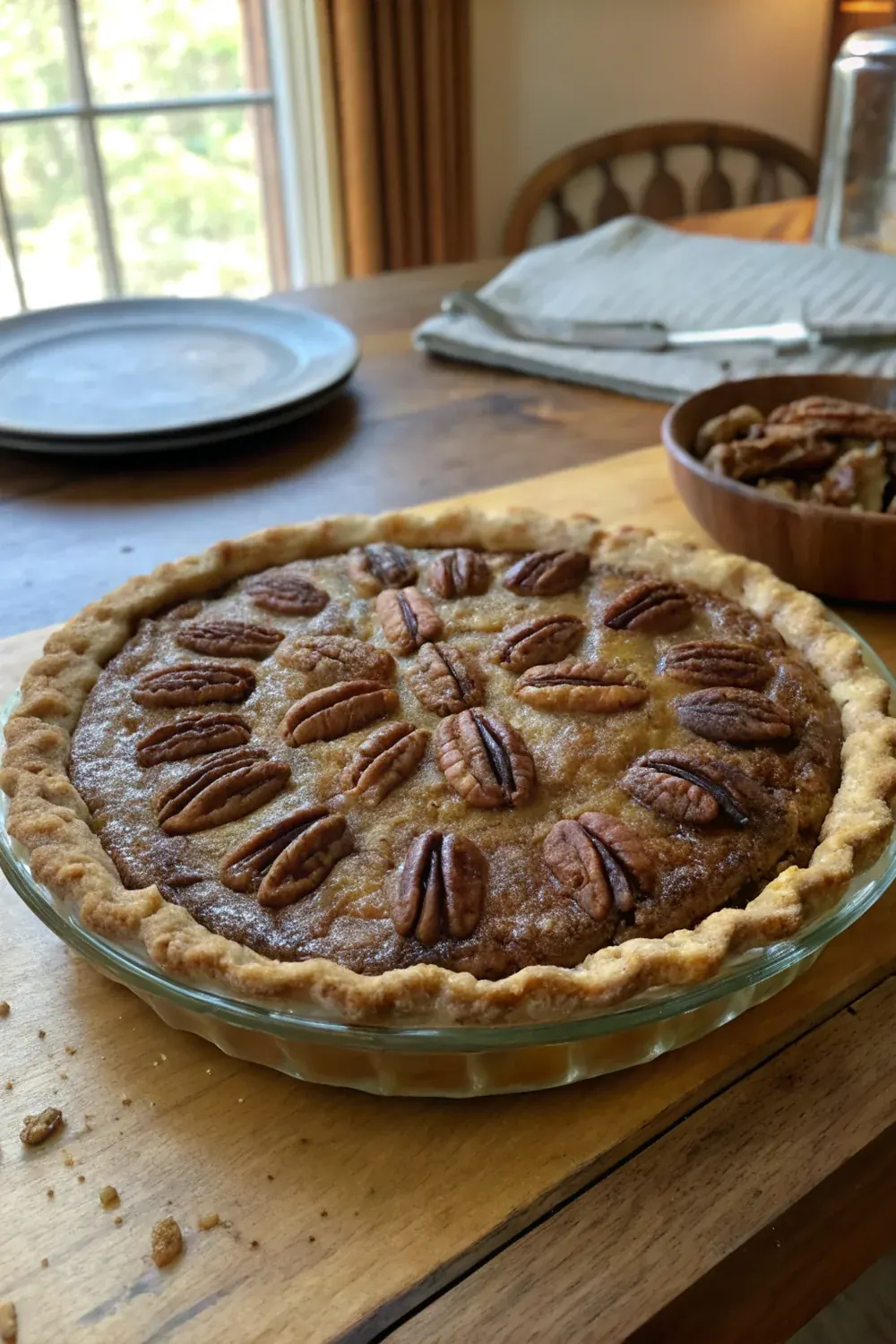
Chef Mia's Texas pecan pie: all-butter blind-baked crust, dark brown sugar and Karo filling, San Saba pecans, optional bourbon. Jiggle test for doneness.
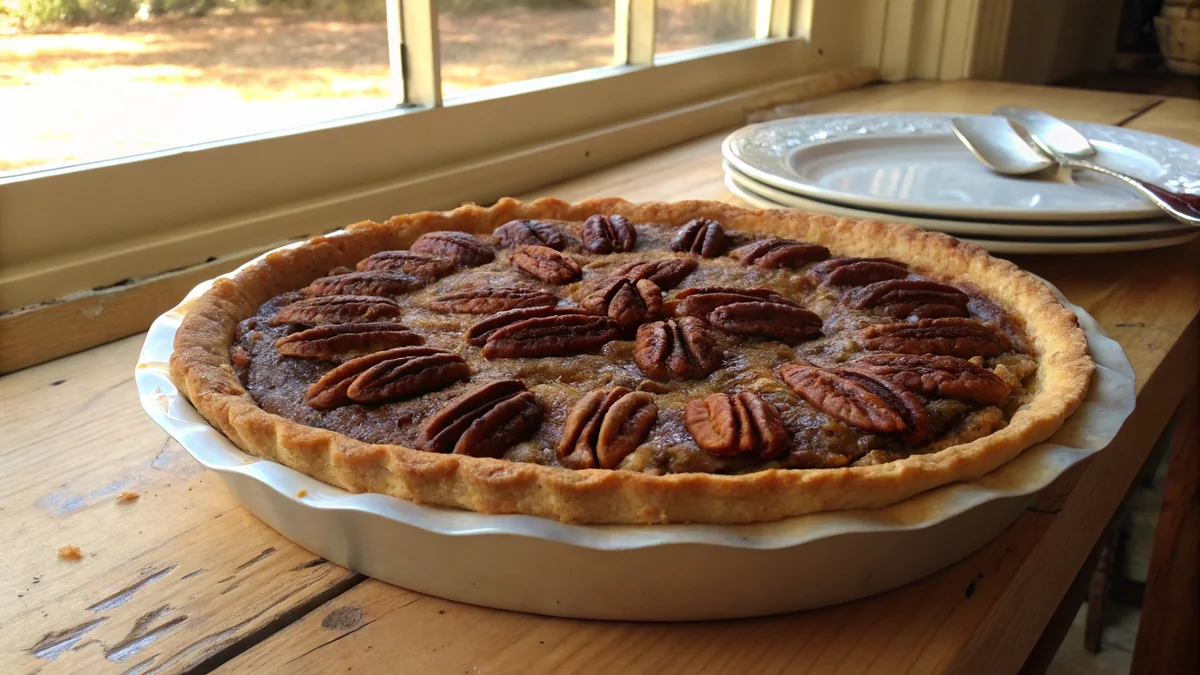
Quick answer: Texas pecan pie starts with an all-butter crust that you blind-bake until golden, then fill with a mix of three eggs, a cup of light corn syrup, dark brown sugar, melted butter, vanilla, a pinch of salt, and an optional tablespoon of bourbon. Top with two cups of Texas pecan halves, bake at 350F for 50-60 minutes until the center jiggles like soft jello but does not ripple, and cool at least four hours before slicing. The state pie of Texas, done right, is firm-but-tender, never runny, never weeping.
Pecan pie is the official state pie of Texas, and there is a good reason: pecans are native to the state, the San Saba region claims to be the pecan capital of the world, and roughly half the country's pecan harvest comes from Texas growers. The pecan tree (Carya illinoinensis) was officially designated the state tree in 1919. None of this is trivia - it shapes how Texas pie tastes. The pecans here are smaller, more flavorful, and oilier than Georgia pecans, which translates to a richer pie even before you start.
I learned to make pecan pie from my aunt outside San Antonio, who learned it from her mother in Goliad, who learned it from a Czech grandmother who arrived in 1906 and adapted her European pastry tradition to whatever the land gave her. The version below is the one I make every Thanksgiving and every November birthday in my family. It uses an all-butter crust because shortening crusts taste like cardboard, dark brown sugar instead of the white sugar most recipes call for because brown sugar gives a deeper molasses note, and one tablespoon of bourbon because that is the small detail that makes guests go quiet on the first bite. It shares the Thanksgiving table with my Texas pumpkin pie every November. And when the pecan bag is open anyway, my Texas trash pie is the loose, chocolate-studded cousin that gets cut first at potlucks.

Why Texas Pecan Pie Is Different
Pecan pie itself is American by way of the South, but Texas claims a particular version. Texas pecans (Carya illinoinensis) are native to the state's river bottoms - the San Saba, the Colorado, the Brazos. These wild and improved pecans are smaller, oilier, and more flavorful than the larger Georgia pecans that dominate grocery shelves. If you can buy from a Texas grower (San Saba, Mason, or Llano counties), the pie tastes noticeably more pecan-forward.
The Texas version also leans on dark brown sugar instead of the white sugar that most generic pecan pie recipes use, on bourbon as a regular addition rather than a fancy variation, and on a butter crust rather than the shortening crusts that dominated American baking from 1950 to 1990. Each of these is a small choice. Together they produce a pie that is darker, more layered, and less aggressively sweet than what most grocery-store pecan pies taste like. Where this pie sits on the wider holiday table, between the sweet potato camp and the pumpkin loyalists, is mapped in my Texas Thanksgiving guide.
The state designated pecan pie its official state pie in 2013, and the pecan tree the state tree all the way back in 1919. Pecan pie has been in Texas cookbooks since the late 1800s, though the corn syrup version we know today did not become standard until Karo syrup launched its famous Karo Pecan Pie recipe on the back of the bottle in the 1930s. Most of what people call "classic" pecan pie today is the Karo recipe, lightly modified.
Choosing Your Pecans: Why Texas Halves Matter
The single biggest upgrade you can make to a homemade pecan pie is sourcing fresh, unrefrigerated Texas pecans from a grower or farmers market in October-December (the harvest window). Pecans go rancid faster than most nuts because of their high oil content - any pecan you buy in a sealed bag from a grocery shelf in July is likely six to nine months old, and the rancid notes will show up in the finished pie.
Halves over pieces. The visual signature of a Texas pecan pie is the layer of intact halves arranged in concentric circles or rows on top. Pieces sink into the filling and turn the surface into a flat brown crust. Halves float, brown beautifully, and give every slice a recognizable pecan crown.
Toasting is optional but improves flavor. Spread the pecans on a sheet pan, toast at 350F for 5-7 minutes until fragrant, and cool before assembling. Toasted pecans give the pie a deeper roasted note. Untoasted pecans are softer and more buttery in the final pie. Both are correct - it is a preference call.
If you cannot find Texas pecans, Georgia or Mexican pecans both work. Avoid "value" pecan halves from warehouse stores - they are often cheap because they are old. A small bag of fresh pecans is worth twice the bag of stale ones.
The Crust: All-Butter, Flaky, Blind-Baked
Pecan pie filling is wet and sweet. Without a fully baked crust, the bottom of the pie becomes a damp paste within an hour of cooling. Blind-baking - pre-baking the crust before adding the filling - is the difference between a pie you can slice cleanly and a pie that gives you a fork-cut every time.
All butter, no shortening. Crisco crusts were popular for decades because they are forgiving, but they taste flat. An all-butter crust browns better, tastes richer, and flakes more elegantly when made correctly. The trade-off is technique: butter melts at 90F, so the dough has to stay cold throughout. Cold butter, ice water, chilled dough, chilled crust before baking. If at any point the butter starts melting into the flour, the crust loses its flakiness.
The blind-bake order matters. First bake covered (parchment + pie weights) at 400F for 15 minutes - this sets the structure without browning. Then uncover and bake another 5-8 minutes - this dries the bottom and develops color. The crust should be pale gold and dry to the touch when finished, not deep brown. The deep brown comes during the filling bake.
Karo Corn Syrup or Maple Syrup
Light corn syrup (Karo) is the traditional choice and produces a clear, glassy filling that lets the pecan flavor lead. Dark corn syrup adds a slightly fuller molasses note but is interchangeable. Avoid "high-fructose corn syrup" - that is the soft drink ingredient and a different product.
Maple syrup is a popular substitute for those who want to avoid corn syrup. Use a Grade A dark or Grade B amber maple syrup at a 1:1 ratio. The pie will taste maple-forward, which is delicious but is no longer traditional Texas pecan pie. Reduce vanilla to 1 teaspoon if going maple, and skip the bourbon - the maple already does what bourbon would.
Honey works at a 3/4 to 1 ratio (3/4 cup honey per 1 cup corn syrup) but the floral note dominates. Brown rice syrup is a less-sweet alternative for those who want a true sugar reduction; the texture comes out a little softer.
Cane syrup (Steen's brand from Louisiana) is a regional cousin and works beautifully. It has a darker, more rum-like character than Karo. Use 1:1 and reduce brown sugar by 2 tablespoons.
Brown Sugar Over White: The Texas Choice
Most generic pecan pie recipes call for granulated white sugar. Dark brown sugar is the Texas upgrade - the molasses content gives the filling a deeper, more caramel-toned flavor that pairs better with the toasted pecans and the bourbon if you are using it.
Light brown sugar is acceptable; the difference between light and dark is the molasses content (3.5 percent vs 6.5 percent), and dark gives a marginally fuller flavor. Do not use turbinado or coconut sugar - they crystallize during baking and give a gritty texture.
Pack the brown sugar firmly into the measuring cup. Loosely scooped brown sugar can be 30 percent less by volume, which throws off the filling balance and leaves the pie too runny.
The Bourbon Question
One tablespoon of bourbon in the filling is the small detail that elevates a Texas pecan pie from very good to memorable. The alcohol bakes off entirely, leaving the oak, vanilla, and caramel notes that whiskey shares with brown sugar. Pecans, brown sugar, and bourbon are an old Southern triangle, and pecan pie sits right in the middle of it.
Use a basic bourbon - Maker's Mark, Buffalo Trace, Wild Turkey 101. Do not use a top-shelf bottle; the bake destroys the subtle notes and leaves only the broad strokes. Avoid flavored bourbons (honey, vanilla, cinnamon) - they read as artificial in the finished pie.
If you do not drink alcohol or are serving children, replace the bourbon with 1 teaspoon of additional vanilla extract plus 1/4 teaspoon of bourbon vanilla extract or maple extract. The pie will not taste exactly the same, but it will still taste excellent.
Other liqueur options that work: dark rum (1:1 substitute, gives a more tropical note), Frangelico (hazelnut, leans dessert), or amaretto (almond, very nice with pecans).
The Doneness Test: Jiggle, Don't Ripple
Pecan pie is the dessert most often served under-baked. The eggs and corn syrup form a custard, and custards continue to set as they cool - which means a pie that looks slightly under-done when it comes out of the oven will be perfect after a 4-hour rest, while a pie that looks fully set will be over-baked.
The jiggle test: gently grasp the rim of the pie plate and shake it. The center 2-3 inches should move as one solid unit, like firm jello, with the rest of the pie staying still. If the center ripples like liquid, it needs another 5-10 minutes. If the whole pie shakes uniformly without distinction between center and edges, it is over-baked.
The temperature test: an instant-read thermometer pushed 1 inch into the center should read 200-205F. Below 195F is under-baked. Above 210F is over-baked. Most home cooks find the temperature test more reliable than the jiggle test for their first few pies.
If the crust edges are browning faster than the filling is setting, tent the edges with strips of aluminum foil after the first 30 minutes. A pie shield (a metal ring you place over the edges) works even better.
Cooling and Slicing
Cool the pie on a wire rack at room temperature for at least 4 hours, ideally 6-8. The filling continues to set during this rest. Slicing earlier gives a runny center and fillings that pool on the plate. Slicing too late (after a fridge stay overnight) is fine; cold pecan pie is firmer but still slices cleanly.
Do not refrigerate during the cool-down. The temperature gradient between hot pie and cold fridge causes condensation on the surface, which makes the top wet and dull instead of glossy.
Slice with a thin sharp knife, wiping between cuts. The first slice is always the hardest - press straight down, pull the knife straight up, do not saw. A serrated knife is too aggressive and tears the pecan layer.
Mistakes to Avoid
Skipping the blind-bake. The single biggest mistake. The bottom crust will be soggy within an hour of cooling. There is no fix once it has happened.
Slicing too early. The filling needs 4 hours minimum to set. A pie sliced at 2 hours runs out onto the plate. Resist the urge.
Over-whisking the filling. Excess air in the egg-and-syrup mixture creates a foam layer on top of the baked pie - cloudy, dull, and prone to cracking. Whisk just until uniform.
Cold corn syrup. Cold syrup is harder to incorporate and gives a streaky filling. Pour the corn syrup at room temperature, or warm it gently in the microwave for 15 seconds.
Stale pecans. Rancid pecans give the pie a metallic, almost soapy aftertaste. Smell them before using - they should smell sweet and faintly oily, not sharp or fishy.
Using a glass pie plate without a lower rack adjustment. Glass conducts heat differently than metal. If using a glass plate, position the rack one notch lower than usual to ensure the bottom crust browns before the top is too dark.
Troubleshooting
Center is runny after cooling. Under-baked. Return to a 350F oven for 10 minutes, tent edges if needed, cool again. If this happens often, your oven runs cool - get an oven thermometer.
Top is cracked. Over-baked or oven runs hot. The filling firmed up and contracted as it cooled. The pie is still edible and tastes fine; cracking is cosmetic. Next time pull the pie 5 minutes earlier or lower oven to 325F.
Pecan layer separated from the filling. Pecans were not pressed gently into the filling, or the filling was poured too quickly. Next time, scatter half the pecans on the warm crust first, pour filling slowly, then top with the remaining pecans.
Filling weeps syrup after slicing. Weeping is under-baking made visible after the cut. Either bake longer next time, or rest longer (try 8 hours instead of 4).
Crust edges burned before filling set. Tent the edges with foil after 30 minutes. Use a metal pie shield if you make pies often. Lower the rack one notch.
Variations
Chocolate pecan pie. Add 4 oz of melted bittersweet chocolate to the filling after the eggs are whisked in. Reduce brown sugar by 2 tablespoons. The result is a darker, fudgier pie that pairs beautifully with vanilla ice cream.
Chocolate-bourbon pecan pie. Combination: 4 oz melted chocolate + 2 tablespoons bourbon. Often called Derby Pie when made with bourbon and walnuts; with pecans it is the Texas-Kentucky border version.
Salted caramel pecan pie. After the pie has cooled fully, drizzle 1/4 cup of warm salted caramel sauce over the top in a lattice pattern. Sprinkle with flaky sea salt. The contrast between the firm filling and the sticky caramel is excellent.
Maple pecan pie. Replace corn syrup 1:1 with Grade A dark maple syrup. Reduce brown sugar to 1/2 cup. Skip bourbon. The pie tastes more maple-forward and is the New England cousin of the Texas version.
Mini pecan pies (hand pies). Use a 12-cup muffin tin lined with crust circles. Fill each with 2-3 pecan halves and 2 tablespoons of filling. Bake at 350F for 25-30 minutes. Yields 12 individual pies, perfect for parties.
Storage
Room temperature: 3 days, loosely covered with foil or in a pie dome. Pecan pie keeps better at room temperature than in the fridge - the filling stays at its ideal sliceable texture.
Refrigerator: up to 1 week in an airtight container. Bring to room temperature for 30-60 minutes before serving for the best texture.
Freezer: up to 3 months. Cool the pie completely, wrap whole in plastic wrap then foil, then freeze. Thaw overnight in the fridge, then bring to room temperature before serving. The filling sometimes weeps slightly after thawing - blot the surface gently with a paper towel.
Make-ahead: pecan pie is one of the few desserts that genuinely improves on day two. The flavors integrate, the crust softens slightly into the filling, and the pecans deepen. Make the day before you serve it whenever possible.
Serving
Serve at room temperature with a scoop of vanilla bean ice cream or a dollop of softly whipped cream. The contrast between the warm spice notes of the filling and the cold cream is what people remember.
A small glass of bourbon, a cup of strong coffee, or an iced tea with lemon are the traditional pairings. Avoid serving with anything else sweet - pecan pie is rich enough to anchor the dessert course on its own.
For a Thanksgiving or holiday spread, slice into 8 or 10 pieces. Pecan pie is filling - many people prefer a smaller slice next to a slice of buttermilk pie or pumpkin pie. For a Texas-themed dessert table, see the Ultimate Texas Desserts Guide.
Texas Pecan Pie Recipe
Ingredients
- For the crust:
- 1 1/4 cups (160 g) all-purpose flour, plus extra for rolling
- 1 tablespoon granulated sugar
- 1/2 teaspoon kosher salt
- 1/2 cup (113 g) unsalted butter, very cold, cut into 1/2-inch cubes
- 3-4 tablespoons ice water
- For the filling:
- 3 large eggs, at room temperature
- 1 cup (240 ml) light corn syrup (Karo brand traditional)
- 1 cup (200 g) packed dark brown sugar
- 1/4 cup (57 g) unsalted butter, melted and slightly cooled
- 2 teaspoons pure vanilla extract
- 1 tablespoon bourbon, optional but traditional in Texas
- 1/4 teaspoon kosher salt
- 1 1/2 to 2 cups (180-220 g) Texas pecan halves (San Saba if available)
Instructions
- Make the dough. In a large bowl, whisk together the flour, sugar, and salt. Add the cold cubed butter and use a pastry cutter (or two forks, or your fingertips) to cut the butter into the flour until you have pea-sized pieces with some larger flat flakes. Drizzle in 3 tablespoons of ice water and toss with a fork. The dough should just hold together when you squeeze it; if it crumbles, add the fourth tablespoon. Do not overmix - visible butter chunks make a flaky crust. Form into a flat disc, wrap in plastic, and chill at least 1 hour.
- Roll and shape the crust. On a lightly floured surface, roll the chilled dough into a 12-inch circle, about 1/8 inch thick. Roll from the center out, rotating a quarter turn between rolls to keep the shape round. Transfer to a 9-inch pie plate by rolling the dough loosely around the rolling pin and unrolling it over the plate. Press gently into the corners without stretching. Trim the overhang to 1 inch, fold under itself, and crimp decoratively. Prick the bottom 8-10 times with a fork. Chill 30 minutes.
- Blind bake the crust. Preheat oven to 400F (200C). Line the chilled crust with parchment paper and fill with pie weights (or dried beans, or rice). Bake 15 minutes. Remove the parchment and weights, return to oven, and bake another 5-8 minutes until the bottom looks dry and pale gold. This step is non-negotiable for pecan pie - skipping it gives a soggy bottom every time. Reduce oven to 350F (175C).
- Whisk the filling. In a large bowl, whisk the eggs until fully combined and uniformly yellow, about 30 seconds. Add the corn syrup, brown sugar, melted butter, vanilla, bourbon (if using), and salt. Whisk until completely smooth, with no streaks of brown sugar. Do not over-whisk - excess foam on the surface gives a cloudy filling. The mixture should be glossy, deep amber, and pourable.
- Arrange the pecans. Scatter half the pecan halves over the bottom of the warm crust, points down. Pour the filling over them slowly so the pecans stay on the bottom rather than mounding. Top with the remaining pecan halves, points up, in concentric circles or rows for a neat finish. The pecans float to the surface during baking, which is correct - they form the signature crusty top.
- Bake at 350F. Place the pie on a rimmed baking sheet (in case of overflow) and bake on the center rack for 50-60 minutes. Begin checking at 50 minutes. The pie is done when the edges are puffed and set, the center jiggles slightly when you tap the pan but does not ripple like liquid, and the surface is deep mahogany. If the crust edges are browning too fast, tent loosely with foil after 30 minutes.
- Test for doneness. The two reliable doneness tests: (1) the jiggle test - tap the pan, and the center should move as one unit, like firm jello, not slosh as a liquid; (2) the temperature test - an instant-read thermometer pushed into the center should read 200-205F. Under-baked pecan pie weeps syrup and slumps when sliced. Over-baked pie cracks on top and tastes dry.
- Cool completely before slicing. Cool the pie on a wire rack for at least 4 hours, ideally 6-8, at room temperature. The filling continues to set as it cools - slicing too early gives runny pieces that look broken on the plate. Do not refrigerate during the cool-down; condensation on the filling makes the surface wet. Once fully cooled, the pie keeps at room temperature for 3 days, covered loosely, or refrigerated for up to a week.
Frequently Asked Questions
Why does my pecan pie come out runny in the center?
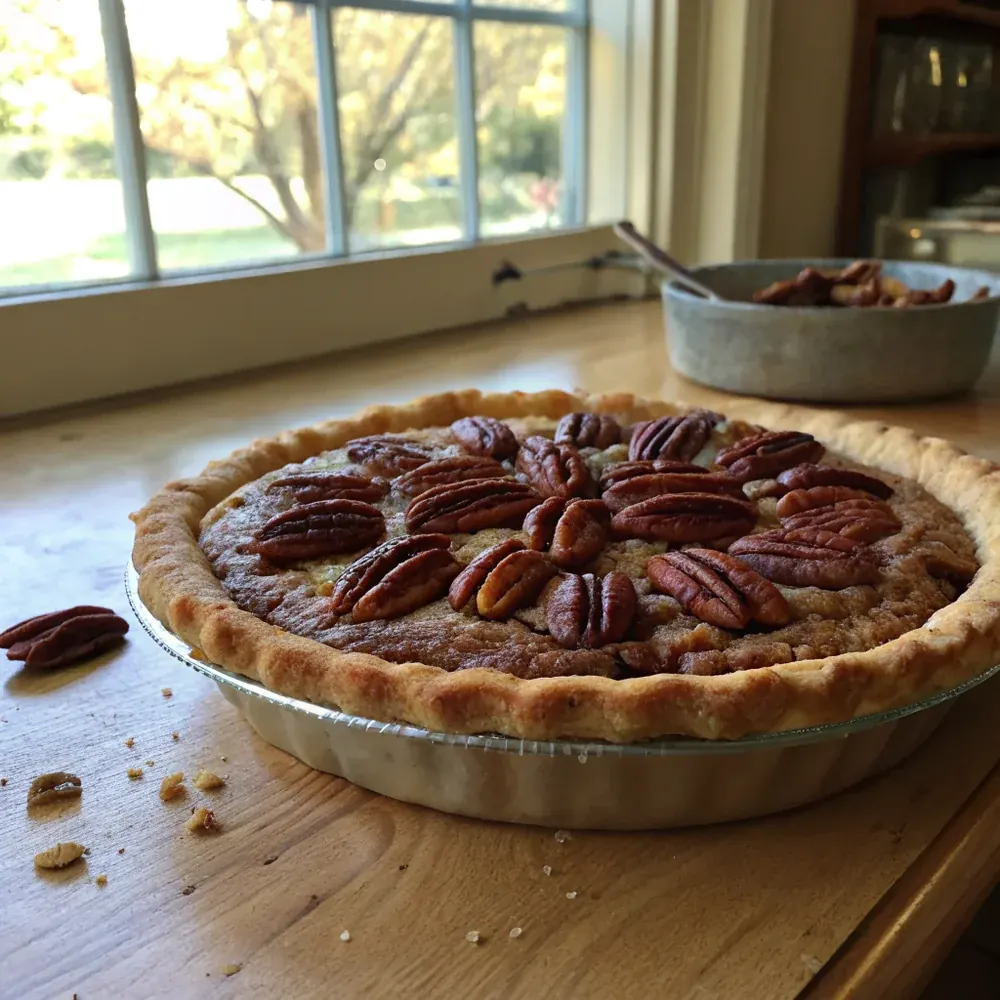
Under-baking is the most common cause. The center should jiggle as one firm unit when tapped, not ripple like liquid. An instant-read thermometer should show 200-205F at the center. Also, slicing before 4 hours of cooling gives a false sense of runniness even when the pie is properly baked - the filling continues to set as it cools.
Can I use maple syrup instead of corn syrup?
Yes, at a 1:1 ratio with Grade A dark maple syrup. Reduce brown sugar to 1/2 cup and skip the bourbon - the maple does the rounded note that bourbon would. The pie tastes more maple-forward and is delicious but is no longer traditional Texas pecan pie.
Should I toast the pecans first?
Optional but recommended. Toast at 350F for 5-7 minutes until fragrant, cool fully before assembling. Toasted pecans give a deeper roasted note in the finished pie. Untoasted pecans are softer and more buttery. Both are correct; it is a personal preference.
Can I make pecan pie ahead?
Yes - pecan pie genuinely improves on day two. Make it the day before serving. Keep at room temperature, loosely covered, for up to 3 days. Refrigerate for up to a week. Freeze whole for up to 3 months.
Why blind-bake the crust?
Pecan pie filling is wet, sweet, and slow-baking. Without a pre-baked crust, the bottom turns into a damp paste within an hour of cooling. Blind-baking sets the crust structure and dries the bottom so it can survive the wet filling. Skipping this step gives a soggy bottom every time, with no fix.
Can I freeze pecan pie?
Yes. Cool the pie completely, wrap whole in plastic wrap then aluminum foil, freeze up to 3 months. Thaw overnight in the fridge, then bring to room temperature for an hour before serving. The filling may weep slightly after thawing - blot the surface gently with a paper towel.
What is the best crust for pecan pie?
An all-butter crust, blind-baked. Shortening crusts are flakier but flatter in flavor. All-butter is more flavorful but requires keeping the dough cold throughout. A 50/50 butter-shortening crust is a reasonable middle ground if you find pure butter dough hard to work with.