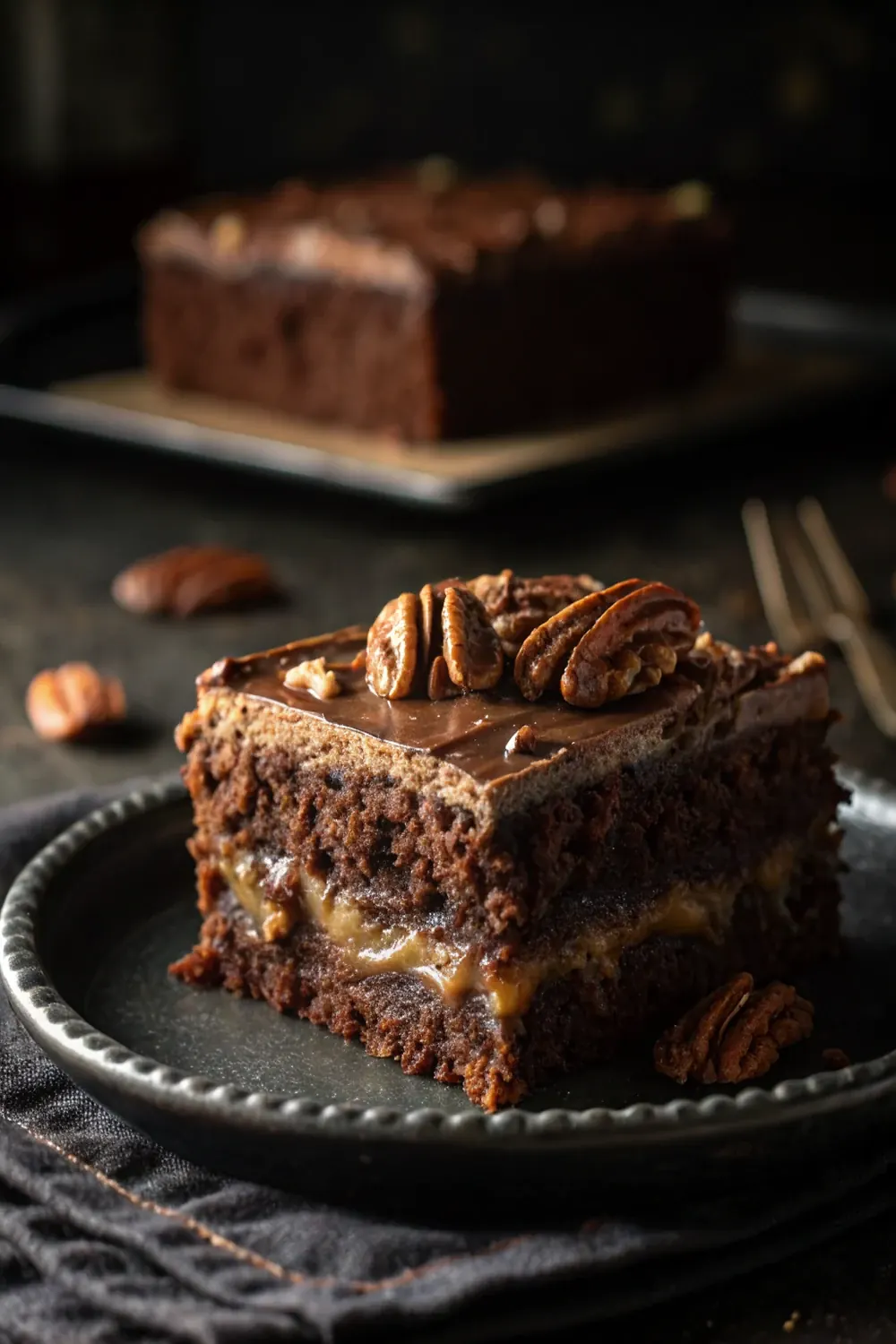
Texas Desserts
Texas Sheet Cake
Authentic Texas sheet cake by Chef Mia: buttermilk-cocoa cake in a jelly roll pan with warm pecan frosting poured over warm cake. Serves 24+ for potlucks.
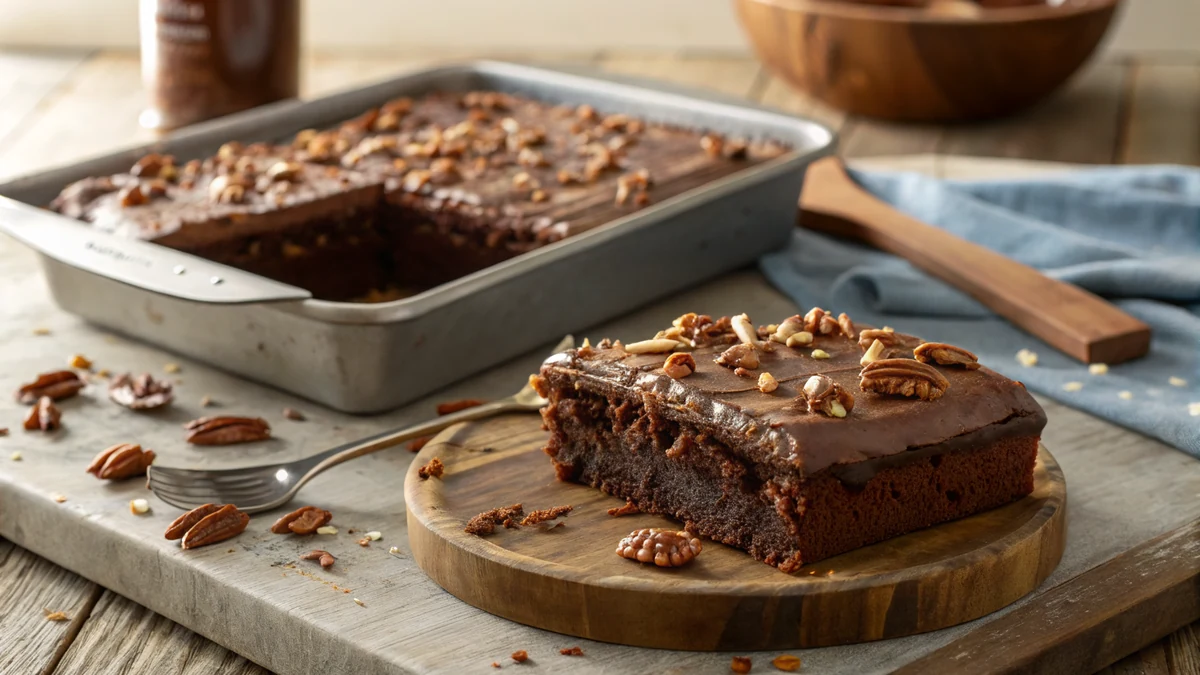
Quick answer: Texas sheet cake is a thin, dense chocolate cake baked in a 13x18 jelly roll pan, finished with a warm pecan-studded chocolate frosting poured over the still-warm cake. The cake batter combines flour, buttermilk, cocoa, and butter in a single bowl. Bake at 350°F for 20 minutes. The frosting (butter + cocoa + milk + powdered sugar + chopped pecans) is poured over while both cake and frosting are warm, creating a fudgy crackled finish. Serves 24+ for potlucks.
Texas sheet cake is the cake of every Texas wedding shower, baby shower, church potluck, funeral reception, and Sunday school class for the past sixty years. It is the cake that travels in a jelly roll pan covered with foil. It is the cake that feeds twenty-four people because the host invited 'just a few' family members and ended up with forty. It is the cake that disappears in the second pass through the buffet.
I grew up watching my grandmother make this cake in a stainless-steel jelly roll pan that had belonged to her mother. She made it for every gathering bigger than four people. The recipe was on a yellowed index card in her recipe box, written in her mother's handwriting. The proportions never changed; the technique never changed. I have it on the same index card now in my kitchen in Lockhart.
Pair this with our deep-dive on the frosting if you want technical detail on the warm-pour method. And if peanut butter outranks chocolate at your table, my peanut butter Texas sheet cake runs the same warm-pour play with a peanut-fudge frosting. Serve at any gathering where you need to feed 20+ people something everyone recognizes as Texas.
Three Things to Know About Texas Sheet Cake
It's a sheet cake, not a layer cake. The shape is structural to the dish; the cake is meant to feed 24+ people from a single pan. A 13x18 jelly roll pan is the right size. A 9x13 cake pan gives you a thicker cake (more like a sheet cake on steroids); a 12-inch round gives you the wrong shape. Use the jelly roll pan if you can find one (Wilton or Nordic Ware both make affordable ones).
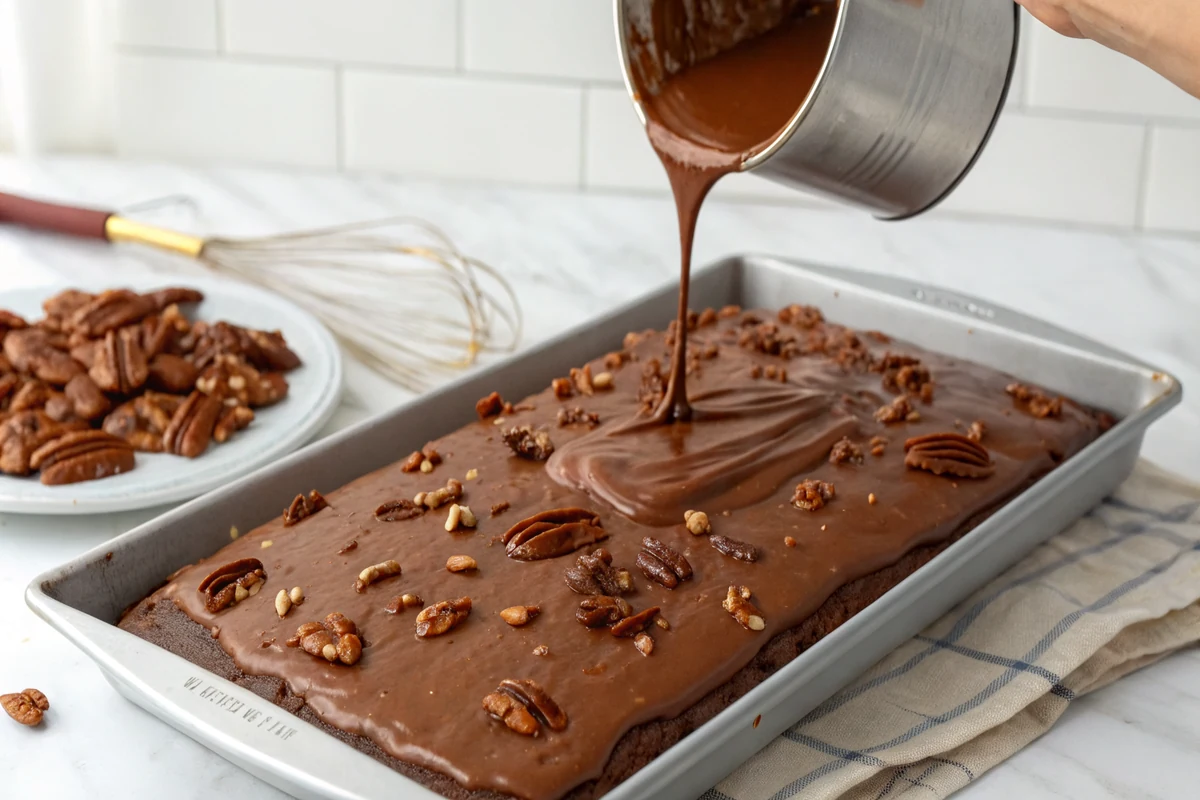
The frosting is poured warm over the warm cake. This is the signature technique. The warm frosting partly melts into the warm cake, creating an integrated layer where you cannot tell where the cake ends and the frosting begins. Pour onto a cold cake and the frosting sits on top like a coin; you taste cake-then-frosting instead of cake-and-frosting together.
Pecans are non-negotiable. The frosting must contain toasted chopped pecans. Pecans are the Texas state tree, and Texas sheet cake without pecans is just a chocolate sheet cake. For the best results, use Texas pecans (San Saba is the canonical Texas pecan region). Toast the pecans before adding to bring out their oil and deepen the flavor.
Choosing the Right Cocoa
Natural cocoa (Hershey's regular red can) is the traditional choice. It is what every Texas grandmother used and what gives the cake its distinctive cocoa-and-not-much-else flavor. Available at every supermarket in America. The red Hershey's can is the Texas standard.
Dutch-process cocoa (Hershey's Special Dark, Guittard Cocoa Rouge, Valrhona) gives a darker color and smoother chocolate flavor. The cake is slightly less acidic and more 'fancy chocolate cake' tasting. Modern Texas bakers (Austin, Dallas) often lean toward Dutch-process. Both are legitimate.
Avoid 'baking chocolate' bars or 'cocoa powder' that's actually drink mix (Nesquick is not cocoa). Cocoa powder for baking is unsweetened. The recipe relies on the unsweetened-ness of the cocoa to balance the 2 cups of sugar; drink mix powder will give you a saccharine result.
The Warm-Frosting Pour Method
Time the frosting to finish when the cake comes out. The frosting takes 5 minutes to make. Start it when there are 5 minutes left on the cake's bake timer. When the cake comes out of the oven, the frosting should be just finished (with pecans folded in) and ready to pour.
Pour from a saucepan or a 4-cup measuring cup. The frosting is thin enough that you need a container with a spout for controlled pouring. A 4-cup Pyrex measuring cup works perfectly. Pour starting from one corner and zig-zag to the other corner, distributing evenly.
Spread quickly with a spatula. The frosting starts to set on contact with the cooler cake surface, so move fast. A wide offset spatula (4-inch icing spatula) is the right tool. Cover every visible bit of cake. The corners get the least frosting; nudge extra into the corners.
Mistakes to Avoid
Pouring frosting on a cold cake. The frosting sits on top like a topping rather than integrating into the cake. The cake-frosting boundary stays distinct and the texture is wrong.
Using a 9x13 pan instead of a 13x18 jelly roll pan. The 9x13 pan produces a thicker cake that bakes longer and ends up denser. The 13x18 jelly roll pan is the right shape for the cake-to-frosting ratio.
Skipping the pecan toast. Untoasted pecans taste raw and slightly bitter in the frosting. The 6 to 8 minutes of toasting transforms them. Always toast.
Overbaking the cake. 20 to 22 minutes at 350°F is the window. Past 25 minutes, the cake dries out. The thin batter cooks fast.
Refrigerating the frosted cake before the frosting sets. The frosting needs 1 hour at room temperature to set to its fudgy crackle finish. Refrigerating immediately makes the frosting set hard and cold rather than fudgy.
Skipping the sifting of powdered sugar. Powdered sugar clumps from humidity, especially in Texas summer. Sift first to prevent lumps in the frosting.
Substituting margarine for butter. Margarine produces a flat, slightly off-flavored cake. Use unsalted butter (Land O Lakes, Kerrygold, or store brand) for both cake and frosting.
Variations Worth Trying
Buttermilk pecan version (this recipe). Buttermilk gives a slight tang and tenderness. Most Texas grandmothers use buttermilk.
Sour cream version. Substitute 1/2 cup sour cream for the buttermilk. Slightly denser and richer cake. Common in some Texas families.
Maple-bourbon Texas sheet cake (modern variant). Add 2 tablespoons of bourbon and 1 tablespoon of pure maple syrup to the cake batter. Replace 1/4 cup of the powdered sugar with maple sugar in the frosting. A boozy adult version popular in Austin.
Mexican chocolate version. Add 1/2 teaspoon ground cinnamon and 1/4 teaspoon cayenne to the cake batter. The slight spice plays beautifully with the chocolate.
Coffee Texas sheet cake. Substitute 1/2 cup of strong brewed coffee for 1/2 cup of the water in the cake batter. The coffee deepens the chocolate flavor without adding obvious coffee taste.
Storage and Reheating
Refrigerator
The frosted cake keeps 5 days in the fridge in a covered container. The frosting firms up when cold; let cake squares come to room temperature 30 minutes before serving for the best texture.Freezer
Cut squares freeze beautifully wrapped individually in plastic, then grouped in a freezer bag. They keep 2 months. Thaw at room temperature for 45 minutes before serving. The frosting may sweat slightly during thaw; this is normal.Reheating
Texas sheet cake does not need reheating; serve at room temperature. If you want a warm dessert experience, microwave a single square at 50% power for 15 seconds. The frosting will go slightly softer and warmer, which is a different (also pleasant) dessert experience.Tips for the Best Texas Sheet Cake
Use room-temperature eggs and buttermilk. Cold eggs and buttermilk can shock the warm cocoa-butter mixture and cause it to seize. Set them out 30 minutes before starting, or warm briefly under hot water (eggs in their shell, buttermilk in a glass measuring cup).
Toast pecans on a small sheet pan, not in a skillet. Skillet toasting requires more attention and can burn unevenly. Oven toasting at 350°F for 6 to 8 minutes is more reliable.
Use a wooden spoon or silicone spatula, not a metal whisk for the cake batter. A whisk over-aerates the batter and creates a tougher cake. Wooden spoon is the right tool.
Plan to serve the day you make it. Texas sheet cake is at its peak quality within 4 hours of finishing. The next day is still excellent, but the first day is best.
Cut clean squares with a hot knife. Run a long sharp knife under hot water, dry, cut. Wipe the knife between cuts. This gives you clean-edged squares that present beautifully.
What to Serve With Texas Sheet Cake
Coffee. Strong black coffee is the canonical pairing. The bitter coffee cuts through the rich chocolate frosting.
Vanilla ice cream. A small scoop on top of a warm square is a Texas restaurant move.
Cold milk. The childhood pairing. Whole milk is best.
After a BBQ dinner: After a heavy plate of brisket or pulled pork, a small square of Texas sheet cake is the right closing note.
For Texas state-fair-scale events, plan on 1.5 squares per person; the cake disappears.
Texas Sheet Cake Recipe
Ingredients
- For the cake:
- 2 cups all-purpose flour
- 2 cups granulated sugar
- 1 teaspoon baking soda
- 1/2 teaspoon coarse kosher salt
- 1 cup (2 sticks) unsalted butter
- 4 tablespoons unsweetened cocoa powder (Hershey's regular red can or Dutch-process)
- 1 cup water
- 1/2 cup full-fat buttermilk, well-shaken
- 2 large eggs, room temperature
- 1 teaspoon vanilla extract
- For the pecan chocolate frosting:
- 1/2 cup (1 stick) unsalted butter
- 4 tablespoons unsweetened cocoa powder (same as cake)
- 1/3 cup whole milk
- 1 teaspoon vanilla extract
- 4 cups powdered sugar (1 lb), sifted
- 1 cup chopped pecans, toasted (Texas pecans, ideally San Saba)
- Pinch of coarse kosher salt
Instructions
- Preheat oven and prep pan. Preheat the oven to 350°F. Grease a 13x18-inch jelly roll pan with butter or cooking spray. Sprinkle 1 tablespoon of flour into the pan, tilt to coat the bottom, and tap out the excess. (A 9x13 cake pan also works for a thicker cake but the proportions and bake time are slightly different.)
- Toast the pecans. Spread the chopped pecans on a small baking sheet and toast in the preheating oven for 6 to 8 minutes, until fragrant and slightly darker. Watch closely; pecans go from toasted to burnt in 30 seconds. Set aside to cool.
- Whisk dry ingredients. In a large mixing bowl, whisk together the flour, sugar, baking soda, and salt until evenly distributed. Set aside.
- Make the wet base. In a medium saucepan, combine the 1 cup butter, 4 tablespoons cocoa, and 1 cup water. Bring to a boil over medium heat, stirring constantly. Once boiling, pour the hot mixture over the dry ingredients in the large bowl.
- Stir to combine. Stir the hot butter-cocoa-water mixture into the dry ingredients with a wooden spoon until smooth. The batter will look thin and glossy, with no flour streaks visible.
- Add buttermilk, eggs, and vanilla. Whisk in the 1/2 cup buttermilk until fully incorporated. Add the 2 eggs and 1 teaspoon vanilla. Whisk until smooth and uniform. The final batter is thin (pourable consistency, like crepe batter); this is correct.
- Pour into pan and bake. Pour the batter into the prepared jelly roll pan. The batter will be thin and spread to the edges as you pour. Tap the pan against the counter to release any air bubbles. Bake at 350°F for 20 to 22 minutes, until a toothpick inserted in the center comes out clean. The cake should spring back when lightly pressed.
- Make the frosting while cake bakes. About 5 minutes before the cake comes out, start the frosting. In a medium saucepan, combine the 1/2 cup butter, 4 tablespoons cocoa, and 1/3 cup milk. Bring to a boil over medium heat, stirring constantly. Remove from heat.
- Whisk in sugar and pecans. Off heat, whisk in the 4 cups sifted powdered sugar (sift first to prevent lumps), the 1 teaspoon vanilla, and a pinch of salt. The frosting will be glossy and thin. Fold in the 1 cup of toasted chopped pecans.
- Pour warm frosting over warm cake. As soon as the cake comes out of the oven, immediately pour the warm frosting over the warm cake. Spread quickly with a spatula or the back of a wooden spoon to cover every inch. The warm frosting will sink slightly into the warm cake and self-level. This is the canonical Texas sheet cake finish.
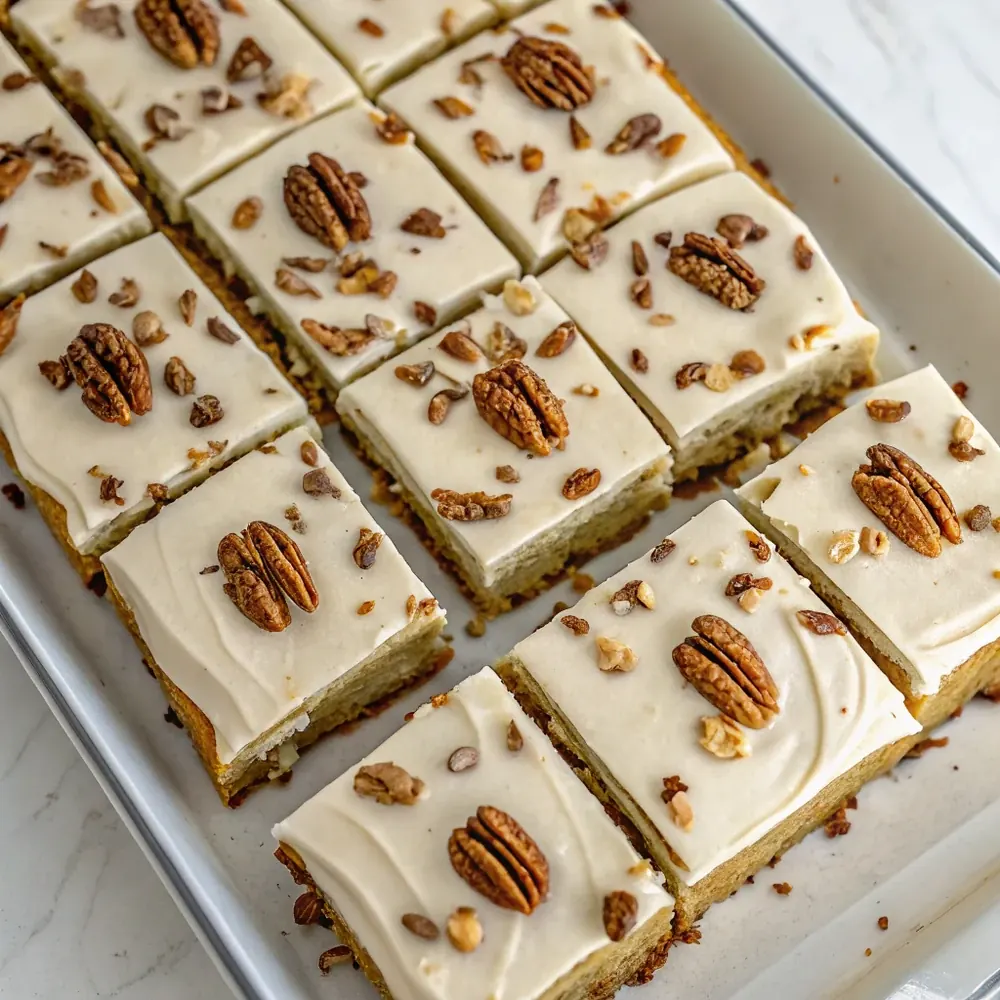
- Cool and cut. Let the cake cool in the pan for 1 hour. The frosting will set into a fudgy, slightly crackled finish. Cut into 24 generous squares (4 across, 6 down) or 32 smaller squares (4 across, 8 down). Serve at room temperature; do not refrigerate before serving.
Frequently Asked Questions
Can I use a 9x13 pan instead of a jelly roll pan?
Yes, but the result is different. A 9x13 produces a thicker cake (about 1.5 inches versus 0.75 inches). Bake at 350°F for 28 to 32 minutes (longer than the 20-22 for the jelly roll). The frosting-to-cake ratio shifts toward more cake per bite; many bakers prefer this. Just know it's a slight variation from the canonical version.
Why does the frosting have to be warm when I pour it?
Because the warm frosting partly soaks into the warm cake surface, creating an integrated layer where the cake and frosting blend at the boundary. A cold cake repels the warm frosting; the frosting sets on top like a topping. The warm-on-warm pour is what defines Texas sheet cake.
Can I make this without nuts?
Yes, but it's technically a chocolate sheet cake rather than a Texas sheet cake at that point. Pecans are structural to the regional dish. If you have nut-free guests, hold back 1/2 cup of frosting before adding nuts to the main batch, pour the nut-free portion over a corner of the cake first.
Can I make this gluten-free?
Yes. Substitute the all-purpose flour with King Arthur Measure for Measure gluten-free flour. The cake will be slightly denser but still excellent. All other ingredients are naturally gluten-free.
How do I know when the cake is done?
A toothpick inserted in the center comes out clean (no wet batter, possibly a few moist crumbs). The top should spring back when lightly pressed. The cake will look slightly damp on top but should be cooked through. Overbaked Texas sheet cake is dry; pull at the first sign of toothpick-cleanness.
Can I double the recipe?
Yes, in two separate 13x18 pans. Doubling in one larger pan does not work because the cake needs to be 0.5 to 0.75 inches thick to bake quickly. If you need to feed 50+ people, make two batches in two pans rather than one larger batch.
What's the difference between natural and Dutch-process cocoa?
Natural cocoa (Hershey's red can) is acidic and fruitier; Dutch-process cocoa is alkalized (treated to neutralize acidity) and gives a smoother, darker chocolate flavor. Both work in Texas sheet cake. Natural is the traditional Texas grandmother choice; Dutch-process is the modern bakery upgrade.
Can I make this dairy-free?
Yes, with substitutions. Replace butter with vegan butter (Earth Balance or Miyoko's), buttermilk with 1/2 cup oat milk + 1 1/2 teaspoons vinegar (let sit 5 minutes), and milk with oat milk in the frosting. The cake will be slightly different in flavor but excellent.