Texas Desserts
Texas Sheet Cake Frosting
Warm-poured fudgy cocoa pecan frosting for Texas sheet cake. Made in one saucepan with butter, milk, cocoa, powdered sugar, vanilla, San Saba pecans.
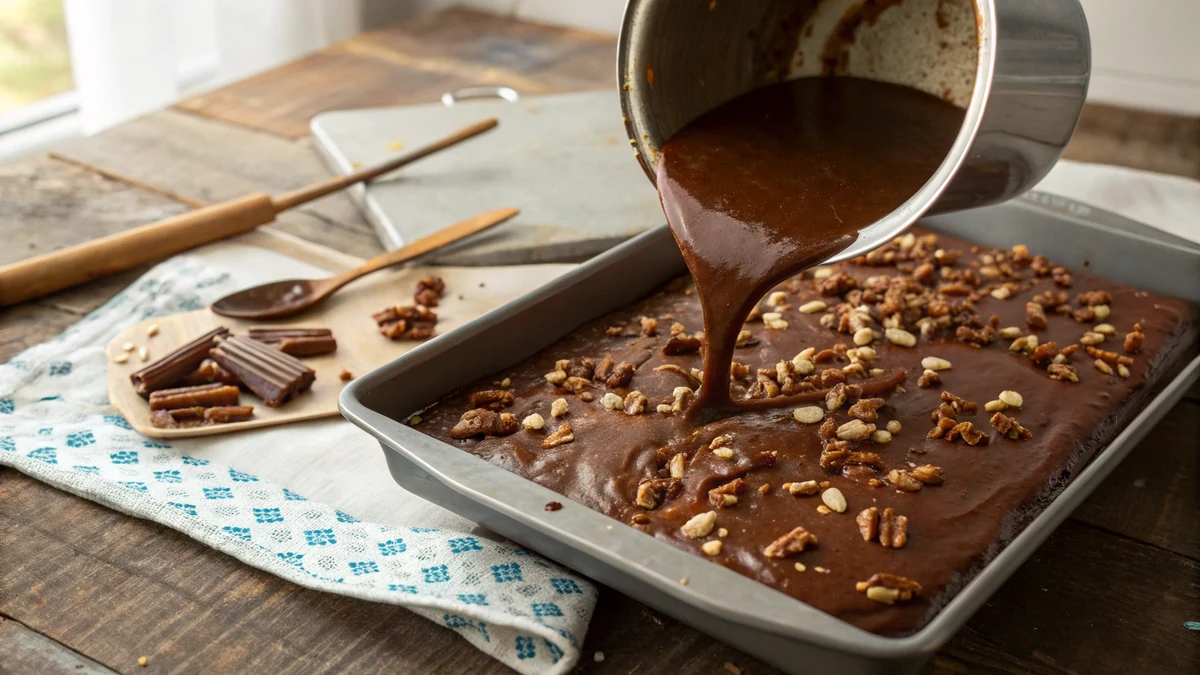
Quick answer: Texas sheet cake frosting is a warm-poured fudgy cocoa and pecan glaze made in the same saucepan minutes before pouring. Butter, milk, and cocoa melt together over low heat, then sifted powdered sugar, vanilla, and toasted pecans get whisked in fast. The frosting is poured over a warm sheet cake so it soaks slightly into the top before setting into a thin fudgy shell. It is not a buttercream and not a ganache. It has its own category.
I learned this frosting from a Stephenville church-potluck lady named Miss Ruby who set down a 9x13 in the fellowship hall, lifted the foil, and let the room fall quiet. Her Texas sheet cake had that lacquered look only this frosting produces, a glossy cocoa shell studded with toasted San Saba pecans, slightly cracked along the edges where it had cooled fastest. She handed me a square on a paper plate without a fork, the Hill Country way, and I ate it standing up with the kind of attention you give a piece of music. The cake underneath was good. The frosting was the reason everyone went back for seconds.
What makes this frosting its own thing is the timing. It is not whipped, not piped, not spread cold. It is built in a saucepan, poured warm over a still-warm cake, and allowed to set in place. Butter, milk, and unsweetened cocoa melt together first. Then sifted powdered sugar, vanilla, and toasted pecans get whisked in fast before the mixture starts to firm. The result soaks slightly into the top crust of the cake and seals into a thin fudgy layer that is somewhere between a glaze, a ganache, and a praline. It pairs with the host cake at /texas-chocolate-sheet-cake/ so completely that the two recipes are almost one.
What Makes Texas Sheet Cake Frosting Different
Texas sheet cake frosting is not a buttercream. A buttercream is whipped, cool, and spreadable; it carries air and stays soft. This frosting is poured, warm, and self-leveling; it carries no air and sets into a thin fudgy shell. If you have eaten a great Texas sheet cake at a Tyler potluck or a Lubbock backyard wedding reception, you know the texture instantly. It is glossy, slightly cracked along the edges, and the first cut releases that brown-sugar-and-cocoa smell that lives only in this specific frosting.
It is also not a ganache. A ganache is chocolate plus cream, melted together until smooth. It can be poured warm like this frosting, but the body and finish are different. Ganache is silkier, richer, and sets softer. Texas sheet cake frosting uses cocoa powder rather than melted chocolate, plus powdered sugar for body, plus butter and milk rather than heavy cream. The result is leaner, sweeter, and firmer when set. It also has nuts, which a classic ganache never does.
The closest cousin is a praline glaze, the kind you might pour over a pecan pound cake or a coffee cake. The pecan-and-cocoa version we use in Texas is its own regional invention, traced back to the LBJ Ranch and Lady Bird Johnson's White House cookbooks in the 1960s. It is the only frosting I know that is built to be poured at exactly the wrong moment for any other frosting: while the cake is still warm and the saucepan is still hot. That timing is the whole trick.
The Pour While Warm Rule
Every Texas sheet cake recipe says it, and almost no one explains why. Pour the frosting over the cake while both are still warm. Here is what is actually happening at the molecular level. When you pour a hot fudgy mixture over a warm cake crust, the top of the cake softens slightly and the frosting wicks down by about 1/8 inch into the crumb. That soak-and-seal layer is what makes every bite taste fully integrated rather than cake-plus-frosting in two distinct phases.
If you pour the frosting onto a cold cake, the frosting cools too fast to penetrate, and you get a layer that sits on top like a separate coin. If you pour the frosting onto a screaming-hot cake straight from the oven, the frosting thins too much and runs off the edges. The sweet spot is a cake that has rested 5-10 minutes on a wire rack out of the pan or in the pan, and a frosting that is hot but no longer at a simmer.
Practical timing: start the frosting when the cake has about 5-7 minutes left in the oven. The frosting comes together in 4-6 minutes total once you start. By the time the cake is out and resting, the frosting is ready to pour. Do not multitask this step. Do not answer the phone. Set every other distraction aside and run the two timelines in parallel. The window is small but the payoff is the cake everyone remembers.
The Cocoa Decision: Natural vs Dutch-Processed
The cocoa you choose changes the personality of this frosting more than any other variable. Natural cocoa powder (Hershey's regular, Ghirardelli, the red can stuff your grandmother used) has a fruity, sharp, slightly acidic chocolate note. Dutch-processed cocoa (Hershey's Special Dark, Guittard Cocoa Rouge, Valrhona, Droste) has been alkalized to neutralize the acidity, which produces a darker color, a smoother flavor, and a less fruity profile.
For Texas sheet cake frosting, both work, and which one you pick is a matter of regional and personal preference. East Texas and Hill Country cooks tend to grab the Hershey's red can because that is what is on the grocery shelf and what their mothers used. Houston and Dallas pastry chefs lean toward Dutch-processed for a darker, glossier finish and a more sophisticated chocolate flavor. The Stephenville church-potluck version I grew up eating used Hershey's Special Dark, which is actually a blend of natural and Dutch, splitting the difference in the most American way.
My current default in my Hill Country kitchen is Guittard cocoa rouge, a Dutch-processed cocoa from a California company that has been making chocolate since the 1860s. It produces a frosting that is almost black in color with a deep, rounded chocolate flavor that is not too sweet against the powdered sugar. Whatever cocoa you use, sift it before measuring. Cocoa clumps are the most common defect in this frosting, and sifting solves the problem completely. The deeper science is simple: Dutch-processed cocoa is treated with an alkali that neutralizes its natural acidity, giving a darker color and a smoother, mellower chocolate flavor than natural cocoa.
Why Pecans, and Why San Saba Pecans Matter
Pecans are not a garnish in Texas sheet cake frosting; they are structural. The toasted pecans give the frosting its texture cue, its caramel depth against the cocoa, and its visual signature. A Texas sheet cake without pecans is a chocolate sheet cake. The pecans are what makes it Texan. The history is geographic: pecans are native to Texas, the pecan is the official state tree, and Texas has been the second-largest pecan-producing state in the country for most of the last century.
San Saba, on the Colorado River about 100 miles northwest of Austin, declared itself the Pecan Capital of the World in the 1890s and has held onto that title with a stubborn pride ever since. San Saba pecans have a thinner shell, a higher oil content, and a sweeter, less tannic flavor than most other pecan varieties. They toast beautifully and stay tender inside a set frosting. If you can buy them mail-order from a San Saba grower, do it. If you cannot, any high-quality fresh pecan from a Texas or Georgia source works. Avoid old grocery-store pecans that have been on a shelf for six months; the oils will have gone slightly rancid and the bitter note ruins the frosting.
Toast them. Always toast them. Raw pecans taste flat and starchy. Toasted pecans, even for just 7 minutes at 350F, take on a brown-butter and caramel depth that pairs with cocoa the way coffee pairs with chocolate. The same rule applies to the pecans in my Texas pecan pie recipe and the pecan layer in my butter pecan ice cream sandwiches.
The Buttermilk Question in the Cake, Milk in the Frosting
The host cake at /texas-chocolate-sheet-cake/ uses buttermilk in the batter. The frosting on top uses regular whole milk, not buttermilk. This split is intentional and worth explaining. Buttermilk in the cake produces a tender crumb because the acidity reacts with baking soda to create lift and tenderness; it also gives a subtle tang that balances the cocoa. Buttermilk in the frosting would do something different. The acidity would react with the cocoa, the texture would loosen, and the finished shell would set softer and tangier than you want.
Regular whole milk in the frosting gives a neutral dairy backdrop that lets the cocoa and the toasted pecans take the lead flavor. You can use 2 percent or even skim in a pinch, but whole milk gives the smoothest, richest finish. Heavy cream is not recommended because it pushes the frosting toward ganache territory and changes the set. The 1/3 cup ratio in this recipe is calibrated specifically to whole milk; substituting different fat levels will give slightly different results.
That said, the buttermilk-frosting variation exists. Some Hill Country bakers, especially around Fredericksburg and Boerne, swear by buttermilk in the frosting for a slightly tangier finish that echoes the cake. If you want to try it, use the same 1/3 cup quantity and accept that the frosting will set marginally softer and read a touch sharper. It is a legitimate regional variation, not a mistake.
Sugar Type and Sifting: Lumps Are the Enemy
Powdered sugar (also called confectioners' sugar or 10X sugar) is the only sugar that works in this frosting. It dissolves instantly into the hot cocoa base because the grains are micronized down to a near-powder. Granulated sugar would refuse to dissolve, the frosting would feel gritty, and the shell would set with a sandy texture. Brown sugar would clash with the cocoa flavor and produce a muddy, overly molasses-heavy finish. Powdered sugar is the only answer.
The single most common defect in homemade Texas sheet cake frosting is little white lumps of undissolved powdered sugar showing through the dark frosting. The fix is simple: sift the sugar through a fine-mesh sieve before adding it to the saucepan. Sifting takes 90 seconds and saves the entire batch. A standard one-pound box of powdered sugar measures out to about 4 cups, give or take a few tablespoons depending on the brand and how packed it is. Imperial Sugar, the Texas brand made in Sugar Land since 1843, is the heritage choice. C and H, Domino, and store brands all work fine.
Sift the cocoa too. Cocoa lumps are even more visible than sugar lumps because they show up as dark specks against the lighter parts of the frosting. A single sifting through a fine-mesh sieve catches both ingredients in 30 seconds. Dump the sifted cocoa and sifted sugar into separate small bowls before you start the frosting so you can move fast once the butter is melted. Mise en place matters here because the frosting comes together in about six minutes from start to pour.
Pan Temperature Theory: Warm Cake Plus Warm Frosting Equals Penetration
There is a specific food-science reason that Texas sheet cake frosting tastes the way it does, and it has to do with the temperature gradient between the cake crust and the frosting at the moment of pour. When a warm cake (around 150-160F internal at the top crust, having rested 5-10 minutes after the oven) meets a hot frosting (around 180-190F), the top 1/8 inch of cake crumb softens just enough to allow the frosting to soak in slightly before the frosting cools below its setting point.
This soak layer is invisible from the outside but you can taste it. A Texas sheet cake bite has no clear boundary between cake and frosting; the two phases blur into each other across about an eighth of an inch of cocoa-saturated crumb. A bite from a cake frosted cold has a hard line: cake here, frosting there, two separate flavors. The warm-pour technique creates the integrated mouthfeel that defines the dessert.
If you cannot pour at exactly the right moment, the better compromise is a slightly warm frosting onto a fully cooled cake. The soak will be minimal but the frosting will still set into a glossy shell because the saucepan heat preserves enough fluidity to self-level. The worst compromise is a cooled frosting reheated in the microwave, which separates the butter and produces an oily, grainy shell. If you missed the window, accept the imperfect outcome and try again next bake.
Frosting Texture: Fudgy vs Shiny vs Cracked
A well-made Texas sheet cake frosting has three visible texture cues: a glossy surface, slight cracks along the edges where it cooled fastest, and a fudgy but not hard interior when you press a fingertip into the cooled shell. If your frosting is matte and dry-looking, you cooked the cocoa base too long or used too much powdered sugar. If your frosting is wet and tacky 30 minutes after pouring, you under-cooked the cocoa base or used too little powdered sugar.
The edge cracks are the prettiest tell. They form because the frosting at the pan edges cools and sets faster than the frosting in the center, and the differential shrinkage produces small hairline cracks. These are not defects; they are praline-style fissures and they signal that the frosting set into the right consistency. A frosting that stays glassy-smooth with no edge cracks is usually softer than ideal.
The fingertip test: 30 minutes after pouring, press gently on the surface with a clean fingertip. The frosting should feel firm but yielding, like the surface of a soft caramel. If it feels hard like a tile, the frosting set too firm and will be sweet rather than fudgy. If your finger leaves a wet print, give it another 15-20 minutes before serving. Once the cake is fully set, the shell holds its shape through cutting, lifting, and transporting on a paper plate the Hill Country way.
Doubling Up: Large Sheet Pan Adaptations
The standard recipe covers a 9x13 sheet cake, which is the canonical Texas potluck pan. For larger gatherings, the half-sheet pan (13x18) is the traditional Texas state-fair size, and you will need to roughly double the frosting recipe to 6 cups total. Use 2 cups of butter, 2/3 cup of cocoa, 2/3 cup of milk, two 16-ounce boxes of powdered sugar, 2 teaspoons of vanilla, and 2 cups of toasted pecans. The saucepan needs to be at least 5 quarts to handle the volume without slopping over when you whisk.
Quarter-sheet pans (9x9 or 10x10) need about 2/3 of the standard recipe. Do not try to scale below half because the small saucepan dynamics get tricky and the heat distribution can scorch the cocoa. If you are baking a single small loaf or an 8-inch round (not the traditional format but it happens), make the full 9x13 frosting batch and store the extra in a sealed container in the fridge. The leftover frosting can be reheated very gently with a splash of milk to use as a dip for shortbread, a topping for ice cream, or the base of a chocolate sauce.
For Texas state-fair-scale presentations, the half-sheet version is the showstopper. I have seen these at the State Fair of Texas in Dallas, at the Houston Livestock Show and Rodeo, and at every Hill Country wedding I have catered. The half-sheet cuts into about 48 squares, feeds a crowd, and travels well in the pan covered with foil. See our full Texas sheet cake recipe for the half-sheet version and the exact cake-to-frosting ratio.
Mistakes to Avoid
Pouring frosting onto a cold cake. The frosting will sit on top like a separate layer instead of soaking into the crust. Pour while both are warm. This is the single most important rule.
Boiling the cocoa base. Cocoa scorches at a hard boil in under a minute, and the bitter note is permanent. Bring the butter, cocoa, and milk just to small edge bubbles, then pull off the heat immediately.
Skipping the sift. Cocoa and powdered sugar both lump, and the lumps will show in the finished frosting as little white or dark specks. Sift both before adding. Ninety seconds well spent.
Using raw pecans. Raw pecans taste starchy and flat against the cocoa. Toast for 7-9 minutes at 350F. The flavor jump is dramatic and worth the small extra step.
Reheating cooled frosting. A frosting that has set cannot be brought back to glory by microwaving. The butter separates, the sugar gets grainy, and the shell loses its glossy set. Make the frosting fresh, every time.
Using granulated sugar. Powdered sugar is non-negotiable. Granulated will not dissolve in the time available and the frosting will set gritty.
Spreading instead of pouring. Pour the frosting, then nudge it gently with an offset spatula or spoon back. Aggressive spreading tears the cake top crust and pushes the frosting around in a way that prevents proper soak-and-set.
Variations Worth Trying
Espresso-Texas frosting. Whisk 1/2 teaspoon of instant espresso powder into the hot cocoa base. The espresso deepens the chocolate flavor without making the frosting taste like coffee, the same trick pastry kitchens use to round out a chocolate cake. A modern Austin coffee-shop move.
Texas cinnamon frosting. Add 1/2 teaspoon of ground Saigon cinnamon along with the vanilla. The cinnamon-chocolate combination is a Texas state-fair-and-rodeo classic, echoing churros and Mexican hot chocolate. Reduce slightly if you find cinnamon dominant.
Texas pecan praline frosting. Replace the 1 cup of toasted pecans with 1 cup of broken homemade pecan praline (or store-bought brittle pieces). The praline adds caramelized sugar crunch and a deeper sweet-roasted note. Use slightly less powdered sugar (about 3/4 of the box) to compensate for the added sweetness from the praline.
Walnut variation. Substitute toasted walnuts for the pecans 1:1. The flavor is more bitter and tannic, and the texture is slightly drier. Some North Texas cooks prefer it. I am loyal to pecans, but the walnut version is a respectable alternative if pecans are unavailable.
Bourbon-vanilla frosting. Add 1 tablespoon of bourbon (Garrison Brothers from Hye, Texas, or Balcones from Waco) along with the vanilla. The alcohol mostly cooks off in the residual heat, leaving a vanilla-oak depth that pairs beautifully with the pecans. A favorite at adult Hill Country dinner parties.
Storage, Cake Refrigeration, and Make-Ahead Notes
Frosted Texas sheet cake keeps loosely covered at room temperature for 2 days. Cover the pan with foil or a clean kitchen towel to keep dust off; do not use plastic wrap directly on the frosting because it will pull the shell when you remove the wrap. The cake stays moist because the warm-poured frosting seals the top, which prevents most of the moisture evaporation that dries out a typical cake.
For longer storage, refrigerate the frosted cake for up to 5 days in a covered container or pan. The frosting will firm up under refrigeration. To serve refrigerated slices, pull them out 30-45 minutes before serving so the frosting softens back to its fudgy room-temperature glory. Cold Texas sheet cake is good (some people prefer it that way), but the frosting is at its peak right at the texture of a soft caramel, which only happens at room temperature.
Freezing works well. Cut the cake into squares, wrap each square in plastic wrap, then in foil, and freeze in a zip-top bag for up to 2 months. Thaw on the counter for 2-3 hours or overnight in the fridge. The frosting freezes cleanly because there is no whipped air to break. The cake itself stays remarkably moist because the sealed frosting shell prevents freezer dehydration.
The History: Lady Bird Johnson and the Texas Sheet Cake Postcard Story
The most-told origin story for Texas sheet cake places it at the LBJ Ranch in the Texas Hill Country during Lyndon B. Johnson's presidency in the 1960s. Lady Bird Johnson was a famous home cook and entertainer, and the cake, often called Lady Bird's Famous Sheet Cake or LBJ Ranch Sheet Cake in old church cookbooks, appeared at White House and ranch gatherings throughout the decade. The recipe spread through Texas during the 1970s via church-and-school cookbooks, AAA postcards, and the same word-of-mouth chain that propagated Texas Caviar and King Ranch chicken.
Whether Lady Bird actually invented the warm-pour technique or simply popularized it is contested. The structure of the cake (cocoa-and-buttermilk batter with a poured cocoa-pecan frosting) appears in earlier American chocolate cake traditions, particularly in Appalachian and Texas Hill Country sheet cakes from the 1930s and 1940s. The specific LBJ-Ranch version is the one most modern Texans grew up with, and it is the version this recipe traces back to.
The other strong origin claim points to the Texas Department of Highways' postcard campaign in the 1970s, which printed sheet cake recipes on the back of state-promotional postcards mailed to tourism inquiries. Some of those postcards survive in Texas Historical Commission archives. The cake also appears in the 1971 Junior League of Houston cookbook and the 1976 Texas Hill Country Cookbook, both of which credit church-potluck traditions in Tyler, Stephenville, and Lubbock as their direct sources.
Pairing the Cake with Drinks
Texas sheet cake is rich, sweet, and chocolate-forward, which means the drinks that pair with it are the ones that cut through richness rather than amplify it. The canonical Texas pairing is black Hill Country coffee, the kind served at every diner from Fredericksburg to Marfa. The bitter coffee against the sweet cake creates a contrast that pulls flavor from both sides. Brewed strong, no milk, no sugar; let the cake handle the sweetness.
Cold whole milk is the other end of the spectrum, and it is the kid-and-potluck pairing that nobody outgrows. A glass of milk against a square of Texas sheet cake is the dessert pairing equivalent of brisket and white bread; simple, perfect, complete. Almond milk or oat milk works for dairy-free guests, though the flavor will be slightly thinner.
Sweet tea is a classic Southern pairing but I find it competes with the sugar in the cake. If you must pair with tea, brew it unsweetened and serve over ice with a slice of lemon. For adult gatherings, a small pour of Texas bourbon (Garrison Brothers, Balcones, Treaty Oak from Dripping Springs) is the slow-evening move. The vanilla and caramel notes in the bourbon harmonize with the pecans, and the alcohol slices through the chocolate fat. A glass of cold buttermilk also works beautifully and echoes the tang in the cake itself. For something fully Texan and non-alcoholic, pair the cake with chilled horchata from my coconut tres leches cake notes, which I sometimes serve alongside.
Kitchen Notes from My Hill Country Saturdays
I make a Texas sheet cake (host and frosting together) about once a month, usually when company is coming or when a church potluck shows up on the calendar. The single change that improved my frosting most was committing to sifting both the cocoa and the powdered sugar every single time. It takes 90 seconds and the texture difference is the gap between home-baker frosting and Miss Ruby's church-fellowship-hall frosting.
The second-best improvement was switching to San Saba pecans whenever I could get them. The mail-order shipping fee is real, but the flavor of fresh, oily, sweet pecans from a Texas grower is night and day against grocery-store nuts that have been on the shelf for six months. If a friend is driving through San Saba, I send a list and pay them back in baked goods.
The cake I pair this frosting with is at /texas-chocolate-sheet-cake/, and the two recipes are designed as a unit. If you have not made the host cake yet, start there and come back to the frosting when the cake has 5 minutes left in the oven. For other Texas dessert classics from the same Hill Country tradition, see my peach cobbler and my buttermilk pie. Both pair well at the same potluck table as a Texas sheet cake and round out a proper Hill Country dessert spread.
Texas Sheet Cake Frosting Recipe
Ingredients
- For the frosting base:
- 1 cup (227 g / 2 sticks) unsalted butter
- 1/3 cup (27 g) unsweetened cocoa powder, sifted (Hershey's Special Dark, Guittard, or Valrhona)
- 1/3 cup (80 ml) whole milk (or buttermilk for tang)
- For the body:
- 1 (16 oz / 454 g) box powdered sugar, sifted (about 4 cups, Imperial Sugar preferred)
- 1 teaspoon pure vanilla extract (Nielsen-Massey or McCormick)
- 1/4 teaspoon fine sea salt
- For the texture:
- 1 cup (115 g) pecan halves or pieces, toasted, San Saba if you can find them
- Optional finish:
- 1/2 teaspoon instant espresso powder (deepens the cocoa, optional)
- 1/2 teaspoon ground cinnamon (Texas state-fair note, optional)
- Equipment:
- 3-quart heavy-bottomed saucepan, stainless or enameled cast iron
- Whisk, fine-mesh sieve for sifting cocoa and sugar, rubber spatula, sheet pan for toasting pecans
Instructions
- Toast the pecans first. Before you start the frosting, toast the pecans. Spread 1 cup of pecan halves or pieces on a small sheet pan and toast at 350F for 7-9 minutes, stirring once at the 4-minute mark. They are done when they smell warm and nutty and look one shade darker than raw. Let them cool on the pan while you do everything else. Toasted pecans are not optional in this frosting. Raw pecans taste flat and starchy against the cocoa. Toasted pecans give a brown-butter and caramel depth that rounds out the chocolate. San Saba pecans (from the Texas pecan capital on the Colorado River) have a higher oil content than most varieties, which means they toast beautifully and stay tender inside the set frosting.
- Time the frosting to the cake. The frosting must be poured warm over a warm cake. That means you start the frosting only when the cake has about 5-7 minutes left in the oven. Pull the cake out, set it on a cooling rack on the counter, and immediately start the frosting. Do not make the frosting ahead. Do not reheat a cooled frosting. The chemistry of pouring a hot fudgy mixture over a warm crust is what creates the soak-and-seal layer that defines Texas sheet cake. Miss this window and you have a glaze sitting on top of a cool cake; you do not have Texas sheet cake.
- Melt the butter, cocoa, and milk together. In a 3-quart heavy-bottomed saucepan over medium-low heat, combine the butter, sifted cocoa powder, and milk. Whisk constantly as the butter melts. The mixture will look broken and grainy at first, which is normal. Keep whisking. After 2-3 minutes the butter will fully melt, the cocoa will fully hydrate, and the mixture will come together into a glossy, dark, slightly thick liquid. Bring it just to a gentle bubble around the edges of the pan. Do not let it boil hard. Cocoa scorches fast at a rolling boil and the bitter note is permanent.
- Pull off the heat at first bubble. The moment you see steady small bubbles climbing the inside edge of the saucepan, pull the pan off the burner. The total time on the heat is usually 3-4 minutes. The mixture should be hot, glossy, and the color of dark espresso. Set it on a folded kitchen towel next to the cake. If you over-simmer the chocolate base, the finished frosting will set too firm and crack into dry plates instead of a fudgy shell. The window is narrow but forgiving with practice.
- Whisk in the powdered sugar in two additions. Add half the sifted powdered sugar to the hot cocoa mixture and whisk hard. The mixture will look pale and shaggy at first. Keep whisking until it smooths out, about 30 seconds. Add the remaining sifted powdered sugar and whisk again until completely smooth, another 30-45 seconds. The frosting should pour from the whisk in a thick ribbon that disappears back into the surface in 4-5 seconds. If you skipped sifting the sugar, you will see small white lumps; whisk harder and they will dissolve in the residual heat, but next time sift.
- Add the vanilla, salt, and optional espresso. Whisk in the vanilla extract, the fine sea salt, and the optional 1/2 teaspoon of instant espresso powder if you are using it. The salt sharpens the cocoa and cuts the sugar so the frosting does not read as one-dimensionally sweet. The espresso (totally optional) deepens the chocolate flavor without making the frosting taste like coffee. If you are doing the cinnamon variation, whisk it in at this stage along with the vanilla.
- Fold in the toasted pecans. Fold the toasted, cooled pecans into the frosting with a rubber spatula. Do not whisk them in; whisking breaks them into smaller pieces than you want. The pecans should be in halves or generous pieces that you can see and feel in the finished bite. Fold until every nut is coated in the dark frosting. The mixture will still be warm and pourable but starting to thicken at the edges of the saucepan.
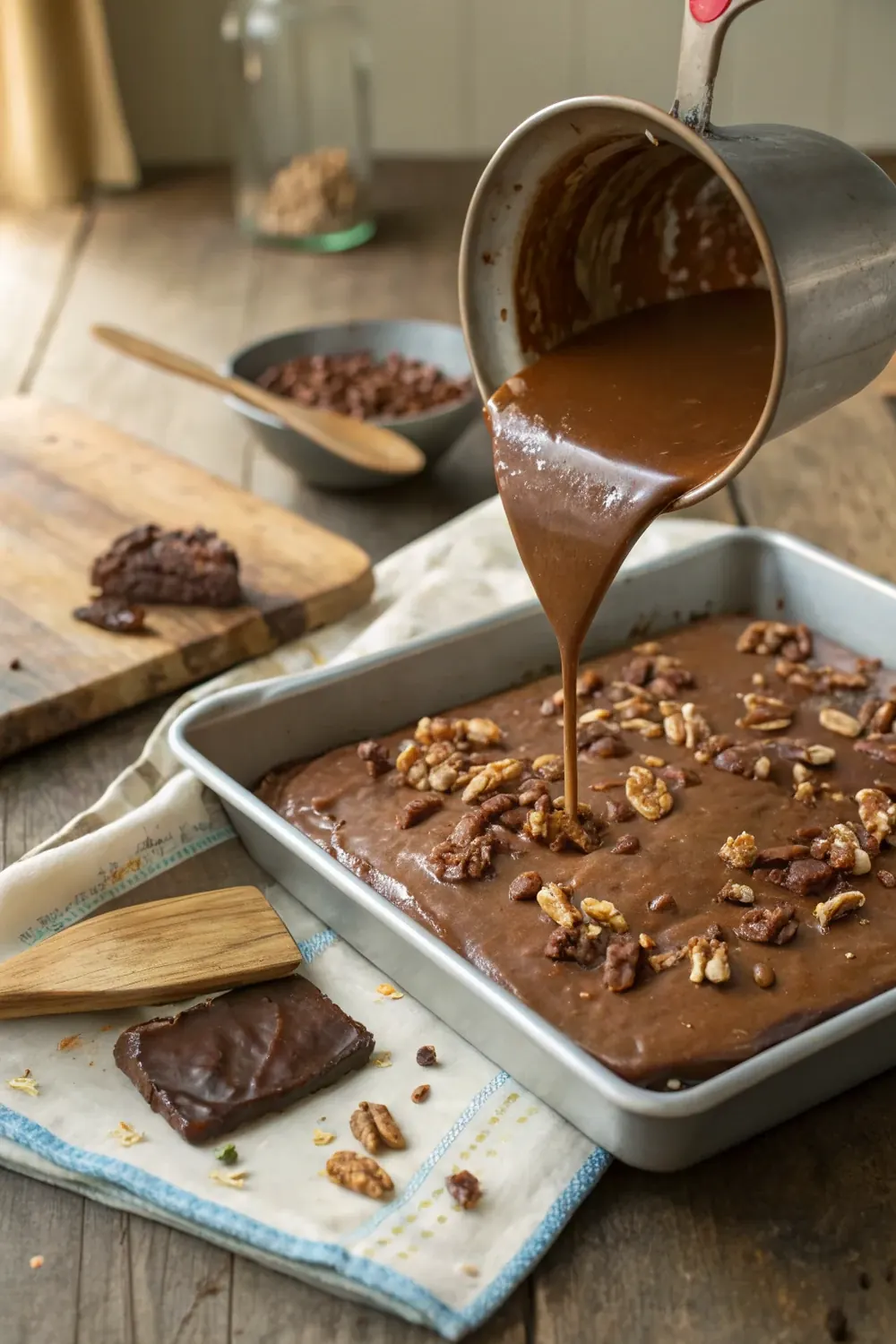
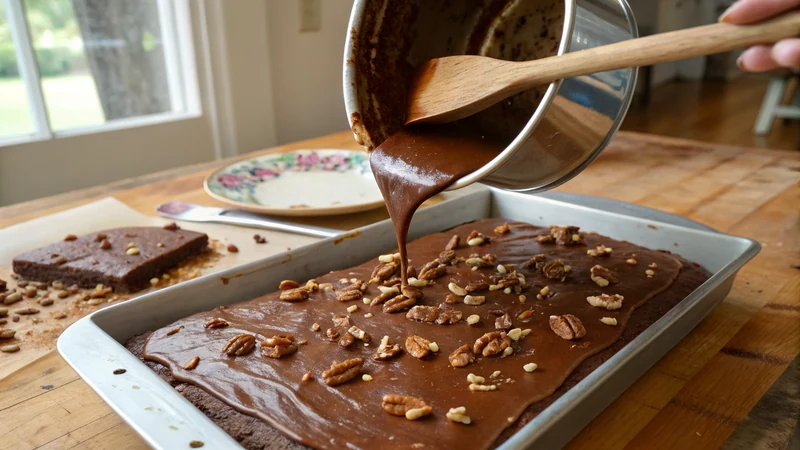
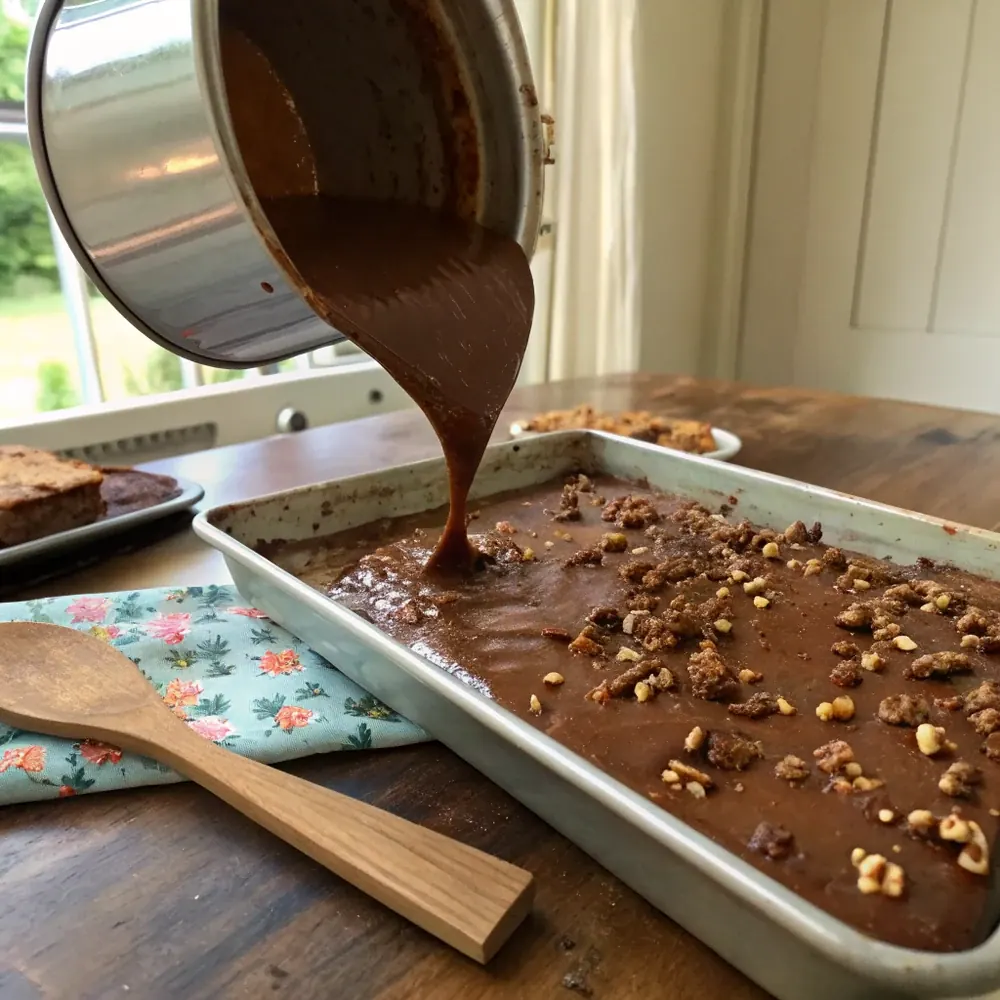
- Pour over the warm cake immediately. Pour the warm frosting over the warm cake while both are still hot. Start from one corner of the 9x13 and pour in a slow steady stream, working your way across the surface. The frosting will spread mostly on its own because the cake is warm and the frosting is fluid. Use an offset spatula or the back of a spoon to gently nudge the frosting into the corners and against the edges of the pan. Do not press or spread aggressively; you want the frosting to soak slightly into the top crust of the cake, not to be smeared like buttercream.
- Let it set without disturbing. Leave the cake on the counter, undisturbed, for at least 30 minutes while the frosting sets. The surface will go from glossy and liquid to glossy and firm. Small cracks may form along the edges where the frosting cools fastest; this is the texture cue you want. The shell will be fudgy under your fingertip, not hard, not soft, somewhere between a praline and a ganache. The cake is best served at room temperature 30-60 minutes after frosting, when the cake itself is just warm and the frosting has fully set.
- Slice and serve in squares. Texas sheet cake is cut in squares with a sharp knife. Wipe the blade between cuts with a paper towel because the warm frosting wants to drag. Lift each square out with a small spatula, no fork needed if you are at a potluck, fork required if you are at the table. The cake keeps loosely covered at room temperature for 2 days, refrigerated for 5 days, and frozen for up to 2 months. Bring refrigerated slices back to room temperature for 30 minutes before serving so the frosting softens back to its fudgy glory.
Frequently Asked Questions
What makes Texas sheet cake frosting different from regular chocolate frosting?
Regular chocolate frosting is usually a buttercream: whipped, cool, and spread over a cooled cake. Texas sheet cake frosting is cooked in a saucepan, poured warm, and self-leveling on top of a still-warm cake. It contains no whipped air and sets into a thin fudgy shell rather than a soft swirl. It also includes toasted pecans, which a typical buttercream never does. The texture and the technique are entirely different. It is closer to a praline glaze than to a buttercream, and pouring it onto a cold cake will give you the wrong result.
Why does the cake have to be warm when I pour the frosting?
Because the warm cake crust softens slightly under the hot frosting and lets the frosting wick down about 1/8 inch into the top of the cake. That soak-and-seal layer is what creates the integrated bite that defines Texas sheet cake. A bite from a properly frosted cake has no clear boundary between cake and frosting; the two phases blur. If you pour onto a cold cake, the frosting sits on top like a coin, and you taste cake-then-frosting in two separate phases rather than as one combined dessert.
Can I make Texas sheet cake frosting ahead of time?
No, and this is the one rule I cannot help you break. The frosting must be poured warm because the chemistry of soak-and-set requires both the cake and the frosting to be hot at the moment of pour. A frosting that has cooled and set cannot be successfully reheated; the butter separates, the sugar gets grainy, and the shell loses its glossy finish. Make the frosting fresh, every single time, in the 5-minute window after the cake comes out of the oven. The good news is that the frosting takes about 6 minutes total to make.
Should I use natural cocoa or Dutch-processed cocoa?
Both work, and the choice changes the personality of the frosting. Natural cocoa (Hershey's regular red can) gives a fruitier, sharper, slightly acidic chocolate flavor. Dutch-processed cocoa (Hershey's Special Dark, Guittard Cocoa Rouge, Valrhona) gives a darker color, smoother flavor, and less fruity profile. East Texas grandmothers reach for the Hershey's red can. Modern Austin and Dallas bakers lean toward Dutch-processed. Both are legitimately Texas. Whichever you use, sift it through a fine-mesh sieve before adding so you do not get cocoa lumps in the finished frosting.
Why does my frosting have white lumps in it?
Those are undissolved powdered sugar lumps, and the fix is sifting. Sift the powdered sugar through a fine-mesh sieve before adding it to the hot cocoa base. The micronized sugar grains stick together in the bag, especially in humid Texas summers, and a single sift breaks them up so they dissolve cleanly into the hot mixture. If you have already poured a lumpy frosting, there is no rescue; next time, sift. The same applies to cocoa, which clumps even more visibly. Sifting both ingredients takes 90 seconds and saves the batch.
Can I leave the pecans out for nut-free guests?
Yes, but the result is technically a chocolate sheet cake rather than a Texas sheet cake. Pecans are structural to the regional dessert, not a garnish. If you have nut-free guests, you have two options. Either make a small separate corner of the cake without pecans by holding back a portion of the frosting before folding in the nuts, or skip the pecans entirely and call it chocolate sheet cake for the day. For sunflower-seed or pumpkin-seed substitutions, they work texturally but the flavor is different. Toasted coconut shreds are another acceptable swap with a more tropical note.
How long does the frosted cake keep?
Loosely covered at room temperature, the cake keeps 2 days with excellent quality. The warm-poured frosting seals the top of the cake and slows down moisture loss, so this cake stays moister longer than a typical buttercream cake. Refrigerated in a covered container, it keeps 5 days. Frozen in wrapped squares, it keeps 2 months. Bring refrigerated or frozen cake to room temperature for 30-45 minutes before serving so the frosting softens back to its fudgy room-temperature texture. Cold frosting is firmer and slightly less expressive of flavor.