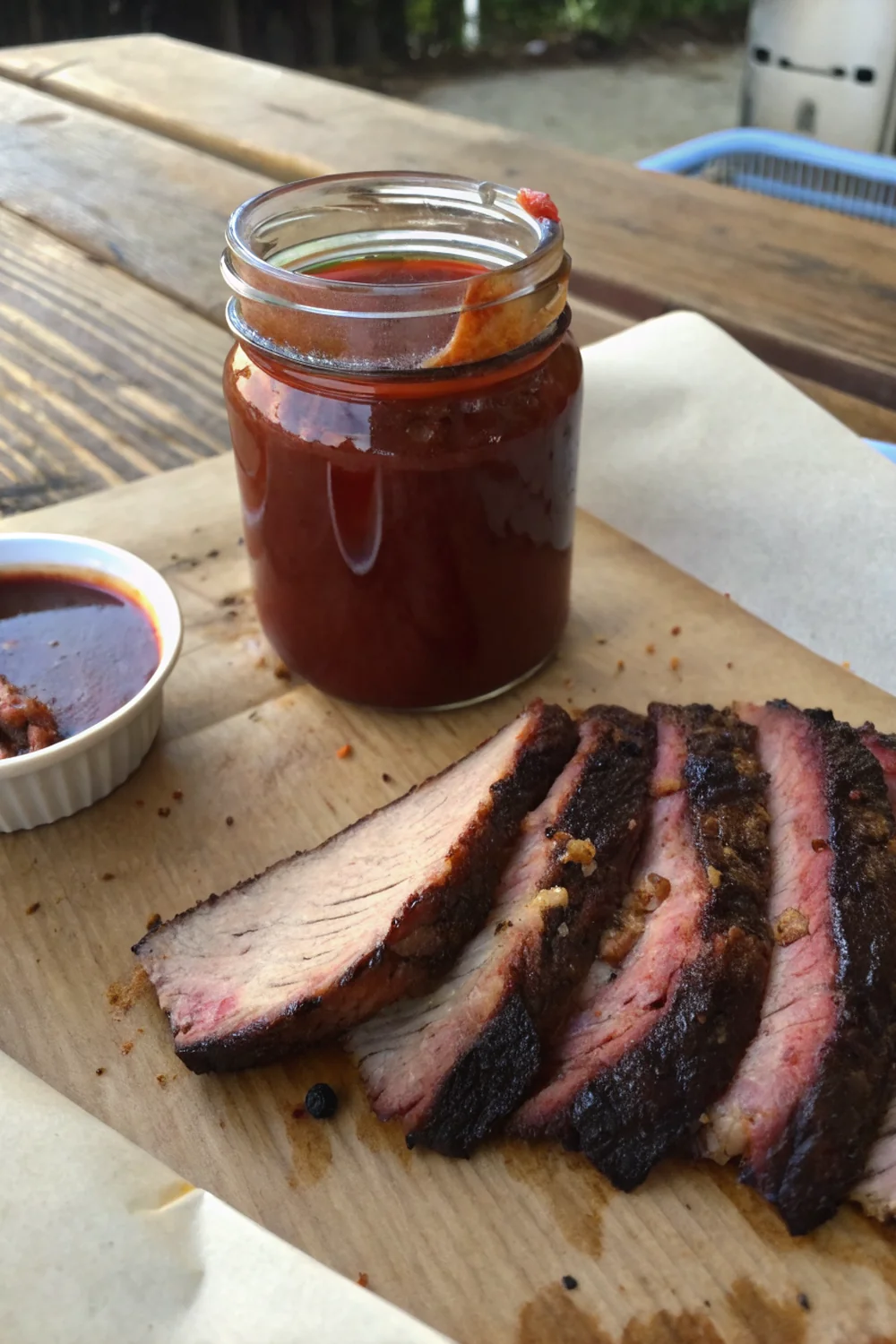
Texas BBQ
Texas BBQ Sauce
Pourable Texas BBQ sauce with beef stock, vinegar, Worcestershire, brown sugar, chili powder, smoked paprika. Built for brisket, ready in 40 minutes.
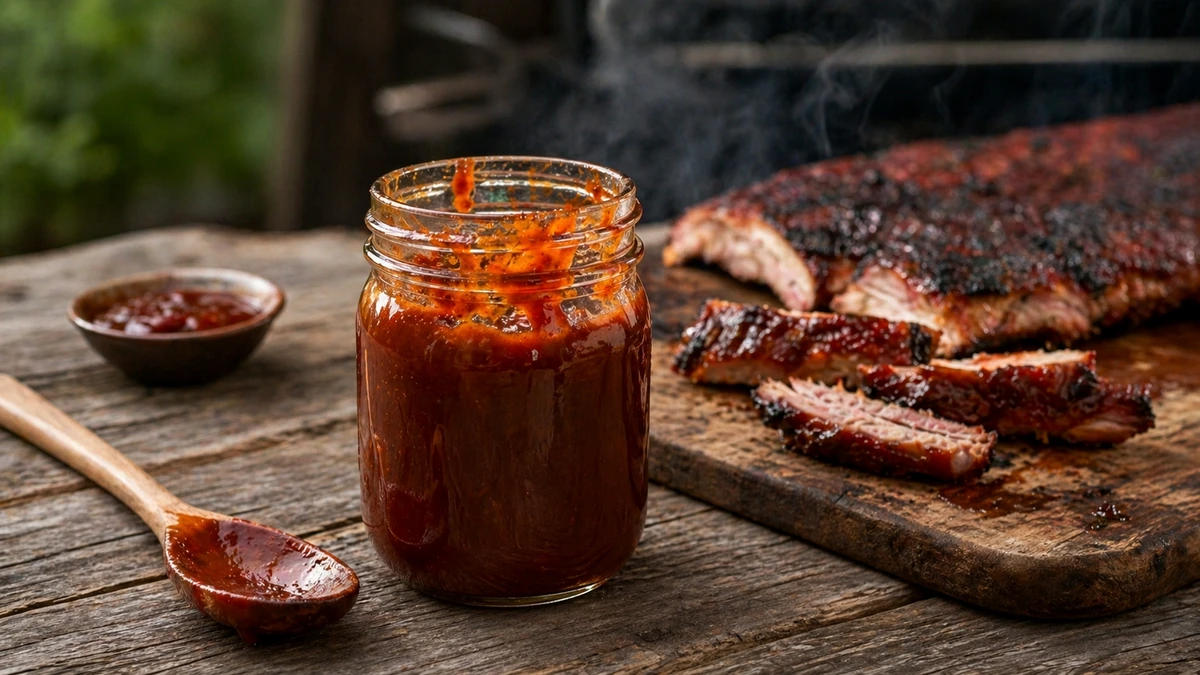
Quick answer: Real Texas BBQ sauce is thin enough to pour from a squeeze bottle, tangy from apple cider vinegar and Worcestershire, and built around beef stock or brisket drippings. It is not Kansas City thick, not Memphis sweet, and not Carolina vinegar-only. The base is canned tomato sauce (not ketchup) sharpened with chili powder and smoked paprika, balanced with brown sugar to round the edges. Simmer 30 minutes and serve alongside brisket, never poured on top.
I learned the difference between Texas BBQ sauce and the rest of the country one summer in Lockhart, sitting on a wooden bench at Black's, watching a guy from Kansas City pour a bottle of Sweet Baby Ray's onto a slice of brisket. The pit boss did not say anything, but I watched his jaw tighten. The Lockhart sauce, when they brought it out, was a thin russet liquid that looked almost like a thinned-out chili gravy, served in a styrofoam cup on the side, and the brisket itself needed none of it. In Central Texas, sauce is a polite afterthought, and even when it appears, it pours like a vinaigrette, not a syrup.
The recipe below is the home-style Texas sauce I make on brisket Saturdays in my Hill Country kitchen, the one I keep in a squeeze bottle in the fridge for chopped beef sandwiches and the rare guest who insists on a finishing drizzle. It is built on canned tomato sauce (not ketchup), thinned with beef stock or brisket drippings, sharpened with apple cider vinegar and Worcestershire, and seasoned with chili powder and smoked paprika. The texture is pourable. The color is brick-red, not Kansas City mahogany. The flavor leads with tang, not sugar. This is the sauce that sits next to the meat, not on it.
The Five Regional Styles of American BBQ Sauce
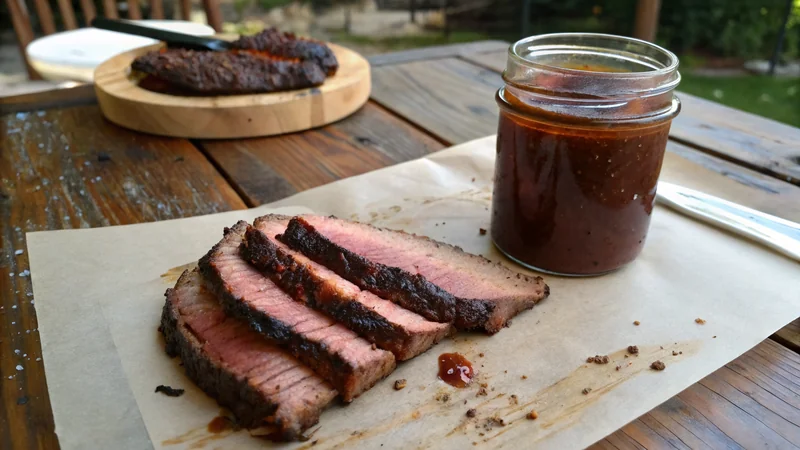
American BBQ sauce is not one thing. It is at least five distinct regional traditions, and most home cooks have only met one of them, the Kansas City style, because Sweet Baby Ray's is the bestselling sauce in America and has shaped what most people picture when they hear the words barbecue sauce.
Kansas City sauce is thick, sweet, ketchup-and-molasses-heavy, dark mahogany in color, and meant to coat ribs in a sticky glaze. Memphis sauce is thinner than KC, more tomato-vinegar balanced, sometimes with a yellow mustard option, and built for both pulled pork and ribs. Carolina sauces split into two camps: Eastern North Carolina is vinegar-and-pepper only, no tomato at all, served on chopped pork; the Piedmont and South Carolina add a yellow mustard base for the famous Carolina gold style. Alabama white sauce is mayonnaise-based, sharp with vinegar and black pepper, designed exclusively for smoked chicken and championed by Big Bob Gibson's in Decatur.
Texas is the fifth tradition, and it is the only one built primarily around beef. The thinness, the beef stock, the optional drippings, the vinegar-forward profile, the absence of molasses heaviness, every choice traces back to the brisket on the plate. A sauce that works on Carolina pulled pork would slide off a slice of fatty brisket without doing any work. Texas sauce is engineered for the meat that defines it.
What Makes Texas Sauce Thin
If you can pour your sauce from a squeeze bottle in a steady stream, you have made Texas sauce. If it plops out in slow blobs, you have made Kansas City. The thinness is not an accident or a shortcut; it is the entire architectural point. There is no cornstarch slurry, no flour roux, no tomato-paste reduction to glue thickness. The body comes from gentle reduction of tomato sauce, beef stock, and aromatics, nothing more.
Why thin? Because Texas brisket is already rich. The fat cap, the bark, the rendered intramuscular fat, the smoke ring, there is enough flavor and texture on the meat that the sauce only needs to add brightness and seasoning, not body or bulk. A thick sauce on brisket is a textural mistake; it covers the bark and competes with the rendered fat.
There is also a serving-format reason. Texas sauce is poured from a squeeze bottle or spooned from a small cup. Both delivery methods need a pourable liquid. Try squeeze-bottling a true Kansas City sauce and you will spend ten minutes shaking the bottle. Texas sauce hits the sweet spot: thin enough to pour, thick enough to coat.
The Lockhart Paradox: Central Texas's No-Sauce Tradition
Here is the strangest fact about Texas BBQ sauce: in the holy land of Texas barbecue (Lockhart, Taylor, Luling, Driftwood), the sauce barely exists. At Kreuz Market in Lockhart, open since 1900, they famously do not serve sauce at all. At Smitty's Market across town, sauce shows up only on request. At Black's, the oldest continuously family-run BBQ joint in Texas (since 1932), sauce sits in a styrofoam cup beside the meat and most regulars leave it untouched. Snow's Barbecue in Lexington serves a sauce so thin and savory it is essentially a seasoned beef au jus.
The reason is cultural. Central Texas barbecue grew out of German and Czech butcher-shop traditions in the 1880s, where smoked meats were sold by weight on butcher paper alongside crackers, cheese, and pickles. The pit master's job was to season the meat with salt and pepper, smoke it over post oak, and let the meat speak for itself. Sauce was a sign that the meat needed help, which was a sign the pit master had failed.
The sauce I am giving you is therefore a hybrid: thin enough to honor the Lockhart purist tradition, but flavored richly enough to please an East Texas or Hill Country eater who expects sauce on the table. If you live in Austin, you have probably eaten at Franklin Barbecue, La Barbecue, or Stiles Switch, all of which serve a sauce in this register: thin, savory, beef-forward, pourable.
Beef Stock: The Texas Signature
If there is one ingredient that distinguishes Texas BBQ sauce from every other American style, it is beef stock, or even better, the rendered drippings collected from the brisket wrap during a smoke. No other regional sauce uses beef as a base liquid. Kansas City uses water and tomato. Memphis uses water and vinegar. Carolina vinegar sauces use straight cider vinegar. Alabama uses mayonnaise. Only Texas reaches for actual beef in the sauce itself, and that single choice is why a real Texas sauce tastes like meat and not like flavored ketchup.
When pit masters wrap a brisket in butcher paper at the stall (around the 165F mark), juices and fat render into the paper over the next 4-6 hours. Once the brisket is finished and rested, those drippings get poured off and saved, sometimes for the chopped beef sandwich pan, sometimes for the cook's beans, and sometimes back into a stock pot to thin the sauce. That is the home-style move I am asking you to make.
If you are not making sauce on a brisket day, low-sodium boxed beef stock works. Better Than Bouillon roasted beef paste (one teaspoon dissolved in a cup of hot water) works even better. It has more roasted depth than most boxed stocks. Avoid bouillon cubes, which are mostly salt. The point is a savory backbone that water alone cannot provide.
The Tomato Base: Why I Use Tomato Sauce, Not Ketchup
Most home BBQ sauce recipes start with ketchup as the base. I have moved to canned tomato sauce, and I want to explain why. Ketchup is already seasoned: it has vinegar, sugar, salt, and proprietary spices baked in. When you build a sauce on ketchup, you are seasoning a seasoned product, which means you are stuck with someone else's flavor decisions. Heinz tastes like Heinz; you cannot un-Heinz a sauce.
Canned tomato sauce (the plain kind sold next to the tomato paste, not jarred pasta sauce) is unsweetened, unsalted, and unseasoned. It is essentially blended tomatoes that have been gently cooked and strained. When you build a sauce on tomato sauce, you control every flavor that follows: the salt level, the sweetness, the vinegar sharpness, the spice profile.
Tomato paste is too concentrated and too raw for this application; it gives the sauce a metallic, undercooked tomato note unless you cook it for a much longer time. Canned tomato sauce is the sweet spot: enough body to give structure, enough water to keep things pourable, and enough neutrality to let the seasonings shine. Hunt's, Muir Glen organic, or store-brand canned tomato sauce all work.
Apple Cider vs Distilled: The Vinegar Question
Vinegar is the spine of Texas BBQ sauce, and the choice of vinegar matters more than most home cooks realize. Distilled white vinegar is what most KC and grocery-store BBQ sauces use. It is cheap, neutral, and one-dimensional. It cleans like a champ but it tastes harsh in a sauce. The acidity is loud and the finish is short.
Apple cider vinegar has fruit-forward sweetness underneath the sharpness, which is why it pairs so beautifully with brown sugar, Worcestershire, and beef. Bragg's unfiltered (the kind with the cloudy mother) is the gold standard. Heinz cider vinegar is fine. Any unfiltered cider vinegar from the grocery store works. The flavor is rounder, the finish lingers longer, and the sauce reads as more complex even though you have done less work.
Some recipes call for sherry vinegar or red wine vinegar. They are acceptable substitutes if cider is what is missing from your pantry, but cider is the Texas-canonical choice. Avoid balsamic. Its sweetness fights the brown sugar and the molasses note clashes with the cider profile.
Worcestershire and the Umami Stack
Worcestershire sauce is the secret backbone of nearly every great BBQ sauce, and Texas sauce uses more of it than the other regional traditions. Worcestershire is a fermented condiment built on anchovies, tamarind, vinegar, molasses, and onion. It contributes savory depth, gentle funk, and a slight acidity that compounds with the cider vinegar to create a flavor architecture that reads as much bigger than the ingredient list.
Use Lea and Perrins if you can. It is the original (1837) and the flavor profile is what most American BBQ sauces are calibrated against. French's Worcestershire is fine. Avoid the cheap store-brand versions; they substitute molasses and corn syrup for the tamarind and the result tastes flat. A vegetarian Worcestershire (Annie's, The Wizard's) works if dietary needs require it.
I add Worcestershire in two waves: the bulk of it goes in early to simmer and integrate with the tomato and stock, and a small finishing teaspoon gets whisked in off-heat at the end. That second hit preserves the bright, fermented top-notes that long cooking dulls. Pit masters working at Goldee's in Fort Worth or Hutchins in McKinney use a similar two-stage technique with vinegars and Worcestershire.
Brown Sugar for Balance, Not Sweetness
Texas sauce uses sugar, but it uses it as a balancer rather than a flavor. The 3 tablespoons of dark brown sugar in this recipe (against 1 cup of beef stock and 15 oz of tomato sauce) is roughly half what a Kansas City sauce of the same volume would use. The sugar's job is to round the sharp edges of the vinegar and Worcestershire, not to make the sauce read as sweet. If you taste the finished sauce and the first thing your tongue notices is sweetness, you have over-sugared. Pull it back with another tablespoon of cider vinegar.
Dark brown sugar is preferred over light because it has more molasses content baked into the granulated sugar, which gives a faint background depth without requiring you to add separate molasses (which can dominate the pot if used heavily). If you only have light brown sugar, add an extra teaspoon of unsulphured molasses to compensate. Avoid white sugar; it is too clean and the sauce reads as one-dimensional.
Sugar-free adaptation: a monkfruit-erythritol blend (Lakanto Golden, Swerve Brown) substitutes 1:1 for brown sugar with no flavor loss. The texture is slightly thinner, but the difference is barely detectable in a finished sauce. Keto and diabetic guests will thank you.
Chili Powder vs Smoked Paprika
These two ingredients sound similar but do completely different jobs in Texas sauce. American chili powder is a blend, typically built around dried ancho or New Mexico chiles plus cumin, garlic powder, oregano, and salt. Gebhardt's (made in San Antonio since 1896) is the Texas heritage brand. Mexene is an alternative. Pendery's in Fort Worth makes excellent custom blends. The chili powder gives the sauce its body of warmth, its earthy chile-pepper backbone, and its slight cumin-and-oregano whisper.
Smoked paprika (Spanish pimenton) does something different entirely: it carries actual smoke flavor. It is made from peppers that have been smoked over oak before being ground, which means the smoke note is locked into the pigment itself. A teaspoon of smoked paprika gives a sauce the suggestion of pit cooking even when the sauce has never seen a smoker. This is the secret weapon for sauces made on a kitchen stove.
Use sweet pimenton (pimenton dulce) as the default; bittersweet (agridulce) works if that is what you have. Avoid hot pimenton (pimenton picante) for this recipe because the cayenne already handles the heat layer. The Spanish brand La Chinata in the small red tin is the gold standard.
The Simmer: Avoid Boiling, Sugar Burns Fast
The single biggest mistake home cooks make with BBQ sauce is letting it boil hard. Sugar at a rolling boil scorches against the pan bottom in 90 seconds, and the bitter scorched note is permanent. You cannot rescue a burnt BBQ sauce. Once that flavor is in there, the whole pot is compost.
The right pace is a lazy simmer: one bubble breaking the surface every 2-3 seconds, with most of the action happening at the edges of the pan. The sauce should be moving but not roiling. Whisk every 4-5 minutes, dragging the whisk along the bottom of the pan to disrupt anything that wants to stick.
Use a heavy-bottomed saucepan to spread the heat evenly. Enameled cast iron (Le Creuset, Lodge enameled) is the best because it is non-reactive with the vinegar and tomato. Stainless steel works. Avoid bare aluminum and bare cast iron, both of which can react with the acid and give the sauce a metallic, tinny aftertaste.
Squeeze-Bottle Storage and the Texas Way to Serve
Once the sauce is cooled, transfer it to a glass squeeze bottle (the kind diners use for ketchup and mustard) or a 24 oz mason jar with a lid. The squeeze bottle is the Texas-canonical serving vessel because it lets each guest pour their own portion in a controlled stream onto the meat or onto a sandwich.
Refrigerate the sauce for at least 4 hours before serving, ideally overnight. Same-day sauce tastes harsh and one-note; rested sauce tastes finished. The flavors marry overnight as the chili powder fully hydrates, the vinegar integrates, and the Worcestershire mellows from sharp to round. The sauce keeps 4 weeks refrigerated in a clean container.
For longer storage, freeze in 1-cup portions in zip-top bags or small mason jars (leave half an inch of headspace for expansion). The sauce keeps 6 months frozen with no quality loss because there is no dairy or egg to break. Thaw overnight in the fridge and whisk briefly if any minor separation occurs.
Kitchen Notes from My Hill Country Saturdays
I make this sauce every other brisket Saturday, which works out to about every six weeks. The single change that improved my version most was switching from ketchup to canned tomato sauce. The clarity of flavor jumped immediately and I never went back. Try it once side by side with a ketchup-based version and the difference will not be subtle.
If I have just finished smoking a brisket, I always use the strained drippings from the wrap as the liquid base. I keep a small fine-mesh strainer over a Pyrex measuring cup specifically for this purpose. The drippings are gold: equal parts beef stock and rendered fat, infused with smoke from the post oak.
The single most useful tool in my kitchen for this recipe is an immersion blender. It saves the dirty blender jar, blends directly in the saucepan, and gives the sauce that velvety squeeze-bottle texture in 30 seconds. For the technique behind the brisket itself, see my full Texas BBQ brisket guide.
Mistakes to Avoid
Using ketchup as the base. Ketchup is already seasoned and you lose flavor control. Use canned tomato sauce instead, and you will taste the difference on the first spoonful.
Making it too sweet. Texas sauce is not Kansas City. If your finished sauce reads sweet first, add a tablespoon of cider vinegar and re-taste. Repeat until tang leads.
Making it too thick. Do not let the sauce reduce by more than a quarter. If it is too thick after cooling, whisk in warm beef stock a tablespoon at a time until pourable.
Skipping the vinegar. A sauce without enough vinegar tastes flat and muddy. The two-stage vinegar addition (most early, a small finishing splash off-heat) is the trick that gives the sauce its bright top-notes.
Using distilled white vinegar. Harsh, one-dimensional, and the wrong note for Texas sauce. Apple cider vinegar is the canonical choice.
Boiling instead of simmering. Sugar at a rolling boil scorches in 90 seconds and the bitterness is permanent. Lazy bubbles only.
Pouring sauce on a Lockhart-style brisket. The brisket does not need it. Serve the sauce in a small jar on the table; let each guest decide.
Variations Worth Trying
Spicy chipotle Texas sauce. Add 2 chipotle peppers in adobo (chopped) plus 1 tablespoon of the adobo sauce in the simmer step. The chipotle adds smoky heat and a slight Tex-Mex tilt. A South Texas favorite.
Espresso Texas sauce. Add 1 teaspoon of espresso powder or 1 tablespoon of strong brewed coffee in the simmer step. The espresso deepens the color and adds a bitter-roast complexity that pairs beautifully with the brown sugar. A West Texas cowboy-camp move.
Peach-bourbon glaze. Add 1/2 cup of pureed canned peaches (in light syrup, drained) plus 2 tablespoons of bourbon in the last 10 minutes of simmer. Reduce the brown sugar to 1 tablespoon. Perfect for smoked chicken or pork ribs. An East Texas classic.
Mustard-Texas hybrid. Whisk in 2 tablespoons of yellow mustard during the seasoning step. The mustard adds a tangy kick that bridges Texas and Carolina styles. Pairs especially well with hot links and smoked sausage.
All-drippings batch. Replace the entire 1 cup of beef stock with 1 cup of strained brisket drippings from the wrap. The sauce will be richer, more savory, and slightly fattier. The signature pit-master move on the day after a long smoke.
What to Serve It With
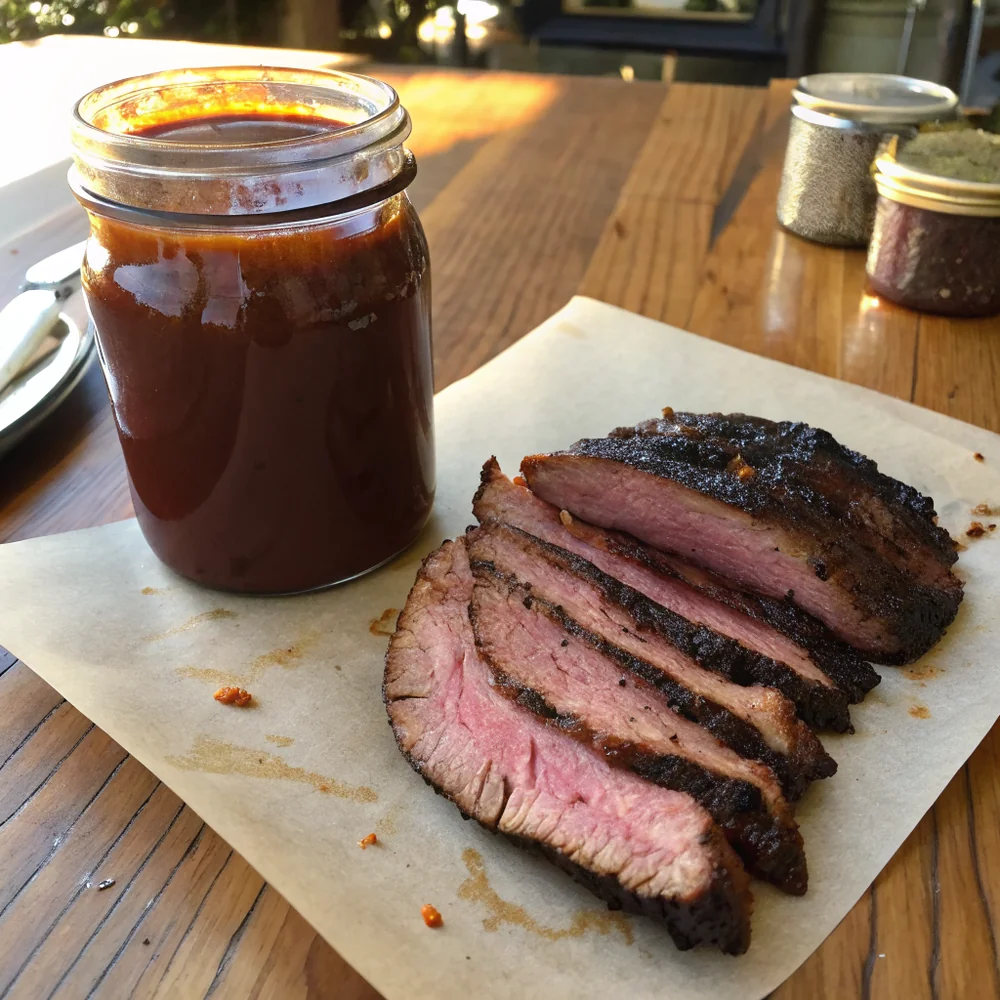
The canonical pairing is brisket. Serve a small jar or squeeze bottle of this sauce alongside a Lockhart-style brisket plate (sliced fresh on butcher paper with white bread, dill pickles, raw white onion, and saltines). Let each guest decide whether to use the sauce. See my full Texas BBQ brisket recipe for the meat itself.
Burnt ends love this sauce because the brown sugar in the sauce echoes the brown sugar in the burnt-end glaze, and the cider vinegar cuts through the rendered fat of the cubed point. A small pour over a tray of fresh-glazed burnt ends takes them from great to unforgettable.
The cornbread brisket sandwich is where this sauce really earns its keep. Mix 2-3 tablespoons of sauce directly into the chopped brisket before piling it onto a split square of skillet cornbread. The sauce moistens the meat and gives consistent flavor across every bite.
Other excellent pairings: smoked pork ribs (used as a glaze in the last 20 minutes of cooking), smoked chicken thighs, hot links, smoked sausage, and brisket-stuffed baked potatoes. For the wider pit-master philosophy and Aaron Franklin's sauce technique, see his Aaron Franklin Texas BBQ resource.
Texas BBQ Sauce Recipe
Ingredients
- For the sauce base:
- 1 (15 oz / 425 g) can tomato sauce (not ketchup, not paste)
- 1 cup (240 ml) beef stock, low sodium, or strained brisket drippings from the wrap
- 2 tablespoons unsalted butter
- 1 small yellow onion, finely diced (about 3/4 cup)
- 3 cloves garlic, finely minced
- For the seasonings:
- 1/3 cup (80 ml) Worcestershire sauce, Lea and Perrins preferred
- 1/4 cup (60 ml) apple cider vinegar (Bragg's or any unfiltered cider vinegar)
- 3 tablespoons (40 g) packed dark brown sugar
- 1 tablespoon chili powder (Gebhardt's, Mexene, or Pendery's)
- 2 teaspoons smoked paprika (Spanish pimenton, sweet or bittersweet)
- 1 teaspoon freshly ground black pepper
- 1 teaspoon kosher salt (Diamond Crystal; halve if Morton's)
- 1/2 teaspoon ground cumin
- 1/4 teaspoon cayenne pepper, to taste
- For finishing:
- 1 tablespoon apple cider vinegar (added at the end, off heat)
- 1 teaspoon Worcestershire sauce (added at the end, off heat)
- Equipment:
- 3-quart heavy-bottomed saucepan, stainless or enameled cast iron (not bare aluminum)
- Whisk, fine-mesh strainer (optional for ultra-smooth finish), squeeze bottle or 24 oz mason jar for storage
Instructions
- Build the aromatics. Melt the butter in a 3-quart heavy-bottomed saucepan over medium-low heat. Add the diced onion and a pinch of salt. Cook gently for 6-8 minutes, stirring often, until the onion is fully softened and just barely starting to take color at the edges. You are looking for translucent and sweet, not browned. Add the minced garlic and cook for 60-90 seconds more, just until fragrant. Do not let the garlic brown; bitter garlic ruins the whole pot.
- Add the tomato base. Pour in the can of tomato sauce and stir to combine with the onion and garlic. The mixture will bubble immediately because the pan is hot. Stir continuously for 2-3 minutes to cook the raw tomato note off and to let the sauce concentrate slightly. The color will deepen from bright orange-red to a richer brick tone as the tomato browns gently against the bottom of the pan. Tomato sauce (not paste, not ketchup) is the canonical Texas base because it is unsweetened and unseasoned, which means you control every flavor that follows.
- Add the liquids and sugar. Pour in the beef stock (or strained brisket drippings if you have them), Worcestershire sauce, and the first 1/4 cup of apple cider vinegar. Whisk in the brown sugar until fully dissolved. The pan will look like a thin, shiny brown-red liquid at this stage; this is correct. Texas sauce starts thin and reduces gently. If you used drippings, the sauce already smells like a smoker. If you used boxed stock, that smoke note will arrive later from the paprika.
- Simmer to thicken slightly. Bring the sauce to a gentle simmer over medium heat. Whisk in the chili powder, smoked paprika, black pepper, kosher salt, ground cumin, and cayenne. The spices will foam slightly as they hydrate, which is normal. Reduce the heat to medium-low so the sauce barely bubbles, about one lazy bubble every 2-3 seconds across the surface. Simmer uncovered for 25-30 minutes, whisking every 5 minutes. The sauce should reduce by roughly a quarter and the color should deepen from brick-red to a darker, glossier red-brown. Do not let it boil hard. Sugar burns fast at a hard boil and the bitterness is permanent.
- Finish with vinegar and Worcestershire. Pull the saucepan off the heat. Whisk in the final tablespoon of apple cider vinegar and the final teaspoon of Worcestershire. Adding these at the end (rather than simmering them in from the start) preserves the bright, sharp top-notes that long cooking dulls. Taste the sauce now. The order on your tongue should go: tang first, savory beef and Worcestershire second, sweetness third, smoke and chili warmth at the back. Adjust if needed: more salt for flatness, more vinegar for sweetness, more cayenne for heat.
- Blend until smooth (optional). If you like a rustic sauce with visible flecks of onion, leave it as is. If you want the squeeze-bottle-restaurant texture, transfer the sauce carefully to a blender and blend on medium for 30-45 seconds until smooth. An immersion blender works directly in the pan, which is what I usually do. The blend pulls the onion and garlic into a uniform body and gives the sauce a velvety mouthfeel that coats a brisket slice without sliding off entirely.
- Strain (optional). For a Franklin-Barbecue-counter level of smoothness, pour the blended sauce through a fine-mesh strainer into a clean bowl, pressing the solids gently with a spatula to extract every drop. This removes any remaining onion fiber and gives a glossy, restaurant-pourable finish. For home use I usually skip this step. The strained version photographs better; the unstrained version tastes a little deeper.
- Cool and bottle. Let the sauce cool in the pan for 30 minutes, then transfer to a clean glass squeeze bottle or a 24 oz mason jar. The sauce thickens about 20 percent more as it cools, so what looks slightly thin in the pan will be perfectly pourable cold. Refrigerate at least 4 hours, ideally overnight, before serving. The flavors marry overnight: the chili powder mellows, the vinegar integrates, and the Worcestershire goes from sharp to round. The sauce keeps 4 weeks refrigerated in a clean container.
Frequently Asked Questions
What makes Texas BBQ sauce different from Kansas City sauce?
Texas sauce is thin, pourable, vinegar-forward, and built around beef stock. Kansas City sauce is thick, sweet, ketchup-and-molasses-heavy, and built to coat ribs in a sticky glaze. Texas leads with tang, KC leads with sugar. Texas is served on the side of brisket; KC is brushed onto the meat. They are essentially opposite philosophies, both delicious in their place, but the Texas style is engineered for beef while KC is engineered for pork ribs.
Why does my Texas BBQ sauce taste too sweet?
Probably the brown sugar is too high or the vinegar is too low. Add a tablespoon of apple cider vinegar at a time, whisk in, taste, and repeat until the sauce leads with tang on the first sip. The order on your tongue should be: tang first, savory second, sweetness third, warmth at the back. If sweetness leads, you have a Kansas City sauce by accident. Vinegar can be added cold and off-heat without breaking anything.
Can I use beef broth from a box instead of brisket drippings?
Yes. Low-sodium boxed beef broth is the realistic home option, and it works well. Better Than Bouillon roasted beef paste (one teaspoon dissolved in a cup of hot water) gives even more roasted depth than most boxed broths. Brisket drippings from a wrap are the gold standard if you have just finished smoking a brisket, but they are not required for a delicious sauce. Avoid bouillon cubes; they are mostly salt.
Why tomato sauce instead of ketchup or tomato paste?
Canned tomato sauce is unsweetened, unsalted, and unseasoned, which means you control every flavor in the final pot. Ketchup is already seasoned with proprietary spices, vinegar, and corn syrup, which limits your control. Tomato paste is too concentrated and raw-tasting for this application unless cooked much longer. Tomato sauce hits the sweet spot: enough body for structure, neutral enough for flavor control.
Should I put this sauce on the brisket itself?
In Central Texas tradition, no. A properly cooked brisket served on butcher paper with white bread, pickles, and onion does not need sauce. The Lockhart pits like Black's, Kreuz, and Smitty's serve sauce only on request and many regulars leave it untouched. The sauce is for chopped beef sandwiches, ribs, chicken, hot links, and the eaters who insist on a finishing drizzle. Set it on the table; let each guest choose.
How long does homemade Texas BBQ sauce keep?
About 4 weeks refrigerated in a clean glass squeeze bottle or mason jar with a tight lid. The vinegar, sugar, and Worcestershire are natural preservatives, so this sauce keeps longer than most condiments. Always use a clean spoon (or pour rather than dip) to prevent cross-contamination. For longer storage, freeze in 1-cup portions for up to 6 months. The sauce thaws cleanly because there is no dairy or egg to break.
Can I make this sauce sugar-free or keto-friendly?
Yes. Replace the dark brown sugar 1:1 with a monkfruit-erythritol blend (Lakanto Golden or Swerve Brown both work). The sauce will be slightly thinner because sugar provides some viscosity, but the difference is barely detectable. Keep the Worcestershire (it has minimal sugar), keep the cider vinegar (no sugar), and the rest of the recipe stays identical. The sauce remains in the Texas-canonical style and is suitable for keto, diabetic, and low-sugar guests.