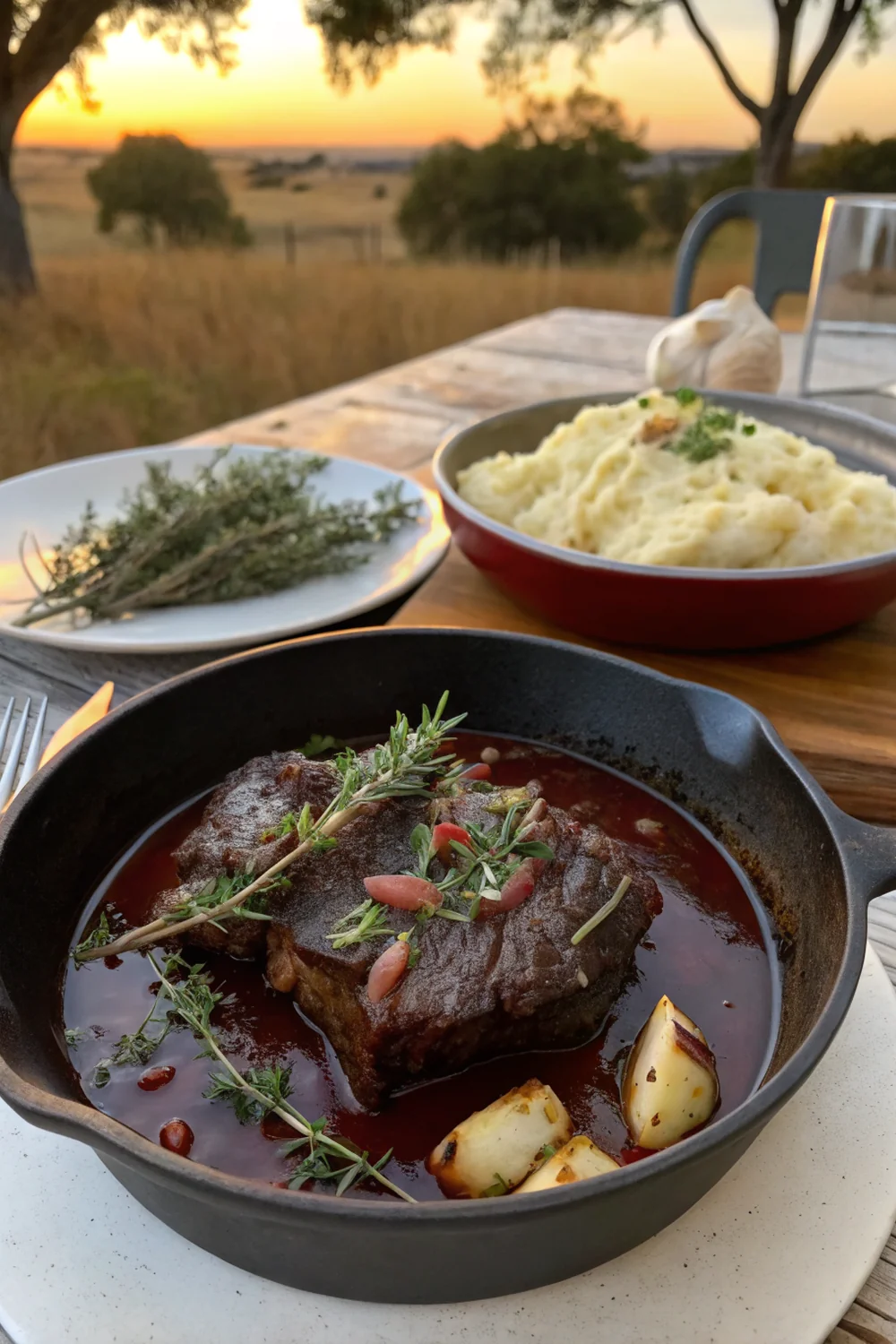
Texas BBQ
Beef Rib Steak Slow Cooker
Chef Mia's slow-cooker beef rib steak: 6 hours LOW in red wine with rosemary and thyme. Steakhouse-tender weeknight dinner, cast iron sear first.
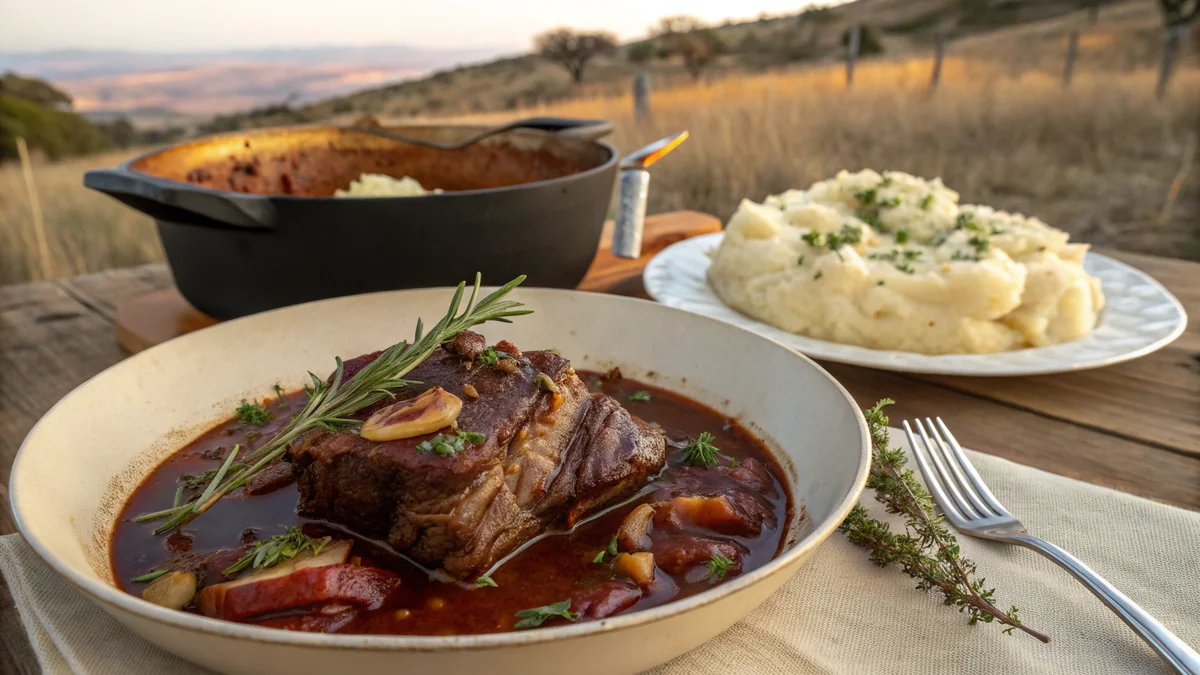
Quick answer: Beef rib steak in the slow cooker takes the marbled, ribeye-cut bone-in or boneless cap and slow-cooks it 6 hours on LOW in a red wine braising liquid built around fresh rosemary and thyme. The 6-hour cook is shorter than the 8 hours short ribs need because rib steak has less connective tissue and more intramuscular fat - it tenderizes faster and dries out faster. Sear the steak hard in cast iron first (2 minutes per side), build the braise with red wine, beef broth, garlic, and Hill Country herbs, then transfer to the slow cooker. Defat the sauce before serving over creamy mashed potatoes.
Beef rib steak is one of those cuts that gets confused with at least three other cuts at the meat counter: short ribs, ribeye, and prime rib. They are all from the same primal section but they are not the same cut, and the differences matter for cooking method. Beef rib steak is essentially a thick-cut ribeye sold with a bone, designed for steakhouse-style cooking - typically 1.5 to 2 inches thick, 12-16 oz per portion, with the rib bone running along one edge. It is the cut most steakhouse menus list as cowboy steak or bone-in ribeye. In the context of this recipe, it goes into a slow cooker rather than a cast iron skillet.
The premise of slow-cooking a steak this nice will sound wrong to most BBQ purists. A 1.5-inch bone-in ribeye is a cut you reverse-sear - 250F oven to 115F internal, then a screaming-hot cast iron sear, finishing at medium-rare. (See cowboy cut ribeye for that method.) The slow-cooker approach is a different technique for a different goal: not steakhouse medium-rare, but a fork-tender, deeply flavored, almost pot-roast-style result that you can leave on for 6 hours and have dinner ready when you walk in the door. It is the weeknight version of a Sunday-dinner cut.
The story behind this recipe is from a pit master friend in Lockhart who runs a backyard rig and a smoker contest team in his off hours. He told me one evening, over cans of Lone Star, that the cuts he loved most were the ones nobody wanted - the secondary muscles, the collagen-heavy chuck pieces, the trim from the brisket point. But sometimes, he said, his wife wanted a real piece of steak for dinner and his smoker was already running brisket and pork shoulder. So he bought rib steaks and slow-cooked them in red wine with herbs from her garden - rosemary, thyme, sometimes oregano - and they came out fork-tender by the time the brisket was done resting. That recipe is the one below, with a few of my own adjustments after years of making it.
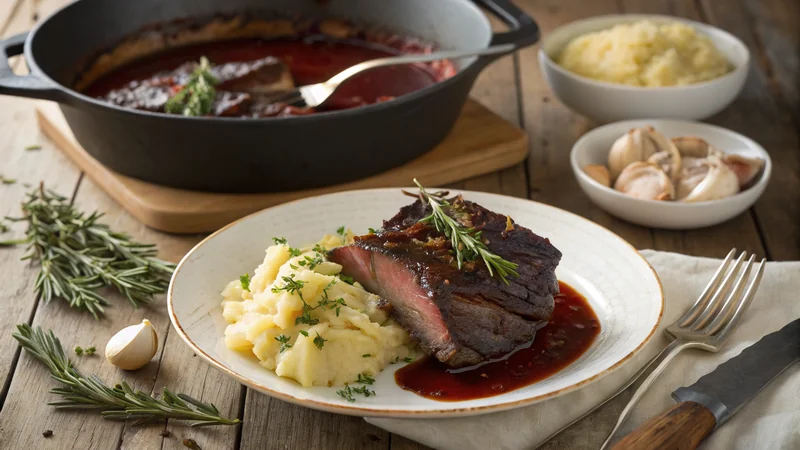
Beef Rib Steak vs Short Ribs vs Ribeye: The Important Differences
These three cuts come from the same beef rib primal section but they are not interchangeable in cooking. Beef rib steak is the marbled, bone-in steak cut from the rib primal - same muscle as a ribeye, just thicker (1.5 to 2 inches) and usually with the bone. It is sometimes labeled cowboy steak or bone-in ribeye. The marbling and texture are designed for high-heat, fast cooking - this is what you reverse-sear in cast iron for 5 minutes total, not slow-cook for 6 hours. The slow-cooker approach in this recipe is the unconventional move; for the conventional steakhouse method, see cowboy cut ribeye.
Short ribs come from a different muscle group than rib steak, despite the shared rib name. Short ribs are the connective-tissue-heavy meat between the ribs and the brisket, designed for long braising. They have much more collagen than rib steak and need 8 hours of slow cooking to fully break down. The slow-cooker recipe at boneless beef short ribs slow cooker uses 8 hours LOW for exactly this reason. Don't substitute short ribs for rib steak in this recipe; the cook times and methods don't translate.
Ribeye is the boneless version of rib steak - same muscle, same marbling, no bone. A 1-inch boneless ribeye cooks like a steak (4-5 minutes per side in a hot pan, medium-rare). A 1.5-inch boneless ribeye is closer to the bone-in rib steak in mass and works with the same reverse-sear or slow-cooker approaches. For this recipe, you can substitute 2 boneless 1-inch-thick ribeyes for 1 bone-in 1.5-inch rib steak; reduce the cook time to 5 hours on LOW.
Prime rib (also called standing rib roast) is the cut you slice into rib steaks. A whole prime rib is 4-7 ribs joined together, typically roasted whole at low temperature. If you slice individual rib steaks off a whole prime rib at home, you have rib steak. They are the same meat at different presentation stages.
The 6-Hour Sweet Spot (Different from Short Ribs)
Beef rib steak does not need 8 hours of slow cooking the way collagen-heavy cuts do. The marbling pattern is different - intramuscular fat woven through the muscle, rather than thick connective tissue layers between muscle groups. The fat renders relatively quickly (within 3 hours), and the muscle fibers tenderize through gentle moist heat over 5-6 hours. Beyond 7 hours, the lean fibers start to dry out and the texture becomes stringy.
The fork test is the right way to know when the steak is done. Insert a fork into the thickest part and twist. If the meat shreds with light resistance (gives way under modest pressure), it is at the optimal tenderness for slow-cooked rib steak. If it shreds with no resistance at all, it has gone past optimal and is approaching the dry-and-stringy stage. If there is firm resistance, give it another 45 minutes.
Most slow cookers hit the sweet spot at exactly 6 hours. Some run cooler (older models, Hamilton Beach 5-quart, Crock-Pot Programmable) and need 6.5-7 hours; some run hotter (newer Crock-Pot models with WeMo, Cuisinart 6-quart) and hit 5.5 hours. Test at the 5.5-hour mark the first time you make this recipe in your specific cooker, then adjust for future cooks.
If you accidentally overcook (you got home an hour late, the meat went 7.5 hours), all is not lost. The texture will be slightly drier than ideal, but the flavor in the braising liquid is excellent. Shred the meat into the reduced sauce, serve over polenta or mashed potatoes, and the sauce coats the meat enough to mask the dryness. Nobody will notice.
Red Wine and Hill Country Herbs
The braising liquid is built around 1.5 cups of dry red wine - the kind of wine you would actually drink, not the cheap supermarket cooking wine. Cabernet Sauvignon is the steakhouse default and works beautifully here. Malbec brings a slightly fruitier character that complements the beef. Texas Hill Country wineries (William Chris, Ron Yates, Pedernales Cellars) make excellent tempranillo blends that are uniquely suited to this dish - they have the structure of a red wine reduction sauce with a faint local herbaceous note that pairs with rosemary and thyme.
If you do not drink wine, replace with 1.5 cups of beef broth + 1 tablespoon balsamic vinegar + 1 tablespoon Worcestershire. The flavor profile is different (less complex, less acidic) but the dish still works. Avoid wine substitutes labeled cooking wine - they are loaded with salt and bitter additives that ruin the finished sauce.
Fresh rosemary and thyme are non-negotiable for the Hill Country character. Dried versions are okay but lack the volatile oils that perfume the slow cooker over 6 hours. Fresh herbs go in as whole sprigs that are removed before serving (the woody stems are not pleasant in the final sauce). 4 sprigs of rosemary and 6 sprigs of thyme is the right ratio - rosemary is more assertive, thyme is more delicate.
If you have access to fresh oregano, add 2-3 sprigs as a Hill Country bonus. Mexican oregano (different from Mediterranean oregano - more citrusy, more peppery) brings a Texas-specific note that ties the dish to the local cooking tradition. The dried Mexican oregano substitute is fine if you cannot find fresh.
The 2 tablespoons of cold butter whisked into the reduced sauce at the end is the French steak-house finishing move (monter au beurre) that gives the sauce its glossy, restaurant-quality body. Skip the butter and the sauce is still good but reads as everyday rather than special. The butter is what makes this a date-night dish rather than a Tuesday-night dish.
The Sear Step (Don't Skip)
The 2-minute-per-side sear in cast iron before the slow cooker is the most important step in this recipe. The Maillard reaction during the sear creates flavor compounds that you cannot generate any other way - not at slow-cooker temperatures, not in a pressure cooker, not in an oven below 400F. Without the sear, you have a fork-tender piece of beef that tastes flat. With the sear, you have a fork-tender piece of beef that tastes deeply meaty.
Cast iron is the right pan for this sear. The heat retention of cast iron means the pan does not drop in temperature when you add the steak; the surface contact stays at 500F+ for the full 2 minutes per side, generating maximum browning. A stainless steel skillet works as a substitute but transfers heat less efficiently. Avoid nonstick pans entirely - they are not designed for the high heat needed for a proper sear and the coating breaks down at these temperatures.
Make sure the cast iron is properly preheated before the steak goes in. Heat the empty pan over medium-high for at least 5 minutes - until you see the first wisp of smoke off the dry surface. The pan should look uniformly dark and feel intensely hot when you hold your hand 3 inches above it. A pan that is not hot enough produces a grey, uneven sear; a properly heated pan produces a deep mahogany crust.
Pat the steak completely dry before searing. Wet meat steams instead of searing - the moisture has to evaporate before the surface can brown. A 60-second pat-down with paper towels right before the steak hits the pan makes a noticeable difference in the quality of the crust.
Resting and Slicing (or Shredding)
After 6 hours in the slow cooker, the rib steak is fork-tender to the point that it does not need traditional resting time. The slow-cooked muscle fibers are not under tension the way a high-heat-seared steak's are; the juices have already redistributed during the long, gentle cook. You can transfer the steak from the slow cooker to the plate and serve immediately.
That said, a 5-minute rest under foil before serving is a good idea for two reasons: it lets the meat firm up slightly so it cuts (or shreds) more cleanly, and it gives you time to defat and reduce the sauce on the stove. Use the rest as a working window, not a waiting window.
Slicing vs shredding is a presentation choice. The bone-in rib steak can be sliced traditionally (1/2-inch slices, against the grain) for a steakhouse plate, or shredded with two forks for a more rustic, beef-stew-style serving. The slicing approach is the date-night choice; the shredding approach is the family-supper choice.
If you are slicing, identify the grain first. The muscle fibers run roughly perpendicular to the bone. Slice across them - the fibers should look short in the slice, not long stringy strands. A long-stringy slice is with-the-grain and chewier; a short-fiber slice is across-the-grain and more tender.
For variations and pairings, see cowboy cut ribeye for the high-heat reverse-sear method on the same cut, or boneless beef short ribs slow cooker for the longer-braise variation. The Ultimate Texas BBQ Guide covers the broader Texas beef family. For the bone-in version of this low-and-slow approach, see my beef back ribs in the slow cooker.
Beef Rib Steak Slow Cooker Recipe
Ingredients
- 1 bone-in beef rib steak, about 1.5-2 inches thick (1.5-2 lb / 700-900 g), USDA Choice or Prime
- OR 2 boneless rib steaks (about 1 lb each)
- 1.5 teaspoons kosher salt
- 1 teaspoon coarse black pepper
- 2 tablespoons (28 g) high-smoke-point oil (avocado, grapeseed)
- 1 medium yellow onion, thinly sliced
- 1 medium carrot, sliced into 1/4-inch rounds
- 1 celery stalk, sliced into 1/4-inch pieces
- 5 cloves garlic, smashed
- 2 tablespoons tomato paste
- 1.5 cups (360 ml) dry red wine (Cabernet Sauvignon, Malbec, or a Texas Hill Country tempranillo)
- 1 cup (240 ml) beef broth
- 2 tablespoons Worcestershire sauce
- 1 tablespoon Dijon mustard
- 4 sprigs fresh rosemary
- 6 sprigs fresh thyme
- 2 bay leaves
- 2 tablespoons (28 g) cold unsalted butter, for the finish (optional)
- Fresh parsley, for garnish
- Mashed potatoes, polenta, or buttered egg noodles, to serve
Instructions
- Pat the rib steak dry and season. Remove the rib steak from packaging. Pat completely dry with paper towels. Season both sides aggressively with kosher salt and black pepper, pressing the seasoning into the meat. Let rest at room temperature for 20-30 minutes - this brings the meat closer to room temp before searing, which produces a better crust.
- Sear hard in cast iron. Heat a 12-inch cast iron skillet over medium-high heat for 5 minutes until smoking. Add 1 tablespoon oil, swirl, let shimmer 30 seconds. Lay the rib steak in the pan away from you to avoid splatter. Sear undisturbed for 2 minutes per side until each side has a deep mahogany crust. Use tongs to also sear the fat edge for 30 seconds. Transfer the seared steak to the slow cooker insert.
- Sweat the aromatics. Reduce heat under the skillet to medium. Add the sliced onion, carrot, and celery to the residual fat. Cook 5-6 minutes, stirring occasionally, until the onion is translucent and the vegetables have started to brown at the edges. Add the smashed garlic, cook 30 seconds until fragrant. This creates a Texas mirepoix base - the savory foundation of the braise.
- Build the red wine braising liquid. Add the tomato paste to the skillet, stir 30 seconds until darkened. Pour in the red wine - it will bubble aggressively. Scrape up all the fond from the bottom with a wooden spoon. Bring to a simmer and cook 3-4 minutes until the wine has reduced by about a third (this drives off the raw alcohol harshness). Add the beef broth, Worcestershire, and Dijon. Stir to combine.
- Pour over the steak. Pour the entire vegetable-and-liquid mixture from the skillet over the seared steak in the slow cooker. The liquid should come about halfway up the steak (not fully submerged - rib steak braises better with the top of the meat exposed to the steam rather than fully submerged in liquid). Tuck the rosemary sprigs, thyme sprigs, and bay leaves into the liquid around the steak.
- Slow cook 6 hours on LOW. Cover the slow cooker. Set to LOW for 6 hours. Do not lift the lid during the cook - every lift loses heat and adds 20+ minutes to the total time. Walk away. The 6-hour mark is the sweet spot for rib steak; beyond 7 hours, the leaner muscle fibers start to dry out (rib steak has less connective tissue than short ribs, so it does not benefit from the longer 8-hour cook).
- Hour 5.5 fork test. After 5.5 hours, check the steak with a fork. Insert into the thickest part. If it shreds with very little resistance, it is ready. If there is still firm resistance, recover and cook another 30-45 minutes. Most rib steaks hit fork-tender between 5.5 and 6.5 hours on LOW. The bone-in version may take 30 minutes longer than boneless because the bone slows heat penetration slightly.
- Defat and reduce the sauce. Carefully transfer the rib steak to a serving platter (use two large spoons or a spider; the meat is delicate and may split apart - that is fine). Tent loosely with foil to keep warm. Pour the braising liquid through a fine mesh sieve into a fat separator or tall measuring cup. Skim off the visible fat layer with a spoon. Pour the defatted liquid into a saucepan, bring to a hard simmer, reduce 5-8 minutes until thickened to a sauce that coats the back of a spoon.
- Mount with butter and serve. Pull the reduced sauce off the heat. Whisk in 2 tablespoons of cold cubed butter, one tablespoon at a time, until the sauce is glossy and slightly thickened (this is the classic French monter au beurre technique). Season with salt and pepper to taste. Pour over the rib steak. Garnish with chopped fresh parsley. Serve over mashed potatoes, with a side of <a href='https://www.texanrecipes.com/texas-roadhouse-green-bean-recipe/'>Texas Roadhouse-style green beans</a> or a simple green salad with lemon vinaigrette.
Frequently Asked Questions
What's the difference between rib steak and short ribs in a slow cooker?
Different muscle, different cooking time. Short ribs come from the chuck/plate area with heavy connective tissue - need 8 hours LOW to fully break down collagen. Rib steak comes from the rib primal (same as ribeye) with marbled intramuscular fat - tenderizes faster, needs only 6 hours LOW. Short ribs benefit from longer cooks; rib steak dries out past 7 hours. Don't swap times between recipes.
Can I use a boneless ribeye instead of bone-in rib steak?
Yes - 2 boneless ribeyes (1 lb each, 1-1.5 inches thick) work as a substitute for 1 bone-in rib steak. Reduce the cook time to 5 hours on LOW since boneless cooks faster. The flavor is 95% the same; the bone in the bone-in version contributes some marrow flavor over the 6-hour cook but the difference is subtle. Use whichever is available at your butcher counter.
Can I cook this recipe in a Dutch oven instead of a slow cooker?
Yes - braise in a 300F oven, covered, for about 3 hours total. Same recipe, same ingredients, just translate the slow cooker LOW to oven 300F. Check fork-tenderness at 2.5 hours. The Dutch oven version often has slightly more concentrated flavor due to the higher temperature, but the slow cooker is more forgiving for hands-off cooking.
What red wine is best for this recipe?
A dry red wine you'd actually drink. Cabernet Sauvignon is the steakhouse default and works perfectly. Malbec brings a fruit-forward character. Texas Hill Country tempranillo blends from William Chris or Pedernales Cellars are uniquely suited and pair locally with the rosemary-thyme herbs. Avoid: cooking wine (over-salted), sweet wines (clash with the beef), rosé (too light).
Can I skip the sear?
No - the sear is the most important step. The Maillard reaction during the 2-minute-per-side sear creates flavor compounds that the slow cooker cannot generate at low temperatures. Skipping the sear produces fork-tender meat with flat flavor. Add 5 minutes of skillet time before the slow cooker for a 60% better final dish. Use cast iron for best results.
How do I know when the rib steak is done?
Fork test, not internal temperature. Insert a fork into the thickest part and twist. The meat should shred with light resistance - giving way under modest pressure but not falling apart with no resistance. If it shreds with no resistance, it has overcooked. If there's firm resistance, give it 45 more minutes. Most slow cookers hit the sweet spot at 5.5 to 6.5 hours.
Can I substitute dried herbs for fresh rosemary and thyme?
You can but the flavor suffers noticeably. Fresh herbs release volatile oils slowly over 6 hours of slow cooking, perfuming the entire dish. Dried herbs are flatter and lose impact during long cooks. If using dried: 2 teaspoons dried rosemary + 1 tablespoon dried thyme. Tied in cheesecloth for easy removal. The dish works but the Hill Country character is muted.
Can I freeze the slow-cooker rib steak leftovers?
Yes, but slice or shred first, then freeze in 1-cup portions with the defatted sauce. Hold up to 3 months. Thaw overnight in the fridge, reheat gently in a covered pan over low heat with a splash of beef broth. The texture is slightly drier after freezing than fresh, but the flavor is excellent and the sauce keeps the meat moist. Make a double batch if you want guaranteed leftovers for the freezer.