Buying guide
Best BBQ Smokers for Texas Brisket 2026
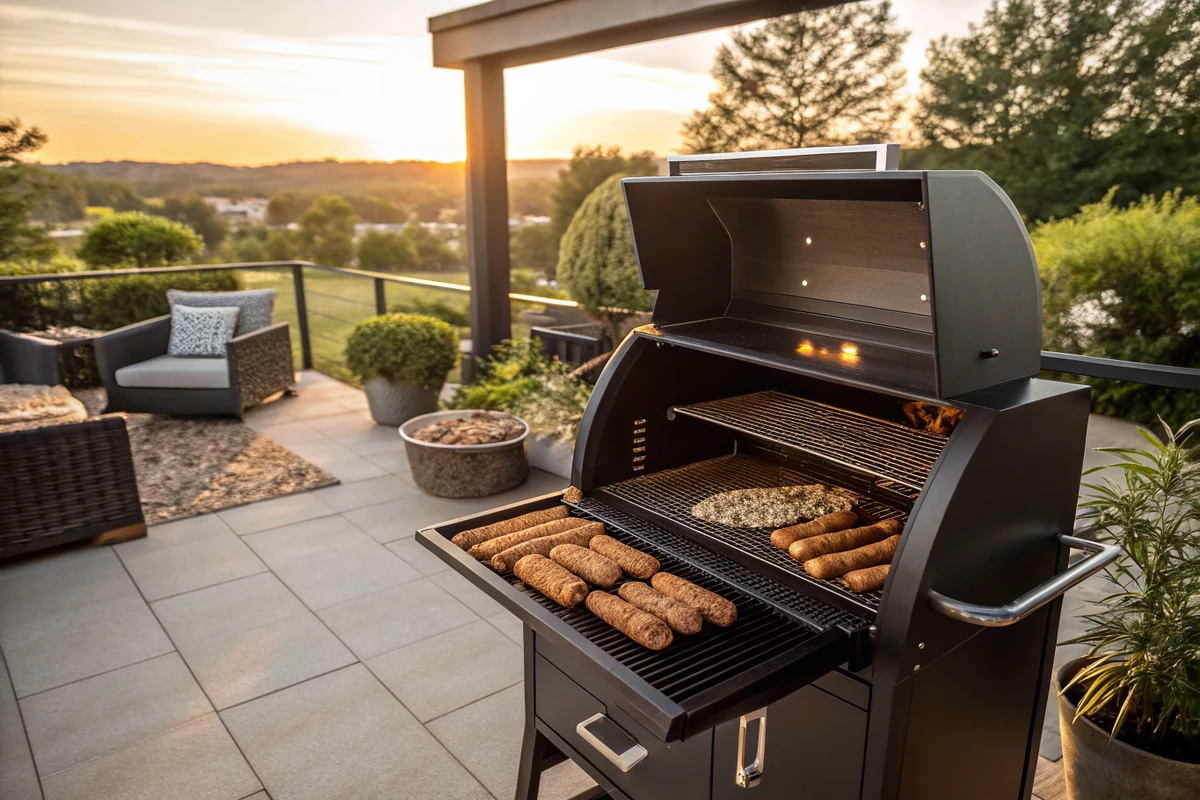
Quick answer: For Texas-style brisket, an offset smoker burning post oak is canonical, Yoder Smokers, Workhorse Pits, and Lang lead this category. For home cooks who want set-and-forget results, the Traeger Ironwood 885 and Yoder YS640S pellet smokers deliver excellent brisket. Budget pick: Pit Boss Pro Series 1100 at under $700. This guide tests 12 smokers across offset, pellet, kamado, and electric categories on 16-hour brisket cooks in Mia's Hill Country kitchen.
As an Amazon Associate, Chef Mia earns from qualifying purchases. This doesn't cost you anything extra and helps keep the recipes free.
My first offset smoker was a cheap thirty-inch box from a big-box store. It leaked smoke from every seam, the firebox door warped after three cooks, and the temperature swung 80°F between when I closed the lid and when I opened it. I cooked brisket on that thing for two years before I finally bought a real smoker. In my experience, a cheap offset is more expensive than a good pellet smoker over five years. The cheap one eats fuel, ruins meat, and lands in the scrap pile by year three. Painful lesson. Worth saying out loud.
This guide tests twelve smokers across four categories: offset, pellet, kamado, and electric. Each smoker ran the same 14-pound USDA Choice packer brisket cook at 250°F until probe-tender, plus a rack of St. Louis spare ribs and six chicken thighs. I measured temperature stability with three Tappecue probes at grate level, evaluated bark and smoke ring at the slice, and tracked fuel consumption and operator effort. Reviewed alongside our tested Texas BBQ rubs and brisket recipe. Planning your first cook on a new pit? My free brisket smoking time calculator turns weight, temperature, and wrap into an hour-by-hour timeline.
The Four Types of BBQ Smokers for Texas Brisket
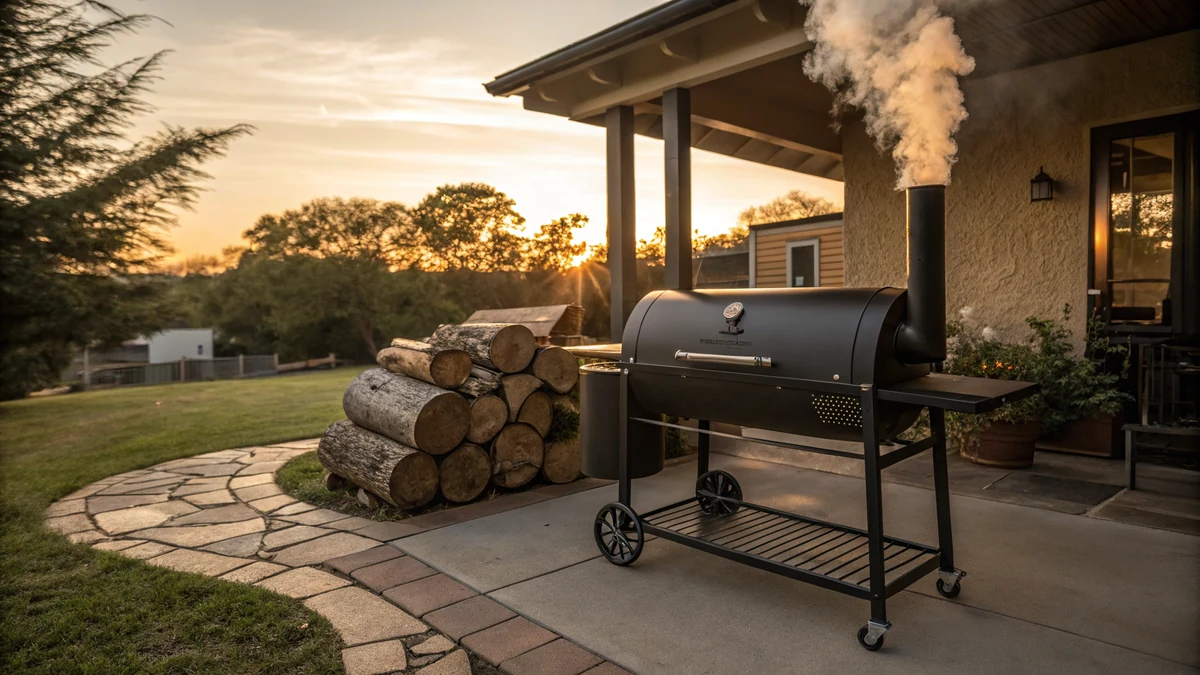
Offset smokers are the traditional Texas pit. A firebox sits next to a main cook chamber, and wood splits (post oak in Central Texas) burn down to embers that pull heat and smoke across the meat horizontally. Offsets demand attention, adding splits every 45 to 60 minutes, managing airflow, learning the smoker's hot spots. The reward is the deepest, cleanest smoke flavor available. Every great Texas barbecue restaurant cooks on an offset.
Pellet smokers are the modern compromise. A digital controller feeds compressed wood pellets into a firebox-style auger, an induction fan circulates heat and smoke, and a thermostat holds temperature within 5°F to 10°F across a 16-hour cook. Pellet smokers cannot match the smoke flavor of an offset because pellet smoke is cleaner and less complex, but they are roughly ten times easier to operate and produce excellent results for the cook who cannot stand by the fire all day.
Kamado grills, Big Green Egg, Kamado Joe, Primo, are thick ceramic eggs that hold heat with remarkable efficiency. Lump charcoal supplies fuel, wood chunks supply smoke, and the ceramic insulation keeps the temperature steady once it settles. Kamados can do brisket well, but the volume is limited (you can fit one packer at most), and the airflow restriction means smoke flavor is gentler than an offset. Where the ceramic genuinely shines is the long rib cook: my Big Green Egg beef ribs method shows the machine at its best, one load of lump, eight steady hours, no water pan needed.
Electric smokers are the entry-level category. A heating element warms a wood-chip tray, smoke fills the cabinet, and a thermostat maintains temperature. Electric smokers do not produce the same depth of smoke as wood-fueled options, but they are inexpensive, simple, and a reasonable way to learn brisket without a $2,000 commitment. Most pitmasters graduate beyond electric, but I have eaten very good brisket from a Masterbuilt.
How We Tested These 12 BBQ Smokers
Each smoker ran the same three protocols. First, a 14-pound USDA Choice packer brisket cooked at 250°F using post oak (offset and pellet) or lump charcoal with post oak chunks (kamado, electric). The brisket was trimmed to a quarter-inch fat cap, rubbed with Meat Church Holy Cow at one tablespoon per pound, rested twelve hours in the refrigerator before cooking, and pulled when probe-tender (typically 203°F to 206°F internal).
Second, a rack of St. Louis-cut pork spare ribs cooked at 275°F for five hours, no foil. Third, six bone-in chicken thighs at 350°F to 175°F internal. Each smoker was instrumented with three Tappecue probes, one at grate left, one at grate right, one at center, to measure temperature variance and stability over time. I logged fuel consumption (pellets in pounds, splits in count, lump in pounds), operator attention (number of times I touched the smoker), and total cook time.
Smokers were scored on five criteria: temperature stability (5 points), smoke flavor depth (5 points), build quality and longevity (5 points), ease of use (5 points), and value at price (5 points). Top scores are 25 points. Each smoker is reviewed below with its category-relative ranking, price, and use-case fit. Prices in this guide reflect manufacturer suggested retail at the time of testing and may have changed.
One philosophical note: the best smoker is the one you will actually use every weekend. A $4,500 Workhorse Pits offset sitting unused under a tarp is worse than a $700 Pit Boss pellet smoker that you fire up every Saturday. Buy the smoker that fits your patience and your schedule, not the smoker that fits your fantasy of a Texas pit life.
Best Offset Smokers (Top 3)
Workhorse Pits 1957
Offset smoker. Hand-built in Pflugerville, Texas by Brian Bisaillon and his team, the 1957 is a 1/4-inch steel offset with a 32-inch cook chamber, reverse-flow plate, and the kind of welding that looks like jewelry. Temperature stability is exceptional once the steel mass heats up. I saw less than 15°F drift over a twelve-hour cook. Smoke flavor is the cleanest of any smoker I tested. Three packer briskets fit comfortably.
✓ What I love
- Exceptional build quality
- Reverse-flow heat distribution
- Made in Texas
- Holds temperature beautifully
- Generational longevity
✗ Where it falls short
- Expensive
- Heavy (over 600 lb)
- Waitlist 12-18 months
- Needs covered shelter
Yoder Smokers Wichita
Offset smoker. Yoder is Kansas-based, but they've built a reputation for offset smokers that compete with the Texas heavyweights at half the price. The Wichita has a 17-inch by 40-inch cooking chamber, 1/4-inch steel, and a stack design that pulls smoke evenly across the cook surface. Build quality sits one step below Workhorse Pits but still excellent. A serious offset at a reasonable price.
✓ What I love
- Excellent value
- Well-engineered airflow
- Strong steel construction
- Optional second-tier grate
✗ Where it falls short
- Ships heavy, requires assembly
- Paint finish is functional rather than beautiful
Lang Smokers 36 Patio
Offset smoker (reverse-flow). Made in Nahunta, Georgia by Lang BBQ Smokers, the 36 Patio is a reverse-flow offset with a long history in competition circuits. The reverse-flow plate sits beneath the cook chamber and redirects heat back across the meat, smoothing out the hot-spot problem. Build quality is solid; the trailer-ready model is popular for backyard catering.
✓ What I love
- Reverse-flow makes temperature uniformity easier
- Established build quality
- Good parts availability
✗ Where it falls short
- Reverse-flow slightly dulls deepest smoke notes
- Shipping from Georgia adds cost
Best Pellet Smokers (Top 4)
Traeger Ironwood 885
Pellet smoker. Traeger invented the pellet grill in the 1980s and the Ironwood line is their current best-in-class home model. The 885 has 885 square inches of cooking surface (enough for two packer briskets or four racks of ribs), the D2 Direct Drive controller, and WiFi via the Traeger app. Temperature stability is excellent (within 7°F across a 14-hour cook).
✓ What I love
- Excellent temperature control
- WiFi monitoring for overnight cooks
- Broad pellet selection
- Well-supported brand
✗ Where it falls short
- Smoke depth gentler than wood-burning offsets
- Electronic controllers can fail outside warranty
Yoder YS640S
Pellet smoker. If pellet smokers are a category of compromise, the Yoder YS640S minimizes the compromise. 1/4-inch steel cabinet, deflector plate with second-shelf option, temperature-management that holds within 5°F across long cooks. Gets up to 600°F at the grate, so it doubles as a high-heat grill.
✓ What I love
- Heaviest-built pellet smoker on the market
- Runs hotter than competitors
- Exceptional temperature stability
- Made in Kansas with US steel
✗ Where it falls short
- Price approaches lower-end offsets
- Weight (over 300 lb) makes placement permanent
- Higher fuel consumption
Pit Boss Pro Series 1100
Pellet smoker, budget pick. The budget pick that genuinely competes. The Pro Series line uses better controllers and slightly thicker steel than the bottom of the Pit Boss lineup. 1100 square inches of cooking surface, 180°F to 500°F temperature range. Smoke flavor decent, temperature stability acceptable (within 15°F). For under $700, the best entry into pellet smoking.
✓ What I love
- Low price
- Generous cooking surface
- Easy to operate
- Widely available
✗ Where it falls short
- Lighter-gauge steel than premium pellet smokers
- Controller occasionally needs reset on long cooks
- Paint finish wears over time
Camp Chef Woodwind Pro 24
Pellet smoker with wood-chunk SmokeBox. Camp Chef's clever differentiator is the SmokeBox, a separate compartment that burns wood chunks alongside the pellet feed, giving better smoke depth than pure pellet smokers. 811 square inches of cook surface, easy ash cleanout, optional sidekick burner for searing.
✓ What I love
- SmokeBox genuinely improves smoke depth
- Easy ash cleanup
- Modular accessories
- Good build quality
✗ Where it falls short
- SmokeBox adds another fuel source to manage
- Smaller cook surface than Traeger 885
Best Kamado Grills (Top 3)
Big Green Egg Large
Ceramic kamado. The original ceramic kamado on the US market, made by Big Green Egg in Tucker, Georgia. The Large is the workhorse with an 18.25-inch cooking surface, enough for one packer brisket trimmed to fit. Temperature stability is exceptional once the ceramic heats up. I've run 14-hour cooks on a Large Egg with less than 10°F drift after the first hour of warm-up.
✓ What I love
- Exceptional heat retention
- Broad accessory ecosystem
- Very efficient fuel use
- Lifetime warranty on ceramic
✗ Where it falls short
- Limited capacity (one brisket max)
- Heavy and fragile to move
- Ceramic can crack if thermally shocked
Kamado Joe Classic III
Ceramic kamado with SloRoller. Kamado Joe's flagship offers thoughtful engineering: the Divide and Conquer multi-level rack system, an air lift hinge that makes opening the heavy lid effortless, and the SloRoller insert specifically designed for low-and-slow cooks. The Classic III holds temperature even better than the Big Green Egg Large thanks to the SloRoller air vortex.
✓ What I love
- Excellent engineering details
- SloRoller noticeably improves long-cook control
- Smooth air lift hinge
✗ Where it falls short
- Twice the price of the BGE Large
- Accessories use a proprietary system
Primo XL400 Oval
Ceramic kamado (oval). Primo's oval design distinguishes it from the round Big Green Egg and Kamado Joe. The oval shape lets you cook two-zone (direct on one half, indirect on the other) more cleanly than a round kamado. 400 square inches of cooking surface, made in the USA, build quality that rivals Kamado Joe at a similar price.
✓ What I love
- Oval shape suits brisket capacity better
- Made in the USA
- Excellent two-zone cooking capability
✗ Where it falls short
- Narrower accessory ecosystem than BGE or Kamado Joe
- Less brand recognition
Best Electric Smokers (Top 2)
Masterbuilt MES 140G
Electric cabinet smoker. Masterbuilt is the dominant brand in electric smokers, and the MES 140G is their reliable mid-tier model. Digital controller manages temperature within roughly 15°F of the set point, four chrome-coated racks give you 730 square inches of cooking surface, wood chip tray sits above the heating element. Brisket cooked in an electric smoker is competent rather than excellent, but for $250 the result is far better than no smoker at all.
✓ What I love
- Very low price
- Simple operation
- Good capacity for a small backyard
- Convenient for apartments with restrictions
✗ Where it falls short
- Smoke flavor is the gentlest in this guide
- Controller stability runs looser than premium options
- Build longevity is modest
Bradley Smart Smoker
Electric smoker with bisquette feeder. Bradley's signature is the bisquette feeder: small pucks of compressed wood drop onto a heating plate at controlled intervals, giving consistent smoke for as long as the hopper holds bisquettes. The Smart Smoker model adds digital control with WiFi. Smoke flavor is slightly better than the Masterbuilt because of the bisquette burn pattern.
✓ What I love
- Bisquette feeder produces consistent smoke
- WiFi monitoring
- Well-built cabinet
✗ Where it falls short
- Bisquettes are proprietary and add ongoing cost
- Smoke depth still doesn't match wood-burning smokers
- Premium price for electric category
Smoker Comparison Table
Quick-reference table covering all 12 smokers across four categories. Price is the manufacturer's suggested retail; cook surface is in square inches; capacity is brisket count assuming standard 14-pound packers.
| Smoker | Type | Price | Cook Surface | Capacity | Score |
|---|---|---|---|---|---|
| Workhorse Pits 1957 | Offset | $4,500 | 1,024 sq in | 3 | 24/25 |
| Yoder Smokers Wichita | Offset | $2,500 | 680 sq in | 2 | 22/25 |
| Lang Smokers 36 Patio | Offset | $2,800 | 740 sq in | 2 | 21/25 |
| Traeger Ironwood 885 | Pellet | $1,500 | 885 sq in | 2 | 23/25 |
| Yoder YS640S | Pellet | $2,500 | 800 sq in | 2 | 23/25 |
| Pit Boss Pro Series 1100 | Pellet | $700 | 1,100 sq in | 2 | 19/25 |
| Camp Chef Woodwind Pro 24 | Pellet | $1,300 | 811 sq in | 2 | 22/25 |
| Big Green Egg Large | Kamado | $900 | 262 sq in | 1 | 22/25 |
| Kamado Joe Classic III | Kamado | $1,800 | 406 sq in | 1 | 23/25 |
| Primo XL400 Oval | Kamado | $1,800 | 400 sq in | 1 | 22/25 |
| Masterbuilt MES 140G | Electric | $250 | 730 sq in | 1 | 17/25 |
| Bradley Smart Smoker | Electric | $700 | 520 sq in | 1 | 19/25 |
Buying Guide: How to Choose a BBQ Smoker for Texas Brisket
Budget first. The harshest lesson from twenty years of Texas barbecue is that cheap offsets do not last. If your budget is under $1,000 and you want to cook brisket every other weekend, the right answer is a Pit Boss Pro Series 1100 or a Big Green Egg Large, not a thin-walled offset. Save up for the offset if you genuinely want one.
Space and placement. Offsets and large pellet smokers are heavy and largely immobile once installed. They need covered shelter or a high-quality grill cover. Kamados are heavy but more compact. Electric smokers are the most space-flexible. Measure your patio before you order.
Fuel type honesty. Offsets burn the most fuel, expect 30 to 40 pounds of post oak splits per 14-hour brisket cook. Pellet smokers use 12 to 20 pounds of pellets for the same cook. Kamados use 8 to 15 pounds of lump charcoal. Electric smokers use electricity plus a small amount of wood chips. Calculate the fuel cost into your decision; over five years of weekly cooking, fuel matters.
Brisket-specific features to look for: temperature stability under 15°F across long cooks, a cook chamber that fits a full packer brisket without trimming, a temperature probe port, a fat-drainage system, a removable ash tray, and a warranty that covers at least the firebox and main cook chamber for five years.
What not to overpay for: smartphone apps, WiFi monitoring, lights, side burners. These are nice but they do not improve the brisket. Steel thickness, welding quality, and airflow design are what produce great barbecue. A heavy offset with no app beats a thin offset with a phone app every time.
Final Picks by Use Case
- Best overall (no budget constraint): Workhorse Pits 1957, the smoker you buy if you have decided that Texas brisket is going to be a meaningful part of the next twenty years of your life.
- Best home pellet smoker: Traeger Ironwood 885, the right balance of size, build quality, WiFi convenience, and proven smoke flavor.
- Best budget smoker: Pit Boss Pro Series 1100, under $700, generous cooking surface, reasonable performance.
- Best kamado: Kamado Joe Classic III, the SloRoller and air lift hinge make the long brisket cook noticeably easier.
- Best for apartment or restricted use: Masterbuilt MES 140G electric, modest smoke depth, but it cooks brisket reasonably well in spaces that forbid wood and charcoal.
- Best for the most serious smoke flavor at home: Yoder Smokers Wichita offset, Texas-quality build at half the price of a custom Workhorse.
Once you have chosen a smoker, read our Texas brisket recipe, choose your Texas BBQ rub, and follow our complete Ultimate Texas BBQ Guide. For a few more cuts to try once the smoker is dialed in, browse our smoked beef ribs, Texas BBQ burnt ends, and the rest of the Texas BBQ collection.
Frequently Asked Questions
What is the best smoker for Texas brisket overall?
For pure brisket performance with no budget constraint, an offset smoker burning post oak, Workhorse Pits 1957 or Yoder Wichita, is canonical and unbeatable. For most home cooks, a Traeger Ironwood 885 or Yoder YS640S pellet smoker provides excellent results with a fraction of the operator effort. The best smoker is the one you will actually use every weekend.
Are pellet smokers good enough for real brisket?
Yes. Pellet smokers produce slightly gentler smoke than offset smokers burning post oak, but the brisket can still be excellent, moist, well-rendered, with a competent bark and a clean smoke ring. Many backyard cooks who switched from offset to pellet still serve brisket that holds up to anything on a Texas restaurant table. Pellet smokers prioritize convenience over smoke depth, and that trade is reasonable for most home cooks.
How much should I spend on my first smoker?
Between $700 and $1,500 covers the range of solid first smokers, a Pit Boss Pro Series 1100 at the budget end, a Big Green Egg Large in the middle, a Traeger Ironwood 885 at the upper end. Avoid sub-$300 offsets; they burn through fuel and warp quickly. Skip $4,000+ custom builds for a first smoker, you do not yet know whether you prefer offset, pellet, or kamado.
Can I cook brisket on a Weber kettle?
Yes, but with limitations. A 22-inch Weber kettle can cook a small brisket flat using the snake method (briquettes arranged in a curved line for slow burn). The capacity is limited to about a 6 to 8 pound flat, and managing temperature requires hourly attention. A kettle is a fine way to learn brisket fundamentals before upgrading, but it is not a long-term brisket solution.
How long does brisket take on a pellet smoker?
At 250°F, a 14-pound trimmed packer brisket takes 12 to 16 hours on most pellet smokers, plus a 1 to 2 hour rest in a dry cooler before slicing. Time varies based on the brisket's marbling, your smoker's actual grate temperature, ambient weather, and whether you use a foil wrap. Plan for 16 hours total and start the night before service.
What wood is best for Texas brisket?
Post oak. It is the wood of Central Texas barbecue, Franklin, Snow's, Smitty's, Mueller's all use it. Post oak burns clean, produces a balanced smoke flavor that complements beef without overpowering it, and creates the classic mahogany bark color. Alternatives: pecan (sweeter, slightly more pronounced), hickory (stronger, more common outside Texas), or mesquite (much stronger; use sparingly).
Is an offset smoker worth the price?
For most home cooks, no. The smoke flavor advantage is real but subtle, and the operator effort is substantial, adding wood splits every 45 to 60 minutes for 12 to 16 hours. If you cook brisket twice a year, a pellet smoker is the right answer. If you cook brisket every weekend and the process is part of the pleasure, an offset is worth it.
How long does a good smoker last?
A well-built offset like Workhorse Pits or Yoder should last 20 to 30 years with proper care. Pellet smokers from Traeger or Yoder typically last 8 to 12 years before the electronics need replacement. Kamados last indefinitely on the ceramic body; gaskets and grates need replacement every few years. Electric smokers typically last 5 to 8 years before the heating element fails.
What is reverse-flow on an offset smoker?
Reverse-flow refers to a steel plate beneath the cooking grate that redirects heat and smoke back across the cook chamber before exiting the stack. The result is more uniform temperature across the grate, no hot spot at the firebox end. Lang Smokers popularized reverse-flow design; Yoder offers it on some models. Traditionalists prefer non-reverse-flow because the hot spot lets you finish a brisket faster on the hot end, but reverse-flow is more forgiving.
Do I need a temperature controller?
Helpful but not required. A controller like the Tappecue or ThermoWorks Smoke X4 monitors grate and meat temperature with multiple probes and alerts your phone when temperature drifts. For pellet smokers, the built-in controller is usually adequate. For offset smokers, an external multi-probe thermometer dramatically reduces the stress of long overnight cooks.