Southern Comfort Food
Chicken-Fried Steak
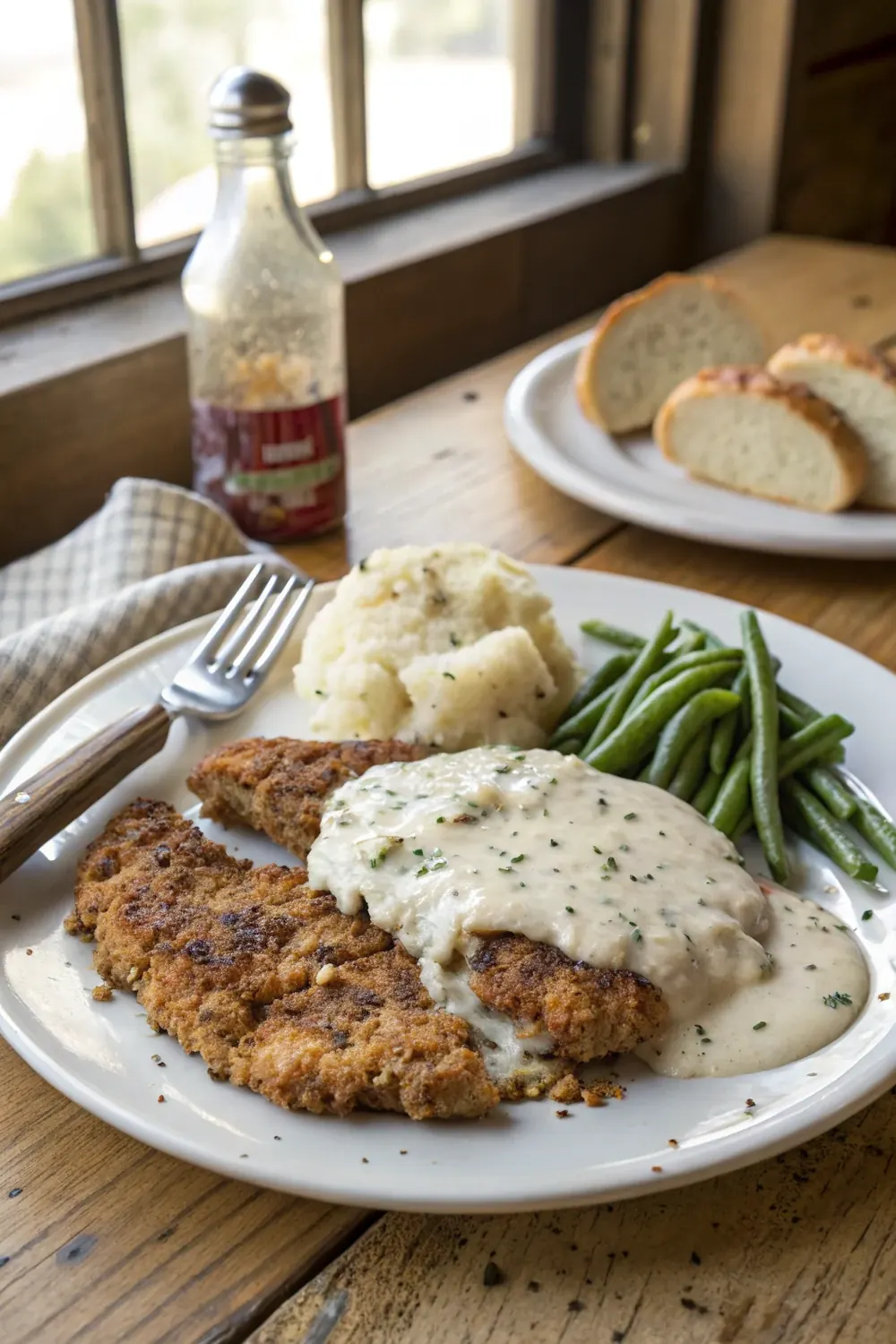
Texas chicken-fried steak with cream gravy. Double-dipped buttermilk batter, cast iron fry, official state dish since 2011. Ready in 30 minutes.
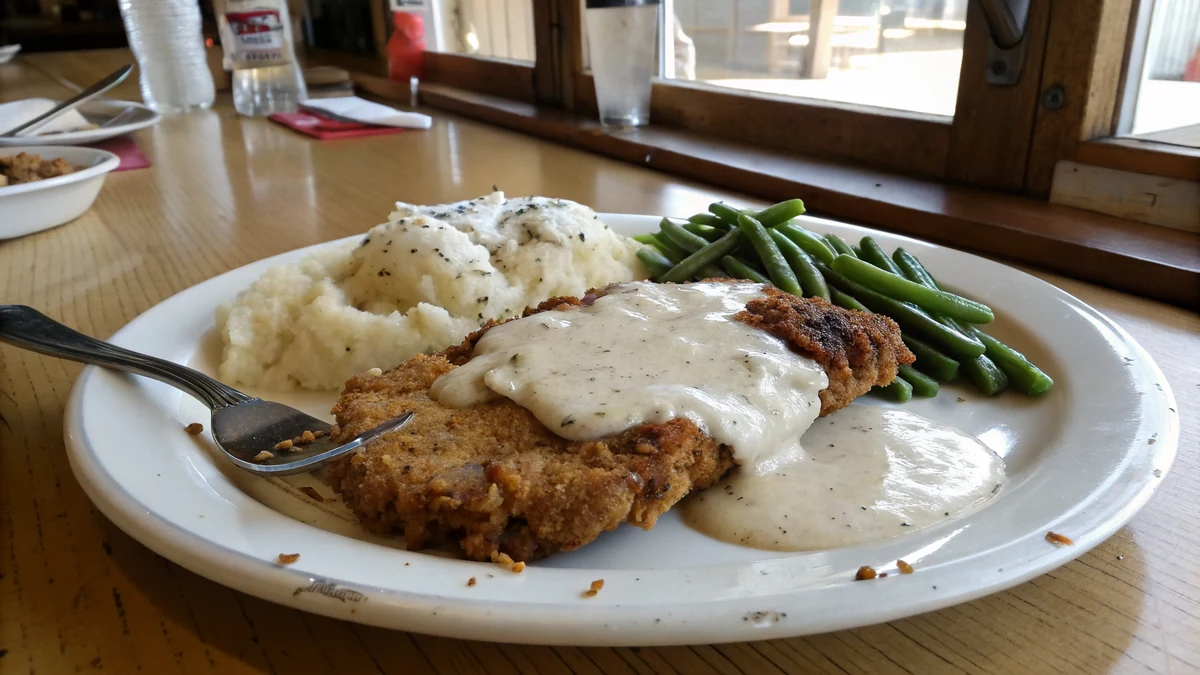
Quick answer: Chicken-fried steak is the official Texas state dish (designated by House Concurrent Resolution 15 in 2011), made by tenderizing round steak, double-dredging in seasoned flour and a buttermilk-egg wash, then frying in cast iron until the crust shatters. The pan drippings become a peppered cream gravy whisked with flour and whole milk. The cooking takes 15 minutes, the eating takes 5, and the memory lasts a lifetime.
I learned to make chicken-fried steak from my grandmother in a kitchen outside Fredericksburg, Texas, on a Sunday afternoon when I was about ten years old. She used a Lodge cast iron skillet that had been her mother's, a wooden meat mallet older than I was, and a stack of round steak from the HEB butcher counter. The crust she built that day, golden and shattering and clinging to the meat, is the standard I have chased for twenty years. When the Texas Legislature designated chicken-fried steak as the official state dish in 2011 by House Concurrent Resolution 15, my grandmother nodded once and said, finally. She had known for decades.
This is the version I make in my Hill Country kitchen now, on a wood stove in winter and a gas range in summer, always in cast iron, always with whole milk gravy that takes its color from the pan. The recipe is medium difficulty, the kind of cooking that rewards a steady hand and a patient attitude toward hot oil. Tenderized round steak, double-dipped buttermilk-and-egg batter, fried until the crust crackles when you press it with the back of a fork. Then a peppered cream gravy made from the drippings, whisked constantly until it coats the spoon. Total time 30 minutes. Texas in a single plate. That same peppered cream gravy is the backbone of my buttermilk biscuits and gravy. And if the skillet itself is the weak link, my guide to the best cast iron skillets covers the pans that survive generations of Sunday gravy.
The Official Texas State Dish (HCR 15, 2011)
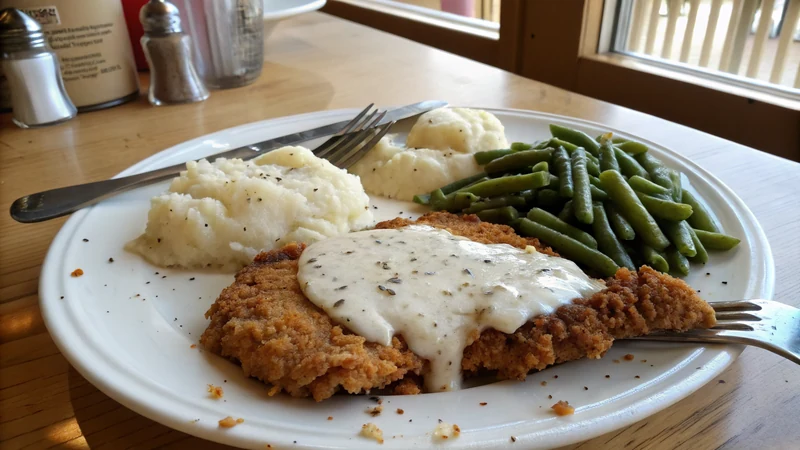
On May 25, 2011, the 82nd Texas Legislature passed House Concurrent Resolution No. 15, designating chicken-fried steak as the official state dish of Texas. The resolution, sponsored in the House and concurred in by the Senate, recognizes chicken-fried steak as a culinary symbol of the state alongside other designated state foods like the jalapeño (state pepper, 1995), the pecan (state nut, 2001), and the Texas sweet onion. The resolution acknowledges that chicken-fried steak is found on diner and cafe menus from Amarillo to Brownsville and from El Paso to Beaumont, and that the dish has become so identified with Texas that it is part of the state's cultural identity.
The legislative recognition was largely ceremonial - chicken-fried steak had already been the de facto state dish for at least seventy years before the resolution. But the formality matters. It is the only state dish in the United States that involves a double dredge and a peppered cream gravy. It is also one of the few state dishes where the recipe is consistent enough across the state that a Texan can order it in any town in Texas and get something recognizable.
What makes it Texan rather than Southern? The cream gravy is one part - chicken-fried steak in Texas is served with white milk gravy, not the brown gravy of country-fried steak. The cut is another - Texas cooks favor round steak or top round, often pre-cubed at the butcher counter, rather than the chuck or sirloin used elsewhere. And the size is the giveaway. A Texas chicken-fried steak is platter-sized, often hanging over the edge of a 10-inch plate. There is a reason.
Lamesa vs Bandera: The Origin Contest
Two Texas towns claim to have invented chicken-fried steak, and the dispute is part of the dish's folklore. The Lamesa claim, in West Texas, is dated to 1911 and credits a short-order cook named Jimmy Don Perkins, who allegedly misread an order ticket reading "chicken, fried steak" as a single instruction and dredged a steak in chicken-fry breading. The dish stayed on the menu and the rest is, as Lamesa tells it, history. The town hosts an annual chicken-fried steak festival in October to commemorate the claim.
The Bandera claim, in the Hill Country southwest of San Antonio, dates to roughly the same era and credits an unknown German-Texan cook adapting wiener schnitzel for the local beef supply. Bandera is in the heart of the Hill Country German settlement region (Fredericksburg, New Braunfels, Boerne, Comfort), where Austro-Hungarian immigrants had been making schnitzel for decades by the 1900s. The Bandera version emphasizes the dish's true ancestry: Italian milanese and Austrian schnitzel, both of which are pounded, breaded, and pan-fried cutlets.
Both claims are probably partially true. Chicken-fried steak almost certainly evolved from German-Austrian schnitzel traditions brought to Texas by Hill Country immigrants in the mid-1800s, and the Lamesa story is a charming origin myth that codified an existing technique. The dish is older than either claim; the names "chicken-fried" and the cream gravy are the Texan additions to a much older European cutlet tradition.
The German Hill Country Roots
The Hill Country towns of Fredericksburg (founded 1846), New Braunfels (1845), Boerne, Comfort, and Castroville were settled by German and Alsatian immigrants in the mid-19th century, and they brought their cooking with them. Wiener schnitzel - a thinly pounded veal cutlet, dredged in flour, egg, and breadcrumbs, then pan-fried in butter or lard - was already a staple of Austro-Hungarian cuisine when those settlers arrived. The Italian milanese (cotoletta alla milanese) is the same dish in a different language: pounded, breaded, fried.
In Texas, the immigrant cooks adapted the technique to the available ingredients. Beef round replaced veal (which was uncommon and expensive on the Texas frontier). Flour replaced breadcrumbs (German immigrants had wheat but not the dried-bread tradition of European cities). Lard or rendered beef tallow replaced butter. And the cream gravy, which is a German technique borrowed from rahmsoße (cream sauce), was kept as a finishing element. By the late 1800s, what we now call chicken-fried steak existed in Hill Country kitchens under various names - panierte schnitzel, Texas schnitzel, fried steak.
The "chicken-fried" name came later, probably in the early 1900s, when Texan cooks noticed that the breading-and-pan-fry technique resembled the way they fried buttermilk fried chicken. The naming convention stuck. Today, you can still order schnitzel in Fredericksburg and chicken-fried steak in Lamesa, and they are recognizably the same dish with different sauces.
The Cut: Round Steak, Cube Steak, Top Round
The traditional Texas cut for chicken-fried steak is bottom round or top round, both of which come from the rear leg of the cow. These cuts are lean, tough, and inexpensive - perfect for the pound-and-fry treatment, which tenderizes the meat through mechanical breakdown of the muscle fibers. A 6-ounce raw round steak, properly pounded to 0.5 inch thick, becomes the platter-sized cutlet that defines the dish.
Most Texas grocery stores - HEB, Central Market, Brookshire Brothers - sell pre-cubed top round labeled as "cube steak" or "cubed steak." These have already been run through a meat tenderizing machine that creates a crosshatch pattern of cuts in the surface, breaking down the connective tissue. Cube steak is the easy mode for chicken-fried steak. It is what 80 percent of Texas cooks use, and it is what most diners and cafes use too. There is no shame in it; it is the Texan default.
If you cannot find cube steak, you can buy whole round steak and cube it yourself with a meat mallet (the spiked side, in a crosshatch pattern). The labor takes about 5 minutes for four steaks. The result is virtually identical to store-bought cube steak. Avoid using sirloin or ribeye for chicken-fried steak - they are too tender and too expensive for the technique. The dish is built for tough, cheap cuts that need help. That is its origin and its honest character.
The Double Dredge
The double dredge is the technique that separates Texas chicken-fried steak from a single-coated schnitzel or cutlet. The sequence is: seasoned flour, buttermilk-egg wash, seasoned flour again. The first flour layer creates a dry surface that the egg wash can grip. The egg wash is the structural binder. The second flour layer is the textural layer - it forms the shattering golden crust that defines the dish. Without the double dredge, the crust is thin and tight to the meat. With it, the crust is thick, craggy, and clearly separated from the meat by a structural egg layer.
The trick to a successful double dredge is patience between layers. After the first flour, shake off the excess. After the egg wash, let the steak hang over the bowl for a moment to drip. After the second flour, press firmly with your palm to drive the flour into the wet binding layer. Then let the dredged steaks rest 5 minutes before frying. The rest allows the egg wash to set and the flour to hydrate, and the result is a crust that adheres through the entire fry.
Some Texas cooks add a third dredge - flour, egg, flour, egg, flour - for an even thicker crust. This is sometimes called "double-dipped" or "triple-dredged" and it produces a CFS that is essentially 50 percent crust by volume. It is fantastic and also slightly absurd; the choice is yours. The recipe above is the standard double dredge that most Texas diners use.
The Buttermilk-and-Egg Dip
The wet binding layer is where Texas chicken-fried steak diverges from European schnitzel. Schnitzel uses egg alone; Texas CFS uses egg combined with buttermilk. The buttermilk does two things: it adds tang and complexity to the breading, and its acidity continues the tenderizing process started by the meat mallet. Two large eggs and 0.5 cup of buttermilk for four steaks is the standard ratio.
The optional addition of a tablespoon of hot sauce (Cholula, Tabasco, or Crystal) is a Texas diner technique. The hot sauce is not enough to make the dish spicy, but it adds a vinegar-and-pepper depth that you taste in the crust. Mary's Cafe in Strawn, Texas - widely cited as one of the best chicken-fried steaks in the state - is rumored to use hot sauce in their dip. I do not know if that is true; I do know that the hot sauce makes the crust better.
Whole-fat buttermilk is the right choice. Low-fat buttermilk works but the dip is thinner and the binding is less robust. If you do not have buttermilk, you can substitute whole milk with 1.5 teaspoons of white vinegar or lemon juice, allowed to sit for 5 minutes before using. This is buttermilk's chemistry replicated in the kitchen and it works fine.
Oil and Cast Iron
Cast iron is the canonical skillet for chicken-fried steak. A 12-inch Lodge cast iron skillet holds heat steady at 350F through the fry, and the dark surface helps the crust brown evenly. A nonstick skillet works in a pinch but does not hold heat as well; the oil temperature drops when the cold steaks go in, and the crust suffers. Stainless steel works too, with similar caveats. If you have cast iron, use it.
Vegetable oil or peanut oil is the right fat. Vegetable oil (corn or soybean) is the diner default - cheap, neutral, high smoke point. Peanut oil is slightly more expensive and adds a faint nutty note that complements the meat. Avoid olive oil (smoke point too low) and butter (will burn at fry temperature). Some old-school Texas cooks use rendered beef tallow, which is the historic fat for the dish; it produces an extraordinary crust but is hard to source.
The oil depth matters: 0.5 inch is the target. Less and the steaks fry unevenly (the top of the steak is above the oil line and stays pale). More and you are deep frying, which is fine but not traditional - Texas chicken-fried steak is shallow-fried, with the top of the steak just above the oil. The flip is the moment the upper crust forms, and the half-inch depth is calibrated for that.
The Cream Gravy
Cream gravy is the Texan finish that makes chicken-fried steak chicken-fried steak. Three tablespoons of pan drippings, three tablespoons of flour, two cups of whole milk, salt to taste, and a heavy hand with the black pepper. The drippings carry the fond from the bottom of the skillet - the browned bits of crust and beef proteins that did not make it onto the steak - and that fond is what gives the gravy its color and flavor. Without the fond, the gravy is just a white béchamel; with it, it is unmistakable.
The technique is a roux. Whisk the flour into the warm drippings and cook for 1-2 minutes, until the paste smells slightly nutty and turns light golden. Do not brown the roux - this is a white gravy, distinct from the brown roux of Cajun gumbo. Slowly pour in the warm milk, whisking constantly to prevent lumps. The gravy will look thin at first and thicken as it simmers. Cook for 3-5 minutes until it coats the back of a spoon. Then season aggressively with black pepper - Texas cream gravy is peppered to the point that you see the flecks throughout. A pinch of cayenne is optional and traditional in some Hill Country recipes.
If you want a fancier version, add a splash of brewed coffee (1 tablespoon) to the gravy for a subtle bitter depth. This is a North Texas trick. Or add a quarter teaspoon of grated nutmeg, which is a German Hill Country touch from the rahmsoße tradition. Both are optional; the basic cream gravy is the standard Texas version. What this is not is the brown gravy that goes over a holiday turkey. That one is built on rendered poultry fat, pan drippings, and a giblet stock, with no dairy in it at all, and my turkey gravy covers it in full. Same word, two entirely different sauces.
Country-Fried Steak vs Chicken-Fried Steak
The most-asked question about this dish: what is the difference between chicken-fried steak and country-fried steak? They are similar but distinct, and Texans are firm about the distinction. Chicken-fried steak is the Texas version: dredged in egg-and-flour breading like fried chicken (hence the name), shallow-fried in oil, and served with white cream gravy. Country-fried steak is the broader Southern version: typically lightly breaded or dusted in flour without the full dredge, pan-fried in less oil, and served with brown gravy made from beef stock and onions.
The brown-vs-white gravy is the most reliable distinction. Order chicken-fried steak in Texas and you get white cream gravy. Order country-fried steak in Tennessee or Georgia and you get brown gravy, often with sautéed onions and mushrooms. Some cafes in border states (Arkansas, Oklahoma) blur the line and serve a dish they call country-fried steak with white gravy, which would technically be a Texas chicken-fried steak by another name. The naming is regional and not always rigorous.
The breading is the second distinction. Chicken-fried steak uses a full egg-and-flour double dredge, producing a thick craggy crust. Country-fried steak typically uses a single dusting of flour (sometimes seasoned, sometimes not), producing a thinner, tighter crust closer to a German schnitzel. If your steak has a thick golden shattering crust and white peppered gravy, it is chicken-fried. If it has a thin crust and brown gravy, it is country-fried. Both are good; only one is Texan.
Chef Mia's Kitchen Notes
I keep my Lodge 12-inch cast iron skillet on the stove at all times, and it is the only pan I use for chicken-fried steak. The skillet has been my pan for ten years, has been seasoned by countless fries, and the crust it produces is more reliable than any other skillet I have tried. If you are new to cast iron, buy a Lodge 12-inch (around 30 dollars at HEB or Tractor Supply) and start using it. It will pay for itself in chicken-fried steak alone.
I always use a wire rack over a sheet pan for draining the fried steaks, never paper towels. Paper towels trap steam and the bottom crust softens; a wire rack lets air circulate and the crust stays crisp. This is a small detail that makes a noticeable difference. The same trick applies to buttermilk fried chicken and to any breaded fry.
The hot sauce in the buttermilk dip is non-negotiable for me. Cholula is what I keep on the counter, but Tabasco or Crystal works equally well. The amount (1 tablespoon for four steaks) is too small to register as heat but big enough to register as a flavor. Trust the technique. It is what diner cooks at Mary's Cafe and Babe's Chicken Dinner House have been doing for generations, even when they will not admit to it.
Mistakes to Avoid
Wet meat going into the dredge. Pat the steaks dry with paper towels first. Wet meat causes the breading to clump and slough off in the fryer.
Single dredge instead of double. A single flour dredge produces a thin, tight crust. The double dredge (flour, egg, flour) is what gives chicken-fried steak its signature shattering thick crust.
Oil too cold. Below 325F, the breading absorbs oil and turns greasy. Use a thermometer; aim for 350F.
Oil too hot. Above 375F, the crust burns before the meat cooks through. The crust will be dark brown but the breading inside will be raw flour.
Overcrowding the skillet. Two cube steaks at a time in a 12-inch skillet is the maximum. More and the oil temperature drops, the steam cannot escape, and the crust steams instead of fries.
Piercing the crust with a fork. Use tongs to flip. A fork pierces the crust, releases steam, and breaks the crust seal.
Brown gravy on chicken-fried steak. White cream gravy is the Texas finish. Brown gravy is for country-fried steak. Do not cross the streams.
Skipping the rest before frying. The 5-minute rest after the second flour dredge is what allows the breading to set. Fry immediately and the breading sloughs off.
Variations
Jalapeño cream gravy. Add 1-2 finely diced fresh jalapeños (seeds removed) to the drippings before the flour. Sauté for 1 minute, then proceed with the roux. Hill Country variation, particularly common in San Antonio. Venison version. Pounded backstrap medallions take the same double dredge and cream gravy, and that plate is the November standard in my deer camp venison recipes.
Sausage cream gravy. Brown 4 oz of breakfast sausage in the skillet before the steak fry, drain the sausage and reserve, then crumble it into the finished cream gravy. This is the chicken-fried-steak-and-eggs breakfast version, served with biscuits and a fried egg on top.
Breakfast chicken-fried steak. Serve a smaller cube steak (4 oz) on a biscuit with a fried egg on top, all gravied. Mary's Cafe in Strawn does a version of this that is famous in the region.
Chicken-fried chicken. Substitute chicken thighs (pounded thin, double-dredged identically) for the steak. The technique is identical, the cooking time is similar (4 minutes per side), and the result is excellent. Many Texas diners offer both.
Chicken-fried bacon. Yes, this exists. Sodolak's Original Country Inn in Snook, Texas, is famous for chicken-fried bacon - thick-cut bacon, double-dredged, fried as you would CFS. Treat it as a snack, not an entree.
Chicken-fried venison. A South Texas hunting-camp variation - venison backstrap, pounded thin and double-dredged. The deep beefy flavor of venison plays beautifully with the cream gravy. Pair with authentic Texas-style corn bread for a classic deer-camp plate.
What to Serve With Chicken-Fried Steak
Chicken-fried steak is the centerpiece of a Texas blue-plate special. The classic supporting cast is mashed potatoes (also gravied), a green vegetable (green beans, fried okra, or pinto beans), a hot biscuit or roll, and sweet iced tea. The plate should be groaning. Order chicken-fried steak at a Texas diner and you will get exactly this lineup, with maybe a small house salad on the side.
For a more substantial spread, pair the steak with Texas scalloped potatoes instead of mashed, and a side of authentic Texas-style corn bread with butter. The corn bread soaks up the cream gravy at the end of the meal, which is its own reward. Add a slice of buttermilk pie or pecan pie for dessert and you have a Sunday dinner that would have made my grandmother proud.
For drinks, sweet iced tea is the canonical pairing. A cold Shiner Bock or Lone Star longneck also works for a casual dinner. For coffee with the meal (a North Texas tradition), strong drip coffee with cream is the move. Texas Monthly's running list of the best chicken-fried steaks in the state, available at Texas Monthly's food section, is the canonical resource if you want to taste the version at Babe's, Mary's Cafe, or the late great Threadgill's. The pilgrimage is worth it; the recipe above gets you 90 percent of the way there in your own kitchen.
Chicken-Fried Steak Recipe
Ingredients
- For the steak and breading:
- 4 cube steaks (top round, 6 oz each, about 0.5 inch thick after pounding)
- 2 cups all-purpose flour
- 1 teaspoon kosher salt
- 1 teaspoon freshly ground black pepper
- 1 teaspoon garlic powder
- 1 teaspoon paprika (sweet, not smoked)
- 0.5 teaspoon onion powder (optional)
- 0.25 teaspoon cayenne (optional, for a quiet warmth)
- 2 large eggs
- 0.5 cup buttermilk, full fat
- 1 tablespoon hot sauce (Cholula or Tabasco), optional but traditional
- For frying:
- About 1.5 cups vegetable oil or peanut oil (enough for 0.5 inch depth in a 12-inch skillet)
- For the cream gravy:
- 3 tablespoons reserved pan drippings
- 3 tablespoons all-purpose flour
- 2 cups whole milk, warmed slightly
- 0.5 teaspoon kosher salt (to taste)
- 1 teaspoon freshly ground black pepper (or more, to taste)
- Pinch of cayenne (optional)
- Equipment:
- 12-inch cast iron skillet (Lodge is canonical) for frying
- Heavy-bottomed saucepan or second skillet for the gravy (optional, gravy can also be built in the same skillet)
- Meat mallet (if pounding round steak yourself; skip if buying pre-cubed)
- Wire rack set over a sheet pan for draining the fried steaks
- Instant-read or candy thermometer (oil at 350F)
Instructions
- Tenderize the steak. If you bought whole round steak, pound it with a meat mallet between two sheets of plastic wrap until it is about 0.5 inch thick. Use the spiked side of the mallet, working in a crosshatch pattern, to break down the muscle fibers. Each steak should end up roughly 6-7 inches across. If you bought cube steaks (already cuber-tenderized at the butcher counter, sold this way at HEB and Central Market), skip this step. The cubing machine has already done the work.
- Set up the dredge stations. Set up three shallow dishes or pie pans in a row. In the first dish, whisk the flour with the kosher salt, black pepper, garlic powder, paprika, onion powder, and cayenne. In the second dish, whisk the eggs, buttermilk, and hot sauce together until smooth. The third station is a clean plate or sheet pan for the dredged steaks to rest on while you finish the rest. The line is: seasoned flour, buttermilk-egg wash, then back to seasoned flour. The double dredge is the heart of the recipe.
- Double-dredge the steaks. Pat each cube steak dry with paper towels - this is important, because wet meat will not hold breading. Press one steak into the seasoned flour, coating both sides and the edges, and shake off the excess. Dip the floured steak into the buttermilk-egg wash, letting the excess drip off for a moment. Press it back into the seasoned flour, this time pressing firmly with your palm to drive the flour into the wet egg coat. Set the dredged steak on the resting plate. Repeat with the remaining three steaks. Let them rest 5 minutes while the oil heats - this rest helps the crust adhere.
- Heat the oil. Pour the vegetable oil into a 12-inch cast iron skillet to a depth of about 0.5 inch. Heat over medium to medium-high until the oil reaches 350F on a candy or instant-read thermometer. If you do not have a thermometer, drop a pinch of flour into the oil - it should sizzle aggressively and brown in about 30 seconds. Too cold and the breading will absorb oil and turn greasy; too hot and the crust will burn before the meat cooks through. 350F is the target.
- Fry the steaks. Carefully lay two steaks into the hot oil, away from you (oil splash goes the other direction). Do not crowd the skillet - two at a time in a 12-inch is the maximum. Fry for 3-4 minutes on the first side, until the crust is deep golden brown and the edges look set. Flip with tongs (not a fork - piercing the crust releases steam and ruins the seal) and fry the second side for 3-4 minutes. The internal temperature of the steak will reach 160F, but with cube steak this thin, color is the better cue. Transfer to a wire rack set over a sheet pan. Repeat with the remaining two steaks.
- Reserve the drippings. Carefully pour off most of the frying oil from the skillet into a heatproof container, leaving about 3 tablespoons of oil and all of the browned bits (the fond) in the bottom of the skillet. The fond is the flavor of the gravy. Do not wipe the skillet. Set the skillet over medium-low heat. The 3 tablespoons of drippings will become the fat for the roux.
- Build the cream gravy. Sprinkle the 3 tablespoons of flour over the warm drippings and whisk constantly for 1-2 minutes, until the flour-and-fat paste turns light golden and smells slightly nutty. Do not let it darken to brown - this is a white gravy, not a Cajun roux. Slowly pour in the warm whole milk, whisking constantly to prevent lumps. Bring the gravy to a gentle simmer, whisking, and cook for 3-5 minutes until it thickens to coat the back of a spoon. Season with kosher salt, lots of freshly ground black pepper (Texas cream gravy is aggressively peppered), and an optional pinch of cayenne. Taste and adjust.
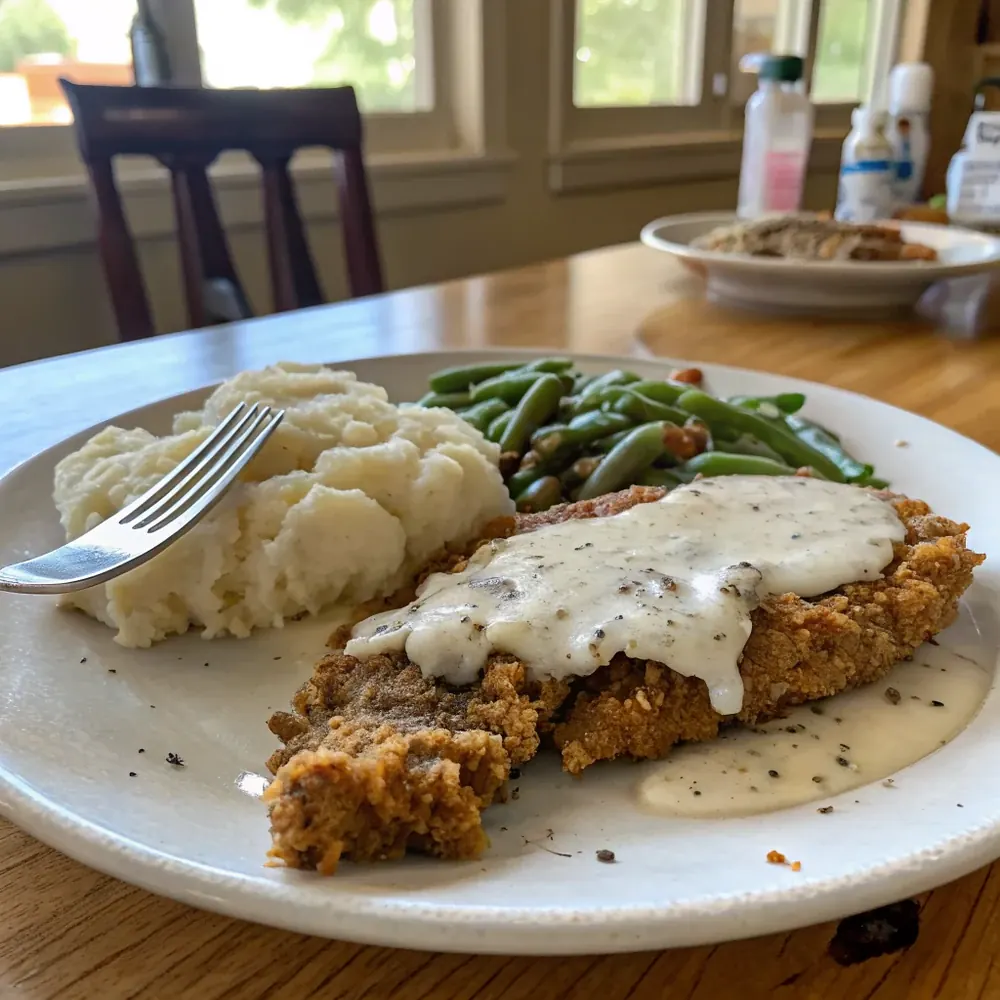
- Plate and serve immediately. Set each steak on a warm plate and ladle a generous pour of cream gravy directly over the top, letting it pool around the meat. Serve with mashed potatoes (also gravied), green beans or pinto beans, and a hot biscuit. The crust will lose its full crackle within 5 minutes of being gravied, so plate to the table. Diners cut through the crust with a knife and the steam released is part of the moment. There are no leftovers; if there are, the gravy will soak into the crust and the texture is changed forever (still delicious, just different).
Frequently Asked Questions
What is the difference between chicken-fried steak and country-fried steak?
Chicken-fried steak is the Texas version: a tenderized round steak that has been double-dredged in egg-and-flour breading like fried chicken (hence the name), shallow-fried in oil until the crust shatters, and served with white peppered cream gravy. Country-fried steak is the broader Southern version: typically lightly dusted in flour rather than fully dredged, pan-fried in less oil, and served with brown gravy made from beef stock and onions. The brown-vs-white gravy is the most reliable distinction.
Is chicken-fried steak really the official Texas state dish?
Yes. The 82nd Texas Legislature passed House Concurrent Resolution No. 15 on May 25, 2011, designating chicken-fried steak as the official state dish of Texas. The resolution acknowledges chicken-fried steak's identification with Texas culinary culture and its presence on diner and cafe menus across the state. It joins the jalapeño (state pepper, 1995) and the pecan (state nut, 2001) as one of Texas's officially designated foods.
Who actually invented chicken-fried steak?
The invention is contested. The Lamesa, Texas claim credits a short-order cook named Jimmy Don Perkins in 1911, who allegedly misread an order ticket reading "chicken, fried steak" as a single instruction. The Bandera, Texas claim credits an unknown German-Texan cook adapting wiener schnitzel for the local beef supply at roughly the same era. The dish's true ancestry is European - Austrian wiener schnitzel and Italian milanese - brought to the Hill Country by German and Alsatian settlers in the mid-1800s. The Texan additions were the cream gravy and the "chicken-fried" naming convention.
What cut of beef do I use for chicken-fried steak?
Top round or bottom round, tenderized into cube steak. Most Texas grocery stores (HEB, Central Market, Brookshire Brothers) sell pre-cubed top round labeled as "cube steak" - this has been run through a tenderizing machine that creates a crosshatch pattern of cuts in the surface. Cube steak is the standard, easy choice. If you cannot find it, you can buy whole round steak and pound it yourself with a meat mallet to 0.5 inch thickness. Avoid sirloin and ribeye - they are too tender and too expensive for the technique.
Why does my breading fall off during frying?
Most likely one of three reasons. First, the meat was wet when it went into the flour - always pat the steaks dry with paper towels before dredging. Second, you skipped the rest period after the second flour dredge - let the dredged steaks rest 5 minutes before frying so the breading can set. Third, the oil was not hot enough at the start - 350F is the target, and cold oil lets the breading absorb moisture and slough off. Use a thermometer to verify.
Can I use a different fat for cream gravy if I do not have drippings?
Yes, in a pinch. Substitute 3 tablespoons of butter for the drippings, melted in the saucepan. The result will be a clean white béchamel-style gravy without the fond depth. To compensate for the missing fond flavor, add a splash of Worcestershire sauce (0.5 teaspoon) and a pinch of beef bouillon. The gravy will be slightly different - cleaner, less complex - but still recognizably Texas cream gravy. Whenever possible, use the actual drippings; they are the flavor.
How do I keep chicken-fried steak crispy if I am cooking for a crowd?
Set the fried steaks on a wire rack over a sheet pan and hold them in a 200F oven while you fry the rest. The wire rack lets air circulate so the bottom does not get soggy, and the low oven heat keeps the steaks warm without overcooking. Do not stack the steaks; do not cover with foil. Hold for up to 30 minutes this way without significant texture loss. Make the gravy at the very end, right before serving, so the gravy is hot when it hits the steaks. A gravied steak loses its full crackle within 5 minutes, so plate to the table.