Southern Comfort Food
Texas Scalloped Potatoes
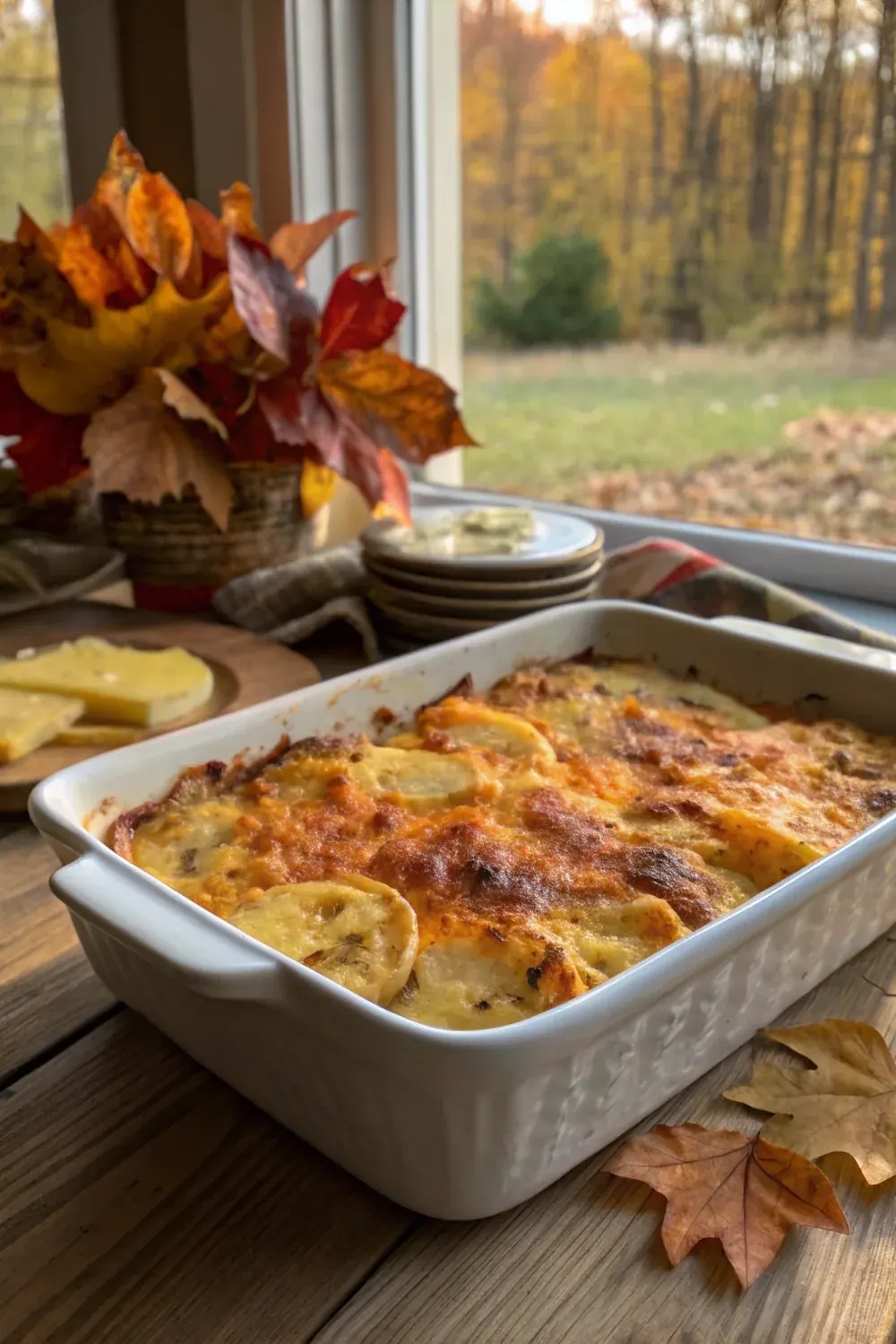
Chef Mia's Texas scalloped potatoes: russet rounds, sharp cheddar, smoked paprika, heavy cream. The cheesy holiday side that disappears before the turkey.
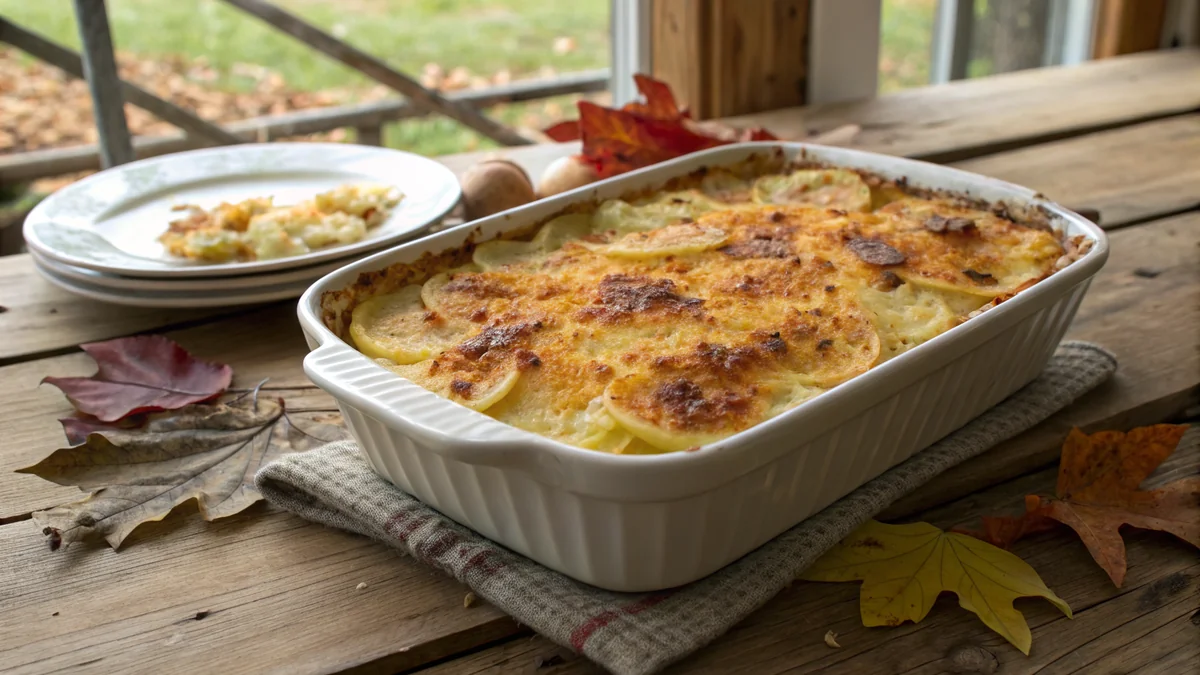
Quick answer: Texas scalloped potatoes layer thinly sliced russet potatoes (1/8-inch thick on a mandoline) with sharp cheddar, Monterey Jack, heavy cream, garlic, and smoked paprika in a 9x13 baking dish. Bake covered at 375F for 45 minutes, then uncovered for another 25-30 minutes until the potatoes are fork-tender, the cream sauce has thickened, and the top has browned to a deep golden crust with crispy edges. Total bake time about 75 minutes plus 15 minutes of resting before serving. The smoked paprika is the Hill Country signature that distinguishes Texas scalloped potatoes from the standard French gratin.
My mother grew up cooking Sunday dinner for a family of eight in a small Hill Country town outside Boerne in the 1960s. She had a 9x13 Pyrex baking dish that her grandmother had given her when she got married, and that dish saw scalloped potatoes every other Sunday for thirty years. The dish made it through her three kids growing up, my parents' moving to San Antonio, my mother's various career shifts, and eventually got passed down to me when I bought my first house. I have used it for the same scalloped potatoes recipe she made, with a few of my own adjustments, for fifteen Thanksgivings now.
The Texas adjustment that sets her recipe apart from the standard scalloped potatoes you find in any Midwestern grandmother's cookbook is the smoked paprika. My mother started adding it sometime in the 1990s after a Hill Country neighbor shared a Spanish pimentón at a holiday party. The smoked paprika contributes a faint pit-smoked quality to the cream sauce that ties the scalloped potatoes thematically to Texas BBQ traditions - the same flavor profile that runs through the brisket, the sausage, and the chili that fills any Texas Thanksgiving table. The dish stops being generic French gratin and starts being specifically Texan.
The recipe below is my mother's recipe with the smoked paprika upgrade. It serves 8-10 people generously and disappears before the turkey at every Texas Thanksgiving I have ever made it for. The active prep time is about 25 minutes (most of it slicing the potatoes on a mandoline; the prep is faster than people expect). The bake time is 75 minutes - covered for 45, uncovered for 25-30 - plus 15 minutes of resting before serving. Make this for Thanksgiving, for Christmas dinner, for any cold-weather Sunday that calls for a cheesy hot side dish that fills the house with smell of butter and cream.
Scalloped vs Au Gratin: The Important Distinction
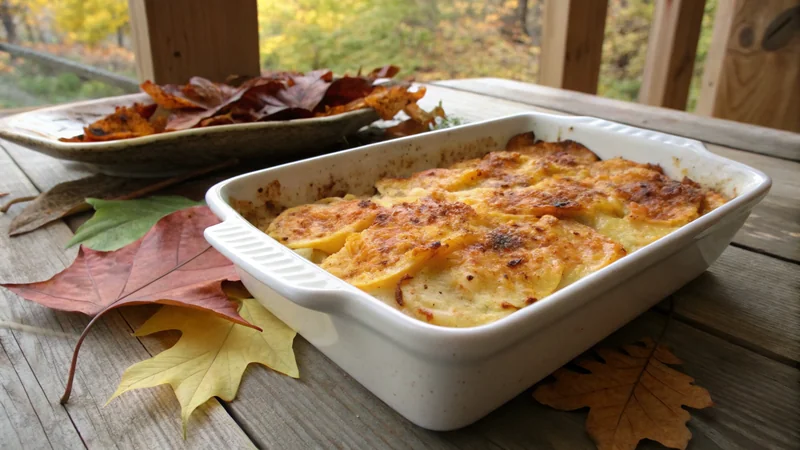
Scalloped potatoes and potatoes au gratin are often confused - they appear similar from the outside, both are layered potatoes baked in cream and cheese, both are creamy and golden. The technical difference: scalloped potatoes are baked primarily in cream (with cheese as one of many flavor components), while au gratin potatoes are baked primarily in cheese (with the cream as a secondary binder). Most American Thanksgiving recipes labeled scalloped are actually closer to au gratin in cheese ratio, including this one.
The historical scalloped potatoes recipe, dating to early 20th-century American household cookbooks, called for cream + butter + flour + onion + thinly sliced potatoes - no cheese at all. The Texas version (and the modern American version more generally) added cheese over the decades until cheese became the dominant flavor. Strict purists would call our recipe potatoes au gratin; everyone else calls it scalloped potatoes. The naming inconsistency is now fully baked into American household cooking; don't let the etymology distract you.
For SEO clarity (and your guests who actually know the difference): you can call this dish scalloped potatoes or potatoes au gratin and both would be technically accurate. The recipe in this method is closer to au gratin (high cheese content) but works equally well under either name. The legacy slug for this page came from Texas household searches for scalloped potatoes recipe with cheese powder which is itself an indication of how blurred the cheese question has become.
The French dauphinois - related but distinct - skips the cheese entirely, layering potatoes in cream with garlic and nutmeg only, and is a French Alpine tradition that pre-dates the American scalloped/au gratin distinction. Dauphinois is excellent on its own but less common at American holiday tables. If you want the cheese-free version, follow this recipe but skip the cheddar, jack, and cotija; the result is closer to dauphinois.
The Right Potato: Russet Wins (Why)
Russet potatoes (the brown-skinned, oblong-shaped baking potatoes - sometimes labeled Idaho potatoes) are the right choice for scalloped potatoes. The reason is starch content. Russets are the highest-starch potato variety commonly available; the high starch means the potatoes release more starch into the cream sauce during baking, which thickens the sauce naturally and creates the smooth, cohesive scalloped potato texture you want.
Yukon Gold potatoes work as a substitute but produce a slightly different result. Yukon Golds are medium-starch with a slightly waxy texture; they hold their shape better than russets but produce a thinner, less cohesive sauce. The flavor is buttery and excellent. If you can't find russets or prefer Yukon Golds, use them with the awareness that the sauce won't be as thick.
Avoid red potatoes, fingerlings, and other waxy varieties. These low-starch potatoes hold their shape well in soups and salads but resist the sauce-thickening function in scalloped potatoes. The result is a watery, separated dish where the cream pools at the bottom and the potatoes float in it. Use russets or yukon golds; skip the waxy varieties.
Three pounds of russets feeds 8-10 people generously - about 4 large potatoes. Peel them; the skins toughen during the long bake and detract from the silky texture. After peeling, slice on a mandoline at 1/8-inch thickness, the standard for scalloped potatoes. Thicker slices don't cook through; thinner slices fall apart.
Soak the sliced potatoes in cold water until ready to use. The cold water rinses off some excess surface starch (which can over-thicken the sauce) and prevents the cut potato surfaces from oxidizing and browning. Drain and pat dry before layering; wet potatoes dilute the cream sauce.
Mandoline Slicing and the 1/8-Inch Rule
Uniform 1/8-inch thickness is the structural rule of scalloped potatoes. Each slice should be the same thickness as the others; uneven slices result in some parts being underdone and some parts being mushy after the bake. A mandoline is the right tool. Hand-slicing with a knife works for the experienced but is slow and produces variable thicknesses for most cooks.
A good mandoline runs $30-100 (Benriner is the gold standard; OXO and Microplane both make decent options). The blade is razor-sharp; use the included hand guard or wear a cut-resistant glove. The mandoline produces perfectly uniform slices in seconds and is one of the most useful kitchen tools for any cook who slices vegetables regularly.
If you don't have a mandoline, use a very sharp chef's knife and aim for the thinnest, most uniform slices you can manage. The slicing will take longer (about 15-20 minutes for 4 large potatoes vs 3-5 minutes on a mandoline). Hold the potato firmly and slice in long, smooth strokes; don't saw back-and-forth, which produces uneven cuts.
Food processors with slicing disks work as a substitute for the mandoline but are less reliable for uniform thickness - the slicing disk is fixed at one thickness, and your potato shape determines whether the slices come out the right thickness. The mandoline is more flexible.
Other vegetables can be added to the layers: thinly sliced onion (1/4-inch thick) between the potato layers adds sweetness; sliced leeks add a milder onion note; sliced fennel adds a subtle anise. These are optional Texas flourishes; the basic recipe is potatoes-only.
Cream Sauce, Cheese Choices, and the Smoked Paprika Texas Touch
The cream sauce is built around 1.5 cups of heavy cream + 1 cup of whole milk - a 60/40 ratio that produces a rich but not over-the-top sauce. Pure heavy cream produces a sauce so rich it borders on dessert; pure whole milk produces a sauce too thin to coat the potatoes. The 60/40 ratio is the calibrated balance.
The cheese trio - sharp cheddar, Monterey Jack, and cotija - does three different jobs. Sharp cheddar (8 oz / 2 cups) provides the umami backbone and the orange-yellow color. Monterey Jack (4 oz / 1 cup) provides the structural melt that holds everything together. Cotija (1/4 cup, sprinkled at the end) provides the salty crumble contrast that elevates the dish from cheesy-casserole to multi-layered Texan-Mexican fusion. The total cheese is about 12 oz for 8-10 servings.
Use freshly shredded cheese, not pre-shredded. Pre-shredded cheese is coated in cellulose powder to prevent clumping in the bag; the coating also prevents clean melting. Hand-shredding from a block takes 5 minutes and produces dramatically better melting and crusting. This is the single biggest texture improvement you can make to any cheesy baked dish.
Smoked paprika is the Hill Country signature ingredient. One teaspoon of sweet or bittersweet (pimentón dulce or pimentón agridulce) Spanish smoked paprika contributes a subtle pit-smoked quality to the cream sauce that ties the dish to Texas BBQ flavor traditions. Don't use hot smoked paprika (pimentón picante) - the heat conflicts with the rich cream and cheese. Spanish brands (La Chinata, La Dalia) are noticeably better than supermarket house brands; the difference is real.
A pinch of freshly grated nutmeg rounds out the sauce. Nutmeg is the secret ingredient in classic French dauphinois and Italian potato gratin - it adds depth and warmth without identifying as nutmeg in the final dish. 1/4 teaspoon (about 8-10 grates of a microplane on a whole nutmeg) is the right amount for 9x13 dish. More than that and the nutmeg starts to dominate.
Bake Method, Resting, and Serving
The covered + uncovered bake sequence is doing two different jobs. The covered phase (45 minutes) traps steam, which is needed to cook the potato slices through to fork-tender. Without the cover, the top browns before the interior cooks; the result is crunchy raw potatoes under a browned crust. The uncovered phase (25-30 minutes) reduces the cream sauce and develops the deep golden cheese crust on top.
Total bake time is 70-75 minutes for a 9x13 dish at 375F. Larger dishes (deeper or wider) need slightly more time; smaller dishes need slightly less. The visual cues are: golden brown top, bubbling around the edges, knife slides through the center with minimal resistance. If the top is browning too fast (sometimes happens at altitude or in convection ovens), tent loosely with foil for the last 10 minutes.
Rest 15 minutes before serving. The cream sauce thickens as it cools slightly, the layered structure sets, and the dish becomes spoon-able. Serving immediately produces a runny puddle; resting produces clean serving portions that hold their shape on the plate. Use the rest as the window to finish other Thanksgiving dishes - it's exactly the right time to carve the turkey.
Storage: leftover scalloped potatoes hold 3-4 days in the fridge in an airtight container. Reheat covered in a 325F oven for 20-25 minutes. The texture changes slightly after refrigeration (the cream sauce sets firmer when cold) but reheats well. Microwave reheating works for office lunches but doesn't recreate the crispy crust.
Make-ahead option: assemble the entire dish (raw potatoes + cream sauce + cheese) up to 24 hours ahead. Cover tightly with plastic wrap and refrigerate. Add 8-10 minutes to the covered bake time to compensate for cold-from-fridge ingredients. The day-of cook time is identical, just longer. For broader Texas holiday side context, see the Ultimate Southern Comfort Food Guide.
Texas Scalloped Potatoes Recipe
Ingredients
- 3 lb (1.4 kg) russet potatoes (about 4 large), peeled
- 3 tablespoons (42 g) unsalted butter, plus extra for greasing the dish
- 3 cloves garlic, minced
- 1.5 cups (360 ml) heavy cream
- 1 cup (240 ml) whole milk
- 1.5 teaspoons kosher salt
- 3/4 teaspoon coarse black pepper
- 1 teaspoon smoked paprika (sweet or bittersweet, NOT hot)
- 1/4 teaspoon freshly grated nutmeg
- 8 oz (225 g) sharp cheddar cheese, freshly shredded (about 2 cups)
- 4 oz (115 g) Monterey Jack cheese, freshly shredded (about 1 cup)
- 1/4 cup (30 g) crumbled cotija cheese, for sprinkling at the end
- Fresh chives, chopped, for garnish
Instructions
- Preheat oven to 375F. Set a rack to the middle position. Preheat the oven to 375F (190C). Generously butter a 9x13 inch baking dish (glass Pyrex is traditional and conducts heat evenly; metal works but heats more aggressively at the edges). The butter prevents sticking and adds a richer crust.
- Slice the potatoes thin (1/8 inch). Using a mandoline set to 1/8-inch thickness, slice the peeled russet potatoes. About 4 cups of slices total. The thinness matters: thicker slices don't cook through during the bake, thinner slices fall apart. If you don't have a mandoline, use a very sharp chef's knife and aim for uniform thinness. Keep the sliced potatoes in a bowl of cold water until ready to assemble; this prevents browning and removes excess starch.
- Make the cream sauce. In a small saucepan over medium heat, melt 3 tablespoons butter. Add the minced garlic and cook 30 seconds until fragrant - don't let it brown. Pour in the heavy cream, whole milk, salt, pepper, smoked paprika, and nutmeg. Whisk to combine. Bring to just below a simmer (small bubbles forming around the edges of the saucepan). Remove from heat. The sauce should be uniformly pinkish-cream from the smoked paprika and aromatic from the garlic.
- Drain and pat the potatoes. Drain the sliced potatoes from the cold water. Pat dry with a clean kitchen towel - excess water on the slices dilutes the cream sauce during baking. The slices should look matte rather than glossy when ready to layer.
- Layer 1: potatoes + cheese. Arrange a third of the potato slices in the buttered baking dish in overlapping rows, like fish scales. The slices should overlap slightly but cover the entire base of the dish. Pour 1/3 of the cream sauce evenly over the slices. Sprinkle 1/3 of the shredded sharp cheddar (about 2/3 cup) and 1/3 of the Monterey Jack (about 1/3 cup) over the cream-soaked potatoes.
- Layers 2 and 3: repeat. Repeat the layering twice more: another third of potato slices in fish-scale overlap, another third of cream sauce, another third of each cheese. End with the third layer of potatoes on top. Pour the final third of cream sauce over the top, then sprinkle the final cheese layer evenly across the surface. The dish should be nearly full but not overflowing - the cream sauce will reduce during baking and the cheese will melt to fill the gaps.
- Bake covered for 45 minutes. Cover the dish tightly with aluminum foil (this traps steam to cook the potatoes through). Bake at 375F for 45 minutes. The covered phase tenderizes the potatoes; without the cover, the top browns before the interior is cooked through, and you end up with crunchy raw potatoes underneath browned cheese.
- Uncover and bake 25-30 more minutes. Remove the foil. Continue baking for 25-30 minutes until the top is deep golden brown, the cream sauce is bubbling visibly through the cheese crust, and a knife inserted into the center slides through the potatoes with minimal resistance. The total bake time is 70-75 minutes. The crust should look impossible-not-to-eat - browned, slightly crispy at the edges, with melted cheese pooling in spots.
- Rest 15 minutes before serving. Pull the dish from the oven and let rest 15 minutes on the counter - non-negotiable. The cream sauce continues to thicken as it cools slightly, the potatoes set into their layered structure, and the dish becomes spoon-able rather than soupy. Serving immediately produces a runny mess; resting produces clean serving portions that hold their shape on the plate.
- Garnish and serve. Sprinkle the crumbled cotija over the warm dish (the residual heat softens the cotija slightly without melting it). Scatter chopped fresh chives across the surface. Serve directly from the baking dish, family-style. The dish pairs beautifully with <a href='https://www.texanrecipes.com/how-to-cook-a-turkey-texas-bbq-style/'>smoked turkey</a>, <a href='https://www.texanrecipes.com/buttermilk-sweet-potato-pie/'>buttermilk sweet potato pie</a>, and <a href='https://www.texanrecipes.com/authentic-texas-style-corn-bread-recipe/'>Texas cornbread</a> for the full Thanksgiving plate. Serve with a chilled crisp Sauvignon Blanc or a glass of pinot noir.
Frequently Asked Questions
Why are my scalloped potatoes runny?
Two likely causes: (1) the dish wasn't rested 15 minutes before serving (the sauce hasn't had time to thicken on cooling); (2) the potato slices weren't dried after soaking (extra water dilutes the sauce). Solution: drain and pat dry the soaked potatoes, and always rest 15 minutes before serving. The sauce continues to thicken during the rest as it cools slightly.
Can I use 2% milk instead of heavy cream?
Yes but the result is less rich and the sauce is thinner. Replace the 1.5 cups heavy cream + 1 cup whole milk with 2.5 cups 2% milk + 2 tablespoons all-purpose flour (whisked into the cream sauce when warming). The flour thickens the sauce without the heavy cream. The flavor and texture are noticeably lighter; for a holiday dish, the original heavy-cream version is recommended.
Can I prep scalloped potatoes ahead of time?
Yes - assemble the entire dish (raw potatoes + cream sauce + cheese) up to 24 hours ahead. Cover tightly with plastic wrap and refrigerate. Add 8-10 minutes to the covered bake time to compensate for cold-from-fridge ingredients. The day-of cook time is identical to fresh-assembled, just slightly longer. Don't bake more than 24 hours ahead - the raw potatoes start to brown.
Can I freeze scalloped potatoes?
Yes - the dish freezes acceptably but with some texture loss. Cool completely, freeze in individual portions in freezer-safe containers for up to 2 months. Thaw overnight in the fridge, reheat in a 325F oven for 25-30 minutes. The cream sauce can separate slightly during freezing; the texture won't be as silky as fresh, but the flavor holds. Best for non-holiday weeknight meals; not recommended for special occasions.
What's the difference between scalloped potatoes and potatoes au gratin?
Technically: scalloped potatoes are baked primarily in cream (with cheese as one component), while au gratin potatoes are baked primarily in cheese (with cream as a secondary binder). Modern American recipes blur this distinction; this Texas recipe uses substantial cheese and could be called either. Both names are now used interchangeably for cheese-rich baked sliced potatoes.
Can I use pre-shredded cheese?
Possible but not recommended. Pre-shredded cheese is coated in cellulose powder to prevent clumping in the bag; the coating prevents clean melting. Hand-shredding from a block takes 5 extra minutes and produces dramatically better melting and crusting. This is the single biggest texture improvement you can make to any cheesy baked dish - worth the extra time.
How do I keep the top from burning before the potatoes are cooked?
Use the covered + uncovered method as written: cover with foil for the first 45 minutes, then uncover for the final 25-30 minutes. The covered phase steams the potatoes through; the uncovered phase browns the top. If the top is browning too fast in the uncovered phase (sometimes happens at altitude), tent loosely with foil for the last 10 minutes. The interior should be fork-tender; the top should be deep golden, not black.
What main dishes pair with Texas scalloped potatoes?
Holiday classics: smoked turkey, Texas brisket, ham, prime rib, or roast chicken. The cheesy creaminess of the potatoes pairs especially well with smoky proteins (turkey, brisket) and rich roasts. For a complete Texas Thanksgiving plate: smoked turkey + scalloped potatoes + Texas cornbread + green beans + buttermilk sweet potato pie for dessert.