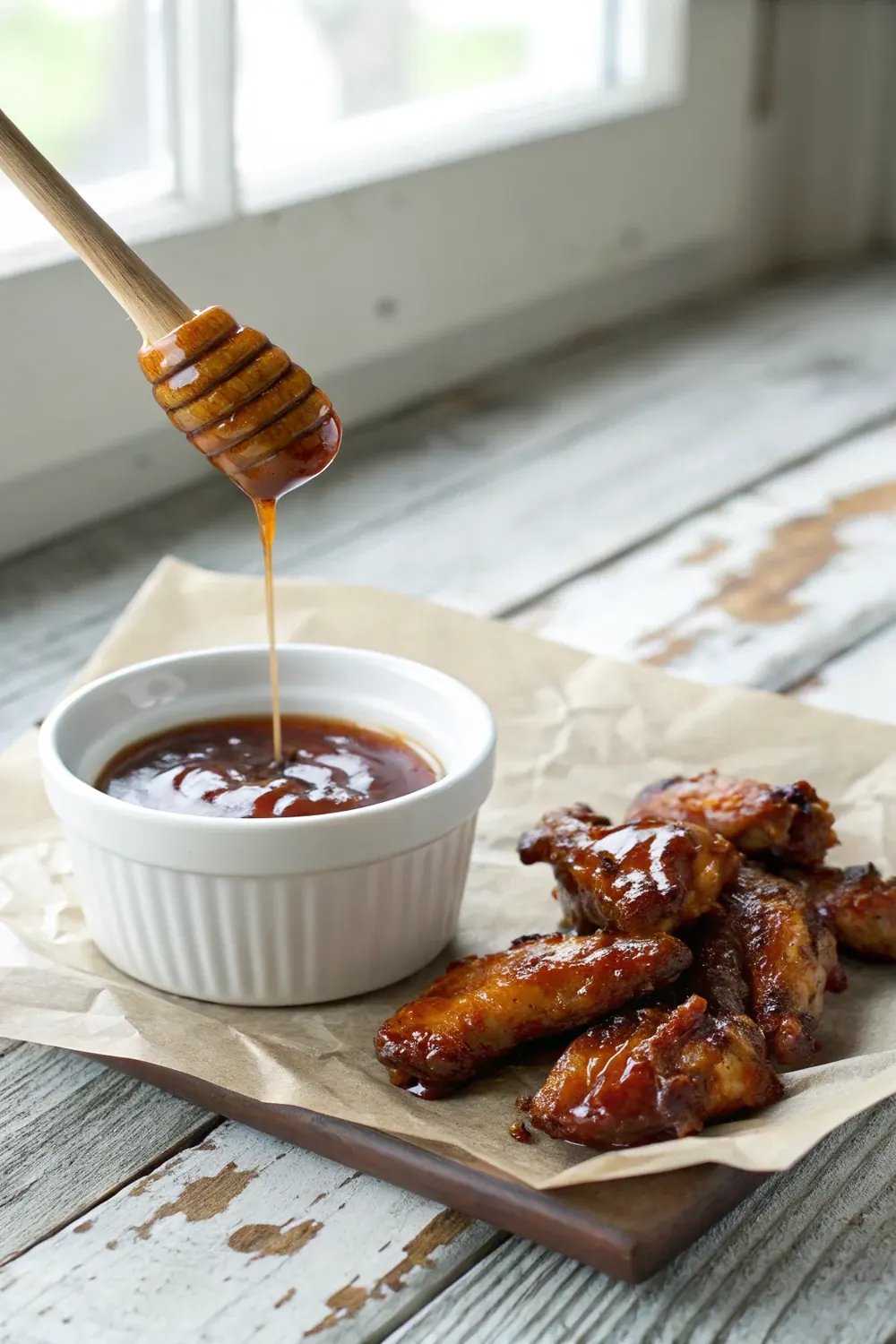
Texas BBQ
Honey BBQ Sauce
Chef Mia's honey BBQ sauce recipe: wildflower honey, ketchup, apple cider vinegar, Dijon, smoked paprika. Sticky glaze for wings, tenders, sliders.
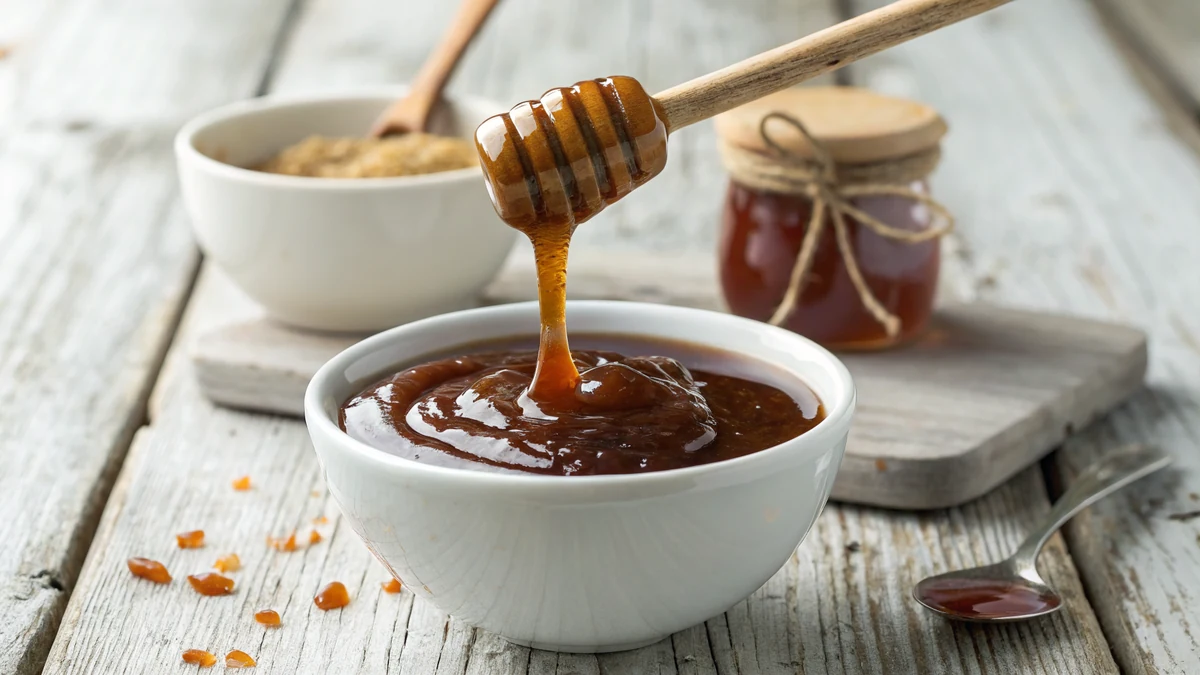
Quick answer: Honey BBQ sauce is the sticky sweet cousin of Texas BBQ sauce: a fast pantry glaze built on equal parts wildflower honey and ketchup, sharpened with apple cider vinegar and Dijon mustard, warmed up with smoked paprika and a whisper of garlic. Whisk everything in a small saucepan, bring to a gentle simmer for 8 to 12 minutes until the sauce coats the back of a spoon, and pull off the heat. Brush onto wings, tenders, sliders, or grilled chicken in the last 5 minutes of cooking so the honey caramelizes without scorching. Keeps 3 weeks in the fridge.
Honey BBQ sauce is the sauce I make when my niece is coming over after a Friday football game and she wants wings. It is not Lockhart-canonical Texas sauce. It is not even East Texas table sauce. It is the sticky, sweet, glossy red-brown stuff that turns up at Buffalo Wild Wings, on the back of every diner menu in the country, and at every little league concession stand from San Antonio to Amarillo. It exists for one reason: kids and grown-ups both love it. Done well at home, with real wildflower honey instead of corn syrup blend, it is dramatically better than the bottle.
The version below is what I keep in a squeeze bottle in the fridge between brisket Saturdays. Five pantry ingredients carry the whole sauce: a cup of honey, a cup of ketchup, a quarter cup of apple cider vinegar, two tablespoons of Dijon, and two teaspoons of smoked paprika. The rest is salt, pepper, and a pinch of cayenne for the back of the throat. No simmering for an hour. No specialty hardware. Fifteen minutes from cold pan to bottled sauce. It is the sauce I reach for when I want sweet sticky glaze on chicken wings, slider patties, or grilled drumsticks, and it has never failed me on a busy weeknight. Ketchup and honey are usually celiac-safe, but labels still surprise you, so I cover whether BBQ sauce is gluten-free in detail.
Where Honey BBQ Sauce Comes From
Honey BBQ sauce is not a regional American tradition the way Kansas City, Memphis, or Texas sauces are. It is a restaurant-chain invention from the wing-bar era of the 1980s, when Buffalo Wild Wings, Applebee's, and TGI Friday's were all racing to invent new sauce flavors that would land on a dipping menu. Honey BBQ was the family-friendly answer to Buffalo: same wing format, same sticky finish, but sweet instead of hot, so kids and heat-averse adults could share the platter.
The original wing-bar sauces were honey poured into store-bought bottled BBQ sauce, stirred, and brushed onto fried wings. The home version below is better than that because we are starting from raw ingredients and building the flavor on purpose. Wildflower honey replaces commercial honey-flavored corn syrup, real Dijon replaces nothing because nobody puts mustard in the bottled stuff, and Spanish smoked paprika gives the suggestion of pit cooking that wing bars fake with liquid smoke and amber food coloring.
Honey BBQ has now been a fixture on diner menus for forty years. The flavor profile is universal enough that almost everyone has tasted it at least once. That makes it a sauce worth doing properly at home, where you control the honey, the sweetness level, and the smoke note.
Honey BBQ vs Texas BBQ: Different Beasts, Different Jobs
If you have read my Texas BBQ sauce recipe, you already know the Lockhart philosophy: thin, pourable, tangy, beef-stock-based, served on the side of brisket, never on top. Honey BBQ is the opposite on almost every axis. It is thick, sticky, sweet, ketchup-based, and meant to be brushed directly onto the meat as a glaze. The two sauces are not competing for the same plate.
Texas sauce belongs next to brisket, beef short ribs, hot links, and chopped beef sandwiches. Honey BBQ belongs on chicken wings, drumsticks, slider patties, oven-baked thighs, baked beans, and pulled pork sliders for kids. The decision is about the meat, not the cook. Once you stop trying to make one sauce do every job, your sauce drawer gets more interesting.
Most home cooks keep two sauces in the fridge: a thin Texas-style for beef and a thicker sweet sauce for poultry and pork. Make a batch of each on the same Sunday afternoon and you are set for two weeks of dinners. The honey BBQ is the easier of the two, ready in 15 minutes versus 40 for the Texas pot. That is part of its value: when a weeknight wing craving hits, the honey sauce is a faster yes.
The Five Pantry Bones: What Each Ingredient Does
Honey carries the sweetness, the body, and most of the flavor identity. Without honey, this is just a slightly sharper ketchup. The viscosity and the slow-coat-the-spoon texture come from honey's natural sugar concentration. The flavor is floral-sweet rather than the flat-sugar note you get from bottled BBQ sauce, which uses corn syrup as the cheaper alternative.
Ketchup contributes tomato body, salt, and a backbone of cooked-tomato flavor that pairs naturally with the honey. The choice of ketchup matters a little: Heinz is the American canonical taste; Sir Kensington's is a cleaner, less sweet option; Whataburger ketchup carries a faint smoked-pepper note that works beautifully if you are cooking in Texas and want a regional twist. Avoid ultra-sweet store-brand ketchups that mostly taste like corn syrup.
Apple cider vinegar is the sharpening agent. Without acidity, the sauce reads as one-dimensional and cloying. A quarter cup is the right amount for 1 cup of honey and 1 cup of ketchup. Less and the sauce tastes flat. More and the vinegar overtakes the honey. Bragg's unfiltered is the gold standard but any cider vinegar works.
Dijon mustard is the sleeper ingredient. Two tablespoons is enough to add umami depth, slight sharpness, and emulsifying power without making the sauce read as mustardy. Dijon also helps the sauce cling to wings during the brush-and-broil stage; the mustard proteins act as a tenuous glue. Yellow mustard works as a substitute but tastes flatter; whole-grain Dijon adds texture if you want a more rustic sauce.
Smoked paprika supplies the suggestion of smoke without a smoker. Spanish pimenton is made from peppers smoked over oak before grinding, which locks the smoke note into the pigment itself. Two teaspoons is enough to read as pit cooking even on a stovetop sauce. Hungarian paprika has no smoke and will not substitute meaningfully.
Choosing the Honey: Why the Brand Matters
All honey is not the same. The clear amber stuff in the plastic bear is fine for tea but mediocre in a sauce because it has been pasteurized at high heat and filtered to remove the pollen, which strips most of the flavor compounds. Use real raw or minimally processed honey if you want the sauce to taste like honey rather than just sweet.
Wildflower honey is my default in Texas. It pulls nectar from multiple bloom sources across the season (clover, mesquite, huajillo, vetch), and the resulting flavor is layered, floral, and slightly herbaceous. Round Rock Honey, Good Flow Honey, Walker Honey Farm in Rogers, and Burleson's Pure Honey are all Texas-based options worth tracking down. National brands like Nature Nate's or Honey Pacifica work well too.
Clover honey is the supermarket default and works fine in a sauce. The flavor is mild and clean. If your only option is generic clover honey, the sauce will still be excellent; it just will not have the same layered floral note as a wildflower batch.
Avoid: blended 'honey' products that list corn syrup as the second ingredient. Several supermarket bears are technically corn syrup with honey flavor and they ruin the sauce. Read the label. The only ingredient should be honey.
Ketchup vs Tomato Sauce: Why I Use Ketchup Here
In my Texas BBQ sauce recipe I argue at length against using ketchup, because Texas sauce is built to be controlled flavor by flavor and ketchup is pre-seasoned in a way that fights that control. Honey BBQ is the opposite case. Here, ketchup is the right choice and tomato sauce would actually be wrong.
Honey BBQ wants a sweet, vinegar-tangy, slightly seasoned tomato base because the sauce is supposed to taste like the diner-menu version, and that taste is encoded into Heinz ketchup at the factory. Trying to rebuild ketchup from canned tomato sauce, sugar, vinegar, and spices is a pointless exercise that adds 30 minutes and tastes the same. Use the ketchup straight.
Heinz is the canonical American taste. Sir Kensington's is a cleaner upgrade. Texas brands like Whataburger ketchup or Texas Pete's ketchup have a slightly different spice profile that works beautifully. Avoid extra-sweet store-brand ketchups (they fight the honey) and avoid sugar-free ketchups (the artificial sweeteners taste off when combined with cooked honey).
Apple Cider Vinegar Sharpness Against the Sweet
Vinegar in a sweet sauce sounds counterintuitive until you have tasted a honey BBQ sauce without it. The vinegar's job is to keep the sauce from collapsing into cloying sweetness. Honey and ketchup together are both sweet; without acidity, the sauce tastes like dessert smeared on chicken.
Apple cider vinegar (not distilled white) is the right choice because it carries fruit-forward sweetness underneath the sharpness, which pairs naturally with honey. Distilled white vinegar would work for the acid contribution but tastes harsh and one-note. Champagne vinegar or white wine vinegar can substitute in a pinch.
A quarter cup for a 2 cup honey-plus-ketchup base is the calibrated ratio. If you want a sharper sauce (closer to a Memphis profile), bump the vinegar to a third of a cup. If you are making it for very young kids and want a milder profile, drop the vinegar to 3 tablespoons. Either direction works.
Dijon: The Secret Weapon for Cling
Most home honey BBQ recipes leave Dijon out. They should not. The two tablespoons in this recipe do three different jobs at once and improve the sauce dramatically without making it taste mustardy.
Job one: emulsification. Mustard proteins keep the honey, ketchup, and vinegar suspended in a uniform sauce rather than separating into oily and watery layers in the jar. Without mustard, a refrigerated batch of honey BBQ tends to develop a slightly watery layer at the bottom that the squeeze bottle then dispenses unevenly.
Job two: cling. When you brush this sauce onto a wing or a slider patty in the last 4 minutes of cooking, the mustard proteins act as a tenuous glue between the meat and the glaze. The sauce stays where you brushed it instead of dripping off into the pan or onto the grill grates.
Job three: flavor depth. Dijon's bright sharpness pulls against the sweetness of the honey and the soft tomato of the ketchup, giving the sauce a more layered flavor than a honey-ketchup-vinegar mix would deliver on its own. Maille and Grey Poupon are the canonical choices; both are fine. Trappey's makes a Louisiana Dijon that adds a slight Cajun warmth if you want to push the sauce sideways.
Smoked Paprika for Pit-Suggestion (No Smoker Required)
Smoked paprika is the move that makes a stovetop sauce taste like it has seen a pit. Two teaspoons is enough for 2 cups of sauce. Use Spanish pimenton (often labeled pimenton de la vera) rather than regular Hungarian or sweet paprika, which has no smoke.
Sweet pimenton (pimenton dulce) is my default for this sauce. The smoke is present but gentle. Bittersweet pimenton (pimenton agridulce) adds slightly more depth and complexity. Hot pimenton (pimenton picante) would work but already brings heat, so you would need to drop the cayenne. La Chinata in the small red tin is the gold standard. La Dalia is also excellent.
If you cannot find smoked paprika and want the same effect, half a teaspoon of liquid smoke is the cheap-but-effective substitute. Liquid smoke is real smoke condensed into water and it does add the campfire note. Use sparingly because too much reads chemical. Wright's brand or Colgin Natural Hickory work well. Skip the artificial 'mesquite' flavors; they taste off.
The Simmer Window: 8 to 12 Minutes, No Hard Boil
Sugar at a rolling boil scorches against the pan bottom in 90 seconds, and honey is even more sensitive than brown sugar. Once the sauce burns, the bitter note is permanent and the whole pot is compost. The simmer must stay gentle.
The right pace is a lazy simmer: one bubble breaking the surface every 2 to 3 seconds, with most of the action happening at the edges of the pan. Whisk every 2 minutes, dragging the whisk along the bottom of the pan to disrupt anything that wants to stick. If the sauce starts hard-bubbling, drop the heat by another notch immediately.
Use a heavy-bottomed saucepan to spread the heat evenly. Stainless steel with an aluminum or copper core is ideal. Enameled cast iron (Le Creuset, Lodge enameled) works beautifully. Avoid bare cast iron and bare aluminum, both of which can react with the cider vinegar in the sauce and give a metallic, tinny aftertaste.
Eight to twelve minutes is the right window for the simmer. Less and the sauce stays thin. More and you start losing the bright top notes of the honey to evaporation. The ribbon test (see step 4) tells you when to pull off heat regardless of clock time.
Brushing, Dipping, Drizzling: When Each Works
Honey BBQ sauce is engineered for three serving formats, and each one has its own technique. Get the format right and the sauce performs like it should. Get it wrong and you waste a perfectly good batch.
Brushing is the canonical move for wings, drumsticks, sliders, baked thighs, and grilled chicken. Brush the sauce on in the last 4 to 5 minutes of cooking, not earlier. The honey will caramelize and turn lacquered under the heat. Brushing too early burns the sauce; brushing too late means the sauce slides off because there is no time for it to set.
Dipping is the format for chicken tenders, slider patties, popcorn chicken, and onion rings. Serve a small bowl of cold sauce next to the platter. Cold honey BBQ is thicker than warm, so it clings to a tender without dripping. A dipping bowl should hold 1/4 cup of sauce per 4 people; refill rather than over-pouring.
Drizzling is the move for finished pulled pork sandwiches, baked beans, slider tops, and grain bowls. Use a squeeze bottle with a narrow tip. A drizzle adds a stripe of sweet-sticky finish without saucing the entire dish. Less is more for drizzles; the sauce is concentrated.
Wings, Tenders, Sliders: The Honey BBQ Trifecta
The three classic applications for honey BBQ sauce are the ones that built the sauce's reputation in the first place. Each one has a slightly different technique, and getting them right turns a good sauce into a great meal.
Wings: bake or air-fry the wings dry at 425F for 35 minutes, flipping once at the halfway mark. Brush the sauce on in the last 5 minutes of cooking. The wings come out crisp underneath and lacquered on top. Toss in a bowl with extra sauce just before serving for full coverage. For full technique, see honey BBQ wings.
Slider patties: form 3 oz beef patties (80/20 blend), grill or cast-iron sear over high heat for 2 minutes per side, brush with the honey BBQ in the last 30 seconds, and assemble on slider buns with a pickle and a thin slice of cheddar. The sauce caramelizes onto the patty crust and gives the slider a sticky-sweet finish that pairs beautifully with the bun. The BBQ chicken sliders page walks through the chicken-thigh version of the same technique.
Tenders: bread the tenders in a 50/50 panko-flour mix and bake at 425F for 18 minutes, flipping once. Skip the brush step. Serve a small dipping bowl of cold honey BBQ alongside, with ranch in a second bowl for the dipper-purists. Tenders eat dry-then-dipped; sauced tenders go soggy in 10 minutes.
Storage and the Honey-Hardens Problem
Honey BBQ sauce is one of the most stable condiments you can keep in the fridge. The honey, vinegar, and salt all act as natural preservatives. A clean container plus a clean spoon equals three weeks of fresh-tasting sauce. The catch is the honey-hardens problem: the sauce thickens significantly as it chills, and a fridge-cold batch can be too thick to dispense from a squeeze bottle.
Refrigerator storage: bottle the cooled sauce in a clean glass squeeze bottle (the kind diners use for ketchup) or a 16 oz mason jar with a tight lid. Keeps 3 weeks. Always use a clean spoon when dipping (or pour rather than dip) to prevent cross-contamination. A pinch of honey-hardening at the top of the bottle is normal and not a sign of spoilage.
Restoring viscosity: if the sauce is too thick to squeeze, microwave the bottle (cap off) for 15 seconds, shake well, and squeeze. Or whisk in 1 to 2 teaspoons of warm water until pourable. The honey will re-soften and the sauce returns to its original texture.
Freezer: freeze in 1-cup portions in zip-top bags (leave half an inch of headspace for expansion) for up to 6 months. The sauce thaws cleanly because there is no dairy or egg to break. Thaw overnight in the fridge and whisk briefly if any minor separation occurs.
Variations Worth Trying
Spicy honey BBQ. Add 1 finely chopped chipotle pepper in adobo plus 1 teaspoon of the adobo sauce in the simmer step. The chipotle adds smoky heat and a slight Tex-Mex tilt. Bump the cayenne to 1/2 teaspoon if you want it hotter. A San Antonio twist on the classic.
Bourbon honey BBQ. Whisk in 2 tablespoons of Texas bourbon (Garrison Brothers, Balcones, Treaty Oak) in the last 3 minutes of simmer. The bourbon adds oak and vanilla undertones that pair beautifully with the honey. Excellent on grilled pork chops, smoked chicken, and beef sliders.
Apple-cider honey BBQ. Replace 1/4 cup of the ketchup with 1/4 cup unsweetened apple butter or apple sauce. The apple deepens the sweet note and adds a fall-orchard complexity. Pairs well with grilled pork tenderloin and smoked turkey.
Honey BBQ with mustard. Double the Dijon to 1/4 cup and bump the apple cider vinegar to 1/3 cup. The sauce tilts toward Carolina gold while keeping the honey backbone. Best on pulled pork sandwiches and smoked chicken thighs.
Smoked-honey edition. Use Mike's Hot Honey or another infused honey for half the honey volume (1/2 cup) and regular wildflower for the other half. The infused honey adds a layered chile heat that lifts the sauce without making it spicy in a one-note way. Pairs beautifully with fried chicken sliders.
Mistakes to Avoid
Boiling instead of simmering. Honey at a rolling boil scorches in under 2 minutes. The burnt note is permanent. Drop to a lazy simmer the moment the sauce starts bubbling.
Using corn-syrup-blend 'honey'. Several supermarket bears are technically corn syrup with honey flavoring. The flavor profile is flat and the texture is gummy. Read the label.
Skipping the Dijon. Two tablespoons does emulsification, cling, and flavor depth. Without it the sauce separates in the jar and slides off wings during the broil.
Brushing too early on wings or chicken. Honey caramelizes fast under direct heat. Brushing 20 minutes before pulling means burned glaze. Brush in the last 4 to 5 minutes only.
Using regular Hungarian paprika. Sweet paprika has no smoke. Smoked paprika (pimenton) is the canonical choice. The smoke note is the entire reason the sauce reads as BBQ rather than as fancy ketchup.
Storing in plastic. The vinegar and honey can leach off-flavors from cheap plastic squeeze bottles over time. Use glass squeeze bottles or mason jars only. The sauce keeps weeks longer in glass.
Kitchen Notes from My Hill Country Saturdays
I make this sauce about every two weeks during football season because someone in my family is always asking for wings on Friday night. The recipe scales up easily: I have done triple batches (3 cups honey, 3 cups ketchup, 3/4 cup ACV) for school potlucks and the only adjustment is a slightly longer simmer time of 14 to 16 minutes.
The single change that improved my version most was switching from generic clover honey to Walker Honey Farm's wildflower honey, harvested 40 miles east of Austin. The wildflower adds a faint herbaceous mesquite note that the supermarket honey cannot match. If you live in Texas and you take this recipe seriously, track down local wildflower honey at a farmers' market.
The single most useful piece of gear for this recipe is a glass squeeze bottle with a narrow tip. The dollar-store version works. Diner-style 16 oz squeeze bottles with a flip-top lid are perfect for the fridge. Plastic bottles work but eventually stain orange-red from the paprika and ketchup.
For the brisket-side companion sauce, see my Texas BBQ sauce. For applying this honey sauce on chicken, the wing-specific technique is in honey BBQ wings. For broiled or oven chicken legs that pair beautifully with this sauce, see BBQ chicken legs in the oven. The wider history and regional context of American BBQ sauces is well-documented in the Wikipedia barbecue sauce article.
Tips for the Best Honey BBQ Sauce
Three batches in, you start noticing the small dials. These are the moves I keep returning to in my Hill Country kitchen, the ones that lift the sauce from good to memorable.
- Source local Texas honey when possible. Walker Honey Farm, Round Rock Honey, Good Flow, or any wildflower honey from a farmers' market adds floral and mesquite notes that supermarket honey cannot match. Worth the small premium.
- Whisk cold, then heat. Whisking the honey, ketchup, and vinegar together in a cold pan before turning on the heat saves scorching at the bottom. Honey dropped into a hot pan splatters and burns at the contact point.
- Brush late, never early. The honey caramelizes fast under direct heat. Brush on wings, sliders, or chicken in the last 4 to 5 minutes of cooking. Earlier brushing burns the sauce and the food beneath it.
- Save the brushing bowl for waste. Once the brush has touched raw chicken or beef, the sauce in that bowl is contaminated. Always reserve a separate clean bowl of sauce for table service.
- Refrigerate at least 2 hours before serving. Same-day sauce tastes sharp; rested sauce tastes finished. The Dijon softens, the paprika hydrates, and the honey-ketchup-vinegar marriage settles into a single coherent flavor.
For chicken-thigh applications of this sauce, head to BBQ chicken sandwich. For a brisket-friendly thin alternative, my Texas BBQ sauce is the canonical other sauce to keep in the fridge.
Honey BBQ Sauce Recipe
Ingredients
- For the sauce:
- 1 cup (340 g) wildflower honey (clover or Texas Hill Country wildflower preferred)
- 1 cup (240 ml) ketchup, Heinz preferred
- 1/4 cup (60 ml) apple cider vinegar, unfiltered Bragg's or Heinz cider
- 2 tablespoons Dijon mustard (Maille, Grey Poupon, or Trappey's)
- 2 teaspoons smoked paprika (Spanish pimenton, sweet or bittersweet)
- For the seasonings:
- 1 teaspoon garlic powder
- 1 teaspoon onion powder
- 1/2 teaspoon kosher salt (Diamond Crystal; halve if Morton's)
- 1/2 teaspoon freshly ground black pepper
- 1/4 teaspoon cayenne pepper, to taste (optional but recommended)
- 1/2 teaspoon liquid smoke, optional, for stovetop-only cooks
- Equipment:
- 2-quart heavy-bottomed saucepan, stainless or enameled cast iron (avoid bare aluminum, it reacts with the cider vinegar)
- Whisk, silicone spatula, squeeze bottle or 16 oz mason jar for storage
Instructions
- Whisk the base in a cold pan. Combine the honey, ketchup, apple cider vinegar, and Dijon mustard in a 2-quart heavy-bottomed saucepan off the heat. Whisk until smooth and uniform. Honey is sticky on its own, so starting cold makes it easier to incorporate; the ketchup acts like a solvent and pulls the honey into solution. The mixture should look glossy brick-red, not pale orange. Streaks of yellow Dijon mean you need another 20 seconds of whisking.
- Add the spices and turn on the heat. Whisk in the smoked paprika, garlic powder, onion powder, kosher salt, black pepper, and cayenne. The spice flecks will float on the surface; this is correct. Turn the heat to medium-low. Whisk steadily for the first 90 seconds as the sauce warms. The spices hydrate and pull into the liquid as the temperature climbs. Add the optional liquid smoke now if you are using it; half a teaspoon is plenty.
- Simmer gently for 8 to 12 minutes. Once the sauce starts showing tiny bubbles at the edges of the pan, drop the heat to low. You want a lazy simmer with one bubble breaking the surface every 2 to 3 seconds, not a hard boil. Whisk every 2 minutes to keep the bottom from scorching. Honey scorches fast at a rolling boil and the burnt note is permanent. The sauce should reduce slightly and darken from bright brick-red to a glossier mahogany over 8 to 12 minutes.
- Run the ribbon test. Pull the whisk straight up out of the sauce. If a ribbon of sauce trails off the whisk and rests on the surface for about a second before sinking back in, you have the right viscosity. If the sauce drips off in thin droplets like water, simmer another 2 minutes. If it falls in heavy blobs, you have gone too far; whisk in a tablespoon of warm water or apple cider vinegar to thin. The ribbon test is more reliable than time because honey brands vary in moisture content.
- Cool 15 minutes in the pan. Pull the saucepan off the heat. Let the sauce sit in the pan for 15 minutes to cool. The sauce thickens further as it cools because honey continues to set as the temperature drops. What looks slightly thin in the hot pan will be perfectly pourable cold. Taste the sauce. The order on your tongue should be: sweet honey first, tangy vinegar second, smoky paprika third, gentle heat at the back from the cayenne. Adjust if needed.
- Bottle and refrigerate. Transfer the cooled sauce to a clean glass squeeze bottle or a 16 oz mason jar with a tight lid. Refrigerate at least 2 hours before using. The flavors marry as the sauce rests: the Dijon softens, the vinegar integrates, the paprika fully hydrates and gives up its smoke note. Same-day sauce tastes sharp and one-dimensional; rested sauce tastes finished. Keeps 3 weeks refrigerated in a clean container with a clean spoon.
- Apply to grilled or baked food. Honey BBQ sauce is a finishing glaze, not a marinade. Brush onto wings, drumsticks, slider patties, chicken tenders, or pulled pork in the last 4 to 5 minutes of cooking. The honey caramelizes fast under direct heat; longer exposure burns. For oven cooks, brush the glaze on at the last 4 minutes of a 400F bake. For grills, brush on after the meat is mostly cooked and flip once for a glossy crust. Reserve a small bowl of sauce for the table; never reuse the brushing bowl after it has touched raw meat.
Frequently Asked Questions
What's the difference between honey BBQ sauce and Texas BBQ sauce?
Honey BBQ is thick, sticky, sweet, ketchup-based, and built to be brushed onto wings, sliders, and chicken as a glaze. Texas BBQ sauce is thin, pourable, tangy, beef-stock-based, and served on the side of brisket. The two sauces solve different problems. Honey BBQ wants to coat and lacquer poultry. Texas sauce wants to dress beef without smothering it. Keep both in the fridge for different weeknights.
Is honey BBQ sauce gluten-free?
This recipe is gluten-free as written. Honey, ketchup (Heinz and most major brands), apple cider vinegar, Dijon mustard, and smoked paprika contain no wheat. Confirm by reading the label of any specific brand you use; some store-brand mustards or BBQ-style ketchups use wheat-based thickeners. If you need a fully certified gluten-free batch, use Tessemae's organic ketchup and Annie's organic Dijon, both of which carry the GFCO certification.
Is honey BBQ sauce vegetarian or vegan?
This recipe is vegetarian. It is not vegan because honey is an animal product (excluded by strict vegan diets even though it is plant-derived in source). Vegans can substitute the honey with the same volume of agave nectar or maple syrup; both work technically and give a slightly different flavor profile. Agave is closer to honey's neutrality; maple adds a more autumnal note that pairs beautifully with smoked tofu or jackfruit pulled-pork substitutes.
How long does honey BBQ sauce keep in the fridge?
About 3 weeks refrigerated in a clean glass squeeze bottle or mason jar with a tight lid. The honey, vinegar, and salt are all natural preservatives, so this sauce keeps longer than most condiments. Always use a clean spoon when dipping (or pour rather than dip) to prevent cross-contamination. If you see any mold or smell anything off, throw it out and start fresh.
Can I freeze honey BBQ sauce?
Yes. Freeze in 1-cup portions in freezer-safe containers or zip-top bags (leave half an inch of headspace for expansion) for up to 6 months. The sauce thaws cleanly because there is no dairy or egg to break. Thaw overnight in the refrigerator before using; whisk briefly if any minor separation occurs. Frozen sauce is essentially indistinguishable from fresh.
Why does my honey BBQ sauce taste too sweet?
Either the vinegar is too low or the honey-to-ketchup ratio is off. Add a tablespoon of apple cider vinegar at a time, whisk in, taste, and repeat until tang balances the sweet. The order on your tongue should be sweet first, tangy second, smoky third, gentle heat at the back. If the sauce tastes like dessert, the acid is too low.
Can I make honey BBQ sauce sugar-free or keto-friendly?
Honey is the entire flavor backbone, so a true sugar-free version is hard. The best compromise: replace half the honey with a monkfruit-erythritol blend (Lakanto Golden, Swerve Brown) and use sugar-free ketchup (Primal Kitchen or G Hughes both work). The texture will be slightly thinner because honey provides viscosity, but the sauce remains drinkable for keto and diabetic guests. For full keto, swap all the honey for the monkfruit blend and accept a flatter flavor.
Can I use this sauce on brisket?
Honey BBQ on brisket fights the meat. The sticky sweetness covers the bark and competes with the rendered fat of a properly smoked Central Texas brisket. For brisket, use a thin Texas-style sauce on the side (see my Texas BBQ sauce recipe). For chopped beef sandwiches mixed with sauce in a pan, honey BBQ does work and adds a sticky sweetness that some Texans love on a sandwich; but on a Lockhart plate of sliced brisket, leave the honey sauce in the fridge.
Is this a copycat of Buffalo Wild Wings honey BBQ?
It is in the same flavor family but is not a direct copycat. Buffalo Wild Wings honey BBQ uses a proprietary blend that leans sweeter and includes corn syrup, caramel color, and natural smoke flavoring (per their published ingredient list). My version uses real wildflower honey, real smoked paprika, and Dijon for emulsification, which gives a more layered taste. Most home tasters prefer my version side-by-side; the Buffalo Wild Wings version is more uniformly sweet but flatter on the tongue.
Why is my honey BBQ sauce separating in the jar?
Either the Dijon was skipped or the sauce was not whisked enough during the simmer. The Dijon proteins emulsify the honey, ketchup, and vinegar into a uniform suspension. Without enough Dijon (or any), the sauce separates into oilier and waterier layers in storage. To fix a separated batch: shake or whisk the jar vigorously, and the sauce re-incorporates. If the problem repeats, double the Dijon in your next batch.