Texas BBQ
Instant Pot Texas Chili
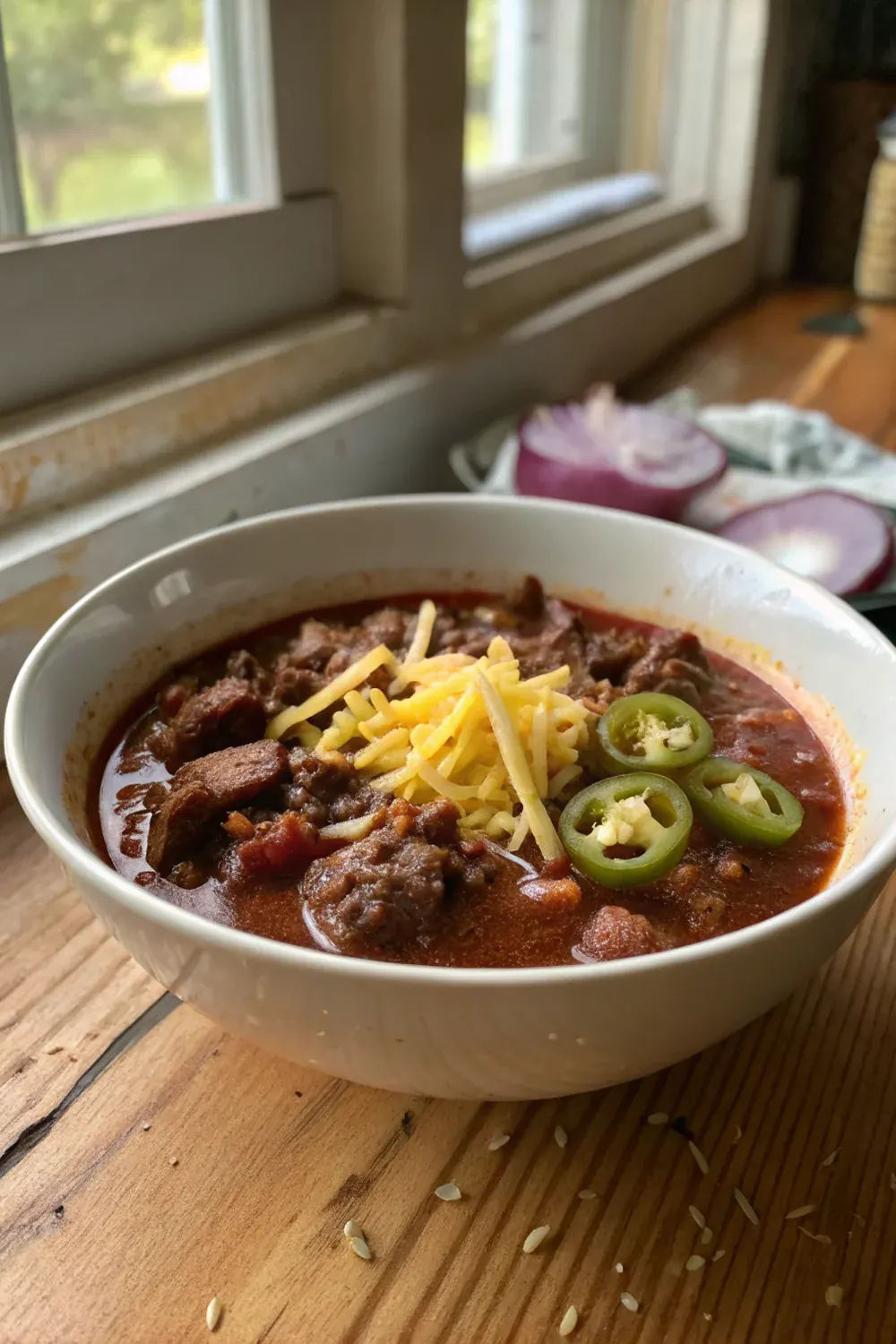
Instant Pot Texas chili with cubed beef chuck, dried chiles, masa harina. Real Texas chili in 1 hour, not 4 hours of stovetop simmer.
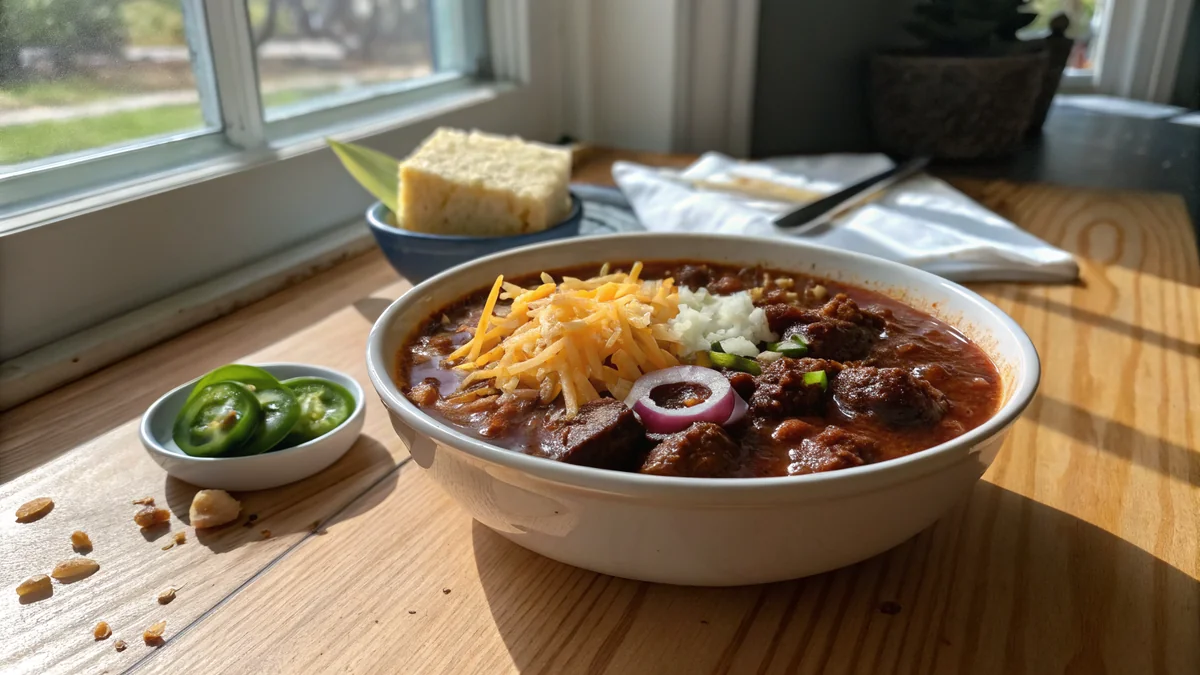
Quick answer: Instant Pot Texas chili is a pressure-cooker adaptation of the classic 4-hour Texas chili: cubed beef chuck (never ground), a sauce built from rehydrated dried ancho and guajillo chiles, beef broth, masa harina as thickener, and absolutely no beans. The pressure cook runs 35 minutes plus a 5-minute natural release. The result tastes like a 4-hour stovetop chili in 1 hour total. Standard Texas chili rules apply: cubed not ground, no beans, no tomato as primary flavor, and the toppings are Texas-style at the table.
I learned to make Texas chili from a man named Big Mike who ran a backyard chili circuit in Austin. His method, the 4-hour stovetop simmer with toasted dried chiles and cubed beef chuck, is the gold standard, and the recipe lives at Texas Chili. But Big Mike retired and I moved into a job where 4-hour Sunday simmers stopped being weekly. The Instant Pot version below is what I make on a Tuesday after work when I want real Texas chili and I have one hour, not four. The flavor is 90% as good and the time investment is 25%. That math works for a working professional in Austin who still wants to eat like a Texan.
The Instant Pot does not magically replicate a long simmer - what it does is accelerate the collagen breakdown in the cubed chuck and the chile rehydration that the 4-hour cook does slowly. Pressure cooking at 11.6 psi raises the boiling point to 250F (versus 212F at sea level), which means tougher cuts tenderize faster and the chiles release their oils more aggressively. The compromise is the lack of evaporation: you cannot reduce a sauce in a sealed pressure cooker. So this recipe ends with a 10-minute open simmer to thicken with masa harina. The result is real Texas chili - cubed beef, dried chile sauce, no beans, no tomato dominance - in one hour total. If you want the long-simmer original behind this shortcut, my Terlingua Texas chili is the competition-style benchmark.
Why the Instant Pot Works for Texas Chili
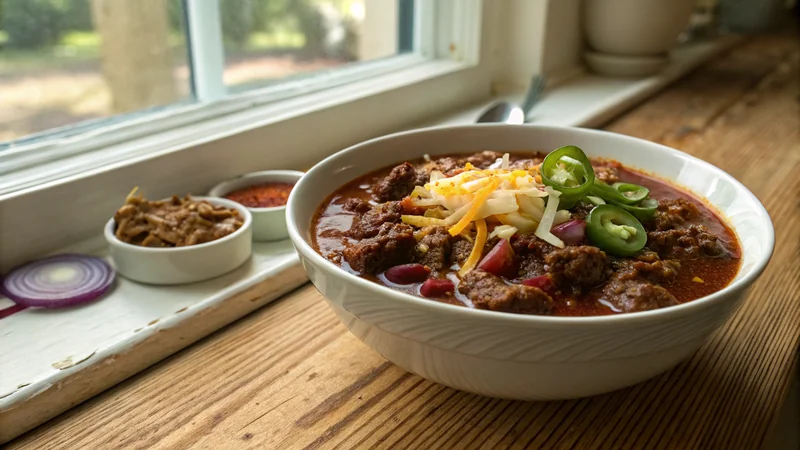
Texas chili at its slow-simmered best is a 4-hour stovetop affair: cubed beef chuck, rehydrated dried chiles, low heat, and time. The collagen in the chuck breaks down slowly into gelatin; the chile sauce reduces and concentrates; the broth thickens through evaporation. Most Texas families have a chili recipe like this and most of them serve it at deer-camp Sundays and football season weekends. The downside is the time commitment.
The Instant Pot accelerates the two longest steps - collagen breakdown and chile rehydration - by raising the boiling point to 250F under pressure. Collagen breaks down at 200-205F, but the rate doubles every 18F above that. At 250F, what takes 3-4 hours at a stovetop simmer happens in 35 minutes. The chiles, similarly, infuse their oils into the sauce three times faster under pressure than over an open simmer.
What the Instant Pot cannot do is evaporate water. Pressure cooking is a closed system - whatever liquid goes in stays in. So the chili at the end of the pressure cycle is thinner than a stovetop chili at the same point. The fix is the masa harina slurry and a 10-minute open saute simmer at the end, which is the structural compromise that makes Instant Pot Texas chili work. The recipe below is built around that compromise.
Cubed Beef Chuck (Not Ground)
Texas chili is made with cubed beef, never ground. This is the single most distinguishing feature of Texas chili compared to Cincinnati chili, Kansas City chili, or supermarket-template-American chili. Ground beef in chili produces a soft, indistinct, sometimes greasy texture that does not represent a Texan eating experience. Cubed beef produces distinct, tender, slowly-rendered chunks that you have to chew through.
Beef chuck is the canonical cut. Chuck roast, chuck-eye, or chuck shoulder all work. Chuck has high collagen content (the connective tissue that breaks down into gelatin under long heat or pressure), which is exactly what you want for a stew-style cook. Avoid lean cuts like sirloin or top round - they dry out and turn stringy. Avoid prime cuts like ribeye - the fat content is too high and the chili turns greasy.
Cube the chuck into 3/4-inch pieces. Smaller cubes (1/2-inch) over-render in the pressure cook and break down into shreds. Larger cubes (1-inch) do not absorb the chile sauce as deeply and the texture is less integrated. The 3/4-inch cube is the canonical Texas chili size and works perfectly for the 35-minute pressure cook.
Dried Chiles: Ancho, Guajillo, Arbol
Texas chili sauce is built on rehydrated dried chiles, not chili powder. The difference is night and day - dried chile sauce has depth, fruitiness, smoky notes, and a brighter color that powdered chili cannot reproduce. Anchos are dried poblanos: sweet, raisin-like, mild heat (1,000-1,500 SHU). Guajillos are slightly hotter and brighter, with a tangy berry note (2,500-5,000 SHU). Arbol chiles are sharp and aggressive (15,000-30,000 SHU) and add the kick.
The recipe uses 4 anchos, 3 guajillos, and 2 arbols. The ratio is 4:3:2 of mild-to-medium-to-hot. If you want a milder chili, drop the arbols and use 5 anchos plus 4 guajillos. If you want a hotter chili, add 1-2 chipotle in adobo to the blender for smoke and heat together.
Toast the dried chiles before rehydrating. 30 seconds per side on a dry comal or in the dry Instant Pot insert in Saute mode. Watch them - they burn fast and burned chile is bitter. After toasting, rehydrate in hot beef broth (not water) for 10 minutes. The broth absorbs the chile flavor while the chiles soften, and you use the same liquid in the blender for the sauce.
Why Beef Broth, Not Water
Most online chili recipes call for water to thin the sauce. Texas pit masters and chili circuit cooks use beef broth - and the choice matters more than people expect. Beef broth carries the savory backbone that water cannot. The sauce stops tasting like "flavored chile water" and starts tasting like "chile-and-beef sauce." That single substitution is the most impactful upgrade most home chili cooks can make.
Use low-sodium beef broth so you control the salt. Better Than Bouillon paste is a fine shortcut - 2 teaspoons in 3 cups of hot water gives a deeper savory note than canned broth. Some Texas cooks use a mix of beef broth and brisket pan drippings if they smoked a brisket the day before. The brisket-drippings version is the secret-weapon Texas chili.
Avoid stock from a beef bouillon cube alone - the flavor is one-dimensionally salty and the chili tastes flat. Avoid chicken broth - the flavor is too light for a beef chili. Beef broth is the answer; brisket drippings are the upgrade.
Masa Harina: The Texas Thickener
Masa harina is dried, nixtamalized corn flour - the same flour used to make corn tortillas. Texas chili tradition calls for masa harina, not flour or cornstarch, because masa adds both thickening and a slight corn flavor that integrates with the chile sauce in a way other thickeners do not. Cornstarch produces a glossy, almost-chinese-food texture that is wrong for chili. Wheat flour produces a starchy, slightly pasty texture. Masa harina produces the canonical Texas chili thickness.
Use masa harina (not regular cornmeal). Masa harina is treated with calcium hydroxide during processing, which gives it the distinctive corn-tortilla flavor and the fine, smooth texture. Cornmeal is just ground dried corn and produces a grainy chili. Maseca is the most common brand and works perfectly. Bob's Red Mill makes a good organic version.
Whisk the masa with cold water before adding to the hot chili. This prevents lumps. The slurry should be pancake-batter consistency. Add it during the final saute simmer at the end of the cook, not before the pressure cook - the masa would over-thicken under pressure and the chili would seize.
Absolutely No Beans (The Texas Chili Code)
Texas chili contains no beans. Period. Real Texas chili recipes - the ones that win at Terlingua's International Chili Cookoff and the ones that survive in deer camps and family Sundays - have zero beans. The bean rule is so strong that Lyndon B. Johnson's Pedernales River Chili recipe, distributed by the LBJ Library, makes a point of including no beans. The Texas Legislature in 1977 declared chili the official state dish, and the Texas Chili Cookoff rules (Original CASI category) explicitly prohibit beans.
The reasoning: chili in Texas is a chile-meat sauce, not a stew. The beans are a Northern adaptation, popularized in the early 20th century when ground beef and beans became cheaper than long-cooked chuck and dried chiles. There is nothing wrong with bean chili - it is just not Texas chili. Cincinnati chili (with beans, on spaghetti, with cheese) is its own thing and is delicious; that thing is not Texas chili.
If you want beans on the side, Texas-style ranch beans (slow-cooked pinto beans with onion, garlic, and bacon) are the canonical accompaniment. Serve them in a small bowl alongside the chili, never mixed in. The bowl-of-chili-with-beans-on-the-side is the Texan compromise; the no-beans-anywhere is the purist position.
Pressure Release Strategy
Pressure release matters more in chili than in most pressure-cooker dishes. After the 35-minute cook, set a 10-minute natural release before opening the steam valve. The natural release continues to break down the collagen at decreasing pressure and lets the meat fully relax. A fast release (opening the valve immediately) seizes the beef cubes - they go from tender to rubbery as the pressure drops too fast.
After 10 minutes of natural release, the remaining pressure is low enough that opening the valve is safe and the meat is stable. Use a wooden spoon to push the valve open if you are nervous about steam (the valve is hot). Wait until the float pin drops before unlocking the lid.
Some Instant Pot models have a Slow Release option that automates this. If yours does, use it. The result is the same as a manual 10-minute natural release.
Stovetop Alternative (No Instant Pot)
If you do not have an Instant Pot, the stovetop version of Texas chili is at Texas Chili - a 3-4 hour simmer that is the gold standard. The Instant Pot recipe above is a working-day adaptation, not the canonical version. If you have a Sunday afternoon to dedicate to chili, do the stovetop version.
If you want to do the recipe above on the stovetop, brown the beef in a heavy Dutch oven, saute the onion-garlic-tomato paste, add the chile sauce and broth and beef, cover, and simmer on the lowest stovetop setting for 3 hours. Stir every 30 minutes. Add the masa slurry in the last 15 minutes of the cook. The total time is 3.5 hours; the result is essentially identical to the slow-simmer Texas chili tradition.
A slow cooker also works. Brown beef and saute aromatics on the stove, transfer everything to the slow cooker, cook on Low for 8 hours or High for 4 hours. Stir in masa slurry in the last 30 minutes. The slow cooker version is convenient but the texture is slightly less concentrated than the stovetop or Instant Pot versions because slow cookers do not evaporate as much liquid.
Toppings Texas-Style
Sharp cheddar. Shredded yellow cheddar is the canonical Texas chili topping. Use a sharp or extra-sharp variety - mild cheddar disappears into the chili. Shred your own from a block; pre-shredded cheddar has cellulose anti-caking that prevents proper melt.
Raw white onion. Finely diced white onion adds the sharp, fresh counterpoint to the rich chili. About a tablespoon per bowl. Red onion is too sweet; yellow onion is too mild; white onion is the right pick.
Fresh jalapeno. Sliced thin, raw, scattered on top. The fresh heat is brighter than the cooked-in chiles and adds a final layer.
Sour cream. A small dollop in the center of the bowl, not stirred in. The cream cuts the heat and richness.
Cornbread. A wedge of Texas cornbread on the side. The traditional Texas chili plate is bowl-of-chili plus cornbread plus iced tea.
Frito pie format. Pour the chili over a bag of Fritos slit open, top with cheddar and onion, the way my Texas Frito pie does it. The traditional Texas-and-New-Mexico ballpark format.
Chef Mia's Kitchen Notes
Big Mike, my chili teacher, was a stovetop purist who would have side-eyed an Instant Pot. He retired before I started making this Tuesday-night version. The recipe above is honest about what it is: a working-professional adaptation. The Sunday version at Texas Chili is still better. The Tuesday version is good enough that I do not feel like I am cheating Texas tradition.
I keep a jar of Mexican oregano (different from Mediterranean oregano - Mexican is more citrusy and earthier) on the chili shelf. Substituting Mediterranean oregano works but the chili reads slightly more Italian and less Texan. Penzeys, Burlap and Barrel, and most Mexican grocery stores carry Mexican oregano.
Chili tastes better the second day. If you have time, make this Tuesday and serve Wednesday. The flavors marry overnight in the fridge and the texture firms up. Reheat slowly on the stovetop with a splash of broth to thin if needed. Microwaving works but the texture is slightly less integrated.
Mistakes to Avoid
Ground beef. Texas chili is cubed, not ground. Ground beef in this recipe produces a soft, undefined texture and signals you are making non-Texas chili.
Skipping the brown. Browning the beef in batches is the most-skipped step in pressure cooker chili and the most flavor-impactful. Do not skip.
Chili powder instead of dried chiles. Pre-mixed chili powder is a shortcut that flattens the flavor. Use whole dried chiles - they are sold at any HEB or Mexican grocery for a few dollars.
Adding masa before the pressure cook. Masa under pressure thickens unevenly and can scorch on the bottom. Add it during the final open simmer.
Fast-releasing the pressure. Fast release seizes the beef cubes. Use a 10-minute natural release minimum.
Beans. Already covered. No beans in Texas chili. Beans go in a separate bowl on the side.
Variations
Smoked brisket chili. Replace half the cubed chuck with chopped leftover smoked brisket. Skip the beef browning step (the brisket is already cooked). Cut the pressure cook to 20 minutes. The result is the most Texas of all chili variants.
Venison chili. Replace the chuck with cubed venison shoulder or leg. Add 1 extra tablespoon of beef tallow to compensate for the leaner meat. The deer-camp Texas tradition - see Venison Chili.
Coffee-deepened. Add 1/4 cup of strong brewed coffee with the beef broth. The coffee adds depth and bitterness that pairs with the dried chiles. A West Texas cowboy variation.
Chocolate-mole. Add 1 oz of dark chocolate (70%+) and a teaspoon of ground cinnamon to the chile sauce. Pushes the chili toward Mexican mole; serve with rice and tortillas instead of cornbread.
Pork-and-beef. Replace 1/3 of the chuck with cubed pork shoulder. The pork adds richness and a slightly different texture. A South Texas variation.
What to Serve With Instant Pot Texas Chili
The canonical Texas chili plate is a bowl of chili with toppings, a wedge of Texas cornbread on the side, and iced tea or cold beer. Cornbread crumbled into the chili is acceptable; cornbread used to scoop the chili is preferred.
If you want to scale up to a chili night for friends, set out a topping bar: shredded cheddar, diced onion, jalapenos, sour cream, fresh cilantro, hot sauce, lime wedges, and Fritos for those who want the Frito pie format. Smoked chorizo queso with chips makes a strong starter, and a pan of cornbread feeds the whole table.
For drinks, cold Mexican lager (Modelo, Tecate, Pacifico), iced tea, or a margarita all work. For dessert, a cobbler or sheet cake. For more chili and Tex-Mex options, see the Tex-Mex Recipes category and the Texas BBQ category.
Instant Pot Texas Chili Recipe
Ingredients
- 3 lb (1.4 kg) beef chuck roast, trimmed of large fat caps and cut into 3/4-inch cubes
- 4 dried ancho chiles, stems and seeds removed
- 3 dried guajillo chiles, stems and seeds removed
- 2 dried chiles de arbol, stems removed (optional, for heat)
- 3 cups (720 ml) low-sodium beef broth, hot
- 2 tablespoons vegetable oil or beef tallow
- 1 large yellow onion, finely diced
- 6 garlic cloves, minced
- 2 tablespoons tomato paste
- 2 teaspoons ground cumin
- 1 teaspoon dried Mexican oregano
- 1 teaspoon kosher salt, plus more to taste
- 1/2 teaspoon coarse black pepper
- 1/2 teaspoon smoked paprika
- 1 tablespoon apple cider vinegar
- 3 tablespoons masa harina (corn flour, not cornmeal)
- 1/4 cup (60 ml) water (for the masa slurry)
- Toppings (Texas-style):
- Shredded sharp cheddar
- Diced raw white onion
- Sliced fresh jalapeno
- Sour cream
- Cornbread on the side
Instructions
- Toast and rehydrate the dried chiles. Open and discard the stems and seeds from the ancho, guajillo, and arbol chiles. Set the Instant Pot to Saute - High mode (no oil yet). Once hot, toast the chiles for 30 seconds per side until fragrant - watch them; they burn fast and burned chile is bitter. Transfer the toasted chiles to a bowl, cover with 2 cups of the hot beef broth, and let sit 10 minutes while you prep the rest. This rehydrates them and starts the chile-broth infusion.
- Brown the beef in batches. Add 1 tablespoon of oil to the Instant Pot insert (still on Saute - High). Once shimmering, add half the cubed chuck in a single layer with space between cubes. Brown for 4-5 minutes without stirring, then turn and brown another 3-4 minutes. Transfer to a bowl. Add the second tablespoon of oil and brown the second batch. Set all browned beef aside. Browning is the most-skipped step in pressure cooker chili and the most flavor-impactful.
- Saute the onion, garlic, and tomato paste. With the Instant Pot still on Saute - High, add the diced onion to the residual oil and cook 4-5 minutes, stirring occasionally, until softened and starting to brown at the edges. Add the minced garlic and tomato paste; cook 1 more minute, stirring constantly, until the tomato paste darkens to brick red. The browned tomato paste adds depth that raw paste cannot.
- Blend the chile sauce. Transfer the rehydrated chiles and their soaking liquid to a blender. Add the cumin, oregano, salt, pepper, smoked paprika, and apple cider vinegar. Blend on high for 60-90 seconds until completely smooth. Strain through a fine mesh strainer back into a measuring cup if you want a perfectly smooth sauce; skip the strain if you do not mind a slightly coarser texture (I skip it).
- Combine in the Instant Pot. Pour the chile sauce into the Instant Pot insert with the onion-garlic mixture. Add the browned beef and any accumulated juices. Add the remaining 1 cup of beef broth. Stir to combine. The mixture should look like a stew with the beef cubes 90% submerged in dark red sauce. If the sauce is too thick to bury the beef, add another 1/2 cup of broth.
- Pressure cook 35 minutes. Cancel the Saute mode. Lock the Instant Pot lid in place with the steam release set to Sealing. Select Pressure Cook (or Manual) on High pressure for 35 minutes. The Instant Pot will take 10-12 minutes to reach pressure before the 35-minute count begins. Total time from this step: about 50 minutes.
- Natural release 10 minutes. When the cook time finishes, do not open the steam release. Let the Instant Pot natural release for 10 minutes. This is critical - the meat continues to relax and the sauce stops boiling, which prevents the beef from going stringy or seizing. After 10 minutes, manually release any remaining pressure by opening the steam valve, then unlock the lid.
- Make the masa slurry. While the natural release happens, whisk the masa harina with 1/4 cup of water in a small bowl until smooth, with no lumps. The slurry should be the consistency of pancake batter. If it looks too thick, add 1-2 more tablespoons of water; too thin, a teaspoon more masa.
- Thicken with masa and final simmer. Set the Instant Pot back to Saute - Low. Pour the masa slurry into the chili and stir gently to incorporate. Simmer uncovered for 8-10 minutes, stirring occasionally, until the chili thickens to a true chili texture - thick enough that a spoon dragged across the bottom leaves a trail that fills in slowly. Taste and adjust salt and acid (a teaspoon more vinegar brightens; a pinch of brown sugar rounds). The chili is now done.
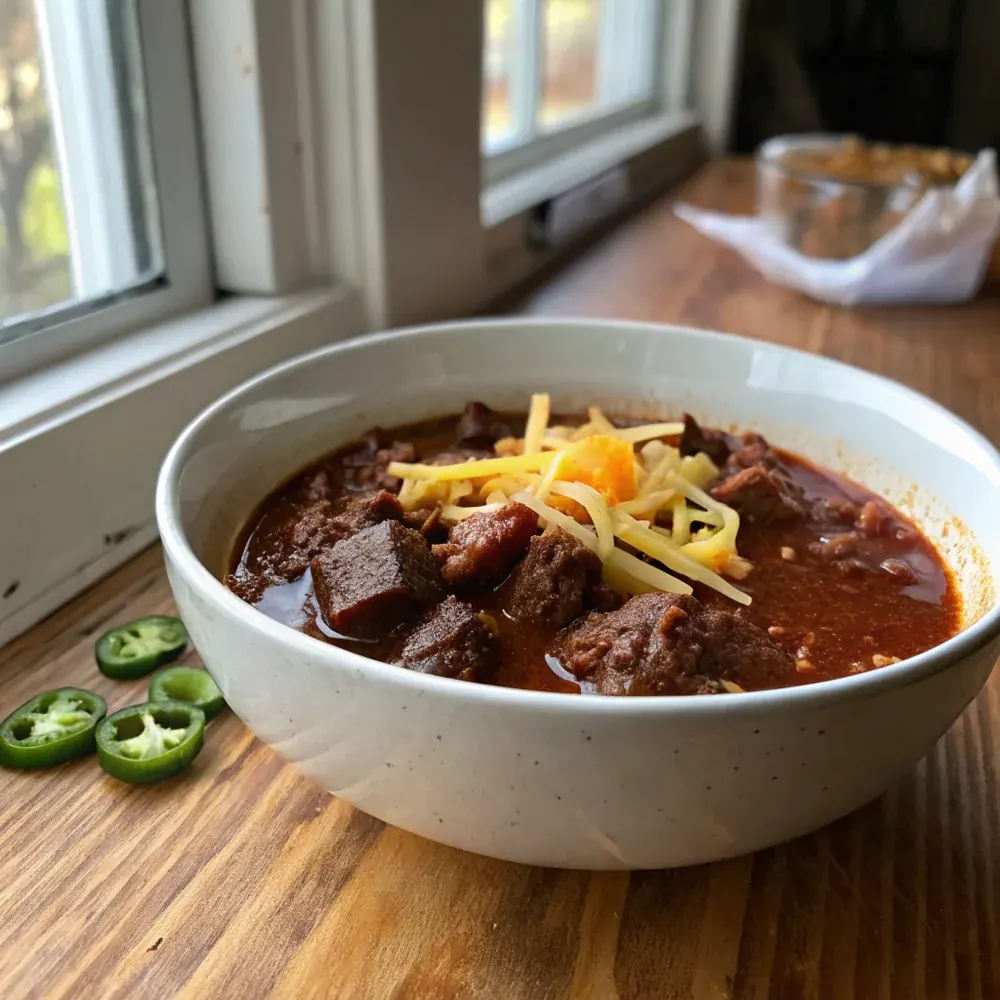
- Rest 5 minutes and serve. Cancel the Saute mode and let the chili rest 5 minutes off heat. The texture continues to set during the rest. Ladle into bowls and top Texas-style: shredded sharp cheddar, diced raw white onion, sliced fresh jalapeno, a small dollop of sour cream, and a wedge of cornbread on the side. No beans. Never beans.
Frequently Asked Questions
Is real Texas chili made with beans?
No. Texas chili contains no beans. The Texas Legislature declared chili the official state dish in 1977, and the Texas Chili Cookoff rules (Original CASI category) explicitly prohibit beans. LBJ's published Pedernales River Chili recipe is bean-free. Bean chili exists - it is the Northern and Cincinnati style - but it is not Texas chili. Beans, if you want them, go in a separate bowl on the side.
Can I make Texas chili with ground beef instead of cubed?
You can, but it stops being Texas chili. Real Texas chili is cubed beef chuck, never ground. The cubed format produces distinct tender chunks; ground beef produces a softer, more uniform texture that signals supermarket-American chili. If a recipe calls itself Texas chili and uses ground beef, it is using the name loosely.
Why use dried chiles instead of chili powder?
Dried chiles produce a sauce with depth, fruitiness, smoky notes, and a brighter color that pre-mixed chili powder cannot reproduce. Chili powder is dried chiles plus cumin, garlic, oregano, and salt - the proportions are pre-tuned for general use, not for a chili sauce. Using whole dried chiles (anchos, guajillos, arbols) gives you full control of the flavor profile and produces a noticeably better chili.
How long do I pressure cook Texas chili?
35 minutes on High pressure plus a 10-minute natural release. The pressure cook breaks down the chuck collagen and infuses the chile sauce. The natural release prevents the beef from seizing as the pressure drops. Total time from button-press to lid-open: about 50 minutes (10-12 minute pressure-up + 35-minute cook + 10-minute release).
Can I substitute masa harina with cornstarch or flour?
Cornstarch produces a glossy, almost-Chinese-food texture that is wrong for chili. Wheat flour produces a starchy, slightly pasty texture. Masa harina is the canonical Texas chili thickener and adds both thickening and a slight corn flavor that integrates with the chile sauce. Maseca is the most common brand and is sold at every HEB. If you absolutely cannot find masa harina, mix 2 tablespoons of cornmeal with the masa amount, but the result is grainier.
What is the difference between Texas chili and chili con carne?
They are essentially the same thing - chili con carne is the older Spanish-language name for what English-speakers now call Texas chili. The Spanish name reflects the dish's San Antonio origin in the late 1800s, where Mexican-American "chili queens" sold bowls of cubed beef in chile sauce in Military Plaza. Modern Texas chili is the direct descendant of those plaza bowls. "Chili con carne" and "Texas chili" are interchangeable in Texas usage.
Can I freeze Texas chili?
Yes - chili freezes exceptionally well. Cool fully, portion into freezer-safe containers (leaving 1-inch headspace for expansion), freeze up to 3 months. Thaw overnight in the fridge, then reheat slowly on the stovetop with a splash of broth to loosen. The flavor often improves with freezing as the chiles continue to integrate. Avoid microwaving frozen chili - the texture comes out uneven.
How spicy is this chili?
As written, mild-to-medium - the 4 anchos and 3 guajillos are dried mild-to-medium chiles, and the 2 arbols add a moderate kick (15,000-30,000 SHU per pepper). Total heat is roughly 4 out of 10 on a Tex-Mex scale. To increase: add 1-2 chipotles in adobo for smoky heat, or 1-2 more arbols for sharp heat. To decrease: skip the arbols entirely and use 5 anchos plus 4 guajillos. The chili powder version (using packaged chili powder) is generally milder than the whole-dried-chile version.