Texas Desserts
Czech-Texan Kolaches
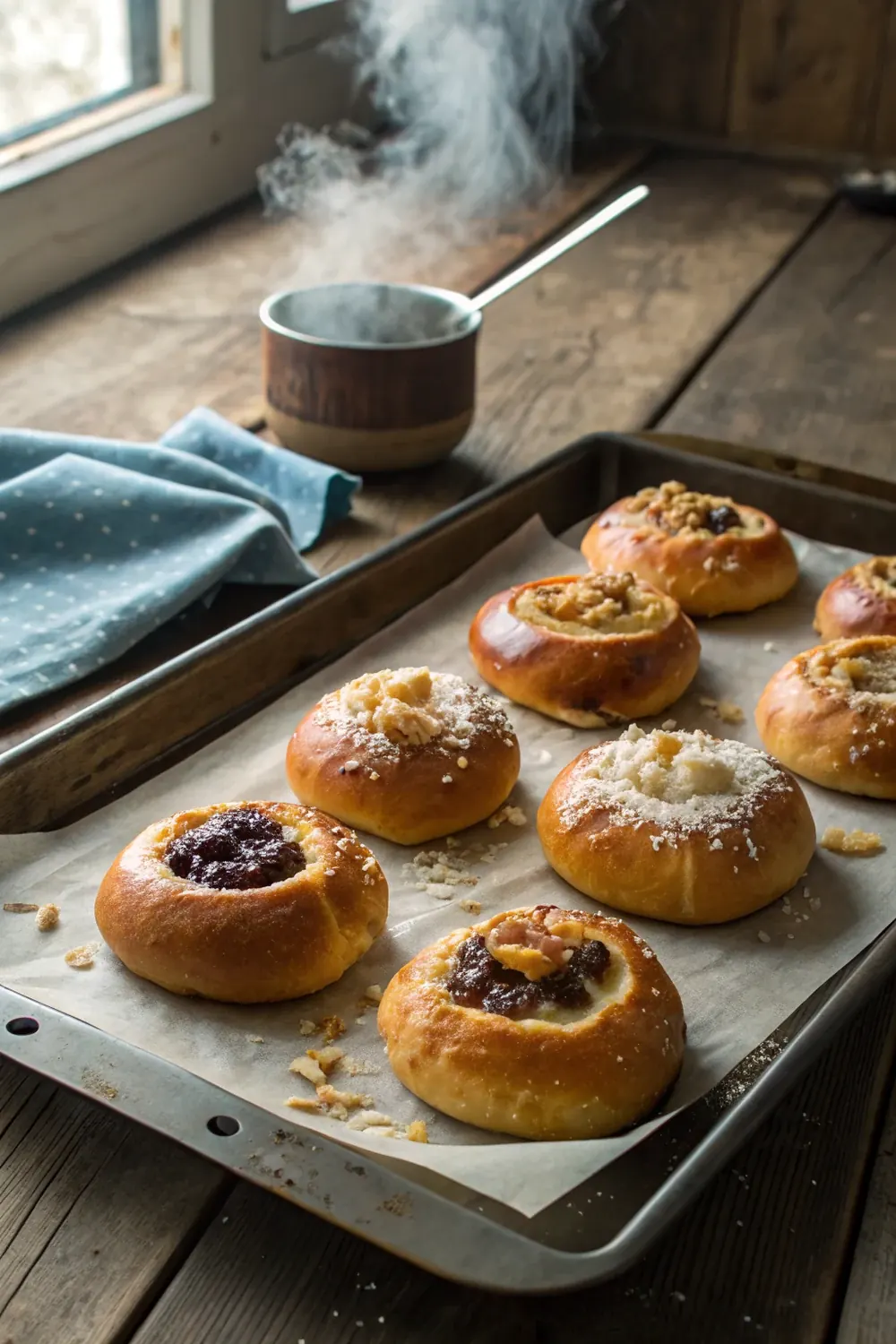
Authentic Czech-Texan kolaches with apricot, prune, poppy seed, and cream cheese fillings - soft, pillowy dough, the real West, Texas tradition in 4 hours.
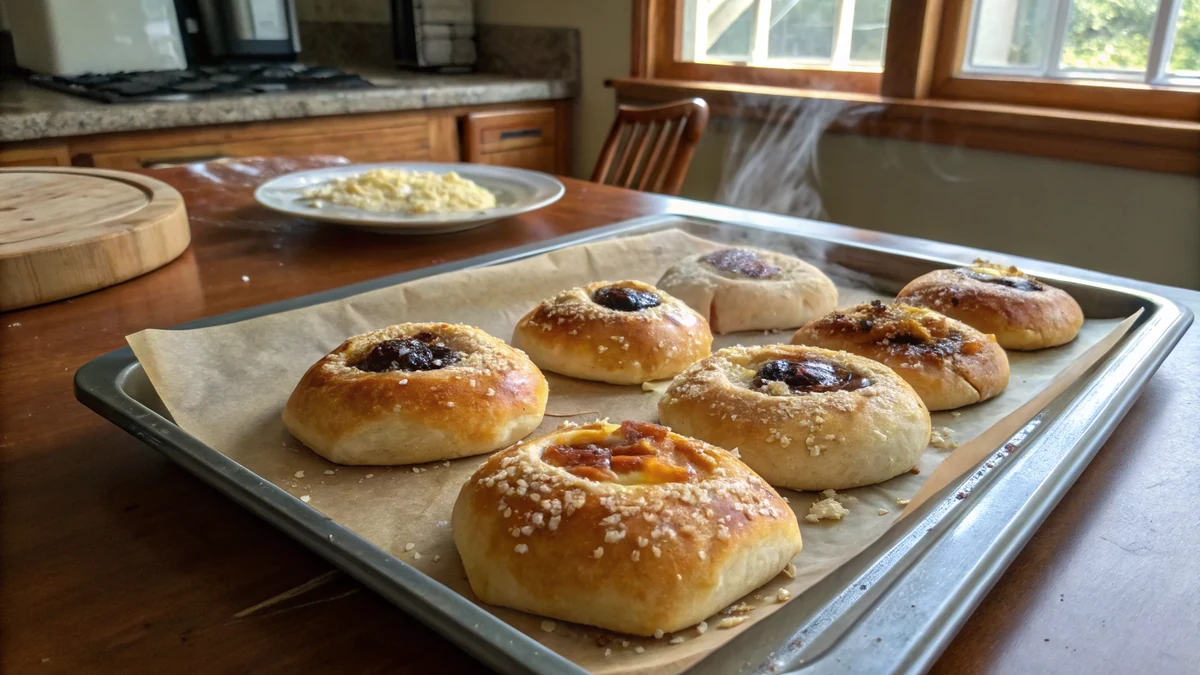
Quick answer: Czech-Texan kolaches are sweet enriched yeasted dough pillows with a thumbprint indent filled with fruit (apricot, prune, poppy seed) or sweetened cream cheese, brought to Central Texas by Czech-Moravian immigrants in the 1880s. The dough is butter-and-egg-yolk-rich (similar to brioche but lighter), proofed twice, indented, filled, sprinkled with posypka streusel, and baked at 350F for about 20 minutes. West, Texas is officially the Kolache Capital of Texas. Total time about 4 hours including two rises.
I learned to make kolaches the way most Texans learn anything important, by watching someone older than me work in a kitchen that smelled like butter and yeast and warm fruit. In my case it was a borrowed Czech grandmother in Caldwell, my friend Lenka's babi, who folded the dough the way her own mother had taught her in Praha (the tiny Fayette County one, not the Prague in the Czech Republic). She did not write anything down. She measured flour with a coffee cup, butter with her thumb, and milk with the warmth of her wrist. The kolaches she pulled out of her oven that afternoon were the lightest, most pillowy, most perfectly indented little pastries I had ever seen, and she told me with a slight frown that they were not as good as her mother's. I have been chasing that frown ever since.
Kolaches arrived in Central Texas with the great wave of Czech-Moravian immigration that came through the port of Galveston starting in the 1850s and accelerating in the 1880s, settling the small towns that now define the Texas Czech Belt: Caldwell, La Grange, Hallettsville, Schulenburg, Praha, and the kolache holy land itself, West, Texas. West (population around 2,800, located on I-35 between Waco and Hillsboro) was officially declared The Kolache Capital of Texas by state proclamation, and every Austin-to-Dallas drive includes a stop at the Czech Stop (founded 1983) or Slovacek's Sausage on the other side of the highway. The recipe below makes 16 kolaches, half fruit and half cream cheese, the way my borrowed Czech grandmother would have made them. Total time about 4 hours, most of it the dough rising on its own.
Czech Immigration to Central Texas, 1850s to 1880s
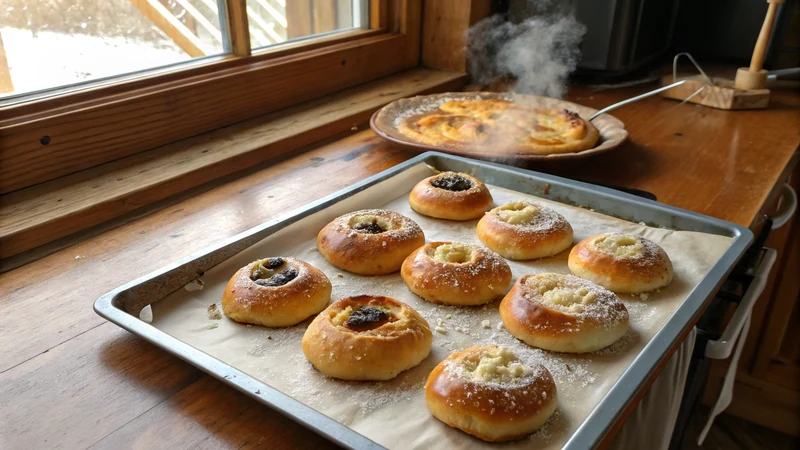
The story of Texas kolaches starts in Moravia, the eastern half of what is now the Czech Republic, in the middle of the nineteenth century. Czech-Moravian farmers facing land scarcity, military conscription, and political pressure under Habsburg rule began emigrating in waves, and Texas became a primary destination because of cheap fertile land in the Brazos and Colorado river valleys. The first organized Czech settlement in Texas was Cat Spring in Austin County, founded in 1847, but the major waves came through the port of Galveston between 1850 and 1900.
By the 1880s, Czech-speaking communities had taken root across what is now called the Texas Czech Belt: Fayette, Lavaca, Austin, Washington, Burleson, Williamson, McLennan, and Hill counties. Towns like Caldwell, La Grange, Hallettsville, Schulenburg, Praha, and West became Czech-Moravian centers, with Czech-language churches, Czech newspapers (Slovan, Svoboda), Czech Halls (SPJST lodges), and a Czech-Texan food culture that blended Old World traditions with Texas ingredients and abundance.
Kolaches came with them. In Moravia, kolache (the singular is kolac, plural kolace, but in Texas everyone says kolache for one and kolaches for many) were a celebration pastry, served at weddings, holidays, and Sunday gatherings. In Texas, with abundant butter, milk, eggs, and fruit, the tradition flourished. By the early twentieth century kolaches had become the signature pastry of Czech-Texan church bazaars, parish festivals, and family bakeries that still operate today.
West, Texas, the Kolache Capital
West (the comma is part of the name, distinguishing the town from the direction) sits on Interstate 35 between Waco and Hillsboro, population around 2,800, and it is the unofficial and officially-proclaimed Kolache Capital of Texas. The Texas Legislature passed a resolution in 1997 designating West as such, and the town leans into the title with the annual Westfest Czech festival every Labor Day weekend, two competing kolache bakeries that catch every I-35 traveler, and a Czech Heritage Museum that documents the immigration story.
The Czech Stop, founded in 1983 by Bill Polk, is the most famous kolache stop in Texas, open 24 hours, with a long glass case of fruit and cream cheese kolaches plus klobasniky (sausage rolls), pigs in blankets, and Czech pastries like rohliky (crescent rolls). Slovacek's Sausage, on the opposite side of I-35, is the other landmark, with a smokehouse and a kolache counter that locals will argue is actually the better bakery. The two-stop debate is a Texas road trip institution.
If you have not made the West pilgrimage, plan it. Drive up from Austin or down from Dallas, exit at I-35 Exit 353, and visit both bakeries in the same hour. Taste the apricot kolache at the Czech Stop and the cream cheese at Slovacek's, then form your own opinion. For more on Central Texas Czech food, see Texas Monthly's food coverage for the West kolache trail features.
The Dough, Enriched but Lighter Than Brioche
Kolache dough is in the family of enriched yeasted breads, alongside brioche, challah, panettone, and pan dulce, but it sits at the lighter end of the spectrum. A canonical Czech-Texan kolache dough has milk, butter, sugar, egg yolks, and a single whole egg per batch, with active dry yeast. The proportion of fat to flour is lower than brioche (which can run 1:1 butter-to-flour by weight in extreme versions), giving kolache dough a softer, more tender, less buttery-rich texture.
All-purpose flour is correct, not bread flour. Bread flour has more gluten and produces a chewier, more bagel-like crumb, which is wrong for kolaches. The kolache crumb should be tender, soft, and almost cloud-like, with a fine even structure that pulls apart in soft strands rather than chewy strings. King Arthur all-purpose, Gold Medal all-purpose, or HEB all-purpose all work; avoid King Arthur bread flour or anything labeled 'high-gluten.'
The egg yolks are essential. Three yolks plus one whole egg gives the dough its yellow color, its richness, and its tender crumb (yolks are about a third fat). The whole egg adds protein and structure. A dough made with all whole eggs would be drier and slightly tougher; the yolk-heavy ratio is what gives kolaches their signature pillowy softness.
The Four Classic Fillings (and What Not to Use)
The four canonical Czech-Texan kolache fillings are apricot, prune (lekvar), poppy seed (mak), and sweetened cream cheese (tvaroh in the Old World, cream cheese in Texas). Each has a place in the tradition and each tells you something about Moravian foodways translated to Central Texas pantries.
Apricot is the brightest and most popular. In Moravia it would have been made from fresh apricots cooked down with sugar; in Texas, Solo Foods (the canonical brand, in the canning aisle of any HEB or Central Market) and Lacrumb (a competitor with a slightly thicker texture) sell prepared apricot filling that is the honest Texas-Czech bakery shortcut. Many of the best bakeries in West and Caldwell openly use Solo. If you make it from scratch, simmer dried apricots with sugar and water until jam-like.
Prune (lekvar) is the deepest and most traditional, made from cooked-down dried plums (prunes) with sugar and lemon. It is the filling that older Czech-Texans grew up on; the younger generation often prefers apricot. Poppy seed (mak) is the Old World filling: ground poppy seeds cooked with milk, sugar, and sometimes honey or raisins. It is dark gray, slightly grainy, and richly nutty, and it is a love-or-hate filling for many Texans. Solo Foods sells a workable canned mak filling.
Cream cheese is the modern Texas favorite, sweetened with sugar and egg yolk and lightly vanilla. It is technically a Texas adaptation; in Moravia tvaroh (a fresh quark cheese) would have been used. Cream cheese is the closest available Texas-pantry equivalent. What NOT to use: jam from a jar (too thin, will run), pie filling (too sweet and too liquid), Nutella in the canonical version (delicious but not traditional), and anything with chunks of fresh fruit (water content collapses the dough). Stick to thick paste-like fillings.
Posypka, the Streusel Topping
Posypka is the small streusel topping that crowns a Czech-Texan kolache, and it is what distinguishes a kolache from a generic enriched-dough fruit pastry. The word means 'sprinkle' in Czech. Posypka is a simple mixture of flour, sugar, and cold butter, sometimes with a drop of vanilla, rubbed together with the fingertips until it forms small pea-size crumbs.
The posypka adds a slight crunch and a buttery-sweet topnote to the soft pillow of the kolache. Some bakeries (notably Slovacek's) sprinkle posypka heavily over every kolache; others (some West bakeries) reserve posypka only for the cream cheese kolaches and leave the fruit kolaches bare. Both traditions are correct. I personally sprinkle a little posypka on every kolache because I think it improves all of them.
Make the posypka while the dough is on its first rise; it keeps in the fridge for a week. Some Czech-Texan bakers add a pinch of cinnamon or lemon zest to the posypka; the canonical version is just flour, sugar, butter, and vanilla. Resist over-flavoring; the posypka should taste of butter, not of bakery-spice-mix.
Kolache vs Klobasnek, the Terminology Dispute
Here is where Texas kolache culture takes a careful turn, and where a Czech grandmother will correct you firmly. A TRUE kolache is a sweet open-faced fruit-filled pastry, the dough wrapped around a thumbprint of fruit or cream cheese. The savory sausage-stuffed version, where a sausage link is fully wrapped inside the dough, is called a klobasnek (singular) or klobasniky (plural), or in some Texas bakeries 'Czech sausage roll' or 'pig in a blanket.'
Many Texas convenience stores, gas stations, and even some bakeries call the savory sausage version a 'sausage kolache' or 'kolache with sausage.' Czech purists, including most older Czech-Texans in West and Caldwell, will tell you firmly this is incorrect. The word kolache means an open-faced sweet pastry; a closed savory sausage roll is a klobasnek. The Czech Stop, to its credit, labels them correctly.
If you order at the Czech Stop, you can ask for an apricot kolache (sweet, indented, fruit-topped) or a klobasnek (savory, dough wrapped around sausage and cheese). Both are delicious and both have a place in Texas cuisine, but they are different pastries with different names. This recipe is for true kolaches; the klobasnek recipe is similar dough but a fully different shaping technique and deserves its own write-up.
Shaping and the Thumbprint Indent Technique
The kolache shape is what makes it a kolache. A round flat-topped pillow with a deep central indent (the 'thumbprint') filled with fruit or cream cheese, with a 1/2-inch raised dough border around the edges. The indent should be deep enough to hold a generous tablespoon of filling but not so deep that you press through to the parchment.
Shape the dough balls tightly. After the first rise, divide the dough and roll each piece into a smooth tight ball by cupping it under your palm and rotating against the counter. The surface should be taut and the seam tucked underneath. Loose balls produce uneven kolaches with collapsing edges; tight balls hold their shape through the second rise and the bake.
Indent AFTER the second rise, not before. If you indent before the second rise, the dough will puff up and fill the indent back in. The right sequence: shape balls, second rise on the sheet pan for 30-40 minutes until puffy, indent with two fingers or the bottom of a small flour-dipped jar, fill, sprinkle posypka, and into the oven. Do not let the kolaches sit too long after indenting; the dough relaxes and the indent shallows.
Proofing in Texas Heat
Yeast doughs proof faster in heat and slower in cold, and Texas kitchens have a wide annual range. In a Texas summer kitchen at 80F+, the first rise can complete in 60-75 minutes; in a winter kitchen at 65F it can take 2 hours. Trust the dough, not the timer. The dough is ready when it has visibly doubled and a finger pressed into the surface leaves an indent that fills back slowly.
If your kitchen is cold (below 70F), help the dough rise by placing the covered bowl in a turned-off oven with the oven light on (the bulb gives off about 10-15F of warmth) or near a sunny window. If your kitchen is hot (above 85F), watch the dough closely; over-proofed kolache dough loses structure and the kolaches will collapse during the bake.
The second rise on the sheet pan is where most home bakers go wrong. The second rise is shorter (30-40 minutes vs 1.5 hours for the first), and the dough should look puffed but not doubled. Over-proofed second rises produce kolaches that flatten when indented and look like sad pancakes after baking. Under-proofed second rises produce dense, tight kolaches that do not have the pillowy texture. The right second-rise stage is when the dough balls feel light and pillowy when touched, but a finger indent springs back rather than collapses.
Kitchen Notes and the West, Texas Pilgrimage
The first time I made kolaches at home in my Hill Country kitchen, I was so eager to get them indented and filled that I rushed the second rise. They came out of the oven dense and slightly tough, with shallow filling pockets and no pillowy lift. My borrowed Czech grandmother in Caldwell would have shaken her head. The second time, I waited until they were truly puffy and light, and the difference was dramatic.
I keep Solo Foods apricot, prune, and poppy seed fillings in my pantry at all times now. They are the Czech-Texan bakery shortcut that even West, Texas bakers use, and they make weekend kolaches a 4-hour project instead of a 2-day one. The cream cheese filling I always make from scratch; it takes 5 minutes and the texture is markedly better than anything jarred.
If you have not made the West pilgrimage, plan a Saturday drive. From Austin it is 90 minutes north on I-35; from Dallas it is 90 minutes south. Stop at the Czech Stop first (southbound side), then loop around to Slovacek's (northbound side). Buy a dozen of each and taste them side by side. You will form an opinion about which is better, and you will be wrong, because they are both excellent. While you are in town, walk through the Czech Heritage Museum on Oak Street and pay respects to the West Fertilizer Plant memorial; small town, big history.
Mistakes to Avoid
Bread flour instead of all-purpose. Bread flour produces a chewier crumb that is wrong for kolaches. Use all-purpose, ideally a soft Southern brand or King Arthur all-purpose.
Overfilling the indent. Filling that mounds above the dough border will overflow during the bake and burn on the parchment. Fill level with the border, no higher.
Underproofing the second rise. Dense, tight kolaches with no pillowy lift come from rushing the second rise. Wait until the dough balls feel light and puffy, even if it takes 45 minutes.
Using jam from a jar as filling. Jam is too thin and will run. Use prepared bakery filling (Solo Foods, Lacrumb) or homemade thick-cooked fillings.
Indenting before the second rise. The indent will fill back in. Indent AFTER the second rise, not before.
Skipping the egg yolks. Substituting whole eggs for the yolks gives a drier crumb. The 3-yolks-plus-1-whole-egg ratio is canonical for a reason.
Calling a klobasnek a 'sausage kolache.' Czech grandmothers will correct you. A kolache is sweet and open-faced; a klobasnek is the savory sausage version. Use the right word at the Czech Stop counter and the older ladies will smile at you.
Variations and Modern Fillings
Cream cheese with fruit swirl. Top the cream cheese filling with a small spoonful of apricot or strawberry filling and swirl with a toothpick before baking. The half-and-half kolache is a modern Texas variation that bakeries like the Czech Stop now offer.
Strawberry kolache. Use prepared strawberry pie filling (Solo Foods) or homemade thick strawberry preserves. A modern Texas favorite that has earned a place in the canon.
Blueberry kolache. Same approach as strawberry, with blueberry filling. Modern but well-loved.
Lemon kolache. Lemon curd as the filling produces a bright, almost tart kolache that pairs well with the rich dough. Make sure the curd is thick.
Nutella kolache. Strictly modern and not at all traditional, but a tablespoon of Nutella in the indent makes a delicious kolache that kids love. Czech grandmothers will frown.
Sweet potato kolache. An Austin-area variation that uses thick sweet potato puree spiced with cinnamon. Pairs beautifully with my double-crusted sweet potato pie filling, scaled down to a tablespoon per kolache.
Holiday spread. Serve kolaches alongside king cake and Texas Christmas trifle for a Czech-Texan-Cajun holiday dessert table.
What to Serve With Kolaches
Kolaches are a breakfast or coffee-hour pastry, not a dessert in the European sense. The canonical Czech-Texan service is kolaches with strong black coffee, served on Sunday morning after church, or as a mid-morning coffee break at a SPJST lodge meeting. A pot of coffee, a plate of kolaches, and conversation in Czech or Texan English; that is the complete experience.
For a Texas-Czech brunch spread, pair kolaches with klobasniky (the savory sausage cousin), scrambled eggs, sliced melon or fresh fruit, and a pitcher of orange juice. Some Czech-Texan families add a small glass of slivovitz (Czech plum brandy) for a special-occasion brunch; the West Czech festival serves slivovitz proudly.
If you are serving kolaches as part of a Texas holiday dessert spread, pair them with strong coffee and a small scoop of vanilla ice cream alongside. For more Texas Czech and Czech-Texan recipes, browse the breakfast and bread categories; for a complete Czech-Texan holiday spread, my Texas Christmas trifle is the appropriate dessert finale.
Czech-Texan Kolaches Recipe
Ingredients
- For the dough:
- 4 cups (480 g) all-purpose flour, plus more for dusting
- 1/2 cup (100 g) granulated sugar
- 1 tablespoon active dry yeast (1 packet plus 3/4 teaspoon)
- 1 teaspoon kosher salt
- 1 cup (240 ml) whole milk, warmed to 110F
- 1/2 cup (115 g) unsalted butter, melted and slightly cooled
- 3 large egg yolks, room temperature
- 1 large whole egg, room temperature
- 1 teaspoon pure vanilla extract
- Zest of 1 lemon (optional, traditional)
- For the cream cheese filling:
- 8 oz (225 g) full-fat cream cheese, softened
- 1/4 cup (50 g) granulated sugar
- 1 large egg yolk
- 1 teaspoon pure vanilla extract
- Pinch of kosher salt
- For the fruit fillings:
- 1/2 cup (about 150 g) prepared apricot filling (Solo Foods or Lacrumb brand, or homemade)
- 1/2 cup (about 150 g) prepared prune (lekvar) filling (Solo Foods or homemade)
- 1/2 cup (about 150 g) prepared poppy seed (mak) filling (Solo Foods or Lacrumb)
- For the posypka topping:
- 1/2 cup (60 g) all-purpose flour
- 1/4 cup (50 g) granulated sugar
- 3 tablespoons (42 g) cold unsalted butter, cubed
- 1/2 teaspoon pure vanilla extract
- For finishing:
- 2 tablespoons unsalted butter, melted (for brushing tops after baking)
- Equipment:
- Stand mixer with dough hook (recommended), or a large mixing bowl and a sturdy wooden spoon
- Two half-sheet baking pans with parchment paper
- Kitchen scale (optional but encouraged for the dough)
- Clean kitchen towel for covering the rise
Instructions
- Mix and proof the dough. Warm the milk to 110F (just barely warm to the touch, not hot). In the bowl of a stand mixer, whisk together 4 cups flour, 1/2 cup sugar, the yeast, and the salt. Add the warm milk, melted butter, egg yolks, whole egg, vanilla, and lemon zest if using. With the dough hook attached, mix on low for 2 minutes until the shaggy dough comes together, then increase to medium-low and knead for 6-8 minutes until the dough is smooth, soft, slightly tacky, and pulls away cleanly from the sides of the bowl. The dough should feel like a baby's earlobe, soft and supple. If it is too sticky, add 1 tablespoon of flour at a time.
- First rise. Lightly grease a large bowl with butter or neutral oil. Form the dough into a ball, place it in the bowl, turn it once to coat, and cover with plastic wrap or a damp kitchen towel. Let it rise in a warm spot for 1.5 hours, or until doubled in size. In a Texas summer kitchen this can take as little as 1 hour; in winter it can take 2 hours. The dough is ready when a finger pressed gently into the surface leaves an indent that fills back slowly, not quickly.
- Make the cream cheese filling and posypka. While the dough rises, beat the softened cream cheese with the sugar, egg yolk, vanilla, and salt in a small bowl until smooth and lump-free. Refrigerate until ready to use. For the posypka, combine the flour and sugar in a small bowl, then rub in the cold cubed butter with your fingertips until the mixture forms small pea-size crumbs. Stir in the vanilla. Refrigerate the posypka until ready to top the kolaches.
- Divide and shape into balls. Punch the risen dough down gently and turn it out onto a lightly floured counter. Divide it into 16 equal pieces (about 60 g each if you are using a scale). Roll each piece into a smooth tight ball by cupping it under your palm against the counter and rotating - the surface should be tight and the seam tucked underneath. Arrange the balls 2 inches apart on two parchment-lined baking sheets, 8 per sheet.
- Second rise on the baking sheets. Cover the baking sheets loosely with a clean kitchen towel and let the dough balls rise for 30-40 minutes, or until they have puffed up by about half their size and feel light and pillowy when touched. The second rise is shorter than the first; do not let them go too long or they will overproof and collapse when indented. While they rise, preheat the oven to 350F.
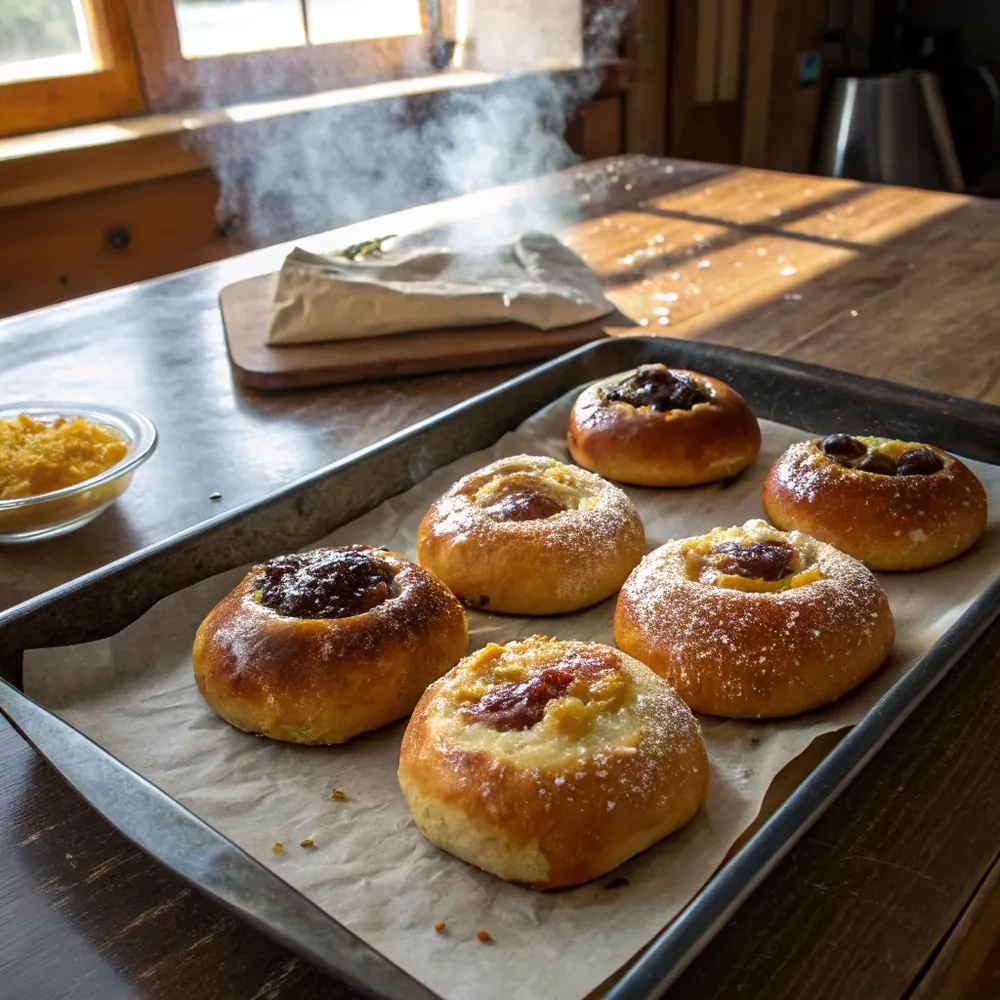
- Indent and fill the kolaches. Once the dough balls are puffed, use two fingers (or the bottom of a small jar dipped in flour) to press a deep indent into the center of each ball, leaving a 1/2-inch raised border around the edges. Do not press all the way through. Spoon about 1 tablespoon of filling into each indent: 4 apricot, 4 prune, 4 poppy seed, and 4 cream cheese is the canonical Texas distribution, but adjust to taste. Fill generously but do not overfill - the filling should be level with the dough border, not mounded above it.
- Sprinkle posypka and finish proofing. Sprinkle the posypka streusel evenly over the cream cheese kolaches and lightly over the fruit kolaches (some bakers skip posypka on fruit kolaches and only top the cream cheese ones - this is a regional preference). Let the filled kolaches rest for 5 more minutes while the oven finishes preheating. The dough should look soft, puffy, and slightly relaxed.
- Bake at 350F. Bake one sheet at a time on the center rack at 350F for 18-22 minutes, until the kolaches are golden brown on top and the bottoms are deep golden when you peek underneath. Rotate the pan halfway through for even browning. As soon as they come out of the oven, brush the tops lightly with the 2 tablespoons of melted butter for shine and softness. Cool on the pan for 5 minutes, then transfer to a wire rack. Best eaten the day they are baked, ideally still slightly warm.
Frequently Asked Questions
What is the difference between a kolache and a klobasnek?
A kolache is a sweet open-faced fruit-filled or cream-cheese-filled pastry, the canonical Czech-Texan pastry brought from Moravia in the 1880s. A klobasnek (plural klobasniky) is the savory cousin: a sausage link fully wrapped inside the same enriched dough. Many Texas convenience stores call the savory version a 'sausage kolache,' but Czech purists firmly correct this; the proper terms are kolache (sweet) and klobasnek (savory). The Czech Stop in West, Texas labels them correctly, and so should you.
Why is West, Texas called the Kolache Capital of Texas?
West (population around 2,800, on I-35 between Waco and Hillsboro) was officially designated the Kolache Capital of Texas by the Texas Legislature in 1997. The town was settled by Czech-Moravian immigrants in the late 1800s and remains a center of Czech-Texan culture, with the annual Westfest Czech festival every Labor Day weekend, two famous kolache bakeries (the Czech Stop founded 1983 and Slovacek's Sausage), and a Czech Heritage Museum. The two bakeries are pilgrimage stops on every Austin-to-Dallas drive.
Can I use bread flour instead of all-purpose?
No - bread flour has more gluten and produces a chewier, denser crumb that is wrong for kolaches. The kolache crumb should be tender, pillowy, and soft, with a fine even structure. Use all-purpose flour: King Arthur all-purpose, Gold Medal all-purpose, or HEB all-purpose all work well. If you only have bread flour, you can substitute by replacing 2 tablespoons per cup with cornstarch to lower the gluten, but all-purpose is the canonical choice.
What is posypka?
Posypka is the streusel topping sprinkled on kolaches before baking. The word means 'sprinkle' in Czech. It is a simple mixture of flour, sugar, cold butter, and a touch of vanilla, rubbed together with fingertips into pea-size crumbs. Some Czech-Texan bakeries (like Slovacek's) sprinkle posypka heavily on every kolache; others reserve it only for cream cheese kolaches. Both are correct. The posypka adds a slight buttery-sweet crunch on top of the soft dough.
Do I have to use prepared fillings (Solo Foods, Lacrumb)?
No, but they are the canonical Texas-Czech bakery shortcut and even the best West, Texas bakers use them. Solo Foods (in the canning aisle of HEB and Central Market) sells apricot, prune (lekvar), and poppy seed (mak) fillings that are honest, thick, and bakery-quality. If you prefer to make fillings from scratch, simmer dried apricots or prunes with sugar and water until thick and jam-like; for poppy seed, grind poppy seeds and cook with milk, sugar, and honey until paste-like. Avoid jam from a jar - it is too thin and will run.
Can I freeze kolaches?
Yes. Cool the baked kolaches completely, then freeze on a baking sheet until solid (about 2 hours), then transfer to a zip-top freezer bag. They keep for up to 2 months frozen. To reheat, thaw at room temperature for an hour, then warm in a 300F oven for 5-7 minutes until just warm and soft. The texture is best the day they are baked, but frozen-and-reheated kolaches are still excellent. Do not microwave from frozen; the dough turns gummy.
Why did my kolaches collapse when I indented them?
The most likely cause is overproofing on the second rise. Once kolache dough has overproofed, the gluten structure cannot support the indent and the dough collapses. The second rise should take 30-40 minutes, until the dough balls feel light and pillowy but a finger indent still springs back partially. If they double in size or feel airy and fragile, they have gone too far. Other causes: not shaping the balls tightly enough during division, or indenting too aggressively (use gentle fingers, not a hard press).