Southern Comfort Food
Double Crusted Sweet Potato Pie
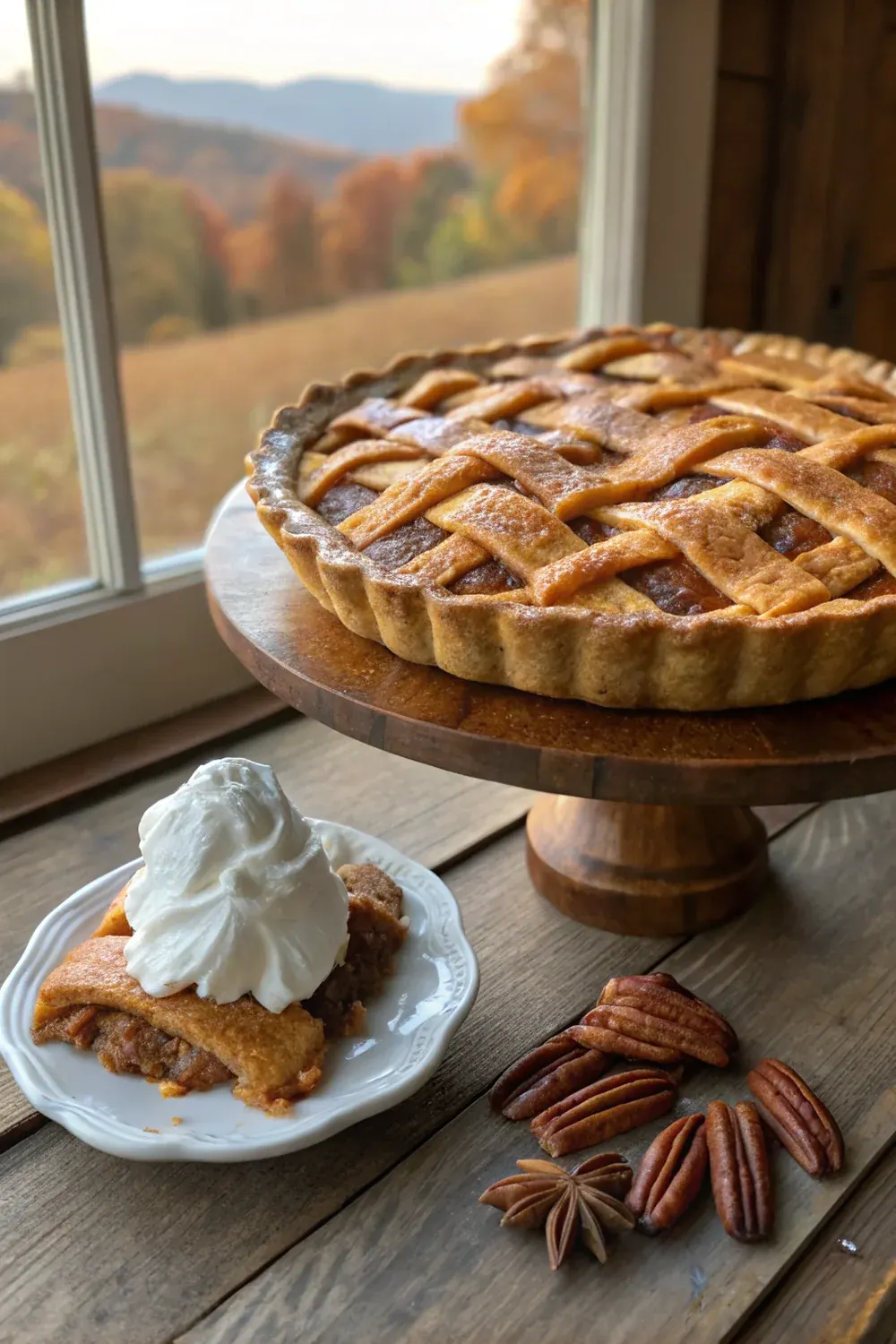
Chef Mia's double crusted sweet potato pie: brown butter spice filling, golden lattice top weave, vanilla cream finish. Texas Thanksgiving showpiece.
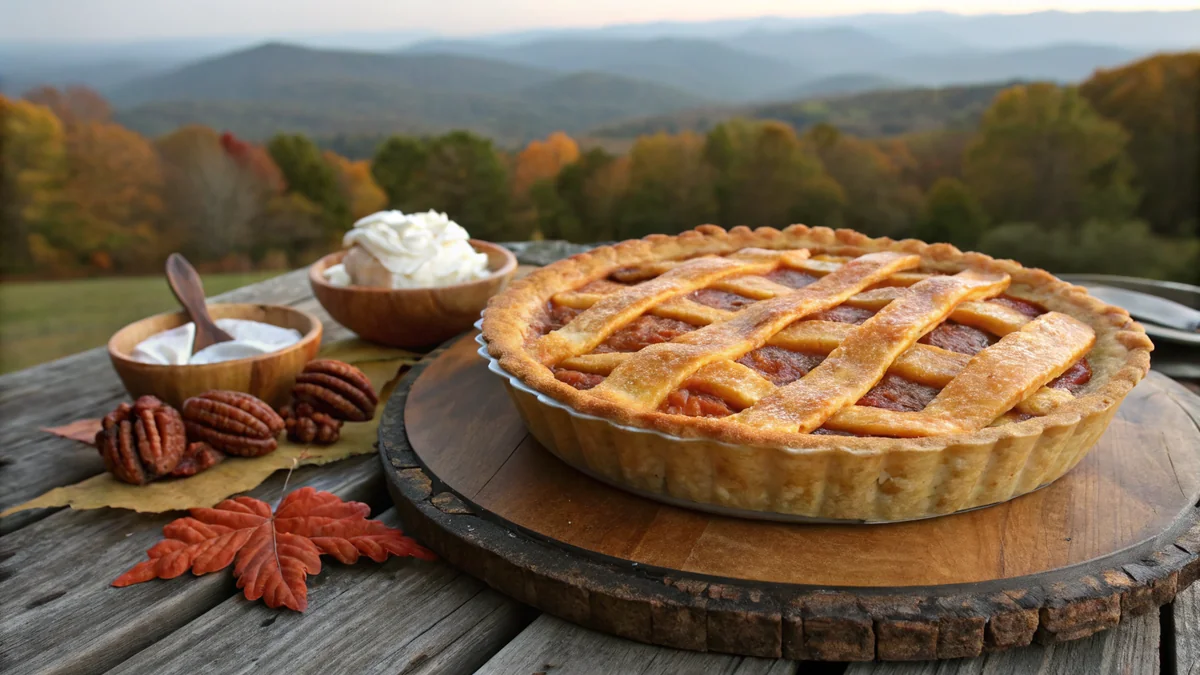
Quick answer: A double crusted sweet potato pie wraps roasted Beauregard sweet potato filling in two pastry layers - a bottom crust and a decorative lattice top. The lattice top weave shows off the deep orange filling between golden pastry strips, transforming a standard sweet potato pie into a Thanksgiving showpiece. Use a from-scratch all-butter pie crust (you'll need a double recipe), roast the sweet potatoes whole (not boiled), make the brown butter spice filling, weave the lattice, brush with egg wash, sprinkle coarse sugar, and bake at 425F for 15 minutes then 350F for 50-55 more minutes. Total time: 1h45 plus chill.
There is a quiet competition every year at my family Thanksgiving in Boerne between me and my cousin Lisa. We are both pie-makers in the family, and we both bring sweet potato pie. She brings the single-crust buttermilk version that her grandmother (my great-aunt) taught her - the same recipe I have written about elsewhere on the site. I bring the double-crusted version, with the lattice top and the brown butter spice filling, that I learned from a baking class at the King Arthur Baking Company in Vermont fifteen years ago. The cousins sample both. We compare notes. Neither of us ever changes our minds about which is better.
The truth is they are both excellent and they serve different purposes. The single-crust buttermilk version is the everyday Thanksgiving pie - simpler, lighter, the one your grandmother actually makes. The double-crusted version is the showpiece pie - the one that goes on the dessert table and gets photographed before it gets eaten, the one that takes 45 extra minutes of work but produces visible drama. Lisa makes hers because it tastes like home. I make mine because I want to win the visual round of the Thanksgiving cousin competition. Neither motivation is wrong.
The recipe below is the double-crusted version with the lattice top, the all-butter crust (the right pastry for visible structural pies), and the brown butter spice filling that distinguishes my recipe from generic sweet potato pies. The active prep time is about 45 minutes (mostly the lattice weaving and the crust work; the filling is fast). The bake time is 65-70 minutes total - 15 minutes at high heat to set the crust structure, then 50-55 minutes at moderate heat to cook through the filling. Plan a Saturday afternoon if you have never made a lattice top before; experienced bakers can knock it out in less time. For the simpler companion recipe, see buttermilk sweet potato pie - the family classic that runs alongside this one at every Texas Thanksgiving I have ever attended. The third pie on that table is usually my Texas pumpkin pie with its brown butter pecan crust.
Why Double Crust? (Visual and Flavor Reasons)
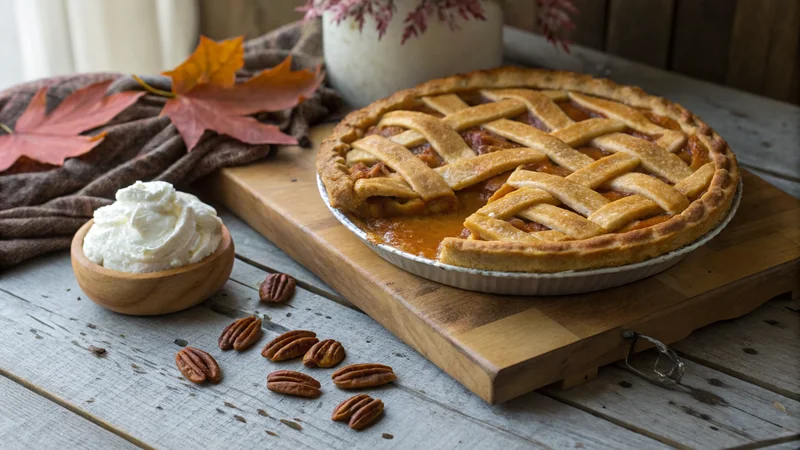
The double-crusted sweet potato pie is the showpiece version - the pie you make when you want to be the star of the dessert table rather than just contributing to it. The lattice top makes the pie visually different from any other pie at the gathering, and the structural complexity (two layers of pastry, woven decoratively) signals effort and craft in a way that single-crust pies never quite achieve. This is the pie for the moment when you want your contribution noticed.
Beyond the visual impact, the double crust contributes meaningful flavor and texture. Twice the pastry per slice means twice the buttery, flaky, caramelized crust contact in each bite. The lattice top develops golden-brown edges around each strip during baking, multiplying the crispy-pastry surface area compared to a flat top. The egg wash and coarse sugar finish make the lattice glossy and slightly crunchy at the surface - a textural contrast against the smooth filling underneath.
The structural choice has trade-offs. The double crust requires twice the dough work (twice the rolling, twice the chilling, the additional weaving step), which adds about 30 minutes to the active prep time. The crust-to-filling ratio is higher, which some sweet potato pie purists object to (the filling is the star; too much crust competes). And the lattice weaving has a learning curve - your first lattice will look amateurish; by your third, it will look professional. None of these trade-offs are deal-breakers; they are just the cost of the upgraded presentation.
If you want the simpler version, see buttermilk sweet potato pie - the single-crust everyday Thanksgiving pie that uses similar filling techniques without the lattice complication. Both pies can coexist on the same Thanksgiving table; many families serve both for variety. The double-crusted version is the showpiece, the buttermilk version is the family staple. Different pies for different roles.
Single vs Double Crust: When to Choose Each
The single-crust sweet potato pie is the right choice for: weeknight desserts, holidays where you have multiple pies to make and time is limited, casual gatherings where presentation matters less than flavor, kid-friendly servings (less pastry, simpler shape), and traditional Southern households where the recipe has always been single-crust. About 90% of sweet potato pies in Texas households are single-crust; this is the default version.
The double-crusted lattice version is the right choice for: special occasions where you want to showcase your baking, contributions to dessert tables where you want to stand out, photography or social media where the lattice will look striking, situations where you have time to do the additional pastry work (about 45 minutes more), and households where multiple cooks make multiple pies and you want yours to be visually different.
The flavor difference between single-crust and double-crusted sweet potato pies is small but real. Both use essentially the same filling. The double-crust version has a slightly higher pastry-to-filling ratio per slice, which means more buttery crust per bite. The single-crust has more filling per slice, which means more sweet potato per bite. Personal preference determines which is preferable; both are excellent.
Many Texas Thanksgiving families serve both pies on the same table - the buttermilk single-crust as the everyday classic, and the double-crusted lattice version as the showpiece. This is the approach in my own family. The double-crusted pie usually gets photographed and sliced for the showy first round of dessert; the buttermilk pie gets eaten more steadily across the rest of the evening. Both have their roles.
If you can only make one pie, the buttermilk single-crust is the safer choice (simpler technique, faster, more forgiving). If you want to push your skills and make a true centerpiece, choose the double-crusted lattice version. The choice is yours. And if what you actually want is sweet potato on the dinner plate rather than in a crust, that is a different dish altogether: my sweet potato casserole is the side dish version, a lightly sweetened mash under pecan streusel with no pastry anywhere near it. Both belong on the same table, and my Texas Thanksgiving guide shows where each one goes.
The All-Butter Crust (and Why You Need a Double Batch)
All-butter pie crust is the right pastry for a double-crusted lattice pie. The butter contributes flavor (a butter-based crust tastes obviously buttery; lard or shortening crusts taste neutral), the high water content of butter creates steam pockets during baking that produce flaky layers, and the milk solids in butter brown beautifully against an egg wash. The result is a crust that tastes excellent and looks professional.
The recipe calls for a double batch of crust (2.5 cups flour + 1 cup butter + 6-9 tbsp ice water) which produces enough dough for both the bottom and the lattice top. Don't try to use a single batch for both crusts; you won't have enough dough for the lattice strips. The double batch is the structural requirement.
Cold butter is essential. The butter should be very cold - just out of the fridge, ideally cubed and refrigerated for an additional 20 minutes after cubing. Warm butter blends into the flour homogeneously and produces a flat, dense crust without flakes. Cold butter stays in pea-sized chunks distributed through the flour, which then expand during baking to create flaky layers.
Ice water is similarly essential. Add 6 tablespoons of ice water (literally ice water - water with ice cubes in it, or water that has sat in the freezer for 5 minutes) and pulse the food processor until the dough just starts to clump. If too dry, add 1-3 more tablespoons gradually. Don't over-process; the dough should look raggy, not smooth. A smooth dough is over-mixed and produces tough crusts.
Chill the dough at least 1 hour before rolling. The chill firms the butter back into the dough (preventing leaks during rolling), gives the gluten time to relax (preventing shrinking during baking), and produces the cleanest pastry results. Up to 2 days ahead is fine; freezer storage is also possible (3 months wrapped tightly). For more general pie crust technique, the broader baking community shares similar standards.
Lattice Top Weaving (Step-by-Step Tutorial)
The lattice top is the visual signature of this pie and the main technique to learn. The over-under weave is structural - it shows decoratively while also holding the pie together during baking. The weaving step takes about 5-7 minutes once you know what you are doing; your first lattice will take 10-15 minutes as you figure out the geometry.
Start with 14 strips, all 3/4 inch wide and roughly equal in length. Roll out the second pastry disc to an 11-inch circle, then cut into strips with a sharp knife or pizza cutter. The strips should be on a parchment-lined sheet pan in the fridge until you are ready to weave; cold strips are easier to handle than warm ones.
Lay 7 strips parallel across the top of the filled pie, evenly spaced (about 1 inch apart). These are your foundation strips going one direction.
Now the weave: fold every other strip back on itself by half (strips 1, 3, 5, 7 - the odd-numbered ones). The folded strips will look like accordion-folded pieces sitting on top of the unfolded ones.
Lay one new strip perpendicular across the unfolded strips. This perpendicular strip is now sitting on top of strips 2, 4, 6 (the unfolded ones).
Unfold the bent strips back over the perpendicular strip. Now strips 1, 3, 5, 7 are sitting on top of the perpendicular strip, while strips 2, 4, 6 are still underneath. This is one row of the weave complete.
Now fold back strips 2, 4, 6 (the ones that weren't folded the first time) and lay another perpendicular strip. Unfold them. Continue this alternating fold-and-place pattern until you have 7 perpendicular strips woven into the original 7. The total weave is 7x7 = a tight lattice.
If the geometry sounds confusing, search YouTube for 'pie lattice weave tutorial' before starting. There are excellent visual guides that show the technique in 60 seconds. Watching a video before your first lattice is faster than trying to figure it out from text alone.
Egg Wash, Sugar Sprinkle, and Bake Strategy
Egg wash is a beaten egg + 1 tablespoon water mixture brushed onto the lattice and crimped edge before baking. The egg wash does three jobs: (1) browns the pastry to a deep golden color (Maillard reaction); (2) creates a slightly glossy finish (the egg proteins develop a sheen); (3) helps the coarse sugar adhere to the lattice. Without egg wash, the lattice bakes pale and dull; with egg wash, it bakes glossy and dramatic.
Apply egg wash with a pastry brush, painting both the top of the lattice and the crimped edge. Don't pool egg wash in the lattice gaps; just glaze the pastry surface. Two thin coats is better than one thick coat for browning evenness.
Coarse turbinado sugar (sometimes labeled raw sugar or sugar in the raw) sprinkled across the egg-washed lattice adds the final crunchy-sweet finish. The sugar crystals adhere to the egg wash, then caramelize slightly during baking to create a faintly crunchy surface. Two tablespoons distributed across the entire lattice is the right amount; more becomes overly sweet, less is barely visible.
The two-temperature bake strategy is the key to the lattice success. The first 15 minutes at 425F sets the pastry structure quickly - this prevents the lattice strips from sagging into the filling. The remaining 50-55 minutes at 350F cooks the filling through without burning the now-golden pastry. Both phases are essential; baking entirely at 350F leaves the lattice flat and disappointing, baking entirely at 425F burns the pastry before the filling cooks.
Tent with foil if the lattice browns too fast. After 35-40 minutes, check the lattice color. If it is already deep golden, drape strips of foil over the most exposed parts (the center of the pie, the highest lattice strips) to slow further browning while the filling continues cooking. The crimped edges often brown faster than the lattice center; have foil ready in case.
Cool fully before slicing. The custard filling sets during the 2-hour cool; cutting too early produces a runny slice. Patience is part of the recipe. For broader Texas dessert traditions, see the Ultimate Texas Desserts Guide.
Double Crusted Sweet Potato Pie Recipe
Ingredients
- FOR THE DOUBLE CRUST (makes top and bottom):
- 2.5 cups (310 g) all-purpose flour
- 1 teaspoon kosher salt
- 2 teaspoons granulated sugar
- 1 cup (227 g) unsalted butter, very cold, cut into 1/2-inch cubes
- 6-9 tablespoons ice water
- FOR THE FILLING:
- 2 lb (900 g) sweet potatoes (about 2 large), Beauregard variety preferred
- 1/2 cup (113 g) unsalted butter, browned
- 3/4 cup (165 g) packed dark brown sugar
- 1/4 cup (60 ml) heavy cream
- 3 large eggs
- 1 teaspoon pure vanilla extract
- 1 tablespoon bourbon (optional)
- 2 teaspoons ground cinnamon
- 1 teaspoon ground nutmeg
- 1/2 teaspoon ground cardamom
- 1/2 teaspoon ground ginger
- 1/4 teaspoon kosher salt
- FOR FINISHING:
- 1 large egg, beaten with 1 tablespoon water (egg wash)
- 2 tablespoons coarse turbinado sugar
- Fresh whipped cream, vanilla ice cream, or pecan halves to serve
Instructions
- Make the double-batch crust. In a food processor, pulse the flour, salt, and sugar to combine. Add the cold cubed butter and pulse 8-10 times until the mixture looks like coarse meal with pea-sized butter pieces. Add 6 tablespoons of ice water and pulse 4-5 times. The dough should clump together when pinched. If too dry, add 1-3 more tablespoons of water gradually. Turn out onto plastic wrap. Divide into two equal portions, shape each into a 1-inch-thick disc, wrap separately. Refrigerate at least 1 hour (or up to 2 days). The chill is essential for flaky pastry.
- Roast the sweet potatoes (45 min). Preheat oven to 400F. Pierce 2 lb sweet potatoes with a fork. Place directly on the oven rack with a sheet pan below. Roast 45-55 minutes until completely tender when squeezed. Cool 15 minutes. Peel; the skins slip off in large pieces. Mash the flesh with a fork until smooth - about 1.5-2 cups. Set aside.
- Make the brown butter (5 min). Melt 1/2 cup butter in a small saucepan over medium heat. Continue cooking, swirling occasionally, for 4-6 minutes until the butter foams, turns light golden, then deep golden brown with a nutty fragrance. Watch carefully in the last minute. Pour into a heatproof bowl to stop the cooking. Cool 10 minutes.
- Roll out the bottom crust. Reduce oven to 375F. Remove one disc of dough from the fridge. Roll on a lightly floured surface to a 12-inch circle, about 1/8 inch thick. Transfer to a 9-inch pie pan, pressing into the corners. Trim the overhang to 1 inch. Refrigerate the shaped crust 15 minutes while you prepare the filling. Do not blind-bake; the lattice-top double-crust pie cooks both crusts together.
- Make the filling. In a large bowl, whisk together the cooled brown butter, brown sugar, sweet potato mash, heavy cream, eggs, vanilla extract, bourbon if using, cinnamon, nutmeg, cardamom, ginger, and salt. Whisk until smooth and uniform - 60 seconds. The mixture should be deep orange-amber, pourable but thick. Pour into the chilled bottom crust. Smooth the top with a spatula.
- Roll out the top crust for lattice. Roll the second disc of dough on a lightly floured surface to an 11-inch circle, about 1/8 inch thick. Using a sharp knife or pizza cutter, cut the dough into 14 strips, each about 3/4 inch wide. The strips should be roughly equal in length and width. Set the strips on a parchment-lined sheet pan in the fridge to firm up while you set up the weaving.
- Weave the lattice top. Place 7 strips parallel across the top of the filled pie, evenly spaced (about 1 inch between strips). Fold every other strip back on itself by half (alternating - fold strips 1, 3, 5, 7 back). Lay one new strip perpendicular across the unfolded strips. Unfold the bent strips back over the perpendicular strip. Now fold back the strips you didn't fold the first time (strips 2, 4, 6). Lay another perpendicular strip. Repeat until you have 7 perpendicular strips woven over-under with the original 7. The result is a classic lattice weave with diamond-shaped openings showing the filling.
- Trim and crimp the edges. Trim the lattice strip ends to about 1/2 inch beyond the pie pan edge. Press the strip ends into the bottom crust overhang. Fold the entire combined edge under itself to create a thick rim. Crimp decoratively with your thumb and forefinger, or press with the tines of a fork. The crimped edge holds the lattice in place during baking.
- Egg wash and bake. Beat the egg with 1 tablespoon water. Brush the lattice and crimped edge with egg wash. Sprinkle 2 tablespoons coarse turbinado sugar evenly across the lattice top. Place the pie on a sheet pan (catches drips). Bake at 425F for the first 15 minutes (this sets the crust structure), then reduce to 350F and bake another 50-55 minutes. The lattice should be deep golden brown, the filling should be set with a slight wobble in the center, and a knife inserted 1 inch from the edge should come out clean. If the crust edges brown too fast, tent with foil strips.
- Cool and serve. Set the pie on a wire rack to cool to room temperature, about 2 hours - non-negotiable. The custard sets fully as it cools. Serve at room temperature or refrigerated. Top each slice with fresh whipped cream, a scoop of vanilla ice cream, or a few toasted pecan halves. Pair with the broader Texas Thanksgiving spread - <a href='https://www.texanrecipes.com/how-to-cook-a-turkey-texas-bbq-style/'>smoked turkey</a>, <a href='https://www.texanrecipes.com/texas-pecan-pie-recipe/'>Texas pecan pie</a> as the second pie option, and <a href='https://www.texanrecipes.com/buttermilk-sweet-potato-pie/'>buttermilk sweet potato pie</a> as the family-classic alternate.
Frequently Asked Questions
How is a double crusted sweet potato pie different from a regular sweet potato pie?
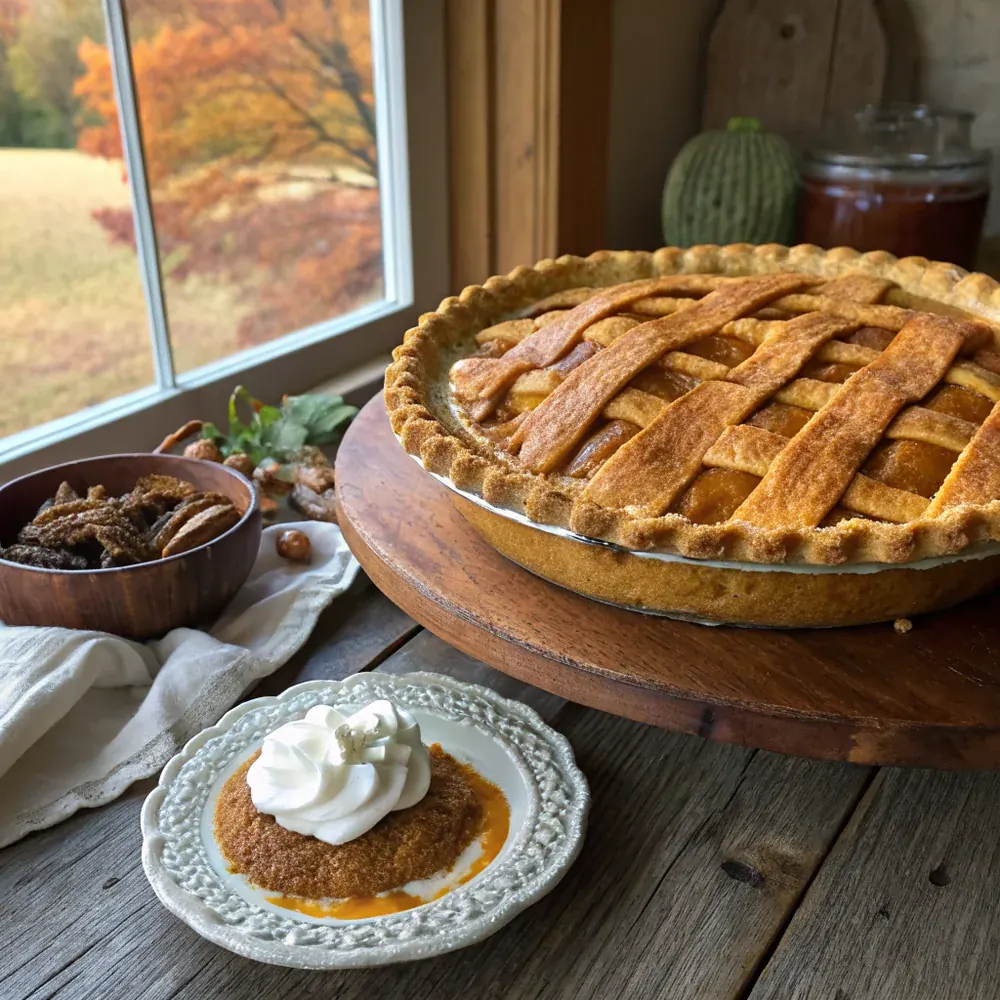
The double-crusted version has both a bottom crust and a decorative top crust (typically a lattice weave), while the regular version has only a bottom crust with the filling exposed on top. Visually, the double-crusted pie is more dramatic with the lattice showing the orange filling between golden pastry strips. Flavor and texture are 90% the same; the double crust adds more pastry per slice and a different visual moment.
Can I use store-bought pie crust for a double-crusted pie?
Possible but not recommended. You'd need 2 store-bought crusts (Pillsbury and others sell 2-packs). The store-bought versions are less buttery and bake to a paler color than from-scratch all-butter crusts. The lattice weave is also harder with store-bought because the dough is thinner and breaks more easily during weaving. For a showpiece pie, the from-scratch crust is worth the extra time.
How do you weave a lattice top?
Cut 14 strips of pastry, each 3/4 inch wide. Lay 7 parallel across the pie. Fold back every other strip (1, 3, 5, 7), lay a perpendicular strip across the unfolded ones, unfold the bent strips. Fold back the alternate strips (2, 4, 6), lay another perpendicular strip, unfold. Repeat until you have 7 strips going each direction (14 total) woven over-under. Total time: 5-7 minutes once you know the technique. Watch a YouTube tutorial before your first attempt.
Why does my lattice sag into the filling during baking?
The lattice was either too thin (under 1/8 inch thick) or too warm when placed on the pie. Solution: roll the pastry slightly thicker (1/8 to 3/16 inch) and chill the strips on parchment paper before weaving. The cold pastry holds its shape during the high-heat first 15 minutes of baking. The 425F initial bake is also essential - it sets the pastry structure quickly before the heat tips into sagging territory.
Can I make a double-crusted sweet potato pie ahead?
Yes - bake the day before, cool to room temperature, refrigerate covered. The flavor improves with a 24-hour rest. The lattice may lose a small amount of crispness from refrigeration; warm individual slices in a 300F oven for 5 minutes before serving to re-crisp. Top with fresh whipped cream just before serving.
Is a double-crusted sweet potato pie hard to make?
It's about 30-40% more work than a single-crust pie, primarily due to the additional crust rolling and the lattice weaving. The filling and bake are essentially identical. The lattice has a learning curve - your first lattice will look amateurish, your second will look better, your third will look professional. If you've never made a lattice top before, plan an extra 30 minutes for the first attempt, and watch a video tutorial first.
Should I blind-bake the bottom crust?
No - for a double-crusted pie, both crusts cook together in the oven. Blind-baking the bottom crust first would over-bake it during the second cook with the filling. The double-crust technique is different from a single-crust where blind-baking is sometimes used. Just chill the shaped bottom crust for 15 minutes before adding the filling.
Can I substitute canned sweet potato puree?
Possible but loses flavor concentration. Roasted fresh Beauregard sweet potatoes have deeper, more concentrated flavor than canned puree. If you must use canned, drain it well in a fine mesh sieve for 30 minutes to remove excess water (canned puree is more watery than roasted fresh), and reduce the heavy cream by 2 tablespoons to compensate. The result will be acceptable but not as outstanding as fresh.