Tex-Mex Recipes
San Antonio Puffy Tacos
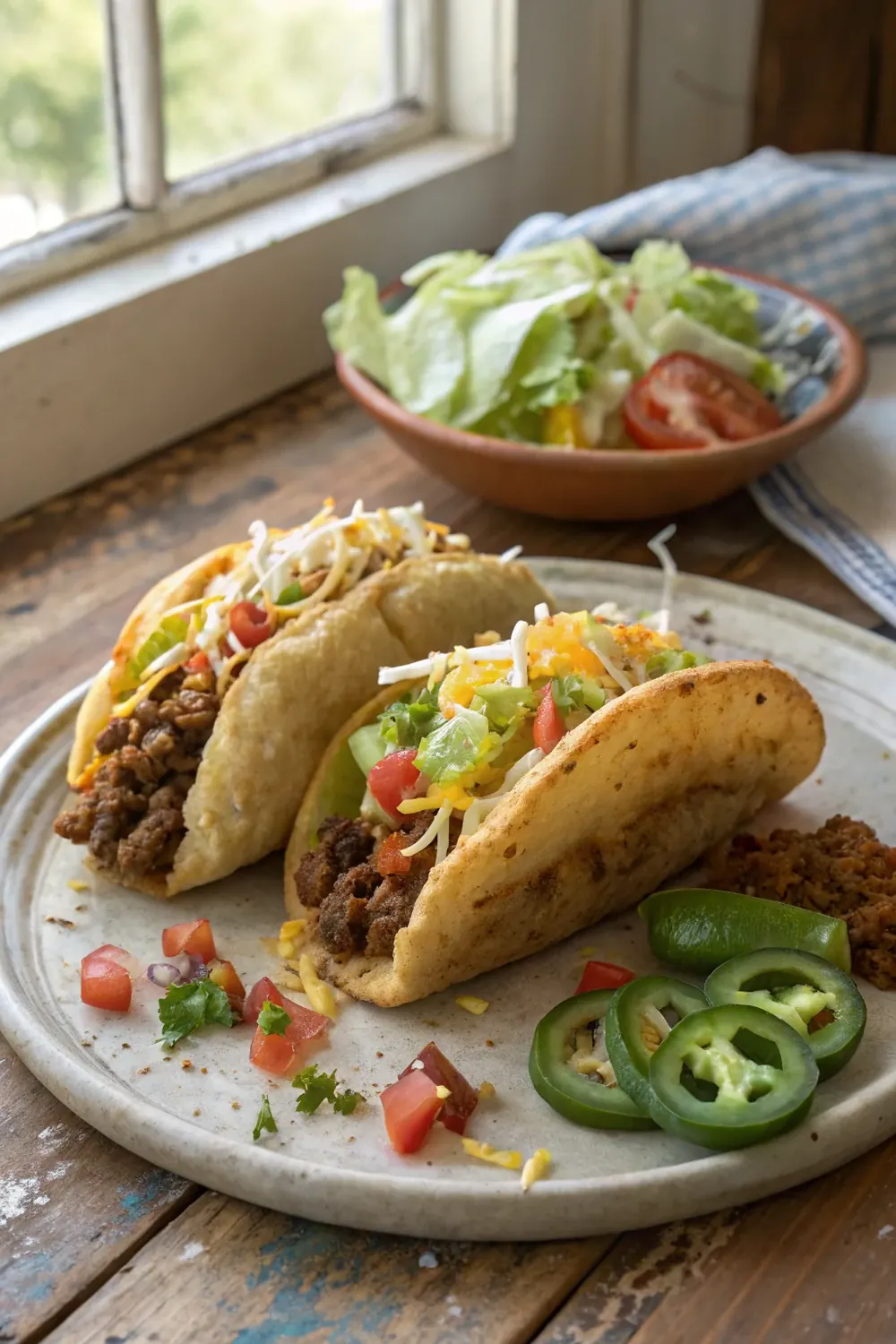
San Antonio puffy tacos with hand-pressed masa shells that puff in hot oil, seasoned ground beef, lettuce, tomato, cheddar. Henry's-style at home in 45 min.
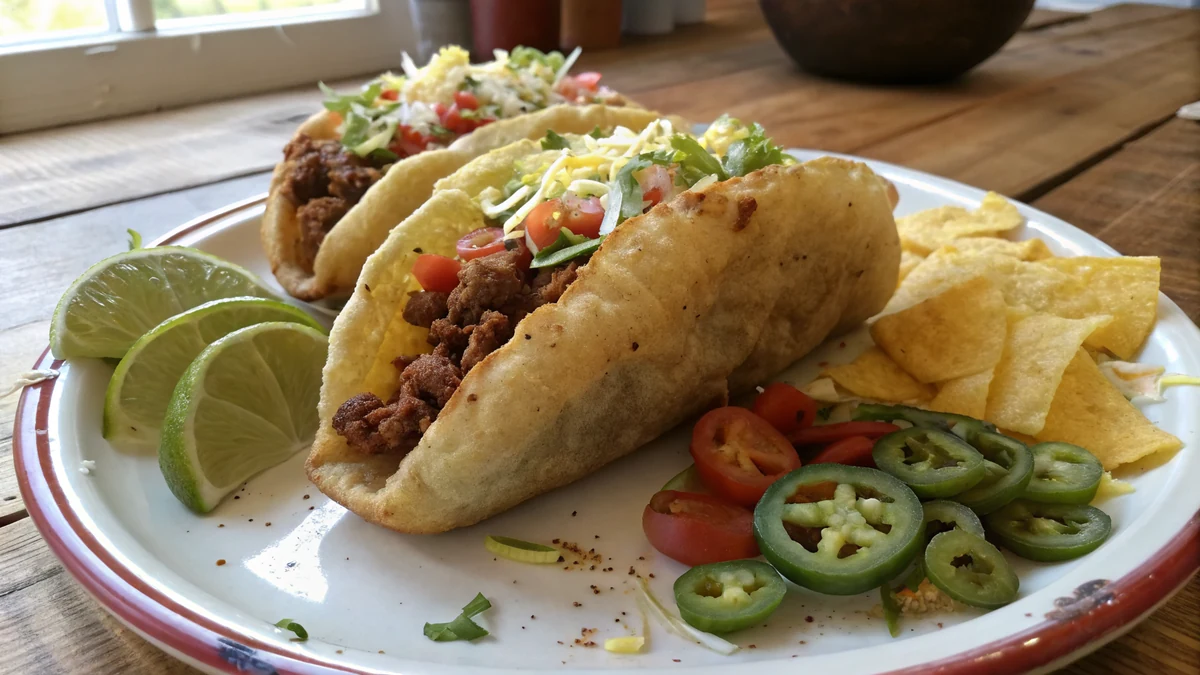
Quick answer: Puffy tacos are a San Antonio Tex-Mex specialty made by frying raw masa rounds in hot oil, where the shell puffs up like a cloud and is then folded around seasoned ground beef, shredded iceberg lettuce, diced tomato, and shredded cheddar. The shell has a thin crispy outside and a tender steamy inside, distinct from a flat fried crispy taco. Henry's Puffy Tacos and Ray's Drive Inn on the West Side are the canonical spots. Total time about 45 minutes.
I had my first puffy taco at Henry's on Bandera Road in San Antonio when I was twenty-two, sitting at a vinyl booth on a Tuesday afternoon, and I remember the exact second the shell hit my teeth. The outside cracked like a chip, the inside was tender and almost steamed, and the seasoned beef juice ran down my wrist before I could get to a napkin. The waitress brought me a stack of paper napkins without being asked, which is how you know a place takes the puffy taco seriously. I drove back to my kitchen that night and started trying to figure out how the shell did that. Puffy tacos are one stop on the city's food map; for the smoke side of San Antonio eating, see my best BBQ in San Antonio guide.
What I learned over the next year of failed batches is that the puffy taco is not a standard fried taco shell. It is raw masa, pressed thin, dropped into hot oil, and pushed in the center with a slotted spoon so the edges puff up into a hollow boat shape. The technique is specific to San Antonio, the Lopez family of Ray's Drive Inn invented it (or made it famous, depending on who you ask) in the 1950s, and Henry Lopez carried it to Henry's Puffy Tacos in 1978 where it became the city's signature. The recipe below is the home-kitchen version, made with Maseca masa harina, a tortilla press, and a cast iron skillet of vegetable oil. Medium difficulty; the puff requires confidence on the first taco, but by the third one your hands know what to do.
What Makes a Puffy Taco Puffy
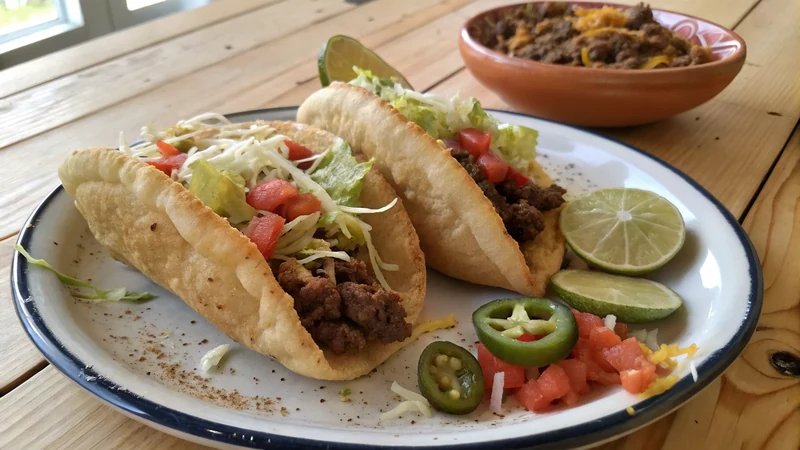
The puff is the whole point, and the science of it is more interesting than it looks. A puffy taco starts as a raw masa round, pressed thin, that gets dropped into hot oil at 350 to 360 degrees F. The water inside the masa instantly turns to steam, the steam tries to escape, and because the masa is fresh and pliable rather than dry like a tortilla chip, the surface seals before the steam can vent. The trapped steam pushes the masa outward and the round inflates into a hollow balloon.
If you let it just inflate, you end up with a hollow corn ball. The San Antonio technique is to press the center of the round down with the back of a slotted spoon as soon as it hits the oil, which forces the steam to push only the edges up. The result is a flat-bottomed boat with puffed walls, perfect for folding into a U-shape and filling. The press happens in the first 5 seconds; wait too long and the whole round inflates uniformly and you have lost the shape.
This is fundamentally different from a Tex-Mex crispy taco shell, which is a fully cooked corn tortilla refried in oil until rigid. A crispy shell is dry, brittle, and crackers-thin. A puffy shell is steamed-tender on the inside, thin-crisp on the outside, and has a corn flavor closer to a fresh tortilla than to a tortilla chip. The two products taste different, eat different, and belong to different traditions even though both are called tacos in Texas.
San Antonio Origin Story (Ray's, Henry's, the Lopez Family)
The puffy taco is San Antonio's, and the Lopez family is the reason. The story starts in 1956 at Ray's Drive Inn, a small West Side spot on West Salinas Street opened by Arturo "Arturo" Lopez and his wife. Ray's served Tex-Mex plates and used a technique that locals had been calling "crispy taco" or "crispy puff" for years. Whether Ray's invented the puff or refined an existing technique is a question San Antonio food historians still argue about. What is not disputed is that Ray's Drive Inn made the puffy taco famous in the city, and the dish became part of the West Side's culinary identity by the 1960s.
In 1978, Henry Lopez and his wife Janie Lopez opened Henry's Puffy Tacos on Bandera Road on the city's Northwest Side. Henry was Arturo's brother (or nephew, depending on which family member you ask). Henry's took the puffy taco out of the West Side neighborhood spot and into a destination restaurant; the Henry's location became the spot tourists got told to visit and locals visited weekly. Henry's mascot, a smiling animated puffy taco named Henry the Puffy Taco, eventually became a San Antonio Missions baseball game tradition; he runs the bases between innings and gets tackled by a kid each game. The dish has reached the level of city iconography.
Other San Antonio puffy taco institutions include Mexican Manhattan downtown, La Tuna in Southtown, and Diana Barrios Trevino's Los Barrios on Blanco Road, all serving slightly different versions of the same dish. The San Antonio Express-News has covered the puffy taco's heritage for decades; their food section regularly features the West Side spots. If you visit San Antonio, the Pearl District and Southtown have newer-generation versions, but the West Side and Bandera Road are where the dish was born.
Maseca vs Fresh Nixtamal Masa
The masa is the foundation, and you have two choices: Maseca masa harina (instant corn flour) or fresh nixtamal masa from a tortilleria. Maseca is what most San Antonio home kitchens use, and what every recipe in this guide is built around. It is dried, finely ground nixtamalized corn flour that you reconstitute with warm water. The dough comes together in 5 minutes, rests for 15, and presses cleanly. Brands: Maseca (the standard), Bob's Red Mill (whole-grain version), King Arthur, or HEB's Hill Country Fare masa harina. All work; Maseca is the most consistent.
Fresh nixtamal masa is the original, and if you live near a tortilleria in San Antonio, Houston, or Austin, you can sometimes buy a 1 lb bag of fresh masa for tortillas. The flavor is rounder and cornier, with a slight tang from the nixtamal process. Fresh masa is also wetter than reconstituted Maseca, so you may need to skip the added water and just press as is, or add a tablespoon of masa harina to firm it up. Fresh masa makes excellent puffy tacos but is harder to source and harder to work with. Maseca is what your great-aunt in San Antonio uses on a Tuesday night.
The dough hydration is the variable that matters most. Too dry and the round cracks at the edges when you press it; the cracks vent the steam in the oil and you lose the puff. Too wet and the round sticks to the press, drags when you peel the plastic, and slumps in the oil. The Play-Doh test is reliable; press a small ball with your thumb and look for the imprint to hold cleanly without cracking. Adjust water by tablespoons until the dough behaves. The same masa technique shows up in Austin breakfast taco tortillas, though those are cooked dry on a comal rather than fried.
The Tortilla Press
A tortilla press is essential. You can roll out masa with a rolling pin if you have to, but you will not get the even thickness or the round shape that a press delivers in 3 seconds. Tortilla presses are inexpensive, available at every Mexican grocery and most HEB stores, and last forever. Cast iron is the canonical material; aluminum presses are lighter and cheaper and work fine. Avoid wooden presses for puffy tacos; the lever mechanism on cast iron presses gives you the leverage to press the round thin enough to puff properly.
Line the press with cut plastic on top and bottom every time. A cut-open Ziploc bag works perfectly, the plastic from a grocery produce bag works too, and some cooks use parchment paper. Without plastic, the masa sticks to the metal and tears when you peel. Put a ball of masa in the center, close the press, push the lever down with firm pressure, and the round comes out at about 5 inches diameter and just under 1/8 inch thick. Slightly thicker than a tortilla; thinner than a sope.
Press all 8 rounds before you start frying. The frying happens fast (30-45 seconds per taco), and stopping to press more rounds between fries lets the oil temperature drift and the rhythm break. Stack pressed rounds with plastic between each (do not let them touch raw or they fuse) and cover with a damp towel until the oil is ready. The press-then-fry workflow is what makes the kitchen feel orderly instead of chaotic.
The Fry: Oil, Temperature, Timing
Use a neutral high-smoke-point oil. Vegetable oil, canola oil, peanut oil, or refined corn oil all work. Do not use olive oil (smoke point too low), butter (will burn), or animal fat (flavor wrong for the shell). I keep a 48 oz bottle of canola in the pantry just for shallow-frying projects.
Pour 1.5 inches of oil into a 10 or 12-inch cast iron skillet or a heavy-bottomed Dutch oven. Cast iron holds heat the most steadily; a thinner-walled pan will see the oil temperature drop noticeably each time you add a masa round, which kills the puff. Heat the oil over medium-high until it reaches 350 to 360 degrees F. Use an instant-read thermometer; eyeballing the oil is the most common reason home puffy tacos fail.
Fry one or two rounds at a time. Crowding the skillet drops the oil temperature and the rounds steam each other instead of puffing. Each round takes about 30-45 seconds per side, then 5-8 seconds of folding. After each batch, give the oil 30-45 seconds to recover to 350 before adding the next round. The whole 8-taco batch takes 12-15 minutes at the stove if you have your rounds pre-pressed and your tongs ready.
The Fold (And Why It Has To Be Fast)
The fold is the second-hardest part after the press. A puffy taco shell is rigid for about 5-8 seconds after you pull it from the oil, then it sets into whatever shape it cooled into. If you fold it during those 5-8 seconds, it forms a U-shape that holds for the rest of its short life. If you wait too long, the shell stiffens flat and cracks straight down the middle when you try to fold it.
The technique I use is to lift the fried round out of the oil with long tongs, hold it briefly over the skillet to let excess oil drip back in, then drape it over the back of a wooden spoon laid across a wire cooling rack. The spoon handle creates the fold line. After 30 seconds the shell has cooled and crisped enough to hold its shape on its own; lift it off the spoon and stand it open-side-up on the rack. Some cooks fold over the edge of a bowl or the rim of a bowl turned upside-down. Both work.
Do not fold the shell tightly closed like a hard-shell taco. The puffy taco shell wants to be open at a 60 to 90 degree angle so you can stuff it generously with beef, lettuce, tomato, and cheese. A too-tight fold makes the shell hard to fill and easy to crack when you bite. Slightly open is the look at Henry's.
The Filling: Seasoned Ground Beef
The classic San Antonio puffy taco filling is seasoned ground beef. Not picadillo (which has potatoes), not barbacoa, not carne guisada. Just ground chuck (80/20) browned with onions and seasoned with chili powder, cumin, Mexican oregano, garlic, salt, and pepper. The seasoning is restrained on purpose; the puffy shell is the personality, and the beef is its straight man. Over-seasoned beef fights with the corn flavor of the masa.
I use Gebhardt's chili powder when I can find it. Gebhardt's is a San Antonio brand (founded 1896 by William Gebhardt, who is also credited with the first commercial chili powder in America), and the spice mix is rounder and slightly sweeter than the commodity supermarket chili powder you might be used to. If you cannot find Gebhardt's, McCormick or Penzeys regular chili powder works fine. Avoid "chipotle chili powder" (smokier, wrong direction) and "hot chili powder" (one-note hot).
A splash of beef broth at the end of the cook keeps the beef moist. Dry seasoned beef is the second-most-common puffy taco mistake (after a cracked shell). The beef should be glossy and just barely saucy when you spoon it into the shell. If the beef is dry, the crispy shell magnifies the dryness and the taco eats like a chip with seasoned crumble on top. For other Tex-Mex ground beef applications, see beef and cheese enchiladas.
The Toppings (Iceberg, Tomato, Cheddar, In That Order)
The canonical San Antonio puffy taco toppings are shredded iceberg lettuce, diced Roma tomato, and shredded mild yellow cheddar. In that order, in those proportions, those exact ingredients. Henry's, Ray's, Mexican Manhattan, and Los Barrios all top puffy tacos this way. Romaine lettuce is wrong (too sturdy), spring mix is very wrong (the leaves are too varied in flavor), and white cheddar or Monterey Jack is wrong (the yellow cheddar is part of the look and the slight tang). This is Tex-Mex, not Cal-Mex.
Iceberg gets shredded thin with a sharp knife, not a box grater. A box grater pulps the lettuce and you end up with wet shreds. Knife-shredded iceberg stays crisp and forms an airy cushion on top of the beef. Romas are firmer and less seedy than slicing tomatoes, which keeps the taco from going soggy. Dice them small (1/4 inch) so they stay on the taco when you bite. Cheddar should be shredded fresh from a block; pre-shredded cheese has cellulose anti-caking dust on it and does not melt against the warm beef the same way.
Optional but encouraged: a spoon of salsa roja or pico de gallo, a few slices of pickled jalapeno, and a squeeze of lime. Sour cream and guacamole are not classic San Antonio toppings on a puffy taco; they appear sometimes at home but rarely at the canonical restaurants. Keep it spare. The shell does the heavy lifting.
Kitchen Notes
The first puffy taco of the batch is almost always a sacrificial one. The oil is just barely at temperature, your hands have not found the rhythm yet, and the press might still be sticky. Eat the first one as a cook's snack and call it research. By taco three or four, you will have figured out exactly how hard to press the center, exactly when to flip, exactly how to fold. By taco eight, you will be making them better than I do.
I keep a sheet pan with a wire rack on the counter next to the skillet. The rack lets fried shells drain and crisp without going soggy on the underside. A paper towel-lined plate works in a pinch but the bottom of the shell ends up oilier. The wire rack is a $12 investment that pays off in every fried recipe you make for the rest of your life.
Leftover masa keeps for 1 day in the fridge wrapped tight in plastic. Bring it back to room temperature and add a splash of warm water to refresh the hydration before pressing. Leftover fried shells do not keep well; the steam from the inside softens the outside within an hour and the shell goes leathery. Fry only what you will eat in the next 30 minutes. If you are feeding a crowd, fry in batches as plates go out, not all at once.
Mistakes to Avoid
Skipping the masa rest. The 15-minute rest hydrates the masa fully. Skipping it means the dough cracks at the edges when pressed and vents steam in the oil instead of puffing.
Oil too cool. Below 340 degrees the shell absorbs oil and turns greasy without puffing. Use a thermometer; eyeballing the oil is the most common reason home puffy tacos fail.
Oil too hot. Above 370 degrees the masa browns before the inside has time to steam and form the puff. The shell ends up brown and flat instead of golden and inflated.
Forgetting to press the center. If you let the round inflate uniformly without pressing the center down, you get a hollow corn ball, not a taco-shaped boat. Press within the first 5 seconds.
Folding too late. The shell stiffens within 5-8 seconds of leaving the oil. Fold immediately or the shell cracks down the middle when you try to bend it.
Filling too early. Filled puffy tacos go soft fast. Fry, fold, fill, eat, in that order, all within 5 minutes per taco. Do not assemble all 8 and bring them to the table; assemble at the stove and serve hot.
Wrong cheese. White cheddar, Monterey Jack, queso fresco, and Oaxaca are all good cheeses but they are not the puffy taco cheese. Use yellow mild cheddar; it is the canonical Tex-Mex top.
Iceberg shredded too thick. A box grater pulps the lettuce; a sharp knife and a thin shred is what stays crisp on top of warm beef.
Variations
Puffy taco with chicken tinga. Replace the seasoned ground beef with shredded chicken in chipotle-tomato sauce. A modern San Antonio variant that some Pearl District spots serve.
Puffy taco with picadillo. Use traditional picadillo (ground beef with diced potato, raisins, olives, and tomato) instead of straight seasoned beef. More Mexican, less Tex-Mex; classic at Mi Tierra in Market Square.
Puffy taco with carne guisada. Use slow-stewed beef chunks in gravy as the filling. Heartier, more San Antonio breakfast-y; the gravy can soften the shell so eat fast.
Bean and cheese puffy taco. Refried beans and shredded cheddar instead of beef. The vegetarian version, common at Henry's as a side option.
Puffy taco al pastor. Marinated pork from a vertical spit (or a home version with chipotle-pineapple-marinated pork shoulder). Less canonical but increasingly common at newer San Antonio spots.
Mini puffy tacos. Press 16 smaller rounds (about 3.5 inches) instead of 8 large ones. Appetizer-sized; great for parties. Pair with a skillet of queso flameado for a Tex-Mex appetizer spread.
What to Serve With Puffy Tacos
The canonical San Antonio puffy taco plate is two puffy tacos, refried beans, and Spanish rice. The beans should be lard-fried (or bacon-fat-fried for ease at home) and topped with a sprinkle of cheddar that melts on top. Spanish rice is tomato-and-broth-based, not cilantro-lime. A small dish of pickled vegetables (zanahorias en escabeche) on the side is a Mexican Manhattan touch I love.
For a fuller dinner, add a starter of queso flameado with warm flour tortillas, then puffy tacos as the main, then a small flan or tres leches for dessert. This is the standard Tex-Mex restaurant progression and it works at home too. Two adults can demolish 6-8 puffy tacos easily; plan for at least 2 per person.
For drinks, a Mexican lager (Tecate, Modelo, Pacifico) is the canonical pairing. A frozen margarita on the rocks works for a celebratory dinner. For non-alcoholic, agua fresca (jamaica, horchata, or limonada) is the move; the slight sweetness balances the seasoned beef and crispy shell. For dessert-adjacent drinks, a Mexican Coke (cane sugar, glass bottle) is the move at any San Antonio West Side restaurant.
San Antonio Puffy Tacos Recipe
Ingredients
- For the masa dough:
- 2 cups (240 g) Maseca masa harina (instant corn masa flour)
- 1.5 cups (355 ml) warm water, plus 1-2 tablespoons more if needed
- 0.5 teaspoon kosher salt
- For the seasoned beef:
- 1 lb (450 g) ground beef, 80/20 chuck
- 1 small yellow onion, finely diced (about 1 cup)
- 2 cloves garlic, minced
- 1.5 teaspoons chili powder (Gebhardt's if you can find it)
- 1 teaspoon ground cumin
- 0.5 teaspoon dried Mexican oregano
- 0.5 teaspoon kosher salt, plus more to taste
- 0.25 teaspoon black pepper
- 0.5 cup (120 ml) beef broth or water
- 1 tablespoon vegetable oil (if the beef is very lean)
- For frying:
- 4-5 cups vegetable oil or canola oil for shallow-frying (enough for 1.5 inches deep)
- For serving:
- 1.5 cups shredded iceberg lettuce (a wedge cut thin with a knife)
- 1 large Roma tomato, diced small
- 1 cup shredded mild cheddar (yellow Tex-Mex style, not white)
- Salsa roja or pico de gallo
- Sliced pickled jalapenos
- Lime wedges
- Equipment:
- Tortilla press lined with cut plastic (a Ziploc bag cut open works perfectly)
- 10 or 12-inch cast iron skillet or heavy-bottomed pot
- Slotted spoon with a flat or curved bowl
- Long metal tongs
- Wire cooling rack set over a sheet pan
- Instant-read thermometer
Instructions
- Mix the masa dough. In a medium bowl, whisk together 2 cups Maseca masa harina and 0.5 teaspoon kosher salt. Pour in 1.5 cups warm water and stir with a wooden spoon until it comes together into a shaggy dough. Knead by hand in the bowl for 1-2 minutes until smooth and uniform. The dough should feel like soft Play-Doh, pliable but not sticky. If it cracks when you press it, add water 1 tablespoon at a time. If it sticks to your palms, sprinkle in a little more masa harina.
- Rest the dough. Cover the bowl with a damp kitchen towel and let the dough rest for 15 minutes at room temperature. The masa harina needs time to fully hydrate, and a rested dough presses thinner without cracking. Skipping this step is the most common reason home puffy tacos crack at the edges instead of puffing. Use the rest time to brown the beef and prep the toppings.
- Brown and season the beef. Heat a 10-inch skillet over medium-high heat. Add 1 tablespoon oil if the beef is very lean (skip if using 80/20). Add the diced onion and cook for 3-4 minutes until translucent. Add the ground beef and break it up with a wooden spoon. Cook for 6-8 minutes until fully browned with no pink. Add the minced garlic, chili powder, cumin, Mexican oregano, salt, and black pepper. Stir for 1 minute until fragrant. Pour in 0.5 cup beef broth, reduce heat to medium-low, and simmer for 4-5 minutes until most of the liquid has reduced and the beef is moist but not soupy. Taste, adjust salt. Cover and keep warm. The seasoning is restrained on purpose. The shell carries the personality.
- Press the masa rounds. Divide the rested dough into 8 equal balls, about 2 ounces (55 g) each. Roll each between your palms into a smooth sphere. Keep the unpressed balls under the damp towel. Open a tortilla press, lay a square of cut plastic on the bottom plate, set a ball in the center, lay a second plastic square on top, and press firmly until the round is about 5 inches across and just under 1/8 inch thick. Slightly thicker than a tortilla, slightly thinner than a thick gordita. Peel the top plastic gently, flip the round onto your palm, peel the bottom plastic. Set on a plate under a damp towel and press the rest. Press all 8 before frying so the rhythm at the stove is uninterrupted.
- Heat the oil. Pour 1.5 inches of vegetable oil into a 10 or 12-inch cast iron skillet (or a heavy Dutch oven). Heat over medium-high until the oil reaches 350 to 360 degrees F (175 to 182 C) on an instant-read thermometer. Temperature is critical. Below 340 the shell absorbs oil and goes greasy without puffing. Above 370 the masa browns before the inside has time to steam and puff. If you do not have a thermometer, drop a pinch of masa in the oil; it should sizzle vigorously and rise to the surface within 2 seconds.
- Fry and form the puff. Slide one masa round into the hot oil, away from your body. Within 5 seconds, use the back of a slotted spoon to gently press down on the center of the round while the edges begin to puff up around it. Hold the center pressed for 15-20 seconds. The edges should balloon up into a boat shape with a flat center seat. Release the press and let the round fry for another 15-20 seconds, basting the top with hot oil from the spoon. Flip with tongs and fry the second side for 20-25 seconds, until both sides are golden and rigid. The whole fry is 30-45 seconds per side, no longer. The shell should be pale gold, not deep brown. For more on the fold-fry technique used in other Tex-Mex shells, see <a href='https://www.texanrecipes.com/beef-and-cheese-enchiladas/'>beef and cheese enchiladas</a>.
- Fold while pliable. Lift the puffed round out of the oil with tongs, hold it briefly over the skillet to drain excess oil, then quickly fold it in half over the back of a wooden spoon or the edge of a bowl to form a U-shaped taco shell. The shell must still be pliable when you fold it. If you wait more than 5-8 seconds after pulling it from the oil, it stiffens and cracks down the middle. Set the folded shell open-side-up on a wire rack to drain and crisp. Repeat with the remaining masa rounds, frying one or two at a time depending on skillet size. Keep the oil temperature steady; let it recover to 350 between batches.
- Fill and serve. Fill each warm puffy taco shell with 2-3 tablespoons of seasoned beef, a generous pinch of shredded iceberg lettuce, a spoonful of diced tomato, and a sprinkle of shredded cheddar. Top with salsa roja, pickled jalapenos, and a squeeze of lime if you like. Serve immediately while the shell is still crispy. Eat within 5 minutes; puffy tacos do not hold. Two tacos is a generous serving with refried beans and rice on the side.
Frequently Asked Questions
What is the difference between a puffy taco and a crispy taco?
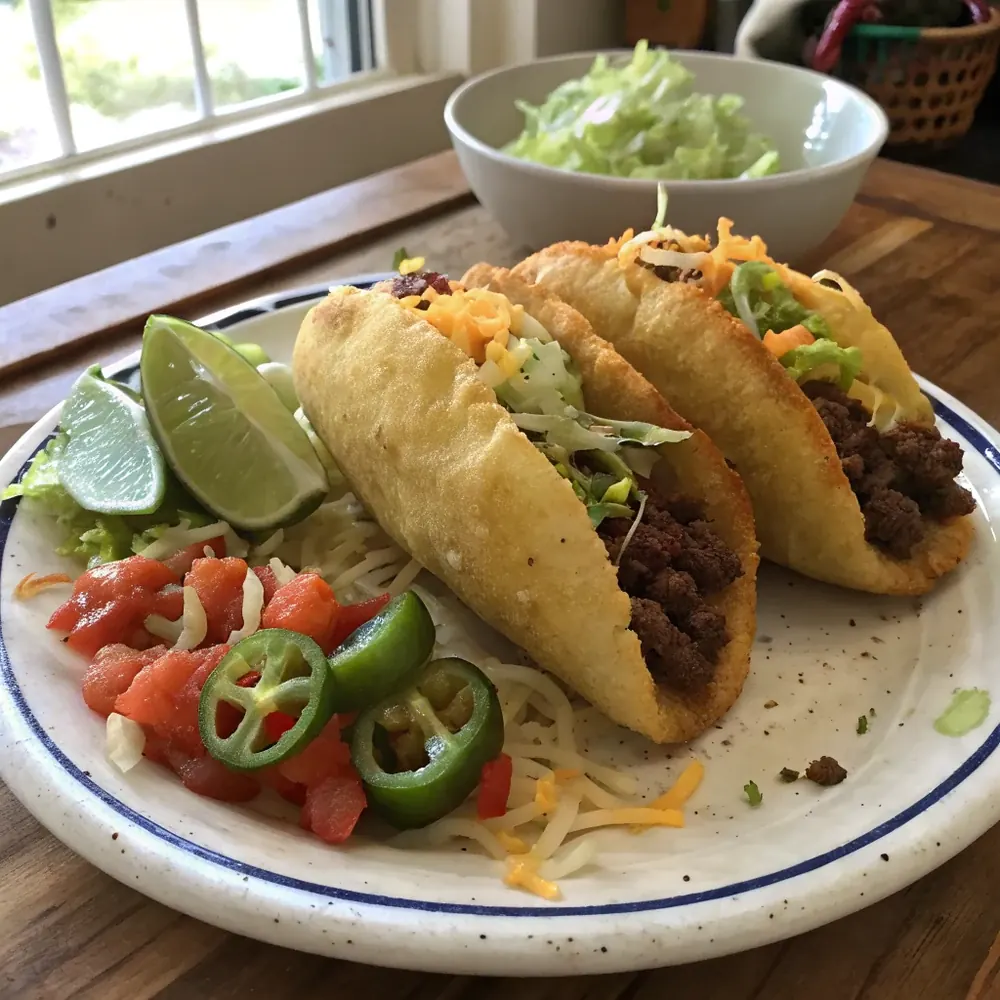
A puffy taco is made from raw masa pressed thin, dropped into hot oil, and pushed in the center so the edges puff up into a hollow boat shape. The shell is thin-crispy outside and tender-steamed inside. A Tex-Mex crispy taco is a fully cooked corn tortilla refried in oil until rigid; the shell is dry, brittle, and cracker-like throughout. The two products taste different and belong to different traditions, even though both are called tacos. Puffy is a San Antonio specialty; crispy is widespread Tex-Mex.
Where did the puffy taco originate?
The puffy taco was made famous by the Lopez family in San Antonio. Arturo "Arturo" Lopez and his wife opened Ray's Drive Inn on West Salinas Street in 1956, and Ray's is widely credited with inventing or popularizing the puffy taco on the West Side. In 1978, Henry Lopez and his wife Janie opened Henry's Puffy Tacos on Bandera Road, which became the most famous puffy taco destination in the city. Both restaurants are still open and still family-owned. Mexican Manhattan, La Tuna, and Los Barrios are other classic San Antonio spots.
Can I use store-bought tortillas instead of making the masa?
No. Puffy tacos require raw masa, not cooked tortillas. A cooked tortilla has already lost its surface moisture and will not puff when fried; it will just curl and crisp. The puff comes from steam trapped inside fresh masa as it hits the hot oil. You must make the dough with masa harina (Maseca is the standard) or buy fresh tortilla masa from a tortilleria. There is no shortcut here; this is the one Tex-Mex shell that genuinely cannot be made from store-bought.
Why didn't my puffy taco puff?
Three common reasons. First, oil temperature was wrong; below 340 degrees F the shell absorbs oil instead of puffing, above 370 the surface browns before the inside has time to steam. Use a thermometer. Second, the masa was too dry and cracked at the edges, venting the steam; the dough should feel like soft Play-Doh. Third, you forgot to press the center down with a slotted spoon as the round hit the oil; without the press, the round either inflates uniformly into a corn ball or stays flat. Press within the first 5 seconds.
Can I make puffy tacos ahead of time?
Not really. Puffy taco shells go soft within 30-60 minutes of frying as the steam from the inside softens the outside. They do not reheat well; a microwave makes them rubbery and an oven dries them out. The dish is a fry-and-eat-immediately situation. You can prep components ahead (mix and rest the masa, brown the seasoned beef, shred the lettuce and cheese) and hold the masa in the fridge for up to 1 day, but the press-fry-fold-fill-serve happens in the last 20 minutes before dinner.
Do I need a tortilla press?
Strongly recommended. You can roll masa with a rolling pin between two sheets of plastic, but the rounds will be uneven in thickness and shape, which makes them puff inconsistently in the oil. A cast iron tortilla press is $25-40 at any Mexican grocery or HEB and lasts a lifetime. It presses a perfect 5-inch round in 3 seconds. If you make tortillas, sopes, gorditas, or puffy tacos with any regularity, the press pays for itself in a month.
What oil temperature is best for frying puffy tacos?
350 to 360 degrees F (175 to 182 C), measured with an instant-read thermometer. Below 340 the shell absorbs oil and goes greasy without puffing properly. Above 370 the masa surface browns before the steam has time to inflate the shell, so you get a flat brown round instead of a puffed gold boat. Cast iron holds the temperature most steadily; thinner-walled pans see big drops each time you add a round, which kills the puff. Recover the oil to 350 between batches.