Tex-Mex Recipes
Queso Flameado
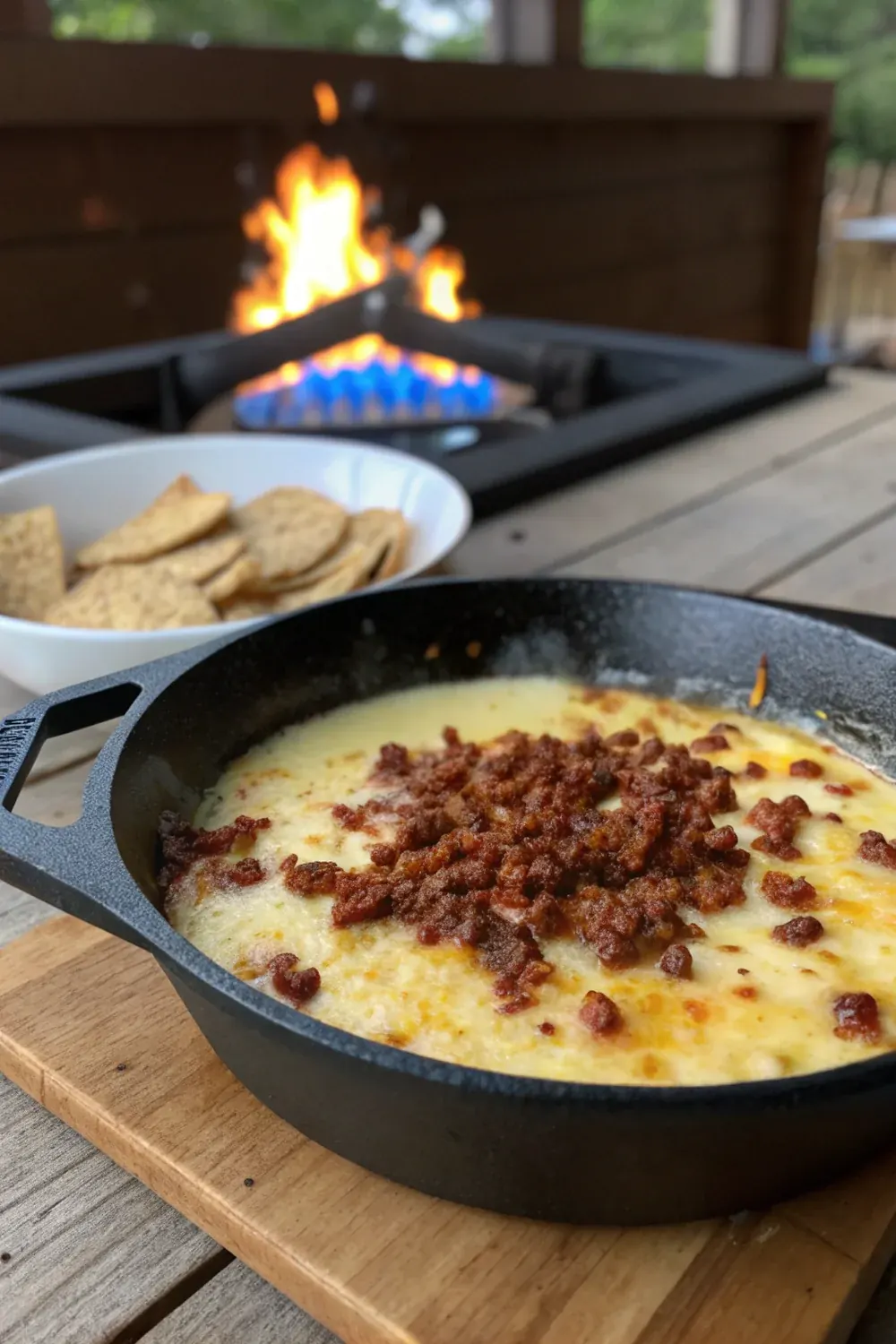
Queso flameado with melted Oaxaca cheese, Mexican chorizo, flambeed tequila. The Tex-Mex appetizer that lights up the table, in 25 minutes.
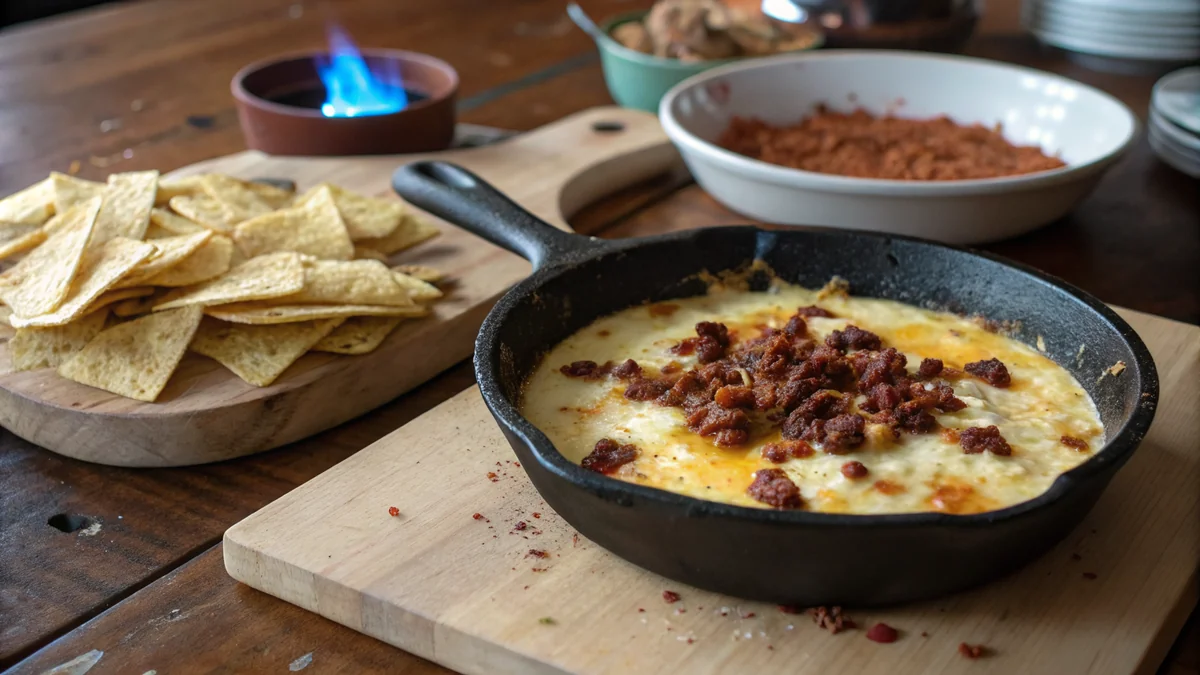
Quick answer: Queso flameado is a Tex-Mex appetizer of melted Oaxaca cheese in a cast iron skillet, topped with browned Mexican chorizo, then flambeed tableside with tequila. The cheese stays stretchy and pull-apart (Oaxaca is a string cheese, not a melting cheese in the classic sense), the chorizo adds a smoky-spicy crumble, and the tequila flambé adds a brief blue-flame caramelization layer. Serve immediately with warm flour tortillas and tortilla chips for scooping. Total time 25 minutes; the flame lasts about 30 seconds.
I had my first queso flameado at Pappasito's Cantina in Houston when I was sixteen, and the memory is mostly the moment when the waiter brought a small cast iron skillet to the table, lit it, and the whole room turned to look. Blue flame, melted cheese strings, smoky chorizo, the smell of charred tequila, and the table around us watching us eat it. Tex-Mex restaurants from Pappasito's to Lupe Tortilla to Mi Cocina have served queso flameado for decades, and every time the flame lights, the table recognizes that something special is happening.
The dish is Northern Mexican in origin - queso fundido with a tableside flambé - and Tex-Mex restaurants adapted it in the 1980s into the version most Texans now know. The Tex-Mex version uses Oaxaca string cheese (not the Spanish-style Manchego of the original), Mexican chorizo for depth and color, and tequila for the flambé. There is also queso fundido, choriqueso, queso flameado, and queso flameante - all closely related, all delicious, all Tex-Mex restaurant staples. The recipe below is the Tex-Mex Pappasito's-style version, made for the home cook with a 10-inch cast iron skillet and a pretty modest tequila collection. Total time 25 minutes from skillet-cold to flambé.
Queso Flameado vs Queso Fundido vs Choriqueso
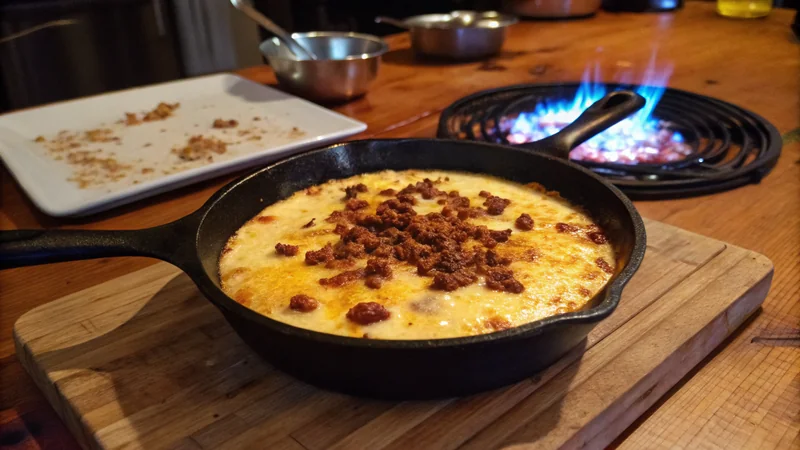
The naming is a Tex-Mex tradition that confuses even Texans. Queso fundido is the Spanish-language original: "melted cheese," usually served in a small clay or cast iron dish with chorizo or rajas (poblano strips). Queso flameado is queso fundido with a flambé - the flameado modifier specifically indicates the tableside ignition. Choriqueso is queso fundido with chorizo, no flambé. Queso flameante is a regional variant of queso flameado used in some Northern Mexican states and a handful of Tex-Mex spots.
In Tex-Mex restaurants, queso flameado is often the menu name for what is technically queso fundido or choriqueso - the flambé sometimes happens, sometimes does not, depending on the server's confidence and the kitchen's policy. At Pappasito's, the flambé is a signature service moment. At a less-theatrical Tex-Mex spot, the same dish arrives without the flame and is sometimes called queso fundido. Both are correct; the flame is a presentation choice.
None of these is chile con queso, the yellow dip of the Tex-Mex chip basket. That one is melted American cheese with green chiles and tomato, eaten with chips rather than a fork, and it has its own page: my chile con queso.
The recipe below is queso flameado proper - cheese, chorizo, and a tequila flambé. If you want to skip the flambé and serve it as choriqueso, the recipe still works (you save the tequila for a margarita). But the flame is what makes this dish a Saturday-night-restaurant moment, and at home it is unforgettable.
Mexican Origin and Tex-Mex Adaptation
Queso fundido has roots in Northern Mexico - specifically Chihuahua, Sonora, and Nuevo Leon, where cheese-making is part of the regional cuisine and ranch-style cooking has always blended cheese with cured or fresh meats. Traditional Mexican queso fundido often uses Chihuahua cheese, sometimes Manchego (Spanish-style, not Mexican), and is served in small clay cazuelas with corn tortillas.
Tex-Mex adapted the dish in the 1980s, popularized by Houston chains like Pappasito's Cantina (founded 1983) and Lupe Tortilla (founded 1983). The Tex-Mex changes: flour tortillas as the primary scoop (corn tortillas are also offered), Oaxaca cheese as the lead cheese for its distinctive pull-apart string texture, Mexican fresh chorizo standardized as the topping, a cast iron skillet replaced the small clay dish, and the tableside tequila flambé became the signature presentation.
The result is a dish that exists in two forms: the more restrained Mexican queso fundido and the more theatrical Tex-Mex queso flameado. Both are Mexican-American, both are valid, and both deserve their tortillas. The recipe above is the Tex-Mex version - the version you remember from a Pappasito's dinner.
The Cheese Trinity
The cheese choice defines the texture. Oaxaca, Monterey Jack, and Chihuahua are the canonical Tex-Mex queso flameado trinity, and each plays a different role. Oaxaca is the lead - a fresh Mexican string cheese (similar to mozzarella) with a clean, slightly tangy flavor. Crucially, Oaxaca melts into pull-apart strings rather than a smooth sauce, which is what gives queso flameado its signature stretchy, lift-with-a-chip texture.
Monterey Jack is the binder. Jack melts smoothly and creamily, which fills in the gaps between Oaxaca's strings and gives the dish its overall melted-and-cohesive look. Without Jack, the Oaxaca alone would be too stringy and the dish would look like a tangle of melted threads. Some Tex-Mex restaurants use Pepper Jack instead - the slight heat is welcome but optional.
Chihuahua is the depth cheese. Chihuahua (also called queso menonita) is a Mexican cheese with a buttery, slightly nutty flavor - similar to a young Gouda or a mild Edam. It adds richness and scoopability. If you cannot find Chihuahua, German Muenster (the white kind, not American yellow Muenster) is the closest substitute. Avoid using cheddar - it overwhelms the Oaxaca and makes the dish taste American, not Mexican.
Mexican Chorizo (Not Spanish Dry-Cured)
Mexican chorizo is the canonical topping. Mexican chorizo is a fresh, soft, uncooked sausage seasoned with chile, vinegar, garlic, and oregano. It comes in a casing or in bulk (in Texas, look for it in the meat section near other fresh sausages). When browned, it renders into a deep red-orange oil and crispy crumble that scatters across the cheese.
Spanish chorizo is a different product - cured, hard, sliced like pepperoni, seasoned with smoked paprika. It is delicious but it is the wrong product for queso flameado. Spanish chorizo would not crumble into the cheese; it would sit on top in pepperoni-style discs and the dish would taste of Spain rather than Mexico. Use Mexican fresh chorizo. Brands available in Texas: V&V Supremo, Cacique, El Mexicano, HEB Hill Country Fare, Whole Foods 365.
Brown the chorizo hard before topping the cheese. The crispy edges add textural contrast to the molten cheese, and the rendered oil is part of the flavor profile. Drain only most of the oil after browning - leave a tablespoon in the skillet to flavor the cheese melt.
Cast Iron Skillet Strategy
Use a 10-inch cast iron skillet. Cast iron is the canonical vessel for queso flameado because it holds heat for a long time after coming off the burner, which is what keeps the cheese molten through the table service. A standard nonstick skillet cools too fast and the cheese stiffens before the flambé moment. A small clay cazuela (the Mexican original) works beautifully but they are uncommon outside of Mexican restaurant supply.
If you have a smaller cast iron - 8 inch - reduce the cheese to 12 oz total and the chorizo to 6 oz. The dish scales down cleanly. A 12-inch skillet works for double the recipe; the cheese will be thinner but the flambé will be more dramatic.
Pre-warm the skillet over medium heat for 2 minutes before starting. Cold cast iron prolongs the melt and gives the cheese a chance to dry out on top before the bottom melts. A pre-warmed skillet melts evenly. After the chorizo is browned, the skillet is already hot and the cheese melts in 3-4 minutes.
The Flambé Technique
The flambé is the theater of queso flameado, and it is also where home cooks panic. The technique is simple but the moment is intense. Warm the tequila in a small saucepan over low heat for 30 seconds - just warm, not boiling. Warm alcohol vapor ignites more readily than cold alcohol. Pour the warmed tequila into a small ladle or heatproof cup that has reach (not a glass).
Use a long-reach lighter or a fireplace match. Hold the ladle slightly away from the skillet and ignite the surface of the tequila in the ladle, away from your face. The tequila will catch with a soft blue flame. Carefully pour the flaming tequila in a slow steady stream over the cheese-and-chorizo. The flame spreads across the surface in a brief blue wave for about 20-30 seconds, then goes out as the alcohol burns off.
Safety: keep your face and hair clear of the skillet. Tie back long hair before the flambé. Do not flambé under a low-clearance overhead vent or near curtains. Have a metal lid nearby to smother the flame if anything goes wrong (extremely rare but worth knowing). The amount of alcohol is small (1/4 cup) and the flame is brief; the dish is much safer than it looks.
Serving Strategy
Serve immediately. The cheese starts stiffening within 5 minutes of leaving the heat. Set the skillet on a heatproof serving tray (cast iron at 300F+ will scorch a wooden table) and bring it to the table the moment the flame goes out. Diners scoop the cheese-and-chorizo with warm flour tortillas, tortilla chips, or a combination. Both vehicles are correct.
Set out the toppings buffet-style: sliced fresh jalapeno, chopped fresh cilantro, lime wedges, pico de gallo or salsa roja, and a small bowl of sour cream if your guests like it. The Pappasito's table also includes thin-sliced raw white onion and pickled jalapenos.
Pace the eating. Queso flameado is meant to be eaten quickly while the cheese is still molten - a 6-person serving disappears in 8-10 minutes. The cheese stiffens noticeably after that. If you have stragglers, the leftover cheese can be re-warmed briefly in a 350F oven for 3-4 minutes, but the texture is never quite as good as fresh-skillet.
That same hold-and-serve logic is what makes melted cheese the single most reliable thing to bring to a tailgate, provided it rides in a small slow cooker rather than an open skillet. My Texas tailgating food roundup covers the two-cooler system behind it and the eleven other dishes that survive a parking lot.
Vegetarian Adaptation
Replace the chorizo with rajas: 2 large poblano peppers roasted, peeled, seeded, and cut into thin strips, sauteed with 1 sliced white onion in 2 tablespoons of butter for 8-10 minutes until the onions are translucent and the rajas are tender. Top the cheese with the rajas the same way you would chorizo. The result is queso fundido con rajas, a classic Mexican vegetarian variant.
Mushrooms also work as a vegetarian topping. Saute 8 oz of cremini mushrooms (sliced) in butter with a splash of soy sauce until deeply browned and slightly crispy. The umami depth replaces what the chorizo normally carries.
For a heartier vegetarian version, combine rajas with sauteed corn (1 cup of fresh or thawed-frozen corn kernels, sauteed in butter for 4 minutes until lightly browned). The rajas-and-corn combination is a Mexican classic that pairs beautifully with the melted cheese.
Chef Mia's Kitchen Notes
The first time I tried to flambé queso flameado at home, I poured the cold tequila directly into the skillet and the flame would not start. After three failed attempts and a slightly cooler skillet, I realized the trick - warm the tequila first. Now the flambé starts on the first try every time.
I keep a small bottle of cheap-but-real tequila just for flambéing. Olmeca Altos Plata, Espolon Blanco, or even a Sauza Silver work fine - the alcohol is going to burn off and the flavor is mostly heat and char. Save your good tequila (Don Julio, Casamigos, Clase Azul) for the margaritas at the table.
The single most useful tool is a long-reach lighter. The cheap kitchen-torch lighters at hardware stores are perfect - 12 inches of reach keeps your fingers and face clear of the flame. A fireplace match works but burns down faster than the flambé takes.
Mistakes to Avoid
Spanish chorizo instead of Mexican. Cured Spanish chorizo will not crumble or render properly. Use fresh Mexican chorizo from the meat section.
Cheddar instead of Oaxaca. Cheddar makes the dish taste American, not Mexican. The Oaxaca-Jack-Chihuahua trinity is essential to the canonical texture.
Cold tequila for flambé. Cold alcohol does not ignite reliably. Warm the tequila for 30 seconds first.
Stirring the cheese. Do not stir the melting cheese into a sauce. Let it melt as a single mass with the chorizo on top.
Glass or ceramic skillet. Glass cracks from the heat shock; ceramic does not hold heat long enough. Use cast iron or a small enameled cast iron.
Flambéing under a vent. A range hood with a low clearance can cause the flame to climb. Do the flambé at a clear-overhead spot, ideally tableside.
Variations
Rajas con queso. Replace chorizo with poblano strips and onion as described above. Vegetarian Mexican classic.
Mushroom queso flameado. Replace chorizo with sauteed cremini mushrooms. Earthy, vegetarian, slightly more grown-up.
Steak fajita queso. Replace chorizo with thinly sliced cooked skirt steak (from a fajita cook) and sauteed onions. The Tex-Mex restaurant variant that some menus call "queso flameado con fajita."
Shrimp queso flameado. Replace chorizo with 8 oz of sauteed shrimp seasoned with chipotle. A Gulf Coast Texas variation.
Mezcal flambé. Replace tequila with mezcal for a smokier flame and a subtle smoky note in the cheese. The smoke layer is barely detectable but adds complexity.
Smoked queso. Pair this with smoked chorizo queso for a multi-cheese-dip Tex-Mex dinner spread.
What to Serve With Queso Flameado
Queso flameado is an appetizer course, not a main. A cold bowl of restaurant-style salsa or guacamole alongside keeps the palate alive between pulls of hot cheese. Serve it before a Tex-Mex dinner of fajitas, enchiladas, or tacos. The canonical Pappasito's progression is queso flameado, then a fajita platter for the table, then a flan or tres leches dessert. Keep the queso course brief - it is a 10-minute appetizer, not a 30-minute one.
For a full Tex-Mex spread, pair the queso with beef and cheese enchiladas or poblano chicken enchiladas as the main course. Migas works as a brunch second course if you are doing a daytime Tex-Mex spread.
For drinks, classic margaritas (rocks, no salt or salt half-rim) are the canonical pairing. A Mexican lager (Modelo, Tecate, Pacifico) or a michelada also works. For a non-alcoholic option, agua fresca (jamaica, horchata, or tamarindo) is the move. For more Tex-Mex appetizers, see the Tex-Mex Recipes category.
Queso Flameado Recipe
Ingredients
- 12 oz (340 g) Oaxaca cheese, shredded or pulled into strands (about 3 cups loose)
- 4 oz (115 g) Monterey Jack cheese, shredded
- 2 oz (55 g) Chihuahua cheese (or Muenster as substitute), shredded
- 8 oz (225 g) Mexican fresh chorizo, casings removed
- 1/4 cup tequila, blanco or reposado (silver or gold)
- 2 teaspoons unsalted butter
- 1/4 teaspoon dried Mexican oregano (optional)
- Pinch of kosher salt
- For serving:
- 12 fresh flour tortillas, 6-inch (warmed)
- Tortilla chips for scooping
- Sliced fresh jalapeno
- Chopped fresh cilantro
- Lime wedges
- Pico de gallo or salsa roja
- Equipment:
- 10-inch cast iron skillet, plus a small flame-safe heatproof tray for serving
- Long-reach lighter or fireplace match (the flambé is safer with reach)
Instructions
- Brown the chorizo. Heat a 10-inch cast iron skillet over medium heat. Add the chorizo (casings removed if links) and cook for 6-8 minutes, breaking it up with a wooden spoon, until fully browned with crispy edges. The rendered orange-red oil is part of the dish - do not drain. Transfer the cooked chorizo to a small bowl, leaving about 1 tablespoon of rendered oil in the skillet.
- Wipe the skillet. Wipe the cast iron skillet with a paper towel to remove most (but not all) of the rendered chorizo oil. You want a thin film of oil for flavor and to prevent sticking, but not enough to pool. Set the skillet back over medium-low heat.
- Combine the cheeses. In a bowl, toss the shredded Oaxaca cheese, Monterey Jack, and Chihuahua (or Muenster) together until evenly mixed. The blend is what gives the dish its signature texture: Oaxaca for the stretchy pull-apart strings, Jack for the creamy melt, and Chihuahua for buttery depth and easier scooping.
- Melt the cheese in the skillet. Add the butter to the warm skillet and let it melt. Add the cheese mixture in a single layer. Sprinkle the Mexican oregano and a pinch of salt over the top. Cover the skillet with a lid or sheet pan loosely (a tent, not a seal) and let the cheese melt over medium-low heat for 3-4 minutes, until the cheese on the bottom is melted and the top is glossy. Do not stir - you want the cheese to fuse into a single melted mass, not become a liquid sauce.
- Top with the cooked chorizo. Once the cheese is fully melted, scatter the browned chorizo evenly over the surface. Do not stir it in - the chorizo should sit on top of the cheese like a topping. Pull the skillet off the heat and transfer to a heatproof serving tray on the table immediately. The cheese will stiffen as the pan cools, so timing matters.
- Warm the tequila. In a small saucepan, gently warm the tequila over low heat for 30 seconds. Do not let it boil - just warm it slightly to help it ignite. Warming alcohol vaporizes more readily, which makes the flame easier to start. Once warmed, pour the tequila into a small ladle or heatproof cup.
- Flambé tableside. Hold the small ladle of warmed tequila over the skillet. Use a long-reach lighter or fireplace match to ignite the tequila in the ladle (away from your face), then carefully pour the flaming tequila over the queso. The flame will spread across the surface in a blue wave for about 20-30 seconds, then go out as the alcohol burns off. Keep your face and hair clear - the flame can flare on the initial pour.
- Serve immediately. Once the flame goes out (it will), serve immediately while the cheese is still molten and stretchy. Set out the warm flour tortillas, tortilla chips, jalapeno slices, cilantro, lime wedges, and pico de gallo. Diners scoop with chips or fold cheese-and-chorizo into tortillas to make small tacos. The skillet stays warm for about 8-10 minutes before the cheese stiffens.
Frequently Asked Questions
What is the difference between queso flameado and queso fundido?
Queso fundido is the Spanish-language original term for "melted cheese," usually served in a small clay or cast iron dish with chorizo or rajas. Queso flameado is queso fundido with a tableside flambé using tequila or mezcal - the flameado modifier specifically indicates the ignition presentation. In Tex-Mex restaurants the names are sometimes used interchangeably depending on whether the flambé happens. The cheese, chorizo, and accompaniments are essentially the same.
What cheese is best for queso flameado?
The canonical Tex-Mex trinity is Oaxaca (for the stretchy pull-apart strings), Monterey Jack (for smooth creamy melt), and Chihuahua (for buttery depth). Oaxaca is essential and irreplaceable - it is the cheese that gives queso flameado its signature stretchy texture. If you cannot find Chihuahua, German Muenster is the closest substitute. Avoid cheddar, which makes the dish taste American.
Is queso flameado safe to make at home?
Yes, with basic precautions. The flambé uses 1/4 cup of tequila, which produces a small soft-blue flame for 20-30 seconds before burning off. Tie back long hair, keep your face clear of the skillet, do the flambé on a clear-overhead surface (not under a low range hood), and use a long-reach lighter or fireplace match. The dish is much safer than it looks; commercial kitchens flambé hundreds of times a day without incident.
Can I make queso flameado without tequila?
Yes - skip the flambé and you have queso fundido or choriqueso. The cheese-and-chorizo dish is delicious without the flame. If you want a flambé without tequila, mezcal works (smokier note), bourbon works (caramel-vanilla note), and rum works (sweeter). Avoid wine or beer - they are too low in alcohol to flambé properly.
Why does my cheese turn into oily sauce instead of stretchy strands?
Probably because you used the wrong cheese, the heat was too high, or you stirred the cheese as it melted. Use Oaxaca as the lead cheese - it is a string cheese and stays in pull-apart strands. Melt over medium-low heat, not high. Do not stir while melting; let the cheese fuse into a single melted mass with the chorizo on top. Cheddar, mozzarella, and other smooth-melting cheeses do not produce the canonical queso flameado texture.
How long does queso flameado stay molten?
About 8-10 minutes if served in a cast iron skillet on a heatproof tray. The skillet retains heat well, but the cheese does start stiffening from the moment it leaves the heat. Plan to eat the queso course quickly - it is a 10-minute appetizer, not a 30-minute one. If your guests are slow, re-warm the skillet briefly in a 350F oven for 3-4 minutes (the texture will not be quite as good as fresh).
Can I make queso flameado ahead?
Not really. The dish is built around the just-melted cheese moment, and reheating cheese is never as good as fresh. You can prep components ahead - shred the cheeses 1 day ahead and refrigerate, brown the chorizo earlier in the day, set up the toppings - but the actual melt-and-flambé must happen right before serving. Total time from start of cooking to serve is 25 minutes; that 25 minutes happens immediately before you eat.
What is Mexican chorizo and where do I find it?
Mexican chorizo is a fresh (uncooked) soft sausage seasoned with chile, vinegar, garlic, and oregano. It is sold in casings or in bulk in the meat section of any HEB, Walmart, Whole Foods, or Mexican grocery in Texas. Brands include V&V Supremo, Cacique, El Mexicano, and HEB Hill Country Fare. Do not confuse with Spanish chorizo, which is cured and sliced like pepperoni - the products are different and not interchangeable for queso flameado.