Tex-Mex Recipes
Ranch Water Cocktail
Ranch water with Topo Chico, blanco tequila, and fresh lime, served straight from the bottle. The unofficial drink of West Texas, in 2 minutes.
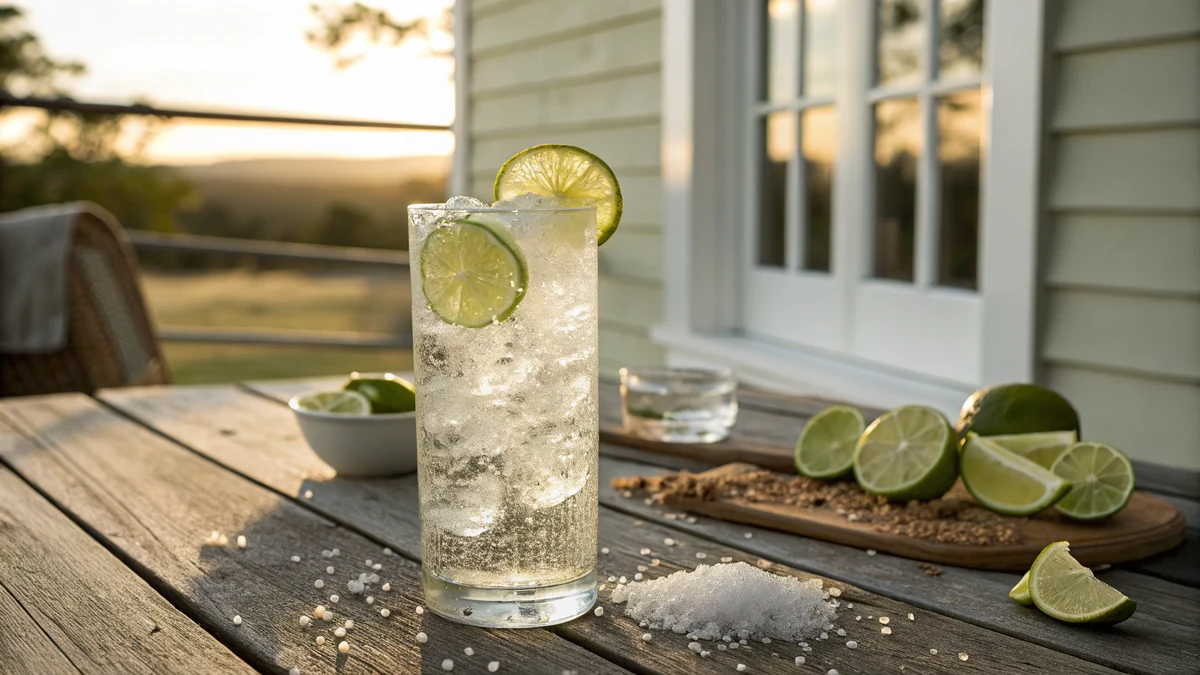
Quick answer: Ranch water is a West Texas cocktail of ice-cold Topo Chico mineral water, blanco tequila, and fresh lime juice, traditionally served by drinking directly from the Topo Chico bottle. You pour off a small sip from the top, add 1.5 oz of blanco tequila, squeeze in half a fresh lime, and drink. The high carbonation and mineral content of Topo Chico are what set it apart from any other sparkling water version. Total time 2 minutes; serves one.
I learned to make ranch water on a back porch in Marfa, in August, when the sun had finally dropped below the horizon and the air still measured ninety-eight degrees. The host pulled three cold Topo Chico bottles from a cooler full of ice, popped the caps with a bottle opener, took a sip off the top of each, then poured a shot of Espolon Blanco straight into the bottle and squeezed half a lime in after it. He handed me one. The bottle was sweating. The first sip was sharp, dry, mineral, and exactly what the heat called for. I had grown up on margaritas and palomas, but ranch water felt different, simpler, and somehow more honest about what a Texas summer cocktail should be.
Ranch water is not a fancy drink. It is three ingredients (Topo Chico, blanco tequila, fresh lime) and one ritual (drink from the bottle). The cocktail was born in West Texas ranch country, the Big Bend and Trans-Pecos region around Marfa, Alpine, Fort Davis, and Terlingua, in the 1980s, when ranch hands and small-town locals figured out that a glass-bottled Topo Chico had just enough headspace for a shot of tequila and a squeeze of lime. The bottle is the canonical glass. There is a restaurant version, served over ice in a highball, but the original is the bottle version, and that is the version I will teach you to make. Total time 2 minutes from cooler to first sip. Where ranch water sits in the wider canon, from chiltons to Mexican martinis, is mapped in my Texas cocktails guide.
West Texas Origin and Big Bend Drinking Culture
Ranch water comes from the Big Bend and Trans-Pecos region of West Texas, the dry, open country around Marfa, Alpine, Fort Davis, Terlingua, and the small ranching towns along the Rio Grande. The terrain is high desert, the summers are brutal, and the local drinking culture has always been minimal: cold beer, cheap tequila, and whatever was already in the cooler. Ranch water is a product of that landscape. The cocktail is what you drink when the temperature is over a hundred, the porch faces west, and the only thing the host has on hand is a flat of Topo Chico, a bottle of tequila, and a lime tree by the gate.
By the 1980s, the drink was a regional staple in the Trans-Pecos, served at the Starlight Theatre in Terlingua, the Paisano Hotel in Marfa, and any number of small ranch kitchens and porch gatherings. The name "ranch water" comes from the cattle ranches around Alpine and the Marathon Basin, where the cocktail was, by some accounts, the everyday hot-afternoon drink for ranch hands and owners alike. The Lost Horse Saloon in Marfa still pours them, and the Marfa Mystery Lights, visible from the viewing area east of town, are best watched with a ranch water in hand.
Topo Chico, the Mineral Water That Makes the Drink
Topo Chico is not interchangeable with any other sparkling water. The brand is bottled in Monterrey, Nuevo Leon, Mexico, from a mineral spring that has been in commercial operation since 1895. Coca-Cola acquired the brand in 2017, but the bottling source did not move, and the formulation did not change. The water has noticeably higher carbonation than LaCroix, Perrier, San Pellegrino, or Bubly, and it has a mineral content that adds a slight salinity and a subtle bitterness on the back end of every sip.
That bite is the entire reason ranch water exists. A LaCroix-and-tequila is a pleasant cooler, not a ranch water. A Perrier-and-tequila is too soft and French. A Topo Chico ranch water has the right amount of fizz to lift the tequila, the right mineral profile to tie the lime to the spirit, and enough cold-bottle gravitas to feel like a real cocktail rather than a spritzer. If you cannot find Topo Chico, the cocktail is not ranch water; it is something close, but not the same drink.
Use the glass bottle only. The 12 oz green glass Topo Chico is the canonical vessel. The aluminum can (introduced in 2020) loses carbonation faster and skips the pouring-off-the-top ritual; the plastic bottle holds bubbles and cold less well. Buy the glass-bottle six-pack at any HEB, Whole Foods, Total Wine, or Spec's in Texas.
The Canonical Bottle Preparation
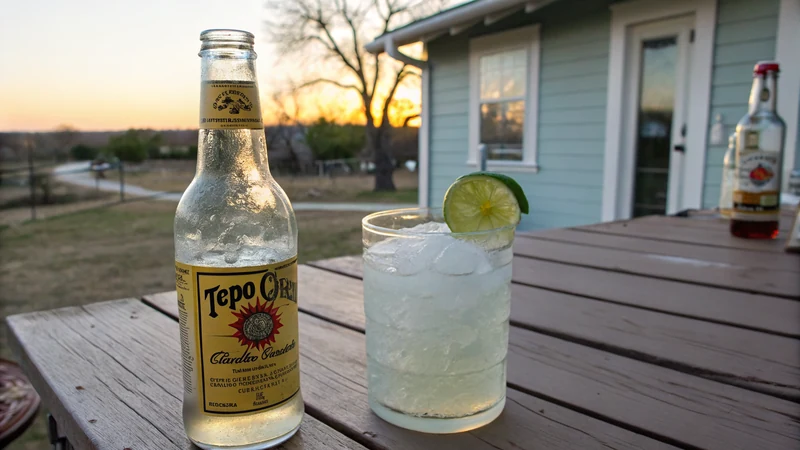
The drink-from-the-bottle preparation is the original. The technique is: open a cold Topo Chico, take one small sip off the top to create headspace, pour 1.5 oz of blanco tequila into the bottle, squeeze in half a fresh lime, and drink. No glass, no ice, no garnish. The bottle goes from cooler to hand to mouth in under two minutes.
The reason the bottle preparation works is that the 12 oz Topo Chico has just enough headspace at the top to accept a shot of tequila and a half-lime of juice without overflowing. The carbonation lifts everything together. The cold glass keeps the cocktail cold for the full 15-minute drinking window. And the bottle itself is the right size for one slow sipping session on a porch, no more, no less.
There is a long-standing debate in Texas about whether the bottle version or the glass-over-ice version is the true ranch water. The bottle version is older and is the West Texas original; the glass version is the Austin and Houston restaurant adaptation that emerged in the 1990s and 2000s. Both are correct, and most Texans drink both, but if a host hands you a Topo Chico bottle with a tequila splash and a lime in the neck, you are drinking ranch water in its purest form. For a refreshing alternative on the same Tex-Mex spectrum, try a Texas margarita.
Tequila Selection: Blanco Only, Never Reposado
Use blanco (silver, plata) tequila and only blanco. Reposado and anejo tequilas are aged in oak barrels for two months to three years; the wood adds caramel, vanilla, and oak notes that taste delicious neat but fight the clean mineral profile of Topo Chico. A reposado ranch water tastes muddled, like someone added a splash of bourbon to a sparkling water. The drink wants the bright agave punch of a fresh blanco, nothing more.
Within blanco, the canonical Texas-bar tequilas are Espolon Blanco (the budget classic, around $25, 100% agave), Casamigos Blanco (the standard at most Texas restaurants, around $50), El Tesoro Blanco (the connoisseur's tahona-stone choice, around $60), and Don Julio Blanco (the smooth crowd-pleaser, around $50). Hornitos Plata is the under-$20 workhorse. Avoid mixto tequilas (anything labeled "tequila" without "100% agave"); they have added sugars and produce harsh hangovers.
Pour 1.5 oz per bottle. That ratio gives the cocktail roughly 6.5% ABV, similar to a beer, and it is the West Texas standard. Pouring 2 oz makes it stronger; pouring 1 oz makes it a spritzer. Use a jigger if your hand is not steady; ranch water is a four-ingredient drink, and every ingredient has to land.
Fresh Lime, One Whole Lime Per Bottle
Use a fresh lime and squeeze it by hand. The half-lime per bottle ratio (about 0.5 oz of fresh juice) is the West Texas standard, and the juice has to be fresh. Bottled lime juice (Rose's lime cordial, ReaLime, Nellie and Joe's) tastes preserved and slightly bitter; it ruins the cocktail. Fresh limes from HEB, Central Market, Sprouts, or any decent grocery store are cheap (around 50 cents apiece) and worth every penny.
Roll the lime on the counter with the heel of your hand before cutting; the rolling breaks cell walls and releases more juice. Cut lengthwise (top to bottom, not equator), and squeeze each half over the bottle, catching seeds with your free hand. A small handheld Mexican-style metal squeezer (yellow and green, about $12) makes the job easier.
Persian limes are the standard. Key limes (the small Mexican bartender limes) are sharper and slightly more aromatic and work beautifully if you can find them. For a comparison of tequila-and-lime drinks, see the Texas margarita recipe.
The Disputed Ranch 616 Attribution
Some sources credit ranch water to Ranch 616, an Austin restaurant founded by Kevin Williamson in 1996 on Nueces Street downtown. Ranch 616 has served ranch water since opening day, and the restaurant has been a champion of the cocktail in Austin for nearly thirty years. The menu lists it, the bartenders evangelize it, and Williamson has talked about ranch water in interviews as a Texas signature drink.
But the historical record is clearer than the attribution suggests. Ranch water was part of West Texas drinking culture by the early 1980s, more than a decade before Ranch 616 opened. The Big Bend and Trans-Pecos region had its own version on porches and at small bars, and the Hotel Paisano and Starlight Theatre were pouring tequila-and-Topo Chico cocktails before Ranch 616 was a glimmer. The Ranch 616 contribution was popularizing the drink in Austin, not inventing it.
The cleaner story: ranch water is a regional folk cocktail from West Texas ranch country, given a restaurant menu by Ranch 616 in the late 1990s, and broadly popularized by Texas Monthly and Eater Texas in the 2010s. Both the West Texas origin and the Austin adoption are real; the cocktail belongs to a region first and a restaurant second.
Ranch Water vs Paloma vs Margarita
Ranch water, paloma, and margarita are the three canonical tequila-citrus highballs of Texas, and they are different drinks despite sharing ingredients. Margarita is tequila, lime, and orange liqueur (Cointreau or triple sec), shaken with ice and strained over ice or up. The orange liqueur and the lime juice are the dominant flavors; the tequila is the base but it is balanced by sweetness. Margaritas can be salted or unsalted, on the rocks or frozen.
Paloma is tequila, fresh lime, and grapefruit soda (Squirt, Jarritos Toronja, or fresh grapefruit juice with sparkling water), served over ice in a salted highball. The grapefruit is the dominant flavor; the lime adds acidity, the tequila is the base. Paloma has a slight bitterness from the grapefruit pith and a mild sweetness from the soda. It is the most popular cocktail in Mexico and a staple of Tex-Mex restaurants in Texas.
Ranch water is tequila, fresh lime, and Topo Chico mineral water, served from the bottle or over ice in a highball. There is no sweetener, no liqueur, no fruit other than lime. The mineral water is the dominant character; the lime brightens, the tequila grounds. Ranch water is the driest of the three and the most minimal; if margaritas are dessert and palomas are summer, ranch water is the porch at sunset. For the brunch-friendly option, a michelada covers similar territory with beer instead of tequila.
The Brand Cocktail Evolution: Lone River and Beyond
In 2019, an Austin-based entrepreneur named Katie Beal Brown launched Lone River Ranch Water, a canned ready-to-drink version of the cocktail made with blanco tequila, lime, and sparkling water. The product hit shelves at HEB and Whole Foods Texas in 2020, became a regional hit, and was acquired by Diageo in 2021 for an undisclosed sum, generally rumored to be in the nine figures. The Lone River cans helped push ranch water from a regional Texas cocktail to a national category.
Other brands followed. Topo Chico itself launched Topo Chico Hard Seltzer Ranch Water in 2021, and Cutwater, White Claw, and smaller producers added ranch water variants to their canned cocktail lines. By 2024, ranch water was a recognizable category in any HEB, Spec's, or Total Wine in Texas. The canned versions are decent ready-to-drink seltzers, but they are not the real cocktail. Real ranch water requires a cold Topo Chico, a fresh lime, and a bottle of blanco tequila, assembled in two minutes on a porch. The five-second can pour is a different drink, no matter what the label says.
Kitchen Notes from My Marfa Porch
The temperature of the Topo Chico matters more than the brand of tequila. I have made ranch water with $20 Hornitos and with $80 El Tesoro Anejo (yes, I know, I broke my own rule), and the warm-Topo Chico version of the cheap tequila tasted worse than the cold-Topo Chico version of either. Chill the bottles for at least four hours, or pack them in ice for thirty minutes. Cold is the fundamental.
Buy a case if you are hosting. A six-pack disappears in about an hour with three or four people on a porch. HEB sells the 24-pack of glass bottles for around $25, which is the right move for any gathering bigger than two people. Keep them in a cooler with crushed ice, not the refrigerator; the cooler stays at thirty-five degrees and the fridge at thirty-eight, and the four-degree difference shows up in the carbonation.
I keep a wooden cutting board, a paring knife, and a Mexican citrus squeezer on the porch when I am hosting. Each guest assembles their own; the ritual is part of the appeal. Set out a bowl of fresh limes, a jigger, the tequila bottle, and the bottle opener, and let people build.
Mistakes to Avoid
LaCroix or any other sparkling water. Topo Chico has higher carbonation and a mineral profile no other brand matches. A LaCroix-and-tequila is a fine cooler, not a ranch water.
Bottled lime juice. Rose's, ReaLime, and any preserved citrus juice taste dull and slightly bitter. Use fresh limes only; the cocktail is built around fresh-squeezed citrus.
Reposado or anejo tequila. The oak aging adds caramel and vanilla notes that fight the mineral water. Use blanco only; the cocktail wants the clean agave punch, not wood notes.
Adding sugar, simple syrup, or agave nectar. Ranch water is a dry cocktail. The sweetness in the canned versions is the corporate adaptation, not the original. Skip the sweetener.
Warm Topo Chico. A warm bottle loses carbonation the second the cap pops off. Chill for at least four hours or ice for thirty minutes.
Plastic-bottle Topo Chico. The plastic bottle holds carbonation less well than the glass and does not have the same ritual. Use the green glass 12 oz bottle.
Garnishing with anything other than a lime wedge. No mint, no jalapeno spear (in the standard version), no cucumber. Ranch water is minimal; do not pretty it up.
Variations
Spicy ranch water. Add 2-3 thin slices of fresh jalapeno to the bottle along with the tequila and lime. The jalapeno infuses for the duration of the drinking window and adds a slow build of heat. A West Texas favorite, especially with BBQ.
Strawberry ranch water. Muddle 2 fresh strawberries in the bottom of a highball glass, then build the cocktail over ice. The strawberry adds a touch of natural sweetness and turns the drink pink. A summer-party twist, popular in Austin.
Mezcal ranch water. Replace the blanco tequila with mezcal (Del Maguey Vida is the standard) for a smoky, mineral-forward version. The smoke pairs beautifully with the Topo Chico minerality. Best on a cool fall evening rather than a hot afternoon.
Grapefruit ranch water (the paloma-ranch hybrid). Add a 1 oz splash of fresh grapefruit juice to the bottle. Slightly sweeter, slightly bitter, halfway to a paloma but still in ranch water territory.
Ranchita. A smaller-format ranch water served in a 7 oz mini Topo Chico bottle, with 1 oz of tequila instead of 1.5. A casual sipper for the second round when you do not need a full 12 oz pour.
Pair with a Tex-Mex appetizer. Serve ranch water alongside queso flameado for a backyard Tex-Mex spread that hits every Texas note.
What to Pair With Ranch Water
Ranch water is a porch cocktail, a hot-afternoon cocktail, and a Tex-Mex sidekick. The drink is dry, mineral, and bright, which means it pairs beautifully with rich, smoky, or spicy food. Pair it with brisket from a Central Texas BBQ joint (Franklin Barbecue in Austin, Snow's BBQ in Lexington, or any backyard smoker), pulled pork sandwiches, smoked sausage, or a plate of beef ribs. The mineral water cuts through the richness; the lime brightens the smoke.
For Tex-Mex, ranch water alongside fajitas, tacos al pastor, or enchiladas is a Texas-summer lineup no margarita can match. The drink is lower-sweet and more refreshing, so you can drink two or three over a Tex-Mex dinner without sugar fatigue. Pappasito's, Lupe Tortilla, and Mi Cocina all serve it.
For non-food pairings: a hot afternoon, a shaded porch, a cooler of ice, and good company. The Texas Monthly food section has run origin-story features on the cocktail and the Big Bend region, worth the read with a ranch water in hand. For more Texan drinks, see the full Texan Recipes collection.
Ranch Water Cocktail Recipe
Ingredients
- For one bottle of ranch water:
- 1 bottle (12 oz / 355 ml) Topo Chico mineral water, ice cold (glass bottle only)
- 1.5 oz (45 ml) blanco tequila (Espolon, Casamigos Blanco, El Tesoro Blanco, Hornitos Plata, or Don Julio Blanco)
- 1/2 fresh lime, juiced (about 0.5 oz / 15 ml of fresh juice)
- 1 lime wedge for the bottle neck (optional)
- For salt rim (optional, restaurant style only):
- 1 tablespoon kosher salt or flaky sea salt
- 1 lime wedge to wet the rim
- 1 small plate to hold the salt
- Equipment:
- Bottle opener
- Citrus juicer or hand-squeeze technique
- Cooler with ice, or a refrigerator set to its coldest setting
- Highball glass and ice (only if making the restaurant glass version)
Instructions
- Chill the Topo Chico. The Topo Chico must be ice cold. Refrigerate the bottles for at least 4 hours before serving, or bury them in a cooler full of ice for 30 minutes. A cold Topo Chico holds its carbonation better, the bottle does not foam over when you add the tequila, and the drink tastes sharper and cleaner. A warm Topo Chico will lose carbonation the second the cap pops off, and the cocktail goes flat. This step is non-negotiable.
- Juice the lime fresh. Cut a fresh lime in half and juice it by hand or with a small citrus juicer. You need about 0.5 oz of juice per bottle, which is half of one medium lime. Do not use bottled lime juice (Rose's, ReaLime, or any preserved citrus); the flavor is dull, slightly bitter, and tastes preserved. Fresh-squeezed lime is the entire reason this drink works. Juice the lime just before assembling the cocktail so the juice is bright.
- Optional salt rim (glass version only). If you are making the restaurant glass-and-ice version and want a salt rim, run a lime wedge around the rim of a highball glass to wet it, then dip the rim in a small plate of kosher or flaky sea salt to coat. The bottle version does not get a salt rim; you cannot rim a bottle. Most West Texas drinkers skip the salt entirely and let the lime carry the brightness. The salt rim is a Houston-and-Dallas restaurant touch, not a Marfa one.
- Pop the cap and pour off the top sip. Use a bottle opener to pop the cap off the cold Topo Chico. Take one small sip directly from the bottle (about 1 oz worth) to make room for the tequila and lime. This is the canonical move. Some Texans pour the sip into a small glass instead of drinking it; either way, you need to create headspace in the bottle. Without that headspace, the bottle will foam over the second you add the tequila.
- Add the blanco tequila. Pour 1.5 oz of blanco tequila directly into the Topo Chico bottle. Use a jigger if you want precision, or free-pour if you have practiced (a slow three-count from a regular bottle is roughly 1.5 oz). Blanco only, never reposado or anejo; the wood-aged versions add caramel and oak notes that fight the mineral water. Espolon Blanco, Casamigos Blanco, and El Tesoro Blanco are the canonical Texas-bar choices. Hornitos Plata is the budget classic.
- Squeeze in the fresh lime. Squeeze the juice from half a fresh lime directly into the bottle, about 0.5 oz of juice. Catch any seeds in your free hand or strain through a small mesh strainer. The lime juice is what brightens the cocktail and ties the tequila to the mineral water. If you prefer a sharper drink, squeeze the whole lime; if you prefer it softer, use a quarter. Half a lime is the West Texas standard.
- Optional pinch of salt in the bottle. Some West Texas drinkers add a small pinch of kosher salt to the bottle, paloma-style. The salt amplifies the mineral profile and rounds out the lime acidity. Optional, mostly a Big Bend touch; Austin and Houston versions skip it. If you add salt, use a tiny pinch (about 1/16 teaspoon), no more, or the cocktail goes briny.
- Serve from the bottle. Replace the cap loosely if you need to (or wedge a lime in the bottle neck to keep bugs out on a porch), and drink directly from the bottle. The cocktail is meant to be sipped slowly while it is still cold and carbonated. A 12 oz Topo Chico bottle of ranch water lasts about 15 minutes on a hot porch. Do not stir or shake; the carbonation does the work. If you want the over-ice version, pour the contents over crushed ice in a salt-rimmed highball glass with a lime wedge.
Frequently Asked Questions
What is ranch water and where did it originate?
Ranch water is a West Texas cocktail of ice-cold Topo Chico mineral water, blanco tequila, and fresh lime juice, traditionally served by drinking directly from the Topo Chico bottle. The drink originated in the Big Bend and Trans-Pecos region of West Texas (around Marfa, Alpine, Fort Davis, and Terlingua) in the 1980s as a porch cocktail for ranch hands and locals. Ranch 616 in Austin, founded in 1996, popularized the drink in central Texas and is sometimes credited with its invention, but the cocktail predates the restaurant by more than a decade.
Why does ranch water specifically need Topo Chico?
Topo Chico, bottled in Monterrey, Mexico, has noticeably higher carbonation than LaCroix, Perrier, San Pellegrino, or any other sparkling water on the market, plus a distinctive mineral profile that adds slight salinity and back-end bitterness. That bite is the entire reason ranch water exists; it lifts the tequila and ties the lime to the spirit. A LaCroix-and-tequila is a pleasant cooler but it is not ranch water. Use the 12 oz green glass bottle; the can and plastic bottle versions hold carbonation less well.
Can I use reposado or anejo tequila in ranch water?
No. Ranch water requires blanco (silver, plata) tequila only. Reposado and anejo tequilas are aged in oak barrels and pick up caramel, vanilla, and wood notes that fight the clean mineral profile of Topo Chico. A reposado ranch water tastes muddled, like someone added bourbon to sparkling water. Use Espolon Blanco, Casamigos Blanco, El Tesoro Blanco, Don Julio Blanco, or Hornitos Plata; any 100% agave blanco tequila works. Avoid mixto tequilas (not labeled 100% agave); they have added sugars.
Is ranch water served in the bottle or in a glass?
Both, but the bottle preparation is the original West Texas method and the glass-and-ice version is the restaurant adaptation. The bottle version: pop a cold Topo Chico, take one sip off the top to make headspace, add 1.5 oz of blanco tequila, squeeze in half a lime, drink from the bottle. The glass version: pour the assembled cocktail over crushed ice in a highball glass with an optional salt rim and a lime wedge. If a host hands you a Topo Chico bottle with a lime in the neck, you are drinking the original.
How is ranch water different from a paloma or margarita?
Ranch water is dry, minimal, and mineral-forward: tequila, fresh lime, and Topo Chico, no sweetener. A paloma is tequila, fresh lime, and grapefruit soda (Squirt or Jarritos Toronja), served over ice with salt; the grapefruit dominates and adds slight bitterness and sweetness. A margarita is tequila, lime, and orange liqueur (Cointreau or triple sec), shaken and served over ice or up; the orange liqueur adds noticeable sweetness. Ranch water is the driest of the three and the most porch-appropriate for a hot Texas afternoon.
What is Lone River Ranch Water and is it the real thing?
Lone River Ranch Water is a canned ready-to-drink hard seltzer launched in Austin in 2019 by Katie Beal Brown and acquired by Diageo in 2021. The product is made with blanco tequila, lime, and sparkling water and helped push ranch water into the national canned cocktail category. It is a decent ready-to-drink option, but it is not the same as the real cocktail. Real ranch water is a cold Topo Chico, fresh lime, and a pour of blanco tequila, assembled in two minutes; the canned version cannot replicate the carbonation, mineral profile, or fresh-lime brightness.
How strong is one ranch water?
About 6.5% ABV, similar to a strong beer. The math: 1.5 oz of 80-proof (40% ABV) blanco tequila is 0.6 oz of pure alcohol, mixed into a 12 oz Topo Chico bottle (less the small sip you pour off the top), plus 0.5 oz of lime juice. Final drink is roughly 12 oz at 6.5% ABV. That makes ranch water a session cocktail; you can have two or three over an afternoon without the sugar load of a margarita. Pace yourself in summer heat, and drink water alongside; the mineral water is not the same as a hydration glass.