Texas Desserts
Texas Chocolate Sheet Cake
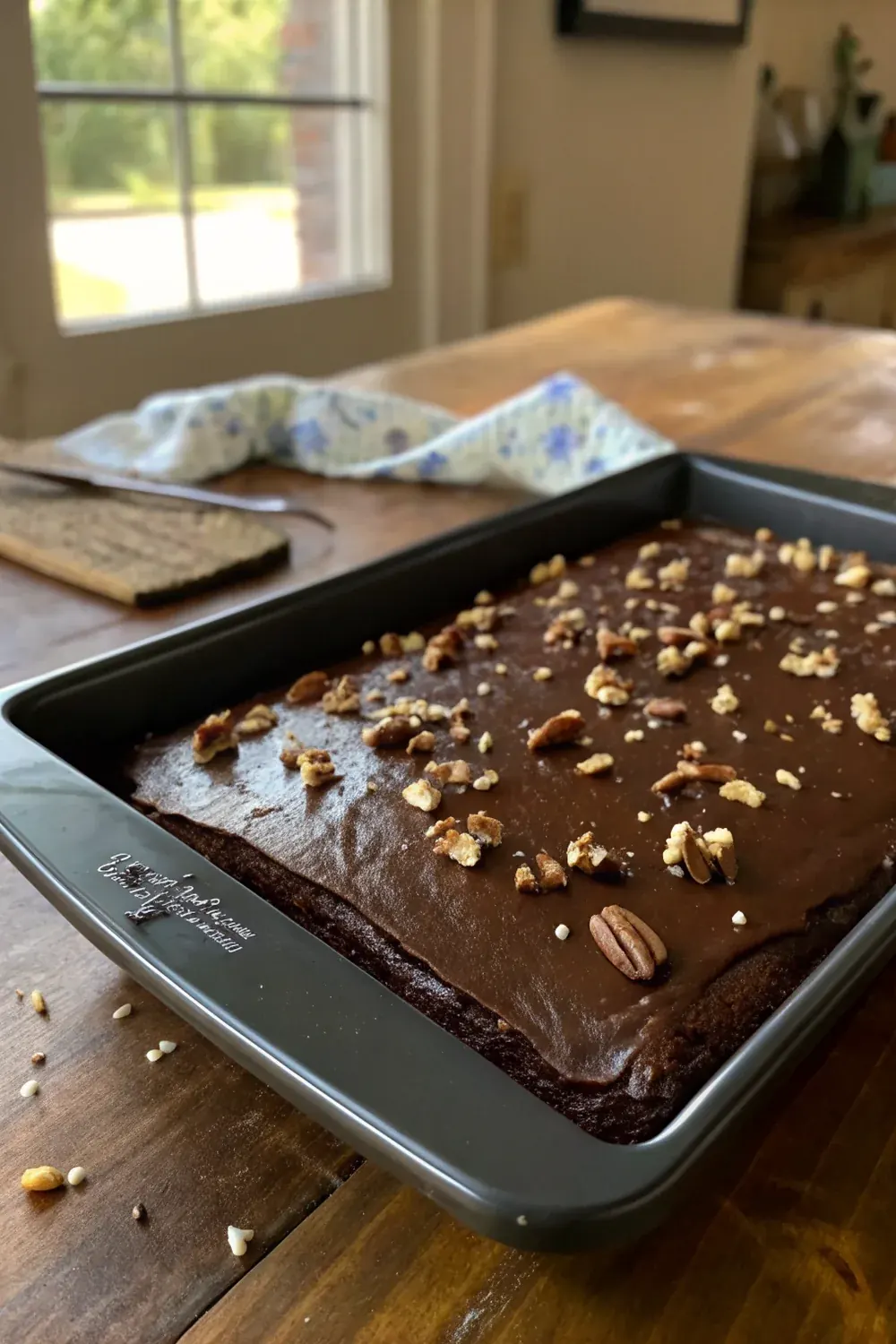
Texas chocolate sheet cake with pecan-buttermilk frosting poured on warm. The Hill Country dessert that wins every potluck, in 45 minutes.
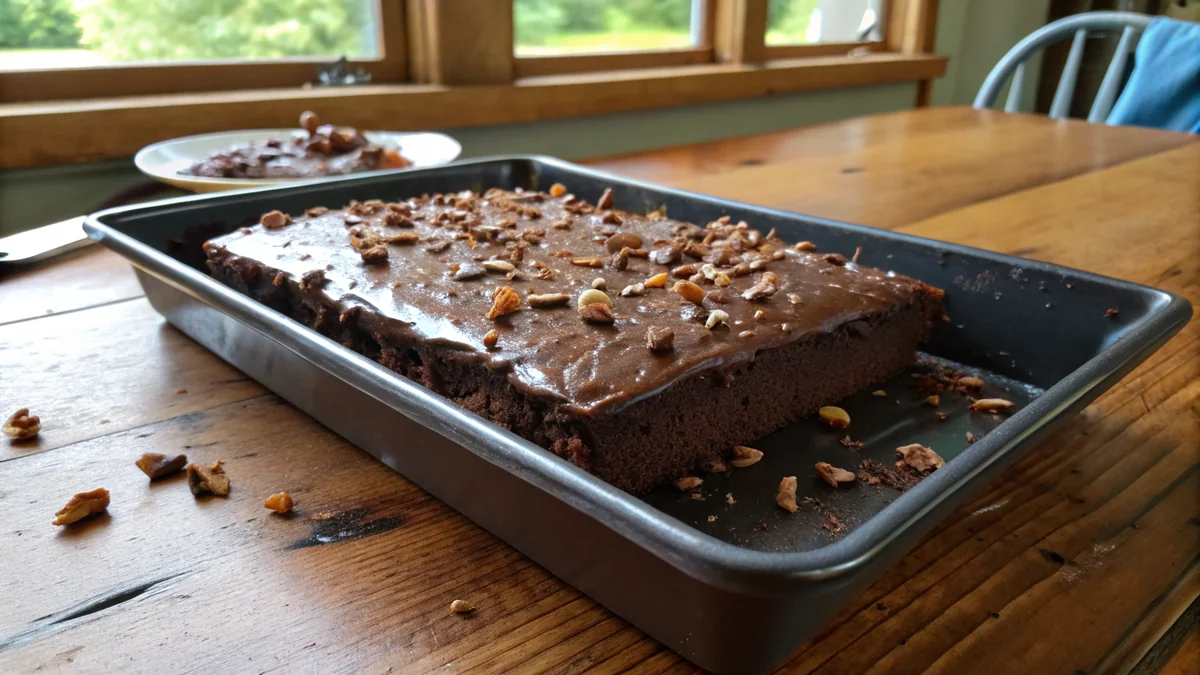
Quick answer: Texas chocolate sheet cake is a thin, fudgy 9x13 cake built on the boiled cocoa method - butter, water, and cocoa simmered together, then whisked into flour, sugar, eggs, and buttermilk. Bake at 350F for 22-25 minutes. While it is still warm, pour over a hot pecan-buttermilk frosting that soaks in, glazes the top, and sets into a cocoa-glossy finish dotted with chopped San Saba pecans. The whole thing comes together in 45 minutes and feeds 24 from a single pan.
I grew up watching my mother carry a 9x13 pan of chocolate sheet cake into Hill Country potlucks, and the first thing that happened, every single time, was that the foil came off, somebody let out a little sound, and the line formed. Sheet cake is the great equalizer of Texas desserts. It does not look like a wedding cake. It does not need a stand or a dome or a turntable. It is a flat, fudgy, pecan-glossed slab that fits in any oven, slices into 24 generous squares, and tastes better the second day if there is any left, which there usually is not.
The version below is the one my mother taught me, with two small changes I made over the years: I lean Texas-Texas with San Saba pecans in the frosting, and I push the buttermilk a little harder than Pioneer Woman's iconic version because the slight tang is what keeps the chocolate from tasting one-note. The boiled cocoa method is non-negotiable - it is what gives the cake its dense, almost-fudgy crumb and what lets the warm frosting fuse to the surface in that signature glossy way. Forty-five minutes start to slice, and you will understand why this cake wins every potluck. If you want the frosting technique in full detail, my Texas sheet cake frosting deep-dive isolates the warm-pour method, and the peanut butter Texas sheet cake is what happens when that same frosting trades cocoa for peanut butter.
Why Sheet Cake (and Why Texas)
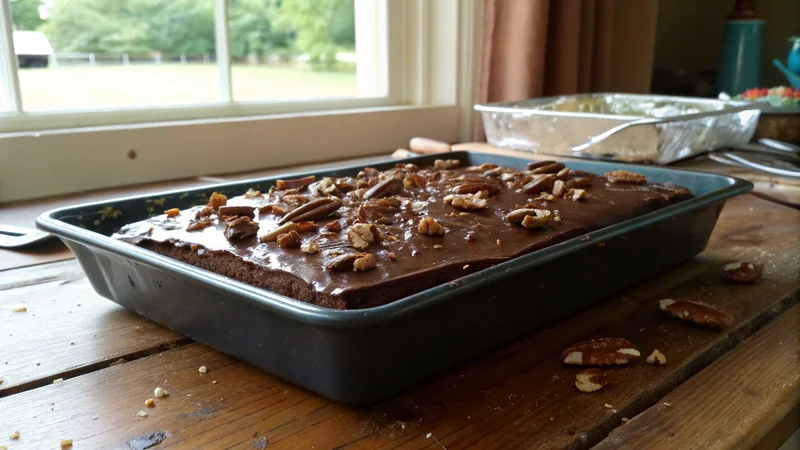
Sheet cake is what Texas brings to the dessert table when there is a crowd to feed and not a lot of time to do it. A 9x13 pan slices into 24 generous squares, fits in any standard oven, transports clean under foil, and tastes even better the second day. There is no decoration argument, no layer collapse, no fondant, no piping bag. It is the great equalizer of Texas desserts: the schoolteacher and the rancher and the church potluck president all bring sheet cake to the table, and nobody outclasses anybody.
The Texas variant of sheet cake has a recognizable signature even before you taste it. The crumb is denser than a layer cake, almost fudge-like, because of the boiled cocoa method that hydrates the cocoa with hot butter and water before it ever meets the flour. The frosting is poured on warm, not spread cold, which is why the surface looks glossy and the top edge of every slice gets a slight chocolate halo. And the pecans on top are non-negotiable in Texas; San Saba pecans are the canonical choice because Texas grows the largest pecan crop in the country.
If you have only had a Pioneer Woman version, this recipe will feel familiar - she popularized the 9x13 chocolate sheet cake to a national audience in the early 2010s. The base method is the same. What changes here is the buttermilk push (more tang, less syrupy sweet), the salt level in the frosting (a real pinch, not a token), and the pecan ratio (closer to a full cup so every slice has texture). It is the version I have brought to potlucks for fifteen years and the version that gets the empty pan back every time.
The Boiled Cocoa Method
The boiled cocoa method is the structural secret of Texas sheet cake. Most cake recipes whisk cocoa into the dry ingredients and call it good. Texas sheet cake melts the butter, water, and cocoa together in a saucepan and brings them to a rolling boil before they ever meet the flour. That short boil does three things: it blooms the cocoa flavor, it dissolves the cocoa solids smoothly so there are no chalky pockets, and it pre-gelatinizes some of the starch when the hot liquid hits the flour, which is what gives the crumb its fudgy density.
Bring the cocoa mixture to a true rolling boil, not just a simmer. You should see steady bubbles breaking across the whole pan surface for about 30 seconds. Whisk constantly while it heats - cocoa powder is hydrophobic and will stick to the bottom and scorch if you walk away. Pull from heat the moment it boils. Boiling longer cooks off too much water and shifts your batter ratio, which produces a drier cake.
Pour the boiling cocoa mixture directly onto the dry ingredients while it is still steaming. The temperature differential is what makes the method work. If you let the cocoa mixture cool first, you lose the bloom and the gelatinization advantage, and the cake comes out closer to a standard chocolate cake - good but not Texas.
Cocoa Powder: Natural vs Dutch-Process
Texas sheet cake recipes traditionally use natural unsweetened cocoa powder - the Hershey's regular tin most American kitchens have on hand. Natural cocoa is acidic, which reacts with the baking soda in the recipe to give the cake some lift and a slight chocolate-bitter edge that pairs with the buttermilk tang. The flavor is forward and bright, not muted.
Dutch-process cocoa (alkalized cocoa) is darker, smoother, and less acidic. It produces a deeper chocolate color and a rounder, more chocolate-fudge flavor, but because it is not acidic, it does not react with the baking soda the same way. If you swap to all Dutch-process, replace the baking soda with 1.5 teaspoons of baking powder to maintain the lift. I use a 50/50 blend of natural and Dutch-process when I want a darker, more sophisticated cake without losing the buttermilk tang interaction.
Avoid hot cocoa mix or sweetened cocoa - those have added sugar, milk solids, or stabilizers that throw off the recipe. Buy single-ingredient cocoa powder. Hershey's, Ghirardelli, Guittard Cocoa Rouge, and Valrhona are all reliable; the difference between the cheapest and the most expensive is real but small for a sheet cake context.
The Buttermilk Tang Differentiator
Buttermilk does two jobs in this cake. First, it adds the slight tang that keeps the chocolate from tasting one-note - the same role buttermilk plays in red velvet cake and in buttermilk pie. Without it, sheet cake reads as sugar-and-cocoa flat. Second, the buttermilk acid reacts with the baking soda to provide most of the leavening, which is why this recipe uses no baking powder.
Use full-fat real buttermilk, not low-fat, and shake the carton hard before measuring. The fat carries flavor and tenderizes the crumb; low-fat buttermilk produces a slightly grainier texture. If you cannot find buttermilk, the standard substitute is 1 tablespoon of white vinegar or lemon juice stirred into 1 cup of whole milk and rested 5 minutes. The substitute works but the cake reads slightly less complex; real buttermilk is worth the trip.
I push the buttermilk a little harder than the classic Pioneer Woman version - 1/2 cup in the cake plus 6 tablespoons in the frosting, versus the more common 1/2 cup total. The extra buttermilk in the frosting deepens the tang and helps the frosting set with a glossier finish. If you find the frosting too soft after the standard 60-minute set, you may have used too much buttermilk; the next batch reduce to 5 tablespoons.
The Pecan-Buttermilk Frosting
The frosting is the signature of a Texas sheet cake. It is not a buttercream and not a ganache; it is a one-step poured frosting that combines hot melted butter, cocoa, and buttermilk with sifted powdered sugar and pecans. The texture is somewhere between a chocolate glaze and a fudge frosting - thin enough to pour and self-level, thick enough to set into a glossy slab as it cools.
Make the frosting in the last 5 minutes of the cake's bake time so it stays warm and pourable. If you make it too early, it cools and sets in the saucepan, and re-warming it changes the texture. If you make it too late, the cake will have started cooling and the frosting will not soak into the top crust the way Texas sheet cake demands.
Sift the powdered sugar before adding it to the saucepan. Powdered sugar lumps - and there is no recovering a lumpy frosting on a sheet cake. Sifting takes 90 seconds and is the difference between a glassy surface and a frosting with visible white speckles. Stir in the pecans last, off heat, so they do not turn soft and lose their crunch in the warm sugar.
Choosing the Pecans
San Saba, Texas, calls itself the Pecan Capital of the World, and the claim has more weight than most regional brags. The Hill Country soil, climate, and 150-year-old pecan groves produce a richer, oilier nut than the typical grocery-store pecan. If you can find San Saba pecans (some Texas H-E-B stores carry them in the fall, or order direct from a Hill Country farm), they make a noticeable difference in this frosting.
If you cannot find Texas pecans, Georgia is the next best thing - Georgia produces more pecans by volume than any state, and the quality is consistently high. Look for fresh-crop pecans from October through February. Older pecans go rancid because of their high oil content; if a pecan tastes bitter or sour, it has turned and the whole batch is suspect.
Chop the pecans coarsely with a chef's knife, not in a food processor. The processor pulverizes some pecans to dust while leaving others whole, and the dust dissolves into the frosting and dulls the texture. Hand-chopped pieces about the size of a dried lentil hold their texture and crunch through the cooled frosting.
9x13 Pan vs Half Sheet Pan
Texas sheet cake is named for the sheet pan format, but the canonical pan is actually a 9x13-inch baking pan, not a half sheet pan. A 9x13 holds about 14 cups of volume; a half sheet pan (18x13) holds closer to 21 cups. This recipe is built for a 9x13 - if you pour it into a half sheet pan, the batter will spread thin and bake in 12-15 minutes instead of 22-25, with a much thinner crumb.
Some Texas family recipes do scale up for a half sheet (the so-called "jelly roll pan size") and that produces the very thin, almost brownie-like sheet cake some people grew up on. Both styles are valid Texas; the 9x13 version has a denser fudge crumb and the half sheet version has more frosting-to-cake ratio. The recipe below is the 9x13 version, which is what most modern Texas potluck cooks bring to the table.
Use a metal pan, not glass or ceramic. Metal conducts heat faster and produces crisper edges and a flatter top. Glass holds heat after the bake ends and continues cooking from the residual heat, which can over-bake the corners. If you only have glass, drop the oven temp to 325F and check at 22 minutes.
Mixing the Batter
Order of operations matters. Whisk the dry ingredients first - flour, sugar, salt, baking soda - until they are evenly distributed. Then pour the boiling cocoa-butter-water mixture directly onto the dry ingredients and whisk until smooth. The hot liquid hydrates the cocoa and starts the gluten development. The batter should be smooth, glossy, and ribbon off the whisk in a steady stream.
Add the buttermilk, beaten eggs, and vanilla last, when the cocoa-flour mixture has cooled briefly (1-2 minutes is enough). Adding eggs to a still-boiling mixture will scramble them. Whisk just until everything is incorporated - about 20 seconds. Overmixing develops too much gluten and turns the cake from fudgy to chewy.
The finished batter is much thinner than a typical layer cake batter, almost pourable like a heavy cream. Do not panic - the thin batter is what produces the dense, even crumb. If your batter looks like a thick paste, you have either under-boiled the cocoa mixture or measured the flour by volume too heavily. Spoon flour into the measuring cup and level with a knife; do not scoop directly with the cup.
Baking to Just-Done
The bake is short - 22 to 25 minutes at 350F. Texas sheet cake is meant to be slightly under-baked at the very center, where the residual heat finishes the cook as it rests. Pull the pan when the top springs back lightly when touched and a toothpick inserted in the center comes out with moist crumbs (not wet batter, but not bone-dry either). If the toothpick comes out clean, the cake will be slightly drier than ideal.
Rotate the pan halfway through the bake - around the 12-minute mark - so the cake bakes evenly. Most home ovens have hot spots, especially in the back corners, and a half-rotation gives even color and rise. Do not open the oven before the 12-minute mark; the rise is still happening and a temperature drop can collapse the center.
If the edges are pulling away from the pan and the top has set firm, the cake is over-baked. Pull it 2-3 minutes earlier next time. A pan that is 1.5 minutes under-baked at the center is the target.
The Pour Technique
Pour the warm frosting on the still-warm cake within 5 minutes of pulling the pan from the oven. The temperature interaction is what makes Texas sheet cake's surface look glassy and what bonds the frosting to the top crust. If the cake cools first, the frosting sits on top instead of partially soaking in, and you lose the signature look.
Pour technique: start at one short edge of the pan, hold the saucepan about 4 inches above the surface, and pour in a slow continuous ribbon while moving steadily across the pan to the opposite short edge. Then come back, working the long edges and the corners. Tilt the pan gently to flow frosting into any uncovered spots. Avoid stirring or spreading with a spatula - it dulls the surface and pulls bits of cake crumb into the frosting.
If your frosting set up too thick before the pour (most likely if the cake bake ran long), put the saucepan over low heat and whisk in 1-2 tablespoons of warm buttermilk to thin it back to a pourable consistency. Do not microwave it - microwaved frosting can break and look greasy.
Cooling and Cutting
Let the frosted cake cool on a wire rack at room temperature for at least 60 minutes before cutting. The frosting transitions from glossy-wet to glossy-set during this time. Cutting too early means messy slices and dragged frosting; cutting too late (overnight) means slightly dulled frosting that still tastes great but lacks the magazine-photo gloss.
Use a sharp chef's knife, not a serrated blade. Wipe the knife with a hot wet cloth between cuts - chocolate frosting builds up on the blade and starts dragging through subsequent slices. The cleanest cut is a single firm down-press, not a sawing motion.
For 24 servings, cut a 4x6 grid: four cuts the long way (creating five rows of about 2.6 inches), three cuts the short way (creating four columns of about 2.25 inches). The squares are generous; for a kid-friendly cut, do a 4x8 grid for 32 smaller pieces.
Storage and Make-Ahead
Store the cake covered tightly with foil or in an airtight cake carrier at room temperature. It keeps 3 days at room temperature with no quality loss. Texas sheet cake is one of the few cakes that genuinely improves on day two as the frosting fully integrates with the top crust. Refrigerating is unnecessary and actively harms texture - cold sheet cake is dry sheet cake.
For longer storage, freeze cut squares individually. Set them on a parchment-lined sheet pan, freeze 2 hours uncovered, then transfer to a zip-top bag and freeze up to 3 months. Thaw at room temperature for 90 minutes before serving. The frosting holds up well to freezing because of the high sugar and fat content.
Make-ahead for a potluck or party: bake and frost the cake up to 24 hours ahead, cover tightly, leave at room temperature. Cut the morning of the event so the cut edges look fresh. Do not bake more than 2 days ahead - even though the cake itself keeps, the visual freshness drops noticeably after day 2.
Chef Mia's Kitchen Notes
My mother's version of this cake had a teaspoon of instant coffee added to the cocoa boil - not enough to taste like coffee, just enough to deepen the chocolate. I keep it in my version when I am baking for adults. For a kids' birthday or a school event, I leave it out and use a teaspoon of extra vanilla instead.
The frosting is forgiving but the timing is not. The first time I made this cake without my mother in the kitchen, I made the frosting too early, it set in the pan, I tried to revive it in the microwave, and it broke into greasy chocolate puddles. Make the frosting in the last 5 minutes of the bake. If you absolutely must hold it, keep the saucepan on the stove off heat and whisk it back warm with a splash of buttermilk just before pouring.
If you are bringing this cake to a Hill Country potluck, the etiquette is foil over the pan, label tape on the bottom with your name, and a serrated cake spatula tucked next to it. The pan comes home empty. That is the rule.
Mistakes to Avoid
Cold ingredients. Eggs straight from the fridge curdle when they meet the still-warm cocoa-flour mixture. Set them out 30 minutes before mixing, or run them under warm tap water for 60 seconds before cracking.
Over-measuring the flour. Volume-measured flour varies by 30% depending on how packed the cup is. Spoon flour into the measuring cup and level with a knife. If you have a scale, weigh it - 240 grams for 2 cups. Over-measured flour is the most common cause of a dry sheet cake.
Cooling the cake before frosting. The frosting must hit the cake while both are still warm. Pour within 5 minutes of pulling the pan from the oven. If you cool first, you lose the gloss and the soak-in.
Refrigerating before serving. Cold sheet cake is dry sheet cake. Always serve at room temperature, even on day 2 or 3.
Using a glass pan at full temperature. Glass holds heat and over-bakes the edges. Drop the oven by 25F if you only have glass.
Variations
Coffee-deepened. Add 1 teaspoon of instant espresso powder to the cocoa-butter-water boil. Not enough to taste like coffee, just enough to deepen the chocolate.
Cinnamon Mexican. Add 1 teaspoon of ground cinnamon to the dry ingredients and a pinch of cayenne to the frosting. The result is a Tex-Mex chocolate sheet cake that pairs beautifully with vanilla ice cream.
Coconut sheet cake. Replace the pecans in the frosting with 1 cup of toasted shredded coconut. Toast the coconut in a dry skillet for 4 minutes before adding.
Salted caramel drizzle. After the frosting sets, drizzle 1/4 cup of warm salted caramel sauce over the top and sprinkle with flaky sea salt. This is the Hill Country wedding version.
Half sheet pan. Double the recipe and bake in a half sheet pan (18x13) for 18-22 minutes. Serves 48. Use this for church potlucks and large family reunions.
What to Serve With Texas Chocolate Sheet Cake
Serve at room temperature, on the same plate it was baked in if it is a casual potluck. Coffee is the classic pairing - a strong drip or French press coffee balances the sweetness. Cold milk works for kids. For dessert wine, a tawny port or cream sherry is the move.
If you are building a Texas dessert table, pair the sheet cake with Texas pecan pie for the pecan-on-pecan combo, with buttermilk pie for the tang continuity, or with buttermilk sweet potato pie for a Thanksgiving spread that hits every Texas register.
For a casual fall-into-winter dessert table, add Texas trash pie for the textural contrast and serve coffee, cold milk, and dessert wine side by side. For more dessert ideas, see the Texas Desserts category and the Ultimate Texas Desserts Guide.
Texas Chocolate Sheet Cake Recipe
Ingredients
- For the cake:
- 2 cups (240 g) all-purpose flour
- 2 cups (400 g) granulated sugar
- 1 teaspoon kosher salt
- 1 teaspoon baking soda
- 1 cup (227 g) unsalted butter
- 1 cup (240 ml) water
- 1/4 cup (20 g) unsweetened natural cocoa powder, plus 2 tablespoons (use Hershey's regular or a Dutch-process for deeper color)
- 1/2 cup (120 ml) buttermilk, full-fat, well shaken
- 2 large eggs, room temperature, lightly beaten
- 1 teaspoon pure vanilla extract
- For the pecan-buttermilk frosting:
- 1/2 cup (113 g) unsalted butter
- 1/4 cup (20 g) unsweetened cocoa powder
- 6 tablespoons (90 ml) buttermilk
- 3 1/2 cups (420 g) powdered sugar, sifted
- 1 teaspoon pure vanilla extract
- 1 cup (115 g) chopped San Saba pecans (any Texas or Georgia pecan works)
- Pinch of kosher salt
Instructions
- Preheat and prep the pan. Preheat the oven to 350F (175C) with a rack in the middle position. Grease a standard 9x13-inch metal baking pan with butter or nonstick spray. Do not use a glass pan unless you reduce the oven by 25F - glass holds heat and over-bakes the edges. Set the pan aside on the counter.
- Whisk the dry ingredients. In a large bowl, whisk together the flour, granulated sugar, salt, and baking soda until fully combined. Whisking dry ingredients before they meet the wet ingredients prevents pockets of unmixed baking soda, which is the most common cause of a bitter spot in a sheet cake. Set the bowl beside the stove.
- Boil the cocoa, butter, and water. In a 2-quart saucepan over medium heat, combine the butter, water, and cocoa powder. Bring to a rolling boil while whisking constantly so the cocoa hydrates evenly and does not clump on the bottom. Once it boils, immediately remove from heat. The mixture should look glossy and chocolate-pudding-thin.
- Pour the hot cocoa mixture into the dry. Pour the still-hot cocoa mixture directly into the dry ingredients. Whisk slowly at first, then more vigorously, until the batter is smooth and ribbony. The hot liquid blooms the cocoa and starts the gluten development - this is the boiled cocoa method that gives Texas sheet cake its signature dense fudge crumb.
- Add the buttermilk, eggs, and vanilla. Pour in the buttermilk, beaten eggs, and vanilla. Whisk just until everything is incorporated - 20 seconds is enough. Overmixing here toughens the cake. The batter will be much thinner than a typical layer cake batter, almost pourable; that is correct.
- Pour into the pan and bake. Pour the batter into the prepared 9x13 pan, scraping the bowl with a silicone spatula. Tap the pan firmly on the counter twice to release any large air bubbles. Bake at 350F for 22-25 minutes, until the top springs back when lightly touched at the center and a toothpick inserted in the middle comes out with moist crumbs but no wet batter.
- Start the frosting in the last 5 minutes of bake. When the cake has about 5 minutes left, start the frosting. In the same 2-quart saucepan, melt the butter over medium heat. Whisk in the cocoa powder and buttermilk until smooth and bring to a gentle boil. Remove from heat. Add the powdered sugar one cup at a time, whisking between additions, then stir in the vanilla, salt, and chopped pecans. The frosting should be thin and pourable but not watery - similar to a thick chocolate sauce.
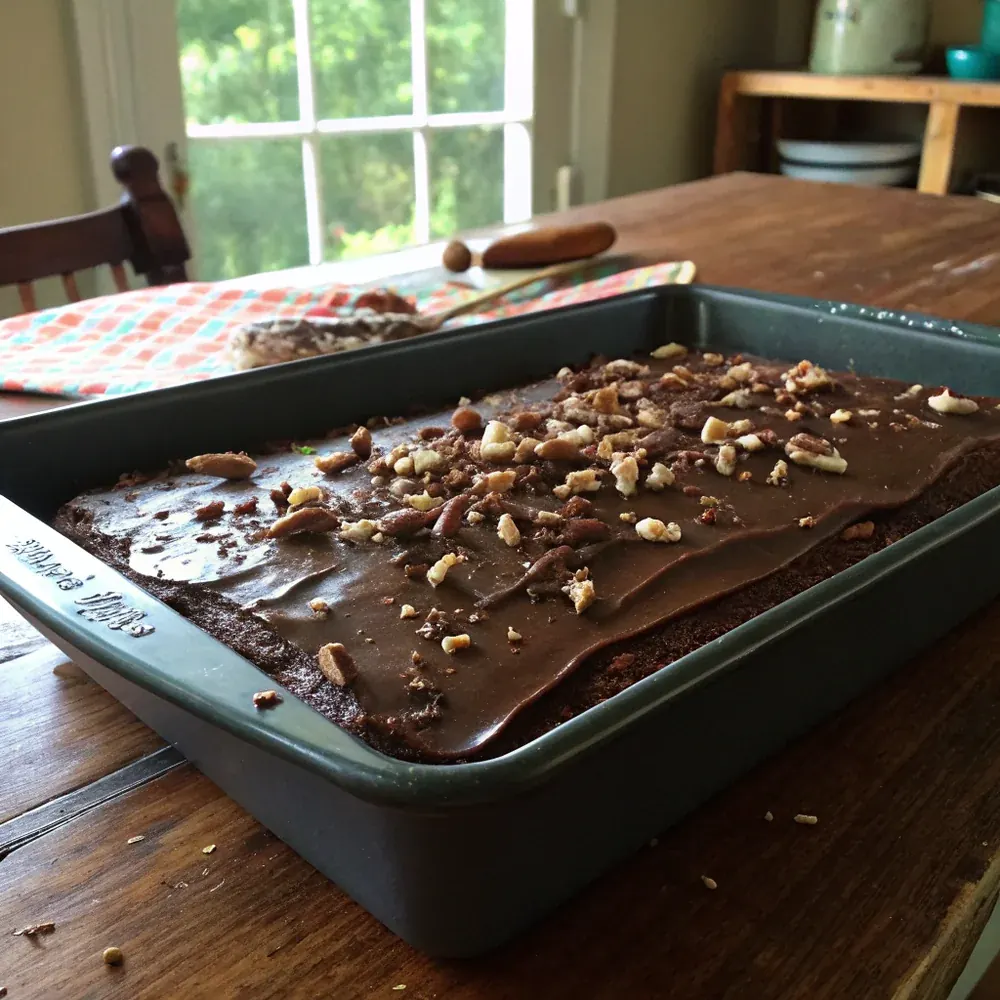
- Pour frosting on the warm cake. Pull the cake from the oven. Within 5 minutes of the bake finishing - while the cake is still warm and steaming - pour the warm frosting evenly over the surface. The pour technique matters: start at one short edge, pour in a slow continuous ribbon while moving across the pan, and finish at the opposite edge. The surface will look like a glossy chocolate pond. Tilt the pan gently to push frosting into the corners.
- Cool to set, then cut. Set the pan on a wire rack and let it cool at room temperature for at least 60 minutes. The frosting sets from glossy-liquid to glossy-set as the cake cools. Cut into 24 squares with a sharp knife (wipe the knife between cuts for clean edges). Serve at room temperature; do not refrigerate before the first slice or the frosting will dull.
Frequently Asked Questions
What makes a chocolate sheet cake Texas-style?
Three things: the boiled cocoa method (butter, water, and cocoa simmered together before meeting the flour), the warm-on-warm frosting pour (frosting goes on while the cake is still warm from the oven), and the pecan topping. The cake is built in a 9x13 pan, has a fudgier crumb than a layer cake, and is meant for potlucks. Pioneer Woman popularized one version; the recipe above leans Hill Country with San Saba pecans and a stronger buttermilk tang.
Can I make Texas sheet cake without buttermilk?
Yes - substitute 1 tablespoon of white vinegar or lemon juice stirred into 1 cup of whole milk, rested 5 minutes. The substitute works but the cake is slightly less complex than with real buttermilk. Avoid using regular milk without the acid - the baking soda needs the acid to leaven properly, and regular milk produces a flatter, denser cake.
Why does my frosting set up grainy?
Two common causes: powdered sugar that was not sifted before adding (lumps create graininess), or microwaving the frosting to re-warm it (microwaving can crystallize the sugar). Fix: sift powdered sugar into the saucepan, and if you need to thin the frosting after it has cooled, do it on the stove over low heat with a splash of warm buttermilk, whisking constantly.
Do I have to use a 9x13 pan?
The recipe is built for a 9x13 metal pan and produces the canonical Texas sheet cake texture. A half sheet pan (18x13) bakes thinner and gives a higher frosting-to-cake ratio - both styles are Texas, but the 9x13 is the modern potluck standard. Avoid square 8x8 pans (too small) and round cake pans (defeats the sheet cake format).
Can I make Texas sheet cake gluten-free?
Yes - replace the all-purpose flour with a 1:1 gluten-free flour blend that includes xanthan gum (King Arthur Measure for Measure or Bob's Red Mill 1-to-1 work well). The crumb is slightly more delicate but the boiled cocoa method actually helps gluten-free baking by gelatinizing the starch. Bake 2-3 minutes longer and check for doneness with the toothpick test.
How far ahead can I make this cake?
Up to 24 hours ahead is ideal: bake, frost, cover tightly, leave at room temperature. Day 2 cake is arguably better than day 1 as the frosting integrates with the top crust. Up to 3 months ahead, freeze individual squares on a parchment-lined sheet pan, then transfer to a zip-top bag. Thaw 90 minutes at room temperature before serving.
What is the difference between Texas sheet cake and Pioneer Woman sheet cake?
Pioneer Woman's version is a Texas sheet cake recipe she popularized to a national audience in the early 2010s. The base method (boiled cocoa, warm-on-warm frosting pour, 9x13 pan) is identical. Differences are matters of degree: the recipe above pushes the buttermilk tang harder, uses more salt in the frosting, and calls for a full cup of pecans instead of the 3/4 cup she uses. Both are valid; this is the Hill Country version I grew up with.
Can I skip the pecans?
You can, but you should not unless someone has a nut allergy. The pecans are not a topping garnish - they are part of the textural identity of Texas sheet cake. If you must skip them, replace with 1 cup of toasted shredded coconut for a Texas-coastal variant, or with 1/2 cup of crushed graham crackers for crunch. Plain frosting without anything in it is a fine cake, but it stops being identifiable as Texas sheet cake.