Tex-Mex Recipes
Texas Frito Pie
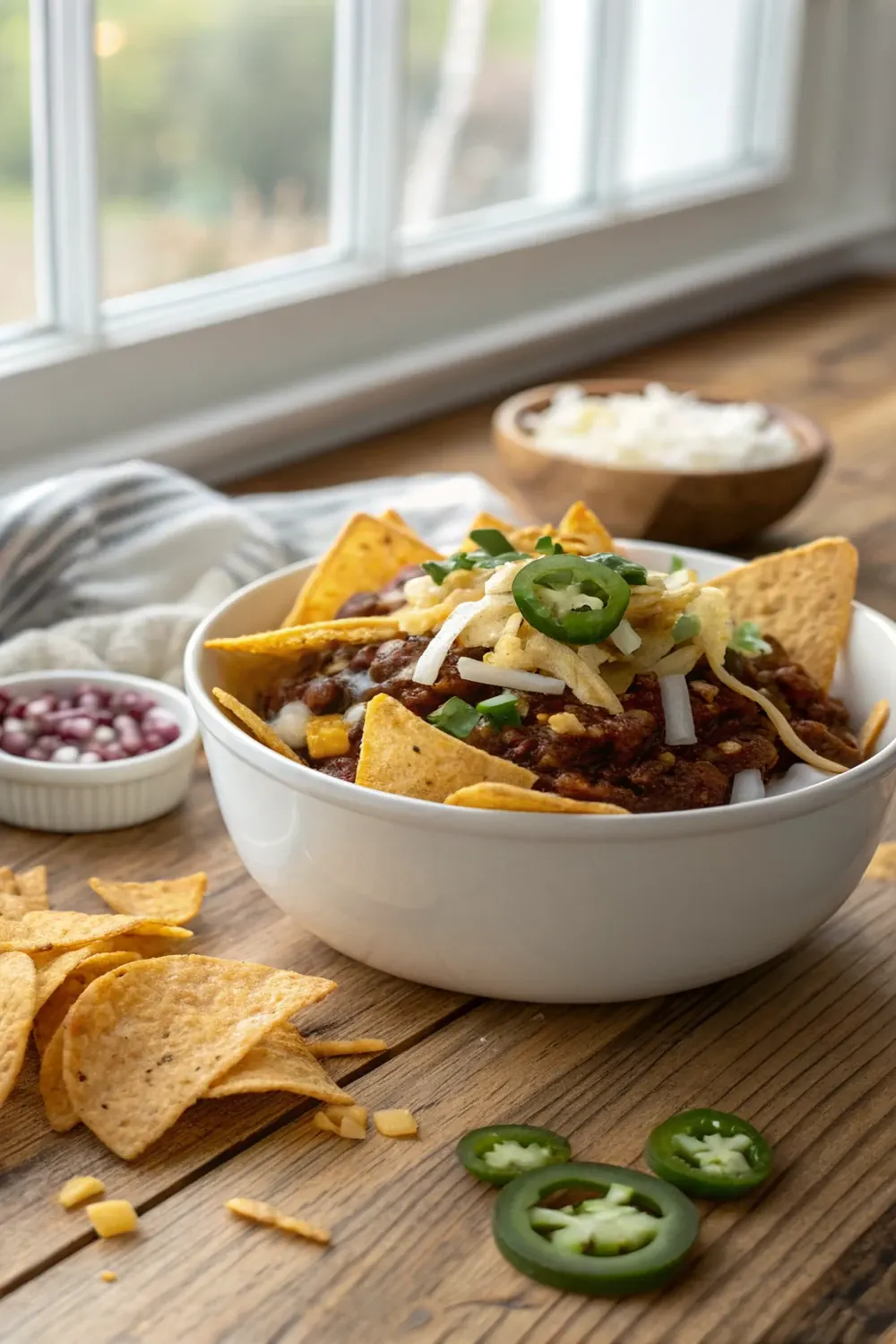
Texas Frito Pie eaten right out of the slit-open bag, with no-bean Texas chili, sharp cheddar, onion, and jalapeno. Cafeteria nostalgia in 15 minutes.
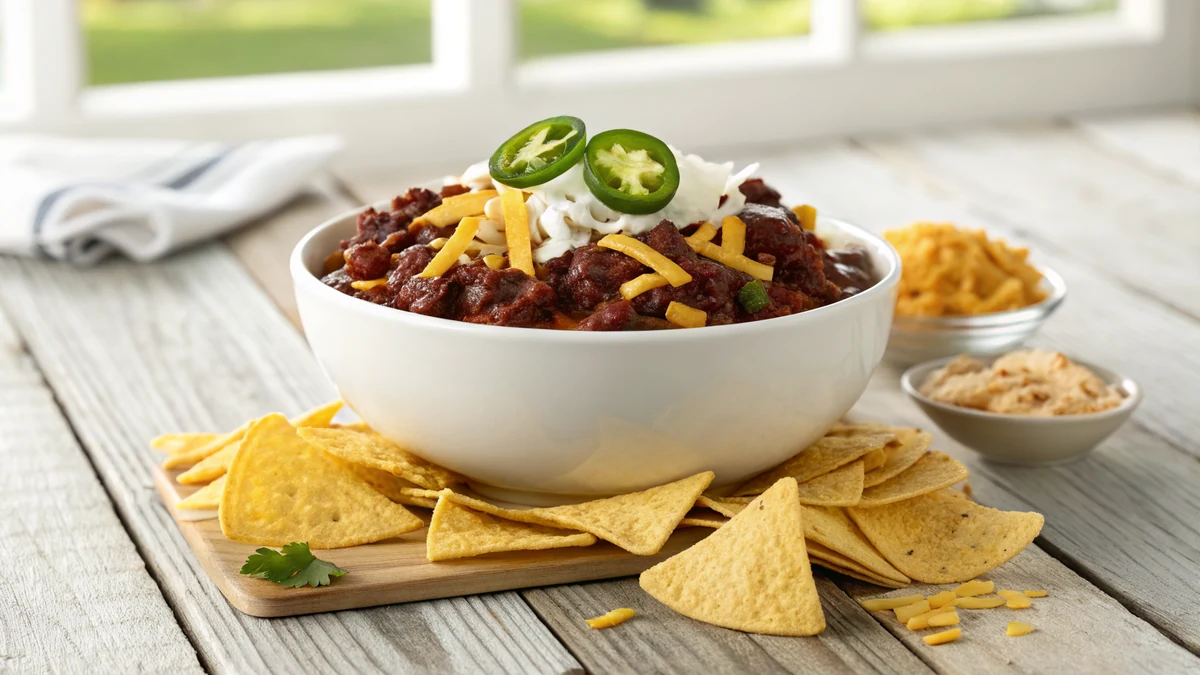
Quick answer: Texas Frito Pie is crushed Fritos served straight from the bag, topped with a ladle of no-bean Texas chili, shredded sharp cheddar, diced white onion, and pickled jalapenos. The bag is slit lengthwise so the chips become the bowl, and you eat it with a fork right out of the foil. Total time 15 minutes assuming pre-made chili. The Texas signature is the bag, the no-bean chili, and the original Fritos corn chips, never Tostitos.
I grew up in San Antonio in the 1990s, and Frito Pie was the lunch of the week at my elementary school cafeteria. The lunch ladies would slit a single-serving bag of Fritos lengthwise, ladle a steaming scoop of no-bean chili over the chips, and finish with a handful of bright orange shredded cheddar and a sprinkle of diced onion. We ate it with a plastic fork right out of the bag, the chips at the bottom going soft from the chili while the chips on top stayed crunchy. That cafeteria tray is one of the most San Antonio memories I have.
Frito Pie is a Texas dish with a contested origin. The most-cited story credits Daisy Doolin, mother of Charles Elmer Doolin (the San Antonio confectioner who bought the Fritos recipe in 1932 and built Frito-Lay into a national company), with developing the dish in the 1930s or 1940s to promote her son's product. Santa Fe also claims the dish through the Original Woolworth's lunch counter, where Teresa Hernandez served it in a bowl over red chile starting in the 1960s. Texas Monthly has written that the bag-served version is unmistakably Texan. The recipe below takes 15 minutes with pre-made chili, 45 minutes from scratch.
The Doolin Family and the San Antonio Origin Story
Frito Pie is, by most accounts, a San Antonio invention. The story starts in 1932, when Charles Elmer Doolin, a young San Antonio confectioner, bought the recipe for a corn chip from a man named Gustavo Olguin for $100. Doolin began producing the chips out of his mother's kitchen in San Antonio, calling them Fritos (Spanish for "little fried things"), and the operation grew into the Frito Company, which eventually merged with H.W. Lay in 1961 to form Frito-Lay. The original San Antonio production kitchen was on the city's south side; Frito-Lay's heritage is rooted in the Pearl District and surrounding neighborhoods.
Daisy Dean Doolin, Charles's mother, is the most-cited inventor of Frito Pie. The story goes that Daisy, who helped Charles develop and promote the chips, created Frito Pie in the late 1930s or early 1940s as a way to demonstrate the versatility of the product. Recipes attributed to Daisy in the 1940s describe a baked casserole of Fritos, chili, cheese, and onion, more like a layered bake than the bag-served version we know today. The bag version emerged later, likely in the 1950s or 1960s, when single-serving Fritos bags became common in school cafeterias and roadside stands across Texas.
By the 1970s, the bag-served Frito Pie was a Texas school cafeteria staple. My San Antonio elementary school served it once a week. Convenience stores from Stripes to Town & Country to 7-Eleven sold versions where you slit the bag yourself and ladled chili from a heat-lamp pot. Friday night football games in small Texas towns sold Frito Pie at the concession stand. The dish became, more than almost any other, the Texas snack food of the back half of the 20th century.
Texas vs New Mexico: The Frito Pie Rivalry
New Mexico claims Frito Pie too, and the rivalry is genuine. The Santa Fe origin story centers on the Original Woolworth's lunch counter on the Plaza in Santa Fe, where Teresa Hernandez, a longtime employee, is credited with serving Frito Pie starting in the early 1960s. The Santa Fe version is served in a bowl, made with red chile (New Mexico-style chile sauce, not Texas chili con carne), and uses different cheese (often a softer melting cheese rather than sharp orange cheddar). Woolworth's closed in 1997, but the Five & Dime General Store on the Plaza picked up the recipe and still serves it today; New Mexicans will tell you it is the original Frito Pie.
Texas Monthly has weighed in repeatedly. The magazine's position, articulated in multiple feature pieces over the past two decades, is that the bag-served version with no-bean chili, sharp cheddar, raw onion, and pickled jalapeno is unmistakably Texan and predates the Santa Fe Woolworth's claim by at least a decade. The Doolin family's San Antonio origin in the 1930s-1940s is documented in Frito-Lay corporate history; the Santa Fe Woolworth's claim begins in the 1960s. Texas Monthly's culinary historians point to this timeline as the definitive answer.
Both states are right about something. New Mexico has a unique and delicious bowl version with red chile that is genuinely different from the Texas dish. Texas has the bag version, the no-bean chili, and the cafeteria-and-football-stand culture that built the Frito Pie into a cultural institution. The honest answer is: the dish was invented in San Antonio by the Doolin family, the bag-served version is Texan, and the Santa Fe Woolworth's bowl version is a regional variant that became iconic in its own right. For deeper reading, see Texas Monthly's food section at texasmonthly.com/food.
Why "In the Bag" Is the Texas Signature
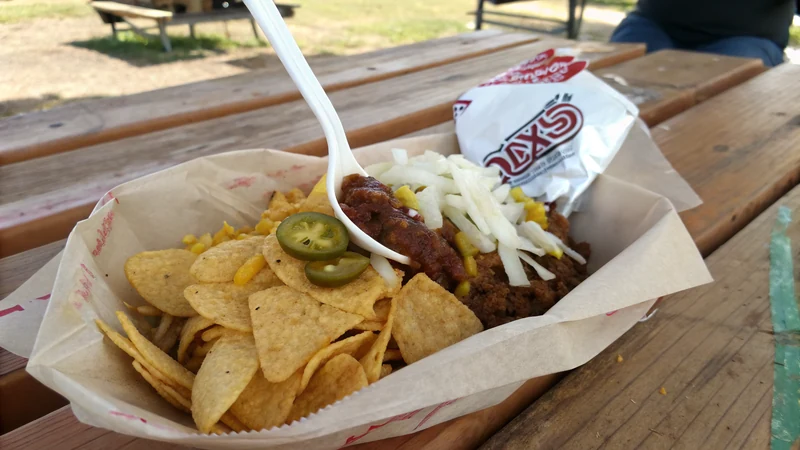
The bag is the dish. In Texas, if you serve Frito Pie in a bowl, people will eat it and enjoy it, but they will gently note that it is not really Frito Pie, it is more like "chili with Fritos." The bag is what makes Frito Pie Frito Pie. The slit-open foil bag becomes the bowl, the serving vessel, the napkin (sort of), and the takeaway container all at once. You eat it with a fork right out of the bag, and when you are done, you toss the bag.
The bag also creates a specific texture profile that a bowl cannot replicate. The chips at the bottom of the bag, in direct contact with the hot chili, soften slightly into a chili-saturated layer. The chips in the middle take a little chili and stay semi-crunchy. The chips on the top, especially around the edges of the bag, stay fully crunchy. A single forkful pulls all three textures at once, and that layered texture is part of why Texans love the dish.
The bag is also a cafeteria and concession-stand technology. A bowl needs to be washed; a bag does not. A bowl is fragile in a school cafeteria; a bag is not. A bowl is hard to eat while standing at a Friday night football game; a bag is easy. The bag-served Frito Pie was perfectly engineered for the Texas mid-20th-century institutions where it became iconic: schools, gas stations, and high school football stadiums. The bag is not just a quirky presentation; it is the operational logic of the dish.
The Chili: No Beans, Texas Style
The chili matters as much as the bag, and Texas chili is famously bean-free. A proper Texas chili (chili con carne) is meat, chiles, onion, garlic, and a tomato or broth base, simmered until thick enough to coat a spoon. Beans, in the official Texas position, do not belong in chili; they belong in beans. The 1977 Texas State Chili Cook-off Association codified this in formal competition rules, and the Texas legislature designated chili as the state dish in 1977 specifically without beans. For Frito Pie, the no-bean rule is doubly important because beans in the chili would change the texture against the chips and dilute the meaty depth that makes the dish satisfying.
The chili for Frito Pie should also be thicker than a soup-style chili. You want a chili you can ladle in a thick scoop, not pour. If your chili is too thin, simmer it uncovered for 10 more minutes to reduce. If it is too thick to ladle, thin with a tablespoon of beef broth at a time. The right consistency is roughly that of a thick pasta sauce: holds its shape on a spoon but flows when you tilt the ladle.
For a from-scratch chili, see the canonical Texas chili recipe. For a quick Frito Pie, a quart of pre-made Texas chili from HEB's heat-and-eat section, Wolf Brand, Hormel No-Beans, or any quality from-the-can option works fine. Wolf Brand is the canonical Texas chili in a can; it has been made in Texas since 1895 and tastes the way most Texans expect chili to taste. Hormel's no-bean variety is also good. Skip any chili labeled "hot dog chili" or "chili sauce," those are different products.
Original Fritos: The Only Acceptable Chip
The chip is non-negotiable. Use original Fritos corn chips, the ones in the yellow bag. The original Fritos shape (slightly curved, narrow, fluted) is the result of an extrusion process that has been essentially unchanged since 1932. The salt level, the corn flavor, the slight oiliness, and the structural ridges are all calibrated for this exact dish (and for a thousand other snack uses). Substituting other corn chips changes the dish in ways that are immediately noticeable to any Texan.
Tostitos are not Fritos. Tostitos are tortilla chips, made from masa rolled flat and cut into rounds or triangles. They are saltier, larger, and more brittle than Fritos. They sog faster in chili and the dish does not eat the same. Fritos Scoops are also wrong, the cup shape lets the chili pool inside the chip and creates a soggy mouthfeel. Generic corn chips (Walmart's Great Value brand, HEB's house brand, etc.) are not as bad but the corn flavor is flatter and the salt is off.
Buy original Fritos in the smallest bag size available for the dish. The 1 oz single-serving bags are the canonical Frito Pie format because each bag is one serving. The 2 oz lunch-size bags work for a bigger serving. Avoid the family-size 9.25 oz bags for the bag-pie format, they are too tall and the chili cannot reach the bottom chips. If single-serving bags are hard to find, HEB stocks them year-round, and most Texas convenience stores (Stripes, Buc-ee's, 7-Eleven) carry them in the snack aisle.
The Bag-Slicing Technique
Slice the bag lengthwise, not at the top. This is the single most important technique in the dish. Lay the bag flat on a plate or tray, then use a sharp paring knife or kitchen shears to slit the bag along one of the wide sides, top to bottom, so the bag opens like a long boat. The chips inside are exposed in a wide flat layer, and the chili can be ladled across the entire surface.
The wrong way (and a common mistake) is to cut the top off the bag, which leaves a tall narrow pocket. In a top-cut bag, the chili pools at the bottom, the toppings sit on top, and the layers do not mix. You end up with a dry top and a chili-soaked bottom, with no integration. The lengthwise slit creates a wide shallow vessel where the chili, cheese, onion, and jalapeno all reach the chips evenly.
Some Texas cafeterias and concession stands use a specialized Frito Pie machine, basically a heated chili dispenser with a built-in bag-slicing guide. The Hatco Frito Pie Warmer is a real piece of commercial equipment that exists for exactly this dish. At home, kitchen shears or a paring knife is fine. The slit should be a single clean cut along the wide side of the bag, about 5-6 inches long for a single-serving 1 oz bag.
The Toppings Hierarchy: Cheese, Onion, Jalapeno
The topping order is canonical and it is not arbitrary. Cheese goes first, directly on the chili. Onion goes second, on the cheese. Jalapeno goes last, on the onion. The order is dictated by physics and flavor: the cheese needs the residual heat of the chili to melt slightly, the onion needs to stay raw and crunchy (so it goes on top of the cheese, not under), and the jalapeno is the visual and flavor finisher.
The cheese should be sharp orange cheddar, freshly shredded if possible. Bright orange cheddar (the kind colored with annatto) is the canonical Texas cheese for Frito Pie. White cheddar works but is less iconic. Avoid Monterey Jack (too mild, not the right flavor profile), pepper jack (overcomplicates the dish), or pre-shredded "Mexican blend" (too much variety dilutes the sharp cheddar bite). Some Texans use Velveeta or processed American cheese, especially in older cafeteria-style recipes; that works too and has its own nostalgia.
The onion should be raw white onion, finely diced. Yellow onion is acceptable but white is more authentic. Sweet onion (Vidalia, 1015) is too mild; you want the bite of raw white onion against the rich chili. The jalapeno should be pickled (the jarred kind from El Pato, La Costena, or HEB), not fresh. Pickled jalapenos add brine and tang as well as heat, and the pickled flavor profile is what most Texans expect on a Frito Pie. Fresh jalapeno slices work in a pinch but they are not the canonical choice.
School Cafeteria Nostalgia and Commercial Frito Pie Machines
Frito Pie was the cafeteria menu of an entire generation of Texas schoolkids, especially in the 1970s, 1980s, and 1990s. My San Antonio elementary school served it on Wednesdays. Friends in Austin, Houston, Dallas, El Paso, and small towns across the state remember the same lunch on the same kind of plastic tray with the same square of cornbread on the side. The dish became a shared Texas memory, a Proustian madeleine of childhood, and the smell of warm chili and Fritos still triggers a specific cafeteria flashback for most Texans of a certain age.
The commercial logic was simple and brilliant. Schools could buy Fritos in bulk single-serving bags, hold a pot of chili on a steam table, and assemble a Frito Pie to order in 30 seconds per kid. The lunch ladies slit the bag, ladled the chili, sprinkled cheese, and handed it to the kid with a fork. The dish was hot, filling, popular, and required almost no plates or utensils to wash. From the school's operations perspective, Frito Pie was a near-perfect cafeteria item.
Convenience stores adopted the same logic. Stripes, Town & Country, and the early Buc-ee's locations had Frito Pie warmers next to the hot dogs and the taquitos. Friday night football games at Texas high schools sold Frito Pie at the concession stand alongside nachos and popcorn. The dish became woven into the texture of Texas public life, eaten at school lunches, gas stations, and stadiums by millions of Texans across decades. For the canonical Tex-Mex spread that often accompanied a Frito Pie at home, see the Austin breakfast tacos recipe and queso flameado for a fuller Tex-Mex menu.
The same bag service turns up every fall at the State Fair of Texas in Dallas, where Frito pie sits alongside the corny dogs and the fried competition entries as one of the fairground's best values. My guide to Texas State Fair foods covers the midway classics and which of them actually reproduce in a home kitchen.
Kitchen Notes from a San Antonio Childhood
I make Frito Pie at home maybe four times a year, usually in the fall when the chili weather hits and I want a quick weeknight dinner that takes me back to the cafeteria. I keep a quart of frozen Texas chili in my freezer specifically for this purpose; thawing it in a saucepan over medium heat takes about 10 minutes, and the bag-pie assembly is another 5 minutes. From freezer to fork in 15 minutes, and the kids love it.
The single best upgrade to a home Frito Pie is freshly shredded sharp cheddar. Pre-shredded cheese has a starch coating that prevents melting; freshly shredded melts into a glossy layer the moment it hits the hot chili. Use a box grater on the large holes; the time investment is 60 seconds and the texture is dramatically better.
The single most underrated topping is pickled red onion. Texans traditionally use raw white onion, and that is canonical, but a half-cup of quick-pickled red onion (red onion sliced thin, soaked in lime juice and salt for 15 minutes) on top is a delicious modern upgrade. It adds tang and color and does not break the dish. I do this at home for adult dinner parties; the cafeteria version stays raw white onion.
Mistakes to Avoid
Chili with beans. Beans in the chili is not Texas Frito Pie. Use bean-free Texas-style chili con carne. If you only have bean chili, drain off as many beans as possible or pick another dish.
Tostitos or generic corn chips. Original Fritos in the yellow bag is the only correct chip. Tostitos are tortilla chips, not corn chips, and they sog faster and taste different.
Cutting the bag at the top instead of lengthwise. The top-cut creates a tall narrow pocket where the chili and toppings cannot reach the chips. Slit the bag lengthwise along the wide side.
Cold or lukewarm chili. The chili needs to be hot enough to slightly soften the bottom chips and melt the cheese. Reheat to a low simmer before ladling.
Pre-shredded cheese only. Pre-shredded cheese has a starch coating that resists melting. Freshly shredded sharp cheddar melts into a glossy layer instantly.
Sweet onion or yellow onion when you have white. White onion is the canonical raw onion. Sweet onion is too mild, yellow onion is acceptable but second-best.
Forgetting the fork. Frito Pie is fork food, not spoon food. The bag is too narrow for a spoon to scoop properly. Hand each diner a fork; do not provide a spoon.
Letting it sit. Frito Pie is best within the first 5 minutes of assembly. After that the chips continue to soften and the texture shifts. Eat immediately.
Variations
Santa Fe-style in a bowl. The New Mexico version, with red chile (not Texas chili con carne), served in a bowl, with a softer melting cheese. Genuinely different and worth trying once.
Breakfast Frito Pie. Top the chili-and-Fritos with two over-easy eggs and a generous handful of cheddar. Brunch favorite in Austin and San Antonio. The runny yolk integrates into the chili beautifully.
Vegetarian Frito Pie. Use a bean-and-vegetable chili (yes, beans are okay in the vegetarian variant; the no-bean rule is specifically for Texas chili con carne with beef). Black beans, pinto beans, and roasted poblanos work well as the chili base.
Brisket Frito Pie. Replace ground beef chili with chopped smoked brisket and a thinner red chile sauce. A Texas barbecue-meets-cafeteria mashup that has become popular at Texas barbecue joints in the past decade.
Buffalo chicken Frito Pie. Replace chili with shredded buffalo chicken, top with cheddar, blue cheese crumbles, ranch, and pickled jalapeno. A Tex-Mex-meets-bar-food variant that works for game day.
Walking taco. The same bag-served format with seasoned ground beef (taco-style) instead of chili, topped with cheddar, lettuce, tomato, and sour cream. Distinct dish but related, and often confused with Frito Pie. Both are bag-served, both use Fritos, but Frito Pie uses chili and walking taco uses taco meat.
What to Serve With Texas Frito Pie
Frito Pie is a complete meal in a bag, but Texas tradition adds a few sides. The cafeteria pairing was a square of cornbread, a small carton of milk, and a piece of fruit (usually an apple or an orange wedge). At home, a side of jalapeno cornbread or another Southern comfort side is the classic accompaniment. The cornbread soaks up any leftover chili from the bag and rounds out the meal.
For drinks, the cafeteria standard was a carton of 2% milk, and that is still surprisingly good with Frito Pie (the dairy cuts the salt and chili heat). For adults, an ice-cold Lone Star or Shiner Bock is the canonical Texas pairing. A margarita on the rocks works for a Tex-Mex spread. For non-alcoholic, sweet tea or a Big Red soda (a uniquely Texas red cream soda) is the iconic move. Topo Chico mineral water with lime is the modern Texas adult pairing.
For a fuller Tex-Mex spread, pair the Frito Pie with a starter of queso flameado and a salad of romaine, tomato, avocado, and lime vinaigrette. Skip a heavy dessert; Frito Pie is filling. A small scoop of Blue Bell vanilla ice cream is the right Texan finish, simple and cold and Texas-made since 1907.
Texas Frito Pie Recipe
Ingredients
- For the chili (or use pre-made, see notes):
- 1 lb (450 g) ground beef, 80/20
- 1 medium yellow onion, diced
- 3 cloves garlic, minced
- 2 tablespoons chili powder (Gebhardt's if you can find it)
- 1 teaspoon ground cumin
- 1 teaspoon smoked paprika
- 1/2 teaspoon Mexican oregano
- 1 (8 oz / 225 g) can tomato sauce
- 1 cup (240 ml) beef broth
- 1 teaspoon kosher salt
- 1/2 teaspoon black pepper
- For the bag-pie:
- 4 single-serving bags of original Fritos corn chips, 1 oz (28 g) each (or 2 lunch-size 2 oz bags)
- Toppings:
- 2 cups (225 g) sharp cheddar cheese, shredded (the bright orange kind)
- 1 small white onion, finely diced (about 3/4 cup)
- 1/2 cup pickled jalapeno slices, drained
- 1/4 cup sour cream (optional)
- 2 tablespoons fresh cilantro, chopped (optional)
- Equipment:
- Sharp paring knife or kitchen shears for slitting the bags
- Small ladle (about 1/3 cup capacity)
- 4 forks (no spoons, the bag does not work with a spoon)
Instructions
- Make or warm the Texas chili. If making fresh: brown the ground beef in a heavy pot over medium-high heat for 6-8 minutes, breaking it apart. Add the diced yellow onion and cook for 4 minutes until translucent. Add the garlic, chili powder, cumin, smoked paprika, and Mexican oregano and toast for 30 seconds. Stir in the tomato sauce, beef broth, salt, and pepper. Simmer uncovered for 25-30 minutes until thickened. If using pre-made chili, warm 3 cups of <a href='https://www.texanrecipes.com/texas-chili/'>Texas chili</a> (no beans) in a saucepan over medium heat until steaming, about 5-7 minutes. The chili needs to be hot enough to slightly soften the bottom layer of Fritos when ladled.
- Prep the toppings. Shred the sharp cheddar cheese on the large holes of a box grater. Pre-shredded cheese works but the texture is drier and the melt is less generous; freshly shredded is ideal. Finely dice the white onion (smaller than 1/4 inch dice, you want it almost as small as the chili). Drain the pickled jalapeno slices on a paper towel. Set everything within arm's reach of the chili pot. Bag assembly is fast and you do not have time to walk around the kitchen mid-build.
- Choose the right bag. Use single-serving 1 oz bags of original Fritos corn chips. Not Tostitos (those are tortilla chips, wrong shape and salt level), not Scoops (those are too thick and the chili pools wrong), not generic corn chips (the salt and corn flavor are different). Original Fritos in the yellow bag is the canonical product. If you cannot find single-serving bags, the 2 oz lunch-size bags also work for one bigger serving. The 9.25 oz family bags are too large for a bag-pie and should be portioned into bowls instead.
- Slit the bag lengthwise. Lay the bag flat on a plate or tray. Using a sharp paring knife or kitchen shears, slit the bag lengthwise along one of the wide sides, top to bottom, so the bag opens like a long boat with the chips inside. Do not cut the top off (that creates a tall narrow pocket where the chili stays at the bottom and the toppings cannot reach the chips). The lengthwise slit is the Texas way and it is the technique that makes the bag function as a bowl. Texas Monthly has written about the bag-slit technique as the defining gesture of the dish.
- Ladle the chili into the bag. Use a small ladle (about 1/3 cup capacity) to spoon the hot chili directly over the chips inside the slit-open bag. Aim for about 1/2 to 2/3 cup of chili per single-serving bag, or about 1 cup for a 2 oz lunch bag. The chili should cover the chips in a thick layer but not drown them. Some chips on the edges of the bag should still be visible. Work fast, the chili will start softening the chips immediately and that is fine, you want some softening but not full sog.
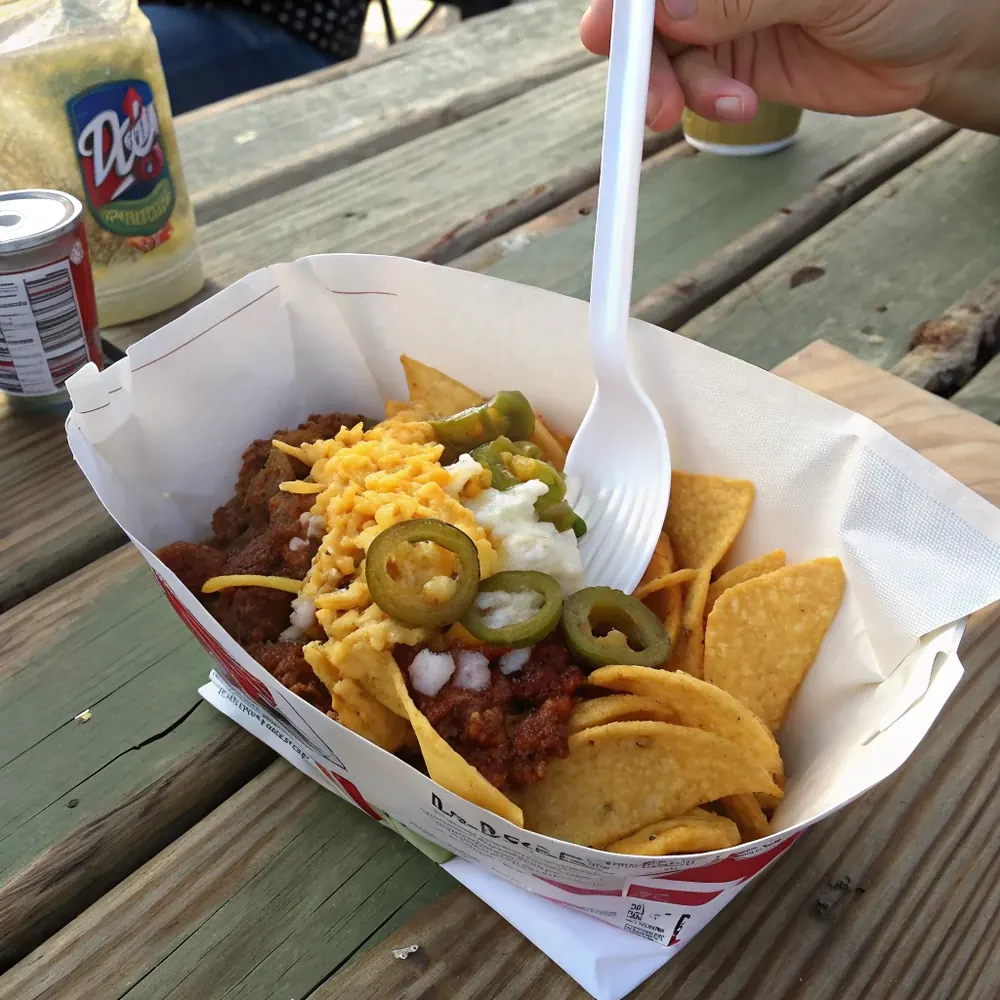
- Top with cheese, then onion, then jalapeno. The topping order matters. First, scatter 1/4 to 1/3 cup of shredded sharp cheddar evenly across the chili. The residual heat of the chili will start melting the cheese into a glossy layer. Second, sprinkle 1-2 tablespoons of finely diced white onion over the cheese. Third, scatter 4-6 pickled jalapeno slices on top. The cheese-onion-jalapeno hierarchy is canonical Texas Frito Pie order. Cheese first, because the heat melts it. Onion second, because it stays crisp. Jalapeno last, because it is the visual and flavor finisher. Optional: a small dollop of sour cream and a sprinkle of cilantro on top.
- Serve immediately with a fork. Serve the Frito Pie in the bag itself, on a small plate or tray to catch any spillover. Hand each diner a fork. Do not provide a spoon, the bag is too narrow and the chips do not scoop right with a spoon. The fork is the canonical utensil. Eat immediately while the cheese is melted and the chips on top are still crunchy. The dish is best within the first 5 minutes; after that the chili continues to soften the chips and the texture shifts toward a chip-and-chili stew. Both phases are good but the first 5 minutes is the magic.
- Optional: bowl version (Santa Fe-style). If you prefer the New Mexico variant or you do not have single-serving bags, the bowl version works. Pour 3/4 cup of original Fritos into a wide shallow bowl. Ladle 1/2 cup of chili over the chips. Top with cheese, onion, and jalapeno. The Santa Fe original at the Woolworth's lunch counter used red chile (New Mexico chile sauce, not Texas chili con carne) and was called Santa Fe Frito Pie. The bowl version is delicious but it is not what most Texans think of as Frito Pie, which is bag-served by definition. Both are legitimate; the bag is the Texas signature.
Frequently Asked Questions
What is Texas Frito Pie?
Texas Frito Pie is a dish of original Fritos corn chips served straight from a slit-open single-serving bag, topped with a ladle of no-bean Texas chili, shredded sharp cheddar cheese, finely diced raw white onion, and pickled jalapeno slices. It is eaten with a fork right out of the bag. The dish was invented in San Antonio by the Doolin family in the 1930s-1940s and became a Texas school cafeteria, gas station, and football stadium staple in the second half of the 20th century.
Is Frito Pie from Texas or New Mexico?
Both states claim it, but the dish is most likely Texan in origin. The Doolin family of San Antonio developed the recipe in the 1930s-1940s to promote their Fritos corn chip product; Daisy Doolin (mother of Frito-Lay founder Charles Elmer Doolin) is the most-cited inventor. New Mexico's claim centers on the Original Woolworth's lunch counter in Santa Fe, which started serving a bowl version with red chile in the early 1960s, two decades after the Texas origin. Texas Monthly's culinary historians have repeatedly defended the San Antonio origin. Both versions are delicious; the bag-served version with no-bean chili is unmistakably Texan.
Why no beans in the chili?
Texas chili con carne is, by Texas tradition and 1977 state legislative designation, a bean-free dish. The Texas position is that beans belong in beans, not in chili. For Frito Pie, the no-bean rule is doubly important because beans would change the texture against the chips (mushy where you want crunch) and dilute the meaty depth that makes the dish satisfying. If you only have bean chili, drain off as many beans as possible. The vegetarian Frito Pie variant is the one exception where beans are acceptable as the chili base.
Can I use Tostitos instead of Fritos?
No. Tostitos are tortilla chips (flat, made from masa); Fritos are corn chips (curved, fluted, extruded from corn dough). They have different textures, salt levels, and chili-absorption properties. Tostitos sog faster and the dish does not eat right. Original Fritos in the yellow bag is the only canonical chip for Frito Pie. Other Frito varieties (Scoops, Twists, Honey BBQ) also do not work well; the original shape is calibrated for this exact application.
Why slit the bag lengthwise instead of cutting the top?
The lengthwise slit creates a wide shallow vessel where the chili and toppings can reach all the chips evenly. A top-cut bag creates a tall narrow pocket where the chili pools at the bottom, the toppings sit on top, and the layers do not mix. You end up with a dry top and a chili-soaked bottom, with no integration. The lengthwise slit is the canonical Texas technique and Texas Monthly has written about it as the defining gesture of the dish. Use a sharp paring knife or kitchen shears to make a clean 5-6 inch slit along the wide side of the bag.
Can I make Frito Pie ahead?
Not really, but you can prep the components ahead. Make the chili up to 3 days ahead and store covered in the refrigerator (chili actually improves with overnight rest, the flavors integrate). Shred the cheese, dice the onion, and drain the jalapenos earlier in the day. The actual bag assembly must happen right before serving because the chips start softening immediately on contact with the chili. Total assembly time is about 30 seconds per bag, so even with last-minute build, the dish is fast.
What size Fritos bag should I use?
The canonical Frito Pie bag is the 1 oz single-serving size, sold in multipacks at HEB, Walmart, Target, and most Texas convenience stores. Each 1 oz bag makes one personal-size Frito Pie with about 1/3 to 1/2 cup of chili. The 2 oz lunch-size bags also work for a heartier serving. Avoid the family-size 9.25 oz bag for the bag-pie format, it is too tall and the chili cannot reach the bottom chips evenly; for a family-size bag, portion the chips into bowls instead and serve as Santa Fe-style bowl pies.