Texas BBQ
How to Cook a Turkey Texas BBQ Style
Chef Mia's smoked turkey: 12 lb bird, salt-pepper-garlic rub, post oak smoke at 275F to 165F breast / 175F thigh. The Thanksgiving game-changer.
Quick answer: To cook a turkey Texas BBQ style, dry-brine a 12-pound bird 24 hours with kosher salt, smoke over post oak at 275F for about 4 hours until the breast hits 165F (74C) and the thigh hits 175F (79C). Apply a salt-pepper-garlic rub right before the bird goes on the pit, baste with butter mid-cook, rest 30 minutes tented under foil before carving. The result is juicier, smokier, and more interesting than any oven-roasted turkey, plus it frees the oven for sides on Thanksgiving morning.
Every November in Lockhart and the surrounding Hill Country, the BBQ joints quietly switch their pits from year-round brisket-and-ribs mode to a special Thanksgiving project: turkeys. Goldee's in Fort Worth runs a famous Thanksgiving turkey weekend special every year, with whole smoked birds available for pickup the Wednesday before the holiday. Aaron Franklin has talked publicly about smoking turkeys for the family Thanksgiving table at home rather than the brisket he is famous for. The reason is simple. Once you taste a properly smoked Thanksgiving turkey - juicy breast, mahogany skin, deep post-oak flavor underneath the gravy - the oven-roasted version stops being interesting.
I spent my first ten Thanksgivings trying to perfect oven-roasted turkey. I brined, I dry-brined, I spatchcocked, I roasted breast-down for the first hour, I read every Cook's Illustrated article ever written on the subject. The birds I produced were always fine. They were never spectacular. Then in 2019, my Uncle Earl, who runs a backyard offset smoker outside San Antonio, brought a 12-pound smoked turkey to my parents' Thanksgiving table. The breast was juicier than any turkey I had ever cooked. The skin had a smoke ring under it. The gravy made from the drippings tasted like a Hill Country BBQ joint had moved into the dining room. I never went back to the oven for turkey.
The recipe below is the one I have refined over six Thanksgivings of smoking my own birds. It takes about 4 hours of cook time at 275F over post oak, plus 30 minutes of resting before carving. You can run a Weber kettle, a kamado, an offset smoker, or a pellet smoker, all with the same method. The gas grill works too, with a smoker box and indirect heat. The trick is the temperature: 275F is the sweet spot for turkey, hot enough to render the skin crispy without drying out the breast, cool enough to give the smoke time to penetrate. Brisket cooks at 250F because it has all day; turkey cooks at 275F because it does not.
Why Smoke Instead of Roast (the Texas Argument)
Oven-roasted turkey is perfectly fine. Smoked turkey is genuinely better, and the difference is not subtle. Three things change when you cook the bird on a pit instead of in the oven. First, smoke flavor penetrates the meat deeply over 4 hours of post-oak smoke; the breast carries smoke notes all the way through, not just on the surface. Second, the indirect heat of a pit at 275F is gentler than a 325F oven and produces juicier meat with less drying at the edges. Third, you free up the oven entirely on Thanksgiving morning, which is the practical case for the method - you can cook all your sides without the bird hogging the only large oven in the house.
Two other pages on this site cover the cooks this one does not. If four hours is more than your day has, my deep fried turkey is the opposite method: 350F peanut oil, about three and a half minutes a pound, done in under an hour, with crackling skin instead of smoke. And if the table is six people rather than fourteen, my smoked turkey breast runs this same brine, rub, and post oak fire on a bone-in breast alone in about three hours, with no thigh timing problem.
The flavor case is the strongest. Aaron Franklin once described smoked turkey as the dish he'd cook if he were starting a BBQ joint over again from scratch and couldn't compete with established places on brisket alone. Goldee's runs a Thanksgiving smoked turkey weekend special every year that sells out by mid-October pre-orders. Pre-order. For turkey. The bird is the centerpiece of Texas Thanksgiving the same way the brisket is the centerpiece of summer Saturday lunch.
The juiciness case is structural. Turkey breast is naturally lean (about 1% fat) and dries out faster than any other major meat. The 325F oven heat exits at the breast surface as steam (cooling the meat) but enters from all sides simultaneously, so the breast cooks from outside-in faster than the dark meat catches up - which is why standard oven roasting often produces dry breast and underdone thighs. The 275F pit heat is gentler and more even; the smoke chamber holds the bird in a moist environment that the dry oven cavity does not match.
The third practical case is the oven-real-estate one. On Thanksgiving morning, you have one oven (most kitchens), 6 sides to cook, and 4 hours to do it. If the turkey is in the oven, the cornbread is on the counter, the green bean casserole is on the stovetop, and the pies are stacked on the dining room table waiting their turn. Smoking the turkey outside removes the central blocker. The oven becomes available for everything else from 8am onward.
Choosing the Right Turkey: Size, Fresh vs Frozen, Brined
A 12-pound turkey is the practical sweet spot for home BBQ. Smaller than 10 lb and the breast cooks too fast for the smoke to penetrate; larger than 14 lb and the cook time stretches past 5 hours, by which point the breast risks drying. Twelve pounds feeds 10-12 people generously with leftovers, fits on every standard 22-inch kettle grate, and finishes in 3.5 to 4 hours. If you have a larger crowd, smoke two 12-pound birds rather than one 18-pound bird - the smaller birds cook better and you get more skin per person.
Fresh vs frozen: fresh wins if you have access. Frozen is fine if fully thawed (allow 1 day per 4 lb of bird in the fridge) and if you avoid the pre-basted/self-basting brands. Butterball, Jennie-O, and similar pre-basted birds are injected with a salt-and-fat solution that conflicts with the dry brine and makes the seasoning unbalanced. Look for plain frozen birds without solution added, or a fresh bird from a reputable Texas grocer (HEB Prime, Whole Foods, Central Market). Heritage breed birds (Bourbon Reds, Narragansetts) are excellent if you can find them, with deeper flavor than industrial Broad Breasted Whites.
Pre-brined or buy plain. If your bird already says self-basting or contains up to X% solution on the label, skip the dry brine and reduce the rub salt by half. The bird is already over-seasoned by the manufacturer. If your bird is plain (most fresh birds, kosher birds, and unbasted frozen birds), the 24-hour dry brine in this recipe is the foundation step that makes the meat properly seasoned all the way through.
Wet brine vs dry brine: dry brine is better for smoking. A wet brine adds moisture that has to evaporate before the skin can crisp, which works against the dry-skin-into-mahogany goal of a smoked bird. Dry brining draws moisture out, then re-absorbs the now-salty liquid into the meat - same seasoning effect, drier exterior. The 24-hour dry brine is what every Lockhart pit master and Goldee's-style smokehouse uses for their Thanksgiving birds. For the arithmetic behind the bird size, including the ten percent you should add when the cook is a long one on the pit, see my guide to how much turkey per person.
The Texas Salt-Pepper-Garlic Rub
Central Texas BBQ uses simple seasonings. The Aaron Franklin trinity for brisket is salt + 16-mesh coarse black pepper + garlic powder. The same trinity, with one addition, works perfectly on turkey: salt (from the dry brine the day before), 16-mesh black pepper (3-4x what you would use on a chicken), garlic powder, onion powder, and optional smoked paprika for color. No sugar, no commercial poultry seasoning, no thyme-and-sage rub mixes. The post-oak smoke and the herb butter under the skin do the aromatic work; the rub provides the savory backbone.
16-mesh black pepper is the BBQ-specific coarse grind that holds up under long smokes without burning to dust. Standard table-grind pepper turns bitter over 4 hours of smoke and disappears into the bark. Find 16-mesh pepper at a butcher shop, restaurant supply store, or online (Spiceology and Lawry's both make it). One bag lasts a year of regular BBQ use.
The herb butter under the skin (separate from the rub on top) is the secret weapon. 8 tablespoons of softened unsalted butter blended with 8 fresh sage leaves and the leaves stripped from 4 thyme sprigs, then pushed under the breast and thigh skin in even patches. As the bird smokes, the butter melts and bastes the meat from inside the skin, keeping the breast moist and infusing the meat with sage-thyme aromatics. This is the move that Aaron Franklin's wife reportedly does for their family Thanksgiving turkey; once you start doing it, you cannot smoke a turkey without it.
Apply the rub right before the bird goes on the pit, not the day before. Salt-and-spice rubs that sit overnight on raw poultry create a cured, ham-like quality that is wrong for a fresh-smoked turkey. The 24-hour dry brine handles the salt; the rub provides the immediate-cooking-surface flavor. Pat the rub firmly into the skin so it adheres during the 4-hour smoke.
Setting Up Your Pit (Kettle, Offset, Pellet, Gas)
Any indirect-heat outdoor cooker can produce a great smoked turkey: charcoal kettle (Weber or knockoffs), offset smoker (Oklahoma Joe's, Yoder), pellet smoker (Traeger, Pit Boss, Recteq), or gas grill with a smoker box. The non-negotiable is steady indirect heat at 275F (135C) and continuous post-oak smoke for the first 2 hours. The specific equipment matters less than the temperature management.
Charcoal kettle (most common): two-zone setup with charcoal banked on one side, empty grate on the other. Add 2 chunks of post oak directly on the lit coals. Set the bird on the empty side, lid on, top vent open, bottom vent half-closed. Stabilize at 275F. Add a charcoal snake or refresh the coals every 60 minutes; turkey is a longer cook than most kettle recipes are designed for.
Offset smoker: this is the easiest setup for turkey because the firebox is separate from the cook chamber. Light a small fire in the firebox, add post oak as it burns down. Stabilize the cook chamber at 275F. Set the bird on the cool end of the chamber. Refresh the fire every 45-60 minutes with small post oak splits. Aim for thin blue smoke; thick white smoke is the firebox starving for oxygen.
Pellet smoker: easiest of all for temperature control. Set the unit to 275F, load the hopper with hickory or pecan pellets (post oak pellets are harder to find but ideal). Place the bird on the grate. Walk away. The smoke flavor from a pellet smoker is slightly milder than a stick burner; if you want stronger smoke, add a smoke tube with smoking chips to the grate for the first 90 minutes.
Gas grill: set up two-zone with the burners on one side high, the other side off. Place a smoker box (or a foil pouch with holes) loaded with post oak chips on the burner side. Set the bird on the cool side. Stabilize the gas grill at 275F. The smoke flavor is significantly milder than charcoal, but the method works for households without a charcoal grill. For more comprehensive Texas BBQ context, see the Ultimate Texas BBQ Guide.
The 4-Hour Cook (Temperature Targets)
Plan for 3.5 to 4.25 hours total cook time at 275F for a 12-pound bird. The target temperatures are 165F (74C) at the breast and 175F (79C) at the thigh. Use a leave-in probe thermometer; pulling the lid every 30 minutes to check with an instant-read drops the chamber temp and adds cook time. Two probes (one per location) are better than one - the breast and thigh cook at different rates, and pulling at the right moment for each part requires watching both.
Hour 0 to 1: bird goes on cold from the room-temperature rest. Smoke ring develops in the first 30-60 minutes - this is the chemistry where nitric oxide from wood combustion reacts with the natural pigments in the meat. Visible mostly on dark meat (thighs, drumsticks) but slightly on the breast too. The skin starts to color from pale to deep yellow by hour 1.
Hour 1 to 2: the bird cruises. Internal temps rise steadily from about 90F at the breast (start) to 130F at the breast (hour 2). The skin deepens from yellow to deep golden brown. Spritzing starts at hour 2 - apple cider vinegar + water in equal parts, spritzed every 60 minutes from this point onward. The acid helps the skin crisp; the water moderates surface temperature.
Hour 2 to 3: temps continue rising. Breast goes from 130F to 150F; thigh goes from 130F to 160F. The skin reaches deep mahogany color and starts to feel firm rather than soft. Some pit masters baste with melted butter at hour 2.5 for an extra layer of richness; optional but nice.
Hour 3 to 4: home stretch. Breast goes from 150F to 165F (target); thigh goes from 160F to 175F. The thigh actually finishes slightly before the breast on most birds - check both probes every 15 minutes from hour 3 onward. When the breast hits 165F and the thigh has hit 173-178F, pull the bird. Total time: usually 3.75 to 4 hours for a 12-pound bird at steady 275F.
Carryover during the 30-minute foil rest brings the breast from 165F to 168-170F (well past the 165F USDA safe minimum) and the thigh from 175F to 178-180F. The meat firms up and the juices redistribute - skip the rest and the slices weep onto the cutting board.
Resting, Carving, and Serving Texas BBQ Style
Tent the bird loosely with foil for the 30-minute rest - not sealed-tight, which traps steam and softens the skin you just worked to crisp. The loose tent slows heat loss without trapping moisture. Set the cutting board on a folded towel near the warm stove if your kitchen runs cold.
Carving order: legs and thighs first (cut through the ball joint where they meet the body), then breasts (cut along each side of the breastbone, lifting the whole breast off in one piece), then wings, then any remaining bits. Slice the breasts across the grain at 1/2-inch slices. The dark meat (legs and thighs) can be sliced or pulled into chunks; the dark meat shreds easily and presents well as a textural contrast to the sliced breast.
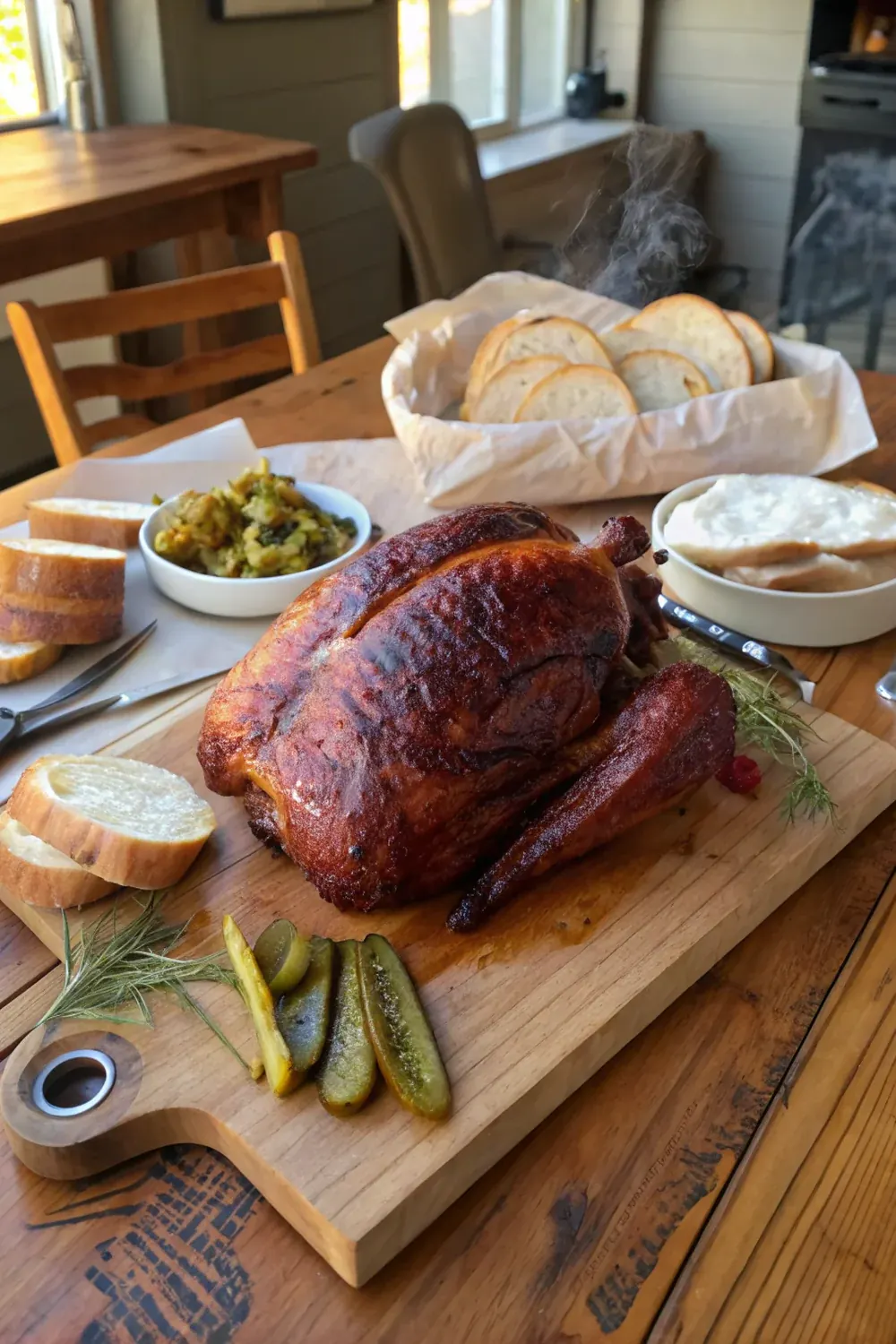
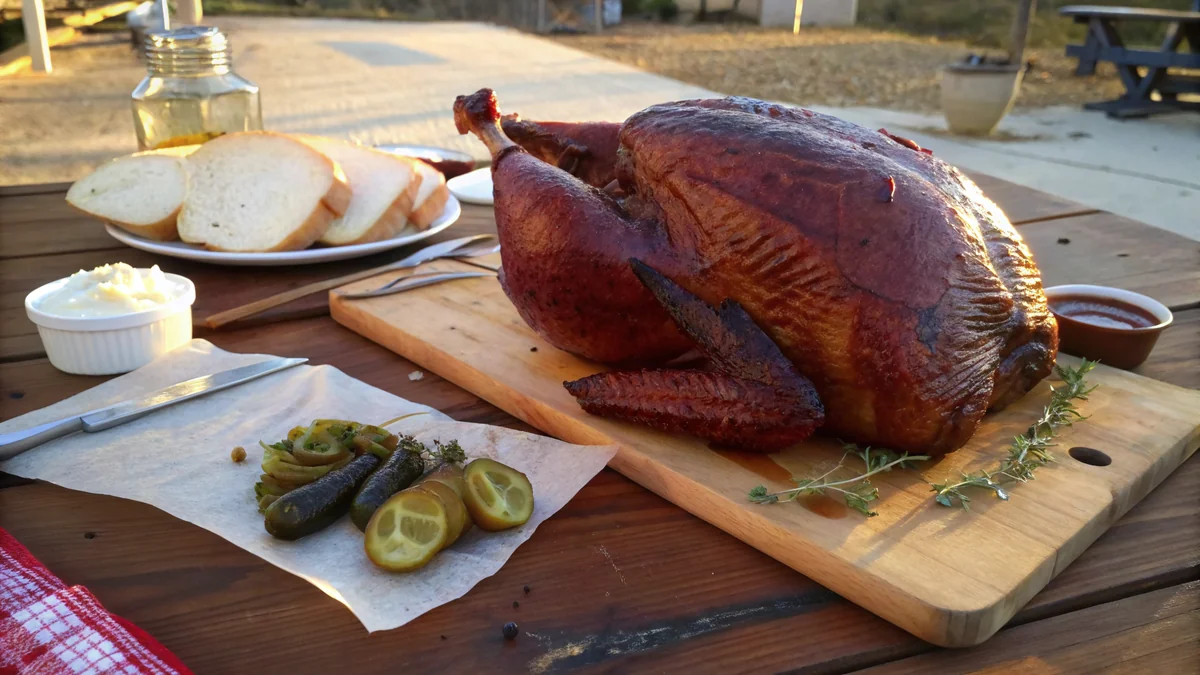
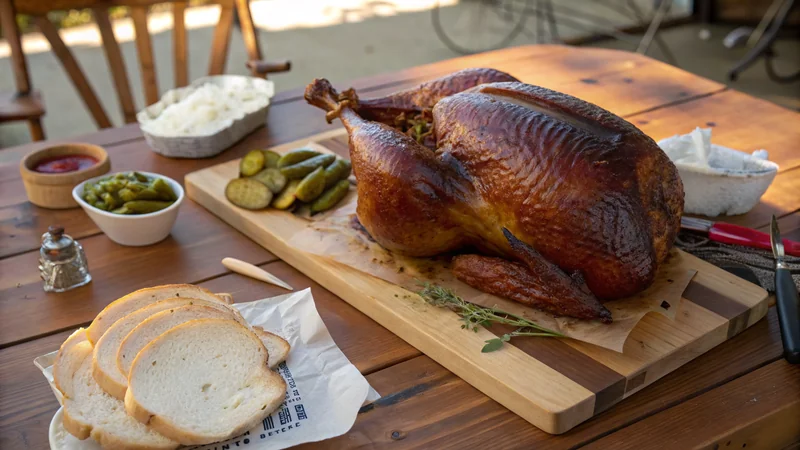
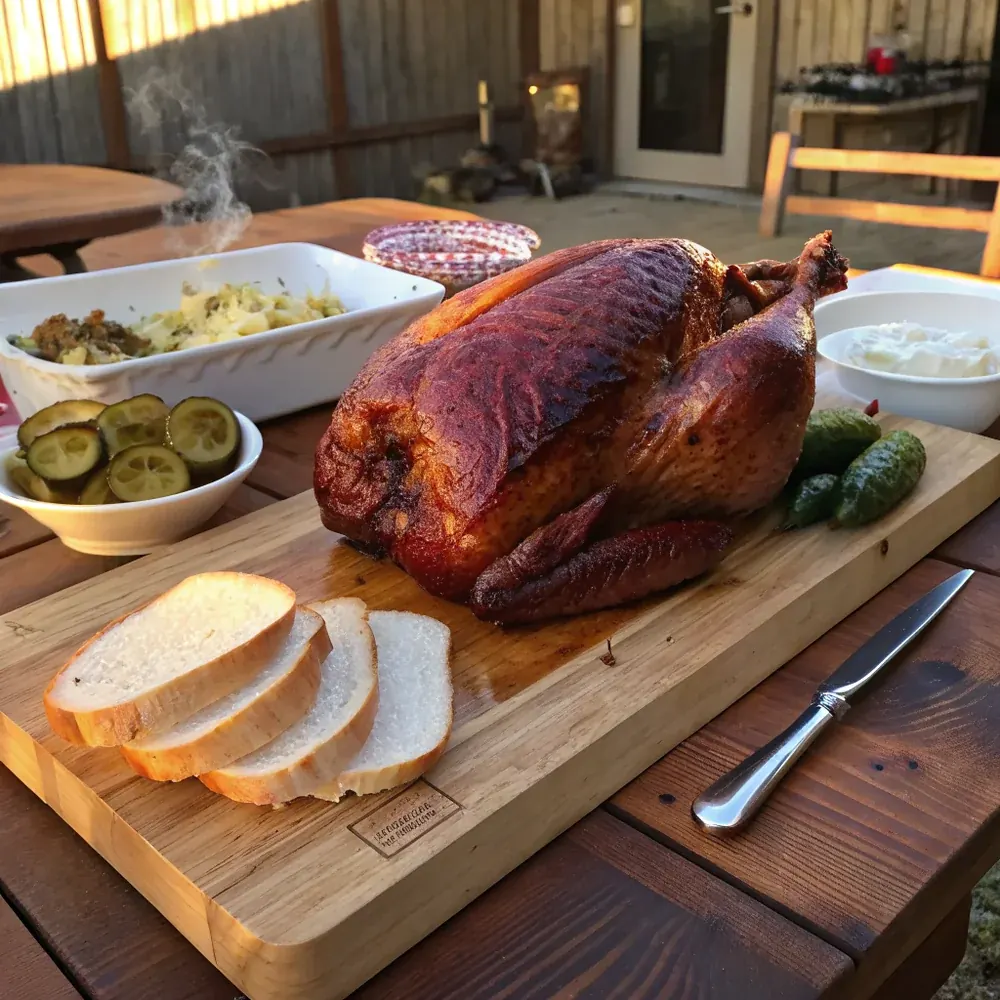
Texas BBQ presentation: butcher paper laid out on a serving board or platter, sliced breast and chunks of dark meat arranged side-by-side, a bowl of gravy alongside. Pickled jalapenos, dill pickles, and white bread (Mrs. Baird's is the canonical Texas brand) for the table. Cranberry sauce on the side - serve it, but do not put it on the bird; let diners spoon it onto their plate.
Make the gravy from the drippings while the bird rests. Strain the drippings (about 1.5 cups from a 12-pound bird) through a fine mesh sieve; skim the fat off the top. Reserve 3 tablespoons of the fat. In a saucepan, whisk the 3 tablespoons of turkey fat with 3 tablespoons flour over medium heat for 60 seconds until smooth. Whisk in the strained pan juices + 2 cups chicken stock, simmering until thickened, 5-7 minutes. Season with salt and pepper. Pour into a gravy boat. The gravy is the silent star of Thanksgiving; smoked drippings make it taste like nothing else. My turkey gravy page builds that sauce properly, from the giblet stock up, and the whole holiday plan lives in my Texas Thanksgiving guide.
Make-Ahead and Reheating
If you cannot smoke the turkey on Thanksgiving morning (kid logistics, oven conflict, weather), the bird can be smoked the day before and reheated for service. Smoke as written, rest 30 minutes, then refrigerate the whole bird (uncarved) overnight. The next day, reheat at 275F oven for 30-40 minutes wrapped in foil with 1/2 cup of stock or pan juices added. Internal temp should hit 145-150F (warm but not hot enough to dry out the breast). Carve and serve.
Smoke-and-reheat actually has advantages: the bird rests overnight in the fridge with the seasonings penetrating further, and you carve and reheat just the slices you need without losing 30 minutes of warm-time on Thanksgiving day. Many catering operations use this method exactly. The flavor is 95% the same as fresh-smoked.
Leftovers: refrigerated turkey keeps 4 days. Slice the meat off the bones the night of (faster cooling, easier storage); save the carcass for stock the next day. Use leftover smoked turkey in the same way you would use leftover smoked brisket - chopped into Texas BBQ sandwiches on cornbread, into Texas hash, into pot pies, or into weeknight dinner recipes originally written for rotisserie chicken.
The full day-after plan built for turkey specifically, from the Friday sandwich to a pot of tortilla soup from the carcass, is on my leftover turkey recipes page.
Carcass stock: simmer the bones with onion, carrot, celery, garlic, bay leaf, and water for 3 hours. Strain. The smoked turkey stock is incredible base for white chicken chili, gumbo, or post-Thanksgiving soup. Freezes 3 months in 2-cup portions.
How to Cook a Turkey Texas BBQ Style Recipe
Ingredients
- 1 whole turkey, 12 lb (5.4 kg), fresh or fully thawed
- 3 tablespoons (45 g) kosher salt, Diamond Crystal preferred
- 2 tablespoons (16 g) coarse 16-mesh black pepper
- 2 tablespoons garlic powder
- 1 tablespoon onion powder
- 1 tablespoon smoked paprika (optional, for deeper color)
- 8 tablespoons (113 g) unsalted butter, softened
- 8 fresh sage leaves, chopped (or 1 tbsp dried)
- 4 sprigs fresh thyme, leaves stripped
- Post oak chunks or splits, about 4-6 lb total
- Charcoal (lump or briquettes), about 4 lb
- 1 cup (240 ml) apple cider vinegar + 1 cup water, for the spritz bottle
- Aluminum foil, for tenting during the rest
- To serve: gravy from drippings, white bread, dill pickles, pickled jalapenos, cranberry sauce on the side
Instructions
- Dry-brine 24 hours ahead. The day before cooking, remove the turkey from packaging. Pat completely dry inside and out. Sprinkle 3 tablespoons kosher salt evenly over all surfaces - inside the cavity, under the skin where you can lift it (breasts, legs), on the outside. Set on a wire rack over a sheet pan, uncovered, in the fridge for 24 hours. The salt draws moisture, then the meat re-absorbs the salty liquid - the surface dries (essential for crispy skin) and the interior is uniformly seasoned all the way through.
- Bring to room temperature. Pull the turkey from the fridge 60-90 minutes before cooking. A cold-from-the-fridge bird takes 30% longer to cook and the temperature gradient between surface and center stays wide. Set on a sheet pan on the counter. The skin should feel cool but not refrigerator-cold when you press it.
- Set up the pit at 275F over post oak. Light a chimney of charcoal. Once fully ashed, pour onto one side of a kettle (two-zone setup) or in the firebox of an offset smoker. Add 2 chunks of post oak directly on the coals. Place the cooking grate. Cover and stabilize the chamber temperature at 275F (135C) - 5-10 minutes of vent adjustments. Aim for thin blue smoke; white billowing smoke is unburnt fuel and tastes acrid. Set up a water pan on the indirect side; the steam moderates the chamber temperature.
- Apply the rub and butter. Mix the black pepper, garlic powder, onion powder, and smoked paprika in a small bowl. In another bowl, mix the softened butter with the chopped sage and thyme leaves. Lift the skin of the turkey at the breast, thigh, and back where you can. Push the herb butter under the skin in even patches; smooth from the outside to distribute. Pat any excess butter onto the outside of the bird. Sprinkle the pepper-garlic rub liberally over the entire exterior, pressing into the skin. The bird should look thoroughly seasoned but not crusted.
- Place breast-up on the indirect side. Set the turkey on the indirect heat side of the grill, breast-up. Insert a leave-in probe thermometer into the thickest part of the breast (avoiding the bone) and another into the thigh (also avoiding bone). Close the lid. The chamber temperature should immediately settle back to 275F; if it dropped below 250F when you opened the lid, give it 5 minutes to recover before starting the timer.
- Smoke for the first 2 hours undisturbed. Do not open the lid for the first 2 hours. Every lid lift drops the chamber temperature 25-50F and adds 15-20 minutes of cook time. The first 2 hours is when the smoke ring forms and the skin starts to develop color. Keep the fire steady - feed splits or chunks of post oak as needed to maintain 275F. After 2 hours, the breast should read about 130F and the skin should be turning deep golden.
- Spritz hourly from hour 2 onward. Fill a spray bottle with the apple cider vinegar + water mix. After hour 2, lift the lid quickly and spritz the entire surface of the bird every hour. The vinegar acid helps the skin crisp and adds subtle tang; the water helps moderate the surface temperature. Each spritz takes 10 seconds; close the lid immediately. Continue spritzing through hour 3.
- Pull at 165F breast / 175F thigh. At about hour 3.5 to 4, the breast probe should read 162-165F (72-74C) and the thigh probe should read 173-178F (78-81C). USDA safe minimum is 165F throughout, but the white meat at the breast is done at 162F (carryover finishes the cook to 165F+) and the dark meat at the thigh needs the higher temperature for collagen breakdown. Pull the bird with these temps in the 165/175 zone. Total cook time for a 12 lb turkey at 275F is typically 3.5 to 4.25 hours.
- Rest 30 minutes tented under foil. Transfer the smoked turkey to a large cutting board. Tent loosely with aluminum foil. Let rest a full 30 minutes - non-negotiable. The juices need to redistribute, the carryover finishes the cook (the breast climbs from 165 to 168-170F during the rest), and the meat firms up enough to slice cleanly. Use the rest as the window to make the gravy from the drippings, warm the cornbread, and finish the sides.
- Carve and serve Texas BBQ style. Remove the legs and thighs first by cutting through the joint where they meet the body. Remove each breast in one piece by cutting along the breastbone. Slice the breast across the grain into 1/2-inch slices; pull the dark meat off the bones in chunks. Arrange on butcher paper or a wooden board with white bread, dill pickles, and pickled jalapenos. Serve with gravy made from the drippings, plus the standard Texas Thanksgiving sides: <a href='https://www.texanrecipes.com/authentic-texas-style-corn-bread-recipe/'>Texas cornbread</a>, <a href='https://www.texanrecipes.com/texas-bbq-potato-salad-recipe/'>Texas BBQ potato salad</a>, <a href='https://www.texanrecipes.com/texas-roadhouse-green-bean-recipe/'>Texas Roadhouse green beans</a>, ranch beans, and cranberry sauce on the side.
Frequently Asked Questions
How long does it take to smoke a 12 lb turkey?
About 3.5 to 4.25 hours at a steady 275F over post oak. Smaller birds (10-11 lb) finish closer to 3 hours; larger birds (13-14 lb) take 4.5 hours. Always cook to internal temperature, not time: pull when the breast reads 165F (74C) and the thigh reads 175F (79C). A leave-in probe thermometer is essential - opening the lid every 30 minutes to check with an instant-read adds 30+ minutes to the total cook time.
Can I smoke a turkey in an oven with a smoker box?
You can get a faint smoke note in an oven with stovetop liquid smoke or a smoker tube with chips, but it will not match a real outdoor smoke. The oven cooks at higher temperatures than a smoker (typical oven roast 325F vs smoker 275F) and the convection heat is different. If you don't have outdoor equipment, oven-roast the bird and accept it for what it is; don't pretend an oven turkey is a smoked turkey.
Do I have to dry brine 24 hours, or can I rush it?
24 hours is the right window for a 12-pound bird. 12 hours works in a pinch with slightly less seasoning penetration. Anything under 8 hours doesn't allow the salt to fully equilibrate through the meat - the surface will be over-salty and the interior bland. If you forget to brine the day before, you can skip the dry brine entirely and add 1 extra tablespoon of salt to the rub - the bird will be acceptable but not as fully seasoned.
What temperature should turkey be smoked at?
275F (135C) is the Texas BBQ standard for turkey. Lower (225F, brisket temp) takes too long for turkey and dries out the breast. Higher (325F, oven temp) cooks too fast for the smoke to penetrate. The 275F window is hot enough to render the skin crispy in about 4 hours and cool enough to keep the breast juicy. Some pit masters go as high as 300F for shorter cook times; either works.
What wood is best for smoking turkey?
Post oak is the Central Texas standard and the right choice if you can get it - clean, neutral, savory. Pecan is the second-best option (sweet, slightly fruity). Apple wood is mild and works well for turkey. Hickory is more assertive and works in moderation. Avoid mesquite past 2 hours - it turns acrid; for a 4-hour turkey cook, mesquite will overpower. Use post oak or pecan as your default.
How do I keep the turkey breast from drying out?
Five rules: (1) dry brine 24 hours; (2) push herb butter under the skin before cooking; (3) maintain steady 275F (don't let the temperature spike); (4) pull the breast at 162-165F internal, not higher; (5) rest a full 30 minutes before carving. Following all five gives you juicy breast meat. Skipping any one gives you slightly drier meat. Skipping multiple gives you cardboard.
Can I smoke a frozen turkey?
No - the bird must be fully thawed before cooking. Frozen turkey takes 1 day per 4 lb of bird in the fridge to thaw. Plan ahead: a 12-pound frozen bird needs to come out of the freezer Saturday night for a Wednesday smoke (3 days). For emergency same-day thaw, submerge the wrapped bird in cold water in the sink, changing the water every 30 minutes - takes about 30 minutes per pound (so 6 hours for a 12 lb bird).
Do I baste the turkey while smoking?
Spritzing yes (apple cider vinegar + water 50/50 every 60 minutes from hour 2 onward); traditional basting with butter or pan drippings - generally no. Spritzing helps crisp the skin without softening it; brushing on melted butter or pan drippings during the cook softens the skin into a soggy, dull-yellow finish. The herb butter under the skin handles the moisture-and-flavor work; the spritz handles the surface. Avoid the lift-the-lid-and-baste-with-a-brush move that works for oven roasting.
How much smoked turkey per person?
Plan for 3/4 to 1 lb of raw weight per person for a Thanksgiving meal with sides. A 12-pound bird feeds 10-12 people generously with 2-3 pounds of leftovers. For a smaller crowd (6-8 people), a 10 lb bird is the right size; for a larger crowd (12-15+), smoke two 12-pound birds rather than one 18-pound bird - smaller birds cook better and you get more skin per person. The full charts, by crowd size and by cut, are in my guide to how much turkey per person.