How to Reheat Brisket
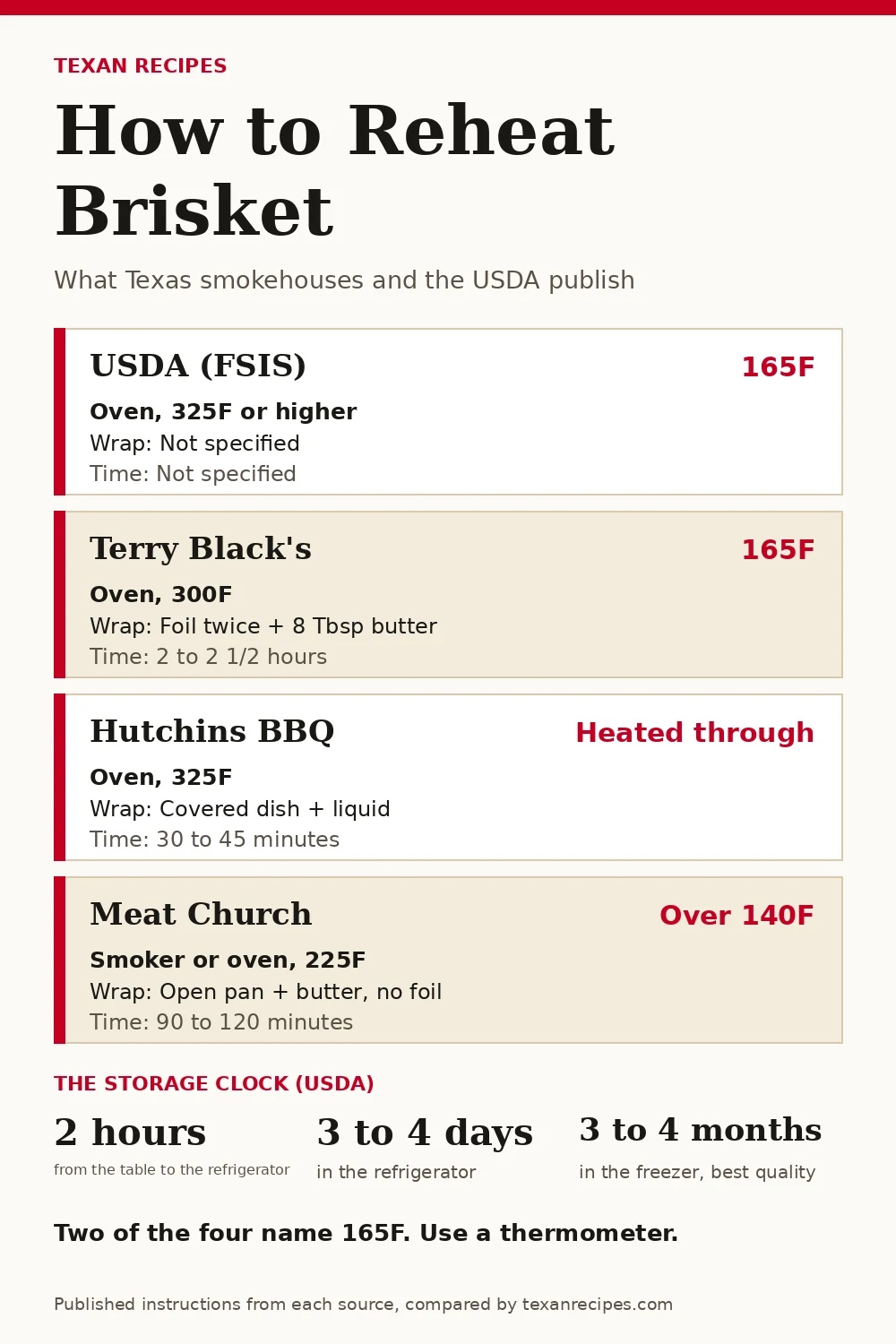
To reheat brisket without drying it out, wrap it tightly in foil with melted butter, saved drippings, or beef broth and warm it in a 300 to 325F oven until the center reads 165F. Slices in a covered dish take 30 to 45 minutes; a whole brisket takes 2 hours or more. Those figures come from the instruction sheets Texas smokehouses give their own customers. This page compares them line by line with the USDA rules, because advice elsewhere runs from 225F ovens to 140F targets and rarely explains the gap.
The short answer: reheat brisket covered, with added fat or liquid, at 300 to 325F, and trust a thermometer over the clock. Terry Black's Barbecue tells customers to baste a whole brisket with a stick of melted butter, wrap it twice in foil, and heat it at 300F for 2 to 2 1/2 hours until it reaches 165F, then rest it 30 minutes. The USDA sets the same 165F target for every leftover. Slice after reheating when possible. Reheat only what will be eaten.
What Texas Smokehouses and the USDA Tell You to Do
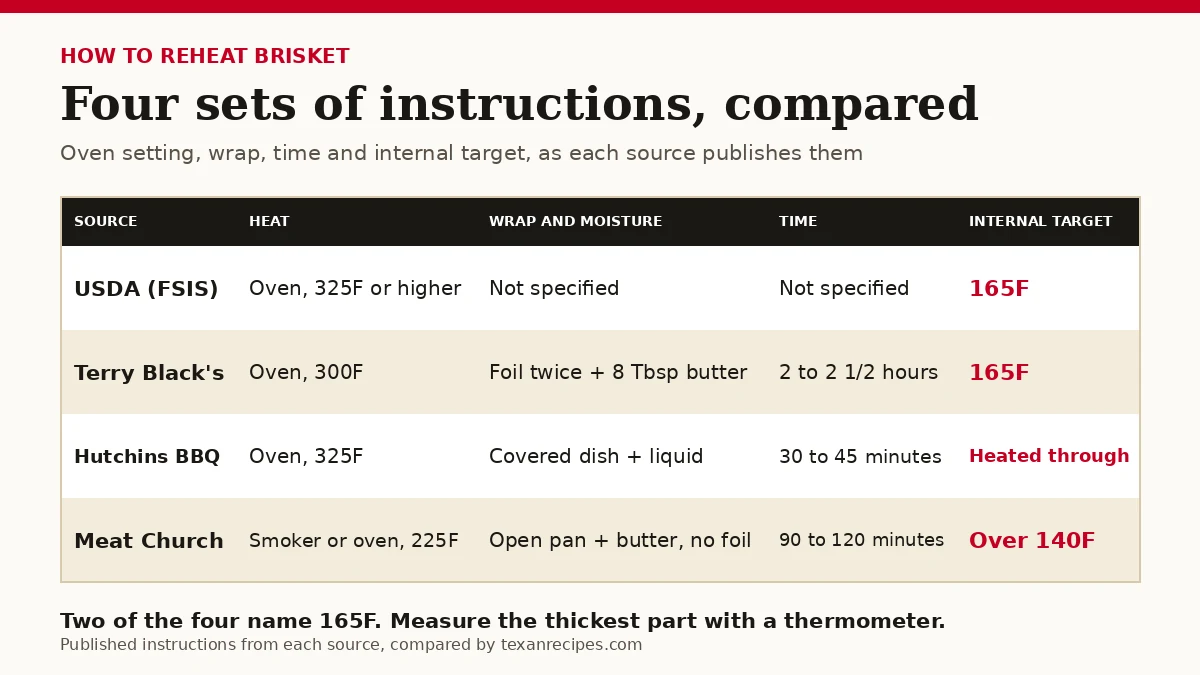
Texas smokehouses and the USDA agree on the basics: cover the brisket, add fat or liquid, and heat it gently until it is hot all the way through. They disagree on the numbers, with oven settings from 225F to 325F and internal targets from just over 140F to 165F.
The table uses published instructions only. Terry Black's Barbecue hands a thawing and reheating sheet to customers who buy chilled meat from its pits in Austin, Dallas, Lockhart, and four other Texas cities. Hutchins BBQ, in McKinney and Frisco, keeps a reheating guide on its site. Meat Church, the Waxahachie rub company, posts two methods for a whole chilled brisket. The federal row combines the USDA pages on leftovers and take-out food.
| Source | Heat | Wrap | Added moisture | Time | Internal target |
|---|---|---|---|---|---|
| USDA Food Safety and Inspection Service | Oven set no lower than 325F | Not specified | Not specified | Not specified | 165F |
| Terry Black's Barbecue (Austin, Dallas, Lockhart) | Oven, 300F | Foil, wrapped twice | 1 stick (8 Tbsp) melted butter | 2 to 2 1/2 hours, then a 30 minute rest | 165F |
| Hutchins BBQ (McKinney, Frisco) | Oven, 325F | Foil-lined dish, covered tightly with foil | A little liquid or water | 30 to 45 minutes | Not stated (heated through) |
| Meat Church (Waxahachie), dry heat | Smoker, pellet grill, or oven, 225F | Open pan or original butcher paper, no foil | Slices of butter on top | 90 to 120 minutes | Over 140F |
| Meat Church (Waxahachie), sous vide | Water bath, 165F | Vacuum-sealed bag | Cook liquid or beef tallow in the bag | 90 to 120 minutes | Not stated (bath temperature) |
Read side by side, the rows sort themselves. The two restaurants that write for paying customers heat at 300 to 325F under foil, and the one that names a temperature picks 165F, the federal figure. The 225F, foil-free method comes from a pitmaster reheating a whole brisket that was chilled in one piece, where saving the bark is the goal and two hours of patience is the price.
For most leftover brisket, which is sliced, a few days old, and headed for a weeknight dinner, the restaurant rows are the ones to copy, even though foil costs some bark.
140F or 165F: Which Internal Temperature Is Right
Heat leftover brisket to 165F, measured in the thickest part, whenever it was stored more than a day, shipped, thawed, or served to guests. A lower finish of 140 to 155F is a texture choice some pitmasters make with brisket they chilled quickly at home, and it falls short of the federal guideline.
The USDA does not grade leftovers by cut. Its leftovers guidance asks for 165F on a food thermometer, and its fact sheet on how temperatures affect food words the same rule as 165F or until hot and steaming. The reason is the band between 40F and 140F, where the agency says bacteria can double in as little as 20 minutes.
Meat Church stops its 225F method once the brisket is over 140F, and the 8 pound brisket in its own example read 158F after two hours. That lower finish keeps a lean flat from tightening. It leaves no margin for a brisket that sat on a serving table through a long party before anyone thought about the refrigerator.
Brisket handles 165F better than most beef. A steak is served at 145F or less, so 165F overcooks it. A brisket already went to about 203F on the pit to melt its collagen, the pull temperature in this site's Texas BBQ brisket recipe, so 165F is well below heat it has already survived. Dry reheated brisket comes from evaporation off cut surfaces, and foil with added liquid is the fix for that.
How to Reheat Brisket in the Oven
Set the oven to 300 to 325F, wrap the brisket tightly in two layers of foil with butter, drippings, or beef broth, and heat it on a sheet pan until the center reaches 165F. Plan on 30 to 45 minutes for a covered dish of slices and 2 to 2 1/2 hours for a whole brisket.
Whole or large pieces
These steps follow the Terry Black's sheet, with the USDA oven setting noted where the two differ.
- Thaw a frozen brisket in the refrigerator, still in its packaging. Terry Black's allows 1 to 2 days.
- Heat the oven to 300F, the Terry Black's setting, or to 325F, the lowest oven setting the USDA recommends for reheating.
- Lay the brisket bark side up on a large sheet of foil. Baste the top with melted butter (a full stick, 8 tablespoons, for a whole brisket), or spoon over saved drippings, beef tallow, or beef broth.
- Wrap it tightly, then wrap it again in a second sheet. Set the packet on a rimmed sheet tray to catch leaks.
- Heat until a thermometer pushed into the thickest part reads 165F: 2 to 2 1/2 hours for a whole brisket at 300F. A smaller piece finishes much sooner, so start checking it after 45 minutes.
- Open the foil carefully, away from the steam, and rest the brisket 30 minutes.
- Slice against the grain, starting from the lean flat end.
Foil softens bark. That is the trade. Meat Church skips foil for this reason, saying it steams the bark off, and reheats in an open pan at 225F instead. A middle path keeps the foil for most of the cook and folds it open for the last few minutes so the surface dries.
Sliced brisket
Slices have far more exposed surface than a whole brisket, so they go in a dish with liquid under them. The Hutchins BBQ method is a 325F oven, a shallow baking dish lined with foil, a little liquid or water in the bottom, and a tight foil cover, for 30 to 45 minutes or until heated through.
Overlap the slices like shingles so each one shields the next. Pour beef broth or saved drippings around them. Check the middle of the stack with a thermometer at the 30 minute mark and take the dish out at 165F.
How to Reheat Brisket Sous Vide
Sous vide is the most forgiving way to reheat brisket because the meat sits sealed in its own juices and can never get hotter than the water around it. Meat Church sets the bath to 165F and leaves a whole vacuum-sealed brisket in it for 90 to 120 minutes.
In the Meat Church example, a 9 pound brisket spent 2 hours in the bath. The same post says to keep leftover cook liquid or beef tallow in the bag, and to squeeze the fat from the butcher paper onto the meat if the brisket was wrapped in paper on the pit. Slice it as soon as it comes out.
There are two limits. The brisket has to be sealed before it is chilled, which takes planning on the night of the cook. And the bark comes out of the bag soft, because nothing in a water bath can dry a surface. Sealed meal-size portions make the method practical: one bag, straight from refrigerator to water, no added liquid.
How to Reheat Brisket on a Smoker or Pellet Grill
A smoker or pellet grill reheats brisket the way an oven does, with indirect heat and a closed lid, and it suits whole briskets best. Meat Church runs the cooker at 225F with the brisket in an open pan under slices of butter and reports 90 to 120 minutes.
The Meat Church instructions put the brisket on a disposable pan or a sheet pan, unwrapped or still in its original butcher paper, with butter laid over the top. Foil is left out to protect the bark. An 8 pound brisket reached 158F inside after 2 hours.
Note the gap. A 225F cooker runs 100 degrees under the lowest oven setting the USDA gives for reheating, so the thermometer carries the whole safety check here. For a brisket that was stored several days, keep it on until it reads 165F, even though that adds time past the two hour mark.
Small Portions: Stovetop, Air Fryer, and Microwave
For one or two servings, a covered pot on the stove is the gentlest quick method, the air fryer works with foil, and the microwave is the last resort. All three need added liquid and a cover, because a few slices of brisket have almost no moisture to spare.
Stovetop. Hutchins BBQ uses a pot with 1/4 to 1/2 inch of water in the bottom, a lid, and medium heat, about 10 minutes for a single serving. Watch that the water does not boil away. Beef broth in place of water adds flavor, and chopped brisket with a spoonful of barbecue sauce suits this method well.
Air fryer. Moving hot air dries bare slices fast. The PureWow version wraps the brisket in foil with its juices or broth and gives it about 35 minutes at 350F, which makes the air fryer a small oven. It is a fair choice when the big oven is busy.
Microwave. Hutchins BBQ covers the brisket with a damp paper towel in a microwave-safe dish and heats it 1 to 2 minutes on high. The USDA fact sheet adds three habits for any microwaved leftover: cover the food, rotate it, and allow at least 2 minutes of standing time so cold spots catch up.
Why the Slow Cooker Is the Wrong Tool
A slow cooker heats cold brisket too slowly, so the meat can sit for hours in the temperature range where bacteria multiply. The USDA page on slow cookers says reheating leftovers in one is not recommended and tells cooks to use the stove, the microwave, or an oven first.
Several popular guides suggest about four hours on low, PureWow among them. The federal advice runs the other way: bring the food to 165F by a faster method, then move it into a preheated slow cooker and hold it at 140F or above. That second step earns the appliance a place at a party. Brisket reheated in the oven, sliced, and kept in its juices stays ready for a buffet line.
Point and Flat Do Not Reheat the Same Way
The flat is the lean half of a brisket and dries out first, so it needs the most liquid and the tightest wrap. The point carries far more fat between its muscle fibers, which makes it forgiving enough to reheat as cubes, chopped beef, or thick slices.
Store the two halves apart if the brisket was separated for slicing. Keep the flat in one block and slice it after reheating, since every cut face is an exit for moisture. Terry Black's tells customers to start slicing from the lean flat side, against the grain.
The point has a different problem. Its fat turns firm and waxy in the refrigerator, and a point that is only lukewarm eats greasy. Heat it all the way to 165F so that fat softens again. Chopped point with a little sauce in a covered pot is the fastest route to smoked brisket sandwiches.
How to Reheat Brisket From Frozen
Thaw frozen brisket in the refrigerator before reheating it; Terry Black's allows 1 to 2 days in the original vacuum packaging. The USDA says frozen leftovers can also go straight into the oven without thawing, a route that is safe but takes longer.
Thawed brisket heats evenly, and that is the reason to plan ahead. When there is no time, the USDA leftovers page allows reheating from frozen in an oven or a microwave. Keep the brisket in foil with liquid, use the 325F setting, and probe the center, because the outside of a frozen block gets hot long before the middle does.
Vacuum-sealed frozen portions can go into a 165F water bath in their bag and need extra time there. Skip the kitchen counter for thawing. The surface of the meat warms into the 40 to 140F range while the core is still ice.
Storing Leftover Brisket So It Reheats Well
Refrigerate leftover brisket within 2 hours of the meal, in shallow containers or tightly wrapped portions with its juices. It keeps 3 to 4 days in the refrigerator and 3 to 4 months in the freezer at best quality, the windows the USDA gives for cooked leftovers.
The 2 hour limit drops to 1 hour when the air is above 90F, which describes an ordinary summer afternoon in a Texas backyard. Both numbers come from the USDA fact sheet on temperature, which also asks for shallow containers so food cools quickly. A whole hot brisket is a dense block. Cut it into halves or large chunks before it goes in the refrigerator, and keep that refrigerator at 40F or below, the setting the CDC recommends.
Three habits on the night of the cook decide how the reheat goes. Leave the meat in the biggest pieces that fit the container. Pour the drippings and any tallow into a jar, because they are the reheating liquid. Wrap tightly or vacuum seal, and write the date on the bag. The USDA notes that frozen leftovers stay safe indefinitely but lose moisture and flavor with time.
Reheating Methods at a Glance
The oven handles any amount of brisket and is the default, sous vide gives the juiciest result for sealed portions, and the smoker suits a whole brisket when bark matters. Whatever the method, the finish line is the same thermometer reading of 165F in the thickest part.
| Method | Setting | Published time | Best for | Source of the numbers |
|---|---|---|---|---|
| Oven, foil-wrapped | 300F | 2 to 2 1/2 hours, plus 30 minutes of rest | Whole or half briskets | Terry Black's Barbecue |
| Oven, covered dish | 325F | 30 to 45 minutes | Sliced leftovers | Hutchins BBQ |
| Sous vide | 165F water bath | 90 to 120 minutes | Vacuum-sealed brisket | Meat Church |
| Smoker or pellet grill, open pan | 225F | 90 to 120 minutes | A whole brisket when bark matters | Meat Church |
| Stovetop, covered pot | Medium heat, 1/4 to 1/2 inch of water | About 10 minutes per serving | Chopped brisket, single servings | Hutchins BBQ |
| Air fryer, in foil | 350F | About 35 minutes | A small piece when the oven is busy | PureWow |
| Microwave, covered | High | 1 to 2 minutes, then 2 minutes of standing | One plate in a hurry | Hutchins BBQ, USDA |
| Slow cooker | Not for reheating | Holding only, at 140F or above | Keeping reheated brisket hot for a buffet | USDA |
Match the row to what is in the refrigerator, add the liquid, and take the brisket out at 165F. Pulled pork and ribs from the same cook need different timings, covered in the best way to reheat pulled pork and how to reheat smoked ribs.
FAQ: Reheating Brisket
How do you reheat brisket without drying it out?
Keep it covered and add moisture before any heat reaches it. Wrap the brisket in two layers of foil with melted butter, saved drippings, or beef broth, heat it in a 300 to 325F oven, and take it out when the thickest part reads 165F. Leave it unsliced if possible, because every cut face loses juice.
What temperature should brisket be reheated to?
The USDA target for all leftovers is 165F, measured with a food thermometer in the thickest part. Terry Black's Barbecue gives customers the same 165F figure for its brisket. Some pitmasters stop once the meat passes 140F to protect the texture of lean slices, which is below the federal guideline.
How long does it take to reheat brisket in the oven?
A whole brisket wrapped in foil takes 2 to 2 1/2 hours at 300F, by the instructions Terry Black's Barbecue publishes, plus a 30 minute rest. A covered dish of slices takes 30 to 45 minutes at 325F, the range Hutchins BBQ gives. Size changes the time, so go by the thermometer.
Can you reheat brisket in the microwave?
Yes, for a single serving. Put the slices in a microwave-safe dish with a spoonful of broth or drippings, cover them with a damp paper towel, and heat 1 to 2 minutes. The USDA advice for microwaved leftovers is to cover the food, rotate it, and let it stand 2 minutes so the heat evens out.
Can you reheat brisket in a slow cooker?
No. The USDA says reheating leftovers in a slow cooker is not recommended, because cold food warms too slowly in it. Reheat the brisket to 165F in the oven, on the stove, or in the microwave, then move it to a preheated slow cooker to keep it at 140F or above for serving.
How long does leftover brisket last in the fridge?
Leftover brisket keeps 3 to 4 days in a refrigerator set to 40F or below, the USDA window for cooked leftovers. Refrigerate it within 2 hours of the meal. Frozen, it stays at best quality for 3 to 4 months and remains safe beyond that as long as the freezer holds 0F.
Sources
- Terry Black's Barbecue, Thawing and Reheating Instructions (customer instruction sheet)
- Hutchins BBQ, Reheating Barbecued Brisket: An Easy Guide
- Meat Church, How to Reheat Brisket
- USDA Food Safety and Inspection Service, Leftovers and Food Safety
- USDA Food Safety and Inspection Service, Safe Handling of Take-Out Foods
- USDA Food Safety and Inspection Service, How Temperatures Affect Food
- USDA Food Safety and Inspection Service, Slow Cookers and Food Safety
- Centers for Disease Control and Prevention, Preventing Food Poisoning
- PureWow, How to Reheat Brisket (air fryer and slow cooker figures)