Southern Comfort Food
Texas Cornbread Dressing
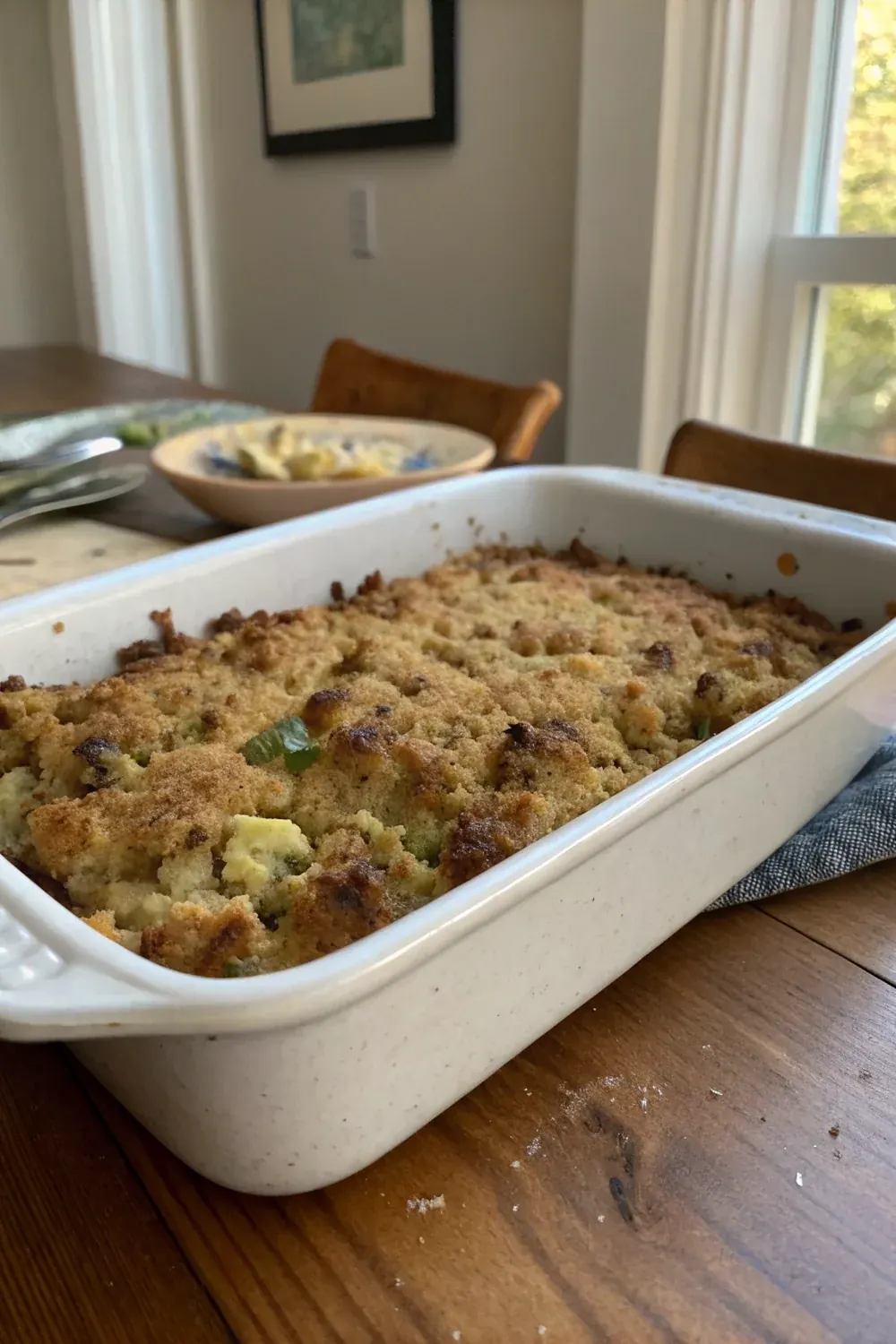
Texas cornbread dressing with sage, sausage, pecans, day-old cornbread. The Hill Country Thanksgiving stuffing alternative, baked in a casserole.
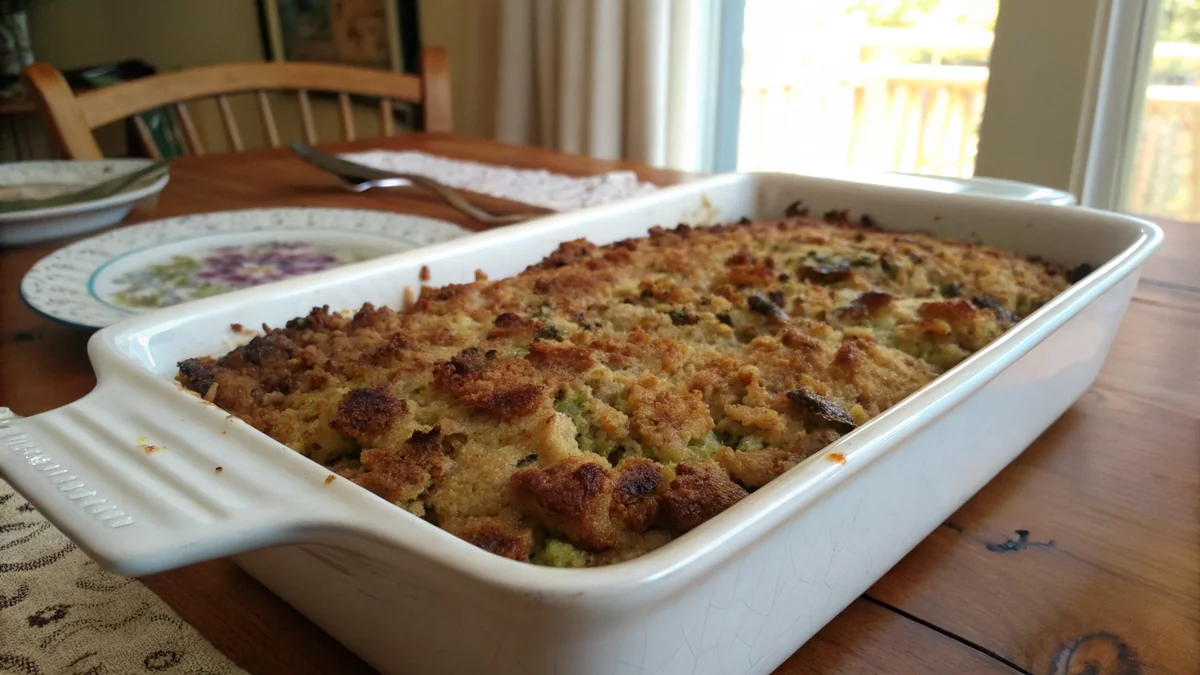
Quick answer: Texas cornbread dressing is a Thanksgiving casserole made by tearing day-old cornbread into a buttered 9x13 pan, layering it with browned breakfast sausage, toasted pecans, sauteed onion and celery, fresh sage and thyme, and binding it with eggs and rich turkey or chicken stock. It bakes at 375F for 40-45 minutes until the top is crisp and golden and the inside is tender but not soggy. Texans call it dressing, not stuffing, because it bakes in a casserole dish, not inside the bird - and the difference matters in this part of the country.
My grandmother lived in a small house outside Fredericksburg, and the most reliable thing about Thanksgiving in that house was that the turkey was an afterthought. The casserole everyone actually came for was the cornbread dressing, made in a 9x13 dish that came out of the oven last so it could rest while the turkey was being carved. By the time the plates came around, the dressing was the first thing on the spoon and the second helping was negotiated before the first was finished. The turkey was a side dish in our house. The dressing was Thanksgiving.
Texas cornbread dressing is not stuffing. We are particular about the word and we are particular about the technique. Stuffing goes inside the bird and tends toward bread cubes and a wetter texture. Dressing bakes in a separate casserole, gets a crisp golden top, and lives or dies on the quality of the cornbread you tear into the pan. The recipe below is the one my grandmother taught my mother and my mother taught me, with a few tweaks for modern kitchens: a touch more sausage, San Saba pecans for crunch, and a sage-thyme blend that tastes more like Hill Country in November than the boxed-mix poultry seasoning most American kitchens reach for.
Stuffing vs Dressing: The Texas Terminology
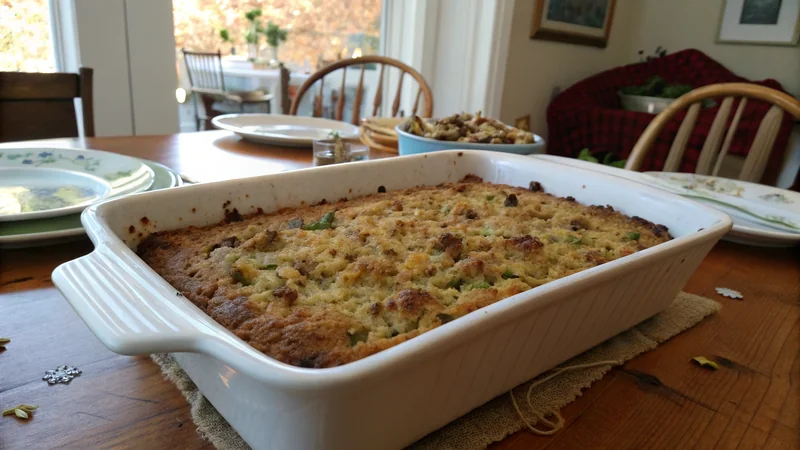
In Texas, stuffing and dressing are not interchangeable. Stuffing goes inside the bird; dressing bakes in a separate casserole dish. The technical difference matters because the cooking method changes the texture: stuffing inside the cavity stays moist and dense from the bird's juices, while dressing in a casserole develops a crispy golden top and a tender, slightly drier interior. Most of the American South leans toward dressing for the same reason Texas does - the casserole format lets the cornbread base hold its identity instead of dissolving into pulpy bird-juice mush.
There is also a food safety dimension. The USDA recommends against stuffing the cavity because the dressing has to reach 165F internal to be safe, and the bird is usually finished long before the cavity contents catch up. Pulling the bird at safe-stuffing temperature usually means an over-cooked turkey. Casserole dressing solves this entirely - the dressing bakes on its own schedule, and the turkey comes off when the breast is at 165F regardless.
Vocabulary aside, the cultural difference is real. If a Texas grandmother hears you say "stuffing," she will pause and gently correct you, possibly while passing you the casserole. The word "dressing" carries the Hill Country tradition of cornbread bases, sage and thyme, sausage and pecans. "Stuffing" carries the New England tradition of bread cubes, dried cranberries, and herb blends. Both are valid, both are Thanksgiving, but they are not the same dish.
Cornbread Base Strategy
The single most important decision in this recipe is the cornbread you start with. Use a real Texas-style cornbread - savory or barely sweet, with a coarse crumb, baked in a cast iron skillet or a 9x13 pan. Authentic Texas Cornbread is the standard. Avoid sweet Northern-style cornbread (Jiffy mix, the 50% sugar versions) - the sweetness throws off the savory dressing entirely.
Day-old or two-day-old cornbread is non-negotiable. Fresh cornbread is too tender and will turn to mush when the stock pours over it. A day on the counter or in a paper bag dries out the crumb just enough to absorb stock without collapsing. If you forgot to bake ahead, dry the torn pieces on a sheet pan in a 250F oven for 30 minutes. Skip this step at your peril.
Tear the cornbread by hand into rough 3/4-inch pieces, not cubes. The irregular tear creates more surface area and uneven edges that brown beautifully on top. Cubes look uniform but bake into a more bread-stuffing texture. The torn pieces are what give Texas dressing its rustic, casserole-from-grandma look.
Some Cooks Add White Bread - Should You?
About a third of Texas family recipes include 1-2 cups of torn white bread or biscuits alongside the cornbread. The white bread softens the cornbread crumb slightly, helps the dressing bind, and is a nod to the Tennessee and East Texas traditions where biscuits are the standard. The all-cornbread version is more rustic and more savory; the cornbread-plus-white-bread version is closer to a stuffing-dressing hybrid.
If you want to try the hybrid, replace 2 cups of the torn cornbread with 2 cups of torn day-old white bread, biscuits, or even sourdough. The proportions, herbs, and bake time stay the same. The result is slightly softer and slightly less corn-forward. And if you want to skip cornbread altogether, my Texas toast stuffing is the all-bread version built on thick, buttery Texas toast.
My grandmother was an all-cornbread purist and that is the version below. It tastes most like Texas. But if you grew up with the white bread addition, it is also a legitimate Hill Country recipe and you should not feel like you are betraying the tradition by including it.
The Sausage Choice
Bulk breakfast sausage is the canonical choice. Look for sage-flavored if your grocery carries it - Jimmy Dean Premium Pork Sausage Sage, Owens Sausage Sage, or H-E-B Hill Country Fare Sage Sausage are all reliable. Sage is the central herb of Texas cornbread dressing, and starting with sage-flavored sausage layers the flavor twice over.
If you cannot find sage sausage, regular bulk breakfast sausage works fine - just increase the chopped fresh sage to 3 tablespoons (or 1 tablespoon dried) to compensate. Avoid Italian sausage (the fennel and red pepper push the dish toward Italy, not Texas) and avoid maple breakfast sausage (the sweetness fights the savory dressing).
Use 1 pound of sausage for the canonical balance. More sausage starts to dominate; less sausage and the dressing tastes thin. Brown it hard - really hard - until you have crispy edges, not just gray pebbles. The browned bits add caramel notes that disappear into the casserole and give the finished dish its depth.
The Texas Pecan Addition
Pecans in cornbread dressing are a Hill Country signature, traceable to the fact that Texas grows the largest pecan crop in the country and San Saba sits at the center of the pecan belt. Pecans add textural contrast (crunch against the soft cornbread), a slight buttery richness, and a visual hallmark that distinguishes Texas dressing from the Carolinas or Tennessee versions.
Toast the pecans before adding. Toasting in a dry skillet over medium-low heat for 4-5 minutes activates the oils and deepens the flavor. Untoasted pecans soften in the casserole and lose their crunch entirely. Toasted pecans hold their texture through the bake.
If you have a pecan allergy at the table, walnuts are a passable substitute. They taste slightly more bitter but the textural role is similar. Avoid skipping the nut entirely - it leaves a textural hole in the dressing that nothing else fills as well.
The Sage and Thyme Herb Blend
Sage is the lead herb. It is what Thanksgiving smells like in a Texas kitchen. Use fresh sage if you can - 2 tablespoons finely chopped, packed loose. Fresh sage carries a bright, almost minty note that dried sage lacks. If you only have dried, use 2 teaspoons and rub it between your palms before adding to release the oils. Avoid "poultry seasoning" mixes - they include too much salt and the proportions are off for dressing.
Thyme plays second chair. A tablespoon of fresh thyme leaves (or 1 teaspoon dried) brings a savory, almost piney background note that keeps the sage from feeling cloying. Together, sage and thyme are the canonical Texas dressing herb blend.
If you want to expand the herb profile slightly, add 2 teaspoons of finely chopped fresh parsley at the end (after the casserole comes out of the oven, sprinkled on top). Parsley adds visual freshness without competing with the sage. Avoid rosemary - it is too piney for cornbread dressing and dominates anything else in the herb blend.
The Stock Method
Use real turkey stock if you have made it from neck and giblets, low-sodium chicken stock if you have not. The stock is what carries the salt, the savory backbone, and the moisture. Better Than Bouillon turkey paste is a very acceptable shortcut - 2 teaspoons in 3 cups of hot water gives a deep flavor most cooks cannot match with packaged broth.
Warm the stock before pouring. Cold stock takes longer to soak in and can create uneven moisture pockets. Microwave or warm on the stove until just steaming, then whisk in the eggs and cream off heat. Pouring boiling stock onto eggs scrambles them; pouring warm stock onto eggs binds them perfectly.
Pour the stock-egg mixture slowly and stop before you have used all 3 cups. Different cornbreads absorb different amounts of liquid - dense buttermilk cornbread takes more, fluffy stand-mixer cornbread takes less. The mixture should look damp and cohesive, not sloppy. If you over-pour, the dressing comes out wet and pudding-like; under-pour and it comes out dry. Aim for damp, like a moist gravel. That same stock, made properly from the neck and giblets, is also the foundation of the turkey gravy, so it is worth simmering a double batch on the same afternoon and splitting it between the two dishes.
The Bake Strategy
Bake at 375F for 40-45 minutes uncovered, in a generously buttered 9x13 ceramic or metal casserole dish. Ceramic gives a slower, more even bake and produces a softer top crust; metal browns harder and faster. Both work; ceramic is the Hill Country grandmother default.
Do not cover the dish during the bake. The crispy golden top is the signature of Texas cornbread dressing - covering it produces a steamed, soft top that is fine but not Texas. If your top browns before the inside is set (around minute 30), tent loosely with foil for the last 10 minutes.
Check doneness with a thermometer: the center should read 160F minimum, ideally 165F. The top should be deep golden with crispy peaks; the edges should pull slightly from the casserole. If the top is pale and the center is set, brown under the broiler for 90 seconds, watching constantly - dressing burns fast under direct heat.
Make-Ahead 24 Hours
Texas cornbread dressing is one of the most make-ahead-friendly Thanksgiving dishes you can prepare. Bake the cornbread 2 days ahead. Brown the sausage, saute the vegetables, and chop the pecans up to 24 hours ahead - store separately in airtight containers in the fridge.
On Thanksgiving morning, combine all dry components in the casserole, refrigerate covered, and pull out 30 minutes before baking. Whisk the stock-egg mixture fresh and pour over the dressing right before it goes into the oven. This timing keeps the eggs from sitting overnight in liquid (which can cause the proteins to break down and make the dressing rubbery).
If you need to fully assemble the dressing the day before, pour 75% of the stock-egg mixture, cover, refrigerate. Add the remaining 25% just before baking. Pull from the fridge 45 minutes ahead and add 5-7 minutes to the bake time. The texture will be 90% as good as fresh-assembled - acceptable for a stress-free Thanksgiving morning. Which dish gets made on which day, across the whole menu, is laid out in my Texas Thanksgiving guide.
Vegetarian Adaptation
Replace the breakfast sausage with 12 oz of finely chopped cremini or shiitake mushrooms sauteed in 3 tablespoons of butter until deeply browned and slightly crispy at the edges (about 12 minutes). Mushrooms provide the umami depth the sausage normally carries. Add 2 teaspoons of soy sauce or Worcestershire to amplify the savory note.
Use vegetable stock or mushroom stock instead of turkey stock. A homemade vegetable stock with caramelized onion and roasted garlic gives the deepest flavor; Better Than Bouillon vegetable base is a fine shortcut.
Increase the sage to 3 tablespoons fresh and add 1 teaspoon of smoked paprika to bring the smoky-savory note that the sausage normally provides. The vegetarian version is genuinely good, not a sad substitute - my mother makes both versions every year for the cousins who do not eat meat.
Chef Mia's Kitchen Notes
My grandmother stored her dressing recipe in her head, never wrote it down, and changed proportions every year based on what was on hand. The recipe above is my best reconstruction from watching her cook a dozen Thanksgivings. The thing she always said: "the cornbread tells you when there is enough stock." If you cannot tell yet, err on the side of less stock - dry dressing is fixable with extra gravy at the table; wet dressing is not.
I bake a small extra ramekin of dressing alongside the casserole every year. It is the cook's snack, eaten standing up at the counter while everyone else sits down. It is also a good test bake - if the small ramekin is browned and set at minute 30, the casserole will be ready at minute 40-42, not 45.
If your casserole has a glass lid, use it once you have pulled the dressing from the oven. The glass lid traps just enough heat to keep the dressing serving-warm for 30 minutes without continuing to cook. This is how my grandmother held the dish while the turkey was being carved.
Mistakes to Avoid
Fresh cornbread. Cornbread baked the same day will turn to mush. Bake at least 24 hours ahead, ideally 48. If you forgot, dry the torn pieces in a 250F oven for 30 minutes.
Over-pouring the stock. Wet, soggy dressing is the most common failure. Pour slowly, stop when the mixture looks damp and cohesive, not sloppy. You can always add more before baking.
Sweet cornbread. Jiffy mix and the heavy-sugar Northern cornbreads make a dressing that tastes like dessert. Use a savory or barely sweet Texas-style cornbread.
Italian or maple sausage. Italian fennel and maple sweetness fight the sage profile. Use plain or sage breakfast sausage.
Covering the bake. The crispy top is the signature. Do not cover unless the top is browning faster than the center is setting.
Variations
Oyster dressing. Add 1 cup of drained shucked oysters with their liquor before the bake. Oyster dressing is a Gulf Coast Texas tradition, especially in Houston and Galveston families.
Jalapeno-cheddar. Add 1 finely diced jalapeno and 1 cup of shredded sharp cheddar to the mixture before baking. This pushes the dressing toward Tex-Mex Thanksgiving and pairs especially well with smoked turkey.
Cornbread-and-biscuit. Replace 2 cups of cornbread with 2 cups of torn day-old buttermilk biscuits. The result is softer and slightly more bread-stuffing-like. East Texas tradition.
Andouille and Cajun. Replace breakfast sausage with andouille and add 1 teaspoon of Cajun seasoning. Trades Hill Country for Acadiana but is a delicious detour.
Fennel-and-leek. Replace celery with finely diced fennel bulb and onion with thinly sliced leek. Lighter, more aromatic, slightly French. Worth trying once.
What to Serve With Texas Cornbread Dressing
The canonical Texas Thanksgiving plate: dressing, smoked or roasted turkey, gravy, cranberry sauce, sweet potato casserole, green beans, dinner rolls, and pecan or sweet potato pie. Texas dressing is the centerpiece, not a side; everything else orbits it.
If you are smoking the turkey, follow the Texas BBQ-style turkey method and serve the dressing alongside. The smoked turkey and the savory dressing complement each other in a way that roasted turkey and dressing cannot quite match.
Two more pairings from the same table. A from-scratch green bean casserole bakes alongside this dressing in the turkey's last hour, and on Friday a cold slab of this dressing is the foundation of the sandwich that opens my leftover turkey recipes.
For sides, Texas scalloped potatoes and buttermilk sweet potato pie round out the plate without competing with the dressing's sage-and-pecan profile. For more comfort food sides, see the Southern Comfort Food category. This dressing starts with a pan of skillet cornbread baked a day ahead and left to dry out.
Texas Cornbread Dressing Recipe
Ingredients
- For the cornbread base (make 1-2 days ahead):
- 1 batch of <a href='https://www.texanrecipes.com/authentic-texas-style-corn-bread-recipe/'>Authentic Texas Cornbread</a>, cooled, dried 24-48 hours, torn into rough 3/4-inch pieces (about 8 cups)
- For the dressing:
- 1 lb (450 g) bulk breakfast sausage, sage-flavored if available (Jimmy Dean, Owens, or H-E-B Hill Country)
- 1 cup (115 g) chopped Texas pecans, toasted
- 1 large yellow onion, finely diced (about 1.5 cups)
- 3 celery ribs, finely diced (about 1 cup)
- 4 tablespoons unsalted butter
- 2 tablespoons fresh sage, finely chopped (or 2 teaspoons dried)
- 1 tablespoon fresh thyme leaves (or 1 teaspoon dried)
- 1 teaspoon kosher salt
- 1/2 teaspoon freshly ground black pepper
- 3 cups (720 ml) low-sodium turkey or chicken stock, warm
- 3 large eggs, beaten
- 1/4 cup heavy cream (optional, for richness)
- Butter for greasing the casserole
Instructions
- Prepare the cornbread the day before. Bake a full pan of Texas cornbread 24-48 hours before Thanksgiving. Cool, then tear into rough 3/4-inch pieces. Spread the torn cornbread on a sheet pan and leave uncovered on the counter overnight. Day-old cornbread is non-negotiable - fresh cornbread turns to mush under the stock pour. If you forgot to bake ahead, spread the torn pieces on a sheet pan and dry in a 250F oven for 30 minutes.
- Toast the pecans. Spread the chopped pecans on a small dry skillet over medium-low heat. Toast for 4-5 minutes, stirring often, until fragrant and one shade darker. Pull immediately - pecans go from toasted to burned in 30 seconds. Set aside to cool.
- Brown the sausage. In a large heavy skillet over medium-high heat, crumble the breakfast sausage. Cook for 8-10 minutes, breaking it up with a wooden spoon, until fully browned with crisp edges. Use a slotted spoon to transfer the cooked sausage to a paper-towel-lined plate. Leave about 2 tablespoons of rendered fat in the skillet for the next step.
- Saute the onion and celery. Add the butter to the same skillet with the sausage drippings. Once melted, add the diced onion and celery. Cook over medium heat for 8-10 minutes, stirring occasionally, until the vegetables are soft and translucent but not browned. Add the chopped sage, thyme, salt, and pepper, and cook 1 minute more. Pull from heat.
- Combine in a large bowl. In a large mixing bowl, combine the torn cornbread, browned sausage, toasted pecans, and the sauteed onion-celery-herb mixture. Toss gently with two large spoons or your hands until evenly distributed. The mixture should still look dry at this point - that is correct.
- Add the stock and eggs. In a separate bowl, whisk the warm stock, beaten eggs, and heavy cream (if using) until smooth. Pour the wet mixture slowly over the cornbread mixture, folding gently as you pour. Stop pouring when the cornbread is moistened but not soaked - you want the mixture to look damp and just-cohesive, not sloppy. Depending on your cornbread's age and density, you may use 2.5 cups of stock or the full 3 cups. Err on the side of less stock; you can always add more before baking.
- Transfer to the casserole and bake. Generously butter a 9x13 ceramic or metal casserole dish. Spread the cornbread mixture into the dish in an even layer. Dot the top with a few small pats of butter for browning. Bake at 375F (190C) for 40-45 minutes, uncovered, until the top is golden brown with crispy edges and the center reads 160F internal on a thermometer.
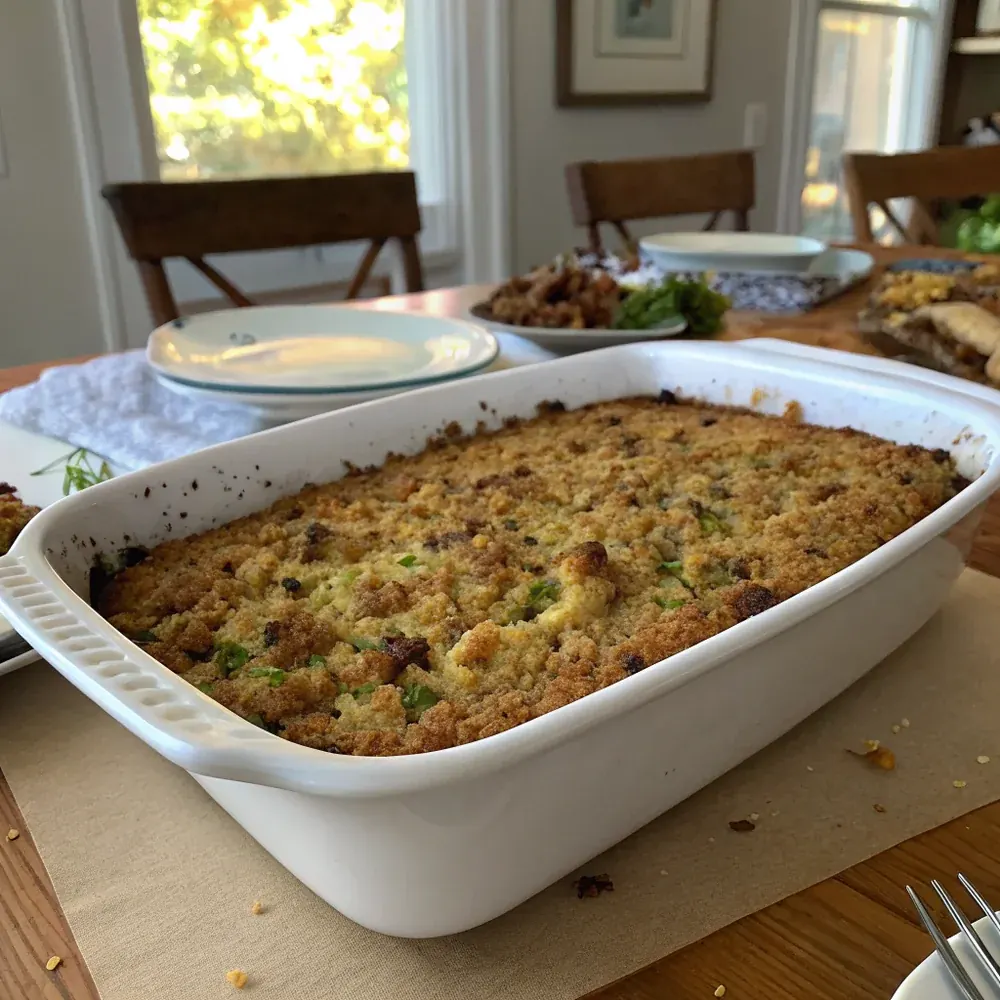
- Rest before serving. Pull the dressing from the oven and let it rest 10 minutes on a wire rack. The center will set during the rest and the texture will firm up. Serve directly from the casserole with a large spoon. The crispy top is the best part - make sure every plate gets some.
Frequently Asked Questions
What is the difference between dressing and stuffing?
Dressing bakes in a separate casserole dish; stuffing bakes inside the bird. Texas and most of the American South use "dressing" for the casserole version, which is structurally different from New England-style stuffing - the cornbread base, the casserole bake, the crispy golden top, and the food-safety advantage are all dressing hallmarks. The two words are not interchangeable in Texas.
Can I bake the dressing the day before?
Partially. Brown the sausage, saute the vegetables, toast the pecans, and tear the cornbread up to 24 hours ahead - store the components separately in the fridge. On Thanksgiving morning, combine, pour the stock-egg mixture, and bake. If you must bake the full casserole the day before, reheat covered at 325F for 20 minutes plus 5 minutes uncovered. The texture is 90% as good as fresh.
Why does my cornbread dressing come out soggy?
Two common causes: fresh (not day-old) cornbread, or too much stock. Cornbread needs 24-48 hours to dry out enough to absorb stock without collapsing. And the standard 3 cups of stock is a maximum - some cornbreads only need 2.5 cups. Pour slowly, stop when the mixture looks damp and cohesive, and add more only if the casserole still looks dry going into the oven.
Can I freeze cornbread dressing?
Yes, but reheat carefully. Freeze the fully baked casserole tightly wrapped in plastic and foil for up to 2 months. Thaw overnight in the fridge, then reheat covered at 325F for 25 minutes plus 5-10 minutes uncovered to re-crisp the top. The texture is good but not perfect - some egg-set firmness loss is normal. Better to assemble fresh and freeze leftover portions.
Do I have to use cornbread, or can I use bread cubes?
Texas cornbread dressing is, by definition, cornbread dressing. Switching to bread cubes makes it a different dish - closer to a New England stuffing. Some Texas family recipes use a 70/30 cornbread-to-white-bread blend, which is the canonical East Texas hybrid. All cornbread is the most Texas version. Pure white bread cubes is no longer Texas dressing, even if you bake it the same way.
How much dressing do I need per person?
Plan for about 1 cup of cooked dressing per adult guest at Thanksgiving, assuming a full plate with all the trimmings. A 9x13 casserole serves 10-12 generously. For 16-20 guests, double the recipe and bake in two casseroles. For very large family gatherings, triple the recipe and use a hotel pan or two stacked 9x13s.
Can I make this dressing gluten-free?
Yes - use a gluten-free cornbread recipe (most cornbread is naturally gluten-free if you use cornmeal alone or a gluten-free flour blend), gluten-free sausage (verify the casing if any), and certified gluten-free chicken stock. The texture is almost identical to standard. Avoid replacing some cornbread with gluten-free white bread - it tends to crumble too fine.
Why does my dressing taste flat?
Three usual culprits: under-seasoned cornbread base (Texas cornbread should already be salty before it goes into the dressing), under-toasted pecans (raw pecans add no flavor), or low-sodium stock without enough added salt. Taste the mixture before adding the eggs - it should taste already-savory, with the herbs and salt forward. If it tastes bland, add 1/2 teaspoon more salt and a teaspoon more sage and re-taste.