Southern Comfort Food
Texas Mint Julep
The Kentucky Derby classic with a Texas twist: Garrison Brothers or Balcones bourbon, Hill Country peach, fresh Bandera mint, crushed ice, silver julep cup.
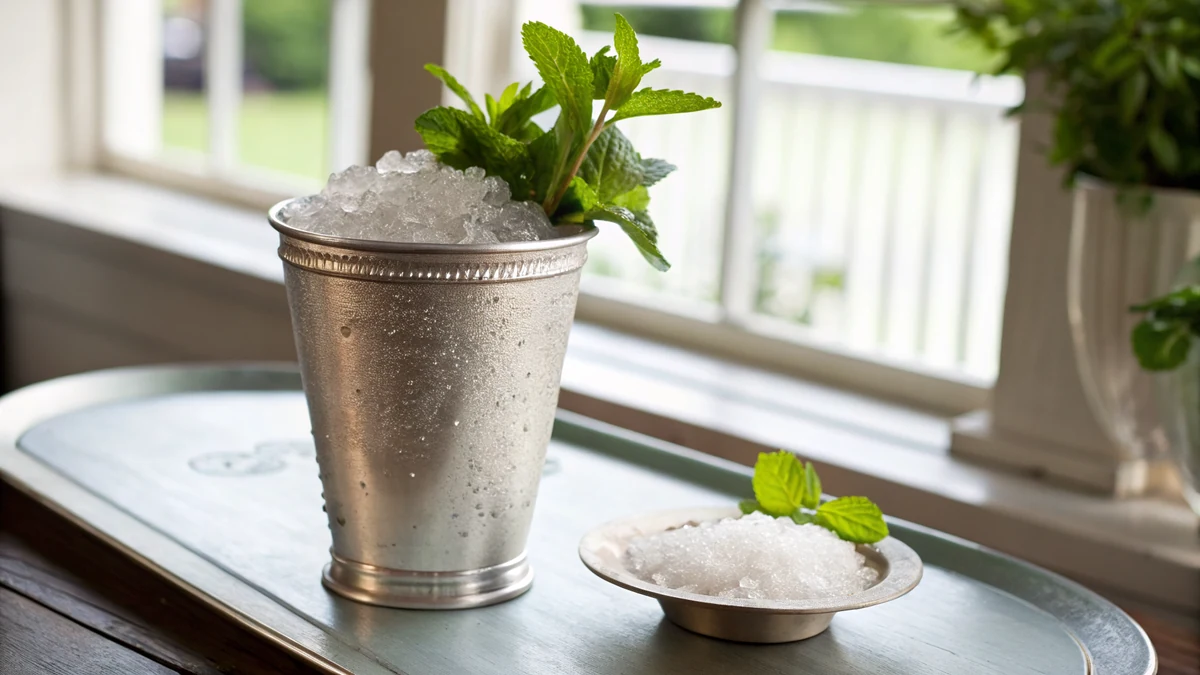
Quick answer: A Texas mint julep is the Kentucky Derby classic adapted for Hill Country porches: 2.5 oz of Texas bourbon (Garrison Brothers, Balcones, Treaty Oak, or Still Austin), simple syrup or muddled sugar, 8 to 10 fresh mint leaves gently bruised, and a generous mound of crushed ice in a frosted silver julep cup. The summer Texas version adds a slice or puree of ripe Hill Country peach from Fredericksburg orchards. Garnish with a fresh mint bouquet, slap to release oil, and sip slowly through a short straw. Total time 5 minutes; serves one.
I made my first Texas mint julep on the first Saturday in May at a Hill Country porch party in Fredericksburg, the radio tuned to the Kentucky Derby pre-show, a peach orchard across the road, and three silver julep cups my hostess had inherited from her grandmother going slowly white in the freezer. The bourbon was Garrison Brothers Small Batch, made twenty minutes up the road in Hye, Texas. The mint was a fistful of spearmint pulled from a galvanized tub by the porch steps. The peach was a Vogel orchard freestone, sliced thin and dropped into the cup before the crushed ice. When the horses left the gate, I took my first sip, and the drink was bourbon, mint, sugar, peach, and cold, in that order, and it was perfect.
A mint julep is a Kentucky drink, and I will not pretend Texas invented it. The cocktail traces to the American South in the late eighteenth century, was codified at Churchill Downs in Louisville for the Derby in the 1930s, and has been the official drink of the race ever since. But the Texas Hill Country has its own bourbon now, made in Hye and Waco and Dripping Springs and Austin, and we have peaches every summer from Fredericksburg and Stonewall, and we have a tradition of throwing Derby Day parties on porches from San Antonio to Tyler. The Texas mint julep is what you get when Kentucky bourbon culture meets a Hill Country summer. Total time 5 minutes; the cup needs to come straight from the freezer. For the non-Derby weekends, a pitcher of sweet tea holds the porch down, and my Texas cocktails guide rounds up all nine drinks a Texas bar should know.
The Derby Day Connection: Kentucky Origin and Texas Adoption
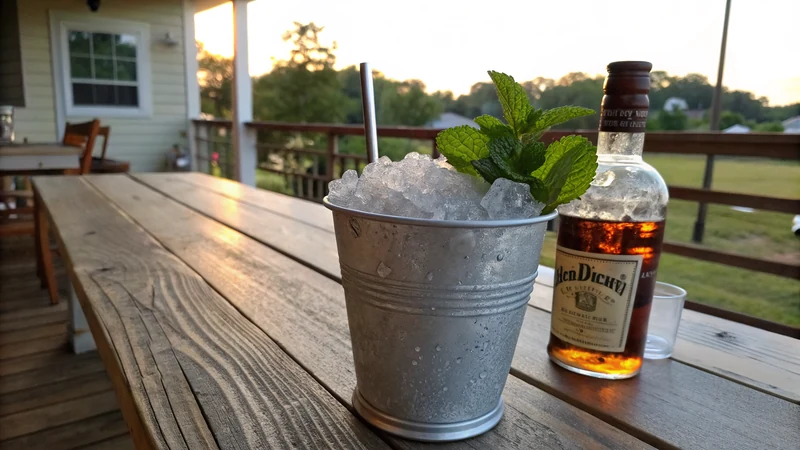
The mint julep is a Kentucky drink and a Southern drink before it is a Texas drink. The cocktail traces to the late eighteenth century in the American South, when Virginia and Kentucky planters drank bourbon, mint, sugar, and ice (when ice was available, which was not often) on hot summer afternoons. The name comes from the Arabic julab, a rose-water syrup, which traveled through Persian and Spanish into English by the seventeenth century. By the 1820s, mint juleps were a fixture in Southern hotels and steamboats, and by 1938, Churchill Downs in Louisville had made the mint julep the official cocktail of the Kentucky Derby. Roughly 120,000 juleps are poured every Derby weekend.
Texas adoption came through a few channels. Houston and Dallas were Southern cities first and Western cities second, and the Derby has always been an event watched on Texas porches; Derby Day parties at private clubs and restaurants from the Petroleum Club in Houston to the Headington Companies set in Dallas have been pouring juleps since the 1950s. The Hotel Saint Cecilia in Austin throws a Derby Day garden party every year on its South Congress lawn, and the bartenders pour Texas-bourbon juleps to a crowd in seersucker. The drink is Kentucky in heritage and Texas in execution.
The Texas twist is bourbon. Until about 2010, every mint julep in Texas was made with Kentucky bourbon (Maker's Mark, Woodford Reserve, Buffalo Trace) because there was no other option. The Texas Hill Country bourbon boom of the 2010s changed that. Garrison Brothers in Hye started distilling in 2008 and bottling in 2010; Balcones in Waco followed. By 2020, a Texas mint julep meant Texas bourbon, and the Hill Country had a Derby Day drink that was distinctly its own.
Bourbon Selection: Kentucky vs Texas Hill Country
The classic Kentucky mint julep uses Kentucky bourbon: Maker's Mark, Woodford Reserve, Buffalo Trace, Old Forester, or Knob Creek are the standard Derby-Day choices. Churchill Downs has a sponsorship deal with Woodford Reserve, and the bottle is on every concession menu at the track. Kentucky bourbon is corn-forward, mellow, with vanilla and caramel notes from the limestone-filtered water and the long Kentucky cave aging. A julep made with Kentucky bourbon is the canonical reference.
Texas bourbon is different. The Texas Hill Country climate produces aggressive temperature swings (forty-degree daily ranges are common), and the bourbon barrels expand and contract through the wood faster than they do in Kentucky. The result is bourbon that ages roughly twice as fast: a three-year Texas bourbon tastes like a six-year Kentucky bourbon, with heavier oak, more vanilla, and more spice. Garrison Brothers Small Batch is the canonical Hill Country julep bourbon, with deep caramel, dark cherry, and a long warm finish. Balcones Texas Pot Still is richer, bigger, and slightly more wood-forward.
For a Texas mint julep, I use Garrison Brothers Small Batch as my default. The bourbon is bottled at 94 proof, which is the right strength for a julep (high enough to carry through the ice and mint, low enough not to burn). If I want more body, I pour Balcones Texas Pot Still. For a softer summer pour, Treaty Oak Ghost Hill works beautifully. Still Austin The Musician is the newer entry, distilled in south Austin, and it is bright and grain-forward, which I like for the peach variation.
The Mint Question: Spearmint vs Peppermint, Fresh vs Muddled
Use spearmint, not peppermint. Spearmint (Mentha spicata) is the mild, sweet, garden-variety mint with broader leaves and a softer aroma; peppermint (Mentha piperita) is the sharper menthol-forward mint used in candy canes and toothpaste. Peppermint in a julep tastes medicinal, cold, and wrong. Spearmint is what every Kentucky Derby julep recipe specifies and what every Texas Hill Country herb garden grows by default. If you are not sure which you have, smell a leaf: spearmint smells green and grassy, peppermint smells icy and sharp.
Bandera mint is the regional name some Hill Country gardeners use for the mild spearmint variety that grows easily in the Texas hill soil. It is not a separate species, just a local strain of common spearmint that handles Texas heat and the Bandera County climate well. If you have a friend with a Hill Country herb tub, that is your mint source; if not, any grocery-store spearmint from Central Market or HEB works fine. Buy it the day you make the cocktail; mint wilts within 48 hours.
The bruising debate: how hard do you muddle. The answer is gently, four to six taps, just enough to release the volatile oils on the leaf surface. Hard muddling shreds the chlorophyll in the leaves, releases bitter compounds, and turns the cocktail grassy and astringent. The Churchill Downs official mint julep recipe specifies to bruise, not crush. If your mint at the bottom of the cup is in tatters, you over-muddled.
Sugar Form Debate: Simple Syrup vs Muddled Sugar Cube
The classic recipe calls for a muddled sugar cube. The technique: drop a single white sugar cube into the cup, add 1 teaspoon of water, and muddle until the sugar dissolves and forms a paste. Then add the mint and bourbon. The sugar-cube version is the Churchill Downs traditional method and is on the printed recipe at the track. The flavor is the same as simple syrup; the technique is just slower.
Simple syrup is easier and more consistent. A 1:1 syrup (1 cup sugar dissolved in 1 cup water over low heat) gives you 0.5 oz of pre-dissolved sweetness per julep with no grit. Most modern Texas bartenders use simple syrup because you can batch it, keep it in the fridge for 2 weeks, and pour clean every time. The Hotel Saint Cecilia in Austin uses simple syrup for their Derby Day juleps because they are pouring hundreds in an afternoon and the cube method does not scale.
Mint-infused simple syrup is a third option. Make standard simple syrup, drop a handful of fresh mint sprigs into the hot syrup, let steep for 15 minutes, strain out the mint, and refrigerate. The infused syrup adds a base layer of mint flavor that doubles up with the bruised leaves in the cup. Some Texas bartenders swear by it; others say it muddies the fresh mint aroma. Try both and see which you prefer; my house default is mint-infused for summer and plain syrup for year-round. Liquor.com has a side-by-side breakdown of both methods.
Crushed Ice Technique: Lewis Bag, Blender, Freezer Method
Crushed ice is the fundamental texture of a julep. The ice must be in rough pebble-sized pieces, not cubed and not snow-fine. Pebbles pack into the cup with small air gaps, which let the bourbon and mint syrup find their way through; cubes are too big and leave large channels; snow-fine ice is too wet and dilutes the drink in three minutes flat. The target is pieces roughly the size of a pencil eraser.
The Lewis bag is the canonical tool. A Lewis bag is a heavy canvas bag (around $20 at Cocktail Kingdom or any bar supply shop) designed to be filled with ice cubes and pounded with a wooden mallet. The canvas absorbs the meltwater so the ice stays dry, and the cloth deadens the noise so you are not banging metal on metal. Fill the bag halfway with cubes, fold the top, and whack on a cutting board for about 30 seconds. The bag yields perfectly dry pebble ice every time.
Substitutes if you do not have a Lewis bag: wrap ice cubes in a clean kitchen towel and crush with a rolling pin, or pulse cubes in a blender for 5 seconds. The blender method is fast but produces wetter ice; drain off the meltwater through a strainer before using. Some Texas bartenders pre-fill an ice tray with water that has been boiled and cooled (which produces clearer ice) and freeze it overnight; the clarity does not matter once the ice is crushed, but the cooled-boiled-water method does produce slower-melting pieces.
The Silver Julep Cup and the Frost Rule
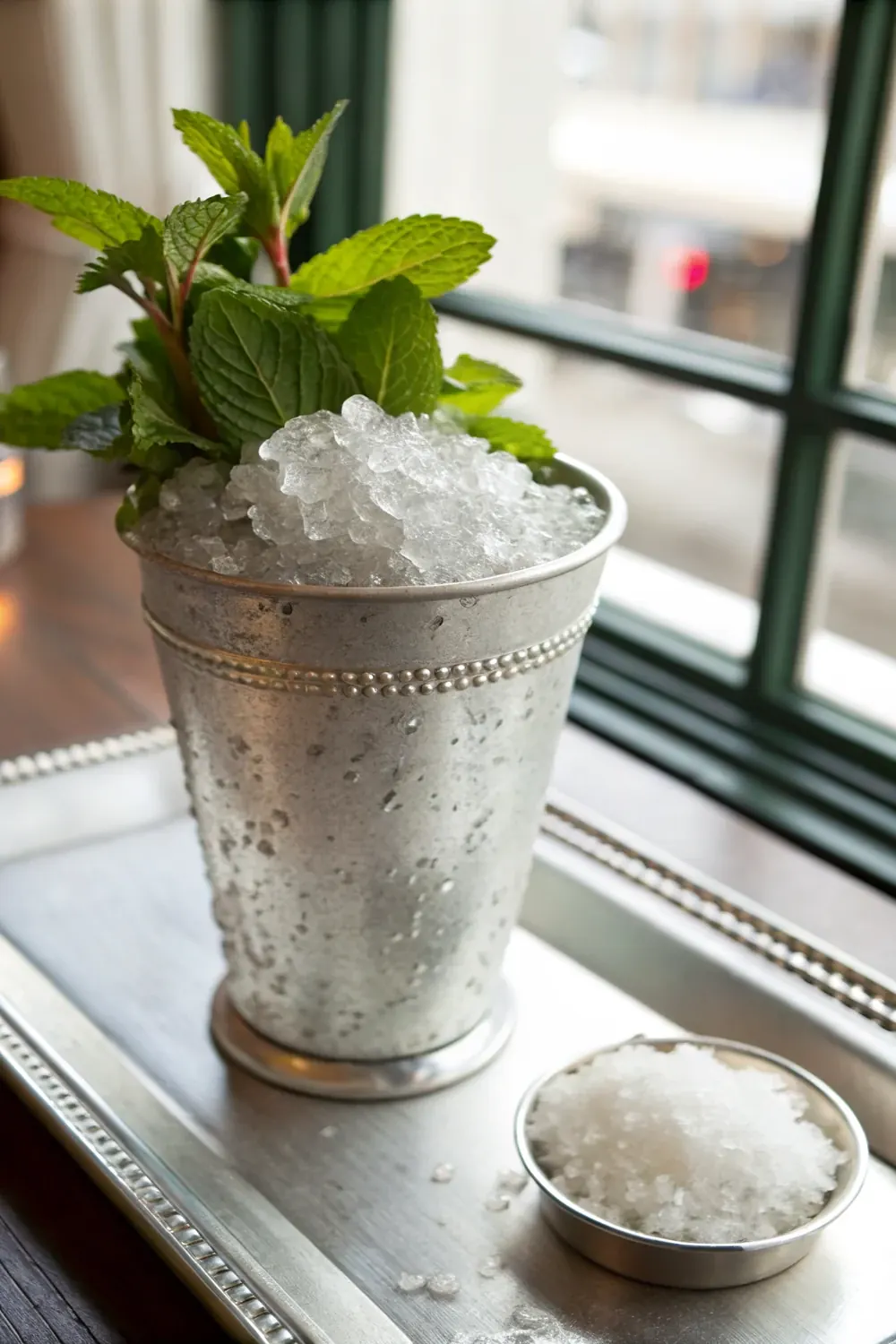
The silver julep cup is the canonical vessel. The traditional cup is sterling silver, 8 to 10 oz capacity, with a broad mouth and a slight inward curve at the top to hold the ice mound. The metal is what makes the drink work. Silver pulls heat from your hand at a rate fast enough to keep the ice solid, and when the cup comes out of the freezer cold, the outside frosts immediately and stays frosted for the full drinking window. A glass tumbler does not frost the same way; metal is part of the cocktail.
Tiffany and Co. has produced sterling silver julep cups since the 1850s, and they remain the gold standard; a single Tiffany cup runs $400 to $600. Hotel Bourbon and other specialty makers produce pewter and silver-plated versions for $40 to $80, which are entirely acceptable. Mass-produced pewter cups from World Market or Amazon run $15 to $25 and work fine for casual use. The metal matters more than the brand. If you inherit a set, treasure them; if you are starting fresh, four pewter cups is the right starter purchase for a Derby Day party.
The frost rule: the cup must be in the freezer for at least 2 hours, ideally overnight, before serving. Pull the cup out only when you are ready to assemble. Do not handle the cup by the body; hold it by the bottom or wrap a cloth napkin around it. The body heat from your fingers will melt the frost in seconds. Once the julep is assembled and you hand the cup to a guest, the frost holds for about 15 minutes, which is the natural drinking window.
The Hill Country Peach Variation
The peach variation is the most distinctly Texas adaptation of the mint julep. From late May through early August, Hill Country peaches from Fredericksburg and Stonewall orchards are in peak season, and a thin slice of ripe peach in the bottom of the cup, muddled gently with the mint and syrup, turns the julep into a summer Hill Country drink. The peach adds soft floral sweetness, slight tartness, and a pink tint that looks beautiful against the silver cup.
Vogel Orchard and Love Creek Orchard, both in the Fredericksburg-Stonewall corridor along US-290, are the canonical peach sources. Vogel grows the freestone varieties (Loring, Redhaven, Fireprince) that slice clean; Love Creek leans toward heritage varieties with more aromatic profiles. Buy peaches at the orchard farm stand or at the Fredericksburg Saturday farmers market; HEB carries Hill Country peaches in season but the orchard-direct fruit is sweeter. Wait for the peach to give slightly under thumb pressure before using; rock-hard peaches have no juice.
The technique: one thin slice of peach goes into the bottom of the cup with the mint leaves and syrup. Muddle gently along with the mint, just enough to release the peach juice. Some Texas bartenders use a 0.5 oz pour of peach puree (peeled peach blitzed in a blender and strained) instead of a fresh slice; the puree distributes more evenly and is easier to scale for a party. Both work. The puree version is what the Hotel Saint Cecilia pours on Derby Day.
Texas Hill Country Bourbon Producers
Garrison Brothers Distillery in Hye, Texas (population 105, on US-290 between Johnson City and Fredericksburg) is the oldest legal bourbon distillery in Texas, founded by Dan Garrison in 2006 and bottling since 2010. The distillery produces Small Batch (94 proof, the everyday julep choice), Single Barrel (94 proof, the connoisseur pick), Cowboy Bourbon (135 proof, cask strength, for sipping not mixing), and Honey Dew (a bourbon-honey blend). The Hye location offers tours and a tasting room; book ahead, the slots sell out.
Balcones Distilling in Waco, founded by Chip Tate in 2008, produces Texas Pot Still bourbon, Texas Single Malt whisky, and the Brimstone smoked corn whisky. The pot still bourbon is the julep-relevant bottle: bigger, richer, and slightly more wood-forward than Garrison Brothers. Balcones uses blue corn from local Hill Country farms for the mash bill, which gives the bourbon a distinct sweetness. The Waco distillery is open for tours and is worth a road trip if you are driving up I-35.
Treaty Oak Distilling in Dripping Springs (just south of Austin) produces Ghost Hill Bourbon, named after a Hill Country hilltop. The bourbon is lighter-bodied than Garrison or Balcones, with more cherry and less oak; works beautifully in the peach julep. Still Austin Whiskey in south Austin produces The Musician, a grain-to-glass bourbon distilled from Texas-grown corn, rye, and malted barley; bright, slightly fruity, and the youngest of the major Hill Country producers but a serious entry. Bonus mention: Andalusia Whiskey in Blanco for a single-malt julep variant. For the full Hill Country bourbon scene, the Imbibe Magazine Texas distillery coverage is worth bookmarking.
Glassware Substitutions: Rocks Glass, Copper Mug, Mason Jar
The silver julep cup is the canonical vessel, but you can serve a perfectly respectable mint julep in other glassware. A double old-fashioned (rocks) glass is the most common substitute; the glass holds 10 to 12 oz and accommodates the crushed ice mound, though the frost effect is weaker and the glass warms in your hand faster than metal. If you are serving Derby Day in a household without julep cups, double old-fashioneds are entirely acceptable.
A copper Moscow Mule mug works well, especially if it has been chilled. The copper conducts cold like silver, frosts on the outside, and the visual is striking. Some Hill Country bartenders use copper mugs for their juleps because the patron-already-owns-it factor is high. The drawback: copper can react with acidic ingredients over long contact, but a julep is served and consumed in 15 minutes, so the reaction is negligible.
Mason jars are the casual Texas option. A pint mason jar (16 oz) is too big for a single julep, but a half-pint or 12 oz jar works. The jar does not frost like metal and looks rustic rather than refined, which is either a feature or a bug depending on your Derby Day aesthetic. For a backyard porch party with twenty guests and no time for ceremony, mason jars are fine; for a candlelit dinner party where the julep is the welcome cocktail, the silver cup matters.
Garnish Strategy: Mint Bouquet, Peach Slice, Bandera Mint
The mint bouquet is the visual and aromatic centerpiece. A proper bouquet is a small handful of fresh mint sprigs, six to eight stems with leaves intact, trimmed to a stem length of about 3 inches so the leaves rise tall above the cup rim. Before placing, slap the bouquet against the back of your hand or against a cocktail napkin to release the aromatic oils on the leaf surfaces. The slap is not optional; without it, the mint bouquet is decoration without smell.
Position the bouquet so the leaves are right next to where the straw exits the cup. The whole point is that your nose passes through the mint cloud with every sip. If the bouquet is on the far side of the cup from the straw, the aromatic effect is lost. Some Hill Country bartenders dust the bouquet with a small pinch of powdered sugar, which sticks to the leaves and frosts the mint visually; classic Churchill Downs juleps do this and the trick works for high-end presentation.
For the peach variation, add a thin half-slice of fresh peach to the rim of the cup or to the ice mound. The peach slice tells the visual story before the first sip. For the bourbon-only classic version, a single mint sprig in the bouquet plus a bourbon-soaked sugar cube on the side is a Derby Day flourish. Avoid berry garnishes, cherry, or anything that fights the mint and peach; a julep is a quiet, restrained garnish drink, not a tropical fruit salad.
Serving Etiquette and Sipping Pace
A mint julep is a sipping cocktail, not a fast drink. The classic julep ABV is around 22 percent of pure liquid (2.5 oz of 94-proof bourbon plus 0.5 oz syrup plus melt water), which is roughly equivalent to a glass of fortified wine. Drink it over 15 to 20 minutes, in small sips through the short straw. The crushed ice will melt gradually and dilute the bourbon as you drink, which is by design; the cocktail gets softer and more refreshing toward the bottom.
Hold the cup by the bottom, not the body. The body of the silver cup is the frosted part, and any contact with warm fingers will melt the frost in seconds. The traditional grip is bottom-and-rim or just the bottom, with the index and middle fingers cradling the base. If the cup is too cold to hold (which can happen with overnight-frozen cups), wrap a cocktail napkin around the body. The frosted exterior is what you want to preserve.
Refill protocol: if a guest finishes a julep and wants another, add fresh crushed ice on top of the remaining mint and syrup at the bottom of the cup, pour another 1 to 1.5 oz of bourbon over the new ice, and re-tuck the mint bouquet. The cup does not need to be re-frosted because the body is still cold. This is the porch refill and is how a single set of four julep cups can serve a Derby telecast worth of drinks. Bon Appetit has a useful Derby Day timing guide.
Variations: Bourbon-and-Peach, Smoked, Frozen, Virgin
Bourbon-and-peach julep (Hill Country summer). The default Texas summer version: 1 thin peach slice or 0.5 oz peach puree muddled with the mint and syrup, then 2.5 oz Texas bourbon and crushed ice. The peach softens the bourbon and adds a Fredericksburg-orchard signature. This is my house pour from May through August.
Smoked julep. Use a smoking gun or a small wood-chip torch to smoke the inside of the empty julep cup before assembly, then invert and trap the smoke under a coaster for 30 seconds. Build the cocktail in the smoked cup. The bourbon picks up a subtle mesquite or pecan-wood note that pairs beautifully with the Hill Country bourbon profile. Best with Balcones Brimstone or Garrison Brothers Cowboy.
Frozen julep. Blend 2.5 oz bourbon, 0.5 oz simple syrup, 6 mint leaves, and 1 cup of crushed ice in a blender for 10 seconds. Pour into a chilled rocks glass and top with a mint bouquet. Slushie texture; works for hot Hill Country August afternoons when crushed ice is melting too fast for the classic build.
Virgin julep (Derby Day for kids and non-drinkers). Replace the bourbon with 2.5 oz of strong cold-brew tea, ginger ale, or a Topo Chico splash. Muddle the mint and syrup as normal, top with crushed ice, garnish with the bouquet. The visual is identical; the alcohol is gone. Especially useful for Derby Day parties where one in five guests does not drink.
Champagne julep (the high-end variant). Build the julep with only 1.5 oz of bourbon, top with 2 oz of dry Champagne (or Texas sparkling wine from Llano Estacado or Becker Vineyards), and serve immediately. Lighter, more festive, and works as a brunch or pre-dinner aperitif. For another Hill Country brunch pour, try a ranch water.
Pairings: Smoked Brisket, Pimento Cheese, Fried Okra
A Texas mint julep is a porch drink first and a dinner drink second, but the cocktail pairs beautifully with smoked and Southern food. Smoked brisket from a Central Texas BBQ joint (Franklin Barbecue, Snow's, La Barbecue, Terry Black's) is the canonical Derby Day food pairing: the bourbon and mint cut through the rich fatty brisket, the peach (if you are pouring the summer version) echoes the sweet bark on the meat, and the cold cup is the right counterpoint to a warm slice. Smoked sausage from Kreuz Market in Lockhart is the second choice.
Pimento cheese is the Derby Day appetizer of record across the South, and the Hill Country version (sharp cheddar, mayonnaise, diced pimentos, a splash of hot sauce, served with Ritz crackers or celery sticks) pairs perfectly with a mint julep. The sharpness of the cheese matches the bourbon, and the mint cools the heat. Most Texas Derby parties run pimento cheese as the welcome snack alongside the first round of juleps.
Fried okra, deviled eggs, biscuits with honey butter, and a slice of buttermilk pie round out the canonical Derby Day spread. The fried okra is the Hill Country crunch; the deviled eggs are the Southern garnish; the biscuits are the carb anchor; the buttermilk pie is the dessert. A julep, a plate of pimento cheese, and a slice of pie on a porch in May is what Texas Derby Day looks like.
Mistakes to Avoid
Pulverizing the mint. Mint should be bruised, not crushed. Four to six gentle muddler taps is plenty. Shredded mint releases bitter chlorophyll and turns the cocktail grassy and astringent. The leaves at the bottom of the cup should still be recognizable as leaves.
Using peppermint instead of spearmint. Peppermint tastes medicinal and cold in a julep. Use spearmint only. If you grew the mint yourself and are not sure which species you have, smell a leaf: spearmint is green and grassy, peppermint is sharp and icy.
Cubed ice instead of crushed. Cubed ice leaves big channels in the cup and does not dilute the bourbon properly. The drink stays too strong for too long, then dilutes too fast at the end. Crushed pebble ice is the texture you want.
A warm or room-temperature cup. The silver or pewter julep cup must come straight from the freezer. Without the frost, the visual signature of the drink is missing, and the ice melts in half the normal time. Two hours in the freezer minimum.
Stirring after the build. A julep is not stirred. The bourbon, mint, and syrup at the bottom mix with the meltwater as you sip; stirring dilutes too fast and disturbs the layered effect. Build, garnish, serve, do not stir.
Tall straws. A short straw (3 to 4 inches) is traditional and keeps your nose at the mint bouquet. A long straw moves your face away from the mint and loses the aromatic effect. Cut a paper straw to size if you only have long ones.
Skipping the mint bouquet slap. The slap-on-the-hand step releases the volatile oils on the mint surface. Without the slap, the bouquet is decoration with no aroma. Always slap before placing.
Cheap bourbon. A julep showcases the bourbon. Bottom-shelf well bourbon (Old Crow, Evan Williams Green) tastes harsh against the mint and sugar. Use mid-shelf or better; the cocktail is only as good as the spirit.
Chef Mia's Hill Country Notes
I learned the silver-cup-frost rule the hard way. The first time I made juleps for a Derby Day party at my Fredericksburg porch, I pulled the cups out of a regular kitchen cabinet, assembled the cocktails, and watched the ice melt down past the rim within five minutes. Everyone said the drinks were delicious; nobody saw the frost. The next year I put the cups in the chest freezer overnight, and when I pulled them out the next afternoon, every cup frosted within three seconds of hitting the warm Hill Country air. The visual was night and day. Freezer overnight, every time.
The peach window matters. Hill Country peaches are in peak season from roughly Memorial Day weekend through the first week of August, with the absolute best fruit in mid-June through mid-July. Outside that window, peach juleps fall flat because the fruit is either underripe (no juice, woody texture) or imported from California or Mexico and lacks the perfumed sweetness of a Fredericksburg orchard peach. If you cannot get a Hill Country peach, skip the peach variation and pour the classic version; do not substitute with grocery-store imported fruit, it is not the same drink.
I keep my Garrison Brothers on a high shelf because it is not an everyday bourbon. The Small Batch runs around $80 a bottle, the Single Barrel around $100, and Cowboy north of $200. For everyday Hill Country sipping I pour Treaty Oak Ghost Hill (around $35) or Still Austin The Musician (around $40); for Derby Day and special occasions I open the Garrison. Serious Eats has a useful guide to Texas bourbon pricing and tasting notes. For the rest of the year, juleps still happen on my porch occasionally on hot evenings; a julep is not just a Derby drink, it is a summer porch drink with a Derby Day spike on the first Saturday in May.
One last note on the silver cups: if you are starting a collection, buy four pewter cups (around $20 apiece from Hotel Bourbon or World Market) before you splurge on a single sterling Tiffany. A set of four pewter cups means you can serve a Derby Day foursome; a single Tiffany cup means three of your guests get rocks glasses. The metal matters more than the brand stamp on the bottom. For more Texan drink and food pairings, see the Thanksgiving turkey brine and the michelada recipe, both Hill Country staples on my porch.
Texas Mint Julep Recipe
Ingredients
- For the simple syrup (makes enough for 8 juleps):
- 1 cup granulated sugar
- 1 cup water
- 1 small handful fresh mint sprigs (optional, for mint-infused syrup)
- For one Texas mint julep:
- 2.5 oz (75 ml) Texas bourbon (Garrison Brothers Small Batch, Balcones Texas Pot Still, Treaty Oak Ghost Hill, or Still Austin The Musician)
- 0.5 oz (15 ml) simple syrup, or 1 sugar cube plus 1 teaspoon water
- 8 to 10 fresh spearmint leaves, plus 1 large mint bouquet for garnish
- 1 slice ripe Hill Country peach (optional, summer version only), or 0.5 oz fresh peach puree
- Crushed ice, enough to mound above the rim of the cup
- 1 short cocktail straw or julep straw
- Equipment:
- 1 silver julep cup (8 to 10 oz), or pewter, or a rocks glass as a substitute
- 1 cocktail muddler (wooden or stainless steel)
- 1 Lewis bag and mallet, or a blender for crushing ice
- 1 jigger or pour spout
- 1 fine mesh strainer (optional, for straining peach)
Instructions
- Freeze the julep cup. Place the silver or pewter julep cup in the freezer for at least 2 hours before serving, ideally overnight. The cup needs to be cold enough to frost the second you pull it out. The frost on the outside of the cup is the visual signature of a real julep and is part of the drinking experience; the metal pulls heat from your hand and keeps the crushed ice intact for the full sipping window. A room-temperature cup melts the ice in five minutes and the drink goes watery.
- Make the simple syrup. Combine 1 cup of sugar and 1 cup of water in a small saucepan over medium heat. Stir until the sugar dissolves completely, about 3 minutes, then remove from the heat. Do not boil; you are not making caramel. For a mint-infused syrup, drop a small handful of fresh mint sprigs into the hot syrup, let steep for 15 minutes, then strain out the mint and refrigerate. The syrup keeps in a sealed jar in the fridge for 2 weeks. One batch covers 8 juleps.
- Crush the ice. Crushed ice is non-negotiable. Use a Lewis bag (a canvas bag designed for the job, around $20 at any bar shop) and a wooden mallet: fill the bag with cubes, fold the top, and whack it on a cutting board until you have rough pebble-sized pieces. The canvas absorbs the meltwater so the ice stays dry. If you do not have a Lewis bag, wrap cubes in a clean dish towel and crush with a rolling pin, or pulse cubes in a blender for 5 seconds. Avoid pre-bagged grocery store crushed ice; it is too wet.
- Bruise the mint. Drop 8 to 10 fresh spearmint leaves into the bottom of the frozen julep cup along with the simple syrup (or 1 sugar cube plus 1 teaspoon of water). Press the mint gently with a muddler 4 to 6 times. The goal is to release the essential oils from the leaves, not to shred them; shredded mint turns bitter, grassy, and leaves green flecks throughout the drink. Bruise, do not pulverize. The cup should smell like a mint garden after this step.
- Add the peach (summer version only). If you are making the Hill Country summer version, add 1 thin slice of ripe peach or 0.5 oz of fresh peach puree to the cup with the mint and syrup. Press the peach gently with the muddler 2 to 3 times to release the juice. Vogel Orchard or Love Creek Orchard peaches from Fredericksburg are the canonical summer choice. For the classic year-round version, skip the peach entirely; the original Kentucky drink is bourbon, mint, sugar, and ice, period.
- Pour the bourbon. Add 2.5 oz of Texas bourbon to the cup. Garrison Brothers Small Batch (from Hye, in the Hill Country) is the canonical Texas choice; Balcones Texas Pot Still (from Waco) is the bigger, richer alternative; Treaty Oak Ghost Hill (from Dripping Springs) and Still Austin The Musician (from south Austin) round out the Hill Country bourbon roster. If you want a Kentucky-Texas blend, pour 1.5 oz Texas bourbon and 1 oz Kentucky bourbon (Buffalo Trace, Maker's Mark, or Woodford Reserve).
- Mound the crushed ice. Pack the cup with crushed ice, mounding it well above the rim into a small snowy dome. Press the ice down gently with the back of a spoon to compact it. The ice mound is part of the visual presentation, and it is the cold reserve that keeps the drink chilled as you sip. Do not stir at this stage; the cocktail builds from the bottom up, and the ice is meant to dilute the bourbon slowly as it melts. A proper julep gets stronger to the bottom, not weaker.
- Slap and place the mint bouquet. Take a large mint bouquet (a small handful of fresh sprigs, leaves intact, stems trimmed), slap it once or twice against the back of your hand to release the aromatic oils, and tuck it into the ice mound so the leaves rise tall above the cup like a green crown. The bouquet is what your nose hits first when you sip; the aroma is half the drink. Garrison Brothers serves their juleps at distillery events with bouquets this tall, and the visual is part of the ritual.
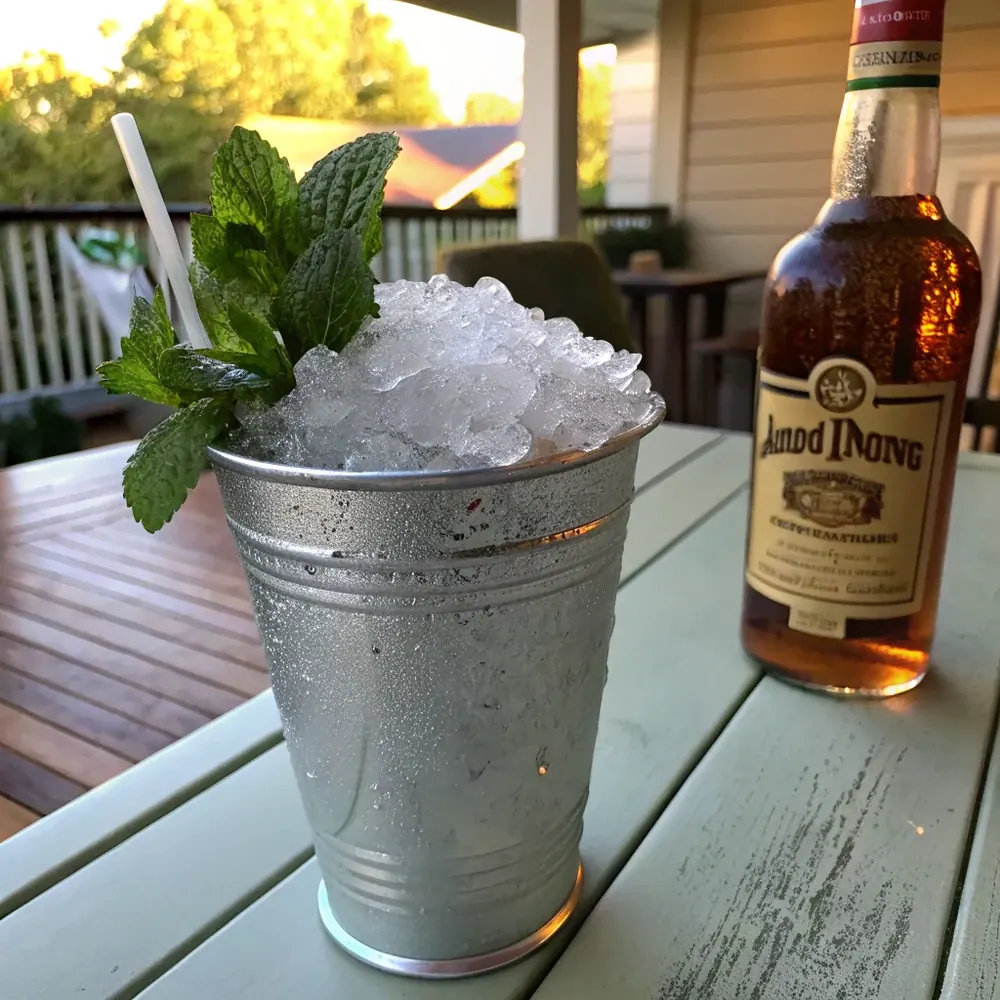
- Insert the straw and serve. Insert a short cocktail straw or a metal julep straw into the ice mound, positioning the tip close to the mint bouquet so your nose passes the mint with every sip. The short straw is traditional; a long straw is wrong. Serve immediately, while the cup is still frosted and the ice is still in pebbles. The drinking window is about 15 minutes, after which the ice melts down and the drink dilutes past the sweet spot.
- Sip slowly and refill the ice. A Texas mint julep is a sipping cocktail, not a shooter. Take small sips over 15 minutes; the bourbon strength builds as the ice melts. If you want a second round, add a fresh mound of crushed ice on top of what remains, and pour another 1 to 1.5 oz of bourbon over the new ice. The mint and syrup at the bottom carry through; this is the Hill Country porch refill, and it is how you make a julep last a full Derby telecast.
Frequently Asked Questions
What makes a Texas mint julep different from a Kentucky mint julep?
The recipe is the same; the bourbon is the difference. A classic Kentucky mint julep uses Kentucky bourbon (Maker's Mark, Woodford Reserve, Buffalo Trace, Old Forester). A Texas mint julep uses Texas Hill Country bourbon: Garrison Brothers Small Batch (from Hye), Balcones Texas Pot Still (from Waco), Treaty Oak Ghost Hill (from Dripping Springs), or Still Austin The Musician (from Austin). The Texas bourbon ages faster in the Hill Country temperature swings and develops heavier oak and spice than Kentucky bourbon. The summer Texas variant adds a slice or puree of ripe Hill Country peach from Fredericksburg orchards like Vogel or Love Creek.
Do I really need a silver julep cup?
The silver cup is canonical, but pewter, copper Moscow Mule mugs, or a double old-fashioned rocks glass all work as substitutes. The reason the silver cup is preferred: the metal pulls heat fast enough to keep the crushed ice solid for the full drinking window, and the cup frosts on the outside the moment you pull it from the freezer. The frost is part of the drink visually and aromatically. If you are using a glass tumbler, chill it for at least 2 hours in the freezer; the frost will not be as dramatic but the cold matters more than the metal. For a starter set, four pewter cups around $20 each beats one sterling Tiffany at $500.
Should I use spearmint or peppermint for a Texas mint julep?
Spearmint, always. Spearmint (Mentha spicata) is the mild, sweet, grassy mint that grows in every Hill Country herb tub; peppermint (Mentha piperita) is the sharper, menthol-forward mint used in candy and toothpaste. Peppermint in a julep tastes medicinal and wrong. If you grew the mint yourself and are not sure which species you have, smell a leaf: spearmint smells green and herbal, peppermint smells cold and icy. Bandera mint is the local Hill Country name for a regional spearmint strain that handles Texas heat well; not a separate species, just a regional variant.
How hard should I muddle the mint?
Gently. Four to six light muddler taps to release the essential oils on the leaf surface. The goal is to bruise, not to crush. Hard muddling shreds the chlorophyll in the leaves, releases bitter compounds, and turns the cocktail grassy, astringent, and full of tiny green flecks. The Churchill Downs official Derby recipe specifies bruise, not crush, and the same rule applies to the Texas version. If your mint at the bottom of the cup is in tatters, you over-muddled and the cocktail will taste bitter. The leaves should still be recognizable as leaves after muddling.
When is Hill Country peach season for the peach julep variation?
Hill Country peach season runs roughly from Memorial Day weekend through the first week of August, with peak fruit from mid-June through mid-July. Vogel Orchard and Love Creek Orchard in the Fredericksburg-Stonewall corridor along US-290 are the canonical Hill Country peach sources; both have orchard farm stands open through the season. Buy peaches that yield slightly to thumb pressure; rock-hard peaches have no juice and add nothing to the julep. Outside the peach window, skip the variation and pour the classic bourbon-mint-syrup version; grocery-store peaches from California or Mexico do not have the perfumed sweetness of a real Hill Country peach.
Can I batch mint juleps for a Derby Day party?
Partially. You can pre-make the simple syrup (or mint-infused simple syrup) up to 2 weeks ahead and keep it refrigerated. You can crush ice up to 4 hours ahead and store in a covered container in the freezer. You can pre-freeze the cups overnight. What you cannot batch is the build itself: the mint must be muddled fresh, the bourbon poured fresh, and the cup served immediately. For a 20-person Derby Day party, set up a julep station with the syrup, fresh mint sprigs in a tub of cold water, a Lewis bag of crushed ice, a bottle of Garrison Brothers, and the frozen cups; build cocktails one at a time as guests arrive. The Hotel Saint Cecilia in Austin uses this exact setup for their Derby Day garden party.
How strong is one Texas mint julep?
A standard Texas mint julep with 2.5 oz of 94-proof bourbon (Garrison Brothers Small Batch is 94 proof, or 47 percent ABV) clocks in at roughly 1.2 oz of pure alcohol, served in a 10 oz cup with crushed ice and melt water dilution. Final drink ABV is around 22 to 25 percent at the start, dropping to roughly 12 to 15 percent as the ice melts down. That makes the julep stronger than wine and weaker than a martini; treat it as a 15 to 20 minute sipping cocktail, not a quick pour. Two juleps over a Derby afternoon is the responsible Hill Country pace; pair with food and water alongside, especially in summer heat.