Southern Comfort Food
Texas Silverside Beef Pot Roast
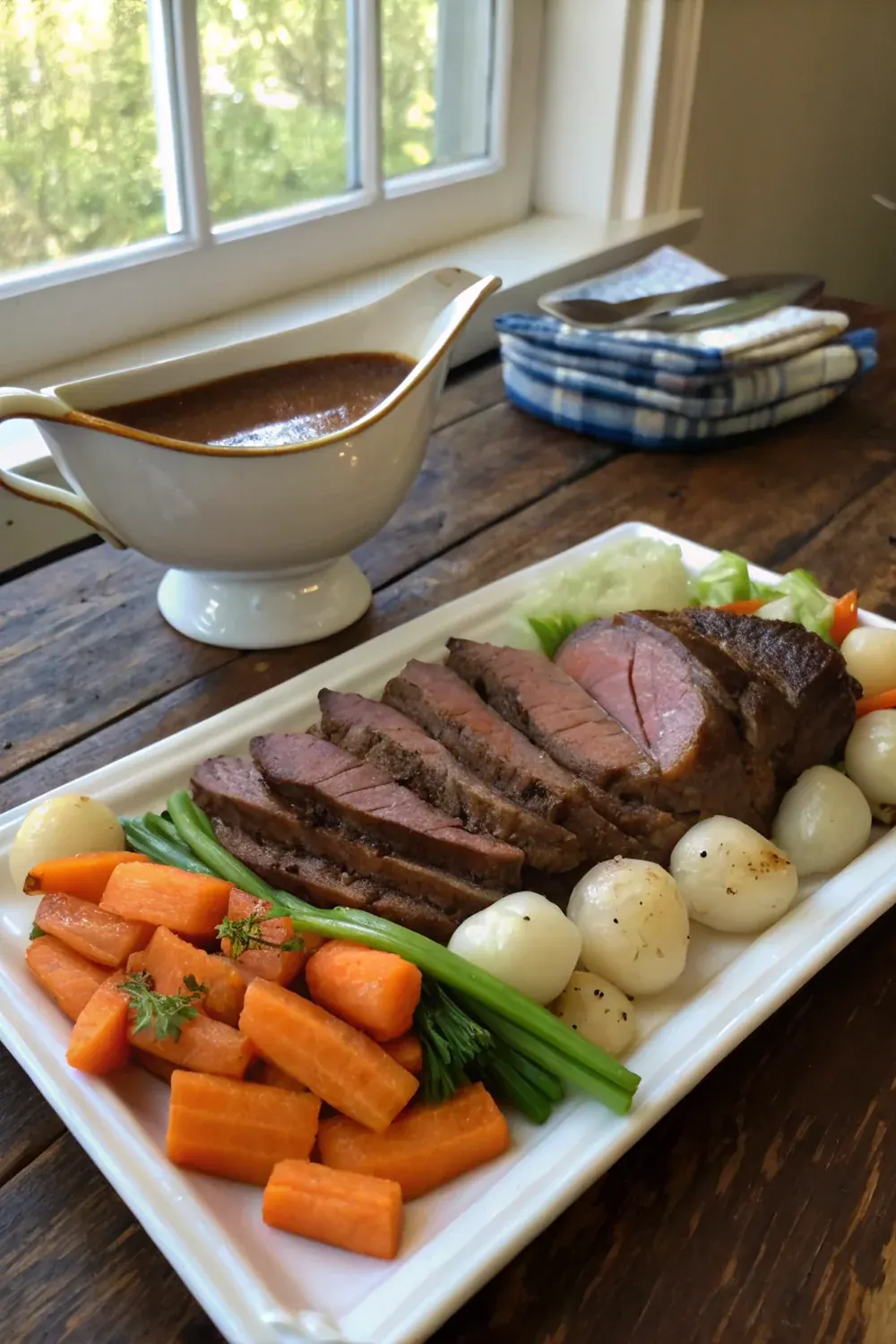
Chef Mia's Texas silverside beef pot roast: 4 lb cut, slow-cooked 8 hours with carrots, pearl onions, bay leaves, and Hill Country garlic.
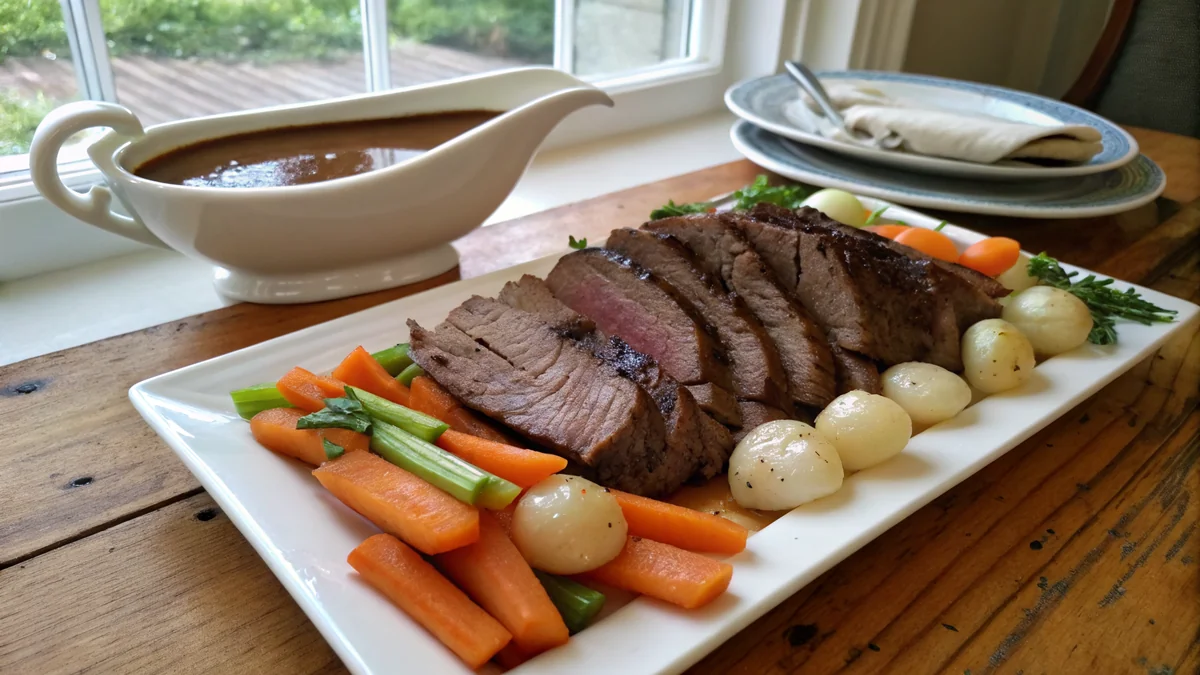
Quick answer: Texas silverside beef pot roast slow-cooks a 4-pound silverside cut (also called bottom round in the US, topside-and-silverside in the UK and Australia) for 8 hours on LOW with carrots, pearl onions, celery, garlic, bay leaves, and beef broth. Sear the roast first to build flavor, then braise low-and-slow until fork-tender. The result is a Sunday-dinner-style sliced beef with rich gravy that pairs traditionally with mashed potatoes and Texas cornbread. Serves 6-8. Make the whole dish in the morning before church; eat at noon.
The first time I heard the word silverside used at a butcher counter, I was in my early twenties and a British exchange student named Helen was visiting my family's ranch outside Boerne for the summer. She had been raised on Sunday roast - a British tradition where her mother would cook a large piece of beef on Sunday mornings and serve it over the course of the day with roasted potatoes and Yorkshire pudding. She asked my grandmother where to buy silverside in San Antonio, and my grandmother, who had cooked beef her entire life, looked at her like she had asked for a unicorn. The cut existed; it just was not called silverside in Texas.
Silverside is the British and Australian term for what most American butcher counters label as bottom round or rump roast. It is the lean, dense, well-flavored muscle that runs along the back leg of the cow, just below the rump. In the UK and Australia, it is the traditional Sunday roast cut - sliced thin, served with rich gravy, eaten with the family around a long table. In Texas, the same cut shows up at HEB labeled bottom round roast and is mostly used for pot roasts and slow-cooker dinners. Same cut, different name, same beautiful Sunday-dinner result.
I learned to cook silverside / bottom round from Helen that summer at our ranch kitchen. She showed me her mother's method: sear hard, build a vegetable bed, braise low, slice thin, serve with gravy. I have adapted that English method over the years to the Texas pantry - adding bay leaves from the bay laurel tree my grandmother kept by the kitchen door, using whole garlic cloves from the Hill Country garlic farms, finishing with a splash of Worcestershire instead of the cider vinegar Helen's family used. The result is a Sunday roast that sits comfortably on a Texas table next to cornbread and potato salad, but carries the memory of an English-style family meal underneath.
What Is Silverside? (UK / Australia / US Translations)
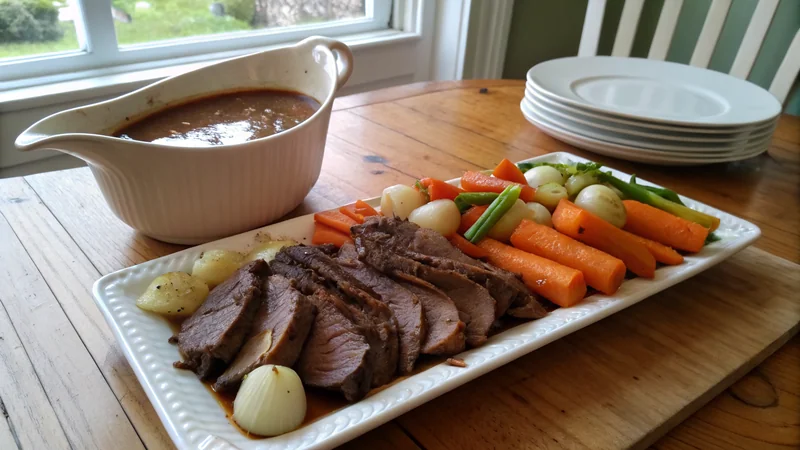
Silverside is the cut of beef that runs along the back leg of the cow, on the outer thigh, just below the rump. It is sometimes called bottom round in the US, topside-and-silverside in the UK, or rump roast at some butcher counters. The British use the term silverside specifically for this cut because of the silvery sinew that runs along one side - a tough membrane that should be trimmed before cooking but contributes to the cut's identification.
In the US grocery store, you will most often find this cut labeled bottom round roast, rump roast, or sometimes outside round. They are all the same muscle. HEB sells it in 3-5 pound roasts at the meat counter; Whole Foods labels it bottom round; Costco sometimes carries a Choice-grade bottom round in 4-5 pound pieces vacuum-sealed. Ask your butcher for silverside specifically and they should know what you mean if they have any UK or Commonwealth experience; otherwise ask for bottom round and you will get the same cut.
The Australian term is silverside, identical to the British. Down Under, silverside is also commonly cured (corned silverside) for boiled-and-served traditional dishes. The American equivalent of cured silverside is corned beef brisket, though the cuts are different - corned beef in the US is usually from the brisket, not the round. For our pot roast purposes, we are using uncured silverside / bottom round.
If you cannot find silverside or bottom round, the next-best substitute is a chuck roast (also called pot roast or chuck eye roast). Chuck has more marbling than silverside, so it produces a fattier, more forgiving result. The cooking method and time are identical. Top round is also acceptable but slightly leaner and can dry out if cooked beyond 7.5 hours. Craving something meatier off the same slow cooker? Try my fall-apart beef back ribs next.
The Trinity Vegetables (Carrots, Celery, Onions)
The carrots-celery-onions combination is the French mirepoix, the Italian soffritto, and the foundation of pot roast traditions across most of the European-American cooking lineage. In a slow-cooked pot roast, the trinity does three jobs: (1) it raises the meat slightly off the bottom of the crock, allowing more even braising; (2) it infuses the braising liquid with sweet, rich vegetable flavor; (3) it provides a complete one-pot meal where the vegetables are part of the dish rather than a separate side.
Carrots: use 3 medium carrots cut into 2-inch chunks, not baby carrots. Baby carrots are partially cooked already and turn to mush over 8 hours. Full-size carrots cut into 2-inch pieces hold their shape and texture, and the larger pieces caramelize against the meat during the cook. Peel the carrots first - the peel can become bitter over a long braise.
Pearl onions: 12 oz of pearl onions (the small marble-sized onions, sometimes labeled cocktail onions when fresh). Frozen pre-peeled pearl onions from the freezer aisle are completely fine and save 15 minutes of peeling. The pearl onions caramelize beautifully in the slow cooker, becoming sweet and silky. If you cannot find pearl onions, substitute with 2 medium yellow onions cut into eighths, but the result is more rustic and less elegant.
Celery: 3 stalks cut into 2-inch pieces. The celery contributes savory umami depth without being sweet like carrots or pungent like onions. Use the inner stalks of the celery if possible - they are more tender and less stringy. Save the leaves for garnish or for chicken stock.
Garlic: 10 whole cloves peeled and left whole. The garlic transforms over 8 hours of slow cooking from sharp-and-pungent to sweet-and-soft, almost like roasted garlic confit. The whole cloves can be served alongside the meat - they are spreadable like butter on a slice of cornbread. Do not mince or chop the garlic; whole cloves are correct here.
Bay Leaves and the Aromatic Layer
Bay leaves are the secret weapon of long-cooked pot roasts. They contribute a subtle, almost-tea-like background flavor that ties together the beef, vegetables, and herbs without dominating any one element. Three bay leaves is the right amount for a 4-pound roast. Fewer than three and you cannot taste them; more than four and they start to assert themselves uncomfortably. The bay leaves are removed before serving (not pleasant to chew on).
If you have access to a bay laurel tree (some Texas Hill Country gardens have them, and they grow well in the climate), use fresh bay leaves. Fresh bay is more aromatic than dried - one fresh leaf has the strength of about three dried. Use 2-3 fresh leaves to replace 3 dried. Fresh bay also has a slight peppery note that dried bay loses.
Thyme and rosemary are the secondary herbs. Thyme is the more delicate, more general-purpose herb; it complements both meat and vegetables. Rosemary is more assertive and slightly piney. The combination is classic Hill Country cooking - both herbs grow well in Texas gardens, and the combination is what differentiates a Texas pot roast from a generic American pot roast.
The dried herb measurements are 1 tablespoon thyme + 1 teaspoon rosemary. If using fresh, increase to 6 sprigs thyme + 2 sprigs rosemary, tied in cheesecloth for easy removal. Fresh herbs are noticeably better than dried over a long slow-cooker braise; the volatile oils release gradually rather than all at once. If your kitchen budget is tight, the dried versions still produce excellent results.
The 8-Hour Sunday Timing (Before Church to Noon)
Silverside is the perfect Sunday-morning recipe because the 8-hour cook time slots into the natural rhythm of a family Sunday: start at 4am if you are an early riser, or 8am if you are a normal human, and the roast is ready by noon (4am start) or 4pm (8am start). The morning-before-church variation is the classic Hill Country move: prep at 7am, sear and slow-cook by 8am, leave for 10am church service, return at noon to a meal that has been cooking for 4 hours and is halfway through.
The classic Sunday timeline: 7:30am - sear roast and prep vegetables (20 min). 8am - slow cooker on LOW, leave for church. 8am-12pm - 4 hours into the cook (halfway). 12pm-4pm - additional 4 hours, family lunch-or-late-lunch. 4pm - serve. This timeline assumes a noon-to-4pm flexible Sunday meal, which is how most multi-generational Hill Country families I know structure their Sunday afternoons.
If you want the meal at noon precisely, you need to start the cook at 4am Sunday morning - not realistic for most families. The alternative is to use the make-ahead method: cook the roast Saturday late afternoon (start at 4pm, finish at midnight), refrigerate overnight in the braising liquid, reheat gently Sunday morning in a 300F oven for 60 minutes. The flavor is actually better the second day - the seasonings penetrate further into the meat overnight.
If you have an extended-cook slow cooker (programmable models from Crock-Pot, Cuisinart, or Hamilton Beach), set the timer to LOW for 8 hours followed by KEEP WARM. The keep-warm setting holds the food at safe serving temperature without overcooking. This is useful for the morning-prep-evening-eat timing where you start at 8am and want to eat at 6pm; the slow cooker switches to keep-warm at 4pm and holds the food until you serve.
Slicing Across the Grain (and Why It Matters)
The single most important rule for serving silverside / bottom round pot roast is to slice across the grain. The grain runs along the long axis of the roast - the muscle fibers all align in one direction. If you slice with the grain (parallel to the fibers), each slice is a long stringy mass of fibers that is unpleasant to chew. If you slice across the grain (perpendicular to the fibers), each slice is a series of short cross-sections of fibers that are much more tender.
Identify the grain before slicing. Look at the surface of the rested roast - you should be able to see the muscle fiber direction as parallel lines running along the meat. Place the knife perpendicular to those lines. Slice 1/4-inch thick. Each slice should hold together as a single piece without falling apart.
Use a sharp slicing knife - the long, narrow blade designed specifically for this kind of meat slicing. A serrated bread knife works as a backup. A standard chef's knife is usable but the slices end up uneven. The reason: the knife should travel through the meat in long single strokes, not back-and-forth sawing motions. A long, sharp blade makes single-stroke slicing possible.
If the meat seems too tender to slice cleanly (sometimes happens with chuck roast substitutions), shred with two forks instead. Shredded silverside is messier on the plate but eats just as well, especially when piled over mashed potatoes with gravy poured on top.
For broader Texas family-dinner traditions, see Texas BBQ brisket for the smoked beef Sunday alternative, or chicken and dumplings for the Southern Sunday-comfort variation. The Ultimate Southern Comfort Food Guide covers the broader Hill Country Sunday-table tradition.
Texas Silverside Beef Pot Roast Recipe
Ingredients
- 1 silverside or bottom round roast, about 4 lb (1.8 kg), trimmed of excess fat
- OR substitute with chuck roast for fattier, more forgiving result
- 2 teaspoons kosher salt
- 1 teaspoon coarse black pepper
- 2 tablespoons (28 g) high-smoke-point oil (avocado, grapeseed)
- 3 medium carrots, peeled, cut into 2-inch chunks
- 12 oz (340 g) pearl onions, peeled (frozen pre-peeled is fine)
- 3 celery stalks, cut into 2-inch pieces
- 10 cloves garlic, peeled and left whole
- 3 cups (720 ml) beef broth (low sodium)
- 1/2 cup (120 ml) dry red wine, optional but recommended
- 2 tablespoons tomato paste
- 2 tablespoons Worcestershire sauce
- 3 bay leaves
- 1 tablespoon dried thyme (or 6 fresh sprigs)
- 1 teaspoon dried rosemary (or 2 fresh sprigs)
- 2 tablespoons (28 g) cornstarch + 2 tablespoons cold water (for thickening gravy at the end)
- Fresh parsley, for garnish
- Mashed potatoes, Texas cornbread, or buttered egg noodles, to serve
Instructions
- Pat dry and season the silverside aggressively. Remove the silverside roast from packaging. Pat completely dry with paper towels - the dryer the surface, the better the sear. Season all sides aggressively with kosher salt and black pepper, pressing the seasoning into the meat. Let rest at room temperature 30 minutes before searing - cold roasts do not sear well, and the temperature differential between cold center and warm exterior makes the cooking less even.
- Sear hard on all sides. Heat a 12-inch cast iron skillet (or heavy stainless skillet) over medium-high heat for 5 minutes. Add 1 tablespoon of oil, swirl, let shimmer 30 seconds. Lay the roast in the pan and sear undisturbed for 3 minutes. Use tongs to turn 90 degrees and sear another 3 minutes. Repeat until all sides are deep mahogany brown, about 12-15 minutes total. Transfer the seared roast to the slow cooker insert.
- Build the vegetable bed in the slow cooker. Arrange the carrot chunks, pearl onions, celery pieces, and whole garlic cloves around the seared roast in the slow cooker. Distribute evenly so the vegetables touch the liquid but don't fully submerge the meat. The bed of vegetables raises the meat slightly off the bottom of the crock, allowing more even braising and infusing the liquid with vegetable sweetness.
- Build the braising liquid. Reduce heat under the searing skillet to medium. Add the tomato paste to the residual fat and stir 30 seconds until darkened. Pour in the red wine (if using), scraping up all the fond from the bottom of the skillet with a wooden spoon. Cook 2 minutes until reduced slightly. Add the beef broth and Worcestershire sauce. Stir to combine. Bring to a simmer.
- Pour over the roast. Pour the entire braising liquid over the roast in the slow cooker. The liquid should come about halfway up the sides of the roast - not fully submerged. Tuck the bay leaves into the liquid. Sprinkle the thyme and rosemary across the top of the roast (or place the fresh sprigs around the meat). The vegetables should poke up just above the liquid line.
- Slow cook 8 hours on LOW. Cover the slow cooker tightly. Set to LOW for 8 hours. Do not lift the lid during the cook - every lift loses heat and adds 20+ minutes. Walk away. This is the morning-before-church recipe: start at 8am, the roast is ready at 4pm. For a noon Sunday dinner, start at 4am the night before is too long; better to start the night before on the LOW-keep-warm setting if your slow cooker has it, or start at 4am on a Sunday if you're an early riser.
- Hour 7.5 fork test. After 7.5 hours, lift the lid for the first time. Insert a fork into the thickest part of the roast and twist. The meat should shred with very little resistance. The temperature in the thickest part should read 200-205F (93-96C). If there is firm resistance, recover and cook another 30-45 minutes. Most silverside roasts hit fork-tender at exactly 8 hours.
- Rest the roast and thicken the gravy. Carefully transfer the silverside roast to a cutting board. Tent loosely with foil and rest 10 minutes. Meanwhile, transfer the vegetables to a serving platter using a slotted spoon. Pour the braising liquid through a fine mesh sieve into a saucepan. Bring to a simmer over medium-high heat. In a small bowl, whisk the cornstarch with cold water until smooth (this prevents lumps). Whisk the slurry into the simmering liquid; cook 2-3 minutes until thickened to a gravy consistency. Taste and adjust seasoning. Pour into a gravy boat.
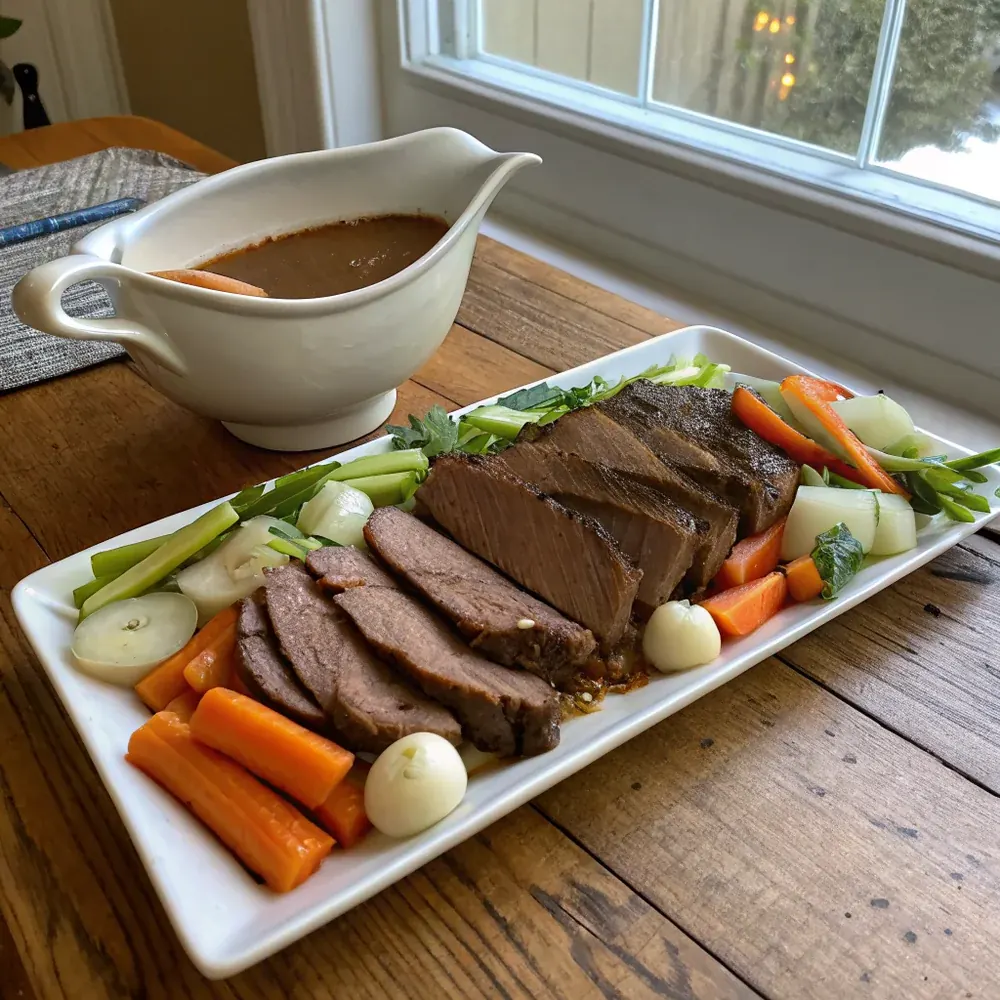
- Slice thin and serve family-style. Identify the grain on the silverside - the muscle fibers run roughly along the long axis of the roast. Slice across the grain at 1/4-inch thickness with a sharp slicing knife. Arrange the sliced beef on a serving platter, fanned out, with the vegetables surrounding it. Pour about 1/2 cup of gravy over the sliced beef so the meat stays moist; serve the rest in a gravy boat. Garnish with fresh parsley. Serve with mashed potatoes, <a href='https://www.texanrecipes.com/authentic-texas-style-corn-bread-recipe/'>Texas cornbread</a>, or buttered egg noodles. Pour a glass of red wine. Sunday dinner achieved.
Frequently Asked Questions
What's the difference between silverside, bottom round, and chuck roast?
Silverside (UK/Australia) and bottom round (US) are the same cut - lean, dense muscle from the back leg. Chuck roast is from the shoulder section - more marbled, fattier, more forgiving in slow cooking. Silverside slices cleanly into thin slabs for Sunday roast presentation; chuck roast tends to fall apart into shreds. Chuck is more forgiving for beginners; silverside gives cleaner slicing for elegant presentation.
Can I use chuck roast instead of silverside?
Yes - chuck roast is the most common substitute and produces a slightly fattier, more forgiving result that shreds rather than slices. Same cooking time (8 hours LOW), same ingredients, same method. The dish loses the elegant sliced presentation but gains in moisture and forgiveness. Many Texas cooks actually prefer chuck for slow-cooker pot roast for exactly this reason - more leeway, less risk of dryness.
How long should silverside cook in a slow cooker?
8 hours on LOW for a 4-pound roast. The internal temperature should reach 200-205F (93-96C) by the end. Smaller roasts (3 lb) need 7 hours; larger roasts (5 lb) need 9 hours. The fork test is the reliable indicator: insert a fork into the thickest part and twist - if it shreds with light resistance, it is ready. Beyond 8.5 hours for a 4-pound roast, the lean fibers start to dry out.
Do I have to sear the silverside before slow cooking?
Yes - the sear is essential for flavor. The Maillard reaction during the 12-15 minute sear creates deep, savory flavor compounds that the slow cooker cannot generate at low temperatures. Skipping the sear produces fork-tender meat with flat, washed-out flavor and a pale grey exterior. The 15 minutes of skillet time before the slow cooker is the most important step in the recipe.
Can I make Texas silverside pot roast in a Dutch oven instead?
Yes - braise in a 300F oven, covered, for 3.5 to 4 hours. Same recipe, same ingredients, just translate the slow cooker LOW to oven 300F. Check fork-tenderness at 3.5 hours. The Dutch oven version often has slightly more concentrated flavor due to the higher temperature and the gravy reduces during the cook. The slow cooker is more forgiving for hands-off cooking; the Dutch oven is faster and produces a more concentrated sauce.
How do I know when the pot roast is done?
Two signals: (1) fork test - insert a fork into the thickest part and twist; the meat should shred with very little resistance; (2) internal temperature - 200-205F (93-96C) at the thickest part. Visual cue: the meat should look like it has shrunk slightly from its original size and the surface should be matte rather than shiny. Combine all three for the most reliable indicator.
Can I freeze leftover Texas silverside pot roast?
Yes - the dish freezes excellently. Slice the roast first, then freeze in 1-cup portions with the gravy and some vegetables, in zip-top bags or sealed containers. Hold up to 3 months. Thaw overnight in the fridge, reheat gently in a covered skillet over low heat for 8-10 minutes, stirring occasionally. The flavor often improves with the freezer rest as the seasonings penetrate further.
What sides go with Texas silverside pot roast?
Classic Hill Country Sunday lineup: mashed potatoes (the gravy magnet), Texas cornbread, buttered egg noodles, or Texas Roadhouse-style rice. Add a green vegetable: Texas Roadhouse green beans, sautéed spinach, or a simple garden salad. Round out with biscuits, butter, and a glass of red wine for the full Sunday family experience.