
Free pitmaster tool
Brisket Smoking Time Calculator
Brisket is the only dish I know that can make a grown pitmaster set three alarms. The cook takes most of a day, the stall eats hours on its own schedule, and dinner guests do not enjoy being fed at midnight. This calculator does the arithmetic I used to scribble on butcher paper: give it your brisket's weight, your smoker temperature, and whether you wrap, and it builds the whole timeline from trim to slice. Better yet, flip it into reverse and tell it when you want to eat - it will tell you when to light the fire. Timing is only half the planning; my brisket per person guide handles the other half, how big a packer to buy for your head count.
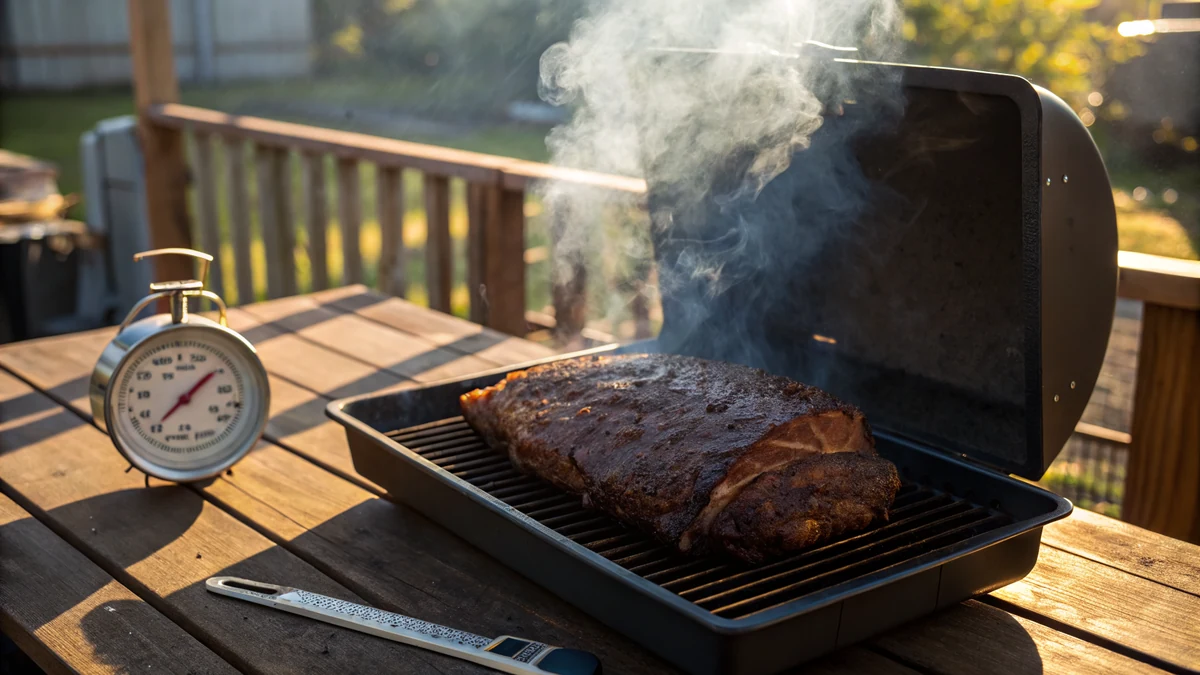
Every brisket is different - it's done when it probes like butter, not when the clock says so.
How the Math Works
The base ratios are the ones working pitmasters actually plan with: about 1.5 hours per pound at 225F, about 1.15 hours per pound at 250F, and about 0.9 hours per pound at 275F. They come from the simple physics of a packer brisket, a thick, collagen-heavy cut that has to climb past 200F internal before it gives up and goes tender. I cross-checked these numbers against years of my own cook logs in Lockhart, and they hold up remarkably well as planning figures.
The wrap toggle applies a reduction of roughly 12 percent to the total. Wrapping in butcher paper, the Texas crutch, blocks the evaporative cooling that causes the stall, so the brisket spends less time stuck on a plateau and more time climbing. Unwrapped briskets take the scenic route: a longer stall, a longer cook, and a thicker, crunchier bark as the reward for the wait.
The window on the probe-tender step widens with the size of the brisket, about plus or minus 30 minutes per 10 pounds. Bigger briskets carry more variance: thickness, grade, and how cold the meat went on all compound over a longer cook. Treat the early edge of the window as your first probe check, not as an alarm to pull the meat. My full Texas BBQ brisket method walks through every one of these stages at the pit level.
The Stall, Explained
Somewhere around 150F to 170F internal, your brisket will simply stop cooking. The temperature sits, sometimes for three hours, and every year it convinces new pitmasters that their smoker is broken. It is not. The stall is evaporative cooling: moisture rising off the surface of the meat carries heat away at almost exactly the rate the fire puts it in, the same way sweat cools your skin on a porch in August.
The stall is also where good things happen. The bark sets, the smoke flavor locks in, and the rendering that makes brisket brisket gets its longest stretch of working time. The calculator places the stall marker at about 60 percent of your total cook, which is where it lands on most packers, and uses it as the wrap moment if you have the wrap turned on.
What you should never do is panic and crank the smoker. Pushing past the stall with raw heat dries the flat and toughens the finished slice. Your two honest options are patience or paper, and both of them are built into the timeline above.
Butcher Paper or Naked: What the Toggle Changes
Wrapping is the great Texas argument, and the calculator refuses to take a side; it just does the math for both. The wrapped path is the modern competition style: pink butcher paper at the stall, a faster finish, and a juicier flat. The paper breathes just enough to keep the bark from going soggy, which is why Texans use it instead of foil.
The naked path is the old Lockhart way. No wrap, no shortcut, a stall you ride out with coffee, and a bark with real crunch and a deeper smoke character. It costs you time, which is exactly what the toggle shows you: flip it back and forth and watch the timeline stretch and shrink. Neither answer is wrong, and I cook both depending on the crowd.
Whichever side you take, the fire matters more than the wrapper. A steady pit beats a fancy technique every single cook, and if your smoker swings 50 degrees on its own, fix that first - my smoker buying guide exists because of exactly this problem. A good rub matters too, and the salt-and-pepper school in my Texas BBQ rubs guide is all a brisket really needs. The wood matters as well, and my free BBQ wood pairing tool will tell you exactly which woods suit brisket and which to use with a light hand.
The Rest Is Not Optional
The rest is the step the calculator will not let you skip, because it is the step most home cooks skip. A brisket pulled at probe-tender is a bundle of juices at a rolling simmer. Slice into it immediately and those juices end up on the cutting board instead of in the meat. An hour wrapped in a towel-lined dry cooler is the minimum; two hours is where the magic settles in, and that is what the timeline plans for.
The faux cambro, a regular cooler with no ice and a couple of old towels, holds a wrapped brisket above 140F for four hours or more. That makes the rest your safety margin in both directions: a brisket that finishes early just rests longer and gets better, while the serve time you promised stays exactly where you promised it.
This is also the honest answer to brisket anxiety. You cannot make a late brisket early, but you can always make an early brisket wait. Aim the finish two hours before dinner, let the cooler do its quiet work, and you will never again carve in front of hungry guests at 10 p.m.
The Clock Estimates, the Probe Decides
I want to be straight with you about what this tool is: a planner, not a thermometer. The numbers are good, the logic is the same one running in my head every cook, and the timeline will land you in the right neighborhood. But briskets are individuals. Thickness beats weight, choice grade behaves differently from prime, a windy norther steals heat from a thin-walled pit, and every peek under the lid costs you minutes.
So use the timeline to plan your sleep, your fire, and your serve time, and then let the probe make the final call. When a skewer or thermometer probe slides into the thickest part of the flat like soft butter, in three or four spots, the brisket is done, whether the clock agrees or not. It is done when it probes like butter, not when the math says so - the math just tells you when to start checking.
If beef ribs are on the menu instead, the same stall-and-wrap logic applies to a plate of dinosaurs - my smoked beef ribs run 7 to 9 hours on the same reasoning, and the whole philosophy lives in the Ultimate Texas BBQ Guide.
Planning an Overnight Cook
Here is where the reverse mode earns its keep. Say you are serving a 14-pound brisket at 5 p.m. at 250F with a wrap. The calculator works backward: two hours of rest puts the finish at 3 p.m., about 14 hours of cooking puts the brisket on the pit just after midnight, and the trim happens before that. Now you know, before you commit, that this is an overnight cook, and you can decide whether to run it or bump the temperature to 275F and sleep in your own bed.
For overnight runs, my rules are simple. Get the fire genuinely stable before the meat goes on, because a pit that needs babysitting at 2 a.m. is a pit that wins. Load enough fuel for the night, set a remote thermometer alarm for the pit temperature rather than the meat, and resist the urge to open the lid before sunrise. The brisket does not need you; it needs steady heat.
And if the arithmetic says you would need to start at 3 a.m., take the hint. Move to 275F, plan the wrap, or smoke the brisket entirely the day before - a fully rested brisket reheats beautifully wrapped in its own paper in a low oven. The calculator's job is to surface that decision while it is still cheap to make.
Brisket Timing FAQ
How long does it take to smoke a brisket per pound?
At 225F, plan on about 1.5 hours per pound. At 250F, the Central Texas standard, figure roughly 1.15 hours per pound, and at 275F about 0.9 hours per pound. Wrapping in butcher paper trims around 12 percent off those totals. A 12-pound brisket at 250F wrapped lands near 12 hours; the same brisket unwrapped at 225F runs closer to 18. These are planning numbers, not promises - always finish by probe feel, not by the clock.
What is the brisket stall?
The stall is the long plateau, usually somewhere between 150F and 170F internal, where the brisket's temperature stops climbing for one to three hours. It is caused by evaporative cooling: moisture rising off the surface carries heat away about as fast as the smoker adds it, like sweat cooling your skin. It is completely normal. Do not crank the heat to push through it; either wait it out or wrap, which is exactly what the wrap option in the calculator models.
When should I wrap a brisket?
Wrap when the bark is set and the color is a deep mahogany, which usually lines up with the stall at around 160-175F internal - roughly 60 percent of the way through the cook. If you can drag a fingernail across the bark without lifting it, the bark is ready. Pink butcher paper is the Texas choice because it breathes; foil pushes through the stall even faster but steams the bark soft. Skipping the wrap entirely is legitimate too - you trade a longer cook for a thicker bark.
How long should a brisket rest?
One hour is the floor, two hours is the sweet spot, and the calculator plans for the full two. Rest the brisket wrapped, in a dry cooler lined with towels - the faux cambro - where it will hold safely above 140F for hours. The rest lets the juices thicken and settle back through the meat instead of flooding the cutting board. Slicing a brisket straight off the pit wastes twelve hours of patient work in about ninety seconds.
Can I hold a brisket if it finishes early?
Yes, and you should plan for it. A wrapped brisket in a towel-lined dry cooler holds above the 140F food-safety line for 4 hours or more, and many Texas joints hold briskets far longer in warmers. This is why smart pitmasters aim to finish 2 to 3 hours before serving: an early brisket resting in a cooler gets better, while a late brisket has no rescue. When in doubt, start earlier than the calculator suggests, not later.
Why is my brisket taking longer than the calculator says?
Because every brisket is its own animal. Thickness matters more than weight, a cold-from-the-fridge brisket starts slower, smokers run hotter or colder than their dials claim, weather and wind steal heat, and every lid lift costs you 15 minutes. Two same-weight briskets can finish 90 minutes apart. That is why the calculator shows a window rather than a minute, and why the only finish line that counts is a probe sliding in like soft butter.
Link to This Calculator
This tool is free, runs entirely in your browser, and always will. If it saved your cook, or your sleep, feel free to share it on your forum, blog, or club page - a plain link is plenty:
https://www.texanrecipes.com/brisket-smoking-time-calculator/
Questions, corrections, or a brisket story worth telling? Write to me - I read everything, usually with coffee while something smokes.