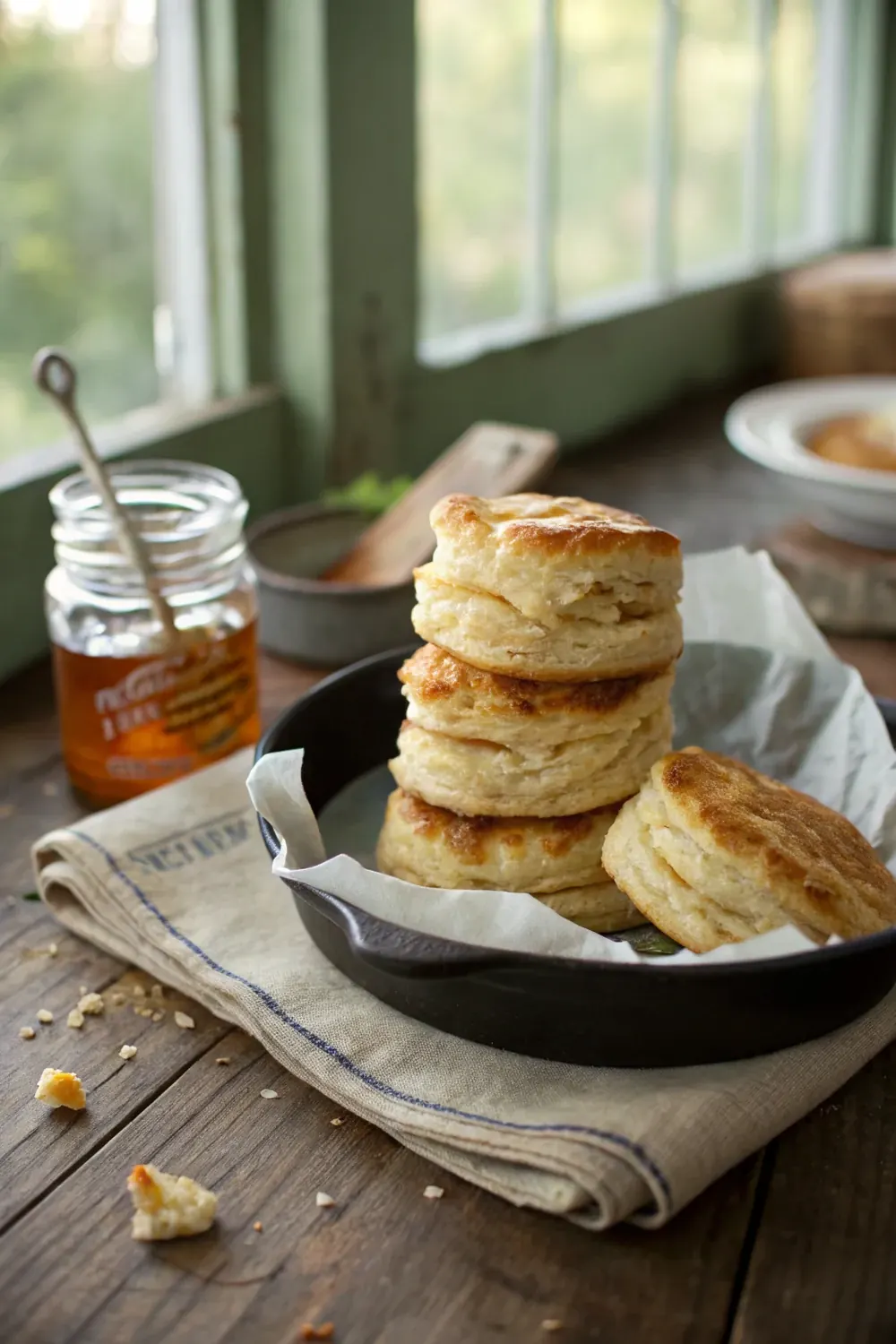
Southern Comfort Food
Buttermilk Biscuits Texas Style
Hill Country buttermilk biscuits with frozen grated butter, cold cultured buttermilk, lamination folds, and a 475F cast iron bake. Tall, flaky, golden.
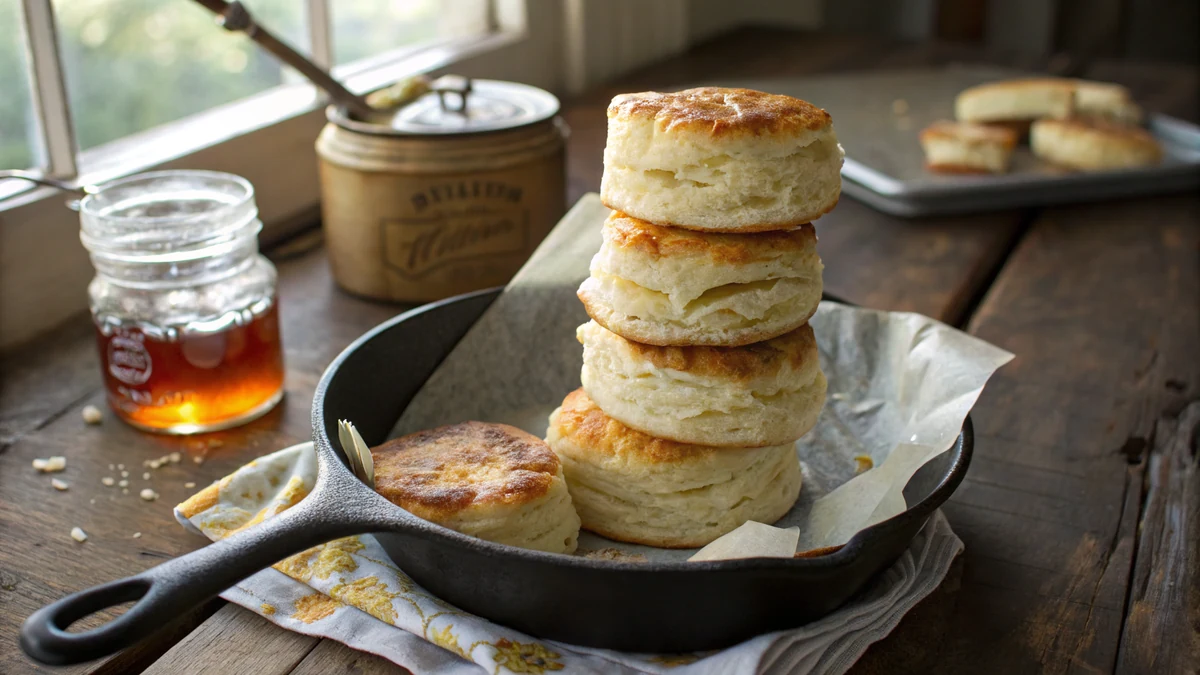
Quick answer: Texas-style buttermilk biscuits are tall, flaky, layered biscuits made with cold soft-wheat flour (White Lily is the gold standard), frozen butter grated on a box grater into the flour, very cold cultured buttermilk (Daisy or Cabot), and a lamination 'fold-and-turn' technique that builds visible flaky layers. The dough is patted out, folded over itself three to four times, cut with a sharp biscuit cutter (no twisting), baked in a hot cast-iron skillet at 475F for 14 to 16 minutes, and brushed with melted butter. Total time about 35 minutes.
I learned to make biscuits the way most Hill Country girls do, standing on a stepstool next to a grandmother who measured flour with a coffee cup and butter with the side of her thumb. In my case it was my mother's mother, who kept a cast-iron skillet on the back burner of her gas stove the way other people keep a teapot, on a ranch outside Stonewall, twelve miles from the LBJ Ranch. Her biscuits were tall and craggy and pulled apart in layers, and the version below is my best reconstruction with help from a Wagon Wheel cafe cook in Fredericksburg who pointed out three things I had been doing wrong.
Texas-style biscuits sit between deep Southern biscuits (the soft-wheat pillowy White Lily school of Tennessee and the Carolinas) and the slightly heartier biscuits of Oklahoma and the Hill Country ranches, where King Arthur all-purpose and a heavier hand are also normal. What unites them is high fat, very cold ingredients, a soft hand on the dough, and a hot oven. The recipe below makes 12 tall, flaky, layered biscuits in a cast-iron skillet at 475F. Frozen butter grated on a box grater is the technique that separates good biscuits from great ones, and lamination folds are the technique that gives you the visible flaky layers that make a biscuit worth its place at a Texas breakfast. Split them under a peppery cream gravy and you have my buttermilk biscuits and gravy, the full Texas breakfast plate.
The Texas vs Southern vs Northern Biscuit
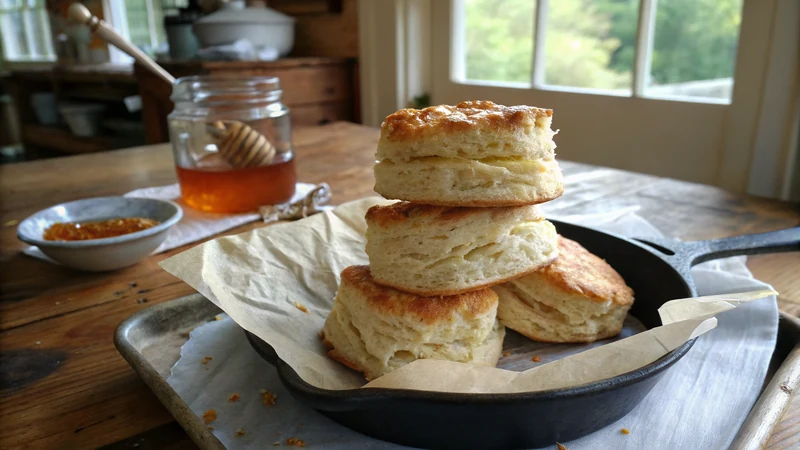
A biscuit in America is a regional object, not a universal one, and the lines between Texas, Southern, and Northern biscuits are real even if they are sometimes blurry. A deep Southern biscuit (think Tennessee, the Carolinas, Georgia, Alabama) is the soft-wheat pillowy biscuit made with White Lily flour, with a tender melt-in-your-mouth crumb and a soft, almost cottony texture. It is the biscuit of Loveless Cafe in Nashville and of every church basement supper from Knoxville to Athens.
A Northern biscuit, which is rarer and less codified, tends to be made with all-purpose flour or even bread flour, with a denser crumb and a heartier texture that veers toward a scone or a drop biscuit. New England buttermilk biscuits exist but they are not the same animal.
A Texas biscuit sits between the two, leaning Southern but with a heavier hand and a slightly sturdier crumb. Hill Country ranch kitchens, where biscuits had to hold up to country gravy, fried eggs, salt-cured ham, and a working appetite, tended to use all-purpose flour (King Arthur or Gold Medal) more often than White Lily. The biscuits were a little taller, a little flakier, a little more structural. The lamination fold-and-turn technique, borrowed from croissants and laminated pastry traditions, was a Hill Country adaptation that produced visible flaky layers without making the biscuit any less tender. That is the school I learned from and the school I teach here.
Flour Selection (White Lily vs King Arthur AP)
Flour matters more for biscuits than for almost any other baked good, because there is no yeast or long fermentation to mask flour differences. The protein content of your flour directly determines the texture of your biscuit, and the soft-wheat-vs-hard-wheat distinction is the single most important variable.
White Lily self-rising flour is the deep Southern gold standard, made from soft red winter wheat with a protein content around 8 percent, which is lower than typical all-purpose flour (10 to 12 percent) and dramatically lower than bread flour (12 to 14 percent). Low protein means less gluten development, which means a more tender, pillowy biscuit. White Lily self-rising also already contains baking powder and salt at the correct ratios for biscuits, which is the foolproof option. You can find White Lily at HEB and Central Market in Texas, or order online from the manufacturer. For the tenderest possible biscuit, use White Lily.
King Arthur all-purpose, Gold Medal all-purpose, or HEB all-purpose work well for a slightly sturdier Hill Country biscuit. The protein is around 10 to 11 percent, which produces a biscuit with more structure, more pull-apart layering, and a heartier texture. If you are making biscuits for country gravy or for stacking with thick-cut ham, all-purpose is arguably the better choice; the biscuit holds together better under sauce. King Arthur baking has a helpful flour guide if you want to go deeper. Do not use bread flour; it is too high in protein and produces a chewy, tough biscuit.
The Frozen-Butter-Grated Technique
Frozen butter grated on the large holes of a box grater directly into the flour is the single technique that separates great biscuits from mediocre ones. The method came to me from the Wagon Wheel cafe cook in Fredericksburg who let me watch her morning service. She kept a half-dozen sticks of butter in the freezer at all times, and she grated them straight into the flour like she was grating cheese onto pasta. The biscuits she pulled out of her oven were the tallest and flakiest I had ever seen.
The technique works because the frozen butter remains as discrete shreds in the flour rather than rubbing into a sandy crumb. When the biscuits hit the hot oven, those butter shreds melt and release steam, and the steam pushes the dough up in thin layers. That is the structural mechanism of a flaky biscuit. If you use softened butter or even room-temperature butter, the butter melts into the flour and coats the gluten strands before the oven heat hits, producing a dense, tender-but-flat biscuit (good for short biscuits, wrong for tall flaky ones).
Plugra and Kerrygold are grass-fed European-style butters with higher butterfat (around 82 to 84 percent vs 80 percent for standard American butter), and the extra butterfat translates to richer flavor and slightly more dramatic layers. They are worth the small splurge for biscuit day. Regular Land O'Lakes or HEB store-brand butter also works well; the frozen-and-grated technique matters more than the butter brand.
Buttermilk Temperature and Real vs Powdered
Buttermilk is the second non-negotiable for Texas-style biscuits, and the type of buttermilk you use matters. Real cultured buttermilk (Daisy, Cabot, Kalona, or HEB store-brand cultured) is fermented with lactic acid bacteria, giving it a tangy flavor and a slightly thick, almost ropy texture. The acidity reacts with the baking soda in the dough to produce extra lift, and the tang gives the biscuit its signature flavor.
Powdered buttermilk (Saco brand is common) is dried buttermilk reconstituted with water, and while it is acceptable for pancakes and salad dressings, it is markedly inferior for biscuits. The flavor is flatter, the acidity is less reliable, and the biscuits do not rise as high. If you are stuck with powdered, mix it slightly stronger than the package directs (use about 1.5 times the powder per cup of water) to boost the acidity. Better: drive to HEB and buy a quart of Daisy.
Temperature matters as much as type. The buttermilk should be cold straight from the refrigerator, ideally 35 to 38F. Cold buttermilk keeps the butter shreds frozen in the dough; room-temperature buttermilk starts melting the butter immediately, which is the wrong direction. In a hot Texas kitchen, you can even put the buttermilk in the freezer for 10 minutes before using; you want it cold enough to make your fingers ache slightly when you handle it. For more on buttermilk science, Serious Eats has a thorough breakdown of cultured vs sweet vs powdered buttermilk.
Mixing Approach (Hand vs Pastry Cutter vs Food Processor)
There are three schools on how to combine cold fat with flour for biscuits, and they produce different textures. The frozen-butter-grated approach I prefer is one. The pastry-cutter approach (using a pastry blender or two knives to cut cold cubed butter into flour) is the classic Southern technique, producing a slightly more uniform crumb with pea-sized butter pieces. The food-processor approach (pulsing cold butter and flour together) is the fastest and produces the most uniform crumb, but it tends to overprocess the butter unless you are very careful.
I have made biscuits all three ways and the frozen-grated method consistently produces the tallest, flakiest biscuits with the most pronounced layers. The pastry-cutter method is a close second and is the right choice if you do not own a box grater. The food-processor method is acceptable for a fast weekday batch but tends to produce a more crumbly, less layered biscuit because the butter gets too small.
If you do use a pastry cutter, cut the butter into 1/2-inch cubes, keep the butter very cold (freezer for 15 minutes minimum), and stop cutting when the butter pieces are still pea-sized, not when the mixture looks like coarse sand. Larger butter pieces produce flakier biscuits. The food-processor approach: pulse the cold cubed butter with the flour in 1-second pulses, no more than 6 to 8 pulses, until the butter is pea-sized. Stop immediately; another pulse or two and you have lost the layers.
The Lamination Fold and Turn for Visible Layers
Lamination is the technique of folding a layered dough over itself to multiply the layers, and it is borrowed from French viennoiserie (croissants, puff pastry) and adapted to biscuit dough by Hill Country and Appalachian bakers who wanted more visible flakiness without changing the basic biscuit recipe. The technique adds about 5 minutes to your biscuit timeline and roughly triples the visible layer count.
The mechanics: after combining the dough into a shaggy mass, you pat it out into a rough 3/4-inch rectangle, fold it in thirds like a business letter (left third over center, right third over that), rotate 90 degrees, and pat back out. Each fold-and-turn is a lamination. Three folds is the Hill Country standard, producing biscuits with 20 to 30 visible layers when you tear one apart. Four folds is acceptable for extra-pronounced layering but increases the risk of warming the butter beyond the point where it stays in discrete flakes.
The key is to work quickly and gently. Do not knead, do not press hard, do not roll with a rolling pin. Pat and fold, pat and fold. If at any point the butter starts to feel soft or sticky or you see it starting to melt into the dough, transfer the dough to a parchment-lined sheet and refrigerate for 10 minutes before continuing. The butter must stay cold or the lamination collapses. Bon Appetit has good visual references for the fold-and-turn technique if you want to see it demonstrated.
Cutting (Sharp Cutter, No Twist, Square Cut Alternative)
How you cut the biscuits matters as much as how you mix them, and the most common mistake at this stage is twisting the cutter. A twist seals the cut edges of the biscuit, gluing the layers together and preventing them from rising as separate flakes. You can see the difference in the oven: a straight-cut biscuit rises tall and straight with visible layered sides; a twisted-cut biscuit rises shorter and lopsided with smooth sealed sides.
Use a sharp metal biscuit cutter, 2.5 inches in diameter, ideally with thin sharp edges. Avoid plastic cutters; they have thicker dull edges that crush rather than cut the dough. Dust the cutter in flour before each cut to prevent sticking. Press straight down through the dough in a single firm motion, then lift straight up. No twist, no wiggle. If the dough sticks to the cutter, dust again and try the next biscuit.
The square-cut alternative is the bench scraper method, popular in some Southern bakeries because it produces zero scraps. Pat the dough into a rectangle and use a sharp bench scraper or knife to cut it into 12 even squares. The square biscuits are slightly less photogenic but rise just as tall and have the practical advantage of no second-cut scraps that have already been worked once. Cathead biscuits (large, irregular hand-pinched biscuits the size of a cat's head, a Hill Country and Appalachian style) are the no-cutter-needed alternative; just tear off rough handfuls of dough and pat into thick rounds.
Cast Iron vs Sheet Pan Bake
Texas biscuits are baked in cast iron, and the reason is the high heat retention of the pan. A preheated 12-inch Lodge cast iron skillet at 475F holds enough thermal mass to slam the biscuit bottoms with intense heat the moment they hit the pan, producing a crispy golden bottom and an upward thermal push that drives the lamination layers apart. A sheet pan, even preheated, does not match cast iron for thermal mass and heat retention.
If you do not own a 12-inch cast iron skillet, you can use a 10-inch (it will fit 9 to 10 biscuits instead of 12) or a half-sheet pan as a backup. The sheet pan biscuits will be slightly shorter and less crispy on the bottom but still excellent. Preheat the sheet pan along with the oven for at least 20 minutes; a cold sheet pan absorbs heat from the dough and produces shorter biscuits.
Lodge and Field Company are the two cast iron brands I keep in my kitchen. Lodge is the workhorse, affordable and indestructible, made in Tennessee since 1896. Field Company is the modern boutique brand, lighter and smoother, made in Wisconsin. Either will outlast you. A 12-inch cast iron skillet is also the right pan for cornbread (see my authentic Texas-style corn bread recipe), Dutch baby pancakes, and pan-roasted chicken. It is the most-used pan in my kitchen.
Oven Temperature (475F vs 450F)
High oven heat is what gives biscuits their tall, golden rise, and Texas-style biscuits go in at 475F, which is hotter than many recipes call for. The 450F school is acceptable and produces a slightly more even color, but 475F is the Hill Country standard for a reason: the initial blast of heat is what vaporizes the water in the cold butter and the buttermilk into steam, and that steam is what pushes the biscuit layers apart vertically.
If your oven runs hot (test with an oven thermometer; most home ovens are 15 to 25F off from their setting), drop to 450F. If your oven runs cool, you can push to 485 or 500F but watch for over-browning. The visual signal is what matters: the tops should be deep golden brown, not pale and not burnt, with the sides set and golden. A biscuit that is pale on top after 15 minutes is in an oven that is too cool; a biscuit that is dark and slightly burnt at 12 minutes is in an oven that is too hot.
Do not open the oven during the first 10 minutes of baking. The initial heat blast is what drives the rise, and opening the oven drops the temperature by 50F or more and stalls the rise. After 10 minutes the structure is set and you can rotate the pan or check progress without harm. A glass oven door is your friend here; you can monitor color without opening.
Butter Brush Finish (Before, After, or Both)
Whether and when to brush the biscuit tops with melted butter is a small but contested question in Texas biscuit culture. Three schools exist: brush before baking only (for extra golden color), brush after baking only (for shine and softness), or brush both before and after (my preference for maximum effect). All three produce a respectable biscuit; the choice is stylistic.
Brushing before baking adds a thin layer of melted butter to the top of the biscuit, which browns more deeply in the high oven heat and produces a glossy, slightly crisp top crust. The risk is that if you brush too heavily, the butter runs down the sides of the biscuit and into the pan, where it can produce a slightly greasy bottom. Brush lightly, just a thin coating with a pastry brush.
Brushing after baking is the deep Southern tradition. The hot biscuits drink in the butter the moment it hits them, and the result is a glossy, slightly salty top that softens the crust and adds visible richness. Use 1 to 2 tablespoons of melted butter for a batch of 12 biscuits, brushed generously while the biscuits are still in the skillet just out of the oven. A pinch of flaky sea salt (Maldon) on top while the butter is wet adds a savory edge that pairs beautifully with honey or sorghum drizzled over.
Serving (Honey, Sorghum, Country Gravy, Jelly, Ham)
A Texas biscuit is a serving platform, not a finished dish, and the toppings are where the regional character of the breakfast shows up. Six canonical pairings cover almost every Hill Country breakfast: salted butter (Plugra or Kerrygold) and honey (Round Rock Honey wildflower or Texas Hill Country Wildflower), salted butter and sorghum syrup (Brazos Valley Sorghum from College Station or Cooper Farms from Tennessee), country sausage gravy, sliced country ham or salt-cured pork, homemade fig or peach preserves, and a fried egg with hot sauce.
Honey is the Hill Country default. The wildflower honey from Round Rock Honey or any of the small Hill Country apiaries (Texas Honeybee Guild, Walker Honey Farm in Rogers) has the complex floral notes that pair beautifully with the butter and the slight tang of the biscuit. Tupelo honey from East Texas and mesquite honey from West Texas are regional alternatives worth seeking out.
Sorghum syrup is the deeper, more old-fashioned alternative to honey, with a molasses-adjacent richness and a slightly bitter edge. Sorghum was a major Texas crop in the 19th century and the syrup is still made in small batches by family operations. Brazos Valley Sorghum and Cooper Farms are the two brands I keep in my pantry. Country sausage gravy (a roux of flour and pork sausage drippings thickened with milk) is the heartiest pairing; see my forthcoming biscuits and gravy recipe for the full Hill Country breakfast plate. For lighter mornings, pair biscuits with my Austin breakfast tacos as part of a two-bread Texas brunch spread.
Mistakes to Avoid
Warm or soft butter. The single most common mistake. Warm butter melts into the flour and coats the gluten, producing a dense, flat biscuit instead of a tall flaky one. Freeze the butter solid for at least 2 hours before grating.
Overmixing the dough. Mix only until the dough comes together as a shaggy, ragged mass. Continued mixing develops gluten and produces tough, dense biscuits. The dough should look craggy and uneven when you turn it out, not smooth and elastic.
Twisting the biscuit cutter. A twist seals the layered edges and prevents the biscuits from rising. Press straight down, lift straight up. No wiggle, no twist.
Rolling with a rolling pin instead of patting. A rolling pin compresses the layers and squashes the butter into the dough. Pat with your hands or a bench scraper to maintain the lamination.
Cold oven or cold pan. The oven and the cast iron skillet must be screaming hot at 475F before the biscuits go in. A 5-degree drop or a cold pan produces short, dense biscuits.
Spacing the biscuits apart on the pan. Touching biscuits rise straight up against each other; spaced-out biscuits sprawl outward and rise less tall. Pack the skillet snugly.
Sweet (uncultured) buttermilk. Sweet buttermilk or buttermilk substitutes (milk with vinegar) lack the acidity to react with baking soda and produce a flatter, less tangy biscuit. Use cultured buttermilk only.
Storage and Reheating (Freeze Raw vs Baked)
Biscuits are a same-day food at their best, but they freeze well in two different stages, raw and baked, and each has its place. Freezing raw is my preferred method for make-ahead breakfasts. Cut the biscuits, arrange them on a parchment-lined sheet pan, freeze solid (about 2 hours), then transfer to a zip-top freezer bag. They keep raw for up to 2 months. To bake from frozen, place directly in a preheated 475F cast iron skillet and add 3 to 5 minutes to the bake time. The biscuits rise nearly as well as fresh.
Freezing baked biscuits is the second option, useful if you have leftovers. Cool the baked biscuits completely, wrap individually in plastic wrap or foil, then place in a freezer bag. They keep baked for up to 1 month. To reheat, unwrap and warm in a 350F oven for 8 to 10 minutes until heated through. The texture is slightly less tender than fresh but still excellent. Do not microwave; the dough turns gummy and rubbery.
Day-old biscuits at room temperature are still good for about 24 hours, especially if stored in a paper bag (not plastic; plastic traps moisture and turns the crust soft). Day-two biscuits should be refreshed in a 350F oven for 5 minutes to revive the crust. Day-three biscuits are best repurposed: split and use as the base for biscuits and gravy, tear into a biscuit bread pudding, or cube and toast as croutons for a salad. For gluten-free biscuit eaters, see my gluten-free breakfast casserole recipes for a complete gluten-free Texas breakfast plan.
Variations (Cheddar-Chive, Jalapeno-Bacon, Sweet Potato, Cathead)
Cheddar and chive biscuits. Add 1 cup of sharp cheddar (grated, ideally Tillamook or Cabot) and 1/4 cup of finely chopped fresh chives to the dry ingredients before grating in the butter. The cheese adds savory depth and a slightly crisp brown top. Pair with country gravy or with a fried egg.
Jalapeno and bacon biscuits. Add 1/2 cup of finely diced cooked bacon (smoked Texas bacon ideally, Wright's or Nueske's) and 2 tablespoons of finely diced fresh jalapeno to the dry ingredients. The biscuits become a Hill Country savory snack that pairs with cold beer and a Friday night porch sit.
Sweet potato biscuits. Replace 1/4 cup of the buttermilk with 1/2 cup of cooled roasted and mashed sweet potato. The biscuits turn a soft orange and gain a subtle sweetness that pairs beautifully with honey and salted butter. A Thanksgiving-week tradition in my kitchen.
Cathead biscuits. The no-cutter Appalachian and Hill Country style. After the third fold, tear off rough handfuls of dough about the size of a baseball and pat into thick rounds (about 3 inches across and 1.5 inches tall). Bake in cast iron at 475F for 18 to 20 minutes. Bigger, taller, more rustic.
Black pepper and buttermilk biscuits. Add 1 1/2 teaspoons of freshly cracked black pepper to the dry ingredients. The peppery edge is excellent with country ham and a fried egg.
Sourdough discard biscuits. Replace 1/2 cup of the buttermilk with 1/2 cup of sourdough starter discard. The biscuits gain a tangy depth and a slightly more pronounced rise.
Holiday breakfast spread. Serve biscuits alongside my buttermilk pie dessert and a platter of buttermilk fried chicken for a Sunday brunch that uses every drop of buttermilk in the house.
Chef Mia's Hill Country Notes
The first dozen times I made biscuits as a teenager I overmixed the dough, twisted the cutter, and used room-temperature butter, and the biscuits were dense and short and disappointing. My grandmother watched me with quiet patience and never told me what I was doing wrong. She just kept making her own biscuits next to mine, and eventually I figured out the differences by comparison. Cold butter. Soft hand. No twist. Hot oven. Those are the four rules, and they take longer to internalize than to read.
The Wagon Wheel cafe in Fredericksburg, where I learned the frozen-grated-butter technique from the morning cook, has been serving biscuits and gravy since the late 1970s. If you are in the Hill Country on a Saturday morning, the line forms outside by 7am. The biscuits are tall and flaky and brown on the bottom from the cast iron, and they come with a small dish of butter and a small dish of honey and a question of whether you want country gravy on top. The answer is always yes.
I keep a 12-inch Lodge cast iron skillet on the back burner of my stove the way my grandmother did. I keep two sticks of butter in the freezer at all times. I keep a quart of Daisy buttermilk in the refrigerator. With those three things I can produce 12 tall flaky Hill Country biscuits in 35 minutes from cold ingredients to hot plate, and that is the simplest happiness I know how to make. For the wider Texas breakfast culture, see Garden and Gun's biscuit and breakfast features, which document the Southern breakfast tradition with care and humor.
Buttermilk Biscuits Texas Style Recipe
Ingredients
- For the biscuits:
- 3 cups (360 g) White Lily self-rising flour, OR 3 cups (390 g) all-purpose flour plus 1 tablespoon baking powder and 3/4 teaspoon kosher salt
- 1 tablespoon granulated sugar (optional, traditional in Hill Country)
- 1/2 teaspoon baking soda (only if using cultured buttermilk, which you should)
- 8 tablespoons (115 g) unsalted butter, frozen solid for at least 2 hours (Plugra or Kerrygold grass-fed preferred)
- 1 1/4 cups (300 ml) cold cultured buttermilk (Daisy or Cabot full-fat), plus 2 tablespoons more if needed
- For brushing and finishing:
- 2 tablespoons unsalted butter, melted (for brushing tops after baking)
- Optional flaky sea salt (Maldon) for sprinkling
- For serving (choose any):
- Texas honey (Round Rock Honey or Texas Hill Country Wildflower)
- Sorghum syrup (Brazos Valley Sorghum or Cooper Farms)
- Salted butter (Plugra, Kerrygold, or Vermont Creamery)
- Country sausage gravy
- Homemade fig or peach preserves
- Equipment:
- Box grater (for the frozen butter)
- 12-inch cast iron skillet (Lodge or Field Company), OR a half-sheet baking pan
- Sharp biscuit cutter, 2.5 inches diameter (metal, no plastic)
- Bench scraper or sharp knife (for the lamination folds)
- Pastry brush
Instructions
- Freeze the butter and chill the buttermilk. At least 2 hours before mixing, place a stick of unsalted butter in the freezer until rock solid. The buttermilk should be in the coldest part of the refrigerator, ideally at 35 to 38F. Cold ingredients are non-negotiable for tall, flaky biscuits. Warm butter melts into the flour instead of staying as discrete flakes, which is how you get a dense biscuit instead of a layered one. If your kitchen is hot (a Texas July afternoon, for example), also chill your mixing bowl and the flour for 20 minutes before starting.
- Preheat the oven and the skillet. Place a 12-inch cast iron skillet on the center rack and preheat the oven to 475F for at least 20 minutes. The skillet should be screaming hot when the biscuits go in; this is the single biggest contributor to tall rise and golden bottoms. If you do not own a cast iron skillet, use a half-sheet pan, but still preheat it. Cold pans absorb heat from the dough and produce shorter biscuits.
- Whisk the dry ingredients. In a large mixing bowl (chilled if your kitchen is hot), whisk together the flour, sugar if using, and baking soda. If you are using all-purpose flour instead of self-rising, also whisk in the 1 tablespoon baking powder and 3/4 teaspoon kosher salt. Whisk for a full 30 seconds to evenly distribute the leavening; uneven leavening produces uneven rise and pockets of bitter baking soda taste.
- Grate the frozen butter into the flour. Using the large holes of a box grater, grate the frozen butter directly into the flour mixture. Work quickly so your hand heat does not melt the butter. Once all 8 tablespoons are grated in, use your fingertips to gently toss the butter shreds with the flour so each shred is coated and separated. Do not rub or pinch the butter into the flour; you want the butter to remain as discrete frozen shreds, not a sandy crumb. This is the single technique that separates Hill Country biscuits from generic ones.
- Add the cold buttermilk. Make a well in the center of the flour and butter mixture. Pour in 1 1/4 cups of the cold buttermilk all at once. Using a wooden spoon or a rubber spatula, gently stir from the center outward, just until a shaggy, ragged dough comes together. Do not overmix. The dough should look craggy and uneven, with some dry flour still visible on the bottom of the bowl. If the dough is truly too dry to hold together at all, add the extra 2 tablespoons of buttermilk one at a time. Better to err on the wet side than the dry side.
- Turn out and do the first lamination fold. Dust a clean counter generously with flour. Turn the shaggy dough out onto the counter, scraping the bowl. Pat (do not roll) the dough into a rough rectangle about 3/4 inch thick. Using a bench scraper or your hands, fold the dough in thirds like a business letter: fold the left third over the center, then the right third over that. Rotate the dough 90 degrees and pat back out to a 3/4-inch rectangle. This is your first lamination fold. The dough will still look craggy and messy; that is correct.
- Do the second and third folds. Repeat the fold-and-turn two more times for a total of three folds. With each fold the dough will become smoother and more cohesive, and you will start to see thin streaks of butter visible in the dough. Those streaks are the layers. If at any point the butter starts to feel soft or sticky, slide the dough onto a parchment-lined sheet and chill for 10 minutes before continuing. Three folds is the Hill Country standard; four is acceptable for extra-pronounced layers but increases the risk of warming the butter.
- Pat to final thickness and cut. After the third fold, pat the dough out to a final thickness of 1 inch. Do not roll with a rolling pin; pat with your hands or a bench scraper. Dust a sharp 2.5-inch biscuit cutter with flour and cut straight down through the dough without twisting. Twisting seals the layers and prevents rise. Cut the biscuits as close together as possible to maximize yield from the first cut. Gently gather the scraps, stack them (do not knead), pat to 1 inch, and cut again. The second-cut biscuits will rise slightly less but are still excellent.
- Arrange in the hot cast iron skillet. Carefully remove the hot skillet from the oven (use thick mitts; it is 475F). Optionally swirl 1 tablespoon of melted butter in the bottom of the skillet for extra crispy bottoms. Arrange the biscuits in the skillet so they are touching each other; touching biscuits rise straight up against each other rather than sprawling out. A 12-inch skillet holds 12 biscuits in a snug pack. If you cut more than 12, bake the extras on a parchment-lined sheet pan.
- Optional pre-bake butter brush. Some Hill Country bakers brush the tops with melted butter before baking for extra golden color; others brush only after baking for shine and softness. I do both for maximum effect. Brush the tops lightly now with about 1 tablespoon of melted butter, saving the rest for after baking. Sprinkle with flaky sea salt if you want a savory edge; skip the salt if you are serving with honey and want a sweeter biscuit.
- Bake at 475F. Bake on the center rack at 475F for 14 to 16 minutes, until the tops are deep golden brown and the sides are set and golden. Do not open the oven during the first 10 minutes; the initial blast of heat is what drives the rise. If your oven runs hot, check at 12 minutes; if it runs cool, give them 17 to 18. The biscuits are done when the tops are a true golden brown (not pale) and a tester inserted into the center comes out clean.
- Brush with butter and serve immediately. As soon as the biscuits come out of the oven, brush the tops generously with the remaining 1 tablespoon of melted butter. The hot biscuits will drink in the butter and develop a glossy, slightly salty top. Let cool in the skillet for 3 minutes, then transfer to a basket lined with a clean tea towel. Serve immediately with honey, sorghum syrup, salted butter, country gravy, or preserves. Biscuits are at their absolute best within 20 minutes of leaving the oven.
Frequently Asked Questions
Why are my biscuits dense and flat instead of tall and flaky?
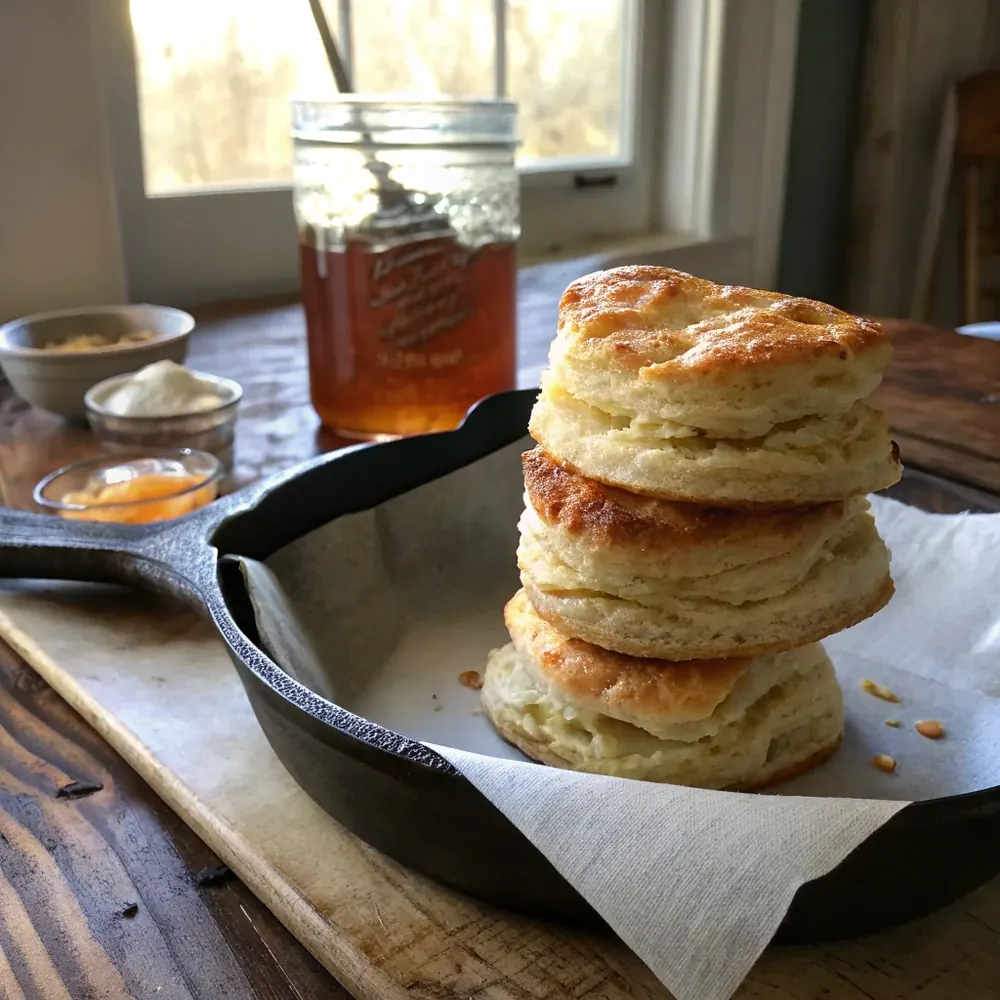
Almost always the cause is warm butter, overmixed dough, or both. The butter must be frozen solid before grating and must stay cold throughout the mixing and folding process. The dough must be mixed only until it comes together as a shaggy mass; any further mixing develops gluten and produces dense biscuits. Other causes: cold oven, cold cast iron skillet, twisted biscuit cutter, or biscuits spaced apart on the pan instead of touching. Texas biscuits need extreme heat (475F), cold ingredients, soft hands, and touching biscuits to rise tall.
Can I use all-purpose flour instead of White Lily self-rising?
Yes, and many Hill Country bakers prefer all-purpose for a slightly sturdier biscuit. Use 3 cups (390 g) of all-purpose flour (King Arthur, Gold Medal, or HEB store-brand) plus 1 tablespoon of baking powder and 3/4 teaspoon of kosher salt. The biscuits will be slightly less pillowy and slightly more structural than White Lily biscuits, which is closer to the classic Hill Country ranch biscuit. Do not use bread flour; the high gluten produces tough, chewy biscuits.
What is the difference between cultured buttermilk and sweet buttermilk or milk with vinegar?
Cultured buttermilk (Daisy, Cabot, Kalona) is fermented with lactic acid bacteria, giving it a tangy flavor, a slightly thick texture, and reliable acidity that reacts with baking soda for extra lift. Sweet buttermilk is the traditional liquid left over from churning butter and is almost never sold in stores. The milk-and-vinegar substitute (1 tablespoon vinegar per cup of milk) produces a slightly acidic milk but lacks the body and reliable tang of cultured buttermilk. For biscuits, use cultured buttermilk only; the substitutes produce a flatter, less flavorful biscuit.
Why do you grate the butter instead of cutting it with a pastry blender?
Grating frozen butter on the large holes of a box grater produces evenly-sized shreds that stay discrete in the flour and melt into thin layers in the oven. A pastry blender produces less uniform pieces and tends to mash some butter while leaving other pieces too large. The grated-butter technique is the single most reliable way to get tall, flaky biscuits with visible layers, and it came to me from a Wagon Wheel cafe cook in Fredericksburg. A pastry blender is acceptable as a backup but consistently produces shorter biscuits.
Do I have to use a cast iron skillet?
No, but it produces noticeably taller and crispier biscuits than a sheet pan. A preheated 12-inch Lodge cast iron skillet at 475F has enough thermal mass to slam the biscuit bottoms with intense heat the moment they hit the pan, driving the rise and crisping the bottoms. A half-sheet pan, even preheated, does not match cast iron for thermal mass. If you do not own cast iron, use a preheated sheet pan and accept slightly shorter, slightly less crispy biscuits. A 12-inch cast iron skillet is a $30 lifetime investment that I recommend for any Texas kitchen.
Can I make the biscuit dough ahead of time?
Yes, in two ways. The best ahead-of-time method is to cut the raw biscuits, freeze them solid on a parchment-lined sheet pan (about 2 hours), then transfer to a zip-top freezer bag for up to 2 months. Bake directly from frozen at 475F, adding 3 to 5 minutes to the bake time. The biscuits rise nearly as well as fresh. The alternative is to mix the dough through the lamination folds, wrap in plastic, and refrigerate for up to 24 hours, then cut and bake the next morning. Do not refrigerate cut biscuits longer than overnight; the baking powder loses potency.
What is the difference between Texas biscuits and Southern biscuits?
The line is blurry, but Texas-style biscuits (especially Hill Country ranch biscuits) tend to be slightly taller, slightly flakier, and slightly sturdier than the deep Southern pillowy White Lily biscuit. Texas bakers more often use all-purpose flour (King Arthur or Gold Medal) instead of soft-wheat White Lily, and the lamination fold-and-turn technique is more common in Texas than in Tennessee or the Carolinas. Texas biscuits are designed to hold up to country gravy, thick-cut ham, and a working appetite; Southern biscuits are more often a tender vehicle for honey or jam. Both traditions are excellent and the lines overlap heavily.