Cookout planning
Labor Day BBQ: The Four-Day Texas Cook Timeline
Quick answer: Labor Day 2026 falls on Monday, September 7. Working backward from a 2:00 PM serve: Friday is shopping, trimming, and fuel. Saturday and Sunday are every side dish, every drink, and every bag of ice, because Monday belongs entirely to the fire. Monday runs on one rule, which is that finished barbecue holds far better than it cooks fast. Brisket goes on at 2:00 AM, ribs at 7:00 AM, sausage at 11:00 AM, chicken at 12:00 PM, and anything that finishes early rests wrapped in a dry cooler until service. Budget half a pound of cooked meat per adult, which means buying close to a pound raw for brisket and pork. Do not plan to have everything come off the pit at once. Plan for everything to be done early and wait.
Every Labor Day disaster I have witnessed had the same cause, and it was never the cook. It was the schedule. Somebody bought a beautiful packer brisket, lit the fire at 6:00 AM for a 1:00 PM lunch, and discovered around 11:00 that a stall does not negotiate with a guest list. The meat was fine. The plan was fatal.
So this page is not a recipe and not a list of sides. Both of those already exist here and they are linked throughout. This is the calendar: what happens Friday, what happens over the weekend, and what happens hour by hour on Monday, September 7, when you are cooking four different things on one smoker and every one of them has to be ready at the same time.
The whole method rests on a single principle that took me a few humbling cookouts to accept. Barbecue holds beautifully and cooks unpredictably. So you never schedule a cook to finish at serving time. You schedule it to finish early and then you park it. Once you internalize that, a four-meat Labor Day on one pit stops being a gamble and becomes arithmetic.
Start With Two Numbers, Not a Menu
Before anything else, settle the head count and the serve time, because every other decision on this page is derived from those two numbers. Write the serve time down and treat it as fixed. Everything that follows counts backward from it.
For quantity, the working figure is half a pound of cooked meat per adult when there are real sides on the table, and about a third of that per child. The trap is that cooked weight is not purchase weight. Brisket loses roughly 40 to 50 percent of its raw weight to trim and rendering, and pork shoulder is close behind, so a 20 person cookout wanting 10 pounds of cooked brisket needs an 18 to 20 pound packer. Sausage and chicken are far more efficient, losing perhaps 15 percent, which is exactly why they belong on a crowd menu.
My guide on how much pulled pork per person works this math out in full for pork, including the group-size tables, and my brisket per person guide runs the same cooked-yield math for the packer. If you are serving multiple meats, do not add full portions together. Total the meat at half a pound per person across all proteins combined, then split that total between them however you like.
Two more numbers people forget. Ice runs about two pounds per guest for a hot September afternoon in Texas, and it is not optional. Fuel runs longer than you think: budget a full bag of charcoal or a comfortable half cord more wood than the cook should need, because running out at hour nine is a genuinely unrecoverable error.
Friday, September 4: Shopping, Trim, and Fuel
Buy the meat three days out
Three days ahead is the sweet spot. The butcher counter still has choice on a Friday, whereas by Sunday afternoon the good packers are gone and you are choosing between what nobody else wanted. Buy everything cold, get it home fast, and put it in the bottom of the refrigerator. Fresh meat is perfectly happy for three days at 38F, and a brisket that sits salted for two days is better than one seasoned an hour before it goes on.
Trim on Friday, not at 1:00 AM Monday
Trimming a packer brisket properly takes 30 to 45 minutes, and nobody does it well in the dark on four hours of sleep. Do it Friday evening with good light and counter space. Trim, season, wrap, and put it back in the refrigerator. The same goes for pulling membrane off ribs and portioning anything that needs portioning. Monday morning you should be lifting meat out of the refrigerator and putting it on a grate, nothing more.
Confirm fuel and hardware while stores are open
Count your wood or charcoal, check the propane, and confirm you own two working thermometers, one for the pit and one for the meat. Friday is the last day this is a shopping problem rather than a crisis. If you are still deciding on rubs or gear, my tested Texas BBQ rubs guide covers what I actually keep on the shelf. Also locate the cooler you will use for holding, and make sure it is empty and clean, because it becomes essential equipment on Monday.
Saturday and Sunday: Everything That Is Not the Fire
Saturday, September 5: cook every side that keeps
This is the day the sides get made, and almost all of them should be. Beans, potato salad, slaw, and anything vinegar-based are genuinely better after a night in the refrigerator, not merely acceptable. My 15 classic Texas BBQ sides roundup marks which dishes improve overnight and which need to be same-day, and the low-carb sides guide covers the same ground for a keto crowd. Do not carry side dish cooking into Monday. Monday has exactly one job.
Sunday, September 6: drinks, ice, and the physical setup
Sunday is logistics. Buy ice Sunday evening, not Monday morning when every store within ten miles is picked clean. Fill the drink coolers and get them cold overnight so Monday's ice is not doing the work of chilling warm cans. Set up tables, chairs, shade, trash cans, and serving vessels. If drinks are part of the plan, my Texas cocktails collection covers what batches well for a crowd, and batching them Sunday night is the correct call.
Sunday night: light check and alarm set
Before bed, clean the pit grates, position the smoker where it will run, and lay out everything Monday's early start needs within arm's reach: fuel, lighter, thermometers, gloves, spray bottle, foil or butcher paper. A 2:00 AM start goes badly when you are hunting for a lighter in the dark. Set two alarms. Then sleep, because tomorrow starts in the middle of tonight.
Monday, September 7: The Hour-by-Hour Pit Schedule
This schedule assumes a 2:00 PM serve, an 18 pound packer brisket, two racks of pork ribs, sausage, and chicken thighs, all on a single smoker running 250F. Shift every time by the same amount if your serve time differs.
2:00 AM. Fire lit, pit brought to a stable 250F, brisket on fat side up. This is the only genuinely unpleasant moment of the day and it buys you everything. A 12 hour window for an 18 pound packer sounds generous because it is meant to; generous is the entire point.
2:30 AM to 6:00 AM. Sleep near the pit if it is an offset that needs tending, or go back to bed if it is a pellet or insulated cooker that holds temperature on its own. Check once around 5:00 AM.
7:00 AM. Ribs on. The brisket is somewhere in the 150s and heading into the stall, which is convenient, because it needs nothing from you for the next few hours.
9:00 AM. Brisket wrapped in butcher paper once the bark is set and dark. If you are unsure whether the bark is ready, the test is whether it resists a fingernail rather than smearing.
11:00 AM. Sausage on. It needs about two hours and it is nearly impossible to ruin, which makes it the ideal thing to add while your attention is on the brisket.
12:00 PM. Chicken thighs on, and this is also the moment to raise the pit toward 275F if the brisket is running behind. Chicken tolerates the higher heat happily and the wrapped brisket will not object.
12:00 PM to 1:00 PM. Ribs come off as they hit tenderness and go into the hold. Brisket comes off when it probes like room-temperature butter, generally somewhere between 200F and 205F, but tested by feel rather than number.
1:00 PM. Everything that is finished is wrapped and in the dry cooler. Chicken and sausage come off last, closest to service, because they are the two that hold the least gracefully.
1:45 PM. Slicing starts. Brisket gets sliced to order rather than all at once, because sliced brisket dries within minutes while an unsliced hunk in the cooler stays perfect for hours.
2:00 PM. Serve. For the underlying technique on any individual cook above, the Ultimate Texas BBQ Guide is where the methods live.
One Smoker, Four Meats: Solving the Collision
The reason multi-meat cookouts fail is that people schedule every meat to finish at serving time, which requires four simultaneously correct predictions about four cuts that finish when they feel like it. Brisket in particular can swing two hours in either direction on identical setups, and no amount of experience makes that predictable enough to bet lunch on.
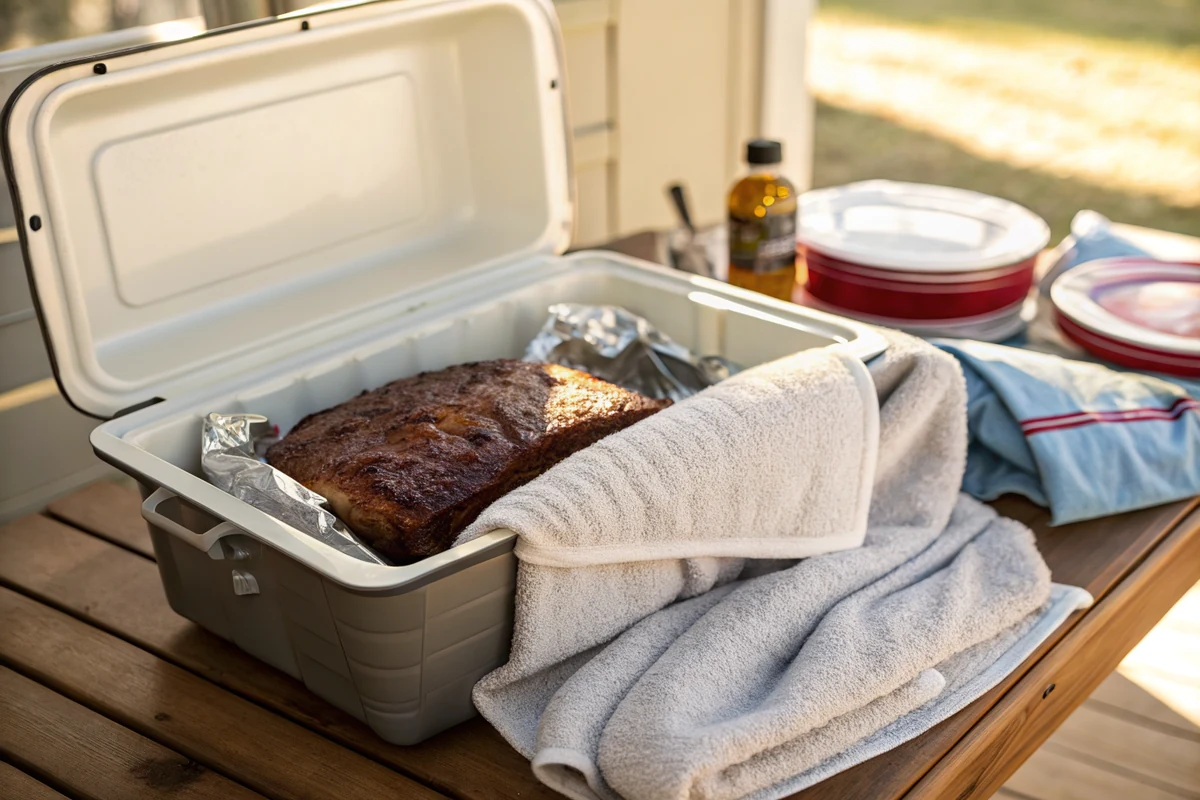
The fix is to stop treating finish time as the target. A wrapped brisket in a dry cooler, insulated with towels, sits above 140F for four to six hours and is meaningfully better at hour three than it was coming off the pit. That hold window is not damage control. It is the scheduling instrument that converts four uncertain finish times into one certain serve time.
So the cook order follows hold tolerance, longest holder first. Brisket holds superbly and goes on first. Pork ribs hold well for two to three hours. Sausage holds acceptably for about an hour. Chicken holds worst of all, going soft and losing its skin within the hour, which is precisely why it goes on last and comes off closest to service.
Two practical constraints. Grate space is real, so measure before you promise four meats to twenty people; a standard 22 inch kettle will not do this cook, and a 22 inch offset barely will. And smoke does not need to run the entire cook, since most absorption happens in the first few hours while the surface is still cool and damp. Later arrivals on the pit will taste less smoky than the brisket, which is normal and usually welcome.
Service: Slice Late, Hold Long
The last hour has one rule worth enforcing against your own impulses: slice to order. A whole brisket sitting in its paper stays juicy for hours, and the same brisket sliced at 1:00 PM for a 2:00 PM serve will be visibly dry by the time the second wave of guests reaches the table. Cut half, put the rest back, cut more when the tray empties.
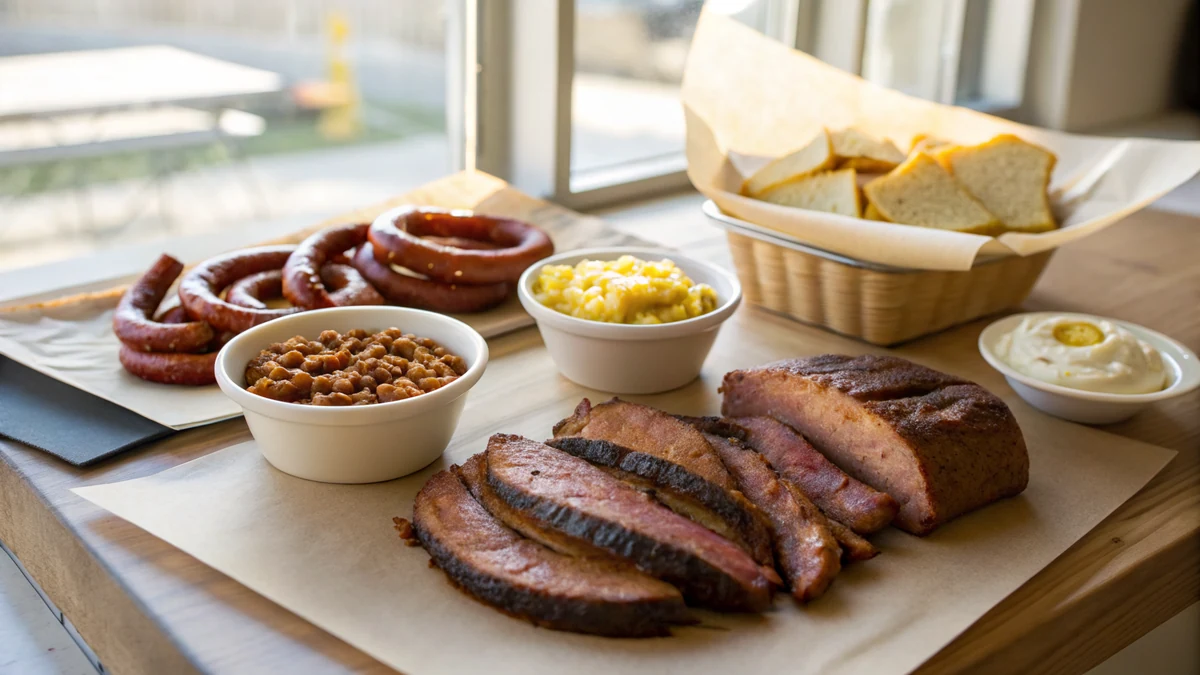
Set the table so the meat is last in line, after plates, sides, bread, and pickles. People fill up on what they encounter first, and putting the twelve hour brisket at the end of the run means it lands on a plate that already has a place for it. Keep a pan of the reserved brisket drippings warm and spoon a little over the sliced meat as you go.
Finally, plan leftovers deliberately rather than accidentally. Cooked barbecue keeps four days refrigerated and reheats well vacuum-sealed in warm water. Buying ten percent over the calculated need is the cheapest insurance available on a day when running out is the only genuinely unrecoverable mistake.
Frequently Asked Questions
When is Labor Day 2026?
Monday, September 7, 2026. Labor Day is always the first Monday in September, which gives most Texas cooks a three-day weekend running Saturday the 5th through Monday the 7th. That structure is what makes the four-day plan on this page practical rather than ambitious: Friday for shopping and trim, Saturday for sides, Sunday for logistics and ice, and Monday entirely for the fire. If your gathering is on Sunday the 6th instead, shift every day on this page back by one.
How much meat do I need for a Labor Day cookout?
Half a pound of cooked meat per adult with real sides on the table, and roughly a third of that per child. The number that catches people out is raw weight: brisket and pork shoulder lose 40 to 50 percent between trim and rendering, so 10 pounds of cooked brisket requires an 18 to 20 pound packer. Sausage and chicken lose closer to 15 percent. When serving several meats, calculate the half pound across all proteins combined rather than adding a full portion for each one.
What time should I start the brisket for a 2:00 PM Labor Day lunch?
2:00 AM for an 18 pound packer at 250F, which builds in a genuinely generous cushion. That may sound excessive for a cook that often finishes in nine or ten hours, and that is the point: finishing three hours early costs you nothing because the brisket rests happily in a dry cooler, while finishing an hour late costs you the entire event. Never schedule a brisket to finish at serving time. Schedule it to finish early and hold.
Can I cook four different meats on one smoker?
Yes, and the whole trick is staging by hold tolerance rather than trying to land everything simultaneously. Brisket holds best so it starts first, then ribs, then sausage, then chicken, which holds worst and comes off closest to service. Anything that finishes early goes into a towel-lined dry cooler. The real limit is grate space rather than technique, so measure your cooking surface before committing to four meats, because a standard kettle will not accommodate this cook.
How long can barbecue hold in a cooler before serving?
Four to six hours safely for a large wrapped cut like brisket or pork shoulder in a preheated dry cooler packed with towels, staying above the 140F food safety line the entire time. Brisket in particular improves during the first couple of hours as the muscle relaxes and reabsorbs juice. Smaller and leaner items hold for less: ribs two to three hours, sausage about an hour, chicken under an hour before the skin goes soft. Never put ice or anything cold in a holding cooler.
What should I make ahead versus on the day?
Every side dish, every drink, and all shopping and trimming happen before Monday. Beans, potato salad, and slaw are genuinely better after a night in the refrigerator rather than merely acceptable, and my Texas BBQ sides roundup marks which ones improve overnight. The only things that belong on Monday are the fire, the meat, and the slicing. If you find yourself chopping vegetables at 11:00 AM on cookout day, something got scheduled wrong two days earlier.
How much ice and fuel do I actually need?
Two pounds of ice per guest for a Texas September afternoon, bought Sunday evening rather than Monday morning when stores run out. For fuel, carry a comfortable margin over what the cook should need, a full extra bag of charcoal or noticeably more wood than the math suggests. Running out of fuel at hour nine of a twelve hour brisket is among the very few mistakes on this page that cannot be recovered from once guests are already in the yard.