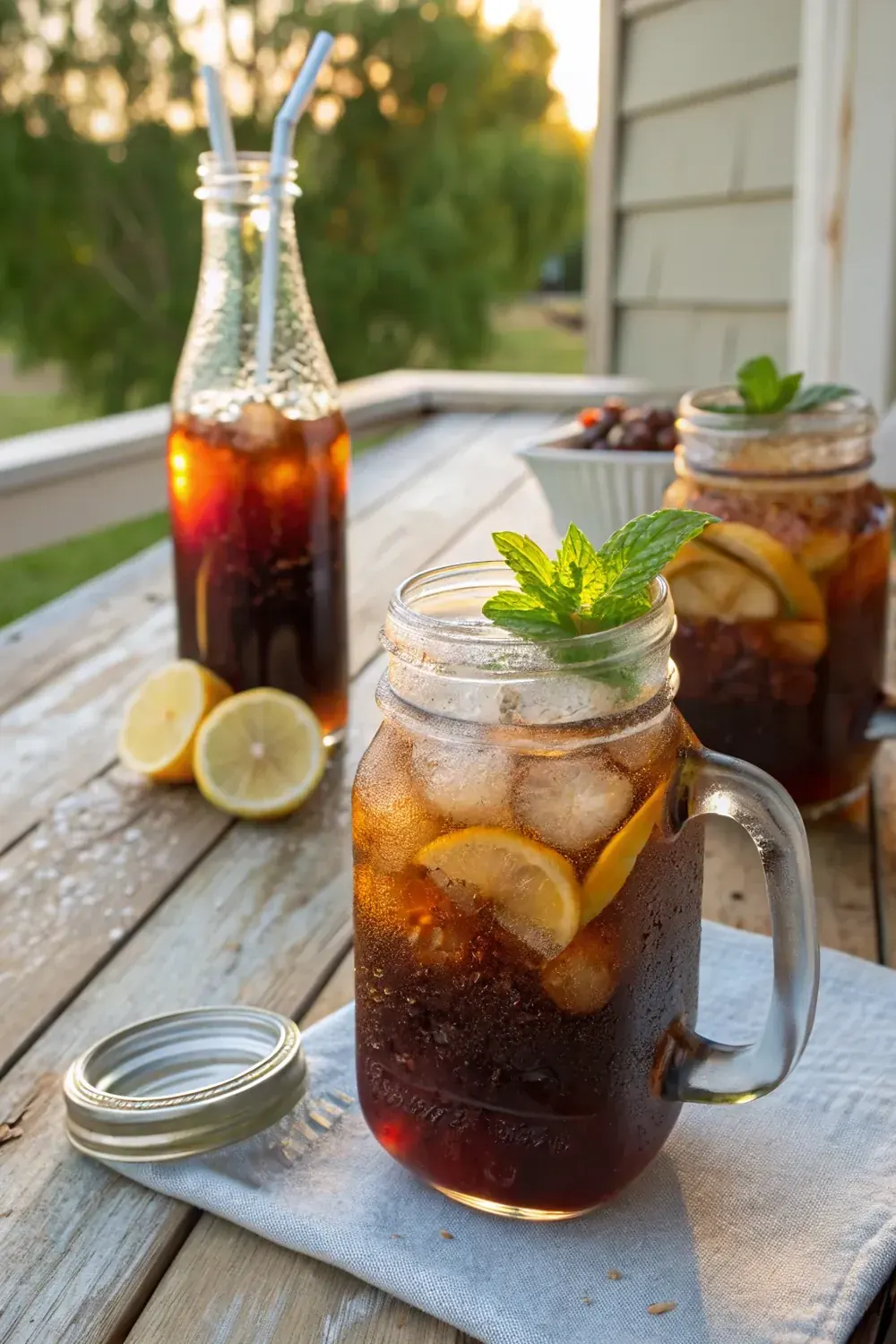
Southern Comfort Food
Texas Iced Tea
The classic Texas iced tea recipe, one cup of sugar per gallon, Lipton or Luzianne black tea, lemon and mint. The Hill Country sweet tea pitcher year-round.
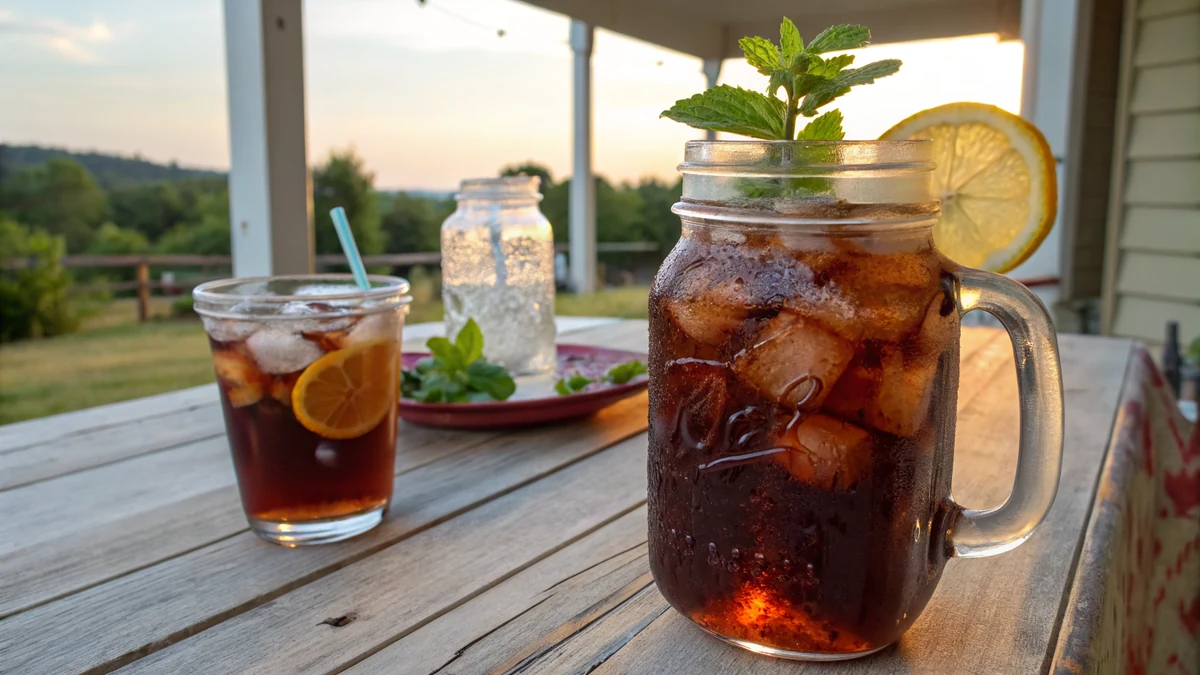
Quick answer: A Texas iced tea recipe is a simple non-alcoholic Southern sweet tea built on the canonical one-cup-of-sugar-per-gallon ratio. Strong black tea (Lipton or Luzianne family-size bags) steeps for 4 to 5 minutes in just-off-the-boil water, the sugar dissolves into the hot concentrate, then cold water fills the pitcher and the whole thing chills over plenty of ice. Lemon wedges and fresh mint go on top. This is the everyday Texas pitcher, not the Long Island cocktail.
The first time I made sweet tea on my own, I was nine years old at my grandmother's house in Tyler, standing on a step stool in front of a stove that had been making tea for forty years. She handed me a measuring cup, pointed at a sleeve of Luzianne family-size bags, and said the rule out loud so I would remember it forever. One cup of sugar per gallon. Four bags of family-size tea. Steep four minutes, not five, never six. Stir the sugar in while the tea is still hot, then top up with cold water and ice. I have not changed a single step in the thirty years since.
What I did not understand at nine was that the pitcher of sweet tea in my grandmother's fridge was the same pitcher in every Texas fridge from Tyler to El Paso, year-round, summer or winter. Tea is not a special occasion drink here. It is what you pour when somebody walks in the door. The recipe below is the Hill Country method I make now in my own kitchen, with a few notes on tannin control, the sweet line, and a couple of variations for peach tea and Arnold Palmers. The pitcher should live in your fridge from May through October at minimum. In a real Texas house, it lives there in December too. Sweet tea is also the only drink that made my Texas cocktails guide without a drop of liquor in it, which tells you exactly how much authority it carries.
Texas Sweet Tea Heritage
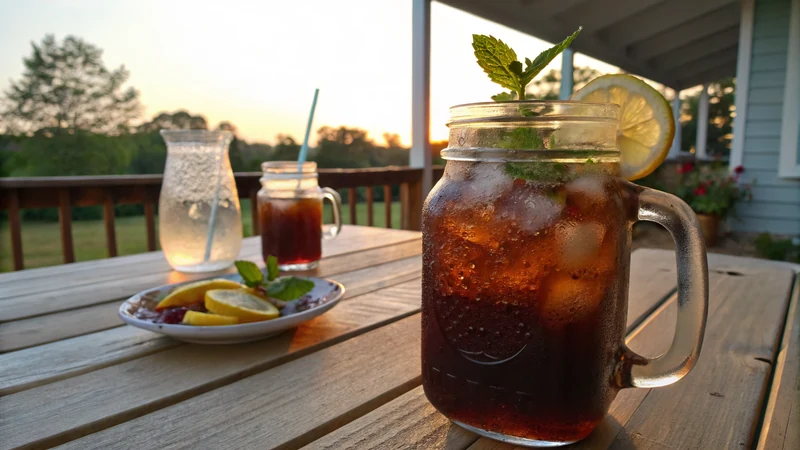
Sweet tea in Texas is not a recipe so much as a household standard, the way salt is a standard in every kitchen drawer. The pitcher lives in the fridge. It gets refilled on Sunday afternoons and emptied by Wednesday morning. Nobody asks if you want some when you walk into a kitchen in Tyler, Lufkin, or Beaumont. Somebody just pours you a glass. The unspoken understanding goes back to the late 1800s, when iced tea first showed up at the 1904 World's Fair in St. Louis and traveled south on rail lines, and Texas adopted it harder than most other states.
What makes Texas sweet tea distinct from, say, South Carolina or Georgia sweet tea is mostly a matter of strength and proportion. The canonical Texas pitcher uses one cup of sugar per gallon, which is a touch lighter than the Deep South default of one and a quarter to one and a half cups per gallon. Texas tea also tends to be a hair stronger on the tannin side, made with Luzianne or Lipton family-size bags rather than the smaller individual bags. The pitcher is built to hold up against barbecue, Tex-Mex, and chicken-fried steak.
Walk into any Texas barbecue joint from Franklin's in Austin to Snow's in Lexington to Cooper's in Llano and the menu reads the same: brisket, sausage, potato salad, beans, and a Styrofoam cup of iced tea the size of your forearm. Salt Lick in Driftwood pours theirs from a stainless pitcher that never leaves the table. Southern Living has documented the regional sweet tea map for decades and Texas always lands as its own category, partly because Texas drinks more of it per capita than any other state.
The One Cup Per Gallon Sugar Ratio Rule
If you remember nothing else from this page, remember the ratio. One cup of granulated white sugar per gallon of tea. That is the canonical Texas sweet tea concentration, used by grandmothers from Tyler to San Antonio for at least four generations. It works because the sugar is high enough to read as clearly sweet on the first sip but low enough that the tannins of the black tea still come through, and the drink does not cross over into syrup territory the way certain Deep South sweet teas do.
The trap is that some Texas families run sweeter and some run lighter. My East Texas relatives use a cup and a quarter per gallon, and my Hill Country relatives use three-quarters of a cup. Both call it sweet tea. The right ratio for you depends on what you grew up drinking, what you are serving it with, and how cold the day is. Always sweeten while hot. The temperature window for dissolving sugar in tea is narrow, and once the pitcher hits room temperature the window closes.
For half-sweet tea, drop the sugar to half a cup per gallon. For unsweet tea (which is rare in a real Texas house but common at restaurants for the sake of customer choice), skip the sugar entirely and let each drinker add their own. Never use artificial sweetener in the hot brew step. Splenda and stevia do not behave like sugar in hot liquid, and the resulting tea tastes off. Add those at the glass, not the pitcher.
Choosing Your Tea (Lipton, Luzianne, Community, Loose Leaf)
The Texas grocery store sweet tea aisle has four working options and they are not interchangeable. Luzianne family-size bags are the New Orleans tea company favorite and the one my Tyler grandmother used. The blend is heavier on the tannic side, which holds up well under a lot of sugar. Luzianne is sold at HEB, Kroger, and Brookshire's across Texas and is my default recommendation. The family-size bag is sized for a quart of water, so four bags makes a gallon.
Lipton family-size bags are the second most common Texas choice. The blend is a touch milder than Luzianne with a cleaner, less astringent finish. Lipton tea is what almost every Texas restaurant uses (Whataburger, Chili's, Cracker Barrel) and the flavor is what most Texans recognize as default iced tea. Either Lipton or Luzianne will give you an honest Texas pitcher. Pick the one your family used.
Community Coffee black tea out of Baton Rouge is a Louisiana-Texas borderland option that shows up in East Texas grocery stores and is excellent for sweet tea. The blend is darker and slightly more chocolatey than Lipton, and it brews very strong. Loose-leaf black tea (Assam, Ceylon, or English Breakfast) gives the cleanest, most professional iced tea, but it needs a strainer and a slightly shorter steep time. Use about 4 tablespoons of loose leaf per gallon. Order from Serious Eats recommended sources if you want to upgrade.
Tannin Management and the Bitter Trap
Black tea contains tannins, which are the same family of polyphenol compounds that give red wine its astringent grip on the back of the tongue. A small amount of tannin gives sweet tea its backbone and structure. Too much tannin and the tea tastes bitter, dry, and unpleasant. Three things drive tannin extraction: water temperature, steep time, and agitation. Get all three right and your pitcher tastes balanced. Get one wrong and the whole batch is off.
Water temperature: 200 to 205F is the sweet spot. Fully boiling water (212F) is too aggressive for black tea and pulls bitter tannins out fast. If you do not have a thermometer, bring the water to a boil and then let it rest off the heat for 30 seconds before pouring it over the bags. This drops the temperature into the right window and gives a smoother brew.
Steep time: 4 minutes is the Texas standard, 5 minutes is the maximum, and 3 minutes is acceptable for a lighter pitcher. Past 5 minutes the tannins overtake the flavor and the tea cannot be saved. Agitation: never squeeze the bags. Squeezing forces concentrated tannin out of the wet leaves and into the brew, and a squeezed bag will turn a perfect pitcher bitter in 30 seconds. Lift the bags out gently when the timer rings and discard them. The optional pinch of baking soda also neutralizes a small amount of tannic acid and rounds the finish.
Sweet vs Unsweet and the Sweet Line
Texas has a soft cultural border called the Sweet Line, which is the latitude above which iced tea is served unsweetened by default and below which it is served sweet by default. The Sweet Line runs roughly along Interstate 20, from Abilene through Dallas to Tyler. North of I-20 (Wichita Falls, Amarillo, the Panhandle) restaurants will ask if you want sweet or unsweet. South of I-20 (Austin, Houston, San Antonio, the Valley) the default is sweet and unsweet is the special request. East Texas runs sweetest of all.
Modern Texas restaurants have largely abandoned the default and now ask every customer, which is a sensible accommodation but also a sign of the times. Whataburger keeps two big urns at every register, sweet and unsweet, and the sweet urn empties faster every single shift. Chick-fil-A serves a famously sweet tea that runs closer to a cup and a half of sugar per gallon, and they sell it by the gallon-jug to go.
At my own house, the default pitcher is the one-cup-per-gallon Hill Country sweet ratio. If a visitor wants unsweet, I make a small fresh quart unsweetened on the side. Mixing sweet and unsweet in the same glass is a perfectly acceptable Texas compromise and is sometimes called half-and-half tea or halfway sweet. Order it that way at any small-town Texas diner and the waitress will know exactly what you mean.
Cold Brew vs Hot Brew vs Sun Tea
There are three working methods for making iced tea, and each one has trade-offs. Hot brew (this recipe) is the Texas standard. Hot water extracts the tea quickly, the sugar dissolves clean in the hot concentrate, and the whole pitcher is ready in about two hours including the chill time. The downside is the kitchen gets warm and the bottle of dish soap on the counter ends up steamier than necessary on a 100F July day.
Cold brew is the modern variation. Tea bags steep in cold water in the fridge for 8 to 12 hours, no heat involved. The cold brew method extracts fewer tannins, so the resulting tea is smoother and less bitter, almost sweet on its own. The downside is the sugar dissolves poorly in cold water, so you either heat up a small portion to dissolve the sugar (defeating the cold method) or use a simple syrup made separately. Cold brew is also less forgiving on weak tea bags. Use only family-size or loose-leaf for cold brew.
Sun tea is the old summer porch method. Tea bags steep in a glass jar of cool water set in direct sunlight for 3 to 5 hours. The result is a mild, lightly tannic tea that tastes like summer itself. Food safety note: sun tea sits in the 70 to 130F danger zone for hours and can grow bacteria if held warm too long. The CDC and most food safety guides now recommend cold-brew refrigeration over sun tea for this reason. My grandmother made sun tea anyway. If you do it, drink it the same day and refrigerate any leftover within four hours.
Ice and Water Quality
Iced tea is mostly water, and the quality of your water shows up in the glass. Texas tap water varies wildly by city. Houston tap water is heavily chlorinated and gives tea a faint pool-water taste. Austin tap water from the Edwards Aquifer is very hard and mineral-heavy, which can clash with the tannins in the tea. San Antonio water is similar. Filter your water for tea. A simple Brita or PUR pitcher filter is enough to clean up the chlorine and soften the minerals, and the difference in the finished pitcher is unmistakable.
Ice is just as important. The ice cubes have to be made from filtered water too, because they melt into the tea as you drink. Hard-water ice cubes carry the same mineral flavor into the glass that hard-water tap would. Make ice from the same filtered water you brew with. If you have a refrigerator with an icemaker connected to a filtered water line, you are already set. If not, freeze trays of filtered water specifically for the tea pitcher.
Use plenty of ice. A tall glass should be filled to the rim with ice before the tea is poured, not garnished with three sad cubes from the dispenser. Ice keeps the tea cold against the Texas heat and the slow dilution from the melt is part of the design. By the bottom of the glass, the tea is slightly weaker, slightly less sweet, and that final sip is meant to feel refreshing rather than syrupy. The math of the original pitcher accounts for the melt.
Garnishes (Lemon, Mint, Peach, Basil)
Lemon is the canonical Texas iced tea garnish. A thin wheel or a fat wedge floats on top of every glass, and a quick squeeze before drinking brightens the whole flavor. Slice the lemon fresh, not the day before. Lemon left in cold tea for hours turns bitter from the pith. One wheel per glass, not three. Too much lemon overpowers the tea.
Fresh mint is the second most common Texas garnish. Spearmint is the right variety; peppermint is too aggressive and reads as toothpaste against sweet tea. Pick a small sprig per glass and slap it gently against your palm before adding to release the oils. Mint grows like a weed in Texas yards from April through October. Most Hill Country gardens have a mint patch specifically for tea.
Fresh peach slices are the summer pitcher upgrade. Stick peaches from Fredericksburg orchards (Vogel, Studebaker, Engel) in July and August are exactly the right peach for tea. Slice two ripe peaches thin and float them in the pitcher for an hour before serving. Fresh basil is the Hill Country variation that has been quietly trending at restaurants like Hayden in Austin and Otto's in Fredericksburg. Basil adds an anise-licorice note that pairs surprisingly well with sweet tea. Use sparingly, two leaves per glass.
Pitcher Storage and Shelf Life
A pitcher of sweet tea keeps in the fridge for 3 to 4 days at peak quality. Past that, the tannins continue to develop slowly even cold, and the tea takes on a slightly sour, flat edge. The pitcher should always be covered with a lid or plastic wrap. Uncovered tea picks up fridge odors, especially from onions, garlic, and leftover Tex-Mex, and you do not want your sweet tea tasting like last night's queso.
Never leave the pitcher on the counter overnight. Tea is a brewed beverage and it will cloud, sour, or grow bacteria at room temperature within a few hours. The cloudiness in particular (which sweet tea drinkers call tea fog) is caused by the tannins precipitating out of solution as the temperature drops slowly, and it happens faster at room temperature than in the fridge. Foggy tea is still safe to drink but does not look as appealing.
If you make a gallon and only drink half by day three, taste it before pouring a fresh glass. Off-tea tastes flat and slightly sour. Pour it out and brew a new pitcher. Real Texas households go through a gallon every two or three days anyway, so the leftover question rarely comes up. The fridge pitcher is meant to be refilled, not preserved. Treat it like fresh milk, not like a shelf-stable drink.
Restaurant Versions Around Texas
Every Texan has opinions on the best restaurant iced tea in the state. Whataburger sets the statewide baseline. The orange-and-white striped urns at the register pour a clean Lipton-based sweet tea that is the lowest-common-denominator Texas pour and the gold standard for fast-food iced tea anywhere in the country. A Whataburger sweet tea with a number 1 combo is the default Texas road trip lunch.
Babe's Chicken Dinner House in Roanoke and across the DFW area serves their sweet tea in Mason jars and refills them aggressively. The Babe's blend runs a little stronger than Whataburger and pairs perfectly with their fried chicken. Hard Eight BBQ in Stephenville and Coppell pours from gallon pitchers at the table and the tea is built to stand up to brisket and ribs. The recipe runs sweet, almost too sweet, but it works against smoky beef.
Black's Barbecue in Lockhart has been serving sweet tea since 1932 and runs theirs slightly less sweet than the East Texas standard, more like the Hill Country ratio. The Salt Lick in Driftwood pours unsweet by default and adds a side caddy of sugar. Sonic Drive-In across Texas runs a sweet tea with the cup-and-a-quarter-per-gallon Deep South ratio, sweeter than most fast food chains, and that tea-and-tots combo is a Texas teenager tradition.
Variations (Peach Tea, Arnold Palmer, Ranch Tea)
Peach tea is the Hill Country summer variation. Add 4 ripe Fredericksburg peaches sliced thin to the hot concentrate while it cools, let them steep for 30 minutes, then strain into the pitcher before adding the cold water. The peach flavor reads as a soft fruit-floral note rather than a sticky-sweet syrup, and the tea takes on a faint pink-amber color from the peach skins.
Arnold Palmer is the half-and-half pour of sweet tea and lemonade. Combine equal parts chilled sweet tea and chilled lemonade in a tall glass over ice. Garnish with a lemon wheel. The original Arnold Palmer (named for the golfer who ordered it at clubs in the 1960s) is one of the most refreshing drinks in the Texas summer arsenal. Some Texas golf clubs call it a half-and-half or a quarter-and-three depending on the ratio.
Ranch tea is the adult-only Hill Country variation, sweet tea with a generous pour of bourbon or Texas-distilled whiskey. Try Garrison Brothers from Hye, Balcones Baby Blue from Waco, or Still Austin Whiskey from south Austin. Two ounces of bourbon over ice with sweet tea poured over the top, lemon wheel, mint sprig. This is the porch drink. If you want an adult drink that is not bourbon-based, try a michelada with brunch or a ranch water cocktail at the end of a hot afternoon. For a tequila pairing on the spicier side, my Texas margarita recipe is the classic Saturday pour. For something with a ginger kick, a Texas Mule in a copper mug is hard to beat, and for a frozen, fruity finish there is the Texas Roadhouse Kenny's Cooler.
What to Serve With Iced Tea
Sweet tea is the universal Texas beverage and pairs with almost any plate. The strongest classic pairings are smoked meats (brisket, ribs, sausage), Tex-Mex (enchiladas, queso, fajitas), Southern fried foods (chicken-fried steak, fried catfish, fried okra), and breakfast plates of all kinds. The sweetness of the tea balances spicy food and the tannins cut through fatty barbecue. The combination is why no Texas pitmaster has ever served a brisket plate without a glass of tea on the side.
For breakfast, sweet tea pairs surprisingly well with Austin breakfast tacos in the morning, especially the bacon-egg-and-cheese variety. The sweetness offsets the richness of the eggs and cheese, and the cold tea is a refreshing wake-up alongside the warm tortilla. For lunch, Texas Frito pie and sweet tea is the Friday night football game Texas combo, served at every high school concession stand from Allen to El Paso.
For dinner, sweet tea is the default with anything barbecued, fried, smoked, or grilled. Food Network has profiled the Texas barbecue trail many times and tea is the consistent table beverage at every joint. A glass of strong tea with two slices of brisket and a fork-full of cole slaw is the most honest Texas plate in the world. For dessert, pour the tea half-and-half with a scoop of vanilla ice cream for a Southern tea float, which is a thing in East Texas that more people should know about.
Mistakes to Avoid
Boiling the water at a full rolling boil. Black tea steeps best at 200 to 205F, not 212F. Fully boiling water pulls bitter tannins out fast and ruins the smoothness. Bring the water to a boil and rest it off the heat for 30 seconds before pouring over the bags.
Steeping longer than 5 minutes. Four minutes is the Texas standard and 5 minutes is the maximum. Past 5, the tannins overtake the flavor. Set a timer. Lift the bags gently when the timer rings. Do not let them sit longer just because you got distracted.
Squeezing the tea bags. Squeezing forces concentrated tannin out of the wet leaves and into the brew, and a squeezed bag will turn a perfect pitcher bitter in seconds. Lift the bags straight up out of the water and discard. Never squeeze, never wring.
Adding sugar to cold tea. Sugar dissolves in hot liquid almost instantly and practically never in cold tea. If you wait until the pitcher is cold to sweeten, you will end up with gritty crystals at the bottom of every glass. Sweeten while the concentrate is still hot.
Pouring hot tea into a cold glass pitcher. A cold glass pitcher hit with hot tea will crack. Run warm water over the outside of the pitcher first to temper it, or pour into the pitcher slowly down the side. Plastic pitchers do not have this problem.
Leaving lemon slices in the pitcher overnight. Lemon pith turns bitter in cold tea after a few hours. Garnish per glass, not per gallon. Slice the lemon fresh and keep it on a small plate beside the pitcher for guests to add as they pour.
Using unfiltered tap water. Hard water and chlorinated water both throw off the tea flavor. Filter the water, both for the brew and for the ice cubes. The difference in the finished glass is unmistakable, especially in Austin, San Antonio, and Houston where the municipal water is famously mineral-heavy or chlorinated.
Chef Mia's Hill Country Kitchen Notes
I keep a pitcher of sweet tea in my fridge every single day of the year. The pitcher I use is a plain glass gallon pitcher from HEB that cost about $12, and I have had it for eight years. The lid is a silicone snap-on from Central Market that fits any standard pitcher. I refill the pitcher every two or three days and the cadence is automatic now, the way some people refill the coffee maker every morning. The first thing I do when I get home from a trip is brew a fresh gallon.
My garden mint patch is the most-used herb in my Hill Country yard, and the whole reason it is there is the tea pitcher. Spearmint runs wild in Texas with very little care. Plant one starter in a partly shaded spot and water it twice a week through the summer, and you will have mint for sweet tea from April through October. The same patch supplies the mint for my michelada recipe on weekend mornings too.
The most underrated tip on this whole page is the pinch of baking soda. My Tyler grandmother told me about it when I was nine and I did not believe her until I was thirty and finally tested a side-by-side pitcher with and without. The version with baking soda was noticeably smoother, less astringent on the back of the tongue, and aged better in the fridge over three days. It is the kind of grandmother trick that turns out to have real chemistry behind it. Bon Appetit tested this exact tip in a 2017 piece and confirmed the result.
Texas Iced Tea Recipe
Ingredients
- For the tea:
- 4 family-size black tea bags (Luzianne or Lipton, each bag steeps about 1 quart)
- 1 cup granulated white sugar (for full Texas sweet, see notes for half-sweet)
- 1 quart filtered water (for the hot steep, about 4 cups)
- 3 quarts cold filtered water (to top up the pitcher, about 12 cups)
- 1 pinch baking soda (optional, cuts bitterness, about 1/8 teaspoon)
- For serving:
- Plenty of ice cubes (filtered water ice if your tap is hard)
- 1 lemon, sliced into thin wheels (or cut into wedges)
- 1 small bunch fresh mint (spearmint preferred, from your garden or HEB produce section)
- Optional garnishes:
- Fresh peach slices (summer pitcher upgrade)
- Fresh basil sprigs (Hill Country variation)
- Lemonade (for an Arnold Palmer half-and-half pour)
- Equipment:
- 1 large kettle or 4-quart saucepan
- 1 gallon glass or food-safe plastic pitcher
- Long-handled stirring spoon
- Liquid measuring cup
- Fine-mesh strainer (optional, if loose leaf is used)
Instructions
- Heat the water to just under a boil. Bring 1 quart of filtered water to a temperature of about 200 to 205F in a kettle or saucepan. You want hot water, not a rolling boil. Boiling water is too aggressive for black tea and pulls extra tannins out of the leaves, which is the difference between smooth sweet tea and the kind that tastes like wet cardboard. If you do not have a thermometer, bring the water to a boil and then let it sit off the heat for 30 seconds before pouring it over the bags.
- Steep four family-size bags for four to five minutes. Place 4 family-size Luzianne or Lipton tea bags in a heat-safe pitcher or large measuring cup. Pour the hot water over the bags, give one gentle press to submerge them, and set a timer for <strong>4 minutes</strong> (5 minutes maximum). Do not squeeze the bags during the steep and do not let them sit longer than 5 minutes. Over-steeping is the single most common Texas sweet tea mistake. The bag squeeze releases trapped tannins into the concentrate. Lift the bags out gently when the timer goes off.
- Add the optional pinch of baking soda. While the concentrate is still hot, stir in a pinch of baking soda (about 1/8 teaspoon for a gallon). This is the secret a lot of Tyler and Tylertown grandmothers use, and the chemistry behind it is real. Baking soda neutralizes a small amount of the tannic acid that black tea naturally releases, so the finished pitcher tastes rounder and less astringent. It does not make the tea taste like baking soda. Use a light hand here. Too much will make the tea taste flat or soapy.
- Dissolve the sugar in the hot concentrate. Add <strong>1 cup of granulated white sugar</strong> to the hot tea concentrate and stir constantly until the sugar is fully dissolved and the liquid runs clear when you lift the spoon. This step is non-negotiable. Sugar dissolves in hot liquid almost instantly but practically never in cold tea, no matter how long you stir. If you wait until the pitcher is cold to sweeten, you will end up with gritty crystals at the bottom of every glass. Stir until the bottom of the measuring cup feels clean.
- Pour the hot sweet concentrate into the pitcher. Transfer the hot sweetened concentrate into your 1-gallon pitcher. If the pitcher is glass, run warm water over the outside first to temper it. A cold glass pitcher hit with hot tea will crack, and you will lose the whole batch and possibly cut yourself cleaning it up. Plastic pitchers do not have this problem, but glass is the Hill Country tradition for a reason. The tea looks better in glass and the pitcher cools faster in the fridge.
- Top up with cold water. Add 3 quarts (12 cups) of cold filtered water to the pitcher, stirring as you pour. The cold water dilutes the concentrate to drinking strength and drops the temperature significantly. Taste the tea now. It should be strong, clearly sweet, and faintly tannic. If it tastes weak, the steep was too short. If it tastes bitter, the steep was too long. Adjust the next batch accordingly, but this batch is done. Sweet tea cannot be re-fixed once the water is in.
- Chill the pitcher in the fridge. Place the pitcher in the fridge uncovered for at least <em>30 minutes</em>, or ideally 2 hours, until fully cold. Hot tea poured straight over ice will melt the ice immediately and water the tea down to nothing. Patience here is the difference between a strong second glass and a sad watery one. If you are in a hurry, set the pitcher in a sink of ice water for 15 minutes to speed-chill it, but the fridge method gives a cleaner result and lets the flavors settle.
- Slice the lemons and pick the mint. While the tea chills, slice a whole lemon into thin wheels (about 1/8 inch thick) and pick a small bunch of fresh mint into clean sprigs. Spearmint is the classic Texas garden variety; peppermint is too aggressive for sweet tea. Keep the lemon and mint separate from the pitcher until serving. Lemon left to soak in the pitcher for hours turns bitter from the pith, and mint left in cold liquid loses its top notes. Garnish per glass, not per gallon.
- Serve over plenty of fresh ice. Fill a tall glass to the rim with fresh ice. Pour the chilled tea over the top, leaving about an inch of headspace. Tuck a lemon wheel and a mint sprig into the glass. Stir once and serve immediately. The ice should be fresh from the freezer, not the half-melted cubes that have been sitting in the fridge dispenser for a week. <strong>Use filtered water for the ice cubes</strong> if your tap water is hard. Hard water ice cubes throw a metallic flavor that ruins iced tea, especially in Central Texas where the water is famously mineral-heavy.
- Store the leftover tea in the fridge. Cover the pitcher with a lid or plastic wrap and refrigerate. Sweet tea stays good for <strong>3 to 4 days</strong> in the fridge, though in any real Texas household the pitcher rarely lasts past day two. Past four days, the tea starts to taste flat and the tannins continue to develop a slightly sour edge. Do not leave the pitcher on the counter overnight. Tea is a brewed beverage and it will cloud, sour, or grow bacteria if held at room temperature for more than a few hours.
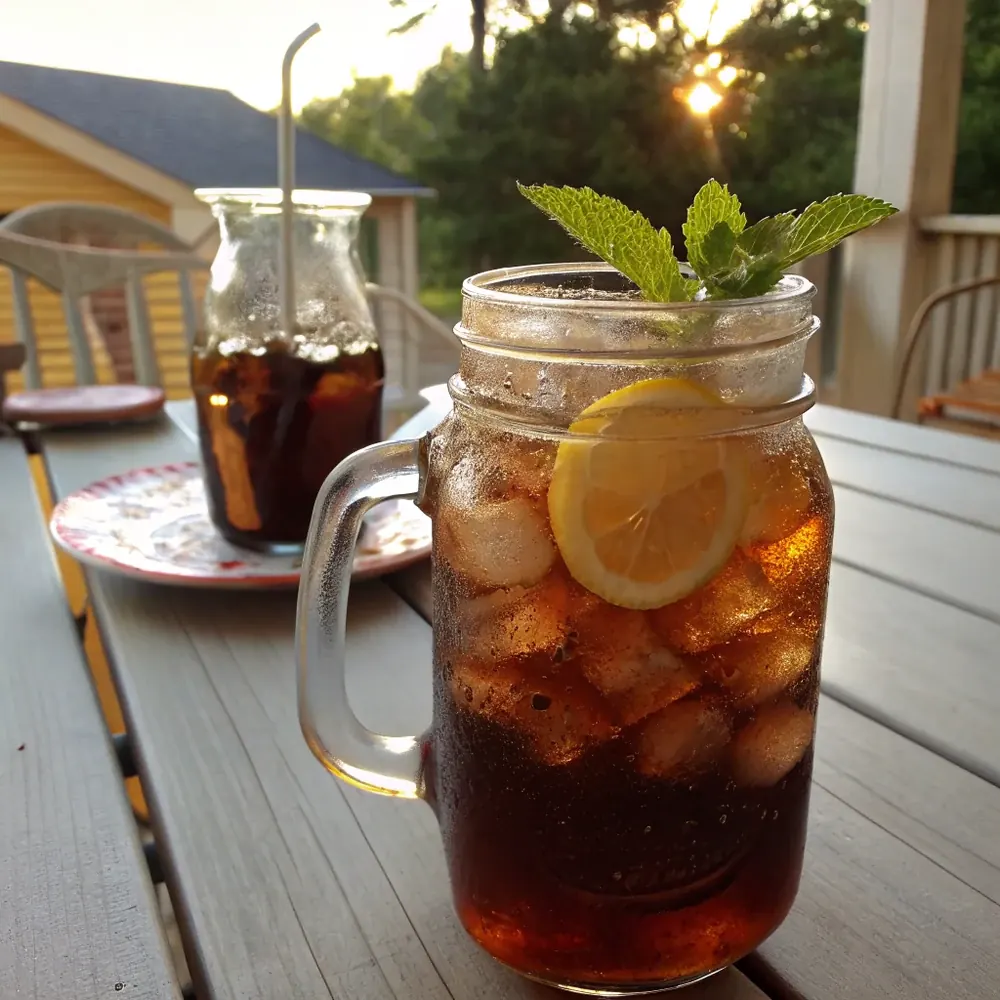
Frequently Asked Questions
How much sugar should I use per gallon of Texas sweet tea?
The canonical Texas sweet tea ratio is one cup of granulated white sugar per gallon. That is the Hill Country and East Texas standard, used by grandmothers across the state for at least four generations. Some Deep South recipes go up to a cup and a quarter or a cup and a half per gallon (Chick-fil-A and parts of Georgia), and some Hill Country and Central Texas families run lighter at three-quarters of a cup. Always sweeten while the tea concentrate is still hot. Cold tea does not dissolve sugar.
Lipton vs Luzianne, which is better for sweet tea?
Both are honest Texas choices and the right one depends on what you grew up drinking. Luzianne family-size bags (from New Orleans) brew darker and more tannic, which holds up well to a full cup of sugar and pairs well with barbecue and Tex-Mex. Lipton family-size bags brew milder and cleaner, and Lipton is what most Texas restaurants use including Whataburger and Chili's. Use four family-size bags per gallon either way. The family-size bag is sized for one quart of water.
Why is my iced tea bitter?
Bitter iced tea comes from one of three causes. First, the water was too hot. Boiling water (212F) extracts too many tannins from black tea; use 200 to 205F instead. Second, the bags steeped longer than 5 minutes. Set a timer for 4 minutes and pull the bags gently. Third, the bags were squeezed, which forces concentrated tannin into the brew. Never squeeze. If the pitcher is already bitter, the tea cannot be saved. Start over and pay attention to time and temperature.
Can I make Texas iced tea with cold brew?
Yes, cold brew is a smooth alternative to hot brew. Place 4 family-size bags in a gallon pitcher of cold filtered water and refrigerate for 8 to 12 hours, then lift out the bags. Cold brew extracts fewer tannins so the tea is mellower and slightly sweeter on its own. The catch is sweetening: sugar does not dissolve in cold water, so you either heat a small portion of the concentrate to dissolve the sugar, or use a separately made simple syrup. Pour over plenty of ice.
How long does sweet tea last in the fridge?
A pitcher of Texas sweet tea keeps in the fridge for 3 to 4 days at peak quality. Past that, the tannins continue to develop and the tea takes on a slightly sour, flat edge. Always keep the pitcher covered with a lid or plastic wrap, both to maintain freshness and to keep the tea from picking up fridge odors. Never leave the pitcher on the counter overnight; tea sours quickly at room temperature. In a real Texas household, the pitcher rarely lasts past day two anyway.
Is Texas iced tea the same as Long Island iced tea?
No, they are completely different drinks despite the similar name. Texas iced tea (also called Southern sweet tea or just sweet tea) is a non-alcoholic drink made from brewed black tea, sugar, water, and ice, usually garnished with lemon and mint. Long Island iced tea is an alcoholic cocktail made from vodka, gin, rum, tequila, triple sec, sour mix, and a splash of cola, with no actual tea in the recipe at all; its tequila-forward Texas cousin, the Texas Tea cocktail, even borrows this pitcher's exact lemon-and-mint look. The recipe on this page is non-alcoholic sweet tea, the everyday Texas pitcher.
What is the pinch of baking soda for in sweet tea?
Baking soda is a Texas grandmother trick that has real chemistry behind it. A tiny pinch (about 1/8 teaspoon per gallon) added to the hot tea concentrate neutralizes a small amount of the tannic acid that black tea naturally releases, so the finished pitcher tastes rounder, smoother, and less astringent on the back of the tongue. It also helps the tea stay clear instead of getting cloudy in the fridge. It does not make the tea taste like baking soda. Use a very light hand. Too much will taste flat or soapy.