Texas BBQ
Texas Twinkies
Texas Twinkies smoked low and slow: jalapenos stuffed with brisket and cream cheese, wrapped in bacon. The Hutchins BBQ Frisco signature, at home.
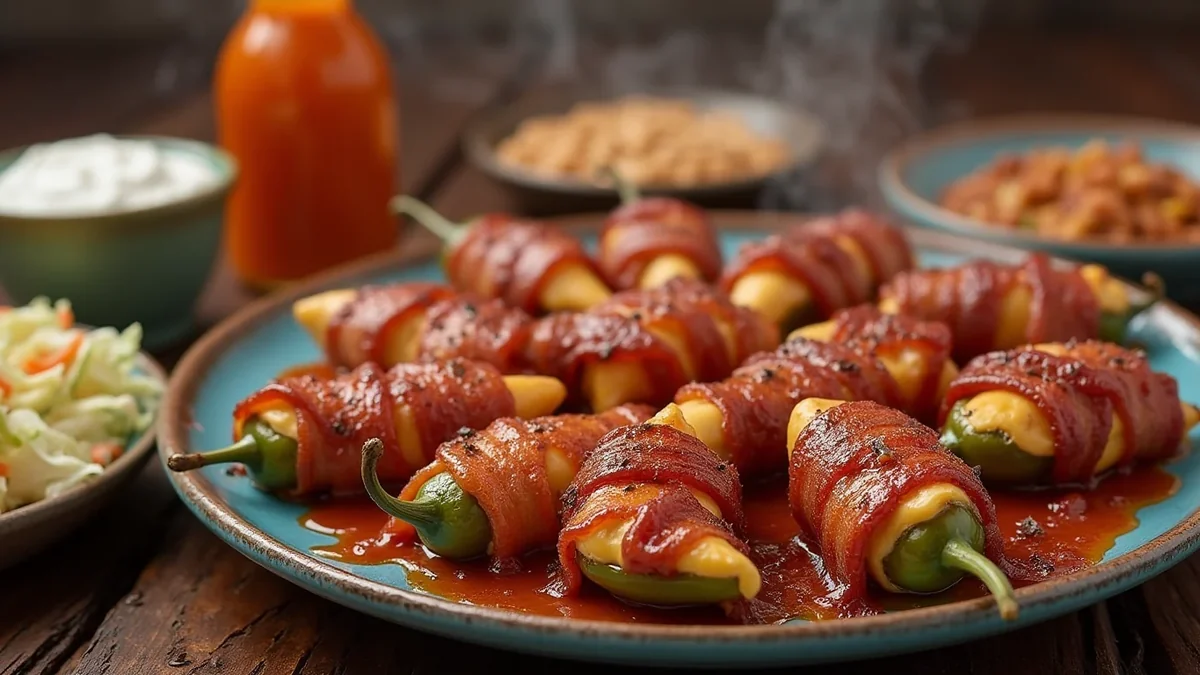
Quick answer: Texas Twinkies are large jalapenos split, seeded, stuffed with chopped smoked brisket and cream cheese, wrapped in thick-cut bacon, dusted with BBQ rub, and smoked at 250F over post oak for about 2 hours until the bacon crisps to mahogany and the jalapeno softens to fork-tender. The dish was popularized by Hutchins BBQ in Frisco, Texas, and became the most copied appetizer on the Texas BBQ trail. Glaze with thinned BBQ sauce in the last 15 minutes for shine.
I drove up to Hutchins BBQ in Frisco for the first time in 2018, hungry from a Saturday-morning brisket pilgrimage, and I ordered the Texas Twinkies because the guy in front of me did. What landed on my tray looked like a bacon-wrapped grenade: a whole jalapeno split open, packed with chopped brisket and cream cheese, smoked until the bacon was mahogany and the pepper was soft enough to give way to a plastic fork. I took one bite and understood why people drive across the metroplex for them. Tracy and Tim Hutchins built a BBQ legend out of a leftover-brisket reuse, and the rest of Texas has been chasing them ever since.
The genius of a Texas Twinkie is the math of leftovers. Brisket, cooked properly, is the most expensive thing on a BBQ pit (12 hours of fuel, a 14-pound packer, hours of wrap-and-rest). At the end of service, every Texas BBQ joint has chopped trimmings and end-cuts that are too good to throw away and not pretty enough to slice. Hutchins turned that pile into a phenomenon. At home the move is the same: cook a brisket, save 8 ounces of chopped trimmings, and turn them into a dozen Texas Twinkies the next weekend. The technique is easy-medium (jalapeno prep takes 20 minutes; the rest is smoker management), and the results stop conversation at the table.
Hutchins BBQ and the Brisket-Leftover Backstory
Tracy and Tim Hutchins opened Hutchins BBQ in McKinney in 1978 and expanded to Frisco in 2014, and somewhere along that timeline the Texas Twinkie went from a back-of-the-pit experiment to the most copied appetizer on the Texas BBQ trail. The story most pitmasters tell is the same: at the end of a Saturday service, the chopped trimmings from a dozen briskets were piled up in a pan, too good to throw away, too irregular to slice. Someone (lore credits a Hutchins pit cook) stuffed them into split jalapenos with cream cheese, wrapped them in bacon, and threw them back on the smoker.
The result was a self-contained bite that combined every flavor the pit produced - smoke, brisket bark, cream cheese richness, jalapeno heat, bacon crisp - into a single object you could eat with your hands. By the late 2010s, Texas Monthly had named Hutchins to its Top 50 BBQ list and the Texas Twinkie had become a marquee item on menus from Goldee's in Brady to Salt Lick in Driftwood. Some joints credit their own pit cooks; the consensus on the trail still gives Hutchins the win.
The dish belongs to the great Texas BBQ tradition of leftover ingenuity. Burnt ends came from cubed brisket point that was too fatty to slice. Beef cheek tacos came from the cheek that pitmasters used to throw away. Texas Twinkies came from chopped brisket that was too irregular for a sliced plate. Every great BBQ dish in Texas was once a way to use something that would otherwise be wasted, and that frugality is the soul of pit cooking.
Choosing the Right Jalapenos
The jalapeno is the foundation, and the right pepper makes or breaks the dish. You want large, firm, dark-green jalapenos, about 4-5 inches long, with smooth unblemished skin. Bigger jalapenos are easier to seed, hold more filling, and have a thicker wall that softens to fork-tender without disintegrating. Bigger is also milder - the heat-to-flesh ratio drops as the pepper gets larger.
Look for jalapenos with the white stretch lines (called corking) running down the skin. Corked jalapenos are mature, slightly hotter, and have firmer flesh that holds up to a 2-hour smoke. Smooth, perfectly green jalapenos are younger and softer; they tend to collapse into mush on the smoker. Texas grocery chains like H-E-B and Central Market stock both; if you have a choice, go corked.
Skip red jalapenos for this dish. Red jalapenos are fully ripened and noticeably hotter, with a sweet undertone that fights the smoky brisket. Some Texas pitmasters use red and green together for visual contrast on a serving platter, which is fine, but the green jalapeno is the canonical choice. Avoid jarred or pickled jalapenos entirely - they have too much moisture and will steam rather than smoke.
The Cream Cheese Filling
Full-fat cream cheese is non-negotiable. The reduced-fat version weeps water on the smoker, and the resulting filling looks separated and tastes flat. Use a full block of Philadelphia or H-E-B Texas Style at room temperature - if it is too cold, the filling will not blend smoothly with the brisket and you will end up with white lumps in a brown filling.
The brisket is the soul of the dish. Use chopped trimmings from a cooked brisket - the bark-heavy chunks from the burnt-end section, the irregular pieces from the point-flat seam, anything that did not make it onto the slice tray. If you have planned ahead, save 8 ounces from your last brisket cook (see my Texas BBQ brisket guide). If you are making twinkies on a Saturday with no leftover brisket, buy 8 ounces of sliced brisket from your local BBQ joint and chop it yourself. Do not use raw ground beef - it will not develop bark in 2 hours of smoking inside the twinkie.
The optional shredded cheddar is a binder, not a flavor lead. About 1/2 cup of sharp cheddar gives the filling more structure and helps it hold together when sliced. Some pitmasters skip it; some use Monterey Jack or pepper jack instead. The Hutchins version is mostly cream cheese and brisket - simple and direct.
The Bacon Wrap (Thick-Cut, Not Thin)
Thick-cut bacon is the only correct choice. Thin-cut bacon shrinks dramatically on the smoker, pulls away from the jalapeno, and leaves the filling exposed to direct smoke (which dries it out). Thick-cut bacon (about 1/8 inch thick) renders gradually over 2 hours, hugs the jalapeno through the cook, and crisps to a mahogany bark without burning. Look for brands like Wright Brand (Texas-made, Tyson-owned), Pederson's, or Nueske's applewood-smoked thick-cut.
One slice per twinkie is the right amount. A 12-ounce pack of thick-cut bacon contains roughly 12 slices, so the math works out cleanly. Wrap in a tight spiral starting at the stem, overlapping each pass by half. Some pitmasters do a cross-wrap (one slice lengthwise, one slice spiraled) for maximum coverage; this works but uses 2 slices per twinkie and requires longer smoking for the inner layer to render. The single-spiral wrap is the standard.
Skip the toothpick if you can. The bacon adheres to itself once the rendering starts, and a well-spiraled wrap stays put without help. If a piece looks loose, secure with a toothpick at the seam (point inserted into the jalapeno). Pull the toothpicks before serving so a guest doesn't bite one.
The Rub: Texas Salt and Pepper or Something More
The simplest rub is also the most Texan: 50/50 kosher salt and 16-mesh black pepper, the central Texas BBQ standard that Aaron Franklin built Franklin BBQ on. The salt-pepper combination forms a clean bark on the bacon and lets the brisket and jalapeno do the talking. If you want more layered flavor, the modern Texas BBQ rub canon includes Meat Church Holy Cow (salt, pepper, garlic), Killen's Steak Rub, or Lambert's Sweet Rub o' Mine.
Three tablespoons of rub for 12 twinkies sounds like a lot; it isn't. The rub coats the entire bacon surface, which is significant once you add up 12 spirals. Apply generously and rotate each twinkie to catch all sides. The rub adheres to the bacon's natural moisture without needing oil or mustard binder.
Avoid sweet rubs heavy on brown sugar. Sugar burns at smoker temperatures over a 2-hour cook and will turn the bacon black and bitter. Sweet rubs work for shorter cooks (chicken thighs, ribs at 225F under wrap) but fight the savory brisket-cream cheese filling here. Save the sweet rub for chicken.
Smoker Setup: Offset, Pellet, or Kettle
Any smoker that holds 250F for 2 hours will cook a Texas Twinkie. Offset stick burners (the classic Texas setup, like a Mill Scale 94 or a Yoder Cheyenne) give you the most authentic post oak smoke profile and the deepest bark. Pellet smokers (Traeger, Yoder YS640, Camp Chef Woodwind) are easier to manage and produce a slightly milder smoke, which still works well for a 2-hour cook.
A kettle grill (Weber 22-inch) handles this beautifully with a two-zone fire setup. Bank the lit charcoal on one side, place 2-3 chunks of post oak on the coals, and put the twinkies on the indirect side with the lid vents above them. A snake or fuse setup of charcoal briquettes maintains 250F for 2-3 hours without intervention - look up the Weber snake method if you haven't done it before.
Avoid gas grills with smoker boxes for this dish. The smoke flavor from a foil pouch of wood chips on a gas burner is too thin to develop the depth you want, and gas grills tend to run hotter than 250F at the lowest setting. If gas is your only option, run the grill as low as it will go (probably 275-300F), reduce the cook time to about 90 minutes, and accept a slightly less-smoky result.
Wood Choice: Post Oak Above All
Post oak is the king of Texas BBQ wood. It burns long, produces a clean white smoke, and adds a mellow oaky depth that complements beef without overwhelming it. Post oak is what Franklin BBQ runs, what Snow's BBQ runs (under Tootsie Tomanetz), what Hutchins runs in Frisco, and what most of the central Texas BBQ trail considers canonical. For pellet smokers, look for B&B Post Oak pellets or Lumber Jack 100% Post Oak.
Hickory is the most common substitute and works fine. Hickory smoke is slightly sweeter and more pronounced than post oak; it is the canonical wood for Kansas City-style BBQ and works well for a 2-hour cook on twinkies. The bacon will be slightly more aggressive in smoke flavor; the brisket inside will pick up another layer of hickory note.
Mesquite is the contentious one. Mesquite is iconic to South Texas and West Texas, where it grows wild and pitmasters use what they have. But mesquite is also the most aggressive, most acrid smoke wood; over a 2-hour cook on bacon, it can turn bitter. The mesquite-vs-post-oak debate has been running on Texas BBQ message boards for decades. My take: mesquite for short cooks (steaks, fajitas, 30-minute chicken), post oak or hickory for anything over an hour. For more on this debate, see my notes in Texas BBQ burnt ends.
Temperature and Timing
250F for 2 hours is the standard, and it gets you to the right finish on every variable: the bacon renders to mahogany crisp, the jalapeno softens to fork-tender, the cream cheese inside reaches 165F (USDA-safe and texturally creamy), and the brisket reheats through without drying. If your smoker is running hot at 275F, cut to 90 minutes; if you are running low at 225F, push to 2.5 hours.
Visual cues matter more than the clock. The bacon should be deeply browned, almost mahogany, with the rub set into a defined bark. The jalapeno should yield slightly when pressed with tongs - not collapsed, just soft. The cream cheese should be slightly puffed and bubbling at the seam. If you bite into a twinkie and the bacon is rubbery, it needed another 20 minutes; if the jalapeno is still firm-crunchy, same story.
Resist the urge to crank the heat. Bumping the smoker to 350F to crisp the bacon faster will dry out the brisket inside and leave the jalapeno crunchy. The dish is a low-and-slow cook by design. If you need bacon-crisp shortcut, finish the twinkies under a high broiler for 2-3 minutes after the smoker - watch them closely, the bacon goes from mahogany to charcoal in 30 seconds.
Finishing Tricks: Glaze and Cheese Topping
The thinned BBQ sauce glaze in the last 15 minutes is the Hutchins-style finish. Use 1/4 cup of your house BBQ sauce thinned with 2 tablespoons apple cider vinegar - the vinegar cuts the sweetness and helps the glaze go on as a thin shine rather than a sticky coat. Brush each twinkie once at the 1:45 mark, then close the lid for the final 15 minutes. The result is a glossy mahogany finish that catches the light on a serving platter.
Some pitmasters skip the glaze entirely and let the rub bark stand alone. This is the more old-school central Texas approach (Franklin, Snow's, Black's in Lockhart all serve their meat dry-rubbed without sauce on the meat). Both approaches are correct; the glaze leans toward the more eastern/Hutchins style.
A cheese topping in the last 5 minutes is a non-traditional but excellent variation. Sprinkle a tablespoon of shredded cheddar or pepper jack across the top of each twinkie at the 1:55 mark and close the lid for the last 5 minutes - the cheese melts into a crusty cap. Goldee's in Brady has been spotted doing a version like this on their Instagram. The dish becomes more loaded but the core flavor is the same.Two seasonal homes for these beyond the backyard. They hold better at room temperature than almost anything else off a smoker, which makes them a rare smoked item that survives a parking lot; my Texas tailgating food roundup explains why that matters and what else travels. And they sit squarely in the bacon-wrapped lineage the fairground has moved toward, covered in my Texas State Fair foods guide.
Chef Mia's Kitchen Notes
The first time I made Texas Twinkies at home, I skipped the gloves. By 11pm that night, I was rubbing my left eye in bed and I sat up in pain so sharp I was certain something was lodged in there. It was capsaicin, transferred from my fingers 8 hours after I had stopped touching jalapenos. I have worn nitrile gloves for every jalapeno prep since, no exceptions. Buy a box of 100 from any hardware store; they cost about $10 and they save you a 2am crying jag.
I keep an 8-ounce container of chopped brisket trimmings in the freezer at all times. After every brisket cook, I bag up the irregular bits and trimmings, label the bag with the date, and freeze it. When the twinkie urge hits, I thaw a bag overnight in the fridge and the prep is half done before I start. The brisket-from-frozen trick has saved me from making subpar twinkies with grocery store deli brisket more times than I can count.
I use Wright Brand thick-cut bacon (Texas-made, Vernon, Texas) almost exclusively for BBQ projects. The slices are honest about their thickness, the smoke level is mild enough not to fight the post oak, and the bacon stays put on the wrap without toothpicks. Pederson's and Nueske's are also excellent if you want something more premium. Avoid the cheap thin-cut from the grocery store endcap - it shrinks to nothing on a 2-hour cook.
Mistakes to Avoid
No gloves while seeding jalapenos. Capsaicin transfers from skin to anything you touch for 8-12 hours. Wear nitrile gloves; thank me at midnight.
Thin-cut bacon. Thin bacon shrinks, exposes filling, and never crisps properly. Thick-cut only - 1/8 inch minimum.
Reduced-fat cream cheese. Weeps water on the smoker and tastes flat. Use full-fat Philadelphia or equivalent.
Mesquite over a 2-hour cook. Mesquite is too aggressive for bacon-and-cheese over this duration. Use post oak or hickory.
Sweet brown-sugar rub. Sugar burns at smoker temps and turns the bacon black-bitter. Use a salt-pepper-based Texas rub.
Cranking heat to 350F to crisp bacon faster. Dries out the brisket and leaves the jalapeno crunchy. Stay at 250F.
Skipping the rest. The cream cheese is molten straight off the smoker and will burn the roof of your mouth. Rest 5 minutes minimum.
Doubling the bacon wrap. Two layers won't crisp through in 2 hours. One slice spiraled tight is the standard.
Variations
Brisket and burnt ends twinkie. Swap half the chopped brisket for chopped burnt ends. The cubed point fat melts into the cream cheese for a richer, more decadent filling.
Pulled pork twinkie. Replace brisket with chopped pulled pork. Sweeter, more eastern Texas in profile. Pair with a sweet-vinegar BBQ sauce glaze.
Smoked sausage twinkie. Replace brisket with chopped smoked beef sausage (a central Texas Lockhart-style coarse-ground sausage). Punchier flavor, less rich.
Chorizo and queso twinkie. Replace brisket with browned Mexican chorizo and add 1/4 cup of the queso from my smoked chorizo queso. Tex-Mex crossover.
Pepper jack topped. Sprinkle shredded pepper jack on each twinkie in the last 5 minutes for a melted-cheese cap. Goldee's-inspired.
Open-boat twinkie. Skip closing the jalapeno halves; smoke them as open boats with bacon woven across the top. More smoke contact with the filling, more bark, slightly less filling per twinkie.
Smaller jalapeno popper version. Use small jalapenos (3 inches) and half-slices of bacon. Yields about 24 mini twinkies for a larger crowd. Same 2-hour smoke. Running the smoker anyway? Throw on a batch of smoky Texas hot links to round out the platter.
What to Serve With Texas Twinkies
Texas Twinkies are an appetizer, not a main, but they are rich enough that two per person is the right portion. Serve as a starter at a Texas BBQ spread alongside sliced brisket, smoked sausage, and ribs. The Hutchins lunch counter pairs them with classic BBQ sides: pickles, white bread, sliced raw onion, potato salad, beans, and slaw.
For drinks, the canonical Texas BBQ pairings are Lone Star, Shiner Bock, or Pearl - all Texas-brewed lagers with enough body to stand up to smoke and fat. A Topo Chico with lime works as a non-alcoholic option (and is the unofficial Texas hospitality water). A Texas red wine pairing is unusual but a Becker Vineyards Tempranillo or a Llano Estacado Viviano can hold its own against the smoke.
If you are running a full Texas BBQ menu, twinkies make sense as a course-one bite while the brisket rests. Serve 2 per person with pickles and a cold beer, then bring out the brisket plate 30 minutes later. The richness layers correctly: cream-cheese-and-bacon up front, lean brisket and sides as the main. Skip dessert if there's pecan pie nearby; Texas BBQ math always rounds up.
Texas Twinkies Recipe
Ingredients
- 12 large fresh jalapenos (about 4-5 inches long, firm, dark green)
- For the brisket-cream cheese filling:
- 8 oz (225 g) chopped smoked brisket (leftover trimmings work perfectly)
- 8 oz (225 g) full-fat cream cheese, softened to room temperature
- 1/2 cup shredded sharp cheddar (optional, adds binding)
- 2 tablespoons BBQ sauce (your house sauce, or a Texas-style thin tomato sauce)
- 1 teaspoon BBQ rub (same rub you use for the wrap)
- For the wrap and rub:
- 12 slices thick-cut bacon (do not use thin-cut, it shrinks too much)
- 3 tablespoons Texas BBQ rub (Meat Church Holy Cow, Killen's Steak Rub, or 50/50 kosher salt and 16-mesh black pepper)
- 1/4 cup BBQ sauce, thinned with 2 tablespoons apple cider vinegar (for the finishing glaze)
- Equipment:
- Smoker (offset, pellet, or kettle with two-zone fire), set to 250F
- Post oak chunks or pellets (mesquite is too aggressive; hickory works as a substitute)
- Nitrile gloves (essential for handling jalapenos, capsaicin transfers and burns hours later)
- Paring knife and a small spoon for seeding
- Toothpicks (optional, to secure the bacon wrap)
- Half-sheet pan with a wire rack (for transport to the smoker)
Instructions
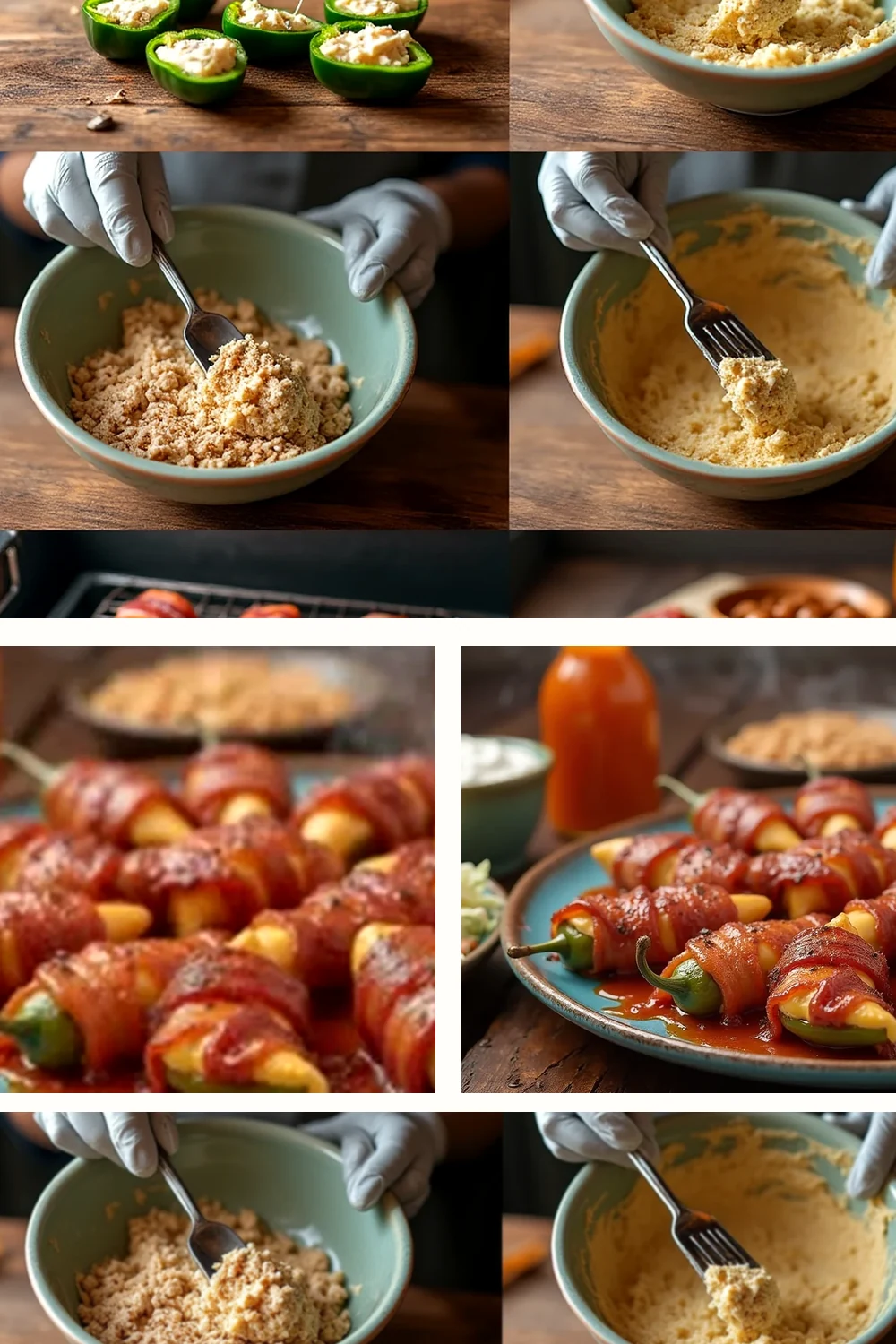
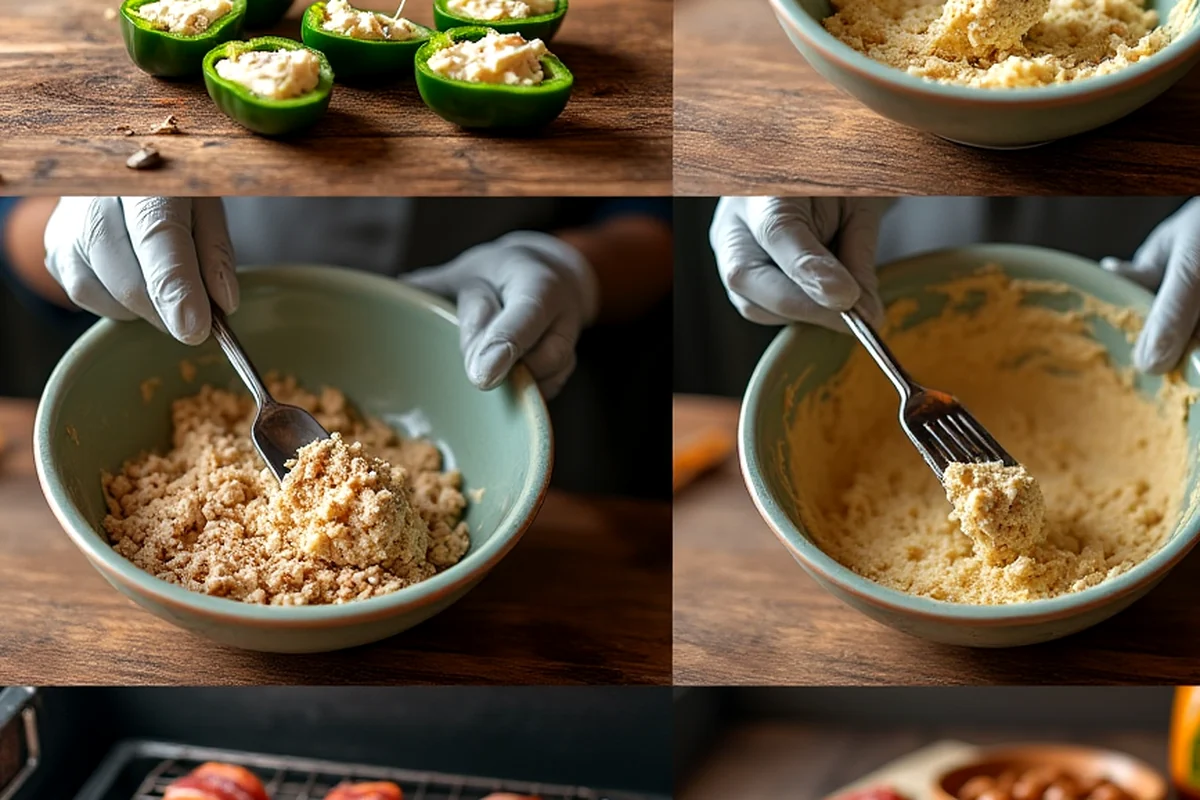
- Prep the jalapenos with gloves on. Put on nitrile gloves before you touch a single jalapeno. I am serious about this. Capsaicin transfers from your fingers to anything you touch for the next 8-12 hours, including your eyes when you rub them at midnight. Slice each jalapeno lengthwise from stem to tip, leaving the stem intact on both halves if possible (it looks better; the stem also gives you a handle). Use the small spoon to scrape out every seed and the white pithy ribs, which carry most of the heat. Lay the prepared jalapeno halves cut-side-up on the wire rack.
- Mix the brisket-cream cheese filling. In a medium bowl, combine the softened cream cheese, chopped smoked brisket, shredded cheddar (if using), 2 tablespoons BBQ sauce, and 1 teaspoon BBQ rub. Mix with a sturdy spoon or your gloved hands until the brisket is evenly distributed and the filling holds together as a thick paste. Taste a small amount; the filling should be punchy with rub, smoky from the brisket, and rich from the cream cheese. If it tastes flat, add another teaspoon of rub.
- Stuff the jalapenos. Spoon the filling into each jalapeno half, mounding it slightly above the rim of the pepper. Each twinkie holds about 2 tablespoons of filling. Pack the filling firmly so it does not fall out during the bacon wrap, but do not overstuff (the filling expands and weeps as it heats). The traditional Hutchins-style twinkie pairs the two halves back together; some pitmasters keep them open as boats. I do them paired - the closed twinkie holds heat better and the bacon wrap goes on cleaner.
- Wrap with thick-cut bacon. Take a slice of thick-cut bacon and wrap it around the entire jalapeno in a tight spiral, starting at the stem and overlapping each pass by about half. The bacon should cover almost the whole pepper with only a small amount of green peeking through. Secure with a toothpick at the seam if needed (most don't need it; the bacon sticks to itself once it starts rendering). Use one full slice per twinkie. Do not double-wrap - the bacon will not crisp through two layers in 2 hours.
- Dust with BBQ rub. Sprinkle the wrapped twinkies generously with 3 tablespoons of BBQ rub, rotating each one to coat the bacon on all sides. The rub forms the bark on the bacon and is the seasoning layer that pulls everything together. A 50/50 kosher salt and 16-mesh black pepper rub is the Texas classic (the central Texas rub philosophy), but Meat Church Holy Cow, Killen's Steak Rub, or Lambert's Sweet Rub all work beautifully. The rub sticks to the moisture on the bacon; no oil needed.
- Fire the smoker to 250F over post oak. Light your smoker and stabilize at 250F. Post oak is the canonical Texas pit fuel - it is what Aaron Franklin uses at Franklin BBQ in Austin, what Tootsie Tomanetz uses at Snow's in Lexington, and what Hutchins runs in Frisco. Post oak burns clean and adds a mellow smoke that doesn't overwhelm the brisket inside. If you can't find post oak, hickory is an acceptable substitute; mesquite is too aggressive for a 2-hour cook and will turn the bacon bitter. For more on the wood debate, see my <a href='https://www.texanrecipes.com/texas-bbq-brisket/'>Texas BBQ brisket</a> guide.
- Smoke for 2 hours at 250F. Place the twinkies directly on the smoker grate, seam-side up, with at least an inch of space between each one for smoke circulation. Close the lid and walk away for the first 90 minutes - resist the urge to peek. After 90 minutes, check the bacon: it should be deeply browned, the rub should be set into a bark, and the jalapeno should yield slightly when pressed with tongs. If the bacon is still pale, push another 20-30 minutes.
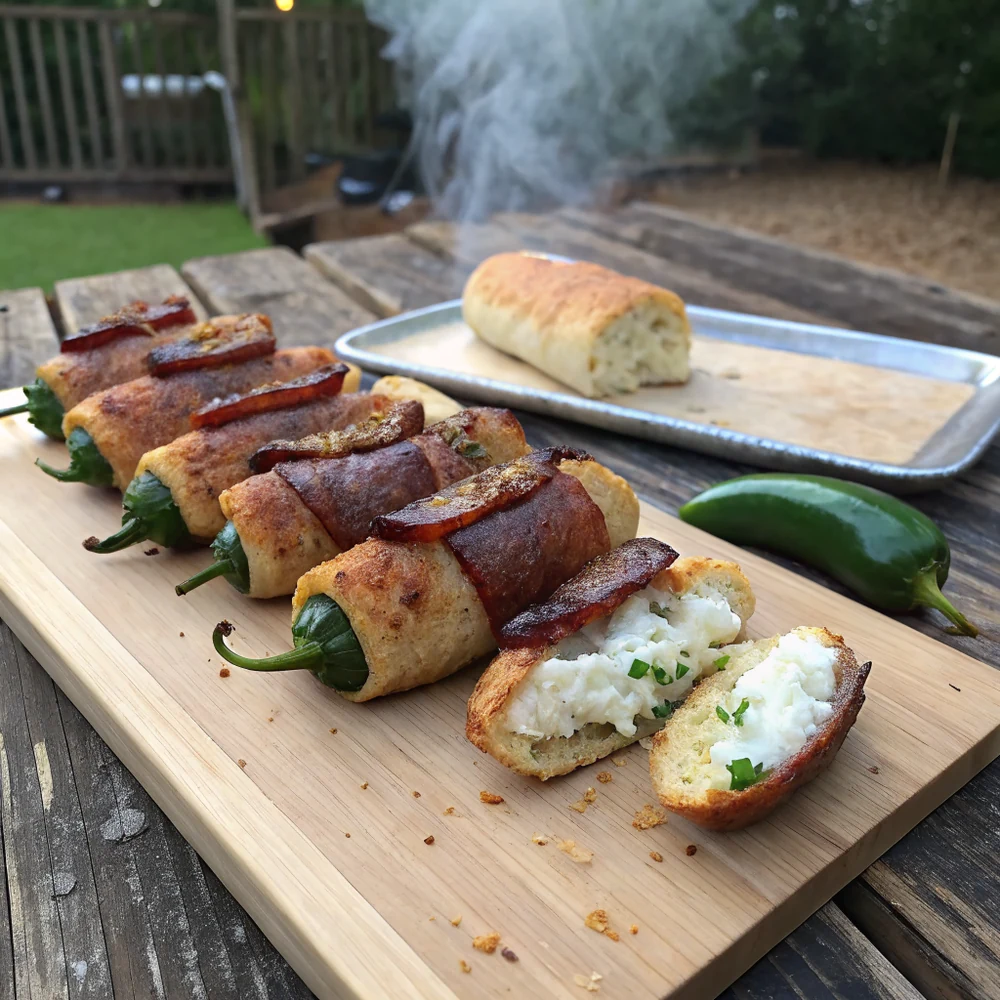
- Glaze and rest. In the last 15 minutes of the cook, brush each twinkie with the thinned BBQ sauce (1/4 cup BBQ sauce mixed with 2 tablespoons apple cider vinegar). The thinned glaze gives the bacon a glossy mahogany finish without becoming sticky. Pull the twinkies off the smoker when the bacon is mahogany-crisp and an instant-read thermometer in the filling reads 165F. Rest on a wire rack for 5 minutes (the cream cheese is molten and will burn the roof of your mouth straight off the pit). Serve with pickles, white bread, and a cold Lone Star or Shiner Bock.
Frequently Asked Questions
Where did Texas Twinkies originate?
Texas Twinkies were popularized by Hutchins BBQ in McKinney and Frisco, Texas, owned by Tracy and Tim Hutchins. The dish became a phenomenon on the Texas BBQ trail in the 2010s and was featured on Texas Monthly's Top 50 BBQ list. Some attribute versions to Salt Lick in Driftwood and Goldee's in Brady, but the consensus on the trail credits Hutchins. The original concept was a leftover-brisket reuse: chopped trimmings from end-of-service stuffed into split jalapenos with cream cheese and wrapped in bacon.
Why do I need to wear gloves with jalapenos?
Capsaicin, the compound that makes jalapenos hot, transfers from the pepper to your skin and stays there for 8-12 hours, even after washing. Hours later, when you rub your eye, touch your face, or go to the bathroom, the capsaicin reactivates and burns. Nitrile gloves block the transfer entirely. A box of 100 gloves costs about $10 at any hardware store. There is no version of this story where the gloves are not worth it.
Can I make Texas Twinkies without a smoker?
Yes, but the result is different. A 350F oven with a hardwood-smoke seasoning (a teaspoon of liquid smoke in the cream cheese filling) gets you a baked version in about 35-40 minutes. The bacon will not develop the same bark as a true smoke, and the brisket flavor will be milder. A pellet smoker, kettle grill, or any backyard smoker delivers far better results. If oven-baking, finish under a high broiler for 2 minutes for crisper bacon.
What kind of brisket should I use?
Chopped trimmings from a smoked brisket are ideal - the irregular bark-heavy bits that didn't make it onto a slice tray. If you don't have leftover brisket, buy 8 ounces of sliced smoked brisket from a local BBQ joint and chop it yourself. Avoid raw ground beef (won't develop bark in 2 hours), corned beef (wrong flavor profile), or pastrami (too dominant). The brisket should be already smoked and ready to reheat through inside the twinkie.
How spicy are Texas Twinkies?
Mildly spicy. The seeding step removes most of the capsaicin (which lives in the white ribs and seeds, not the flesh). The cream cheese also tempers the heat significantly. A well-prepped Texas Twinkie reads as warmly spicy rather than aggressively hot - similar to a mild salsa. If you want more heat, leave some of the white ribs intact when seeding. If you want less, choose larger jalapenos (heat-to-flesh ratio drops with size) and seed thoroughly.
Can I prep Texas Twinkies the night before?
Yes, with one caveat. Prep through the bacon-wrap stage (jalapenos seeded, filling stuffed, bacon spiraled, rub applied), then refrigerate uncovered on the wire rack for up to 24 hours. The cold rest actually helps the rub set into the bacon and the filling firm up. Pull from the fridge 30 minutes before smoking to take the chill off. Do not pre-smoke and reheat - the bacon goes rubbery on a reheat.
What if I can't find post oak in my area?
Hickory is the most accessible substitute and works well. Pecan is excellent and is a regional Texas favorite (especially in central and east Texas). Red oak is closer to post oak in profile if you can find it. Avoid mesquite for this 2-hour cook - it turns bitter on bacon. For pellet smokers, look for 100% post oak pellets from B&B Charcoal or Lumber Jack; these ship to any state via Amazon and the BBQ specialty retailers. Post oak chunks from Fogo or B&B are widely available for offset and kettle smokers.