Texas BBQ
Flanken Beef Short Ribs
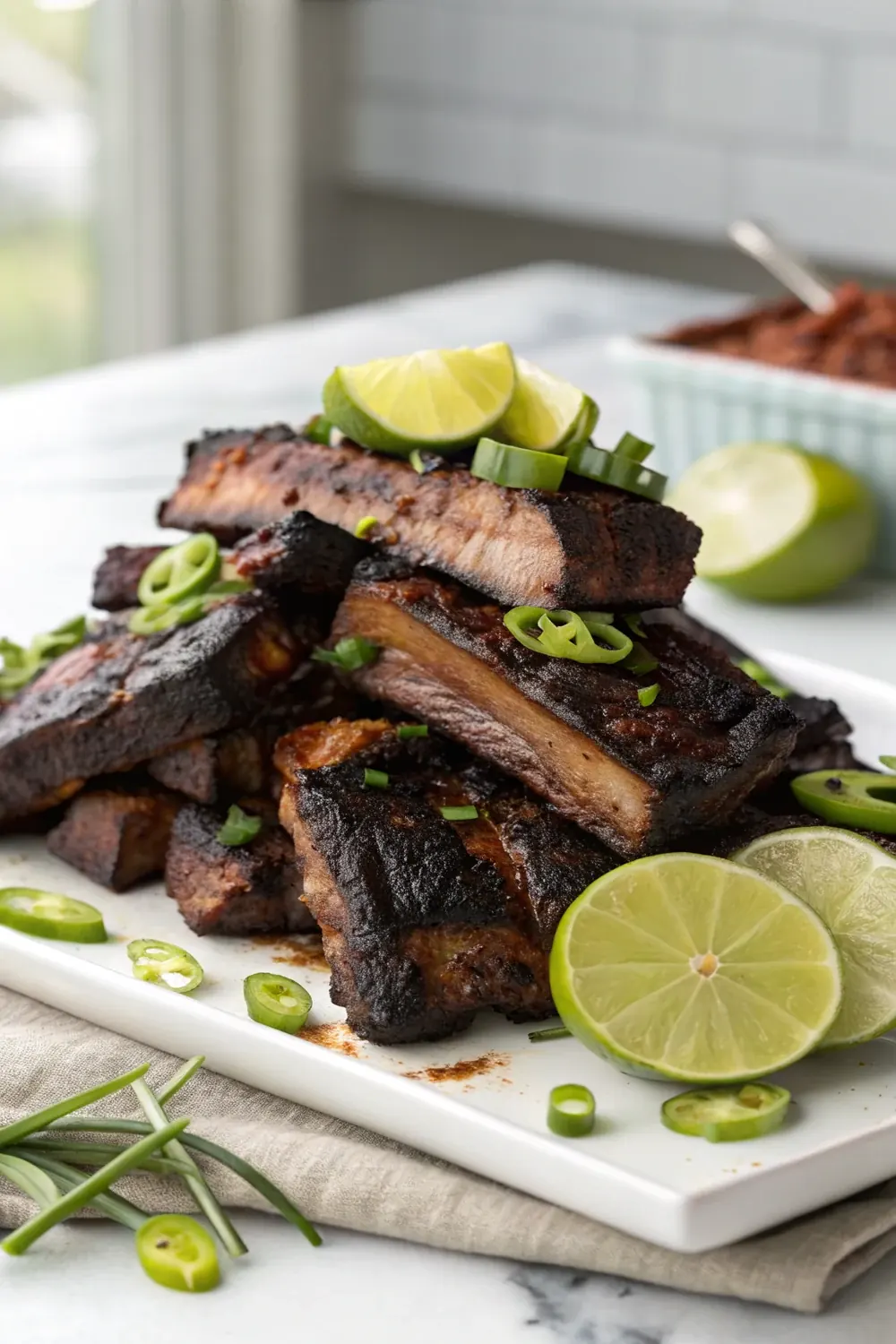
Chef Mia grills flanken beef short ribs hot and fast: 2 to 8 hours in a soy-lime-jalapeno marinade, then 2 to 3 minutes per side over screaming coals.
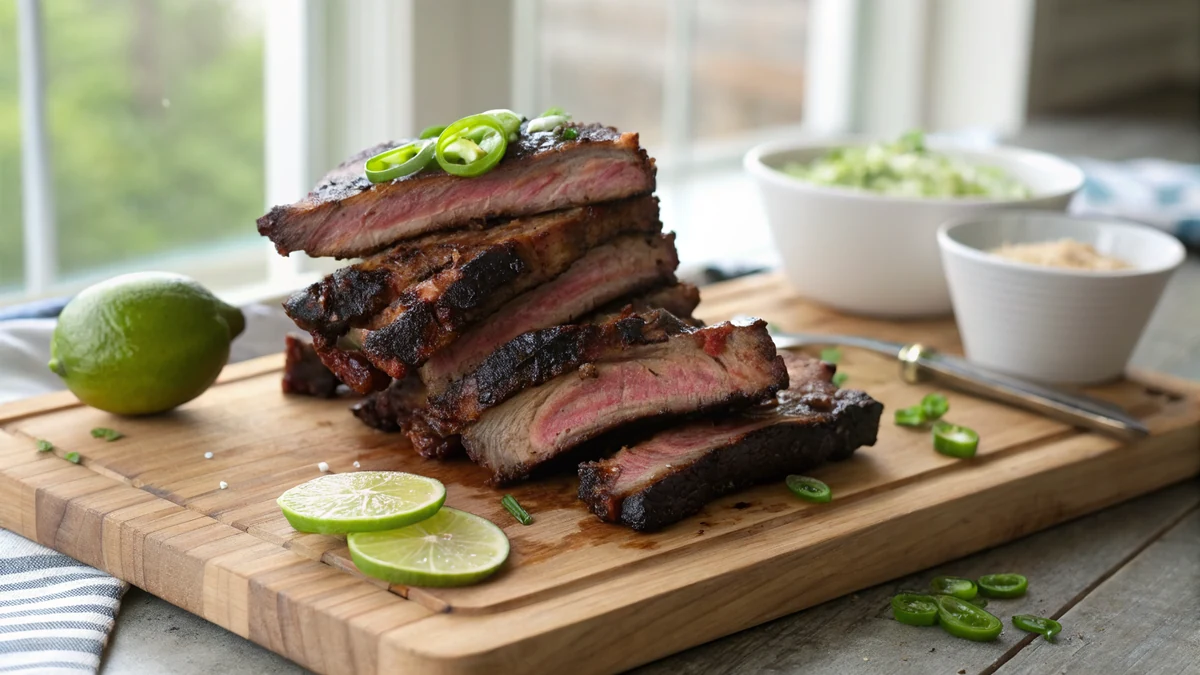
Quick answer: Flanken beef short ribs are the same short rib plate you know, sawed across the bones into strips 1/4 to 1/2 inch thick, and they cook nothing like the thick English cut. Marinate 3 pounds of strips for 2 to 8 hours in 1/2 cup soy sauce, 1/4 cup fresh lime juice, 1/4 cup dark brown sugar, 6 grated garlic cloves, a minced jalapeno, and 2 tablespoons of oil. Build the hottest direct charcoal fire you can, clean and oil the grate hard, then grill the strips 2 to 3 minutes per side until the edges char and the sugar caramelizes deep mahogany. No thermometer, no foil, no waiting. Rest them 3 minutes, then serve straight off the cutting board with warm tortillas, grilled onions, and lime wedges, or pile them over rice. Ten minutes of fire time feeds four people, and a slight, pleasant chew is exactly the texture you are after.
I owe the flanken cut an apology, and this page is it. Every thick short rib recipe I have ever written tells you the same thing at the butcher counter: walk past the thin cross-cut strips, those are for quick grilling, buy the big English-cut blocks instead. That advice is correct for the smoker and it has quietly slandered a magnificent piece of beef for years. Flanken is not the wrong short rib. It is the right short rib for a completely different job, the one where you want deeply beefy, char-edged meat on the table 25 minutes after you strike a match, and nothing else in the meat case does that job as well.
The trick is accepting that everything you know about short ribs runs backward here. Same muscle, same bones, opposite method. A 2-inch English block needs 8 hours of low smoke to melt its collagen; a 3/8-inch flanken strip is so thin the collagen never needs melting at all, so you hit it with the hottest fire you own for 2 to 3 minutes a side and pull it. Korean cooks figured this out generations ago with kalbi, and my Lockhart backyard version runs their playbook through a Tex-Mex filter: soy, lime, garlic, brown sugar, and one jalapeno with opinions. My daughter calls them beef candy. She is not wrong.
What the Flanken Cut Actually Is
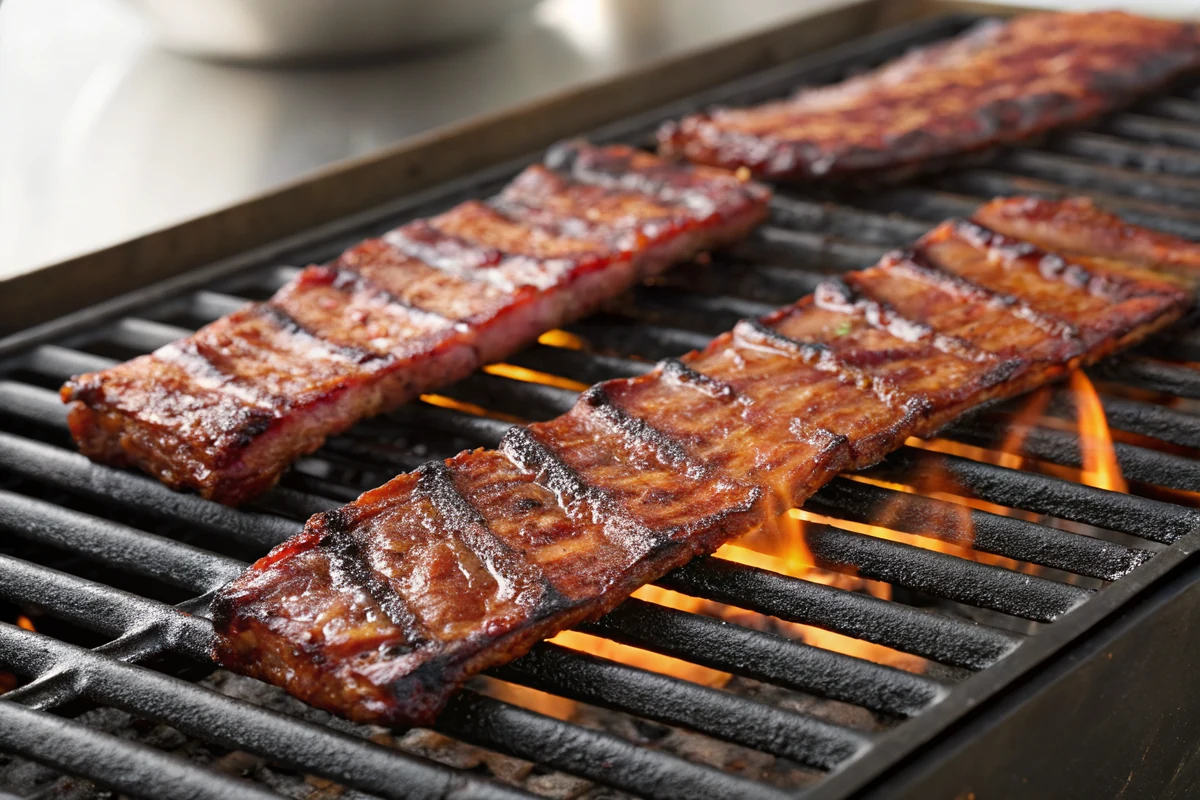
Flanken is not a different rib. It is the same beef short rib plate, from the same chuck section, sawed in a different direction. An English cut runs the knife parallel to the bones, giving you those thick 2-to-3-inch blocks with one long bone apiece, the ones built for braising and smoking. Flanken runs the bandsaw straight ACROSS the bones, producing long strips 1/4 to 1/2 inch thick, each carrying 3 to 4 little cross-sections of bone in a row. I call them bone coins, and they are the cut's signature: small ovals of bone framed in deeply marbled meat, like a strip of beef with buttons sewn down one edge.
That one change of saw angle changes everything about how the meat behaves. The short rib muscles, mostly serratus ventralis, are loaded with connective tissue and fat, which is why the thick cut is so unforgiving of shortcuts. But when the saw crosses the grain every 3/8 of an inch, each strip becomes a sheet of very short muscle fibers with the collagen sliced into fragments too thin to matter. You are not fighting the connective tissue anymore. You are eating around it, and at this thickness that is a genuinely pleasant thing to do.
Names cause half the confusion at the counter, so here is the decoder. Flanken, crosscut short ribs, Korean-style short ribs, kalbi or galbi cut, costilla in a Mexican carniceria: all the same cut, give or take thickness. It has nothing to do with flank steak despite the sound of the word, which comes from Yiddish and German for flank or side. And if you are still sorting out where short ribs sit in the larger rib universe, my beef vs pork ribs breakdown maps the whole territory, because flanken is the one beef rib that cooks on a pork-chop timeline.
Every Short Rib Rule, Reversed
Here is the logic inversion that makes this page necessary. A thick English-cut short rib is a collagen problem: 2 inches of dense muscle threaded with connective tissue that only dissolves after hours at low temperature. That is why my smoked beef short ribs spend 8 hours in the pit, and why every page on this site that says avoid the flanken cut says it. For low-and-slow, that advice stands. Flanken in a smoker dries into beef-flavored shingles long before any collagen surrenders, because there is almost no thickness to protect the meat while the magic happens.
But turn the problem sideways and it stops being a problem. At 3/8 of an inch, the collagen never needs melting, because the saw already did the work the smoker would have done: it shortened every fiber and fragmented every seam of connective tissue. What is left is a thin sheet of the most marbled, beef-forward muscle on the animal, and thin, fatty, well-marbled beef wants exactly one thing, which is the hottest fire you can build and almost no time over it. Two to 3 minutes per side. The same muscle that demands your whole Saturday as a block demands 6 minutes as a strip.
I find it genuinely useful to think of short ribs as one cut with three speeds. Thick and smoked is the 8-hour weekend project. Precise and modern is sous vide beef short ribs, 24 to 48 hours in the water bath for steak-textured results. Hands-off and weeknight-friendly is my slow cooker boneless short ribs. Flanken is the fourth speed nobody tells you about: the sprint. It is the only short rib format that goes from refrigerator to table in under half an hour of active work, and once you internalize that, you start keeping a package in the freezer on purpose. The sprint even has an indoor lane now: my beef short ribs in the air fryer run the same hot-and-fast logic on boneless strips for the nights the weather cancels the fire. And the fifth speed, the sauce-maker, is the classic Sunday route: beef short ribs in the oven, braised at 300F until the pot makes its own gravy.
Kalbi Roots, Texas Detour
Credit where it is fully due: this way of cooking short ribs is Korean, and it is old. Kalbi, also spelled galbi, literally means rib, and grilled marinated flanken-cut beef has been the centerpiece of Korean barbecue for generations, the classic marinade built on soy sauce, sugar, garlic, sesame oil, and often grated Asian pear, whose enzymes gently tenderize the meat. The reason you can buy flanken at all in most American cities is that Korean markets and Korean restaurants created the demand for it. Anyone who writes about this cut without saying that plainly is borrowing without citing, and I was raised better than that.
My version is not kalbi and does not claim to be. It is what happened when a Lockhart pitmaster fell for the Korean method and started reaching for what was already on her counter. Lime juice steps in where rice vinegar or pear might go, because lime is the acid of my kitchen. A fresh jalapeno brings the heat that gochugaru brings in Seoul. Dark brown sugar replaces white for its molasses depth, and the sesame oil stays home so the beef and char stand further forward. The grammar of the marinade is Korean. The accent is pure Central Texas.
What both traditions agree on, completely, is the fire. Korean barbecue cooks flanken over hard charcoal at close range, fast, with tongs and attention. That is exactly how a Texas backyard treats a thin cut of beef too, which is why the marriage feels so natural on the plate: char, salt, sugar, acid, chile, beef. Serve these next to a pot of beans and a stack of tortillas and nobody at the table files a complaint about authenticity. They are too busy reaching for the last strip.
The Marinade, Measured
For 3 pounds of flanken, the marinade is 1/2 cup soy sauce, 1/4 cup fresh lime juice, 1/4 cup packed dark brown sugar, 6 garlic cloves grated to a paste, 1 seeded and minced jalapeno, 1 tablespoon grated ginger, 2 tablespoons neutral oil, 1 teaspoon black pepper, and 2 minced green onions. Whisk until the sugar dissolves completely, because undissolved sugar sits on the meat in patches and burns in patches. Tasted straight, it should be too salty and too sweet. That is correct. A marinade mild enough to sip is too mild to season beef in 2 hours.
Every line item earns its spot. Soy is the salt engine and brings glutamates that push the beef flavor louder. Lime brightens and loosens the surface fibers. Brown sugar is the char engine; those mahogany edges are caramelized sugar, not luck. Garlic and ginger do the aromatic heavy lifting, the oil carries their fat-soluble flavors and helps the strips release from the grate, and the jalapeno leaves a warm hum at the back of the bite rather than a sting. If your crowd runs heat-shy, keep the jalapeno but strip every seed and rib; if it runs brave, leave the seeds in and add a second one.
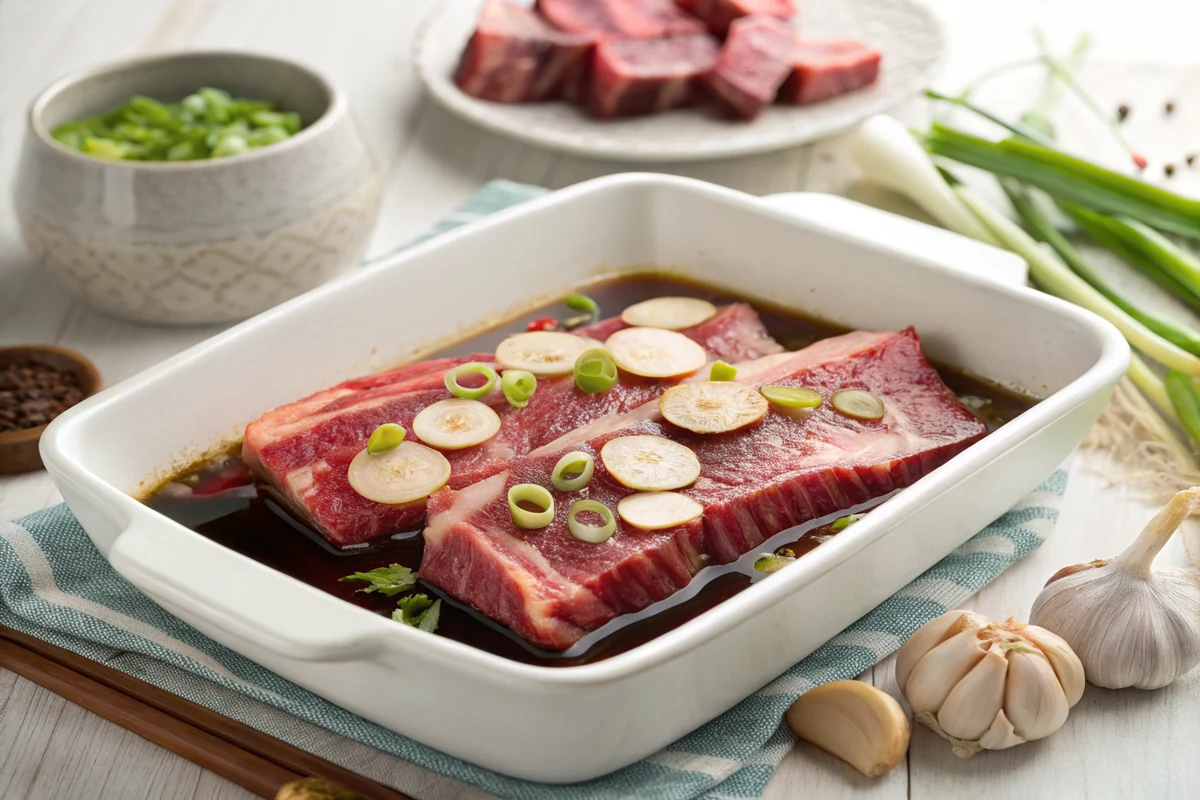
Two practical notes from a few hundred batches. First, mix and marinate in a glass or ceramic dish, not metal; the acid and soy will sit for hours and I want nothing reactive under them. Second, make a double batch of marinade and reserve half BEFORE the raw beef touches it, then boil the reserved half for 2 minutes and reduce it slightly. That becomes a finishing drizzle for the rice bowls that is completely safe and tastes like the grill in liquid form. Never reuse marinade that touched raw beef without a hard boil. That rule has no exceptions in my kitchen.
Why 2 to 8 Hours, Never Overnight
Marinades are mostly a surface treatment, which is why they underwhelm on thick cuts: on a 2-inch short rib, the flavor stops a few millimeters in and the interior never hears the news. Flanken flips that math. A 3/8-inch strip is nearly all surface. Salt and sugar migrating a few millimeters from each face meet in the middle, so the marinade genuinely seasons the whole cross-section instead of painting the outside. This is the one beef cut where the marinade is not a garnish but the actual seasoning system, and it is why marinated flanken tastes so much more finished than its 6-minute cook time has any right to produce.
That same math is why overnight is a mistake, not an upgrade. The soy keeps pushing salt inward long after the flavor has peaked, and by hour 14 a thin strip is cured rather than seasoned, with a wet-ham texture at the surface and salt crowding out the beef. Meanwhile the sugar keeps building on the exterior, and an over-sugared surface goes from mahogany to carbon in the first 90 seconds over real coals. The window that works is 2 to 8 hours. I aim for 4. If life intervenes and you hit 10, they will still be good. At 24 they are somebody else's recipe.
If you only have 45 minutes, all is not lost: leave the strips at room temperature in the marinade while the chimney lights, and they will pick up a real if lighter seasoning by fire time. And if you have zero minutes, flanken takes a dry treatment shockingly well. Salt, black pepper, garlic powder, and a little brown sugar rubbed on 15 minutes ahead gets you 80 percent of the way there, with the lime squeezed over at the table doing the acid's job. The cut is generous like that. It wants to be dinner.
Where to Buy It, and What to Ask For
The best flanken in Texas comes from two places, and neither is the supermarket cold case. Mexican carnicerias cut it constantly, usually labeled costilla de res, often at exactly the 3/8-inch thickness you want, because cross-cut beef ribs are a staple of the asada tradition too. Korean markets are the other stronghold; look for the kalbi or LA-style label, and expect beautiful, consistent strips because the entire clientele judges the store on this one cut. In both shops it typically runs cheaper per pound than English-cut short ribs, which is one of the last genuine bargains in the beef case.
No carniceria or Korean market nearby? Any supermarket with a staffed meat counter can make flanken in 5 minutes, because it is a bandsaw cut, not a knife skill. Ask the butcher to take chuck short ribs from the plate and saw them across the bones at 3/8 inch. Be specific about the number; ask for thin and you will get 1-inch slabs that cook like neither steak nor braise. If the ribs are frozen in back, even better: partially frozen meat saws cleaner and straighter than fresh. Frozen-then-sawed flanken is not a compromise, it is how a lot of the good stuff is produced.
While you are at that counter, look one tray over. Butcher counters hide a small family of underpriced, overdelivering beef cuts, and flanken's closest sibling is the finger rib, the strips of meat sawed from BETWEEN the bones. My beef finger ribs page covers that one, and the two cuts make a natural pair: same rich short-rib muscle, same bargain pricing, one with bone coins and one boneless. Quality cues for flanken are simple: even thickness end to end, bright cherry-red meat, creamy white fat, moist but never slimy. Skip any strip sawed so ragged it is falling into pieces.
Fire Setup: Charcoal First, Two Honest Backups
Charcoal, full stop, if you have it. Light a complete chimney, about 4 pounds of lump or 100 briquets, let the coals ash over fully, and spread them in a single even layer under half the grate with every vent wide open. You are chasing 550F (288C) or hotter at the grate, the kind of heat where a bare hand 5 inches up lasts 2 seconds and no longer. Thin, sugary meat over medium heat steams and stews in its own marinade; the same meat over ferocious heat chars before it can dry out. The bare half of the grill is your parking lot when flare-ups get pushy.
Grate hygiene matters more here than on any other recipe I write. Preheat the grate 5 minutes over the coals, scrub it with a stiff wire brush, then wipe it with an oiled paper towel held in tongs, twice. A marinade this sugary is glue on dirty steel, and a stuck flanken strip does not release with patience the way a steak does; it tears, leaving the char welded to the grate and a gray, naked strip in your tongs. Clean, hot, oiled. Three words, 3 minutes, and every strip lifts free when it is ready.
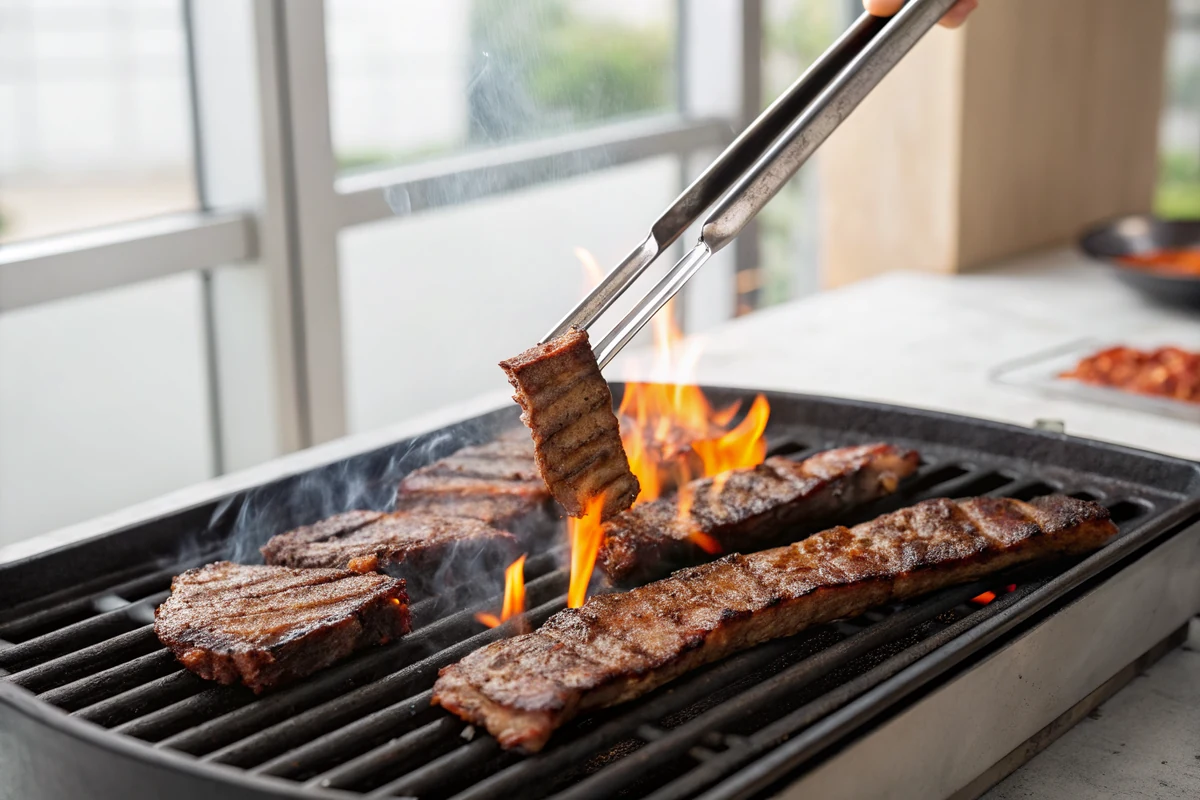
No charcoal, no problem, two honest backups. The broiler is the closer of the two: rack 4 inches from the element, broiler on high and preheated a full 10 minutes, strips in a single layer on a foil-lined sheet pan, 3 to 4 minutes per side with the door watched like a suspect. Cast iron works too, and it builds the best crust of all three, but do it in batches over the hottest burner with the vent fan committed and a window open, because sugar plus screaming iron makes memorable smoke. Gas grills land third: fine, but crank every burner and preheat with the lid down for 15 minutes first.
Doneness Without a Thermometer
Put the instant-read probe away; at 1/4 to 1/2 inch thick there is nothing to probe and no time to probe it. Flanken doneness is read with your eyes and your tongs. The first side is ready to flip when the edges show real char, the surface has gone glossy and mahogany from caramelized sugar, and the strip releases from the grate without a fight. The second side is done when it matches, usually 2 to 3 minutes, and the meat between the bone coins feels just firm when poked with the tongs, springy rather than squishy. Total time over the fire: 4 to 6 minutes, and 6 is the long end.
Color cues in order, so you know what you are watching for. Raw strips hit the grate dark from the marinade and dull. Within a minute the surface turns glossy as the sugar melts. By minute 2 the edges and any thin spots are properly charred, black in flecks, mahogany overall, and juices start beading on the top face. That bead of juice on the raw side is your flip alarm. After the flip the same show runs in fast-forward, and the strips come off when the second face matches the first. If any strip chars ahead of schedule, it moves to the bare half of the grill, not off the fire.
Now the expectation-setting sentence this cut deserves: flanken has a slight chew, and the chew is correct. This is not braised short rib and it is not trying to be; it will never be fork-tender and spoon-soft, because you deliberately skipped the 8 hours that produce that texture. What you get instead is closer to a great skirt steak with a deeper, richer, more roasted-beef flavor, tender enough to bite through cleanly with a pleasant tug behind it. Chase softness by cooking longer and you will get the opposite: past about 7 minutes total the thin meat dries and toughens fast. When in doubt, pull early. The fire cannot un-ring that bell.
Serving: Off the Board, In a Tortilla, Over Rice
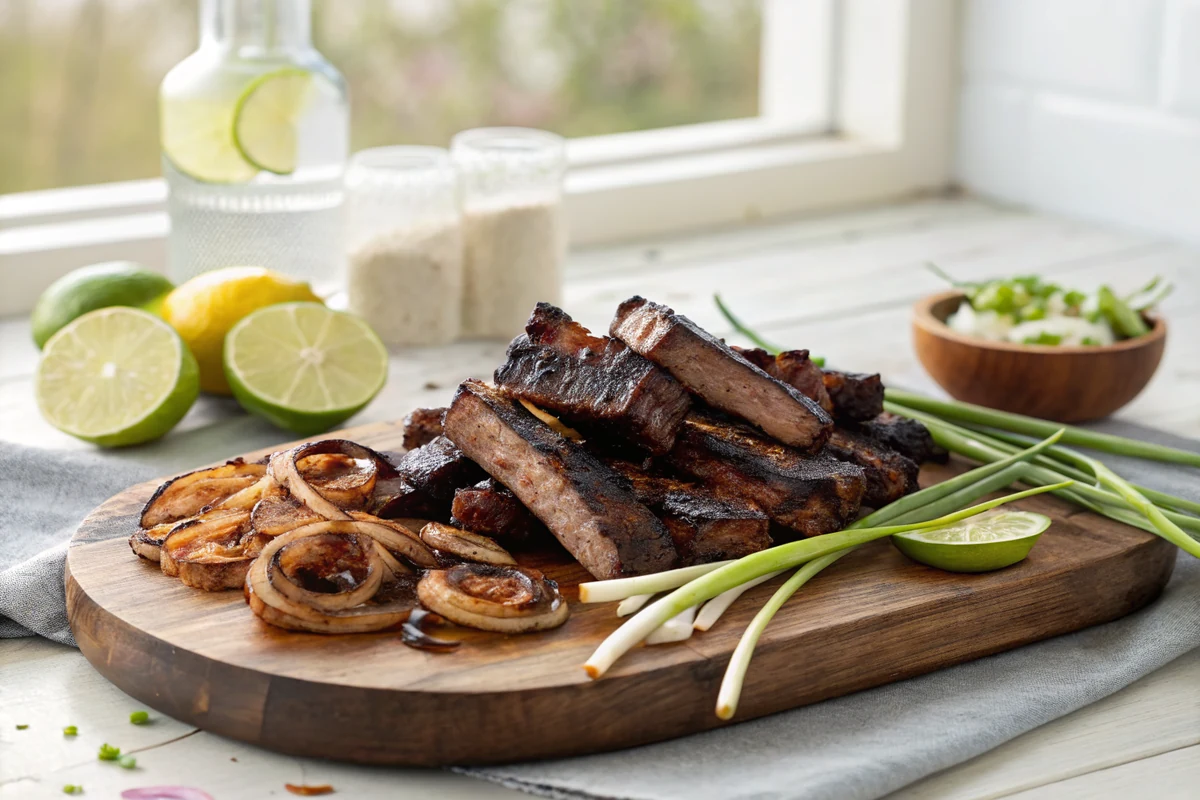
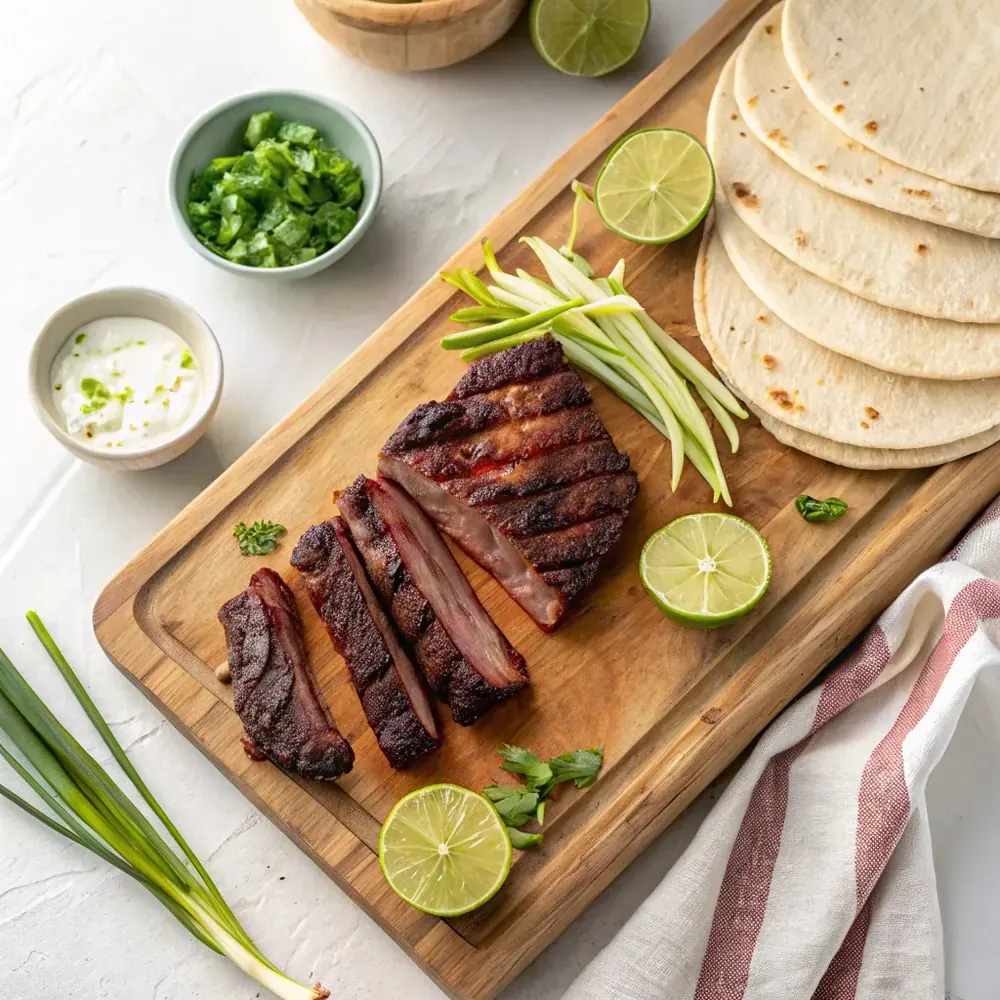
Flanken is cutting-board food, and I mean that as a serving instruction. Pile the strips on a big wooden board in the middle of the table, rest them 3 minutes, scatter the sliced green onion, and put the tongs where everyone can reach. People pick up a whole strip, eat the meat off the bone coins with their hands, and go back for another. Plating these individually is like plating watermelon slices; you can, but you have misunderstood the occasion. The bones are handles. The board is the platter. Napkins are the only formal element.
The taco move is the house favorite. While the coals are still hot, grill thick rounds of white onion 3 to 4 minutes a side until charred and sweet, and warm the tortillas right on the grate for 20 seconds a side. Shear the meat off the bones with a knife, chop it rough, and build tacos with the grilled onion, a squeeze of lime, and whatever salsa is in the fridge. The other direction is the rice bowl: whole strips or sheared meat over white rice with that boiled reserved marinade drizzled on top, which quietly nods at the cut's Korean roots and eats like a reward.
Rounding out the table is easy because the ribs are rich and the marinade is loud; you want sides with acid, crunch, and cool. A vinegary slaw, charro beans, grilled corn, a tomato-cucumber salad with plenty of lime, any two of those and dinner is complete. My full Texas BBQ sides lineup has a dozen candidates that were built for exactly this kind of smoky, sweet-salty centerpiece. Figure 3/4 pound of ribs per person, because the bones are part of that weight and because nobody in recorded history has eaten a polite portion of these.
The Five Mistakes That Ruin Flanken
Mistake one is cooking it like its thick siblings. Flanken in a 275F smoker or a covered grill on low turns leathery, because thin meat loses moisture faster than low heat can do anything useful with the collagen. If your fire is medium, your result will be gray, chewy, and steamed-tasting no matter how good the marinade was. This cut has exactly one gear: as hot as you can get, as fast as the color allows. If the strips are not sizzling violently the second they land, the fire was not ready and the grate was not hot enough. Pull them off, wait 5 minutes, start again.
Mistake two is the overnight marinade, covered above, and mistake three is its cousin: taking the strips to the grill dripping wet. A soaked strip rains sugar and soy onto the coals, which answers with bitter black smoke and soot on your dinner, and the waterlogged surface spends its first precious minute steaming instead of searing. Lift each strip, let it drip 5 seconds, and lay it down with only a clinging glaze. Mistake four is crowding: strips overlapping or jammed edge to edge trap steam between them and cook pale. Two batches of comfortable spacing beat one batch of gridlock every single time, and the first batch holds fine on the cutting board.
Mistake five is walking away, and it is the one that gets the confident cooks. A brisket forgives a 20-minute absence; flanken punishes 40 seconds. With sugar in the marinade and flames in play, the line between mahogany and carbon is one short conversation. Stand there. Tongs in hand, beverage in the other, eyes on the grate, for the whole 10 or 12 minutes both batches take. I have cooked these a couple hundred times and I still do not leave. It is the shortest shift in barbecue and the least forgiving one, and honestly, watching thin beef char over live fire never gets old anyway.
Flanken Beef Short Ribs Recipe
Ingredients
- For the ribs:
- 3 pounds (1.4 kg) flanken-cut beef short ribs, 1/4 to 1/2 inch (6 to 12 mm) thick, 3 to 4 bone coins per strip
- For the marinade:
- 1/2 cup (120 ml) soy sauce
- 1/4 cup (60 ml) fresh lime juice, from about 3 limes
- 1/4 cup (50 g) packed dark brown sugar
- 6 garlic cloves, grated on a rasp
- 1 jalapeno, seeded and minced fine
- 1 tablespoon (15 g) grated fresh ginger
- 2 tablespoons (30 ml) neutral oil
- 1 teaspoon freshly cracked black pepper
- 3 green onions, 2 minced for the marinade and 1 sliced for serving
- For serving:
- 8 warm flour or corn tortillas
- 2 limes, cut into wedges
- 1 white onion, sliced into 1/2-inch rounds for grilling, optional
- Cooked white rice, optional
- Equipment:
- Charcoal grill and chimney starter, long tongs, a stiff wire brush, and a large cutting board
Instructions
- Mix the marinade. In a large bowl or a 9x13 ceramic dish, whisk together the soy sauce, lime juice, brown sugar, grated garlic, minced jalapeno, ginger, oil, black pepper, and the 2 minced green onions until the sugar fully dissolves. It should taste aggressively salty-sweet on its own; a 3/8-inch strip of beef will tame it fast.
- Marinate 2 to 8 hours. Add the flanken strips and turn each one so both faces and the cut edges are coated. Cover and refrigerate for at least 2 hours and no more than 8, turning the strips once at the halfway point. Do not go overnight; the cut is thin enough that soy oversalts it and the sugar load makes burning far more likely on the grill.
- Build the hottest fire you own. Light a full chimney of charcoal, about 100 briquets or 4 pounds of lump. When the coals are fully ashed over, dump them in an even single layer under one half of the grate and open every vent wide. You want the grate around 550F (288C) or better, hot enough that you can hold your hand 5 inches above it for only 2 seconds.
- Clean and oil the grate. Set the grate over the coals and let it preheat 5 full minutes, then scrub it hard with a wire brush and wipe it with a folded paper towel dipped in oil, gripped in tongs. A sugary marinade welds thin meat to a dirty grate. This 2-minute step is the difference between clean release and shredded strips.
- Drain the strips. Lift the strips from the marinade and let the excess drip back into the dish for a few seconds each; do not rinse and do not pat them completely dry. You want a thin, clinging glaze of marinade, not a dripping coat that rains sugar onto the coals and sends up bitter black smoke.
- Grill 2 to 3 minutes on the first side. Lay the strips over direct heat in a single layer without crowding, working in two batches if needed. Leave them alone for 2 to 3 minutes, until the edges char, the sugar caramelizes to a deep mahogany, and the strips release from the grate with an easy tug of the tongs. Expect flare-ups; shift strips a few inches rather than pulling them off.
- Flip once and finish. Flip each strip with tongs and grill the second side 2 to 3 minutes more, until it matches the first: charred at the edges, glossy and dark across the face, with the thin meat between the bone coins just firm to a poke. Total fire time is 4 to 6 minutes per strip. There is no temperature to take at this thickness; color and feel are the whole test.
- Rest 3 minutes and serve. Pile the strips on a cutting board, rest them 3 minutes, and scatter the sliced green onion over the top. Serve straight off the board with tongs, warm tortillas, lime wedges, and grilled onions, or shear the meat off the bones with a knife and pile it over rice. Squeeze lime over everything right before eating.
Frequently Asked Questions
What is the difference between flanken cut and English cut short ribs?
Same ribs, different saw direction. English cut slices parallel to the bones, yielding thick 2-to-3-inch blocks with one long bone each, built for braising, smoking, and sous vide. Flanken cuts straight across the bones, yielding long strips 1/4 to 1/2 inch thick with 3 to 4 small oval bone cross-sections per strip. The thin cross-grain cut shortens every muscle fiber and fragments the collagen, so flanken cooks hot and fast in minutes, while English cut needs hours of low heat to become tender. Choose the cut by the method you plan to use, never the other way around.
How long should you marinate flanken short ribs?
Two to 8 hours in the refrigerator, and 4 is my sweet spot. Because the strips are only about 3/8 inch thick, the soy, sugar, lime, and garlic penetrate to the center in a few hours, seasoning the whole cross-section rather than just the surface. Overnight is too long for this cut: the soy keeps driving salt inward until the meat tastes cured, and the accumulating sugar on the surface burns almost immediately over hot coals. In a pinch, even 45 minutes at room temperature while the chimney lights gives you real flavor, with lime at the table covering the gap.
How long do you grill flanken ribs and at what temperature?
Two to 3 minutes per side over the hottest direct fire you can build, 550F (288C) or better at the grate, for a total of 4 to 6 minutes. That is the whole cook. Use a full chimney of charcoal spread in a single layer, vents wide open, and keep half the grill bare as a safe zone for flare-ups. The strips are done when both faces are glossy mahogany with charred edges and the meat feels just firm to a poke from the tongs. Past about 7 minutes total, thin meat dries out and toughens quickly, so when in doubt, pull early.
Can I cook flanken short ribs without a grill?
Yes, two good options. The broiler: rack 4 inches from the element, preheat on high for 10 full minutes, strips in a single layer on a foil-lined sheet pan, 3 to 4 minutes per side, watching constantly. Cast iron: hottest burner, batches with no crowding, 2 to 3 minutes per side, vent fan on and a window open, because the sugary marinade makes serious smoke on hot iron. The skillet actually builds the deepest crust of any method. What does not work is a moderate oven or a covered gentle grill, which steams the thin meat gray instead of charring it.
Why are my flanken ribs tough?
Usually one of three reasons, and none is the cut's fault. First, too long over the fire: past roughly 7 minutes total, a 3/8-inch strip dries out and tightens fast, so pull at color, not at the clock. Second, too cool a fire: medium heat steams the meat in its own marinade before any char forms, and steamed thin beef chews like a tire. Third, miscalibrated expectations: properly cooked flanken has a slight, pleasant chew, closer to skirt steak than to braised short rib, because you skipped the hours that melt collagen. It should bite through cleanly with a light tug, not dissolve.
Are flanken short ribs the same as kalbi or galbi?
Flanken is the cut; kalbi, also spelled galbi, is the beloved Korean dish made from that cut, marinated in soy, sugar, garlic, sesame, and often grated pear, then grilled hot over charcoal. The cut is frequently labeled Korean-style or LA-style short ribs precisely because Korean barbecue created most of the American demand for it. My recipe follows the Korean method faithfully, hot fire, quick cook, sweet-salty marinade, but swaps in lime, jalapeno, and dark brown sugar for a Tex-Mex accent. If you want the traditional version, seek out a proper kalbi recipe; both deserve a place in your rotation.
Where can I buy flanken cut short ribs?
Mexican carnicerias and Korean markets cut it best and most consistently: look for costilla de res at the former and kalbi or LA-style short ribs at the latter, usually at a better price per pound than English-cut short ribs. No specialty market nearby? Any supermarket with a staffed counter can produce it in minutes; ask the butcher to saw chuck short ribs across the bones at 3/8 inch thick. Partially frozen ribs actually saw cleaner and straighter than fresh, so frozen-then-cut flanken is completely fine. Look for even thickness, bright red meat, and creamy white fat.