Southern Comfort Food
Texas Roadhouse Twice Baked Potatoes Copycat
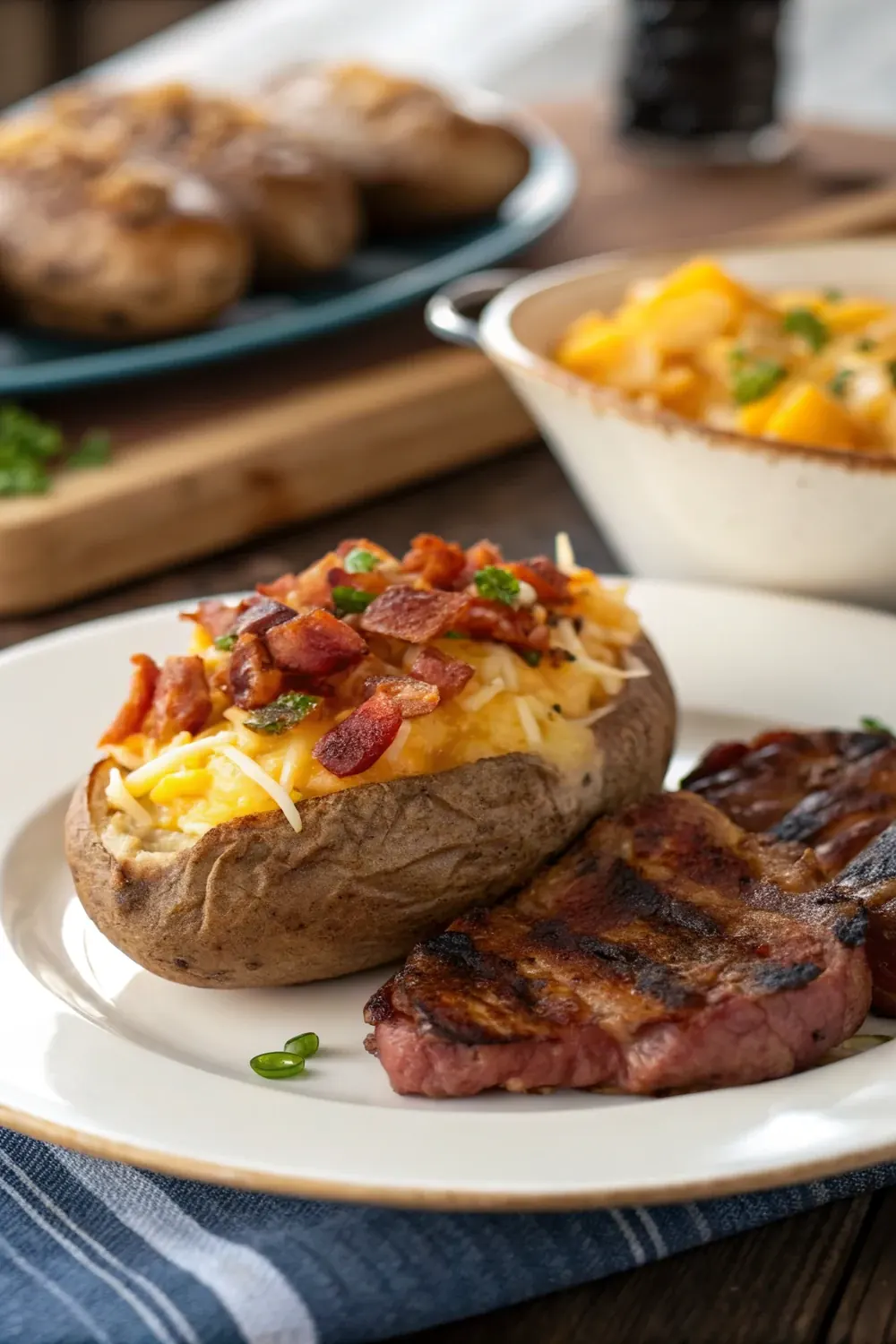
Chef Mia's Texas Roadhouse twice baked potatoes: salt-crusted russets mashed with cheddar, bacon, and sour cream, refilled and browned in crisp shells.
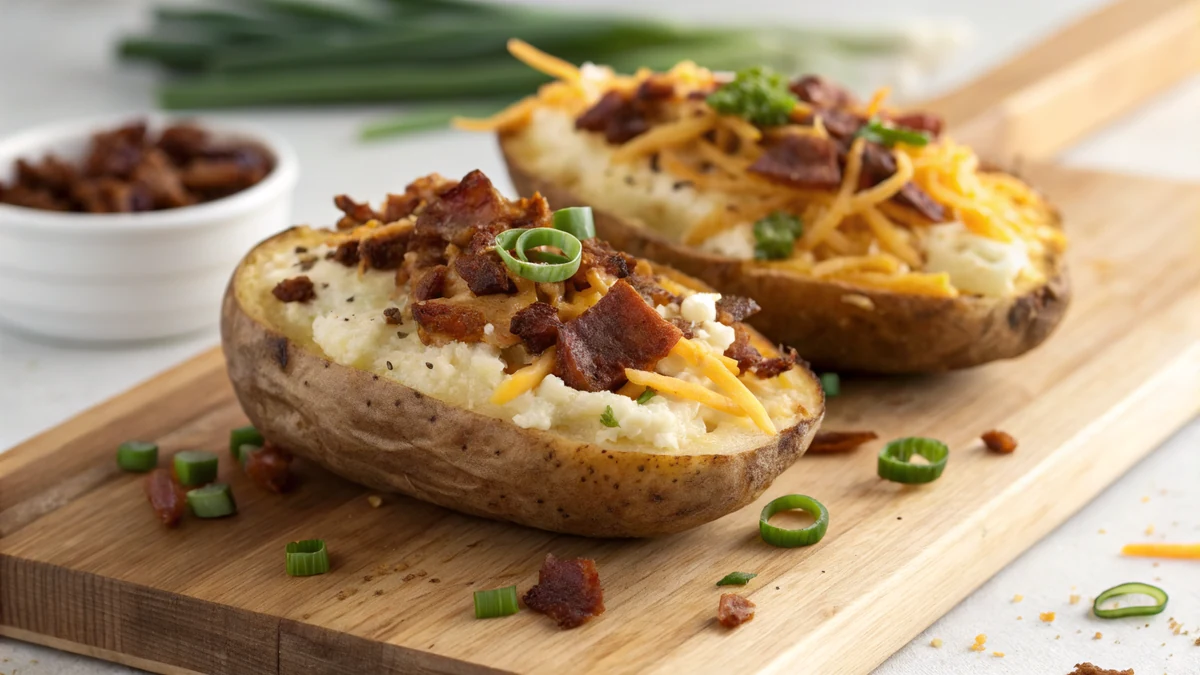
Quick answer: Let me be straight with you first: Texas Roadhouse does not sell a twice baked potato. The menu item is the loaded baked potato, and this recipe converts it into steakhouse twice-baked. Bake 4 large russets oiled and rolled in kosher salt at 425F for 55 to 65 minutes until the centers hit 205 to 210F, cool briefly, halve lengthwise, and scoop, leaving a 1/4-inch wall. Mash the hot flesh with 4 tablespoons butter, 1/2 cup sour cream, a splash of warm milk, 1 cup sharp cheddar, 6 slices of crumbled bacon, and garlic powder. Refill the skins, top with more cheddar and bacon, and bake at 400F for about 20 minutes until browned. You get 8 loaded halves, and they freeze better than any potato side I know.
Somebody asks me for the Texas Roadhouse twice baked potato recipe about once a month, and every time I give the same slightly annoying answer: there is no such menu item. What the restaurant serves is a loaded baked potato, salt-crusted skin, butter, sour cream, cheddar, bacon, green onion, assembled at the last second. But the question keeps coming because people are really asking for something specific: those flavors, in the make-ahead, oven-browned, hold-in-your-hand format that steakhouses have served since before I was born. That dish absolutely exists. You just have to build it.
So that is what this page does. We take the salt-crusted first bake straight from the restaurant playbook, scoop the potatoes into boats, mash the flesh with the entire loaded topping lineup, refill the shells, and send them back into a 400F oven until the cheddar browns and the edges crisp. Eight loaded halves from four russets, ready hours or even months ahead. I have made these for Christmas Eve in Lockhart, for a July brisket party of twenty, and for a random Tuesday when the fridge held exactly four potatoes and hope. They have never once come back with leftovers.
The Menu Truth, and Why We Are Building This Anyway
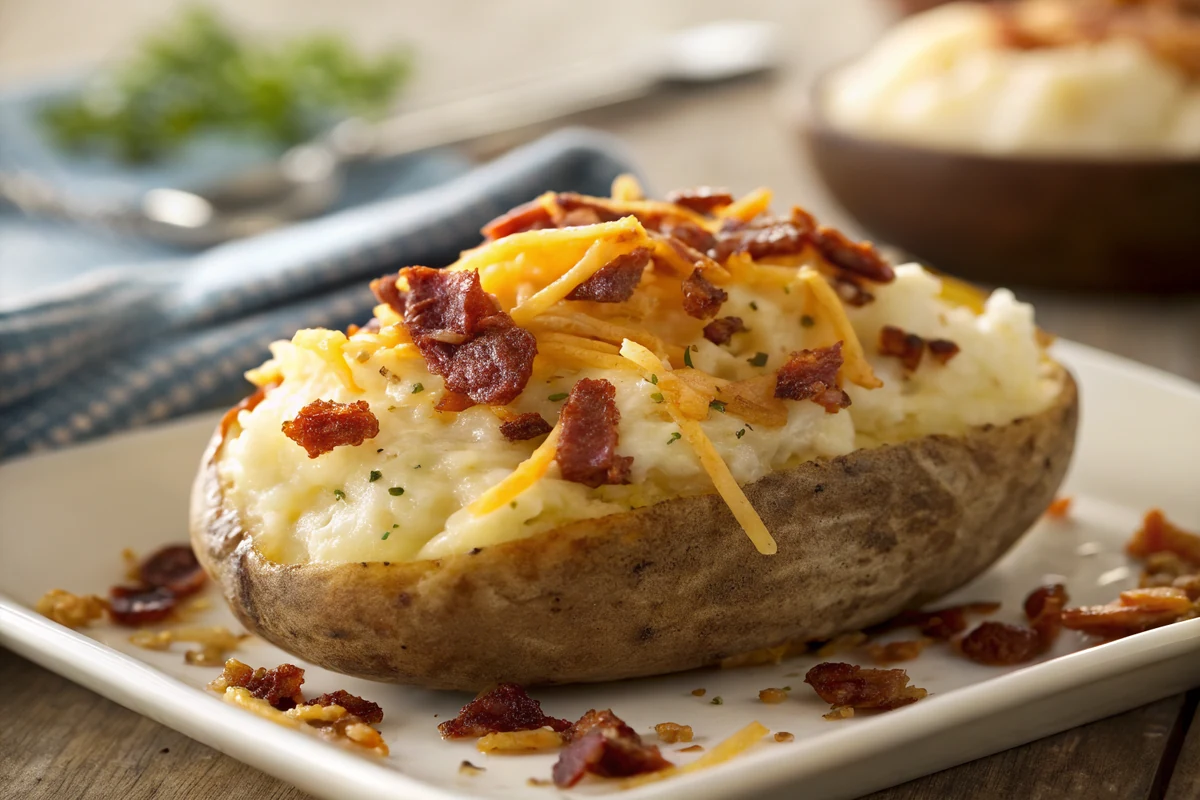
Check the Texas Roadhouse menu top to bottom and you will not find a twice baked potato. The sides list offers a baked potato and a loaded baked potato, and the loaded one is what people are remembering when they search for this recipe: salt-crusted skin, butter, sour cream, sharp cheddar, bacon, green onion. I am not going to pretend the restaurant serves something it does not. What I will do is take every one of those components and rebuild them in the classic steakhouse twice-baked format, because the conversion is short and the payoff is enormous.
Twice-baked is what happens when the loaded potato stops being an assembly job and becomes a finished dish. Instead of toppings sitting on fluffed potato, the butter, sour cream, cheddar, and bacon get mashed through every bite, the seasoning reaches the bottom of the skin instead of the top inch, and the whole thing goes back into a hot oven until the surface browns. The skin still crackles. The inside is creamier than any baked potato can manage. Nothing is lost in the translation and a good deal is gained.
There is also a hosting argument that seals it for me. A loaded baked potato has to be built at the table, hot, with six toppings in play at once. A twice-baked potato is done hours before anyone arrives. My loaded mashed potatoes sit at the creamy end of this flavor family and the salt-crusted baked potato holds down the crisp end; the twice-baked is the one dish that refuses to choose, and it is the one I hand people when they ask what to bring to a cookout.
Picking Russets by Weight and Shape
Russets, no substitutes, and for twice-baked the reason is doubled. Their high-starch, low-moisture flesh mashes light and fluffy, which the filling needs, and their thick skin bakes into a shell sturdy enough to be scooped, refilled, and baked a second time. Yukon Golds make a lovely mash and a hopeless boat; the thin skin sags and splits the moment the spoon goes in. Red potatoes are not even in the conversation, and neither are sweet potatoes, which are a different recipe entirely. Buy russets and this dish cooperates from the first step.
Weight matters because these finish as individual portions, not scoops from a bowl. I buy 10-to-12-ounce potatoes, weighed on the produce scale like I mean it, because a 10-ounce half is a generous steakhouse side and a 16-ounce half is a commitment nobody finishes. More important, buy them matched: four potatoes within an ounce or two of each other bake in the same window, scoop into equal shells, and look like a deliberate set on the platter instead of a rummage sale. Mismatched potatoes mean somebody gets the runt, and they notice.
Shape is the part nobody tells you about. You want long, evenly oval potatoes with one slightly flat side, because each half needs to sit level on the sheet pan without rocking and dumping its filling into the corner. Round, knobby, or banana-curved potatoes make tippy boats that spill in the oven. I stand at the bin and pick like I am choosing lumber for a porch rail, and I always buy one extra potato as insurance against the shell that tears during scooping. If nothing tears, the spare becomes tomorrow's lunch.
The Salt-Crust First Bake
The first bake is not a blank canvas step, it is the flavor of the finished dish, and I run it exactly like my Texas Roadhouse baked potatoes: scrubbed and dried russets pricked with a fork, rubbed with a thin coat of oil, rolled generously in coarse kosher salt, and baked bare on the oven rack at 425F for 55 to 65 minutes. No foil anywhere near them. The salt pulls moisture out of the skin while the oil crisps it in place, and that seasoned, crackly skin is what separates these from cafeteria potato boats.
For twice-baked, the crisp skin stops being a nicety and becomes engineering. The shell has to survive scooping, refilling, a second trip through a 400F oven, and being lifted off a platter by hand. A foil-wrapped, steam-softened skin collapses at station one. A salt-crusted skin that spent an hour drying at 425F handles the whole gauntlet and comes out the far side crisper than it started. The crust also seasons the wall of potato you leave behind, so even the last bite against the skin tastes finished.
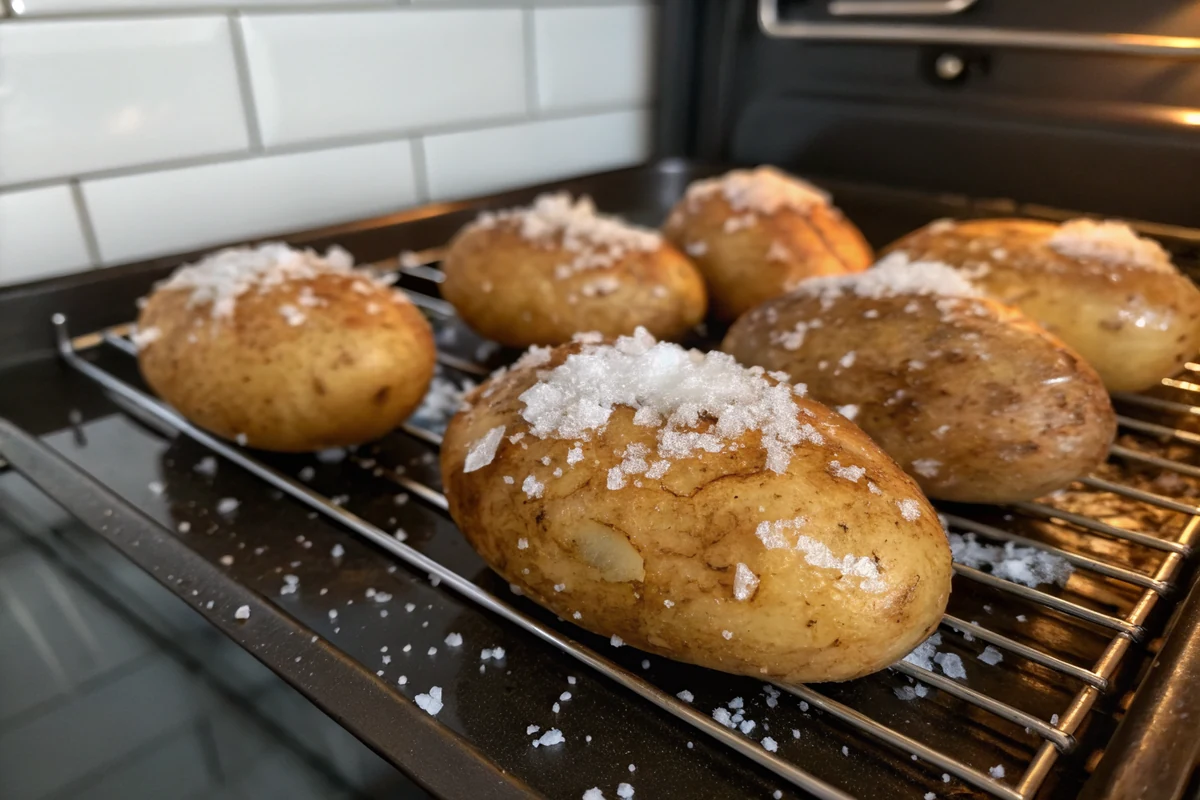
Doneness rules do not change from the original recipe: 205 to 210F at the center on an instant-read thermometer, or a potato that gives easily everywhere when squeezed through an oven mitt. If anything, err long for twice-baked. An extra ten minutes dries the flesh slightly, and drier flesh drinks up more butter and sour cream without the filling going loose. An underbaked center, on the other hand, mashes waxy and dense, and no amount of dairy fixes it. When in doubt, leave them in; the skins only get better.
The Scoop: a Quarter-Inch Wall and a Kitchen Towel
Timing the scoop is a small art. Let the potatoes rest 10 minutes out of the oven, long enough that a folded kitchen towel makes them handleable, short enough that the flesh is still properly hot. Hot flesh matters twice: it mashes smooth instead of gluey, and it melts the butter on contact so the fat coats the starch evenly. Wait until the potatoes go cold and the filling turns pasty. I halve them lengthwise with a serrated knife, flattest side down, so each half sits on the pan like a rowboat.
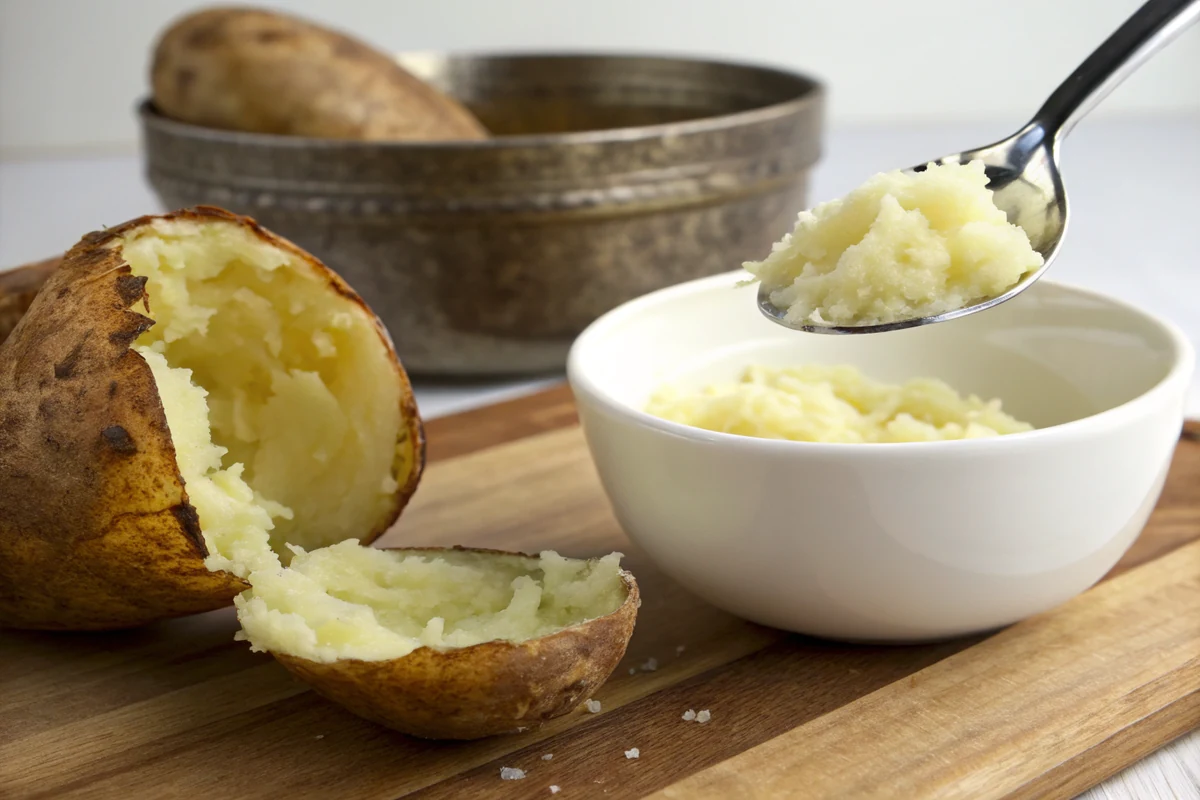
The quarter-inch wall is the number that makes or breaks the dish. Scoop with a soup spoon, working from the center outward, and stop while a visible layer of potato still lines the entire skin. That layer is rebar. Scrape down to bare skin and the shell buckles when you refill it, tears when you lift it, and slumps in the oven. Leave too much and the halves eat like plain baked potato with a garnish. A quarter inch, roughly the thickness of your pinky finger, holds shape and still gives the filling the starring role.
If a shell tears anyway, do not mourn it. Patch the hole from inside with a bit of the scooped flesh, press it flat, and refill; the mash spackles invisibly and the second bake sets the repair. And keep every scrap of scooped potato even if it comes out ragged, because it is all getting mashed in thirty seconds anyway. The scooping step looks fussy in writing and takes about four minutes in practice. My daughter has done it since she was ten, with exactly one casualty on her record.
The Filling, Ounce by Ounce
Here is the ratio for the flesh of four large russets, roughly a pound and a half once scooped: 4 tablespoons softened salted butter, 1/2 cup sour cream, 1/4 cup warm whole milk, 1 cup shredded sharp cheddar, 6 slices of crisp bacon crumbled fine, 1/2 teaspoon garlic powder, 3/4 teaspoon kosher salt, 1/2 teaspoon black pepper, and half the green onions. Butter goes in first, alone, mashed into the hot flesh until it vanishes. Fat coats the starch before the wetter dairy arrives, which is the difference between silky and sticky.
Then the sour cream and warm milk, mashed just until the texture reads like stiff mashed potatoes, thicker than you would serve in a bowl. The filling has to mound and hold a peak, because a loose filling slumps over the shell walls in the oven. Warm milk matters more than people think; cold milk seizes the starch and tempts you into overmashing to smooth it out. Use a masher or a ricer and quit early. A food processor turns potato into wallpaper paste in eight seconds, and there is no walking that back.
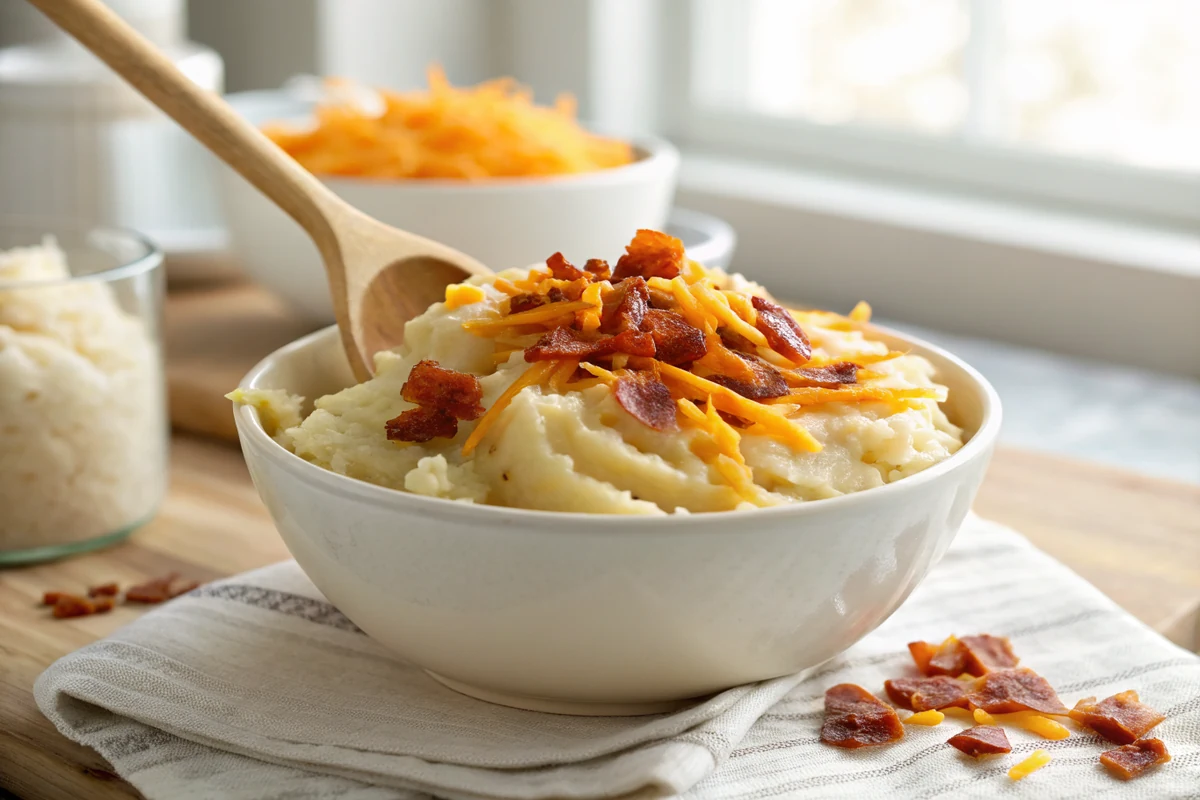
Cheese, bacon, and green onion get folded in with a spatula after the mashing is finished, so the cheddar stays in melty pockets instead of dissolving into the background. Then taste, and season braver than feels polite. This filling gets cooled, chilled, or frozen, and rebaked, and every one of those steps mutes flavor a little. A filling that tastes exactly right warm from the bowl will taste shy after the second bake. I aim for one notch past perfect, and it lands perfect on the plate every time.
Block Cheddar or Nothing
Buy a block of sharp cheddar and shred it yourself, and I will die on this hill twice. Pre-shredded cheese comes dusted with cellulose and potato starch so it pours freely from the bag, and those same anti-clump coatings keep it from melting into the filling; you get grainy flecks where you wanted molten pockets. Five minutes with a box grater buys you cheese that actually melts. For a dish whose entire finale is browned, bubbling cheddar, the bagged shortcut is the single cheapest place to sabotage yourself.
Sharpness is not optional either. A pound and a half of potato plus butter, milk, and sour cream is a lot of rich blandness for cheese to shout over, and mild cheddar simply disappears into it. Sharp or extra-sharp survives the crowd and shows up in the finished bite. The split matters too: 1 cup folded through the filling for those interior pockets, 1/2 cup scattered on top where the dry oven heat can brown it into the blistered, spotty lid that makes people reach for their phones before their forks.
Room to play exists once the base is respected. Half sharp cheddar and half Monterey Jack gives you better stretch on the pull-apart. Pepper jack pushes the whole tray toward Tex-Mex. Smoked cheddar is outstanding if these are headed next to brisket, and a couple tablespoons of grated parmesan in the topping cheese browns faster and deeper than cheddar alone. What never works is a soft fancy cheese in the filling; brie and goat cheese turn the mash greasy and loose. This is a steakhouse potato. Keep the cheese sturdy.
Bacon Done Right
The bacon in a twice-baked potato has to be cooked past the point most people stop, fully crisp, almost brittle, because it is about to be buried in moist potato filling and rebaked. Bendy bacon goes into that environment and comes out soft and flabby, chewing like little pieces of ham. I lay the slices on a foil-lined sheet pan and slide it onto the oven's lower rack while the potatoes bake, 15 to 18 minutes, no flipping, no spatter on the stovetop. When it cools it should snap clean in half.
Crumb size deserves a sentence. For the filling I crumble it fine, pieces the size of a pencil eraser, so bacon lands in every bite instead of three lucky ones. For the topping I leave the reserved slices in bigger, craggier shards that stay visible and crunchy after the second bake. Six slices in, two slices on: that split covers a full tray of eight halves. And save a spoonful of the drippings; brushed inside the empty shells before refilling, it is a quiet, smoky upgrade nobody identifies but everybody notices.
Skip the jarred bacon bits, which taste like smoke-flavored gravel, and be careful with thick-cut bacon, which takes noticeably longer to reach true crispness and tends to get pulled early. Regular-cut crisps reliably and crumbles finer. If pork is off the table, a crisped, finely chopped smoked sausage works, and leftover smoked brisket chopped fine is flatly spectacular, though at that point you are previewing the variations section. Whatever you use, cook it crisper than instinct says. The filling forgives almost everything except soggy meat.
The Second Bake: 400F Until Browned
The second bake is short and hot: 400F, middle rack, 18 to 22 minutes for room-temperature potatoes, until the cheese on top is fully melted with browned patches and the filling reads 165F at the center. The shells reheat and re-crisp, the filling heats through and puffs slightly above the rim, and the topping cheese does its blistering. There is nothing to baste and nothing to turn. If the tops look pale at 20 minutes, two minutes under the broiler finishes the color; stand there and watch, because broilers escalate from golden to regrettable in about forty seconds.
Starting temperature changes the math and nothing else. Straight from the refrigerator, after a make-ahead day, give them 28 to 32 minutes and trust the thermometer over the clock; a browned top can still hide a cool center when the filling started at fridge temperature. From frozen, they go 375F for 45 to 55 minutes, or thaw overnight in the fridge first and rejoin the refrigerated schedule. In every case 165F in the middle of the filling is the finish line, and an instant-read probe answers the question in three seconds.
Doneness looks like this: cheese melted edge to edge with amber spots, filling risen just proud of the shell, skin edges visibly crisp and dry, and a faint sizzle at the bacon on top. Rest the tray 5 minutes so the molten interior settles from lawsuit-hot to merely hot, then scatter the reserved fresh green onions over everything. Fresh onion on hot cheese wakes the whole tray up. Green onion baked for twenty minutes just surrenders. That tiny sequencing choice is most of the difference between homemade-looking and steakhouse-looking.
Make-Ahead and the Freezer Timeline
This is the section that turns people into repeat offenders, because twice-baked potatoes are the rare potato dish that improves logistics without losing quality. Fully assembled halves, filled and topped, hold 3 days in the refrigerator, covered on their sheet pan or tucked into an airtight container once cool. Baked potatoes go stale and mashed potatoes gel in the fridge, but the twice-baked format was practically designed for the pause: the shell protects the filling, the fat keeps it supple, and the second bake erases the wait entirely. Assemble Thursday, host Saturday, look effortless.
The freezer play is even better, and it is why I never make a mere four potatoes' worth. Freeze the assembled halves uncovered on a sheet pan for two hours until solid, then wrap each one in plastic and bag them together. They keep 3 months with no real loss. Bake from frozen at 375F for 45 to 55 minutes to 165F, or thaw overnight in the fridge and treat them as make-ahead. High-moisture sides like casseroles weep when frozen; a twice-baked potato, being mostly starch and fat, simply does not care.
My standing routine in Lockhart: any week russets go on sale, I bake a dozen, spend one evening scooping and mashing while something plays on the radio, and lay twenty-four wrapped halves into the chest freezer. For the next few months, a legitimate steakhouse side sits 50 minutes from any Tuesday dinner, one frozen half per person, no planning required. When my son came home from college with three friends and zero warning, six halves and a pound of smoked sausage fed the table by eight o'clock. The freezer stash has bailed me out more times than my smoker has.
Variations: Brisket, Jalapeno-Cheddar, and Ranch
Brisket-loaded is the Texas move and the best use of half a pound of leftover smoked brisket I know. Swap the bacon for finely chopped brisket, fold a tablespoon of barbecue sauce into the filling, keep the cheddar, and top each half with a few larger brisket shards before the second bake. Smoked cheddar instead of sharp doubles down nicely. These eat like burnt-end potato boats, and I have watched them outdraw the actual brisket platter at my own table, which stung a little and taught me to make more.
Jalapeno-cheddar runs the sausage-shop playbook: fold in two seeded, finely diced fresh jalapenos plus a tablespoon of chopped pickled jalapeno for the vinegar note, and swap half the cheddar for pepper jack. The fresh chile stays grassy and hot, the pickled brings the twang, and the potato's richness keeps everything civilized. For a milder table, roast the jalapenos first; the heat rounds off and a smoky sweetness moves in. This is the version my neighbors specifically request whenever the smoker is running and they have suddenly remembered to be friendly.
Ranch is the crowd-pleaser for tables with kids. Add a tablespoon of dry ranch seasoning to the filling, cut the added salt to 1/4 teaspoon because ranch mix carries plenty, and finish with extra chives. It tastes like the loaded potato skins at every small-town Texas bar, in the best way. Beyond those three: broccoli-cheddar with small blanched florets folded in, a Greek-ish version with feta that admittedly leaves the Roadhouse universe entirely, and a breakfast build with sausage and a fried egg on top that has ended several New Year's mornings correctly.
Building the Plate Around Them
These were engineered to sit next to beef, so let them. For a holiday or Sunday spread, a Texas Roadhouse style prime rib is the natural anchor: the potatoes' 400F second bake slides neatly into the roast's long resting window, so both hit the table hot without any oven warfare or juggling of racks. Round the plate out with green beans with bacon and onion and you have rebuilt the whole steakhouse experience at home, right down to the argument over who gets the crispest, most browned half.
For a two-person night that still feels like an occasion, one big cowboy cut ribeye split down the middle plus a twice-baked half apiece is about as good as beef and potato get in one kitchen. The timing is almost suspiciously convenient: potatoes into the 400F oven as the steak comes off for its rest, and both land together. A twice-baked half is rich, so one per person next to a big steak is right; solo alongside a salad, two halves make a legitimate supper.
They earn their keep beyond steak night, too. At a barbecue they ride shotgun with ribs and pulled pork, happily absorbing stray sauce. Under chili and extra cheese, a pair of halves becomes a full open-faced dinner. And at a potluck they are the dish that travels best in the whole potato family: no gravy to slosh, no assembly at the site, just a tray of halves and twenty minutes in the host's oven. I have carried them to church suppers, tailgates, and one memorable funeral where the widow asked for the recipe. This is that recipe.
Texas Roadhouse Twice Baked Potatoes Copycat Recipe
Ingredients
- For the first bake:
- 4 large russet potatoes (10 to 12 oz / 280 to 340 g each), scrubbed and dried
- 1 tablespoon (15 ml) neutral oil
- 1 tablespoon (12 g) coarse kosher salt, for the crust
- For the filling and topping:
- 8 slices bacon, cooked crisp and crumbled, divided
- 4 tablespoons (56 g) salted butter, softened
- 1/2 cup (120 g) sour cream
- 1/4 cup (60 ml) whole milk, warmed
- 1 1/2 cups (170 g) shredded sharp cheddar, from a block, divided
- 1/2 teaspoon garlic powder
- 3/4 teaspoon kosher salt, for the filling
- 1/2 teaspoon freshly cracked black pepper
- 3 green onions, thinly sliced, divided
- Equipment:
- Sheet pan, instant-read thermometer, a sturdy spoon for scooping, and a potato masher
Instructions
- Salt-crust the first bake. Preheat the oven to 425F. Prick each scrubbed, dried russet 6 to 8 times with a fork, rub all over with oil, and roll in the coarse kosher salt. Bake directly on the rack, no foil ever, for 55 to 65 minutes, until the centers read 205 to 210F and the potatoes squeeze soft through an oven mitt.
- Cook the bacon meanwhile. While the potatoes bake, lay the bacon on a foil-lined sheet pan on a lower rack and cook 15 to 18 minutes until fully crisp, or fry it in a skillet. Drain on paper towels and crumble. Set aside about a quarter of the crumbles for topping and keep the rest for the filling.
- Halve the potatoes. Let the baked potatoes rest 10 minutes, just until you can handle them with a kitchen towel. Slice each one in half lengthwise with a serrated knife, cutting through the flattest axis so every half sits steady on the pan like a boat. Work while the flesh is still hot; hot potato mashes smooth, cold potato mashes gluey.
- Scoop, leaving a 1/4-inch wall. With a soup spoon, scoop the flesh from each half into a large bowl, leaving a 1/4-inch wall of potato attached to the skin on all sides. Resist the urge to scrape clean; that wall is the structure that lets the shell hold its shape through the second bake and survive being picked up.
- Mash the filling. Add the softened butter to the hot potato flesh and mash until it disappears, then mash in the sour cream, warm milk, garlic powder, filling salt, and pepper. Use a masher or a ricer, never a food processor or mixer; overworked potato starch turns the filling into glue. A few small lumps are correct.
- Fold in cheese, bacon, and onion. With a spatula, fold in 1 cup of the shredded cheddar, the larger portion of crumbled bacon, and half the sliced green onions. Taste it. The filling should be assertively seasoned, a notch saltier than you would serve as plain mash, because the flavor mutes slightly as the potatoes cool and rebake.
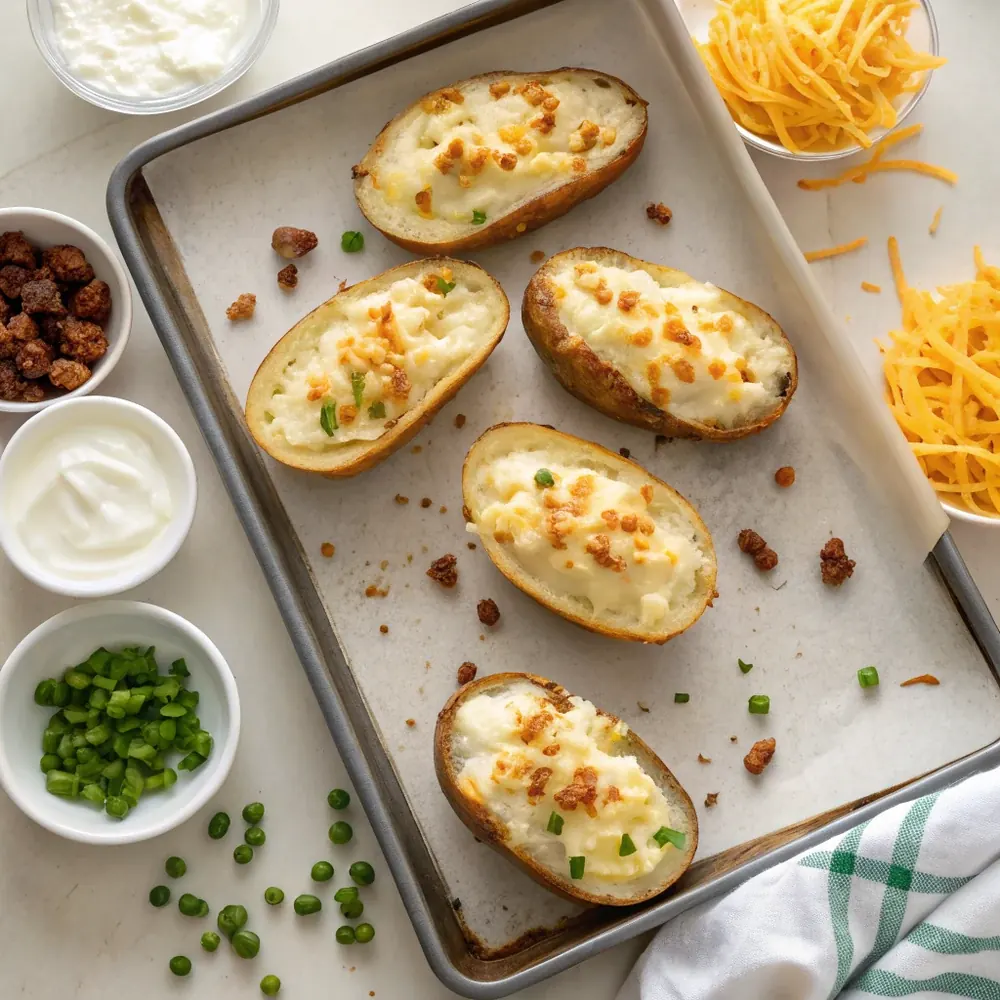
- Refill and top the shells. Arrange the 8 shells on a sheet pan and divide the filling among them, mounding it slightly above the rim rather than packing it flat and tight. Scatter the remaining 1/2 cup cheddar over the tops, then the reserved bacon. At this point the potatoes can be covered and refrigerated up to 3 days or frozen.
- Second bake at 400F. Bake at 400F for 18 to 22 minutes, until the cheese is melted and browning in spots and the filling is hot through, 165F on a thermometer. From the fridge, add about 10 minutes. For deeper color, run them under the broiler for the last 2 minutes. Rest 5 minutes and finish with the remaining green onions.
Frequently Asked Questions
Does Texas Roadhouse have twice baked potatoes?
No. Texas Roadhouse serves a baked potato and a loaded baked potato, but no twice baked potato appears on the menu. This recipe is a conversion: it takes the restaurant's salt-crusted baked potato and its loaded topping lineup of butter, sour cream, sharp cheddar, bacon, and green onion, then rebuilds them in the classic steakhouse twice-baked format. The flavors are the loaded potato's; the make-ahead, refill-and-rebake construction is the part the menu never offered. If you order loaded at the restaurant and love it, this is the same profile with the toppings mashed through every bite.
Can you make twice baked potatoes ahead of time or freeze them?
Yes, and they are better for it. Fully assembled halves, filled and topped, keep 3 days covered in the refrigerator; bake at 400F for 28 to 32 minutes, to 165F in the center. For the freezer, freeze the assembled halves solid on a sheet pan, wrap each individually, and store up to 3 months. Bake from frozen at 375F for 45 to 55 minutes, or thaw overnight in the fridge first. Because the filling is mostly starch and fat, it does not weep or break the way casseroles can, which makes these the best-freezing potato side there is.
Why are my twice baked potatoes gummy?
Overworked starch, almost every time. Mashing potatoes in a food processor or electric mixer ruptures the starch cells and turns the filling into glue within seconds; use a hand masher or a ricer and stop while a few small lumps remain. The second culprit is cold potato: flesh that cooled before mashing stiffens and tempts you into overworking it, so scoop and mash while the potatoes are hot. Cold milk does the same thing, which is why the recipe calls for warm. An underbaked first bake also mashes waxy and dense, so confirm 205 to 210F before you scoop.
Do you eat the skin of a twice baked potato, and why do my shells collapse?
The skin is the best part here, salt-crusted in the first bake and re-crisped in the second, and it is what lets you eat a half out of hand. Collapsing shells trace back to two mistakes. First, scooping too aggressively: always leave a 1/4-inch wall of flesh attached to the skin all the way around, because that layer is the structure. Second, a foil-wrapped or underbaked first bake, which leaves the skin soft and steamy instead of dry and rigid. Bake the potatoes bare at 425F until fully done and the shells will hold through refilling, rebaking, and handling.
What goes with twice baked potatoes?
Beef, first and always: prime rib, a thick ribeye, or grilled sirloin, with the potatoes' 20-minute second bake timed to the meat's rest. They are equally at home beside barbecue, where a brisket or rib plate treats them like upgraded potato salad. Add a green vegetable with some bacon of its own, green beans being the steakhouse classic, and the plate is complete. On their own, two halves with a sharp dressed salad make a full supper. For parties, they are the potato side that needs no serving spoon, no gravy, and no last-minute work.
Can I microwave the potatoes for the first bake?
As a hybrid, yes; alone, no. A microwave steams the potato, so the skin stays soft and pale and the shell will not hold its shape once scooped. The workable compromise: microwave the pricked, unsalted russets 5 to 6 minutes to jump-start the centers, then oil them, roll them in kosher salt, and finish in a 425F oven for 20 to 25 minutes until the skin crisps and the centers reach 205F. You save half an hour and keep a usable shell. If you have the time, the full oven bake still makes the sturdiest, best-tasting skins.
How do I reheat leftover twice baked potatoes?
A 375F oven or air fryer for 15 to 20 minutes brings a refrigerated, already-baked half back with the top re-crisped and the filling hot through; loosely tent with foil for the first half if the cheese is already deeply browned. The microwave works in a hurry, about 2 minutes per half, but it softens the skin, so give microwaved halves a few finishing minutes in a hot oven or skillet if you care about the crust. Stored airtight, baked leftovers keep 3 to 4 days in the refrigerator. Freeze extras before the second bake rather than after; the texture holds better.