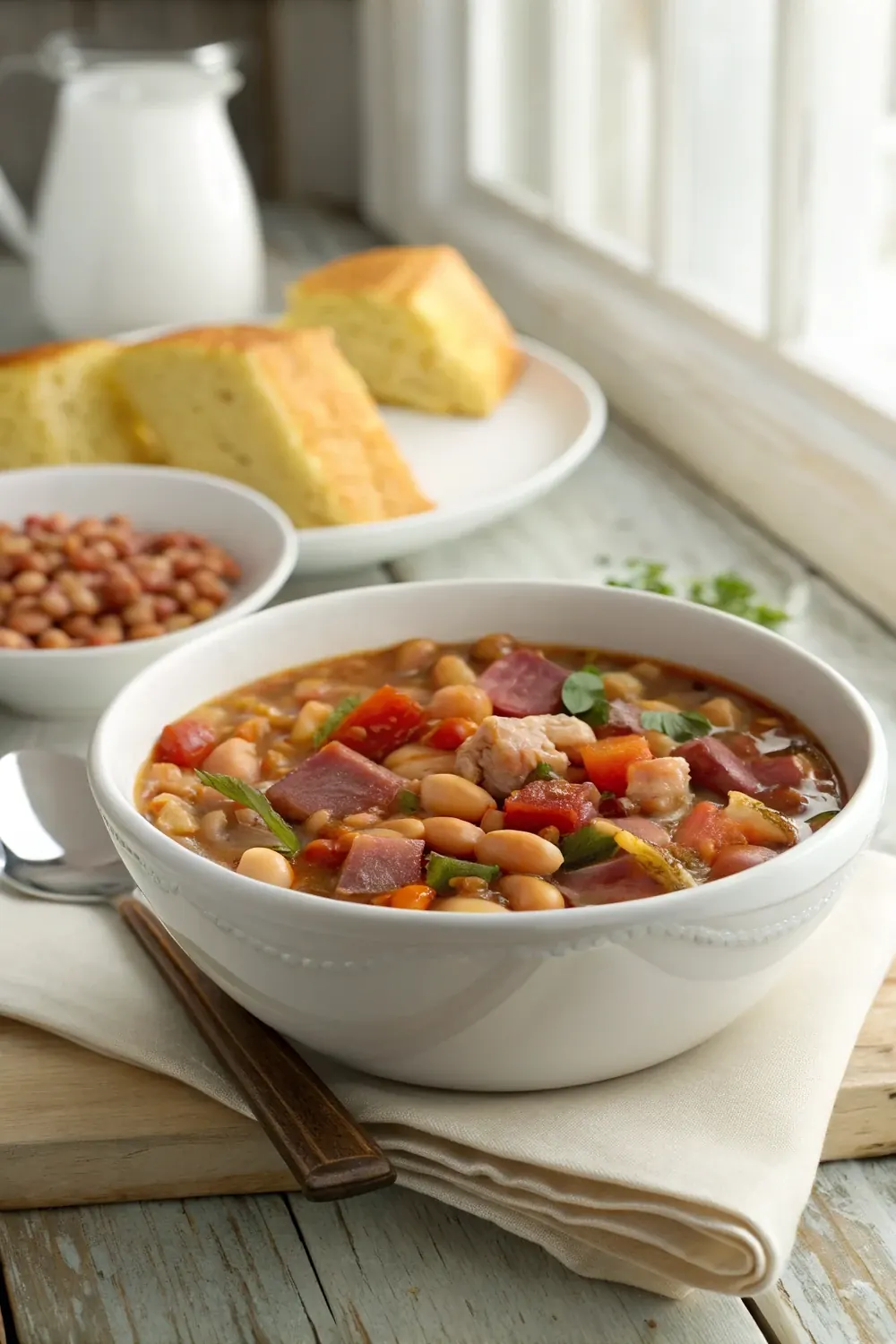
Southern Comfort Food
15 Bean Soup Slow Cooker
Chef Mia's 15 Bean Soup slow cooker: Hurst's HamBeens blend, smoked ham hock, kielbasa, onion, celery, tomatoes, lemon finish. 8 hours low for cozy Texas bowl.
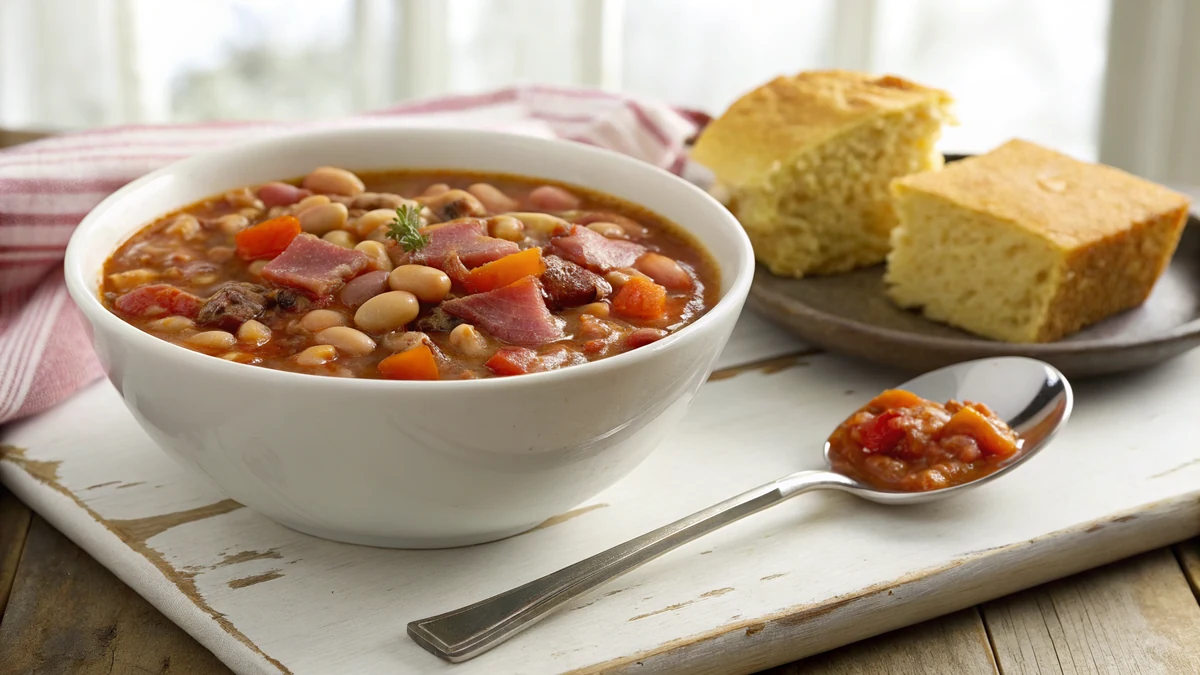
Quick answer: The slow cooker version of 15 Bean Soup is the cozy Hill Country supper that runs unattended through the working day and shows up tender, smoky, and brothy when you walk back into the kitchen. Rinse a 20-ounce bag of Hurst's HamBeens 15 Bean Soup blend, drop it into a 6-quart slow cooker with a 1.5-pound smoked ham hock, 1 pound of sliced kielbasa, a diced yellow onion, four ribs of celery, six garlic cloves, a can of diced tomatoes, eight cups of low-sodium chicken broth, two bay leaves, smoked paprika, cumin, thyme, and pepper. Cook on low for eight hours, shred the ham off the hock, stir in the seasoning packet from the Hurst's bag, finish with the juice of half a lemon, and serve with hot cornbread.
15 Bean Soup is the supper my grandmother kept in a Crock-Pot on Sunday mornings in San Marcos so that there would be something hot waiting after church. Beans soaked the night before, the smoked ham hock sat on top of the bag, and the whole house smelled like a smokehouse by the time we walked back through the door. She used the Hurst's HamBeens 15 Bean Soup blend (the small purple-and-gold bag with the seasoning packet inside), and I have never bothered to switch. The blend hits 15 different beans in one bag - small reds, pintos, kidney beans, navy, pink beans, baby limas, garbanzos, black-eyed peas, light reds, large limas, blackeyes, cranberry, great northern, yellow eye, and white kidney - which means each spoonful gives you a different texture.
Slow cookers were invented for soups like this one. The 8-hour low-and-slow setting hydrates the dry beans completely, melts the collagen off the ham hock into the broth, and lets the smoked sausage warm through without losing its snap. You can walk out the door at 8 AM, work a full day, and come home at 5 PM to a soup that tastes like it has been on the stove all afternoon. The version below is what I make in my Hill Country kitchen every November when the first cold front blows through, and the leftovers always taste better on day two and day three. It is the perfect cozy Texas bowl for football Saturdays, work-week lunches, and church potlucks.
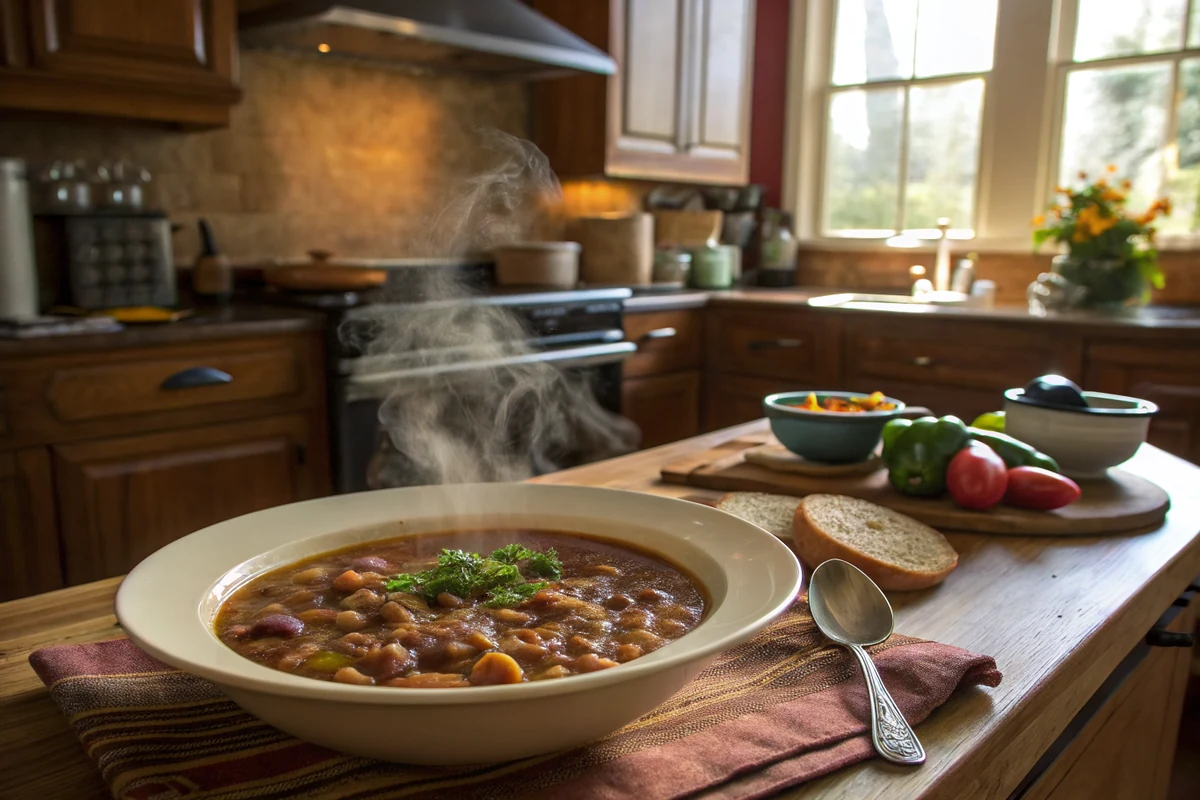
What 15 Bean Soup Is, and Where Hurst's HamBeens Comes From
15 Bean Soup is exactly what it sounds like: a soup built around a packaged blend of 15 different dried beans, cooked low and slow with a smoked ham hock and aromatics until the beans turn tender and the broth turns into a smoky, brothy, deeply savory bowl. It is one of the cheapest and most filling suppers in the Southern recipe canon. A single 20-ounce bag plus a $5 ham hock and a $4 kielbasa feeds eight people generously, with leftovers for tomorrow's lunch.
The dish as we know it today is essentially the Hurst's HamBeens version. N.K. Hurst Company in Indianapolis launched the HamBeens 15 Bean Soup blend in 1986, dropping a small foil packet of ham-flavored seasoning inside the bag of mixed beans. The bag became the easy on-ramp for a generation of home cooks who had inherited the bean-soup tradition from their grandmothers but did not know how to source 15 different beans individually. Forty years later, the Hurst's bag is in every Texas grocery store from H-E-B to Brookshire's, usually shelved next to the dried beans for $3.50 to $4.50.
Hurst's bean blends are sold in several varieties (15 Bean Soup, Cajun, Chili Mix, etc.), but the 15 Bean is the canonical Southern soup mix. You can make this recipe with any generic 15-bean blend if your store does not stock Hurst's, but the seasoning packet adds a measurable ham-and-smoke note that you would otherwise have to recreate manually with bouillon plus smoked paprika.
The Slow Cooker Advantage: Walk Away, Come Back Hours Later
Slow cookers exist for soups like this. The 8-hour low-and-slow timeline hits three goals at once: it fully hydrates the dry beans without any pre-soak; it melts the connective tissue off the ham hock into the broth, which is what gives the soup its body; and it lets the smoked sausage warm through slowly without breaking up or losing its snap.
I have made this on the stovetop and in a slow cooker side by side. The stovetop version takes 3 to 4 hours of active simmering and constant attention to keep the beans from sticking. The slow cooker version takes 15 minutes of prep at 8 AM and 5 minutes of finishing at 5 PM. The flavor is essentially identical. Unless you specifically enjoy babysitting a pot all afternoon, the slow cooker is the move.
The 6-quart size is the right slow cooker for this recipe. A 4-quart is too small (the soup expands as the beans hydrate and you risk overflow). A 7-quart works if you have one. Brand does not matter much. A basic Crock-Pot from Walmart, a Hamilton Beach with a programmable timer, or an Instant Pot in slow-cook mode all give comparable results. The cook time is identical across brands because the heating elements are calibrated to the same low-temperature standard.
The 15 Beans in the Bag (and Why the Variety Matters)
The Hurst's HamBeens 15 Bean Soup blend contains, by federal label declaration: small red beans, pinto beans, dark red kidney beans, navy beans, pink beans, baby lima beans, garbanzo beans (chickpeas), black-eyed peas, light red kidney beans, large lima beans, blackeye beans, cranberry beans, great northern beans, yellow eye beans, and white kidney beans. The blend is roughly 12 percent of each bean by volume, though Hurst's adjusts the ratio seasonally based on which beans are abundant from contracted farms.
The variety matters for two reasons. First, texture: each bean variety hydrates and cooks at a slightly different rate. Small red beans and pintos are fully tender at 7 hours. Garbanzos and large limas hold their bite longer, sometimes still slightly firm at 8 hours. The mix gives every spoonful a varied texture - some beans melt into the broth and thicken it, others stay distinctly chewy. A single-bean soup (just pinto, or just navy) tastes one-note by comparison.
Second, flavor: each bean variety carries its own flavor profile. Black-eyed peas have a slightly nutty grassy note. Cranberry beans taste sweet and creamy. Garbanzos add a chestnut-like backbone. Navy beans are clean and neutral. The 15-way blend creates a depth that no single bean can match, even when seasoned identically. It is essentially the same principle as a brisket rub blending multiple spices: more components, more layered finish.
Ham Hock vs Ham Bone vs Diced Ham: Pick the Hock
A smoked ham hock is the canonical Southern choice for bean soup, and it remains the single ingredient that makes the biggest flavor difference. A smoked ham hock is the ankle joint of a pig, smoked over hickory or applewood for 10-20 hours during curing. It is loaded with connective tissue (collagen) that breaks down during the 8-hour slow cook into the broth, which is what gives 15 Bean Soup its slightly silky body without thickener or roux.
Find smoked ham hocks at any major grocery in Texas: H-E-B carries them in the smoked meat case near the kielbasa, usually $4-6 for a 1 to 1.5 lb hock. Brookshire's, Kroger, Whole Foods, and Walmart all stock them. They should be deep mahogany on the outside (from the smoke), with visible meat, fat, and bone. A 1.25 to 1.5 lb hock is the right size for a 6-quart slow cooker.
If smoked ham hocks are not available, in order of preference: smoked turkey leg (similar size, same shredding technique, slightly less rich); leftover ham bone from a holiday meal (works beautifully for bean soup if you have one); 1 cup diced cooked ham (acceptable substitute but missing the collagen-and-smoke depth); 4 ounces of diced bacon plus 1 teaspoon liquid smoke (the cheap improvisation; the soup will taste good but not the same).
Avoid using a fresh (un-smoked) ham hock. The smoke is doing half the flavor work and there is no shortcut for it.
Smoked Sausage: Texas Brands Worth Looking For
The kielbasa or smoked sausage layer adds texture and another wave of pork-and-smoke flavor. Most Texas grocery stores carry several brands; the choice changes the soup more than you would expect.
Polish kielbasa from a major brand (Hillshire Farm, Eckrich, Johnsonville) is the affordable canonical choice. The flavor is mild, the texture is firm, and the casing stays intact through 8 hours of cooking. Sliced 1/2-inch thick, the coins stay snappy and visible in the soup. A 14-16 ounce package costs $4-6 and is what I usually grab on a weeknight grocery run.
Conecuh Original Smoked Sausage (Alabama, sold throughout the South including Texas H-E-B stores) is the upgrade. It has more pepper, more smoke, and a slightly looser snap. About $7 for a 1-pound coil. Worth the extra dollar if you find it.
Texas-made options: New Braunfels Smokehouse (Hill Country), Slovacek's (Snook, between Austin and Houston), and Kreuz Market sausage (Lockhart) are all elite-tier choices. Slovacek's jalapeno cheddar smoked sausage is a favorite for bean soup; the jalapeno carries through the broth without overwhelming the ham notes. See Texas hot links for more on Texas sausage culture if you want to dig deeper.
Aromatics: The Southern Soup Trinity
Onion, celery, and garlic are the Southern bean-soup trinity. Not the Cajun trinity (which adds bell pepper and skips garlic), not the French mirepoix (which goes onion-carrot-celery). The Southern soup trinity is just three aromatics, and they belong in this soup.
One large yellow onion, diced (about 1.5 cups), provides the soft sweet backbone. Yellow onion sweetens beautifully during a long slow cook. Sweet onions (Vidalia, Texas 1015) work but lean too sweet for this application. White onion is too sharp. Red onion stains the broth pink (technically fine, looks weird in the bowl).
Four ribs of celery, diced, give a faint green herbal note that balances the heaviness of the ham. Skip the celery leaves; they go bitter during a long simmer. If celery is missing from your fridge, sub fennel or leeks; either works but changes the flavor profile away from canonical Southern.
Six cloves of garlic, minced, is the right amount for an 8-quart finished soup. Half the amount tastes timid. Double the amount overpowers the ham. Minced is better than crushed for slow cooker work because crushed garlic can turn bitter over 8 hours; minced disperses and integrates.
Tomatoes and Broth: Building the Base
Tomatoes and broth provide the liquid medium that the beans cook in and the body that holds the finished soup together. The amounts are calibrated for an 8-cup-yield slow cooker bowl.
Fire-roasted diced tomatoes are the upgrade ingredient. The fire-roast process before canning adds a charred smoky note that pairs beautifully with the ham hock smoke. Muir Glen and Hunt's both make excellent fire-roasted diced tomatoes; H-E-B Central Market store-brand is fine. One 14.5 oz can is the right amount. Regular (non-fire-roasted) diced tomatoes work as a substitute and lose only a small amount of complexity.
Low-sodium chicken broth is the standard liquid base. Eight cups for a 20-ounce bean bag is the right ratio. The chicken broth gives the soup more body than water alone but does not compete with the ham flavor. Better Than Bouillon roasted chicken paste, dissolved in hot water (1 teaspoon per cup), gives a richer broth than boxed and costs less per batch. Avoid bouillon cubes; they are mostly salt. Vegetable broth works as a substitute and tilts the flavor profile slightly herb-forward.
Avoid beef broth in this recipe; the heavy beef flavor fights the smoked pork. Save the beef broth for Texas BBQ sauce or beef chili.
Spice Profile: Smoked Paprika Anchors the Bowl
The spice rack for 15 Bean Soup is short and predictable. Smoked paprika, ground cumin, thyme, bay leaves, black pepper, cayenne, kosher salt. That is it. The Hurst's seasoning packet adds its own ham-and-smoke blend at the end, so the spices in the slow cooker need to harmonize with that rather than compete.
Smoked paprika (Spanish pimenton) does the heaviest lifting on flavor. Two teaspoons is enough to thread a campfire note through the entire pot. Sweet pimenton is the default; bittersweet works if that is what you have. Hungarian paprika has no smoke and will not substitute meaningfully.
Cumin gives the soup an earthy warmth that pairs with the smoked paprika. One teaspoon is the right amount; more pushes the soup toward Tex-Mex. Mexican oregano (not Mediterranean) works as an addition if you have it - one teaspoon adds a slight floral citrus note.
Thyme is the herb that keeps the soup tasting Southern rather than Tex-Mex. One teaspoon dried thyme; substitute 1 tablespoon fresh thyme leaves if you have a pot growing. Bay leaves are non-negotiable for any slow-simmered soup; they soften the rough edges of the ham fat. Pull them out before serving.
To Soak or Not to Soak the Beans
Traditional Southern bean-soup recipes call for an overnight soak: cover the dried beans in cold water, add a tablespoon of salt, leave on the counter for 8 to 12 hours, drain, rinse, and proceed. The soak hydrates the beans before cooking and shortens the cook time by 30 to 40 percent.
For the slow cooker version of 15 Bean Soup, the soak is optional. The 8-hour low-and-slow timeline gives the beans plenty of time to hydrate during the cook itself. I usually skip the soak because I plan the soup on the morning of the day I want to eat it, not the night before. If you remember to soak, the soak version cooks in 6 hours on low instead of 8 and the bean texture is slightly creamier.
Quick-soak shortcut: bring the rinsed beans to a boil in 8 cups of water, boil 2 minutes, cover, remove from heat, let stand 1 hour, drain, rinse. The quick-soak gives most of the benefit of an overnight soak in about an hour of mostly hands-off time.
What does not work: skipping all hydration, including no slow-cooker time, just simmer for 90 minutes on the stove. Dried beans need either an overnight soak followed by long simmer, or no soak followed by very long simmer (the 8-hour slow cooker approach). Halfway between these two does not work; the beans stay tough.
The 8-Hour Slow Cooker Timeline (When to Touch It)
Slow cookers reward leaving them alone. Every time you lift the lid you lose 10-15 degrees of internal temperature and the recovery adds 20 minutes to your total time. The 8-hour low-and-slow setting is structured so that you do not need to touch the cooker for the first 7 hours.
Hour 0: layer everything, set on low, walk away. Hour 6: optional, lift the lid once to check that the broth still covers the beans (add 1 cup more chicken broth if it looks too dry). Hour 7: pull the ham hock out, shred the meat, return the meat to the cooker. Stir in the Hurst's seasoning packet. Hour 7.5: taste the broth, adjust seasoning. Hour 8: finish with lemon and parsley, serve.
If you have a programmable slow cooker (Hamilton Beach, modern Crock-Pot, Instant Pot), set it on low for 8 hours and let the automatic warm setting kick in at the end. The soup holds beautifully on warm for another 2-3 hours without overcooking, which is useful if your dinner timing slips.
If you have a basic slow cooker without a timer, plan to be home at the 7-hour mark for the ham-shredding step. Or set an alarm. The soup will not overcook on low if you go an hour or two long, but the beans will start breaking down past the 10-hour mark and the texture turns mushy.
The Lemon Finish: The Bright Top Note
Half a lemon's juice, stirred in at the end, is the small move that lifts the entire soup from heavy to balanced. Without the lemon, the soup tastes one-dimensional - savory, smoky, ham-heavy. With the lemon, the same soup tastes layered - smoky savory ham first, brothy depth second, bright citrus lift at the back. The lemon trick is something Southern cooks have been doing for a century, and it is the canonical finish for any long-simmered bean soup.
Use the juice of half a lemon for one batch. Fresh, not bottled - the difference is dramatic. Roll the lemon firmly under your palm on the counter before cutting, which releases more juice. Add the juice off-heat, after pulling the slow cooker lid and fishing out the bay leaves. Simmering the lemon in from the start (rather than adding off-heat) dulls the bright notes that the finish is meant to deliver.
If you do not have lemon, the second-best substitute is 1 tablespoon of apple cider vinegar. The vinegar gives a similar bright acid lift, though without the floral citrus top note. White wine vinegar works too. Avoid balsamic; it is too sweet and the flavor fights the ham.
If the soup tastes too lemony after the finish (rare but possible), stir in a teaspoon of brown sugar or a tablespoon of cream. Both balance the acid quickly without changing the overall character of the soup.
Storage and the Day-Two Truth
15 Bean Soup is one of those rare dishes that tastes better on day two than it does on day one. The flavors marry overnight: the smoked paprika fully integrates into the broth, the lemon brightness mellows into a more polished acidity, the bean starches thicken the broth slightly, and the ham softens further into the broth. I make a double batch on Sunday specifically so I have day-two lunches Monday and Tuesday at work.
Refrigerator storage: cool the soup to room temperature within 2 hours of cooking, then refrigerate in airtight containers. Keeps 5 days at 38F or below. The soup thickens significantly in the fridge as the bean starches set; thin with a quarter to half cup of chicken broth or water when reheating.
Freezer storage: portion into freezer-safe quart containers or zip-top bags (leave 1 inch of headspace for expansion), freeze flat for compact storage. Keeps 3 months at zero degrees Fahrenheit. The texture changes slightly after freezing - some beans go softer than fresh - but the flavor is well preserved. Thaw overnight in the fridge before reheating.
Reheating: gentle is the rule. A medium-low burner with frequent stirring, or 50 percent power in the microwave with stirs every 90 seconds. Hard-boiling reheated bean soup breaks the beans further and can make the soup mushy. Add a tablespoon of fresh lemon juice when reheating to revive the bright top note that fades during storage.
Serving Suggestions: The Cozy Texas Bowl
15 Bean Soup is meant to be served in a wide bowl with three or four garnishes and a side of bread. The Texas-canonical setup is the bowl plus cornbread plus a small dish of hot sauce. Everything else is optional.
If you like this bowl format but want something faster and more Tex-Mex, my charro beans arrive in the same place from a different direction: pintos instead of a fifteen-bean blend, bacon and chorizo instead of a ham hock, and two and a half hours on the stovetop instead of eight in the crock. Same wide bowl, same spoon, much shorter afternoon.
Cornbread is the canonical Southern pairing. Authentic Texas-style cornbread made in a cast iron skillet has the right balance of sweet-corn crumb and slightly crisp edges. The crumb soaks up the smoked-ham broth without falling apart. Cast iron skillet cornbread is a close cousin and works equally well. Buttermilk biscuits, like the ones in buttermilk biscuits Texas style, are an alternative.
Garnishes: thinly sliced green onion (top with abandon, every bowl), chopped fresh parsley (a small handful per bowl), sliced fresh jalapeno for heat seekers, a dollop of sour cream for the lactose-tolerant. Avoid shredded cheese on this one; the flavor fights the ham broth.
Hot sauce belongs on the table for guests who want kick. Cholula and Crystal are the Southern canonical hot sauces for bean soup. Tabasco is fine. Avoid Sriracha, which is too thick and too garlic-forward. For winter Sundays, the soup pairs beautifully with a glass of Texas sweet iced tea in the summer or a cold lager in the winter.
Variations Worth Trying
Cajun 15 Bean Soup. Add 1 diced green bell pepper to the aromatics, 1 teaspoon Cajun seasoning (Tony Chachere's or Slap Ya Mama) to the spice blend, and 1 teaspoon hot sauce stirred in at the end. Replace the kielbasa with andouille sausage. The soup tilts toward Louisiana with deeper heat and more savory backbone. Serve over white rice instead of cornbread.
Tex-Mex 15 Bean Soup. Add 1 chopped chipotle pepper in adobo plus 1 teaspoon adobo sauce, 1 teaspoon Mexican oregano, and the juice of a whole lime instead of the half lemon. Top with cilantro, queso fresco, and avocado slices. The soup leans Tex-Mex with chipotle heat and a brighter finish. See my Texas chili for the same chile-forward technique.
Vegetarian 15 Bean Soup. Skip the ham hock and sausage. Add 2 tablespoons olive oil, 1 chopped portobello mushroom, 1 teaspoon liquid smoke, and 1 teaspoon mushroom powder (or 1 extra teaspoon smoked paprika) to mimic the smoke. Replace the chicken broth with vegetable broth. The soup loses some richness but stays satisfying. Add cooked vegetarian sausage at the end if you want texture.
Spicy ham hock 15 Bean Soup. Double the cayenne to 1/2 teaspoon, add 1 finely chopped jalapeno to the aromatics, and stir in 2 tablespoons of pickled jalapeno juice at the end. The soup carries serious heat that builds with each spoonful. Pair with extra sour cream or a glass of milk.
White bean fusion. Replace half the 15-bean mix with 1 cup of dried great northern beans. The texture leans creamier and the color reads paler. Add 1 tablespoon dijon mustard and 2 sprigs of fresh rosemary for a New England tilt. Sun-dried tomatoes can replace the canned diced tomatoes for a Tuscan twist.
Mistakes to Avoid
Skipping the rinse and sort step. Dried beans occasionally carry small stones that can crack a tooth. Sixty seconds of sorting is non-negotiable, even with name-brand bags like Hurst's.
Adding the seasoning packet too early. The Hurst's packet contains concentrated salt and seasonings. Stirring it in at hour zero over-salts the broth as it reduces. Stir it in at hour 7, after the ham hock has done its work.
Lifting the lid too often. Each peek loses heat and adds 20 minutes to the total time. The slow cooker is engineered for closed-lid cooking; let it do its thing.
Cooking on high for the full 4 hours without low. High setting cooks beans faster but slightly less evenly; some beans soften while others stay firm. Low-and-slow is canonical for 15 Bean Soup and delivers more uniform texture.
Forgetting the lemon finish. Without lemon (or vinegar), the soup tastes flat and one-dimensional. The bright acid at the end is the move that finishes the bowl.
Using bouillon cubes. They are mostly salt and they make the soup taste over-seasoned without adding depth. Better Than Bouillon paste or boxed low-sodium broth is the correct choice.
Over-salting at the start. The smoked ham hock and the smoked sausage both contribute significant salt during the long cook. Start with 1 teaspoon kosher salt, taste at the end, and add more then if needed.
Kitchen Notes from My Hill Country Sundays
I make this soup most often on the Saturday morning before a cold-weather Sunday. The slow cooker runs from 9 AM Saturday to 5 PM Saturday, the soup rests in the fridge Saturday night, and Sunday lunch is reheated bowl plus fresh cornbread plus iced tea. The day-two flavor is the real reason to make this soup; day one is delicious but day two is the payoff.
The single change that improved my version most was switching from generic dried bean blends to the actual Hurst's HamBeens 15 Bean Soup bag. The seasoning packet inside the bag is calibrated to the bean blend, and substituting your own ham-and-smoke seasoning never quite matches it. The Hurst's bag is $3.50 at H-E-B and worth tracking down.
If you have leftover smoked ham from a holiday meal (Easter, Thanksgiving, Christmas), this is the recipe that justifies saving the ham bone. Use the bone in place of (or in addition to) the smoked ham hock. The cooked ham meat clinging to the bone shreds into the soup and adds another dimension. For Thanksgiving ham, see also my Thanksgiving turkey brine for the bird-side companion.
The most useful piece of gear for this recipe is a 6-quart programmable slow cooker with an automatic warm setting. The slow cooker turns off after 8 hours, switches to warm, and holds the soup safely at 165F for another 4 hours without overcooking. The Hamilton Beach Set-and-Forget at about $50 does this job reliably. The Hurst's company maintains a recipe page with more bean-blend ideas, but the canonical version above is the one I keep coming back to.
Tips for the Best 15 Bean Soup
Five batches in, you start noticing the small dials. These are the moves I keep returning to in my Hill Country kitchen, the ones that lift the soup from good to memorable.
- Use Hurst's HamBeens 15 Bean Soup, not generic bean blends. The seasoning packet is calibrated to the bean ratio. Generic 15-bean blends from bulk bins lack the packet and you have to recreate the seasoning manually.
- Source a smoked ham hock at H-E-B or Brookshire's. Fresh ham hocks lack smoke and the soup loses half its identity. The smoked hock is non-negotiable for canonical Hill Country bean soup.
- Slice the sausage 1/2 inch thick. Thicker slices stay snappy and visible; thinner slices break apart during the 8-hour cook. Coin shape rather than cube shape gives the most coverage per bowl.
- Lemon at the end, never at the start. The bright top note belongs in the last 5 minutes off-heat. Simmering lemon in from hour zero dulls the brightness completely.
- Double the batch for day-two lunches. The soup tastes better tomorrow than today. A doubled batch yields 16 servings and freezes beautifully in quart containers.
For the perfect cornbread side, head to authentic Texas-style cornbread. For another slow-cooker comfort dish to rotate alongside this one, Texas chili is the canonical winter Sunday partner.
15 Bean Soup Slow Cooker Recipe
Ingredients
- For the soup:
- 1 bag (20 oz / 567 g) Hurst's HamBeens 15 Bean Soup mix, seasoning packet reserved
- 1 smoked ham hock, 1 1/4 to 1 1/2 lb (570-680 g)
- 1 lb (450 g) smoked kielbasa or Texas hot links, sliced into 1/2-inch coins
- 1 large yellow onion, diced (about 1 1/2 cups)
- 4 ribs celery, diced
- 6 cloves garlic, minced
- 1 can (14.5 oz / 411 g) fire-roasted diced tomatoes, with juice
- 8 cups (1.9 L) low-sodium chicken broth, plus more as needed
- 2 dried bay leaves
- 2 teaspoons smoked paprika (Spanish pimenton, sweet or bittersweet)
- 1 teaspoon ground cumin
- 1 teaspoon dried thyme
- 1/2 teaspoon freshly ground black pepper
- 1/4 teaspoon cayenne pepper, to taste (optional)
- 1 teaspoon kosher salt (start with this; ham hock is salty)
- For the finish:
- Juice of 1/2 lemon, freshly squeezed
- 2 tablespoons fresh parsley, chopped, plus more for garnish
- Optional: 1 fresh jalapeno, sliced (for serving)
- Optional: 3 green onions, thinly sliced (for garnish)
- Equipment:
- 6-quart or larger slow cooker (Crock-Pot, Hamilton Beach, or Instant Pot in slow-cook mode all work)
- Cutting board, chef's knife, ladle, tongs for shredding the ham hock
Instructions
- Sort and rinse the beans. Pour the Hurst's HamBeens 15 Bean Soup blend into a colander and rinse under cold water for about 60 seconds, picking out any small stones, debris, or shriveled beans. Set the seasoning packet aside; it goes in at the end, not the start. Sorting is not optional - dried beans from any brand occasionally carry small pebbles that can crack a tooth. Sixty seconds of attention now saves a dental appointment later.
- Skip the overnight soak (the slow cooker handles it). Traditional 15 Bean Soup recipes call for an overnight soak in cold water. The 8-hour slow cooker timeline makes this unnecessary - the beans rehydrate fully during the long cook. If you have planned ahead and want to soak overnight anyway, soak in cold water with 1 tablespoon of kosher salt for 8-12 hours, then drain and rinse. Soaked beans cook in 6 hours on low instead of 8. Both methods work; pick the one that fits your morning.
- Layer the slow cooker. Spread the rinsed beans across the bottom of a 6-quart slow cooker. Add the diced onion, celery, garlic, sliced sausage, fire-roasted diced tomatoes with their juice, bay leaves, smoked paprika, cumin, thyme, black pepper, cayenne, and kosher salt. Stir gently to distribute. Nestle the ham hock in the middle of the bean mixture so the bone is partially submerged. Pour 8 cups of chicken broth over the top. The liquid should cover everything by about 1 inch; add a little more broth or water if needed.
- Cook on low for 8 hours (or high for 4 to 5). Cover and cook on LOW for 8 hours, or HIGH for 4 to 5 hours. Low and slow is the canonical setting for 15 Bean Soup because dried beans need full hydration time and the ham hock needs time to release its collagen and fat into the broth. Avoid lifting the lid for the first 6 hours - every peek loses heat and adds 15-20 minutes to the total time. After 6 hours, you can check that the beans are softening; they will not be fully tender until closer to 7 hours.
- Shred the ham hock. At hour 7 or when the beans are nearly tender, use tongs to lift the ham hock onto a cutting board. Let it cool for 5 minutes. The meat will pull off the bone easily. Discard the bone, the rind (the tough outer skin), and any large fat pieces. Pull the ham meat into bite-sized shreds with two forks and return them to the slow cooker. There will be 1 to 1 1/2 cups of cooked ham; this is the savory backbone of the bowl.
- Stir in the Hurst's seasoning packet. Open the reserved Hurst's seasoning packet (it is the small foil sachet that came inside the bean bag) and stir it into the soup. The seasoning packet contains a ham-and-smoke flavor blend that complements the ham hock and rounds out the broth. If your bean bag had no seasoning packet (some generic 15-bean blends ship without), substitute 1 teaspoon of bouillon powder plus 1/2 teaspoon of smoked paprika. Cook on low for another 30 minutes to let the seasoning integrate.
- Finish with lemon and parsley. Pull the lid off, fish out the bay leaves, and squeeze in the juice of half a lemon. Stir in the chopped parsley. Taste the broth. The order on your tongue should be: smoky ham first, brothy depth second, gentle heat from cumin and cayenne third, bright lemon at the back. Adjust if needed: more salt for flatness (start with 1/4 teaspoon and re-taste), more lemon for too-heavy ham notes, more cayenne for heat. Let the soup rest, lid off, for 10 minutes to settle.
- Serve hot with cornbread. Ladle the soup into wide bowls. Garnish each bowl with sliced green onion, a small handful of chopped parsley, and a few thin rounds of fresh jalapeno if you want extra heat. Serve with hot cornbread on the side - the crumb is built to soak up the smoked-ham broth. Hot sauce, like Cholula or Crystal, lives on the table for guests who want more kick. Leftovers keep refrigerated for 5 days and the soup tastes better on day two.
Frequently Asked Questions
What is 15 Bean Soup?
15 Bean Soup is a Southern slow-cooked bean soup built around a packaged blend of 15 different dried beans (small reds, pintos, kidney, navy, garbanzos, black-eyed peas, and more), cooked with a smoked ham hock, smoked sausage, onion, celery, garlic, tomatoes, and broth until the beans are tender and the broth is smoky and brothy. It is one of the cheapest and most filling suppers in the Southern canon and benefits from day-two reheating.
Where do I find the 15-bean mix?
Hurst's HamBeens 15 Bean Soup mix is sold in the dried bean section of most major US grocery stores including H-E-B, Brookshire's, Kroger, Whole Foods, Walmart, and Target. The 20-ounce bag costs about $3.50 to $4.50 and includes a seasoning packet inside. If your store does not carry Hurst's, look for any generic 15-bean blend (often store-brand). If no blend is available, mix equal parts pinto, kidney, navy, garbanzo, and black-eyed peas to approximate.
Do I have to soak the beans overnight?
No. The 8-hour slow cooker timeline fully hydrates the dry beans during the cook itself. If you want a slightly creamier texture, soak overnight in cold water with 1 tablespoon kosher salt and reduce the cook time to 6 hours on low. A quick-soak (boil 2 minutes, rest 1 hour, drain) also works and shortens the slow-cook to 6 hours. The no-soak slow cooker approach is the easiest method for a same-day weekday meal.
Can I make this on the stovetop or in an Instant Pot?
Yes. Stovetop method: rinse beans, combine all ingredients in a 6-quart Dutch oven, bring to a simmer, cover and cook on low for 3 to 4 hours, stirring every 30 minutes to prevent sticking. Add broth as needed. Instant Pot method: rinse beans, combine all ingredients in the Instant Pot, seal, cook on high pressure for 45 minutes, natural release 20 minutes, then shred the ham and finish with lemon. Both methods produce comparable results; the slow cooker version is the most hands-off.
Can I make 15 Bean Soup vegetarian or vegan?
Yes. Skip the ham hock and smoked sausage. Replace the chicken broth with vegetable broth. Add 1 teaspoon liquid smoke and 1 chopped portobello mushroom to mimic the smoke and richness. Optionally add cooked vegetarian sausage (Beyond Meat, Field Roast smoked apple sage) at the end for texture. The soup loses some depth but remains satisfying. For full vegan, also skip any cream or butter additions. For the canonical Texas vegetarian profile, see also our Southern comfort food pillar.
Is this recipe gluten-free?
Yes, as written. The dried beans, ham hock, smoked sausage (most major brands like Hillshire Farm and Conecuh), aromatics, broth, tomatoes, and spices contain no wheat. Confirm by reading the label of any specific sausage brand you use; some smoked sausages use wheat-based fillers. Hurst's HamBeens seasoning packets are certified gluten-free per the company's published statement. The lemon finish is naturally gluten-free.
Why is my soup too thin or too thick?
Too thin: cook uncovered for the last 30 minutes to let liquid evaporate, or stir in 2 tablespoons of cornstarch mixed with 1/4 cup cold water and simmer 5 minutes more. Too thick: stir in 1/2 to 1 cup additional chicken broth, taste, and adjust seasoning. The soup naturally thickens significantly as it cools in the fridge; this is expected and easily corrected when reheating with a splash of broth.
How long does 15 Bean Soup keep?
Refrigerated in airtight containers for up to 5 days at 38F or below. The soup tastes better on days 2 and 3 than on day 1 because the flavors marry as it rests. Frozen in quart containers or zip-top bags (with 1 inch of headspace), it keeps for 3 months at zero degrees Fahrenheit. Thaw overnight in the fridge before reheating. Reheat gently on the stove or at 50 percent power in the microwave, stirring every 90 seconds.
What sides go with 15 Bean Soup?
Cornbread is the canonical Southern pairing. Authentic Texas-style cornbread in a cast iron skillet is the gold standard. Buttermilk biscuits work as an alternative. Other excellent sides: a simple green salad with cider vinaigrette, pickled jalapenos or pickled okra (Talk O' Texas brand), sliced raw red onion, and a glass of Texas sweet iced tea. Hot sauce on the table is non-negotiable for the canonical Hill Country setup.
Why use Hurst's specifically versus generic beans?
Two reasons. First, the seasoning packet inside the Hurst's HamBeens bag is calibrated to the specific bean blend ratio. The flavor profile is balanced for a 20-ounce bean bag of that exact composition. Generic blends from bulk bins lack the packet, and recreating it manually with bouillon plus smoked paprika gets close but never matches. Second, the bean blend itself is consistent across batches because Hurst's manages a commercial supply chain. Generic blends vary widely in bean ratio and cook time.