Texas Desserts
Banana Pudding
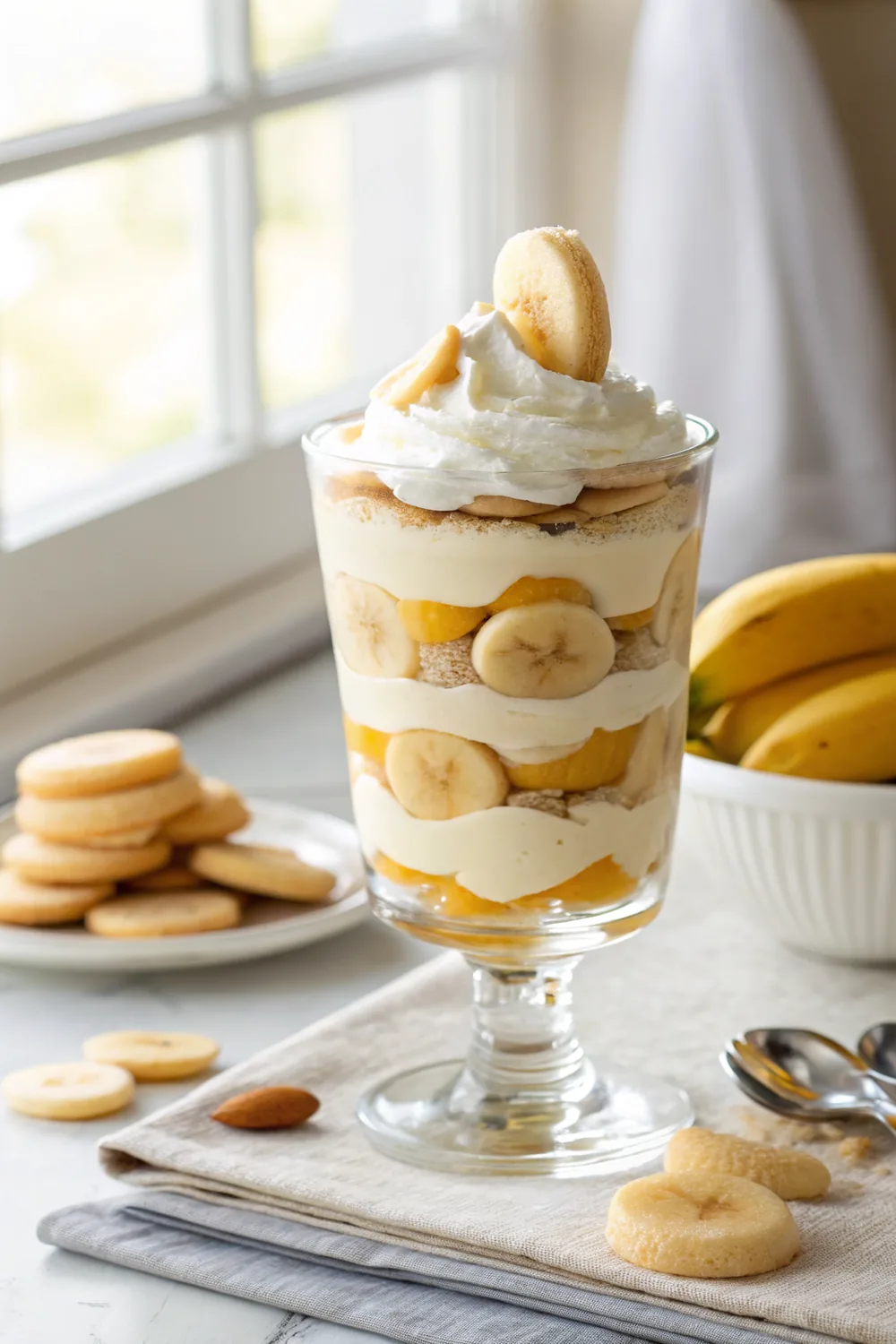
Chef Mia's banana pudding: scratch five-yolk custard, no instant mix, sealed bananas that never brown, and the 4-hour rest that turns wafers cake-like.
Quick answer: Banana pudding is layered, not baked: vanilla wafers, sliced ripe bananas, and real vanilla custard built up in a dish, chilled, and topped with whipped cream or meringue. The custard is the whole recipe, five egg yolks and cornstarch cooked into whole milk until it genuinely boils, with no instant mix anywhere near it. Assemble while the custard is still warm so it seeps into the wafers, seal every banana slice completely under custard so it cannot brown, then walk away. The pudding needs a minimum of 4 hours in the refrigerator, and it is honestly better at hour 12, when the wafers have softened into something close to vanilla cake. Whipped cream goes on before serving if you made it ahead; meringue only if you are serving the same day. About 35 minutes of work, 4 to 24 hours of waiting, and it feeds 12 people straight off a brisket.
Walk the dessert case at any serious barbecue joint in Central Texas and you will find the same short list: pecan pie, maybe a cobbler, and a deep steam-table pan of banana pudding with a ladle standing in it. Not a scoop, a ladle. Banana pudding is the dessert that gets served by the half pound after two hours of brisket and salt and smoke, because it is cold, creamy, and gentle in exactly the ways barbecue is not. It is also the dessert of every church potluck I attended growing up around Lockhart, where three different women would bring three different pans and everybody quietly kept score.
Here is where I lose some of those women: I do not use instant pudding mix, and I am not going to pretend the box version is the same dish. Instant mix sets by chemistry in cold milk and tastes like the idea of vanilla. Real custard, five egg yolks and cornstarch cooked in whole milk until it thickens and boils, tastes like eggs and cream and actual vanilla, and it costs you maybe twelve extra minutes at the stove. Twelve minutes. For the difference between a dessert and a decent one, I will stand at the stove.
The other thing this recipe takes seriously is time, because banana pudding is not finished when you finish making it. The dish goes into the refrigerator looking like cookies standing in pudding and comes out 4 to 24 hours later as something unified, the wafers softened into cake-like layers, the bananas perfumed all the way through the custard. That window, and how to keep the bananas from browning inside it, is most of what separates a great pan from a sad one, so we are going to walk through all of it honestly.
Real Custard or Nothing: Why the Instant Box Stays Shut
Let me be precise about what instant pudding mix is, because the box has fed a lot of good potlucks and it deserves an honest description rather than a sneer. Instant mix is pregelatinized starch and phosphate salts that set cold milk in five minutes without heat. It is a chemistry trick, and as chemistry it is genuinely clever. What it is not is custard. There are no eggs in it, no butter, and the vanilla is a flavoring that sits on top of the milk instead of being cooked into it.
Real banana pudding custard is a stirred creme patissiere loosened for spooning: egg yolks for richness and that faint eggy warmth that reads as old-fashioned in the best way, cornstarch for body, whole milk for the dairy backbone, butter and vanilla whisked in at the end for gloss and perfume. Cooked properly it tastes layered, sweet up front, dairy in the middle, vanilla and egg on the finish. The instant version tastes like the first note and then stops.
I want to be fair about shortcuts, because I am not a purist across the board. My peach cobbler with cake mix is a shortcut recipe I will defend in public: the mix is doing a job, the peaches carry the flavor, and the result is honestly delicious. Banana pudding is different, and the difference is exposure. In a cobbler the shortcut hides under fruit and butter. In banana pudding the custard is half the volume of the dish and touches every single bite. There is nowhere for a shortcut to hide, so the custard has to be worth eating by the spoonful on its own.
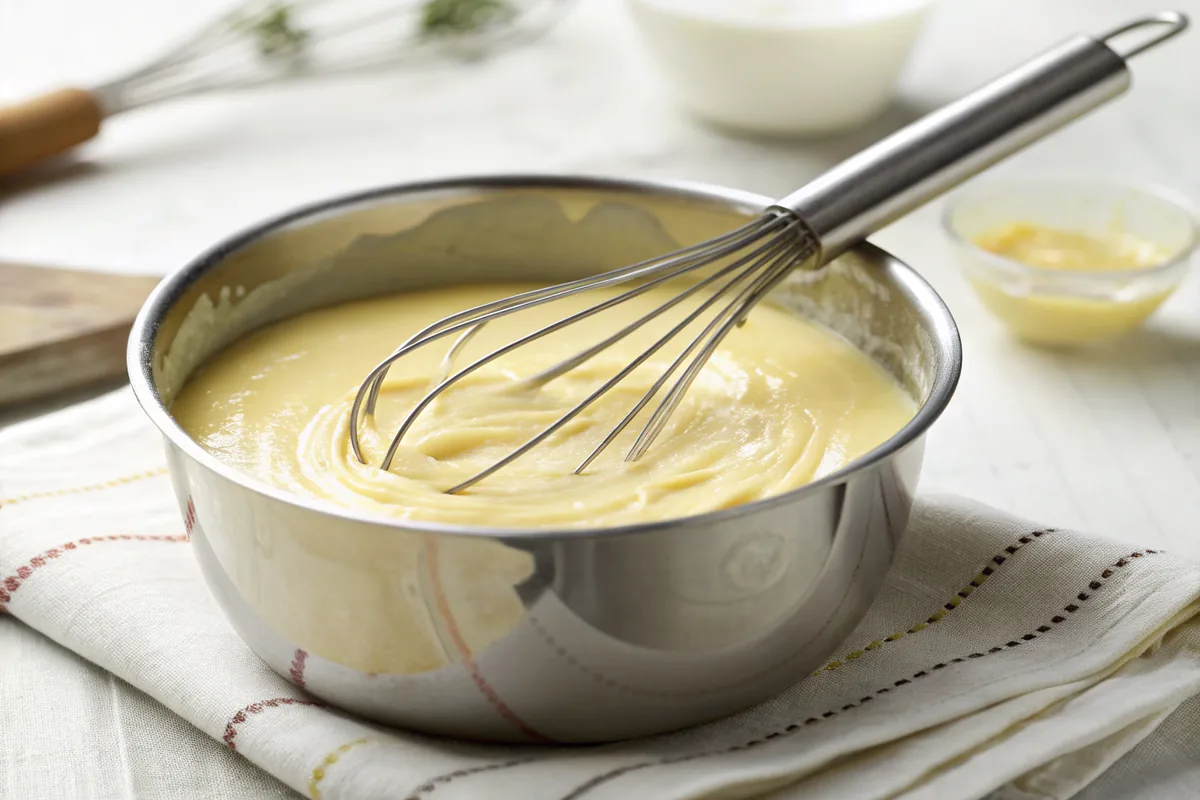
The technique has exactly one non-negotiable moment, and most failed scratch custards fail right there: the boil. Egg yolks carry an enzyme called alpha-amylase that eats starch, and it survives temperatures that already look thick in the pan. If you pull the custard the second it coats the spoon, the enzyme keeps working in the refrigerator and by morning your pudding has thinned back toward soup, right when the resting window matters most. The fix costs 90 seconds: bring the custard to a real, visible boil and hold it there, whisking, until you have counted well past sixty.
One more honesty checkpoint: cook-and-serve pudding mix, the kind you heat on the stove, splits the difference and makes a passable pan. If scratch custard is genuinely the barrier between you and making this dish, use cook-and-serve over instant every time. But try the yolks once. It is one saucepan, one bowl, and twelve minutes of whisking, and the first spoonful will settle the argument better than I can.
Bananas: Ripeness Is a Range, and Browning Is a Choice
The right banana for pudding is spotted: yellow peel scattered with brown freckles, flesh that smells loudly of banana at arm's length, still firm enough to slice clean. That is the moment when the starch has converted to sugar but the slice can still hold its shape under custard for a day. A green-shouldered banana tastes like packing material and never improves inside the dish. A fully browned, bread-banana specimen turns to paste when you slice it and ferments slightly by hour twelve.
Buy the bananas three or four days before you need them and let them ripen on the counter, because the store almost never sells them at pudding stage. If they are running ahead of schedule, the refrigerator is your pause button: the peel goes ugly and dark in the cold but the flesh underneath holds at its current ripeness for several days. Ignore the peel, trust the fruit.
Now the browning question, which deserves a straight answer instead of folklore. Cut banana browns because an enzyme in the flesh reacts with oxygen, the same reaction as a cut apple. That gives you exactly two levers: acid, which slows the enzyme, and coverage, which removes the oxygen. The internet leans hard on the lemon juice lever. I mostly do not, and here is why: a real toss in lemon juice, enough to matter chemically, is enough to taste, and a sour edge on the banana fights the custard instead of flattering it.
Coverage is the better lever, and this recipe is built around it. Every banana slice gets laid flat and then completely buried in warm custard, no edges peeking out, and the top layer of the dish is always custard, never fruit. Custard is thick enough to be a genuine oxygen barrier, and a slice sealed under it stays pale and clean-looking for a full 24 hours. Assembly order is your anti-browning strategy; the citrus is a rounding error next to it.
The corollary is the one rule people break for looks: never decorate the top of a make-ahead pudding with raw banana slices. Those exposed slices are the ones in every sad potluck photo, gray by serving time while the buried fruit underneath is perfect. If you want banana visible on top, slice one fresh banana at the table, the moment before it is served, and not one minute earlier.
Vanilla Wafers: The Load-Bearing Cookie
The wafer looks like the humblest thing in the dish and it is doing the most structural work. A vanilla wafer is essentially a dehydrated sponge cake, low in fat and baked hard, which is precisely why it performs here: it drinks custard by the layer, swells, and softens into something with real crumb instead of dissolving. A richer, more delicious cookie fails at this job. Shortbread goes greasy, graham crackers go to sand, and butter cookies turn into slick little rafts.
You need about 60 wafers, which is one standard box with a handful left over for the cook. Do not crush them for the layers; whole wafers create the distinct strata that make the finished scoop look and eat the way banana pudding should. Save the crushing for the garnish, where a scatter of crumbs over the whipped cream puts a bit of dry crunch back on top of a dish that is otherwise entirely soft.
If you feel like going full scratch, a homemade vanilla wafer is a simple drop cookie, butter, sugar, egg, flour, and a heavy hand with vanilla, baked until dry at the edges. I have done it, it is lovely, and I will still tell you the truth: inside the pudding, after twelve hours of soaking, the difference between homemade and store-bought wafers narrows to almost nothing. The custard is where scratch effort pays. The wafer is where the store earns its keep.
Chessmen-style butter cookies deserve a mention because a famous trifle-dish version of this dessert uses them, and plenty of Texans swear by it. It makes a richer, sweeter, more buttery pan, closer to cake and cream than to classic banana pudding, and the cookies never fully soften the same way. I make it maybe once a year for people who grew up on it. For the barbecue-joint pan this page is about, the plain wafer is correct.
Whatever cookie you choose, mind the edges of the dish. Wafers standing against the glass wall of a trifle bowl look beautiful but soften slower than buried ones, since only one face touches custard. If you line the walls for looks, press the cookies flat against the glass and give the dish the full 12 hours so the wall layer catches up with the interior.
Assembly: Build It Warm and Seal Every Layer
The single most useful assembly decision is temperature: layer the dish while the custard is still warm, about 15 minutes off the stove. Warm custard flows into the gaps between wafers, starts softening them immediately, and settles into a level layer without spreading and dragging. Fully chilled custard has already set; it sits on the cookies in stiff drifts, leaves air pockets, and never knits the layers together the same way. Warm, not hot: custard straight off the boil will slick the banana surfaces and make them weep.
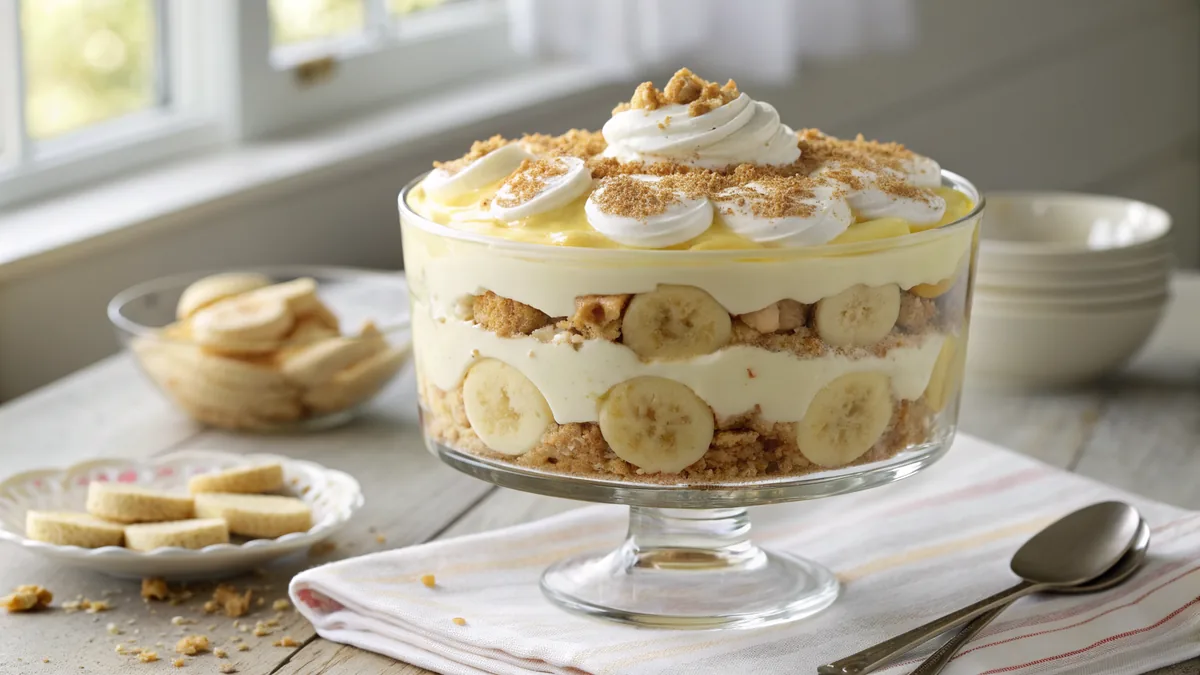
The architecture is three rounds of the same sequence in a 9x9 dish or a 3-quart trifle bowl: wafers in a single tiled layer, banana slices in a single flat layer, then a third of the custard spread to the edges. Start with a thin smear of custard under the first wafers so the bottom layer softens too, and end with custard on top, smoothed level. Resist the urge to double up the bananas in any one layer; stacked slices create wet pockets the custard cannot seal.
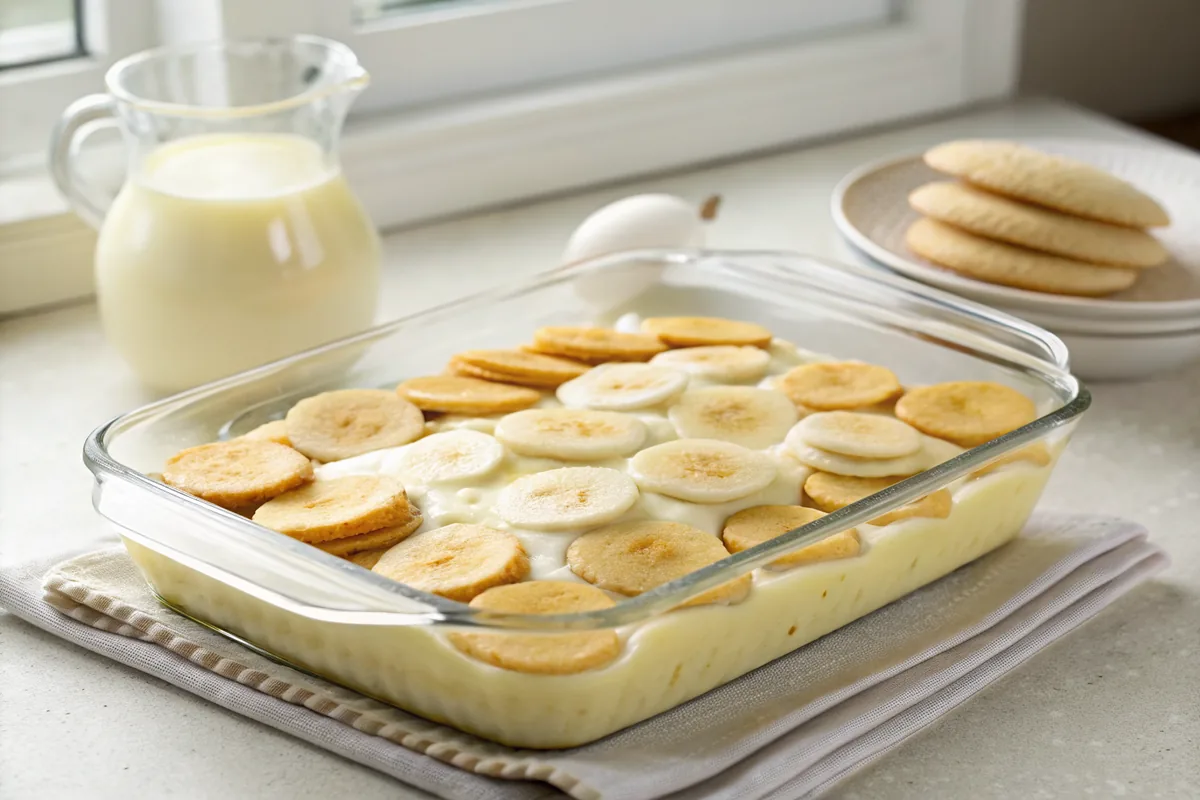
Spread each custard layer like you are frosting a cake, all the way to the walls, and check the perimeter. The failure point of most pans is the edge, where a banana slice touches the dish wall above the custard line and browns in the gap. Run your spatula around the border of every layer and let the custard ride slightly up the sides. The plastic wrap pressed directly on the finished surface does the same sealing job for the top.
Dish choice changes the eating more than people expect. A wide 9x9 gives you shallow layers and a higher wafer-to-custard ratio, cakier and easier to serve square-ish portions from at a potluck. A deep trifle bowl gives you dramatic strata and a wetter, softer spoonful. Both are correct; the trifle bowl just demands the longer end of the resting window because the center of a deep dish chills and softens slower.
Meringue or Whipped Cream: The Debate, Settled Honestly
The oldest banana puddings wore meringue, and the logic is right there in the recipe: the custard takes five yolks, the whites are sitting in a bowl looking at you, and thrift was a Southern kitchen commandment. Whipped with sugar, spread over the assembled pudding, and baked hot for a few minutes until the peaks toast, meringue is beautiful, nostalgic, and marshmallow-sweet against the custard. When it is good, it is the prettiest version of this dish that exists.
It is also the fussiest, and the fuss has a clock attached. Meringue starts weeping within hours, beading syrup on top and pooling liquid where it meets the custard, and the toasted crown slides greasily off the layers by the next day. There is no stabilizer trick that fully stops it. Meringue is a same-day topping, full stop, and since the pudding underneath demands hours of resting, a meringue pan forces you to bake the topping onto an already-chilled dish and serve within the afternoon.
Whipped cream surrenders the toasted drama and wins everything else. Heavy cream whipped to soft peaks with powdered sugar holds its texture, tastes like dairy instead of sugar foam, and its slight richness sits better against the lean wafers anyway. The powdered sugar is doing quiet double duty: its cornstarch fraction stabilizes the foam, so a properly whipped topping added at serving time looks the same at the end of the potluck as it did at the start.
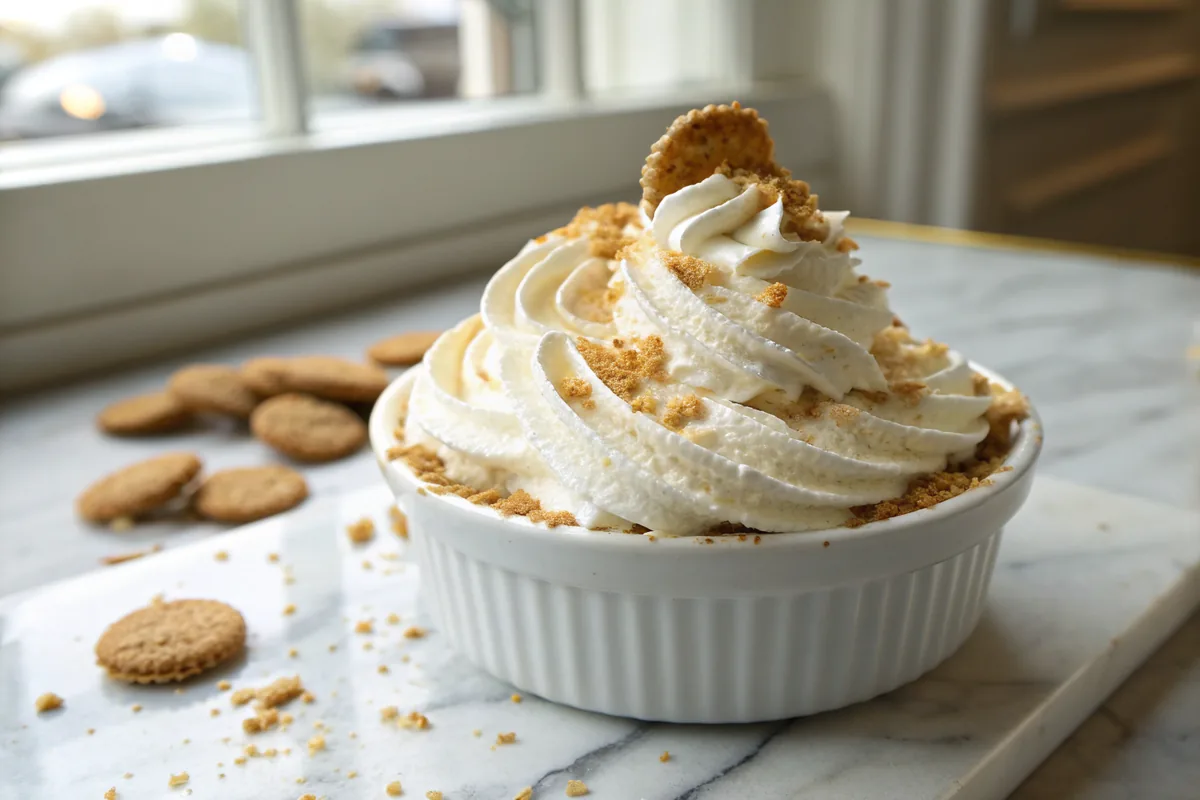
So here is the ruling, and it is about logistics, not taste: whipped cream if the pudding rests longer than a few hours or travels anywhere, which for me is nearly always. Meringue if you are serving the whole pan today, at home, and you want the showpiece; give the assembled pudding at least 4 hours of chill first, spread the meringue to touch the dish walls on every side so it cannot shrink back, and toast it in a 350F oven for 10 to 12 minutes just before folks sit down.
Whichever you choose, the timing rule is identical: the topping is a serving-day garment, not a storage blanket. A pudding that rests overnight rests naked under plastic wrap, and gets dressed at the last minute.
The 4-to-24-Hour Window: Where the Dish Actually Happens
Banana pudding straight from assembly is three ingredients sharing a dish. Banana pudding after a rest is one dessert, and the transformation is worth understanding because it tells you exactly when to make the pan. In the refrigerator, the wafers pull moisture out of the custard layer by layer, swelling and softening from the faces inward, while banana aroma compounds migrate outward until the custard itself tastes of the fruit. Neither process can be rushed with heat or shortcuts. Only time does it.
The timeline runs like this. At hour 2 the wafer edges have gone tender but the centers still snap; serve now and it eats like cookies and pudding, pleasant and unfinished. Hour 4 is the honest minimum, soft wafers with a last whisper of chew in the middle, layers starting to hold together on the spoon. Hours 8 through 16 are the peak, and this is the cake-like stage people chase: the wafers have the crumb of a soaked vanilla sponge, the custard has settled dense and silky, and a spoonful comes up in clean strata. By hour 24 the dish is still very good, just softer and quieter, the layers beginning to blur into one another.
Past 24 hours the slope turns down, gently at first. The bananas, even sealed, start to slacken and give up moisture, thinning the custard around them, and by day two the wafers have crossed from cake-like into pudding-logged. Day-two banana pudding gets eaten standing at the refrigerator with no complaints, but it is not what you serve company. This is a dessert with a peak, and the peak is roughly the twelve hours around midnight if you built the pan after supper.
That schedule is why banana pudding is one of the great make-ahead desserts in the Southern arsenal: the make-ahead is not a compromise, it is the recipe. It shares that quality with my coconut tres leches cake, its milk-soaked cousin from the other side of the Texas table, where the sponge likewise needs a long overnight drink before it becomes itself. If your menu already has you cooking all day, both of these desserts are the answer, done and improving in the refrigerator while you tend everything else.
Practical rhythm for a Saturday barbecue: cook the custard and build the pan Friday evening, rest it overnight, whip the cream Saturday just before serving. Total hands-on time on the day you are actually busy: five minutes. That, as much as the flavor, is why the dish never left the barbecue joint dessert case.
Gulf Ports, Church Ladies, and the BBQ Joint Dessert Case
Banana pudding reads as deeply Southern, which is funny for a dessert built around a fruit that does not grow within a thousand miles of a Texas smokehouse. The banana is a port story. When the fruit trade out of the Caribbean ramped up in the late 1800s, bananas poured into the Gulf ports, New Orleans above all, and Galveston and Houston took their share of the traffic. Rail lines ran the fruit inland fast and cheap, and the South, closest to the docks, got bananas earlier and cheaper than most of the country. Within a generation, an imported tropical fruit had become an everyday Southern staple.
The dessert followed the fruit almost immediately. Recipes for layered banana custards show up in American cookbooks by the 1880s, usually with sponge cake standing in for the not-yet-standard wafer. The cookie took over in the early twentieth century when boxed vanilla wafers became a pantry item, and by mid-century the recipe printed on the wafer box had done what recipes on boxes do: standardized the dish across several million kitchens at once. That is the version the potluck tables of my childhood inherited, minus the instant-mix shortcut that crept in later.
In Texas the dish put down two deep roots. The first is the church potluck and family reunion circuit, where banana pudding sits in the make-ahead pantheon next to buttermilk pie, both of them desserts built the night before by people who would be too busy feeding a crowd to bake on the day. The second is the barbecue joint, where it solved a specific problem: what do you serve for dessert out of a meat market with a pit and no pastry oven? Something assembled cold in a hotel pan, ladled into cups, and better on day two than day one. Banana pudding was not one candidate among many. It was practically the only answer.
It earned the permanent spot for reasons beyond logistics. After a tray of smoked meat, salt, fat, pepper bark, and smoke, the palate wants the opposite, and banana pudding is the exact photographic negative of barbecue: cold against hot, creamy against crusty, mild and sweet against salt and smoke. A little cup of it lands like a cool washcloth at the end of the meal. Pitmasters figured that pairing out decades before anyone wrote about menu theory.
If you want to see where the pan fits in the bigger family, my Texas desserts hub walks the whole table, the pies, the cobblers, the sheet cakes, and the ice creams that show up wherever brisket does. Banana pudding holds its seat in that lineup against far fancier company, which tells you most of what you need to know about it.
Serving It: After Brisket, at the Potluck, and What Goes Alongside
The classic service is the barbecue-joint cup: a few honest ladlefuls in a small cup, dug from the bottom of the pan so every serving carries wafer, banana, and custard together. At home, out of the 9x9, serve it the same way, one big spoon plunged to the dish floor. Surface-skimming servers get custard and cream and no structure, and they will come back confused about what the fuss is. Portion small; after barbecue, a modest cup is exactly right and the pan feeds twelve with ease.
Temperature matters more than garnish. Banana pudding wants to be served genuinely cold, straight from the refrigerator, because the chill is half of what it offers after a hot, heavy meal. If the pan has been sitting on a buffet an hour, park it over a dish of ice. The custard slackens and the whipped cream droops as it warms, and a lukewarm banana pudding loses the very contrast that earned it the job.
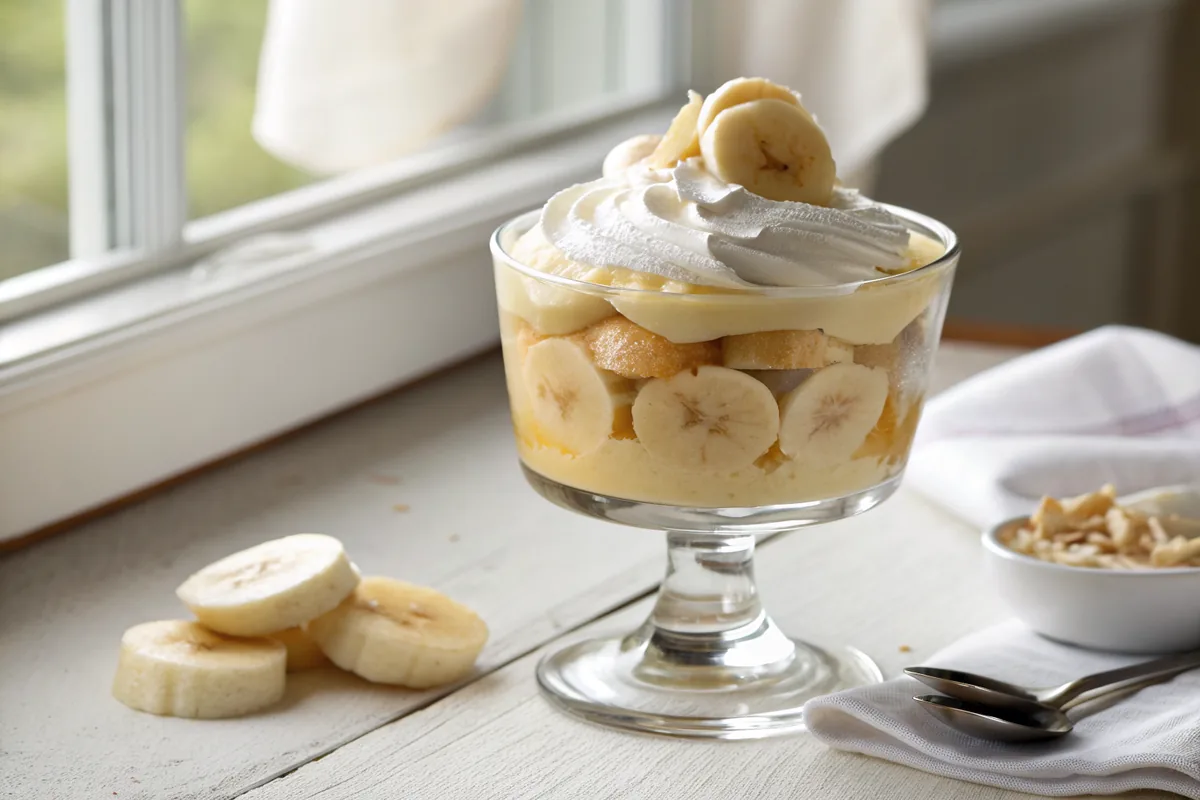
For a dinner-party plating rather than a potluck pan, layer the same components in individual glasses, one wafer round, banana, custard, twice over, and rest the glasses covered overnight. Same dish, but every guest gets the cross-section view, and the portions police themselves. Top each glass to order and lay one crisp reserved wafer on the cream so there is a dry, snappy bite against all that softness.
If you are composing a dessert plate, a small scoop of ice cream beside a cup of pudding is a genuinely great move, and my honey lavender ice cream is the one I reach for: the floral honey reads beautifully against banana and vanilla, and the icy scoop against the soft custard gives the plate two temperatures and two textures instead of one. For a bigger spread built around a smoker, I will put the pudding pan next to a peanut butter Texas sheet cake and let people agonize; peanut butter and banana is an Elvis-approved argument that settles itself on the plate.
One last serving note for travel: the pan rides to the potluck cold, topped with nothing, plastic wrap still pressed to the surface. The whipped cream travels separately in a covered bowl, or gets whipped on site in two minutes. Assembled-then-driven whipped cream arrives looking tired, and the whole point of doing this dish right is that it arrives looking better than the box versions on either side of it.
Mistakes That Ruin Banana Pudding
Pulling the custard before a true boil. Thick-looking is not done. The yolk enzyme survives until a real boil and will thin your custard overnight, exactly when the pudding is supposed to be peaking. Boil it, whisking, for a slow count of ninety.
Instant mix in a dish this exposed. The custard touches every bite and has nowhere to hide a shortcut. If scratch is truly off the table, cook-and-serve mix beats instant, but the five-yolk version costs twelve extra minutes and repays all of them.
Green bananas, or brown ones. Under-ripe fruit stays starchy and mute no matter how long the pan rests; over-ripe fruit slicks into paste and turns slightly boozy by hour twelve. Spotted yellow, firm to the knife-less test of a gentle squeeze, is the whole window.
Banana slices exposed to air. Every gray pan you have ever seen at a potluck broke the sealing rule. Bury every slice fully in custard, keep fruit away from the dish walls, end with a custard layer, and press plastic wrap onto the surface. Decorative raw banana goes on at serving time only.
Serving it too early. At hour one it is cookies standing in pudding. The dish needs 4 hours minimum and genuinely wants 8 to 16, when the wafers hit their cake-like stage. Build it the night before and the timing solves itself.
Topping it before the rest, or crushing the wafers into the layers. Whipped cream stored on the pudding overnight weeps and deflates, and meringue does worse; the pudding rests under plastic wrap and gets dressed the day it is eaten. As for the cookies, crumbs dissolve into sludge and erase the strata that make the dish. Whole wafers in the layers, crushed wafers on top of the cream, in that order, always.
Banana Pudding Recipe
Ingredients
- For the custard:
- 3/4 cup (150 g) granulated sugar
- 1/4 cup (30 g) cornstarch
- 1/2 teaspoon fine salt
- 5 large egg yolks
- 4 cups (960 ml) whole milk
- 3 tablespoons (42 g) unsalted butter, cut in pieces
- 1 tablespoon vanilla extract, or half extract and half paste
- For the layers:
- 11 oz (310 g) vanilla wafers, about 60 cookies
- 4 large ripe bananas (about 1 1/2 lbs / 680 g), spotted but not brown
- For the topping:
- 1 1/2 cups (360 ml) cold heavy cream
- 3 tablespoons (23 g) powdered sugar
- 1 teaspoon vanilla extract
Instructions
- Build the yolk base. Whisk the sugar, cornstarch, and salt together in a medium bowl so the starch cannot clump, then whisk in the egg yolks until the mixture is smooth, thick, and pale. It will look like too little liquid for the dry ingredients at first; keep whisking, it comes together into a paste and then a heavy cream texture.
- Heat the milk. Bring the whole milk just to a bare simmer in a heavy 3-quart saucepan over medium heat, until small bubbles ring the edge and the surface steams. Do not walk away; milk goes from steaming to boiled over in about a minute. Take it off the heat as soon as it is there.
- Temper the yolks. Ladle about a cup of the hot milk into the yolk mixture in a thin stream, whisking the whole time, then a second cup the same way. This raises the temperature of the yolks gently so they cannot scramble. Pour the warmed yolk mixture back into the saucepan with the rest of the milk, whisking as you go.
- Cook until it truly boils. Return the pan to medium heat and whisk constantly, reaching the corners of the pan. The custard will thicken at around 175F, but do not stop there. Bring it all the way to a lazy boil and hold it, still whisking, for a full 60 to 90 seconds. This step is not optional: it kills the yolk enzyme that would otherwise thin the custard back to soup during the overnight rest.
- Finish off the heat. Pull the pan off the burner and whisk in the butter and vanilla until the butter melts completely and the custard turns glossy. If you suspect any lumps or bits of cooked egg, pour it through a fine strainer into a bowl. Let it cool on the counter for about 15 minutes, whisking now and then, until warm but no longer hot.
- Slice the bananas. Peel the bananas and slice them into rounds a generous 1/4 inch thick, working just before you assemble so the cut surfaces spend as little time in the air as possible. Thinner slices vanish into the custard; thicker ones dodge the spoon. You want a slice that still announces itself in the finished bite.
- Layer wafers, bananas, custard. Spread a thin layer of warm custard over the bottom of a 9x9 baking dish or 3-quart trifle bowl. Cover it with a third of the wafers, then a third of the banana slices in a single layer, then a third of the remaining custard, spreading it so every banana slice is completely covered. Repeat twice more, ending with custard, and make sure the top surface is banana-free and fully sealed.
- Rest at least 4 hours. Press a sheet of plastic wrap directly onto the surface of the custard and refrigerate for a minimum of 4 hours, and up to 24. This is when the dish actually becomes banana pudding: the wafers drink custard and soften into cake, the banana perfume spreads, and the layers knit together. Do not shortcut it.
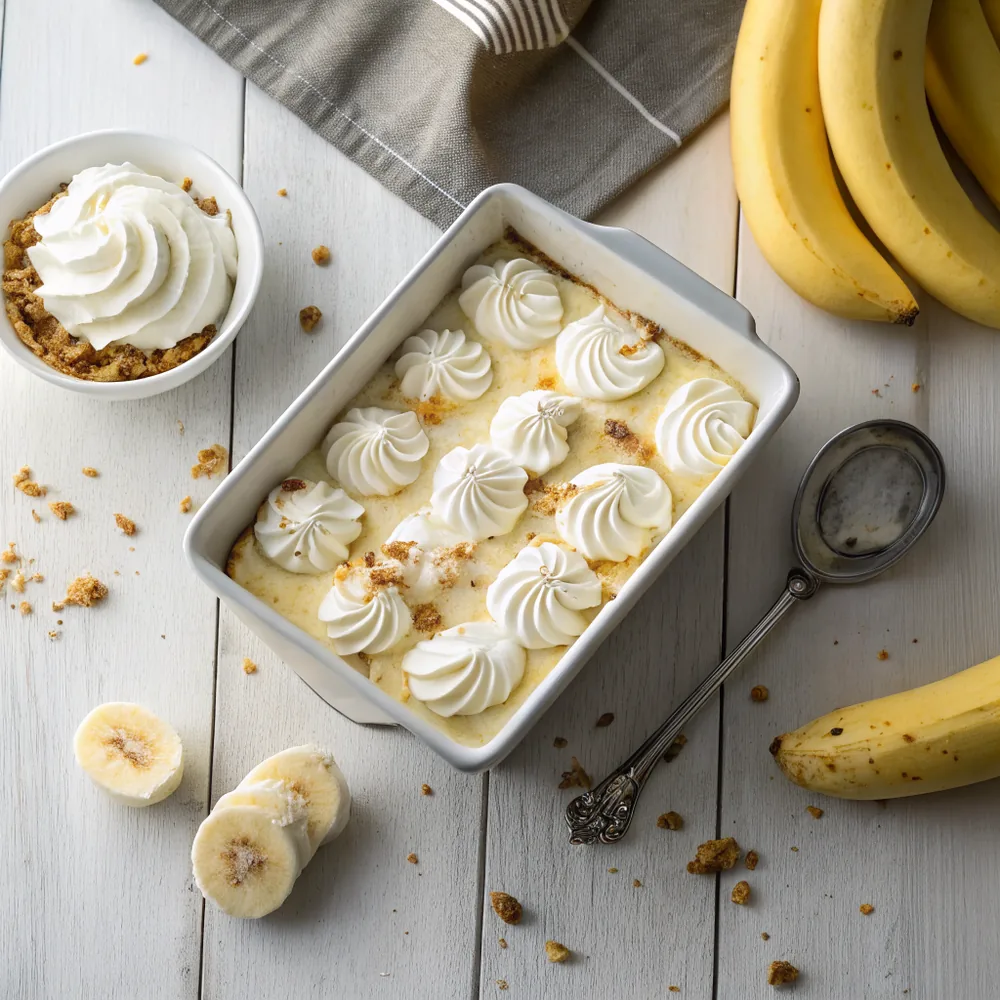
- Whip the cream and serve. Just before serving, whip the cold cream with the powdered sugar and vanilla to soft, cloud-like peaks that barely hold. Spread it over the pudding in swirls, scatter a handful of crushed wafers on top for crunch, and serve cold with a big spoon. Dig to the bottom of the dish with every serving so everyone gets all three layers.
Frequently Asked Questions
Can I use instant pudding mix for banana pudding?
You can, and it will be sweet and fine, but it will not taste like the barbecue-joint pan you are chasing. Instant mix sets cold milk with modified starch and contains no eggs, so it misses the rich, faintly eggy depth that defines real banana pudding custard. The scratch version needs one saucepan, five yolks, and about twelve extra minutes. If you must use a box, cook-and-serve mix comes noticeably closer than instant.
How do you keep bananas from turning brown in banana pudding?
Coverage beats lemon juice. Cut bananas brown when the flesh meets oxygen, so bury every slice completely in custard, keep fruit away from the dish walls, finish with a custard layer, and press plastic wrap directly on the surface. Sealed that way, slices stay pale for a full 24 hours. Skip heavy citrus, which makes the fruit taste sour, and never decorate the top with raw banana until the moment you serve.
Is meringue or whipped cream better on banana pudding?
Meringue is the traditional showpiece, made from the whites the custard leaves behind and toasted golden, but it weeps within hours and slides by the next day, so it only suits pudding served the same afternoon. Whipped cream holds its texture, travels well, and flatters the custard. The honest rule is logistical: whipped cream for any make-ahead or potluck pan, meringue only when the whole dish is being eaten at home today.
How long should banana pudding sit before serving?
A minimum of 4 hours in the refrigerator, and the sweet spot is 8 to 16. The rest is when the wafers absorb custard and soften into a cake-like layer, and when the banana flavor spreads through the whole dish. At one hour it eats like cookies floating in pudding. The easiest schedule is building the pan the evening before and serving it the next day, topping it with whipped cream at the last minute.
How ripe should bananas be for banana pudding?
Spotted but firm: a yellow peel freckled with brown, flesh that smells strongly of banana, and slices that hold a clean edge. That stage has the sugar of ripeness without the mush. Green-tinged bananas stay starchy and flavorless inside the dish, and fully browned ones smear into paste and can turn faintly fermented after the overnight rest. Buy the fruit a few days ahead and let it ripen on the counter to hit the window.
Can you make banana pudding the day before?
Yes, and you should; the overnight rest is when the dish becomes itself. Assemble the layers, seal every banana under custard, press plastic wrap onto the surface, and refrigerate up to 24 hours. Hold the topping separately and whip the cream just before serving. Past the 24-hour mark the pudding is still edible but sliding: the bananas slacken, the custard thins around them, and the wafers cross from cake-like into soggy.
Why did my banana pudding turn watery overnight?
Almost always an undercooked custard. Egg yolks carry an enzyme, alpha-amylase, that digests cornstarch, and it survives until the custard reaches a genuine boil. If you pulled the pan when it merely looked thick, the enzyme kept working in the refrigerator and thinned the custard by morning. Next time, bring it to a visible boil and whisk for a full 60 to 90 seconds. Overripe bananas releasing juice can add to the puddle, but the enzyme is the usual culprit.
Why do Texas BBQ joints serve banana pudding?
Logistics and contrast. A barbecue joint has a pit, not a pastry oven, and banana pudding is assembled cold in a hotel pan the day before, holds beautifully, and gets ladled into cups in seconds. It also happens to be the perfect ending to smoked meat: cold against hot, creamy against bark, mild and sweet against salt and smoke. Bananas reached Texas cheap and early through the Gulf ports, and the dish has been on the smokehouse menu more or less ever since.