Tex-Mex Recipes
Mexican Street Corn (Elote)
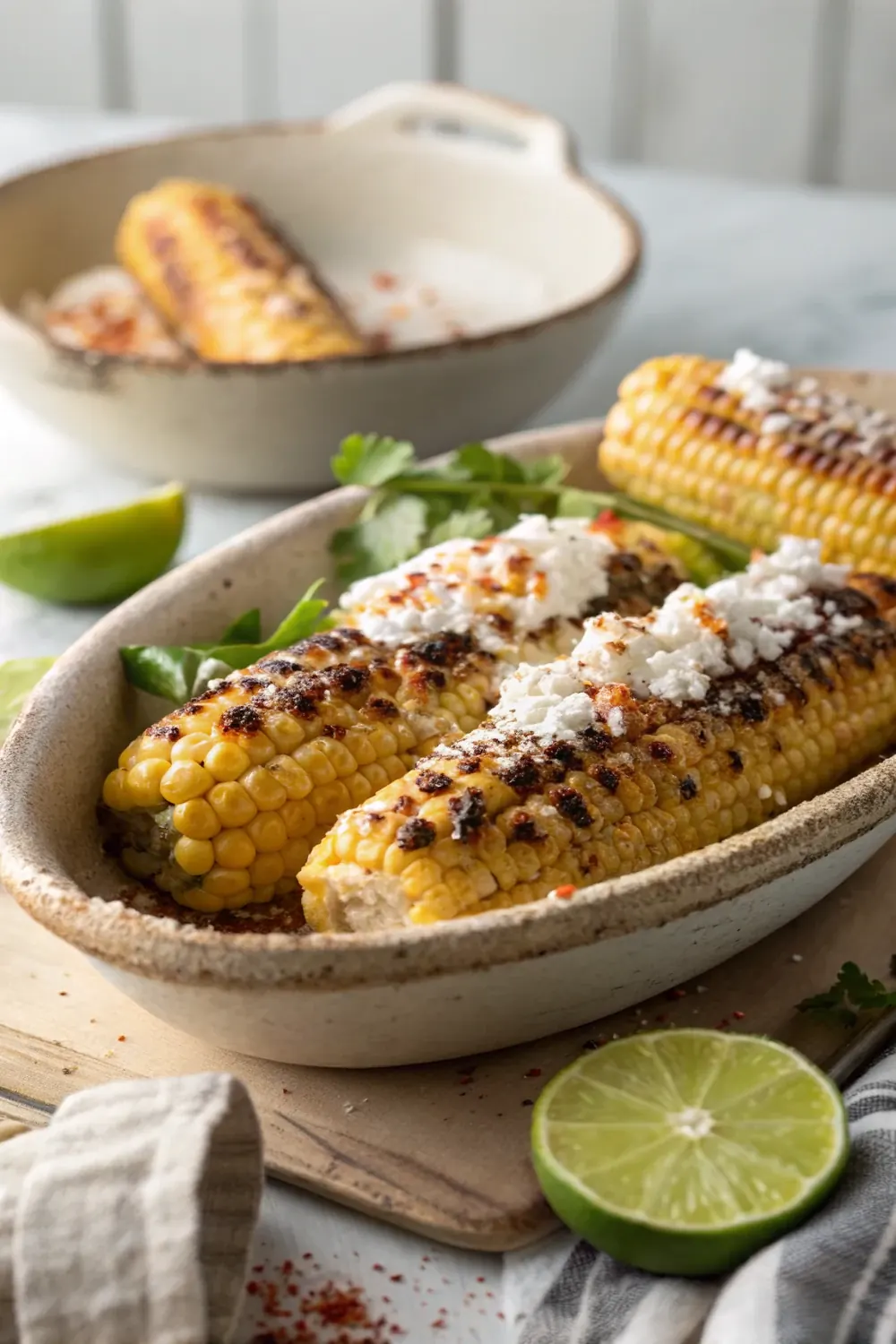
Chef Mia's elote: husked corn charred dry over direct flame, then rolled in mayo, crema, cotija, chile and lime. Plus the esquites cup version. 25 min.
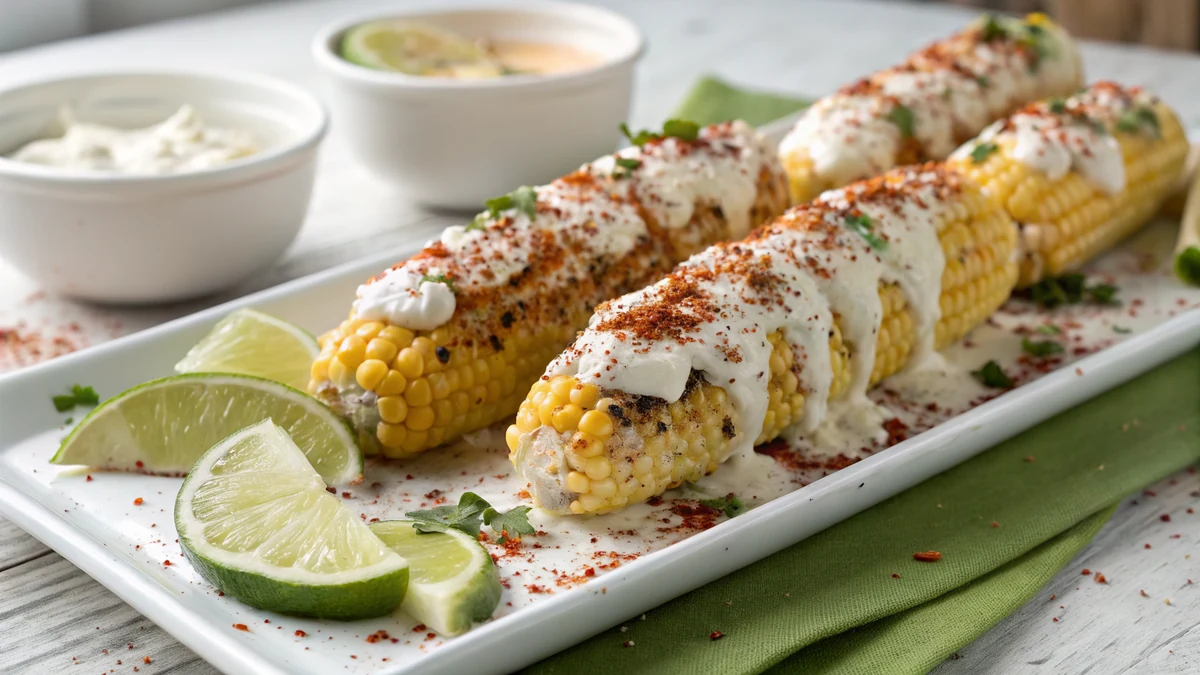
Quick answer: Mexican street corn, or elote, is corn charred naked over direct high heat and then coated in a mayonnaise and Mexican crema mixture, rolled in crumbled cotija, and finished with chile powder and lime. The method that separates real elote from buttered corn is the dry char: shuck the corn completely, put it straight over the hottest part of a grill or gas burner with no oil and no foil, and turn it every 90 seconds for about 10 minutes until roughly a third of the kernels are blackened. Those blackened kernels are a flavor, not a mistake. Coat the ears while they are still hot so the crema clings. Total time about 25 minutes. Cut the kernels off and stir everything together in a cup and the same dish becomes esquites, which is easier to serve to a crowd.
The first time I ate elote from a cart, I was in San Antonio near Market Square and I did not understand what I was looking at. A man pulled an ear of corn out of a steel pot, jammed a stick in the end, brushed something white on it, rolled it through a tub of crumbled cheese, dusted it red, and handed it over with a lime wedge. It was messy in a way that felt slightly aggressive. It was also one of the best things I had eaten that year.
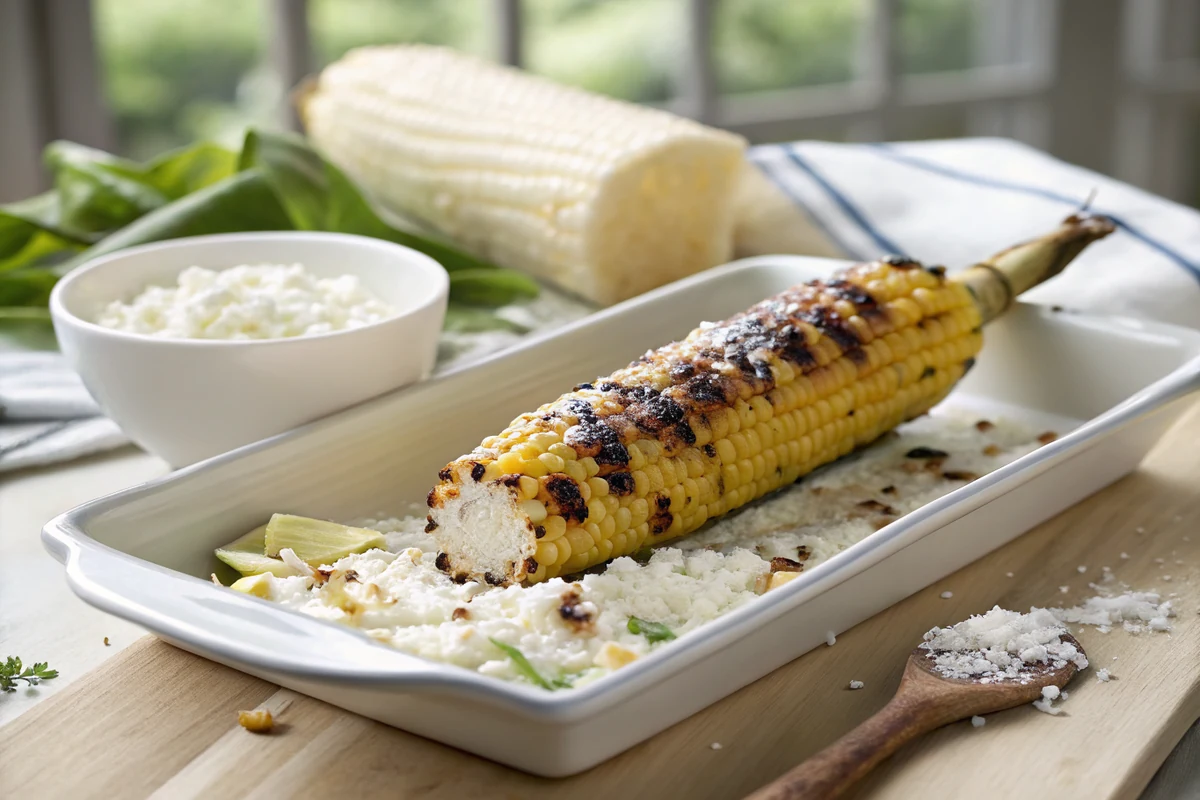
What surprised me most was the char. Cart elote is often boiled rather than grilled, but the grilled version I have chased ever since is defined by blackened kernels, and blackened is the correct word. Not golden, not lightly toasted. Genuinely black in patches, over maybe a third of the ear, which tastes bitter and smoky on its own and turns into something else entirely once the fat and acid land on it.
That is the thing most home versions get wrong. People treat elote as a topping applied to nicely cooked corn, and it is not; it is a char that gets balanced. If you grill your corn to a polite yellow and then add mayo and cheese, you get a rich, pleasant, slightly sweet side dish and you will not know what you missed. This page is about getting the char right first and then everything that goes on top of it, plus the cup version, esquites, which solves the fact that elote is genuinely difficult to eat politely.
The Dry Char Is the Whole Technique
Everything that makes elote taste like elote and not like a rich corn side dish happens in ten minutes over direct fire, before a single spoonful of crema touches it.
Shuck the corn completely. Husk-on grilling, foil wrapping, and soaking in water are all techniques for steaming corn, and they all produce sweet, tender, evenly cooked ears with no char whatsoever. They are legitimate methods for other dishes. They are wrong for this one, and the fact that they show up in half the elote recipes online is why so many home cooks think their version is close enough.
No oil on the corn. This is counterintuitive if you are used to oiling vegetables before grilling, and there are two reasons for it here. Oil dripping onto coals causes flare-ups that scorch unevenly and taste acrid rather than charred. And oil on the surface means the kernels fry in a thin film rather than making direct contact with hot metal, which produces a different, duller kind of browning.
The fire needs to be genuinely hot, 450 to 500F, which is hotter than most people grill vegetables. At a moderate temperature the corn simply dries out over twenty minutes, losing moisture without ever developing char, and you end up with tough, chewy kernels and no flavor payoff. Hot and fast is the entire approach.
Turn every ninety seconds, a quarter turn each time. Longer between turns and one face burns past useful char into ash. Shorter and no single face gets enough uninterrupted contact to blacken. Four turns over ten minutes gets you around the ear twice, which is about right.
How Much Char Is Right
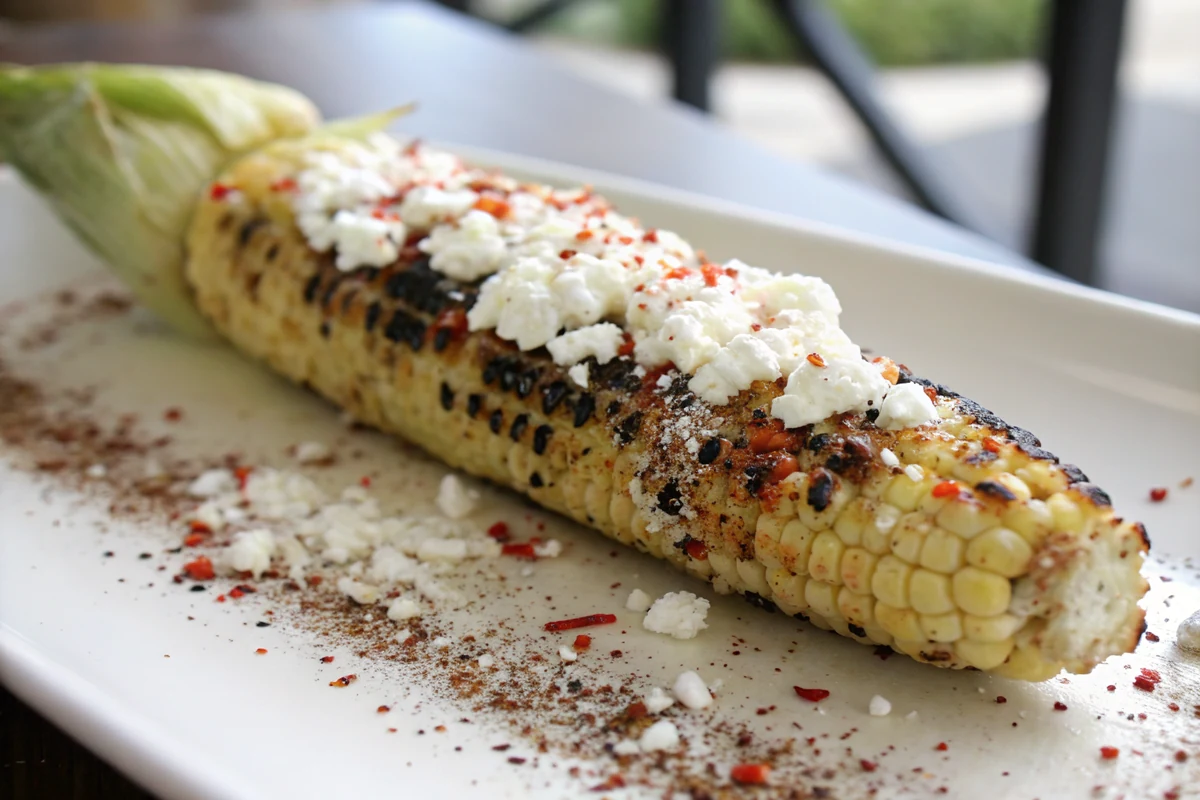
About a third of the kernels genuinely black, the rest deep golden and blistered. That is the target, and the first time you cook it to that point you will be convinced you overdid it.
You have not. A blackened corn kernel on its own tastes bitter and slightly acrid, which is exactly why the coating exists. The mayonnaise and crema bring fat that rounds bitterness off. The lime brings acid that cuts it. The cotija brings salt. Every element of the topping is calibrated against char, and if there is no char to balance, the topping has nothing to do but be rich.
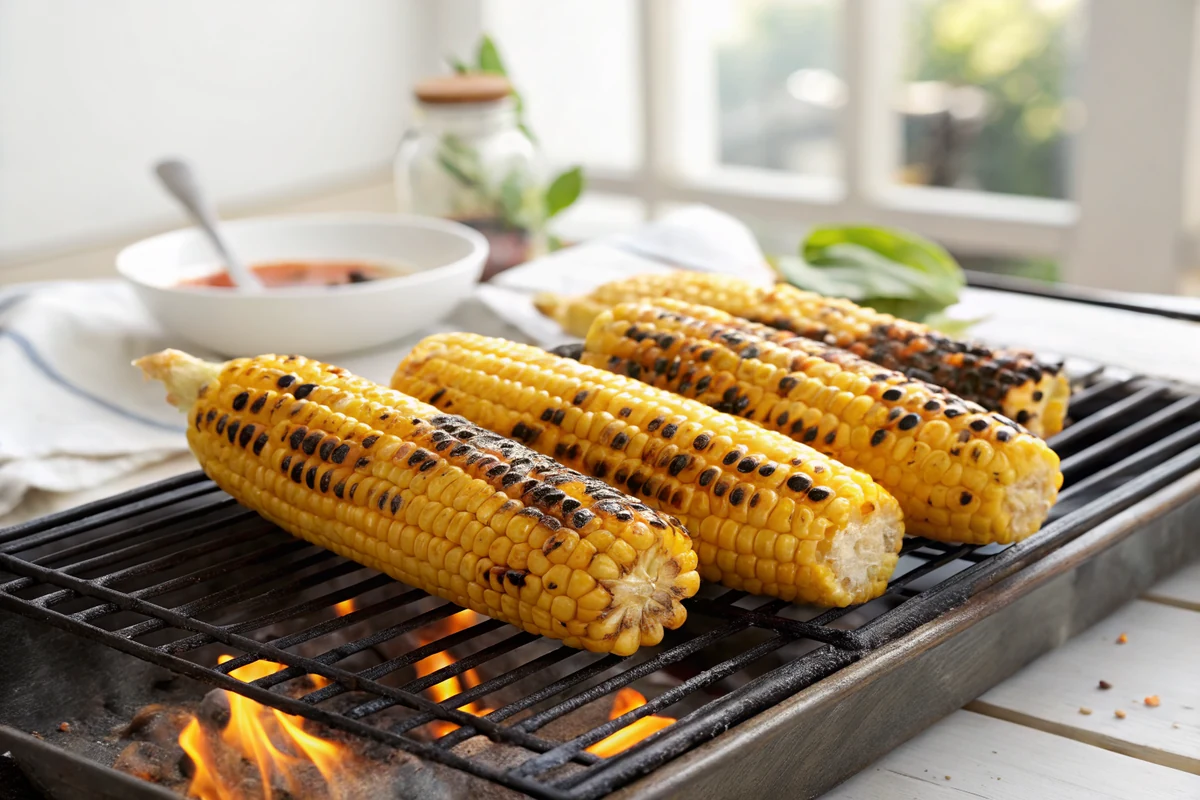
What you are avoiding is uniformity in either direction. An evenly blackened ear is burnt and tastes like it. An evenly golden ear is undercooked for this purpose. You want patches, because the contrast between a sweet golden kernel and a bitter black one within the same bite is a large part of what makes the dish interesting.
If you are cooking indoors, a gas burner works remarkably well. Set an ear directly on the grate over a high flame and turn it with tongs the same way. A cast iron grill pan preheated for eight minutes is the second-best indoor option. A broiler is the third and gives the least satisfying result, because radiant heat from above browns more than it chars.
Cotija, Crema, and What to Substitute
The three coating ingredients each do a specific job, and knowing what the job is tells you what can be swapped and what cannot.
Cotija is a hard, dry, salty aged Mexican cheese, and its function is salt plus a crumbly texture that sits visibly on the surface. Crumble it by hand into uneven pieces rather than grating it; grated cheese packs down into a paste and disappears into the crema. If you cannot find cotija, feta is the best substitute by a wide margin, though it is wetter and tangier. Parmesan is a distant third and reads as wrong, though it is better than nothing.
Mexican crema is a cultured cream, thinner and less sour than sour cream and less sweet than crème fraîche. Its job is to loosen the mayonnaise into something spreadable and to add a mild tang. Sour cream thinned with a tablespoon of lime juice is a perfectly good stand-in and is what I use when I do not have crema on hand.
Mayonnaise is doing the structural work and it is not optional. Its emulsified fat is what makes the coating cling to a hot ear of corn instead of running off. Recipes that replace it entirely with sour cream produce a coating that slides. Use full-fat; light mayonnaise has more water and breaks on hot corn.
For the chile, an ancho or guajillo powder gives a fruity, mild, deep red result. Tajin, the chile-lime-salt blend, is what a great many carts actually use and it is excellent here, though it adds salt so pull back on any additional salting. Plain cayenne is too hot and too one-dimensional; chili powder for chili is too cumin-forward.
Elote vs Esquites: Cob or Cup
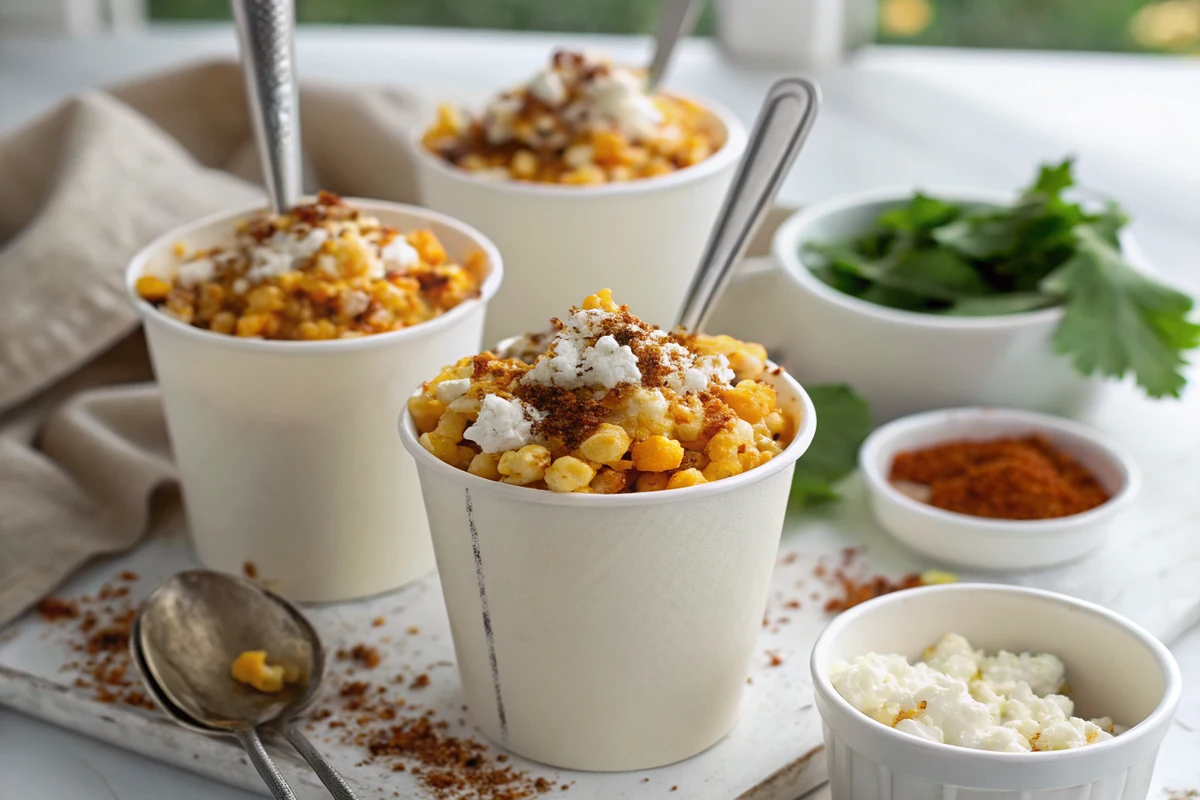
Esquites is the same dish with the kernels cut off and stirred together in a cup, eaten with a spoon. It is not a lesser version or a shortcut; it is the form most Mexico City carts sell more of, and for entertaining it is genuinely the better choice.
The practical case for esquites is simple. Elote on the cob is delicious and almost impossible to eat without wearing some of it. There is a reason it comes on a stick with napkins. If you are serving it at a party, on a plate, to people holding drinks, esquites solves a real problem.
There is also a flavor argument. Cutting the kernels off exposes far more surface area to the coating, so every spoonful has the full ratio of char, fat, salt, acid, and chile. On the cob, the coating sits on the outside of the kernel rows and the ratio varies bite to bite. Esquites is more consistent; elote is more dramatic.
The method is identical up to the char. Grill exactly as written, let the ears cool for three minutes so you can handle them, then stand each one in a large bowl and cut down the ear with a knife. The bowl catches the kernels, which otherwise scatter across the entire kitchen.
Traditional esquites often includes epazote and is sometimes served warm in its own broth. That is a legitimate and older version and worth seeking out. The one on this page is the charred, dry, mayo-and-cotija version that most people mean when they say esquites in Texas.
Corn Selection and Timing
Fresh corn in season, and this is a dish where that matters more than usual, because there is nowhere for a mediocre ear to hide.
Look for tight green husks, moist-looking silk that is brown at the tip but not dry all the way down, and a heavy feel for its size. Peel back a small window at the top and the kernels should be plump and tightly packed to the tip. Gaps or shriveled tips mean the ear is old or was picked underdeveloped.
Corn starts converting sugar to starch the moment it is picked, and the conversion is fast; an ear a week off the stalk is measurably less sweet than one picked that morning. Buy from a farm stand in season if you can, and if you buy at the grocery store, cook it the same day.
Frozen corn works for esquites and does not work for elote, for the obvious reason that it is not on a cob. For esquites, thaw and dry it thoroughly, then char it hard in a dry cast iron skillet over high heat in a single layer, letting it sit undisturbed for two minutes at a time. It gets genuinely close. Canned corn is too soft and too wet and I would skip it.
Off season, this is a dish worth waiting for. The window in Texas runs roughly May through August for local corn, which is conveniently also grilling season. Out of season you are better off making my buttered skillet corn, which is built for frozen or canned corn and does not depend on char.
The Three Corn Recipes and Which to Use
There are three corn dishes on this site and they get confused, so here is the plain distinction, because picking the wrong one for your situation is the main way people end up disappointed.
This page is elote: high, direct, dry char over open flame in ten minutes, then a rich coating balanced against that char. It is a grilling recipe and it needs fresh corn on the cob and a hot fire. Assertive, messy, and the best of the three when you have both.
My Texas Roadhouse corn copycat is the opposite approach: buttered, lightly sweet, cooked gently on the stovetop or in a slow cooker, no char at all. It works with frozen or canned corn, feeds a crowd from one pot, and suits people who do not want heat or tang. If you are cooking for kids or in January, that is the page.
My guide to smoking corn on the cob is a method page for low-and-slow corn at 225 to 250F, husks on for about an hour, and it includes a smoked street-corn variation as one application of that method. Smoked and charred are genuinely different: smoke is a low-temperature aromatic infusion over an hour, char is a high-temperature surface reaction in ten minutes. If your smoker is already running for a brisket, put the corn on it and use that page. If you want elote specifically, you want a hot grate, not a smoker.
Worth saying: you can absolutely char corn on a smoker if you can get it running hot, and plenty of people finish smoked corn over direct flame for the last few minutes. That hybrid is excellent and gives you both. It just takes an hour and a half rather than twenty-five minutes.
Serving It at a Cookout
Elote is a fantastic cookout side and a mildly awkward one to time, because it wants to be coated hot and served immediately, which is exactly when you are also plating everything else.
The move is to do the char early and hold. Grill all the corn twenty or thirty minutes ahead, leave the ears whole and uncoated on a sheet pan, and coat them right before serving after a two-minute return to the grill to bring the heat back. Reheated char is nearly as good as fresh char; a coated ear that has sat is noticeably worse.
Or go to esquites, which holds far better. Charred kernels cut off and held warm in a covered bowl can be dressed a few minutes before serving with no real quality loss, and the cups can be filled ahead. For anything over eight people, this is what I do.
It pairs naturally with the whole Tex-Mex spread. Alongside fajitas it is close to canonical, and the char echoes the grill marks on the meat. With crispy chicken tacos or puffy tacos it does the job a slaw would otherwise have to do. Set out queso blanco and chips and you have a party. A bowl of pico de gallo on the same table is the fresh counterweight to all that crema and cotija.
On a barbecue plate it works too, though be aware it is rich. Next to brisket I would serve it instead of, not alongside, another creamy side. Two mayonnaise-based dishes on one plate is a lot, and something sharp like pickled onions earns its place more.
Variations Worth Making
Bacon esquites. Render four strips of chopped bacon, char the corn kernels in the bacon fat in that same skillet, and fold the bacon back in at the end. It pushes the dish toward Texas and away from Mexico City, and it is extremely good.
Elote dip. Char the corn, cut the kernels off, and fold everything together with an extra two ounces of cream cheese, then bake at 375F for 20 minutes until bubbling. It is the same flavor set as a scoopable dip and it is one of the most reliably popular things I bring anywhere.
Swap the chile. Chipotle powder brings smoke and heat, which suits a grilled dish. Aleppo pepper is not remotely traditional and works beautifully, mild and fruity. A pinch of cayenne mixed into ancho gives you heat without losing the fruity base.
Add heat to the coating. A minced serrano or a spoonful of adobo sauce whisked into the mayo mixture spreads heat evenly rather than leaving it on the surface. Better for people who want the dish spicy rather than dusted with something spicy.
Lighter version. Replace half the mayonnaise with plain Greek yogurt. It holds together better than replacing all of it, the tang works with the char, and you keep enough emulsified fat that the coating still clings. This is the one substitution in the lighter direction I think genuinely works.
Mistakes That Ruin Elote
Grilling in the husk or in foil. This steams the corn and makes char impossible. If you want steamed corn, that is fine, but it is a different dish and the whole topping is calibrated against a char that will not be there.
Oiling the corn first. Causes flare-ups and produces frying rather than charring. The corn has enough moisture to survive a hot grate naked for ten minutes.
Too cool a fire. The most common problem. At 350F the corn dries out slowly and never blackens. You need 450 to 500F and you need to hear it sizzle when it lands.
Coating cooled corn. The crema will not adhere and most of it ends up on the plate. Coat within a minute of pulling the ears off, or reheat briefly first.
Grating the cotija. It compacts into a paste and disappears. Crumble by hand into uneven pieces.
Skipping the lime. The dish is mayonnaise, cream, cheese, and charred corn, and without acid it is heavy and flat by the third bite. Wedges on the table, squeezed at the last second.
Leaving silk on the ear. Corn silk burns to bitter black threads that stick to the coating and taste terrible. Run a hand down every ear after shucking.
Mexican Street Corn (Elote) Recipe
Ingredients
- For the corn:
- 6 ears fresh sweet corn, husks and silk removed completely
- For the coating:
- 1/2 cup (115 g) mayonnaise
- 1/3 cup (80 ml) Mexican crema (or sour cream thinned with 1 tablespoon lime juice)
- 2 garlic cloves, finely grated
- 1 tablespoon lime juice, plus wedges for serving
- To finish:
- 1 cup (110 g) cotija cheese, crumbled fine
- 2 teaspoons chile powder such as ancho or guajillo, or Tajin
- 1/2 teaspoon smoked paprika
- 1/4 cup chopped fresh cilantro
- Kosher salt, to taste
- 6 wooden skewers or corn holders, optional
Instructions
- Shuck the corn completely. Pull off every scrap of husk and silk. Do not soak the corn, do not leave the husk on, and do not wrap anything in foil. Every one of those techniques steams the corn, and steamed corn cannot char. Run your hand down each ear to catch the last silk strands, which will burn to bitter threads if you leave them.
- Get the grill genuinely hot. Build a hot direct fire, 450 to 500F, or set gas burners to high and preheat 10 minutes with the lid down. You want the grate hot enough that the corn sizzles audibly on contact. A moderate fire will dry the corn out over 20 minutes without ever charring it, which is the most common failure.
- Mix the coating while the grill heats. Whisk the mayonnaise, crema, grated garlic, and lime juice in a wide shallow dish, one long enough to roll an ear of corn in. Grate the garlic on a microplane rather than mincing; you want it dissolved into the sauce with no raw chunks. Taste and add a pinch of salt.
- Char the corn dry. Put the naked ears directly on the hot grate with no oil at all. Oil causes flare-ups and fries the surface instead of charring it. Turn every 90 seconds for about 10 minutes total, rotating a quarter turn each time, until roughly a third of the kernels across the ear are blackened and the rest are deep golden and blistered.
- Judge the char, not the clock. You are looking for genuinely black kernels in patches, not an even tan. Individual kernels should look collapsed and blistered where they caught the fire. If your corn is uniformly golden after 10 minutes, the grill is not hot enough; move the ears over the hottest spot and give them 3 more minutes.
- Coat while blazing hot. Take the corn straight from the grill to the dish of coating and roll each ear, using a spoon to work the sauce into the gaps between kernel rows. Heat is what makes the crema cling and melt slightly into the surface. Corn that has cooled for even five minutes sheds the coating onto the plate.
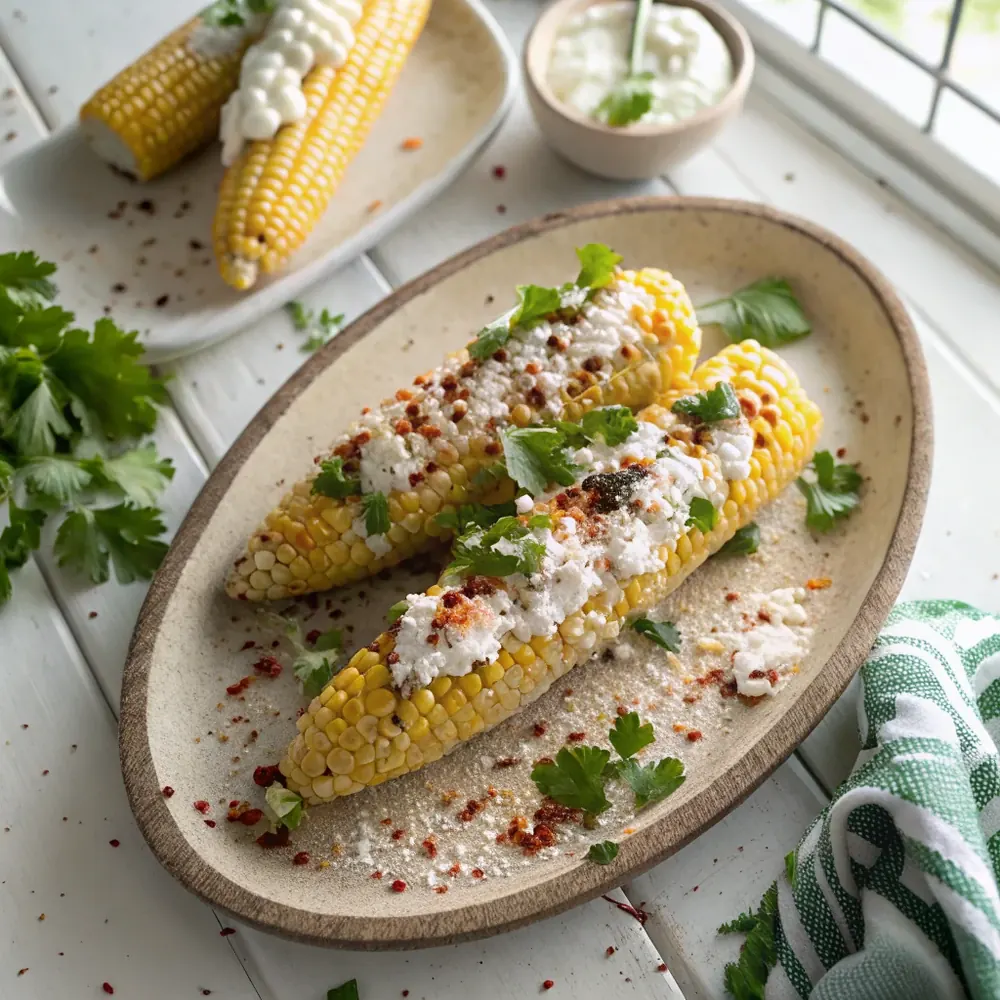
- Roll in crumbled cotija. Spread the crumbled cotija on a plate or shallow tray and roll each coated ear through it, pressing lightly so the cheese adheres in a thick, uneven layer. Crumble it by hand rather than grating; grated cheese compacts into a paste and vanishes into the sauce instead of sitting on it in visible crumbles.
- Dust with chile and finish. Dust each ear with the chile powder and smoked paprika from a height so it lands evenly, then scatter the chopped cilantro over the top. Push a skewer into the base of each ear if you want a handle. Do not skip the dusting; the chile is what pulls the whole thing back from being simply rich.
- Serve immediately with lime. Serve hot with lime wedges and let people squeeze their own. The squeeze at the table is the last balancing act and it should happen seconds before eating, since lime juice sitting on the coating for ten minutes goes flat and starts to thin the crema.
- For esquites, cut and stir. To make the cup version instead, char the corn the same way, let it cool 3 minutes, then stand each ear in a bowl and cut the kernels off with a downward stroke. Stir the hot kernels together with the coating, cotija, chile, cilantro, and lime, and serve in cups with spoons. Same flavors, far easier to eat and to serve to a crowd.
Frequently Asked Questions
What is Mexican street corn?
Mexican street corn, or elote, is corn charred over direct high heat and then coated in a mixture of mayonnaise and Mexican crema, rolled in crumbled cotija cheese, and dusted with chile powder and lime. It is sold from carts across Mexico and in Texas cities, usually on a stick. The defining element is the char: roughly a third of the kernels should be genuinely blackened, and the rich coating exists to balance that bitterness.
What is the difference between elote and esquites?
Elote is served on the cob, esquites is the same dish with the kernels cut off and stirred together in a cup, eaten with a spoon. The flavors are identical. Esquites is easier to serve and to eat, and gives a more consistent ratio of coating to corn in every bite, which makes it the better choice for a crowd. Elote is more dramatic and considerably messier.
Should you grill corn in the husk for elote?
No. Husk-on grilling, foil wrapping, and soaking all steam the corn, which produces tender kernels with no char at all. Elote needs the corn shucked completely and placed naked on a hot grate so the kernels make direct contact with the metal and blacken. Steamed corn under an elote topping is a rich side dish, but it is not elote.
What cheese is used on Mexican street corn?
Cotija, a hard, dry, salty aged Mexican cheese. Crumble it by hand into uneven pieces rather than grating, since grated cheese compacts into a paste and disappears into the coating. Feta is the closest substitute if cotija is unavailable, though it is wetter and tangier. Parmesan is a distant third and reads noticeably wrong.
Can you make elote without a grill?
Yes. A gas burner works well: set the shucked ear directly on the grate over a high flame and turn it with tongs every 90 seconds. A cast iron grill pan preheated for eight minutes is the next best option. A broiler is the weakest choice, since radiant heat from above browns the surface more than it chars it, but it still beats boiled corn with topping.
Can you use frozen corn for street corn?
For esquites, yes. Thaw and dry it thoroughly, then char it hard in a dry cast iron skillet over high heat in a single layer, leaving it undisturbed for two minutes at a time so it blackens rather than steams. It gets genuinely close to the fresh version. Frozen corn obviously cannot be used for elote on the cob, and canned corn is too soft and wet for either.
What can I use instead of Mexican crema?
Sour cream thinned with a tablespoon of lime juice is a very good substitute and what I use when crema is not available. Do not replace the mayonnaise, though; its emulsified fat is what makes the coating cling to hot corn, and versions built on sour cream alone slide off onto the plate.
How is street corn different from smoked corn?
Char and smoke are different reactions. Elote uses high direct heat, 450 to 500F for about ten minutes, to blacken the kernel surface. Smoked corn runs at 225 to 250F for about an hour, usually husks on, to infuse aroma without any surface char. You can combine them by finishing smoked corn over direct flame, which takes about an hour and a half and gives you both.