Southern Comfort Food
Sweet Potato Casserole
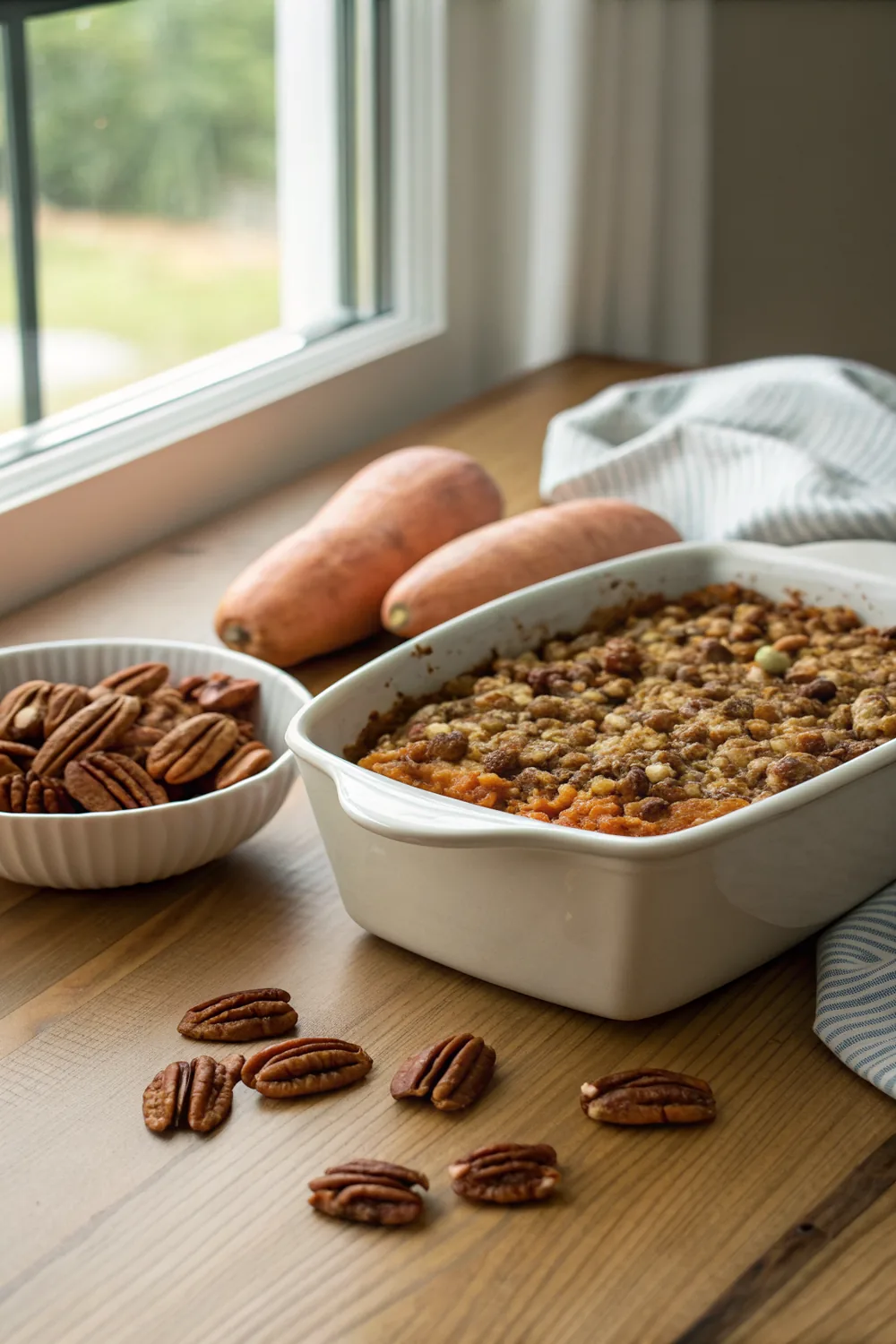
Chef Mia's sweet potato casserole: roasted, not boiled, bound with two eggs, and finished with pecan streusel or marshmallows. The side dish, not a pie.
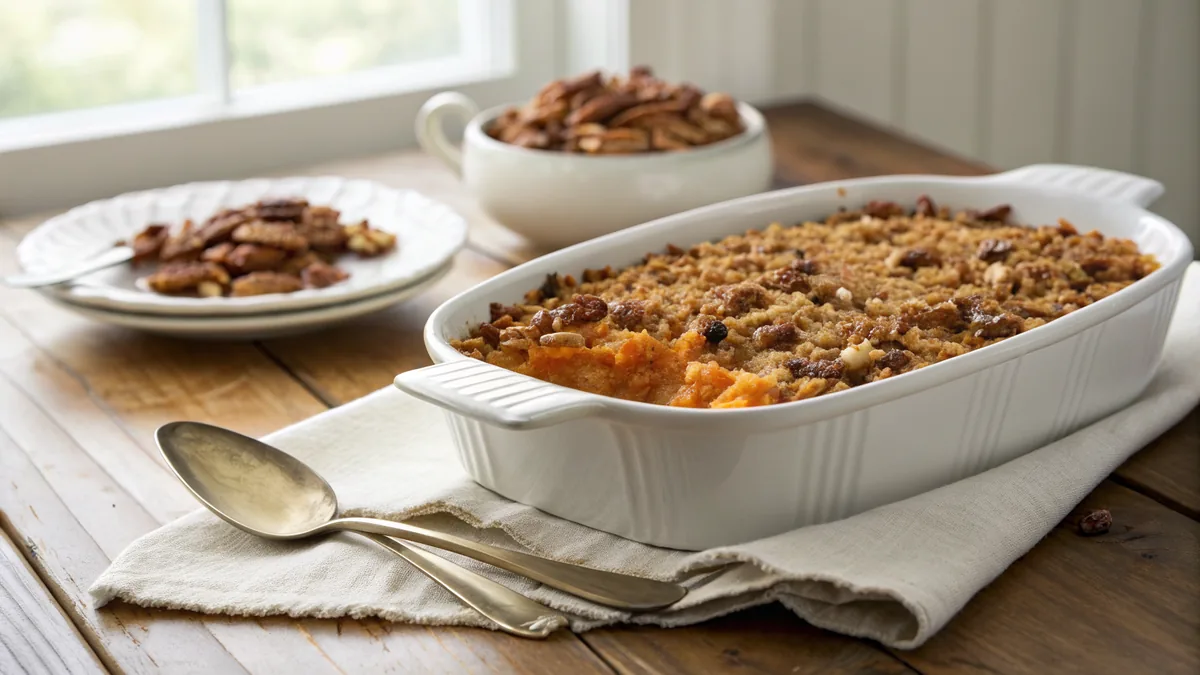
Quick answer: Sweet potato casserole is a baked side dish, not a dessert: about 4 pounds of sweet potatoes roasted whole until the skins blister and the sugars concentrate, mashed with butter, brown sugar, two eggs, and warm spice, spread in a 9x13 dish, then topped with either a pecan streusel or marshmallows and baked at 350F for 30 to 35 minutes. Roasting rather than boiling is the decision that separates a good casserole from a watery one, because a boiled sweet potato absorbs water it then has to give back in the oven. The two eggs matter as much: they set the mash into something that holds a spoon mark instead of slumping. If you are using marshmallows they go on for the last 8 to 10 minutes only, or they melt into a flat sugar sheet. It assembles two days ahead and it belongs on the table with the turkey, not after it. Serves 10 to 12 as a side.
Let me settle the argument in the first paragraph, because it comes up every single November: sweet potato casserole is a side dish. It goes on the plate at the same time as the turkey, the dressing, and the green beans, and it gets eaten with them. It is sweet, yes, and it has marshmallows on it half the time, and it is still a side dish, in the same way that cranberry sauce and honey-glazed carrots are side dishes. Nobody serves it with a fork and a coffee at the end of the meal.
That distinction matters more than it sounds, because it changes how you build the thing. A sweet potato pie is a custard: sweet potato, eggs, evaporated milk, sugar, set firm enough to slice and hold a clean edge in a crust. A casserole is a mash: looser, chunkier if you want it, seasoned to sit next to gravy rather than to follow it. If you build a casserole like a pie filling you get something cloying that fights everything else on the plate, and if you build a pie like a casserole it will not slice. Same vegetable, two entirely different jobs.
My version comes out of a lot of Novembers spent trying to make the dish less sweet without making it dull, and the answer turned out to be in the cooking method rather than the sugar bowl. Roast the sweet potatoes whole, in their skins, until they are collapsing and caramel is bubbling out the ends. That single change concentrates the potato's own sugar so hard that you can cut the added brown sugar almost in half and end up with something that tastes more, not less, like sweet potato. Then pick your topping and let the family fight about it, which is half the tradition anyway.
Casserole, Souffle, or Pie: Getting the Categories Straight
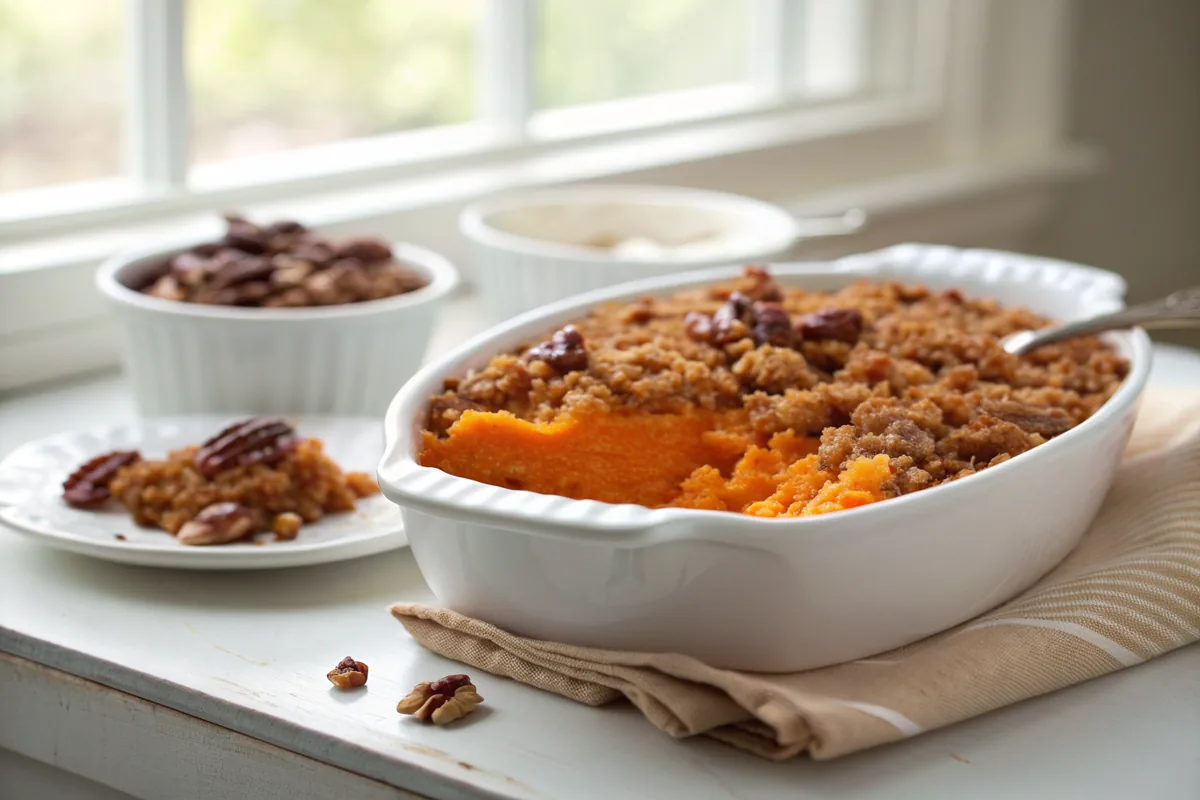
Three dishes share the same vegetable and get confused constantly, so here is the map. A sweet potato casserole is a mash: cooked sweet potato loosened with butter and dairy, sweetened moderately, bound with egg, spread in a wide shallow dish, and topped with something crunchy or something toasted. It is served hot with the main course and eaten with a serving spoon.
A sweet potato souffle, at least the Southern restaurant version, is the same thing with more egg and more air, sometimes with the whites whipped separately, baked in a deeper dish so it rises. The line between the two is genuinely blurry and half the recipes labeled souffle in Texas church cookbooks are casseroles with ambition. I do not lose sleep over the distinction.
A sweet potato pie is a different animal entirely. It is a custard: the puree is thinned with evaporated milk or cream, loaded with enough egg to set firm, poured into a pastry crust, baked until just barely jiggly at the center, and then cooled completely so it slices. It is a dessert, served at room temperature or cold, usually with whipped cream. My buttermilk sweet potato pie is the tangy Southern version of that custard, and my double crusted sweet potato pie is the showpiece with a woven lattice top. Neither of them is what you want in a 9x13 dish next to the turkey.
The practical consequence is about ratios. This casserole has 6 cups of sweet potato flesh and two eggs, which is barely enough to set it. A pie filling for a single 9-inch crust runs closer to 2 cups of puree with three eggs and a can of evaporated milk, four times the egg-to-potato ratio, because it has to stand up as a slice. Swap the recipes and you will get a pie that never firms up and a casserole with the texture of a cold quiche. Cook the one you actually want.
Roast, Never Boil: The One Decision That Matters
Most sweet potato casserole recipes tell you to peel, cube, and boil the potatoes, and this is the reason so many casseroles come out watery, pale, and needing a cup of sugar to taste like anything. A sweet potato dropped in boiling water absorbs water. It also leaches sugar and water-soluble flavor into the pot, which you then pour down the drain. You have made the potato blander and wetter in one step, and every subsequent step is compensation for that.
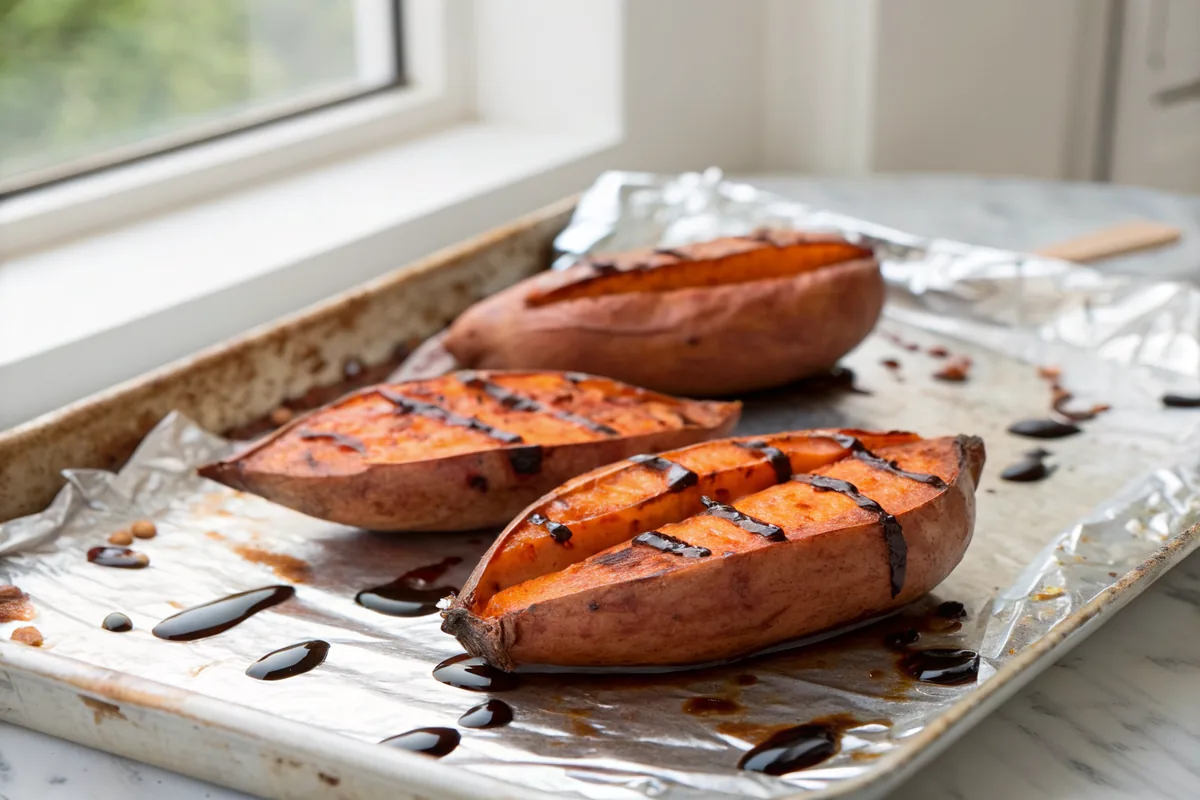
Roasting does the opposite on both counts. Dry heat drives moisture out rather than in, concentrating everything left behind. More importantly, a sweet potato held at temperature for an extended stretch converts a significant portion of its starch into maltose through the action of its own amylase enzymes, which stay active up to about 170F. The longer that window, the sweeter the potato gets on its own. That dark syrup weeping onto the foil is literally the potato's own caramelized sugar, and a boiled potato never makes any of it.
This is why my recipe uses a third of a cup of brown sugar in the base where many call for a full cup. The potato is already doing the sweetening. If you roast properly and then add a cup of sugar on top of it, you get candy. Start low, taste the base before the eggs go in, and add more only if your particular potatoes were bland. Late-season storage potatoes in February are noticeably less sweet than fresh-dug ones in October and may want a little help.
One shortcut worth knowing: if the oven is jammed, you can microwave the potatoes whole for 10 to 12 minutes and then finish them in a 425F oven for 20 minutes to get some of the caramelization. It is not as good as the full roast, but it is far better than boiling, and on Thanksgiving morning the oven is the scarcest resource in the house.
The Marshmallow Question, and Where It Actually Came From
The marshmallow topping is not a folk tradition and it is not old Southern cooking. It is an advertisement. In 1917 the Angelus Marshmallows company commissioned a booklet of recipes to sell more marshmallows, and one of those recipes, developed by Janet McKenzie Hill of the Boston Cooking School, paired them with mashed sweet potatoes. It worked spectacularly. Within a couple of decades the combination had embedded itself in the American holiday table so thoroughly that most people assume it came over on a wagon.
Knowing that it started as marketing does not make it wrong, and I want to be clear about that. Toasted marshmallow over sweet potato is genuinely good: the top browns into something with real caramel bitterness, the interior goes molten, and the textural contrast against the dense mash is the entire appeal. Children who will not touch a vegetable will eat this. That is worth something on a day built around getting a lot of people fed and happy.
What I object to is the compound sweetness. If you have already put a cup of sugar in the base, then covered it in marshmallows, you have made a dessert and put it next to the gravy. The fix is exactly what this recipe does: pull the sugar way down in the base so that the topping is providing the sweetness rather than doubling it. A restrained base under a marshmallow lid is a dish that works on a dinner plate.
Technique matters here more than anywhere else in the recipe. Marshmallows go on for the last 8 to 10 minutes only, on a casserole that is already hot and set. Put them on at the start and they melt completely, flow into the corners, and bake into a flat, hard sugar sheet with no puff and no contrast. And if you are tempted to finish them under the broiler, stand at the oven door with the light on and do not walk away. The window between golden and carbonized is under a minute.
The Pecan Streusel Camp
The other topping is a brown sugar and pecan streusel, and in Texas this is the version I make more often, for the obvious reason that we grow the pecans. The pecan is the state tree, the state nut, and the state pie, and putting a cup of them on top of a sweet potato dish is not a stretch here, it is default behavior.
A streusel works differently from marshmallow. Instead of a soft, sweet lid it gives you a crisp, sandy, buttery crust with real toasted-nut bitterness underneath the sugar. That bitterness is what makes it a better partner for a savory plate: it stops the dish reading as candy. The flour is what makes it a streusel rather than just sugared nuts, binding the crumbs into clusters that hold together when a spoon goes through.
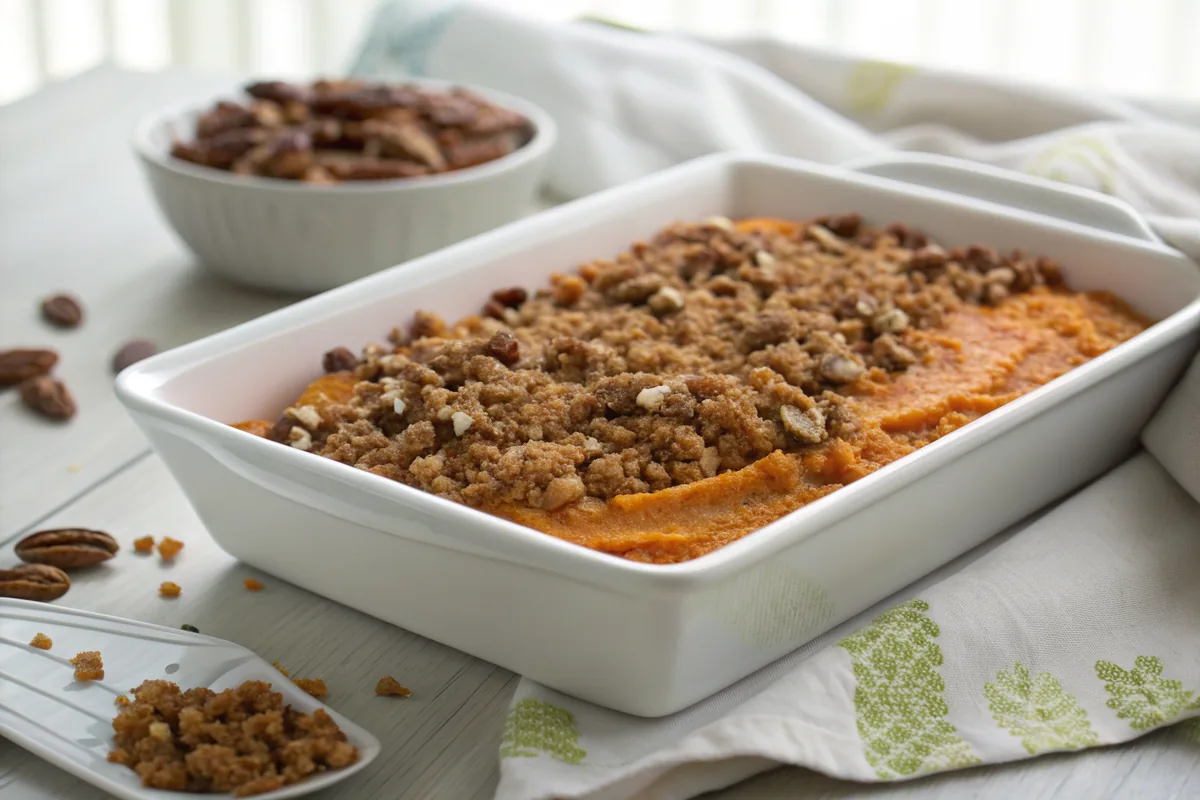
The technique is the same as any crumble topping: cold butter, worked in with fingertips only until it looks like coarse gravel with some larger lumps, never worked to a paste. Warm butter smears rather than crumbles and you end up with a solid greasy layer instead of a crust. If your kitchen is warm, cube the butter and put it back in the refrigerator for ten minutes before you start. The same rule governs any streusel-topped dish, which is why a cake mix peach cobbler works at all: dry crumbs over wet fruit, hydrating from below while they crisp from above.
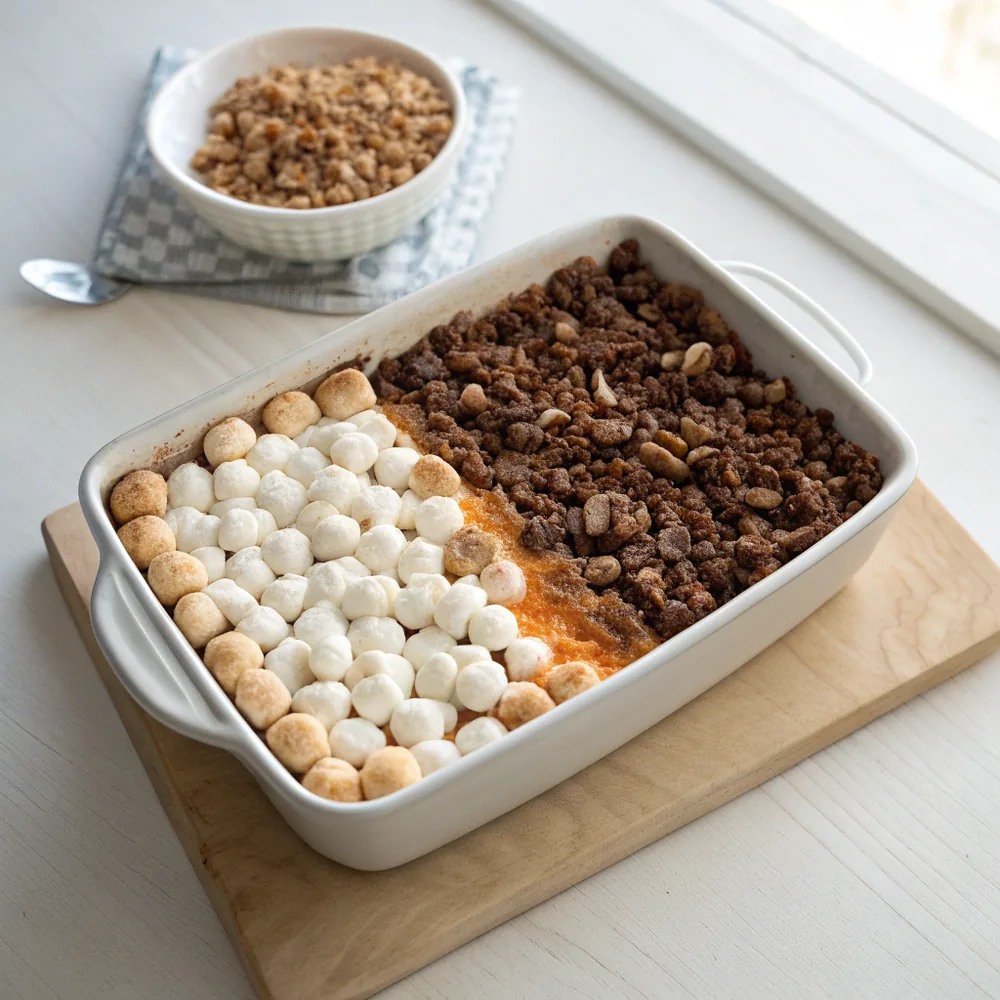
You can also refuse to choose. Line up the streusel down one long half of the dish and the marshmallows down the other, put the streusel on at the start and the marshmallows on for the last eight minutes, and serve a divided casserole. It looks deliberate, it ends the argument, and I have never once had leftovers of either half.
Make-Ahead, Storage, and Oven Traffic Control
Thanksgiving is not a cooking problem, it is a scheduling problem, and the sweet potato casserole is one of the most cooperative dishes on the list. The base can be made completely, spread in its buttered dish, covered tightly, and refrigerated for two full days. The streusel can be mixed and refrigerated separately in a bag for the same two days. On the day, the topping goes on and the dish goes in the oven, and that is your entire remaining workload.
Do not put the topping on before refrigerating. A streusel sitting on wet mash overnight absorbs moisture and bakes into a soft paste, and marshmallows do worse. Keep them apart until the dish goes in the oven. This is the same principle behind every make-ahead crumble in existence.
Coming straight out of the refrigerator, a 9x13 dish of cold casserole needs 12 to 15 extra minutes and benefits from sitting on the counter for 30 minutes first while the oven comes up to temperature. Check the center with a knife: it should come out hot to the touch on your wrist, not lukewarm. Cold in the middle is the classic make-ahead failure.
You can also bake it fully a day ahead and reheat, which I do when the oven schedule is genuinely impossible. Cover it with foil, reheat at 325F for 25 to 30 minutes, then pull the foil for the last 10 to crisp the top back up. The marshmallow version does not survive this treatment; the streusel version barely notices. Leftovers keep four days in the refrigerator and reheat the same way. The full dish-by-dish schedule, including which things can share an oven rack, is laid out in my Texas Thanksgiving guide.
Choosing Sweet Potatoes, and the Yam Confusion
What you want here is an orange-fleshed sweet potato: Beauregard, Jewel, or Garnet are the three you will actually find. Beauregard is the workhorse of the American crop, developed at Louisiana State University in the 1980s and now the majority of what sits in the bin. It is moist, deeply orange, and sweet, and it is the right choice for this dish.
Almost all of those bins are labeled yams, and almost none of them contain yams. A true yam is a starchy tuber from West Africa and Asia with rough bark-like skin and pale, dry, mealy flesh, sold mostly in international markets. The mislabeling goes back to the mid-twentieth century, when Louisiana growers marketing the new soft orange varieties adopted the word to distinguish them from the paler, drier sweet potatoes Americans already knew. The USDA still requires the word sweet potato to appear somewhere on the label, which is why you see both words on the same sign.
The pale-fleshed sweet potatoes, white and Japanese varieties, are drier, starchier, and much less sweet. They are wonderful roasted in wedges and they are wrong here: without the moisture and sugar of the orange varieties you get a dry, bland casserole that needs a lot of sugar to rescue. If white sweet potatoes are all you can get, add an extra two tablespoons of butter and a splash more cream.
Buy them firm, with no soft spots and no shriveling at the ends, and store them somewhere cool and dark but not in the refrigerator. Cold storage below about 50F causes chilling injury: the flesh develops a hard core that never softens no matter how long you roast it. A paper bag in a pantry is right. They keep a month that way, which makes them one of the easiest things to buy early in a November where the grocery store gets worse every day.
Mistakes That Ruin Sweet Potato Casserole
Boiling the potatoes. It waterlogs them, washes flavor into the pot, and skips all the caramelization that makes the dish taste like sweet potato instead of like brown sugar. Roast them whole, in their skins, until syrup runs out the ends.
Using a food processor or a stand mixer. High-speed blades rupture the starch granules and turn the mash gluey and elastic, the same failure mode as gummy mashed potatoes. A hand masher or a ricer, thirty seconds, done.
Doubling the sweetness. If you have kept a cup of sugar in the base and then covered it with marshmallows, the dish has left the dinner plate and become a dessert. Sweeten the base lightly and let the topping carry it.
Putting the marshmallows on at the start. They melt flat, run to the corners, and bake into a hard sugar sheet. Eight to ten minutes at the end, on an already hot casserole, and stay in the room.
Warm butter in the streusel. It smears into a paste instead of crumbling, and you get a greasy layer rather than a crisp crust. Cold butter, cubed, fingertips only, stop while there are still pea-sized lumps.
Skipping the eggs. Without them you have a pan of mashed sweet potatoes that slumps into a puddle the moment it is served. Two eggs is the minimum that lets a spoonful hold its edge, and they must go into a base that has cooled below scrambling temperature.
Storing sweet potatoes in the refrigerator. Below 50F they develop a hard core that no amount of roasting will soften. A paper bag in a cool dark pantry keeps them a month.
Where It Sits on the Texas Table
On a Texas Thanksgiving plate, this casserole is doing a specific job: it is the sweet, soft, orange corner that balances the salt of the turkey and the savory density of the dressing. It sits well next to a cornbread dressing precisely because the two are opposites, one crumbly and sage-heavy, one smooth and sweet. If you are building the plate deliberately, my Texas cornbread dressing is the dish I would put beside it.
The green corner of the same plate has two answers on this site. When the oven has room, my green bean casserole bakes at 375F, the same temperature as this dish, so the two can share the turkey's last hour; when it does not, the skillet green beans with bacon stay on the stove.
Portion it generously. A 9x13 dish serves 10 to 12 as one of six or seven dishes, but sweet potato casserole disappears faster than almost anything else on the table, and it is the leftover people fight over on Friday. If you are feeding more than a dozen, make two dishes rather than one enormous deep one, because a deeper casserole takes much longer to heat through in the middle and the topping burns waiting for it.
The dessert course is a separate conversation and it should stay that way. That is where the pies belong, and my Texas desserts collection has the full lineup, pecan pie and buttermilk pie and the sheet cakes. Serving a sweet potato casserole and a sweet potato pie at the same meal is not a crime, but it is a lot of the same vegetable in one afternoon, and the pie usually wins.
Sweet Potato Casserole Recipe
Ingredients
- For the sweet potato base:
- 4 lbs (1.8 kg) orange-fleshed sweet potatoes, about 5 or 6 medium, scrubbed
- 6 tablespoons (3 oz / 85 g) unsalted butter, melted
- 1/3 cup (2 1/2 oz / 70 g) packed dark brown sugar
- 2 large eggs, beaten
- 1/3 cup (2 3/4 oz / 80 ml) whole milk or heavy cream
- 1 1/2 teaspoons pure vanilla extract
- 1 1/4 teaspoons kosher salt
- 3/4 teaspoon ground cinnamon
- 1/4 teaspoon freshly grated nutmeg
- For the pecan streusel topping:
- 1 cup (4 oz / 115 g) pecan halves, roughly chopped
- 1/2 cup (3 1/2 oz / 100 g) packed dark brown sugar
- 1/3 cup (1 1/2 oz / 45 g) all-purpose flour
- 4 tablespoons (2 oz / 55 g) cold unsalted butter, cut into small cubes
- 1/4 teaspoon kosher salt
- For the marshmallow topping, if you go that way instead:
- 1 (10 oz / 285 g) bag mini marshmallows, about 6 cups
Instructions
- Roast the sweet potatoes whole. Heat the oven to 400F. Scrub the sweet potatoes, prick each one three or four times with a fork, and set them directly on a foil-lined sheet pan. Roast 55 to 75 minutes depending on size, until a knife slides through the thickest part with no resistance and dark syrup is bubbling out of the ends onto the foil. That syrup is the point of the whole exercise. Let them cool 20 minutes, until you can handle them.
- Scoop, do not peel. Split each potato lengthwise and scoop the flesh out with a spoon straight into a large bowl, leaving the skins behind. Roasted skins slip away cleanly and this is far faster and less wasteful than peeling raw potatoes. You are looking for about 6 cups of cooked flesh. Discard any tough, stringy sections near the stem end.
- Mash to the texture you want. Mash with a potato masher for a rustic casserole with some body, or run it through a ricer for a smooth one. Do not use a food processor or a stand mixer: sweet potato starch turns gluey and elastic under high-speed blades, exactly the way regular potatoes do. Thirty seconds with a masher gets you where you need to be.
- Build the base while it is warm. Stir in the melted butter, brown sugar, milk, vanilla, salt, cinnamon, and nutmeg until fully combined. Taste it now, before the eggs go in, and adjust the salt and the sugar to your liking. A warm base takes seasoning better and this is your last chance to judge it honestly.
- Add the eggs off the heat. Let the mixture cool to just warm, then beat in the eggs until no streaks remain. The eggs are what set the casserole into something you can cut a clean spoonful out of instead of a slump. If the base is hot when they go in they will scramble in threads, so give it ten minutes if it is still steaming.
- Spread and settle. Butter a 9x13 inch baking dish and spread the mixture in an even layer, smoothing the top with the back of a spoon. Do not pack it down hard; you want it settled, not compressed. At this point you can cover and refrigerate for up to two days if you are working ahead.
- Make and add the streusel. In a bowl, rub the cold butter into the brown sugar, flour, and salt with your fingertips until it looks like coarse gravel with some pea-sized lumps, then stir in the chopped pecans. Scatter it evenly over the casserole all the way to the edges. Cold butter and a light hand are what give you a crumbly, crisp crust instead of a flat greasy layer.
- Bake at 350F for 30 to 35 minutes. Drop the oven to 350F and bake, uncovered, for 30 to 35 minutes, until the streusel is deep golden and the casserole is puffed slightly at the edges and no longer wobbly in the center. If you started from cold out of the refrigerator, add 12 to 15 minutes and check the middle with a knife. Rest 10 minutes before serving so the set firms up.
- For the marshmallow version, wait. If you are topping with marshmallows instead, bake the bare casserole at 350F for 25 minutes first, then scatter the marshmallows evenly over the surface and return it for 8 to 10 minutes, until they are puffed and golden. Watch them the whole time. Under a broiler they go from pale to burnt in about forty seconds, and there is no fixing it.
Frequently Asked Questions
Is sweet potato casserole a side dish or a dessert?
A side dish. It goes on the plate with the turkey, the dressing, and the gravy, and it is eaten alongside them with a fork. The confusion comes from the marshmallow topping and from recipes that load a full cup of sugar into the base, which does push it toward dessert. Keep the base lightly sweetened, around a third of a cup of brown sugar for four pounds of potatoes, and it sits comfortably on a dinner plate. The dessert version of the same vegetable is sweet potato pie, which is a custard baked in a crust and served cold.
Should I boil or roast the sweet potatoes?
Roast them, whole and in their skins, at 400F until syrup bubbles out the ends. Boiling waterlogs the flesh and leaches sugar and flavor into water you then throw away, which is why boiled casseroles come out pale and need extra sugar. Roasting drives moisture out and gives the potato's own enzymes a long window to convert starch into maltose, so the potato sweetens itself. If the oven is full, microwaving them whole for 10 to 12 minutes then finishing at 425F for 20 minutes is a reasonable compromise.
Can I make sweet potato casserole ahead of time?
Yes, and it is one of the best make-ahead dishes on the menu. Assemble the base completely, spread it in its buttered dish, cover tightly, and refrigerate for up to two days. Keep the topping separate in a bag, because a streusel sitting on wet mash overnight turns to paste and marshmallows do worse. On the day, add the topping and bake, adding 12 to 15 minutes for the cold start. You can also bake it fully a day ahead and reheat covered at 325F for 25 to 30 minutes.
Marshmallows or pecan streusel?
Both are legitimate, and they do different things. Marshmallows give a soft, sweet, toasted lid with a caramel bitterness on top and a molten interior, and children love it. Pecan streusel gives a crisp, sandy, buttery crust with real toasted-nut bitterness that balances the dish better on a savory plate, and it is the more common choice in Texas because we grow the pecans. If your household is split, put streusel on one half of the dish and marshmallows on the other. Streusel goes on at the start, marshmallows only for the last 8 to 10 minutes.
Why is my sweet potato casserole watery?
Almost always boiled potatoes. Boiling adds water to a vegetable that then releases it in the oven, and no amount of baking fixes it. The other two causes are too much added dairy, since roasted sweet potatoes need far less liquid than boiled ones, and skipping the eggs, which are what set the mash into something that holds a spoon mark. If you are stuck with a loose mixture, bake it uncovered for an extra 15 minutes before adding the topping to drive some moisture off.
How is this different from sweet potato pie?
Ratio and purpose. This casserole is 6 cups of sweet potato flesh bound with just two eggs, spread in a wide dish, topped with something crunchy, and served hot with the main course. A pie filling runs about 2 cups of puree with three eggs and evaporated milk, roughly four times the egg-to-potato ratio, poured into a pastry crust and baked until it sets firm enough to slice, then cooled and served as dessert. Using one recipe for the other job gives you either a pie that never sets or a casserole with the texture of cold quiche.
Do I have to use eggs in sweet potato casserole?
You do not have to, but you will notice their absence. Without eggs the dish is essentially mashed sweet potatoes with a topping, and a serving slumps flat on the plate instead of holding its shape. Two eggs for four pounds of potatoes is the minimum that gives structure without making it eggy or custard-like. Add them once the base has cooled to just warm, or they will scramble into threads. For an egg-free version, an extra two tablespoons of butter and a slightly firmer mash help a little.
Are yams and sweet potatoes the same thing?
No, though American grocery stores label them as if they were. Nearly everything sold as a yam in the United States is an orange-fleshed sweet potato, usually a Beauregard, Jewel, or Garnet. True yams are starchy West African and Asian tubers with rough bark-like skin and dry pale flesh, sold mainly in international markets and completely wrong for this dish. The mislabeling dates to mid-century Louisiana marketing, which is why the USDA still requires the words sweet potato to appear somewhere on the sign.