Southern Comfort Food
Green Bean Casserole
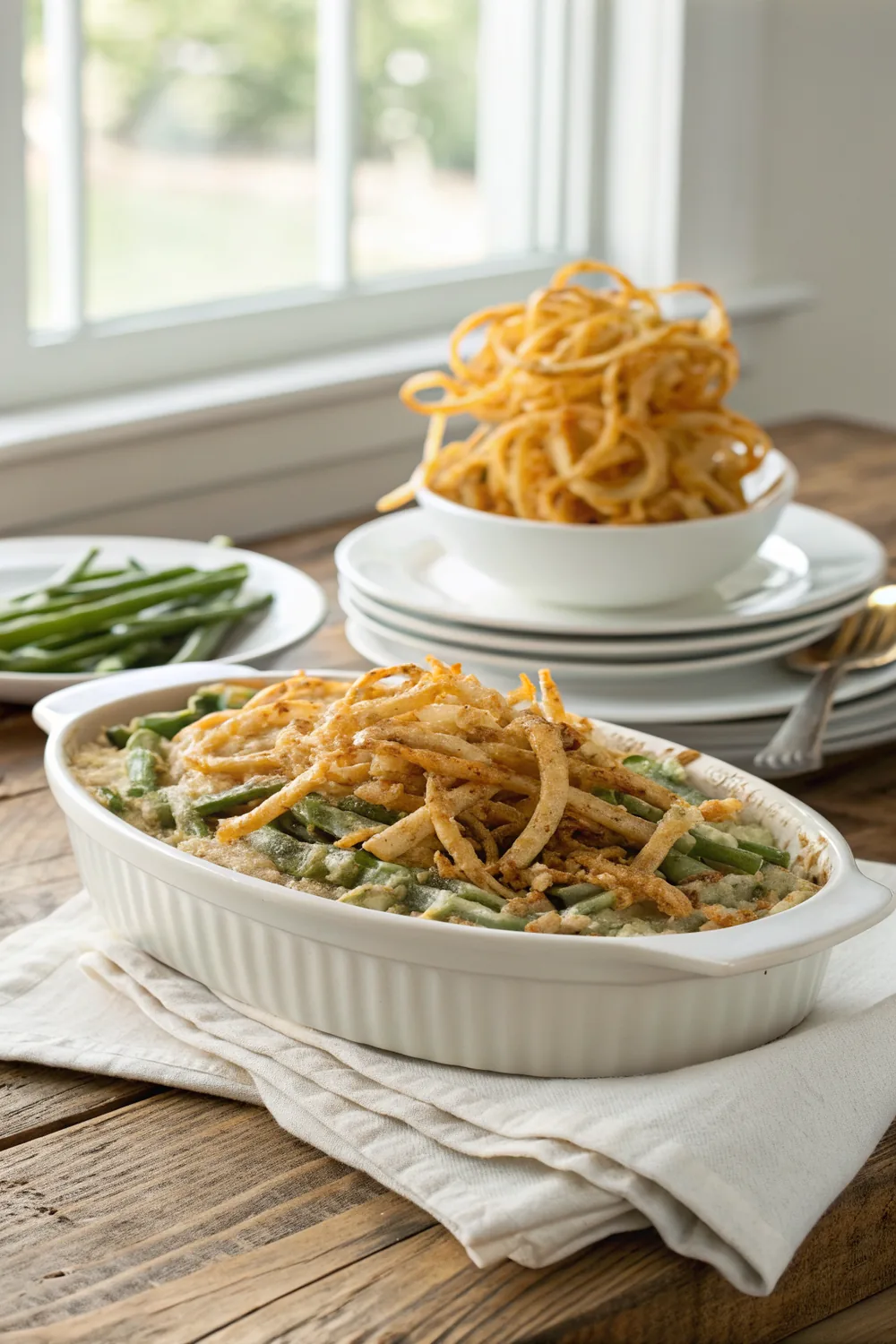
Chef Mia's green bean casserole: blanched beans, scratch cremini cream sauce, buttermilk fried onions, 375F 25 to 30 minutes in a 9x13. Serves 10 to 12.
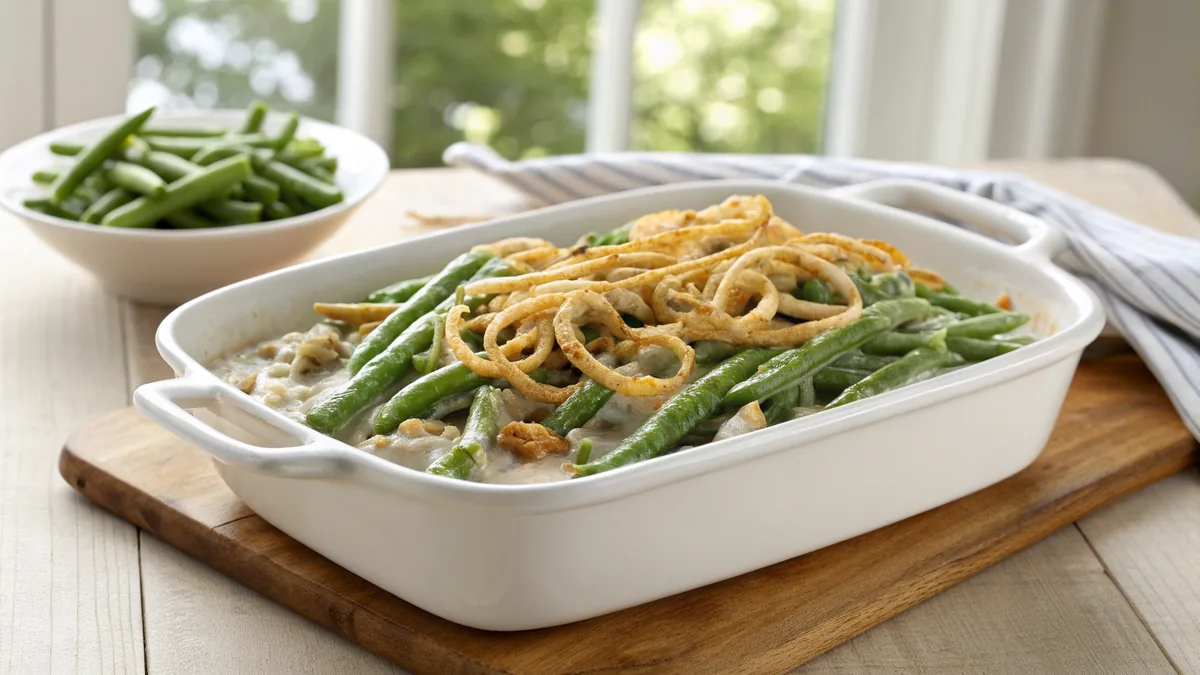
Quick answer: Green bean casserole is blanched green beans folded into a mushroom cream sauce, baked in a 9x13 dish, and finished with a layer of crisp fried onions. Blanch 2 1/2 pounds of green beans for 4 minutes in salted water and shock them in ice water; brown a pound of sliced cremini mushrooms in 4 tablespoons of butter, stir in 1/4 cup of flour, then 2 cups of chicken stock and 1 cup of heavy cream, and season with 2 teaspoons of soy sauce; fry two thinly sliced onions dredged in buttermilk and a flour-cornstarch mix in 350F (175C) oil for 3 to 4 minutes. Bake at 375F (190C) for 15 minutes, add the onions, and bake 10 to 15 minutes more. Serves 10 to 12, and the sauce and beans can be made two days ahead.
Green bean casserole earned its bad reputation one can at a time, and it loses that reputation one skillet of mushrooms at a time. The dish was invented in 1955 in a soup-company test kitchen as a way to sell condensed soup, and the version most of America eats on Thanksgiving still tastes exactly like its origin: salty, gray, and vaguely mushroom-adjacent, with a topping that went soft under the foil an hour before dinner. None of that is the fault of the green beans. Swap the can for a real cream of mushroom sauce made in twenty minutes, fry your own onions, and the same dish turns into the side people reach for twice.
This is the oven casserole. I want to be clear about that from the start, because this site already has a page for skillet green beans simmered with bacon and onion, which is a stovetop dish with no cream sauce, no oven, and no crisp topping, and readers who arrive here looking for that one should head over there. What you will find on this page is the classic Thanksgiving build: blanched beans, a mushroom cream sauce, and a crackling layer of buttermilk-dredged fried onions, baked in a 9x13 dish at 375F (190C) until the edges bubble. If your oven is going to be full on the day, the skillet beans are the escape hatch, and I say so again further down.
In my Lockhart kitchen this casserole sits on the Texas Thanksgiving table between the cornbread dressing and the smoked bird, and it has picked up a few local habits over fifteen years: a minced jalapeno in the sauce, a handful of sharp cheddar, and pecans in the onion topping. All three are optional and all three are covered below. The recipe serves 10 to 12, the sauce and the beans can be made two days ahead, and the whole thing goes into the oven for 25 to 30 minutes while the turkey rests. That timing is not an accident. It is the reason the dish survives on a holiday when the oven is the most contested piece of equipment in the house.
Why a Pan of Mushrooms Beats the Can (and the Two Days a Year the Can Is Fine)
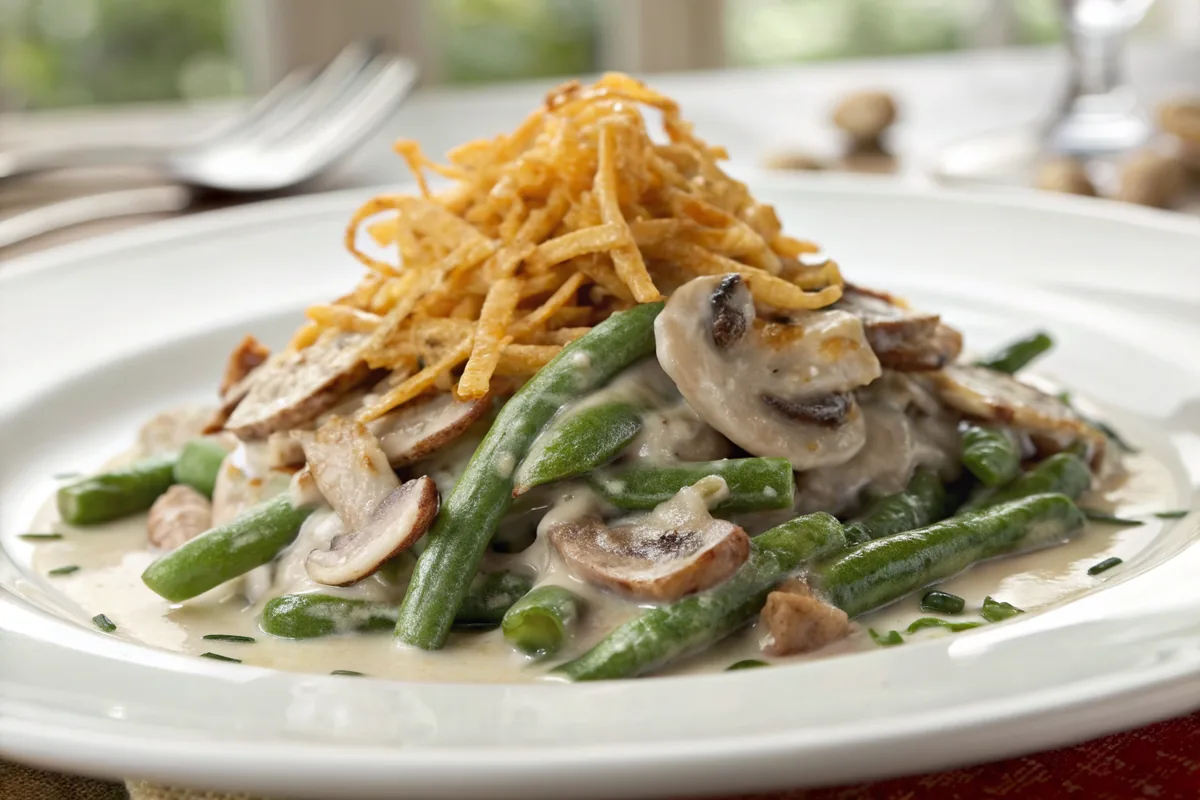
Condensed cream of mushroom soup is a shelf-stable emulsion of modified starch, vegetable oil, dried mushroom pieces, and a good deal of salt, and it was engineered to survive a year in a pantry, not to taste like mushrooms. When you bake it over green beans, the starch sets into a gray, gluey coating that sits on the beans rather than clinging to them, and the flavor is mostly salt with a sour dairy note behind it. The dish became a joke because of that texture. Nobody ever complained about the beans or the onions.
A scratch sauce fixes it in twenty minutes with things you already have. A pound of cremini mushrooms browned hard in butter gives you real mushroom flavor, the roasted kind, concentrated in the pan. A quarter cup of flour cooked into the butter is a roux, which thickens the sauce with a smooth, glossy body rather than a starchy one. Chicken stock and cream give it savory depth and richness in the right proportion, and a couple of teaspoons of soy sauce or Worcestershire add the glutamates that the canned soup was reaching for with its salt. The result tastes like a mushroom cream sauce from a steakhouse, because that is what it is.
Now the honest part. If you are cooking for twenty, the oven is double-booked, and green bean casserole is the eleventh dish on the list, the can is a legitimate shortcut and I will not pretend otherwise. Use two 10.5-ounce cans of condensed cream of mushroom soup, thin them with 3/4 cup of milk and 1/4 cup of cream, add the soy sauce, a heavy grind of black pepper, and a clove of grated garlic, and fold in the blanched beans exactly as written. It will be better than the back-of-the-can version, and a store-bought tub of fried onions on top finishes the job. But the difference between that and the scratch sauce is not subtle, and on a day when the sauce can be made two days early, I never take the shortcut.
Fresh, Frozen, or Canned Beans, and the Four-Minute Blanch
Fresh green beans are the first choice and they are cheap and plentiful in Texas in November. Look for beans that snap cleanly rather than bend, trim the stem ends, and cut them into 2-inch pieces so they fit on a spoon. Two and a half pounds trimmed is the right amount for a 9x13 dish, which sounds like a lot until you see how much they settle once they are coated in sauce. Haricots verts, the thin French beans, work but overcook easily; blanch them 2 minutes instead of 4 and expect a more delicate casserole.
Frozen cut green beans are my second choice and a perfectly good one. They were blanched before freezing, so they need only 2 minutes in the boiling water straight from the bag, and then the ice bath like fresh. Skip the blanch and dump them in frozen and the casserole leaks water as they thaw, thinning the sauce into soup. Thawed and drained without blanching, they are limp before they hit the oven. Two minutes in salted boiling water, then ice, gives them back most of their snap.
Canned green beans belong in the skillet version with the bacon, where their soft, surrendered texture is the whole point, and not in this casserole, where they turn to mush under the sauce and the bake. If canned is what you have, drain them very well, skip the blanch, and cut the bake to 20 minutes total with the onions on for the last 10. It will be edible and it will be the 1955 version.
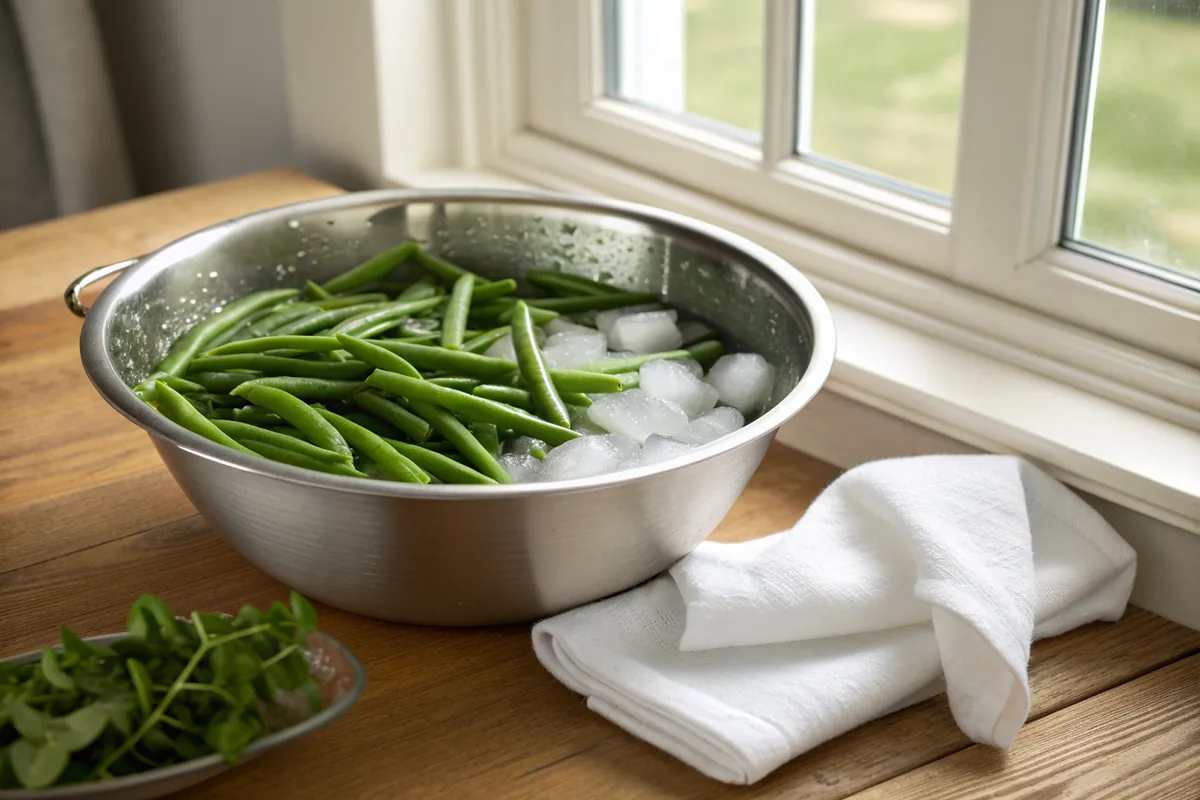
The blanch matters more than people think, for two reasons. First, the beans go into the oven already cooked to the tender-crisp stage, so the 25 to 30 minutes of baking only has to heat them through and finish them, which means they are still green and still have bite at the table. Beans that go in raw need 45 minutes to soften, by which time the sauce has broken and the onions have burned. Second, the ice bath stops the cooking cold and locks the chlorophyll, so the finished dish is green rather than olive. Salt the water hard, a full 2 tablespoons for a big pot, because this is the only chance the beans get to season from the inside.
Cremini, Shallot, and Two Cups of Stock to One Cup of Cream
The sauce is a mushroom veloute enriched with cream, and the ratio to remember is 4 tablespoons of butter, 1/4 cup of flour, 2 cups of stock, and 1 cup of cream for a 9x13 dish of beans. That gives you about 3 1/2 cups of sauce, which sounds like too much and is exactly right, because the beans absorb some as they bake and the sauce reduces slightly in the oven. Less than that and the casserole is dry and clumpy by the time it comes to the table; more and it slides off the spoon.
Cremini mushrooms, the brown ones sometimes sold as baby bellas, have more flavor than white button mushrooms and hold their shape better in the sauce. Slice them 1/4 inch thick, not thinner, so they stay meaty. The browning is the step people rush and it is the whole flavor of the dish: mushrooms into hot butter in a single layer, left alone for three minutes so they sear instead of steam, then stirred and cooked until the pan is dry and the edges are dark. That takes 8 to 10 minutes and there is no faster way. A pound of raw mushrooms cooks down to about a cup and a half, which is the right amount to find in every spoonful without the dish becoming a mushroom casserole.
A shallot is sweeter and finer than an onion in a cream sauce, and since there are already two onions in the topping, it keeps the sauce from tasting like onion twice. Garlic and thyme go in with it for two minutes, no longer, so the garlic does not scorch. The flour goes over everything and gets stirred for a full minute; that cooks the raw taste out and coats the mushrooms so the sauce thickens evenly. Stock goes in gradually, stirring, and the sauce will look lumpy for the first thirty seconds and then smooth out. Cream last.
Soy sauce is my choice over Worcestershire because it adds savory depth without the tamarind and vinegar notes, but either one does the job, which is to supply the glutamates that make a mushroom sauce taste deeper than its ingredients. Two teaspoons is enough; you should not be able to identify it. Salt after the soy, because the soy brings salt of its own, and taste with a bean in the spoon, since the beans are seasoned from the blanch and the balance changes once they are in. A pinch of nutmeg is classic in any cream sauce and worth including. The sauce should coat a spoon thickly at this stage; if it seems thin, simmer another two minutes, since it will not thicken much more in the oven.
Buttermilk Onions Fried at 350F, With Cornstarch for the Shatter
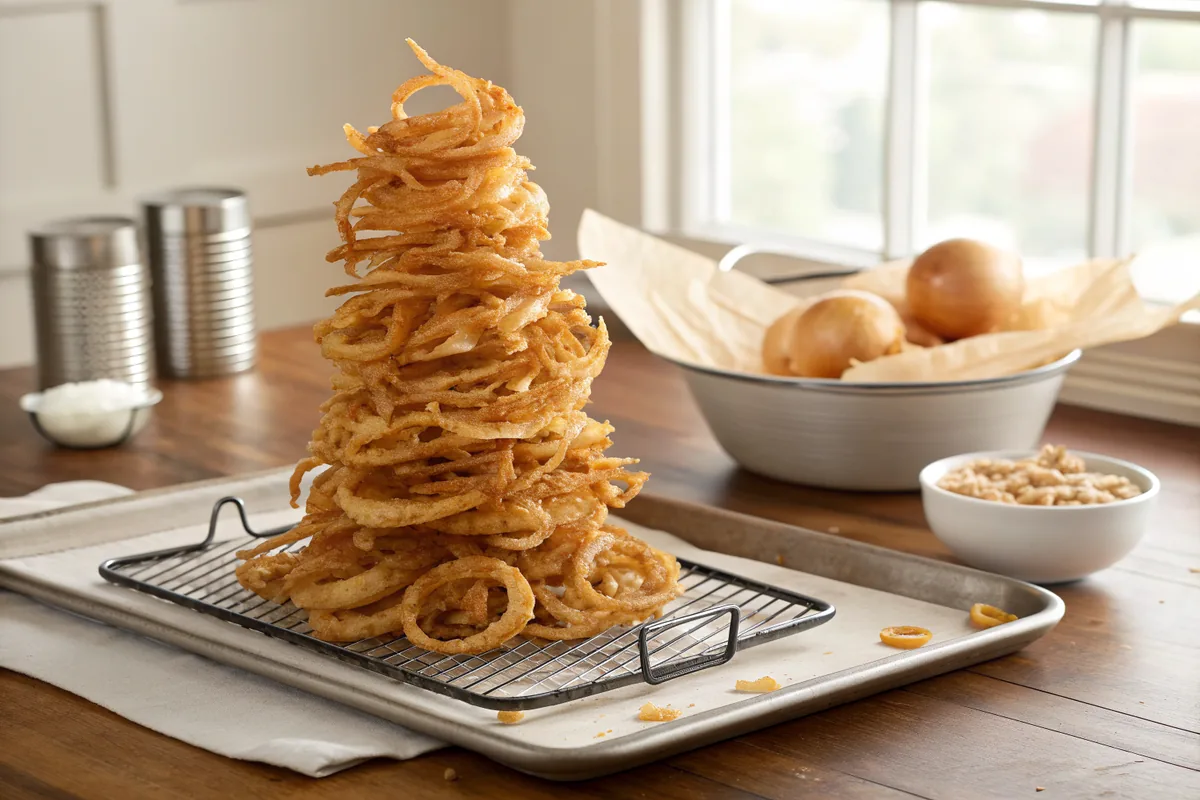
Store-bought fried onions are fine and I say so plainly at the end of this section, but homemade ones are a different food. They are thinner, they taste like onion instead of like salt, and they shatter instead of crunching. The method is a shallow fry of buttermilk-soaked onion slices dredged in seasoned flour and cornstarch, and it takes about 20 minutes for two onions, which is less time than the sauce.
Slice the onions as thin as you can manage, about 1/8 inch, halved through the root first so you get half-rings rather than full circles that tangle. A mandoline is the right tool; a sharp knife and patience work too. Thick slices stay soft in the middle and go limp on the casserole within minutes. The buttermilk soak, 15 minutes to an hour, does two things: its acidity softens the sharp raw onion bite, and it leaves a tacky film that the dredge grips, so the coating stays on the onion in the oil instead of floating off in flakes.
The dredge is 1 cup of flour to 1/4 cup of cornstarch with salt, pepper, and smoked paprika. Cornstarch is the crisping agent. Flour alone fries to a coating that is crunchy for ten minutes and then softens as it absorbs moisture from the onion inside; cornstarch has no gluten and fries to a glassy, brittle shell that stays crisp on top of a steaming casserole for the length of a meal. Do not go higher than one part cornstarch to four parts flour or the coating turns hard and tastes of nothing.
Oil at 350F (175C), measured, about 1 1/2 inches deep in a Dutch oven, and fry a loose handful at a time for 3 to 4 minutes, stirring once so the strands do not fuse into a raft. They are done when they are deep gold, not brown; they will darken another shade in the oven. Drain on a wire rack, never paper towels, salt them while hot, and let the oil recover to 350F before the next batch. Two onions make about 4 cups of fried strands, which sounds like too much and disappears fast, since half the household will eat them off the rack. Fried onions keep in an open container at room temperature for a full day and crisp back up in a 350F oven for 3 minutes if the day is humid.
The fallback: a 6-ounce container of store-bought crispy fried onions covers a 9x13 casserole. They are thicker and saltier than the homemade ones, so cut the salt in the sauce by half a teaspoon, and they go on at the same point, the last 10 minutes of the bake. If you use them, toss them with a handful of chopped pecans and a pinch of black pepper first. It is a small thing and it makes them taste like a choice instead of a shortcut.
Assembly in the 9x13 and the 375F Bake, Onions On for the Last Ten
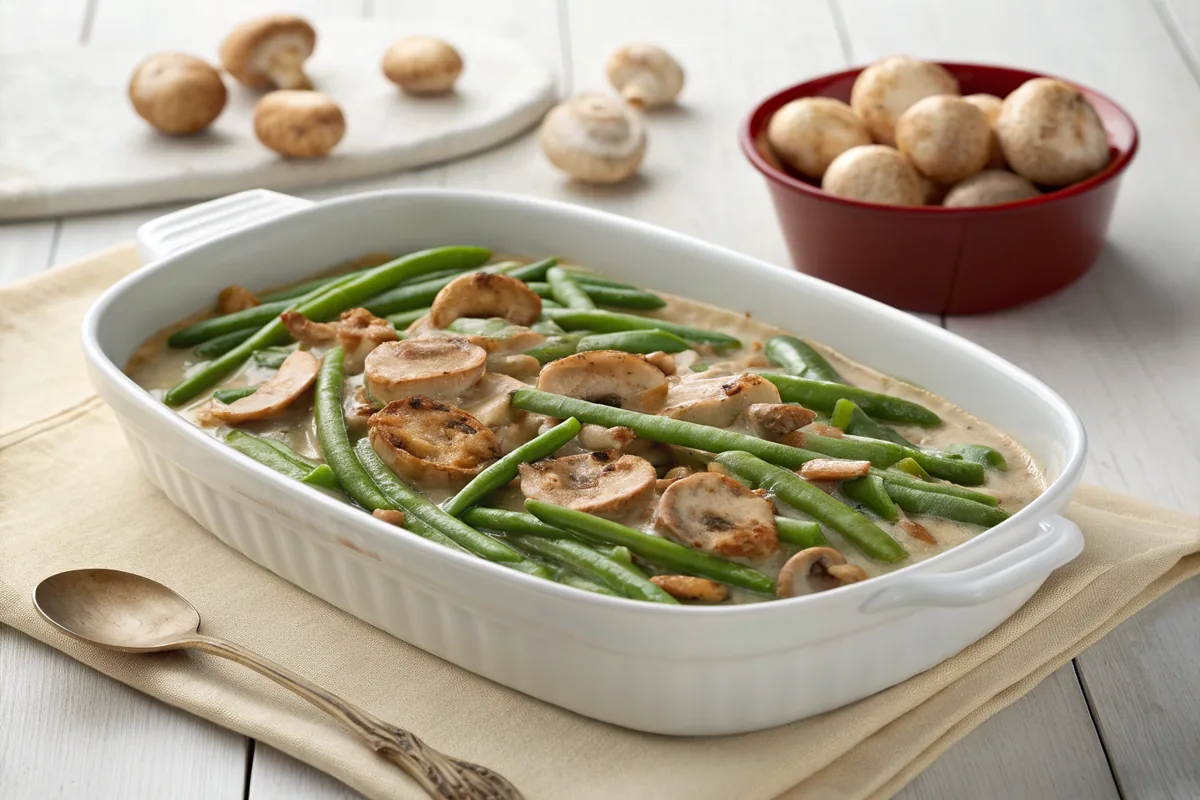
Butter the dish, fold the dry blanched beans into the finished sauce in the skillet or a big bowl so every piece is coated, and spread the mixture level. Drying the beans on a towel after the ice bath matters here; wet beans water down the sauce and it never recovers. The casserole should look slightly over-sauced at this stage, with the beans submerged rather than peeking out, because the sauce tightens in the oven and the beans drink some of it.
Bake uncovered at 375F (190C). That temperature is hot enough to get the sauce bubbling at the edges and heat the center through in 15 minutes from room temperature, or about 20 from the refrigerator, without scorching the edges. Covering the dish with foil is the mistake that made every childhood green bean casserole soggy: it traps steam, the sauce thins, and any topping underneath it goes soft. Leave it open. If the edges brown faster than you like, the dish is too shallow or the oven runs hot; drop to 350F next time.
The onions go on for the last 10 to 15 minutes and not before. Fried onions put on at the start spend 30 minutes absorbing steam from the sauce below and are limp by the time the casserole is done, which is the second reason the classic version has a bad name. Ten minutes at 375F is enough to warm them, deepen their color one shade, and marry them to the sauce at the edges while leaving the top layer crisp. The casserole is done when the center reads 165F (74C), the sauce bubbles across the whole surface and not just the edges, and the onions are a deep amber.
Rest it 10 minutes before serving. Straight out of the oven the sauce is thin and the beans slide; ten minutes on the counter and it tightens to the consistency that holds on a spoon. On Thanksgiving this rest coincides neatly with the last ten minutes of the turkey resting and the gravy coming together on the stove, and the casserole holds happily under a loose tent of foil for 30 minutes after that if the bird is running late.
Two Days Ahead: The Make-Ahead Plan and Thanksgiving Oven Traffic
This casserole was built to be assembled early, and the make-ahead plan is the reason I keep it on the holiday menu. Two days before: blanch, shock, and dry the beans; make the mushroom cream sauce; fold them together in the buttered 9x13, cool, cover tightly, and refrigerate. The morning of: fry the onions and leave them in an open container on the counter. Late afternoon: pull the casserole out of the refrigerator 30 minutes before it goes in the oven, bake it 20 minutes, add the onions, and bake 10 to 15 more. Nothing about the day-of work takes more than a minute of attention.
Do not fry the onions two days ahead. They will keep, technically, but they lose their shatter after about a day even in a sealed container, and re-crisping them in the oven only mostly works. The morning of is the sweet spot, and it is 20 minutes of work at a time when the kitchen is still quiet. If the oil is already hot for something else, fry them while it is there. If you are using store-bought onions, this step disappears.
Oven traffic is the real problem on Thanksgiving and this dish is one of the easier ones to route around. A 375F casserole shares an oven happily with the sweet potato casserole, which bakes at a similar temperature, and with the cornbread dressing if you stagger them: dressing on the bottom rack, this on the middle, sweet potatoes in as the dressing comes out. All three want to go in during the window when the turkey is out and resting, which in a Texas house is often not the oven's problem at all. A bird cooked on the smoker, a deep-fried turkey, or a smoked turkey breast leaves the indoor oven free from noon on, which is the single best argument for cooking the turkey outside.
If the oven is still full at the moment this casserole needs it, you have two options. The first is to bake it early, up to two hours before dinner, without the onions, then hold it tented on the counter and reheat it at 375F for 12 minutes with the onions on top right before serving. The second is to give up on the oven entirely and make the skillet version with bacon instead, which takes twenty minutes on a burner and needs no oven at all. Both are better than serving a casserole that sat under foil in a warming drawer for an hour.
Jalapeno in the Sauce, Sharp Cheddar, Pecans on Top: The Lockhart Version
The classic casserole is a Midwestern dish and it does not need help, but fifteen years of Thanksgivings in Lockhart have added three things to mine and I would miss any of them. All three are optional, all three are small, and none of them turns the dish into something else. Use one or all.
One jalapeno, seeded and minced fine, goes into the skillet with the shallot and garlic. Cooked into a cream sauce it loses most of its heat and leaves a green, grassy warmth at the back of the throat that cuts the richness of the cream. Nobody who does not know it is there will identify it, and the children eat it without noticing. If you want it to register as heat, leave a few seeds in or use two peppers. A serrano gives a sharper, cleaner heat if that is what is at the market.
A cup of grated sharp cheddar stirred into the sauce off the heat turns it from a cream sauce into something closer to a light cheese sauce, which reads as very Texan next to smoked mac and cheese and brisket. Use an aged, sharp cheddar with some bite so it tastes of cheese and not just of fat, add it off the heat so it melts without breaking, and cut the salt in the sauce by a quarter teaspoon to compensate. A mild cheddar or a Jack disappears and adds only heaviness.
Pecans are the Texas touch that makes the most difference and costs the least effort. Half a cup, roughly chopped, tossed with the fried onions before they go on the casserole, then toasted by the last ten minutes in the oven. They add a buttery crunch that survives even if the onions eventually soften, and pecans with green beans is an old Southern combination that predates the casserole by a century. Do not put them on raw at the start of the bake; they burn. If someone at the table has a tree nut allergy, leave them off entirely rather than trying to substitute; the dish is complete without them.
This Is the Oven Casserole, Not the Skillet Beans With Bacon
Two green bean dishes live on this site and they are not the same dish, so let me draw the line once and clearly. The page you are reading is the Thanksgiving casserole: blanched fresh or frozen beans, a mushroom cream sauce made from scratch, baked in a 9x13 at 375F, finished with crisp fried onions. It takes about an hour and forty-five minutes end to end, most of that hands-off, and it needs the oven for 25 to 30 minutes.
The other page is the skillet green beans with bacon and onion, the copycat of the steakhouse side. That dish is canned green beans simmered for 20 minutes in one skillet with bacon, onion, butter, a spoon of sugar, and chicken broth until they are soft, smoky, and faintly sweet. There is no sauce, no cream, no mushrooms, no oven, and no topping, and canned beans are the point rather than a compromise, because their soft texture is what soaks up the bacon fat. It is a weeknight side that happens to work on a holiday table for one specific reason: it never touches the oven.
So the choice on Thanksgiving is practical. If you have oven space for 30 minutes at 375F, make this one, and make it ahead as described above. If you do not, because the dressing and the rolls and the pies have claimed every rack and the bird is in there too, make the skillet beans on a back burner and nobody will feel shortchanged. Some years in my house both show up, the casserole for the people who grew up with it and the skillet beans for the people who want bacon, and both dishes are empty by the end of the meal. The rest of the table is mapped on the Thanksgiving hub, where you can see how the two fit with the bird, the dressing, and the gravy.
Doubling for Twenty and the Hotel-Pan Math
A 9x13 dish serves 10 to 12 as a Thanksgiving side, when there are eight other things on the plate. For a smaller crowd, halve everything into an 8x8 dish and cut the first bake to 12 minutes. For a bigger one, the recipe doubles without any adjustment to the sauce ratio, but the vessel changes the timing and that is where people get caught.
Two 9x13 dishes side by side is the simplest way to double and the one I recommend. They bake in the same time as one, they fit on one oven rack if it is a standard 30-inch oven, and the second one can go straight to the table for the second round of plates. A single full-size hotel pan, which is roughly the capacity of two 9x13 dishes, works if you have one and an oven that fits it, but the depth changes: a hotel pan is deeper, the casserole in it is thicker, and the first bake needs 25 minutes rather than 15 before the onions go on. Check the center with a thermometer for 165F rather than trusting the edges.
Frying onions for a double batch means four onions and about 40 minutes at the stove, and this is where the store-bought fallback earns its keep. A reasonable compromise: fry two onions for the top of the dish that will be seen first and use store-bought on the second dish, or mix the two together across both. The blanch also scales oddly; five pounds of beans in one pot drops the water off the boil for so long that the beans stew instead of blanching. Do it in two or three batches, bringing the water back to a full boil between them.
For a smoked-meat crowd, where the table is brisket and ribs rather than turkey, the casserole holds its own next to the standard barbecue sides and the cheddar version is the one to make. Bring it in the dish it was baked in, wrapped in a towel; it holds heat for 45 minutes that way and reheats in the dish if it needs it.
Leftovers, and Reheating Without a Soggy Top
Leftover green bean casserole keeps 4 days in the refrigerator, covered, and the sauce actually improves on the second day as the mushroom flavor settles into the beans. The onions do not improve. Once they have sat on the casserole overnight they have absorbed enough moisture to become a soft, savory layer, which is not unpleasant but is not the dish. The fix is to keep a handful of fried onions aside in an open container for reheating day, or to use store-bought ones for the leftovers without shame.
To reheat, spread the casserole in a baking dish, cover loosely with foil, and heat at 350F (175C) for 15 to 20 minutes until the center is hot, then uncover, scatter fresh onions over the top, and give it 5 minutes more. A single portion reheats in a covered skillet over low heat with a tablespoon of water or stock in 5 minutes, and then the onions go on at the table. The microwave heats it fine but turns any onions on top into wet paper; if the microwave is the only option, scrape the old onions off first and add fresh ones after.
Freezing is possible but not recommended for the assembled dish. The cream sauce separates slightly on thawing and the beans go soft. If you want to freeze, freeze the sauce alone, up to 2 months, and blanch fresh beans when you thaw it; the sauce comes back together with a whisk over low heat. The leftovers also make a respectable filling stirred into a pot pie with the last of the turkey, which is one of the better uses for the second day; the other ideas are on the leftover turkey page.
The Six Ways a Green Bean Casserole Goes Wrong
Skipping the blanch. Raw beans go in needing 45 minutes and come out olive-colored with a broken sauce and burned onions. Four minutes in salted boiling water, then ice.
Wet beans. Beans straight from the ice bath carry a quarter cup of water into the sauce and thin it into soup. Dry them on a towel.
Pale mushrooms. Mushrooms steamed instead of seared taste of nothing and leak liquid into the sauce during the bake. Single layer, hot butter, three minutes untouched, then cooked until the pan is dry.
Onions on from the start. Thirty minutes of steam turns any fried onion soft. On for the last 10 to 15 minutes only.
Foil on the dish. It traps steam, thins the sauce, and softens the top. Bake uncovered at 375F.
Serving it straight from the oven. The sauce is thin and the beans slide until it has rested ten minutes. Give it the ten minutes; the turkey needs them too.
A seventh, for the shortcut cooks: using condensed soup straight from the can without thinning it. Undiluted it sets into paste in the oven. If you are using the can, loosen it with milk and cream, season it, and treat it like a sauce, not a binder.
Green Bean Casserole Recipe
Ingredients
- For the beans:
- 2 1/2 pounds (1.1 kg) fresh green beans, trimmed and cut into 2-inch pieces (or 2 1/2 pounds frozen cut green beans, see the bean section)
- 2 tablespoons kosher salt, for the blanching water
- For the mushroom cream sauce:
- 4 tablespoons (2 oz / 57 g) unsalted butter
- 1 pound (450 g) cremini mushrooms, sliced 1/4 inch thick
- 1 large shallot, minced (about 1/3 cup)
- 3 garlic cloves, minced
- 1 teaspoon fresh thyme leaves
- 1/4 cup (1 1/4 oz / 35 g) all-purpose flour
- 2 cups (16 oz / 480 ml) chicken stock
- 1 cup (8 oz / 240 ml) heavy cream
- 2 teaspoons soy sauce or Worcestershire sauce
- 1 teaspoon kosher salt, plus more to taste
- 1/2 teaspoon freshly ground black pepper
- Pinch of freshly grated nutmeg (optional)
- 1 jalapeno, seeded and finely minced (optional Texas touch)
- 1 cup (4 oz / 113 g) grated sharp cheddar (optional Texas touch)
- For the crispy fried onions:
- 2 medium yellow onions, halved and sliced 1/8 inch thick
- 1 cup (8 oz / 240 ml) buttermilk
- 1 cup (4 1/4 oz / 125 g) all-purpose flour
- 1/4 cup (1 oz / 30 g) cornstarch
- 1 teaspoon kosher salt
- 1/2 teaspoon freshly ground black pepper
- 1/2 teaspoon smoked paprika
- 4 cups (32 oz / 950 ml) peanut or vegetable oil, for frying
- 1/2 cup (2 oz / 57 g) chopped pecans (optional Texas touch)
- Store-bought fallback: one 6-ounce container of crispy fried onions in place of the homemade topping
Instructions
- Blanch and shock the beans. Bring a large pot of water to a rolling boil with 2 tablespoons of kosher salt and set a big bowl of ice water beside it. Add the green beans and cook 4 minutes for fresh (2 minutes for frozen, straight from the freezer) until bright green and just tender with a snap left in them. Drain and plunge into the ice water until fully cold, then drain again and spread on a towel to dry.
- Soak the onions in buttermilk. Put the sliced onions in a bowl, pour the buttermilk over them, and toss to coat. Let them sit while you make the sauce, at least 15 minutes and up to an hour.
- Brown the mushrooms. Melt the butter in a 12-inch skillet over medium-high heat. Add the mushrooms in a single layer and leave them alone for 3 minutes, then stir and cook until they have released their liquid, the pan is dry again, and they are browned at the edges, 8 to 10 minutes total. Add the shallot, garlic, thyme, and the jalapeno if using, and cook 2 minutes more.
- Build the cream sauce. Sprinkle the flour over the mushrooms and stir constantly for 1 minute so it coats everything and loses its raw smell. Pour in the chicken stock a splash at a time, stirring, until smooth, then add the cream, soy sauce, salt, pepper, and nutmeg. Simmer 4 to 5 minutes until the sauce thickens enough to coat a spoon. Taste and adjust the salt. Off the heat, stir in the cheddar if using.
- Combine the beans and sauce. Fold the dried beans into the sauce until every piece is coated, then spread the mixture into a buttered 9x13 baking dish. At this point the casserole can be covered and refrigerated up to 2 days.
- Heat the oil to 350F. Pour the oil into a Dutch oven or deep heavy pot to a depth of about 1 1/2 inches and heat to 350F (175C) on a thermometer. Set a wire rack over a sheet pan beside the stove. Whisk the flour, cornstarch, salt, pepper, and smoked paprika together in a wide bowl.
- Dredge and fry the onions in batches. Lift a handful of onions out of the buttermilk, let the excess drip off, toss them in the flour mixture until every strand is coated, shake off the loose flour, and drop them into the oil. Fry, stirring once or twice, until deep golden and crisp, 3 to 4 minutes. Move them to the rack and salt lightly while hot. Let the oil return to 350F and repeat with the rest. Toss the pecans with the fried onions if using.
- Bake the casserole at 375F. Heat the oven to 375F (190C). Bake the casserole uncovered on the middle rack for 15 minutes (20 minutes if it went in cold from the refrigerator) until the sauce bubbles at the edges.
- Add the onions for the last 10 minutes. Scatter the fried onions evenly over the top and return the dish to the oven for 10 to 15 minutes more, until the onions are a shade darker and the center of the casserole reads at least 165F (74C) on a thermometer.
- Rest 10 minutes and serve. Let the casserole sit 10 minutes on the counter so the sauce tightens and the beans stop sliding. Serve straight from the dish with a large spoon.
Frequently Asked Questions
Can I make green bean casserole ahead of time?
Yes, and it is better for it. Blanch and shock the beans, make the mushroom cream sauce, fold them together in the buttered 9x13 dish, cool, cover, and refrigerate up to 2 days ahead. Fry the onions the morning of the meal and keep them in an open container at room temperature. On the day, let the dish sit out 30 minutes, bake it uncovered at 375F for 20 minutes, add the onions, and bake 10 to 15 minutes more until the center reads 165F. Do not add the onions before refrigerating or they will be soft by the time the casserole is baked.
Can I use fresh green beans instead of canned in green bean casserole?
Fresh green beans are the best choice for the oven casserole, and the only adjustment is a 4-minute blanch in salted boiling water followed by an ice bath. That precooks them to tender-crisp so the 25 to 30 minutes in the oven only heats them through, keeping them green with some bite. Frozen cut green beans work nearly as well with a 2-minute blanch straight from the freezer. Canned beans turn to mush under a cream sauce in the oven; they belong in the stovetop skillet version with bacon, where their soft texture is the point.
How do I make green bean casserole without cream of mushroom soup?
Make the sauce in a skillet in about 20 minutes. Brown a pound of sliced cremini mushrooms in 4 tablespoons of butter until the pan is dry, add a minced shallot, 3 garlic cloves, and a teaspoon of thyme, stir in 1/4 cup of flour for 1 minute, then whisk in 2 cups of chicken stock and 1 cup of heavy cream. Season with 2 teaspoons of soy sauce or Worcestershire, a teaspoon of salt, black pepper, and a pinch of nutmeg, and simmer 4 to 5 minutes until it coats a spoon. That makes about 3 1/2 cups, enough for 2 1/2 pounds of beans in a 9x13 dish.
Why is my green bean casserole watery?
Three usual causes. The beans went in wet from the ice bath or, worse, frozen without blanching, and released water into the sauce as they heated. The mushrooms were steamed rather than browned and leaked their liquid during the bake. Or the dish was covered with foil, which trapped steam and thinned the sauce. Dry the blanched beans on a towel, cook the mushrooms until the pan is dry, and bake uncovered at 375F. If the sauce itself seemed thin before assembly, simmer it 2 minutes longer; it does not thicken much in the oven.
How do I keep the fried onions crispy on a green bean casserole?
Put them on for the last 10 to 15 minutes of the bake only, never at the start, and bake the dish uncovered so steam escapes instead of collecting under foil. Homemade onions dredged in flour with a quarter of its volume in cornstarch stay crisp far longer than flour alone, because cornstarch fries to a brittle, glassy shell that resists moisture. Let the finished casserole rest 10 minutes uncovered. For leftovers, keep a handful of onions aside and add them fresh at reheating, since any onions that sit on the casserole overnight will soften.
What temperature and how long do you bake green bean casserole?
Bake it uncovered at 375F (190C) for 25 to 30 minutes total in a 9x13 dish: 15 minutes for the sauce to bubble at the edges (20 minutes if the dish is cold from the refrigerator), then scatter the fried onions on top and bake 10 to 15 minutes more until the onions are a deep amber and the center reads at least 165F (74C). Rest it 10 minutes before serving so the sauce tightens. A deeper vessel such as a hotel pan needs about 10 extra minutes before the onions go on; check the center with a thermometer.
Can I add cheese or jalapeno to green bean casserole?
Both are natural additions and both are optional. A cup of grated sharp cheddar stirred into the finished sauce off the heat makes it richer and closer to a light cheese sauce; use an aged sharp cheddar and reduce the salt by a quarter teaspoon. One seeded, minced jalapeno cooked with the shallot and garlic adds a green warmth that cuts the cream without reading as spicy; leave a few seeds in for real heat. Half a cup of chopped pecans tossed with the fried onions before topping adds a buttery crunch. These three together are the Texas version of the dish.
How many people does a 9x13 green bean casserole serve?
A 9x13 dish made with 2 1/2 pounds of green beans serves 10 to 12 as one side among many on a holiday plate, or 8 as the main vegetable at a smaller dinner. To double, use two 9x13 dishes side by side rather than one deep pan; they bake in the same time as one. A full hotel pan holds a double batch but is deeper, so give it 25 minutes before adding the onions and check the center for 165F. Halve the recipe into an 8x8 dish for 5 to 6 servings and cut the first bake to 12 minutes.