Holiday kitchen
How Much Turkey Per Person
Turkey is the one piece of meat most people buy exactly once a year, which is why the portion question comes up every November as if it had never been asked before. It also has the least intuitive yield of anything in the meat case: a whole bird is so much bone, skin, and water that the number on the label bears almost no relationship to what ends up on the plates.
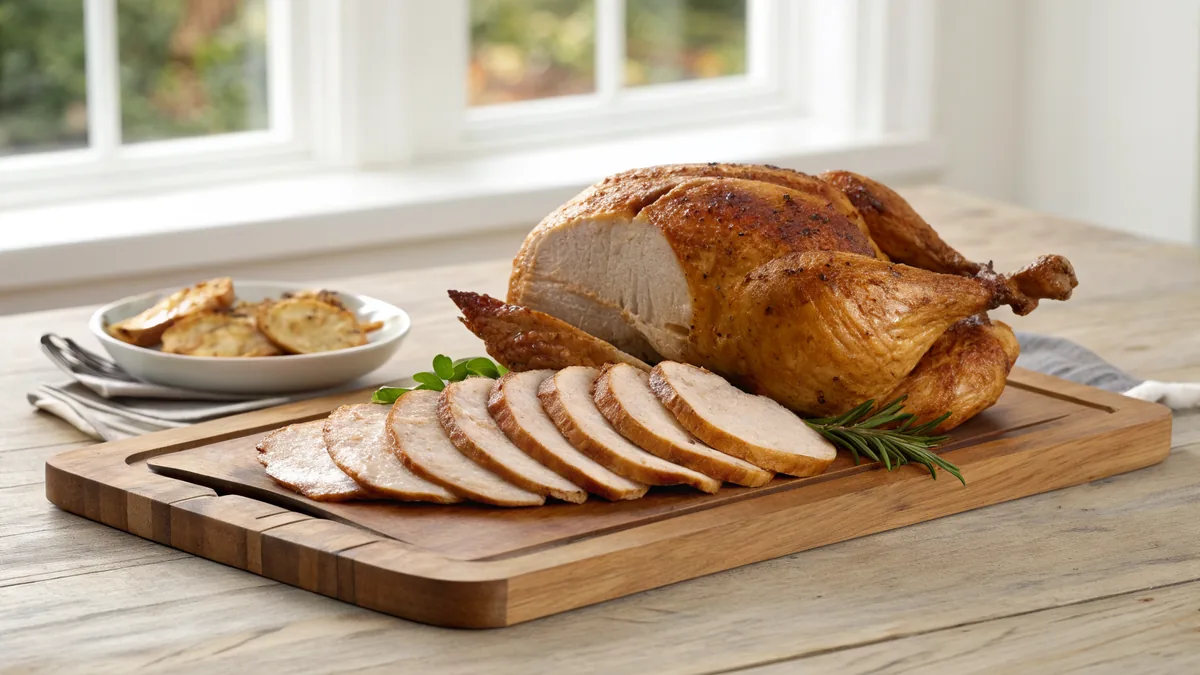
The short answer: buy 1 pound of raw whole turkey per person for a meal with a full spread of sides, and 1 1/4 to 1 1/2 pounds if you want leftovers. A whole bird yields only about 40 to 45 percent of its raw weight as cooked edible meat, so that pound becomes roughly half a pound on the plate, which is one generous adult portion. For 10 guests that is a 12 to 14 pound bird; for 20, two 15 pounders rather than one enormous one. Bone-in breast needs 3/4 pound per person and boneless breast roast only 1/2 pound, because the bone-to-meat ratio is far better.
The Base Number: One Pound Raw, Half a Pound Cooked
Every portion figure on this page comes from a single anchor: half a pound of cooked turkey per adult when turkey is the centerpiece of the meal. That is two or three good slices of breast plus a little dark meat, on a plate that also carries dressing, potatoes, a vegetable, and gravy. It is the same anchor I use for every other meat I plan around, which is why this page has the same shape as my guides to how much brisket per person and how much pulled pork per person.
The number flexes in predictable directions. Children under twelve count as half an adult. A lunch service, an older crowd, or a table with eight side dishes on it all pull the figure down toward a third of a pound cooked. Teenagers, a sandwich-heavy plan, and any household where the leftovers are considered part of the point pull it up. Start at half a pound cooked and adjust deliberately rather than guessing at the raw weight directly.
Where turkey differs from every other meat is the conversion from that cooked figure to the number on the price tag, and it is a brutal one. Doubling is the working rule: half a pound cooked means one pound raw. It feels like far too much bird sitting in the cart, and it is correct.
Why a Whole Turkey Yields Less Than Half Its Weight
Three separate things eat the difference between the label and the plate. The first is skeleton. A turkey carries a proportionally heavier frame than a chicken, and the back, ribs, and wing bones account for something like a quarter to a third of the raw weight before you have cooked anything. The second is moisture: over three to four hours in an oven, a bird loses roughly 20 to 25 percent of its weight to evaporation and rendered fat. The third is the parts nobody portions, the giblets, the neck, and the skin that does not get eaten.
Add those together and a whole turkey delivers about 40 to 45 percent of its raw weight as cooked, carvable meat. A 16 pound bird yields somewhere around 7 pounds of actual food, which at half a pound per person feeds 14 people well. That is why the one-pound-per-person rule works out: it is not generosity, it is arithmetic.
Brining changes this slightly in your favor, which is one more argument for doing it. A brined bird retains meaningfully more moisture through the cook, so the finished weight is higher and the meat is juicier at the same internal temperature. My Texas turkey brine covers the ratios and the 24-hour timing, and the difference is most obvious in the breast, which is the part that dries out first and the part most of your guests are eating.
Turkey by Group Size
This is the chart, built on one pound raw per person for a full plate with no leftovers, and one and a half pounds when you want the sandwiches. The cooked-meat column is what you should actually expect to carve off the bird.
| Guests | Bird size, no leftovers | Bird size, with leftovers | Cooked meat expected |
|---|---|---|---|
| 4 | 5-6 lb breast or small bird | 8 lb | about 2 lb |
| 6 | 7-8 lb | 10 lb | about 3 lb |
| 8 | 9-10 lb | 12 lb | about 4 lb |
| 10 | 10-12 lb | 15 lb | about 5 lb |
| 12 | 12-14 lb | 18 lb | about 6 lb |
| 16 | 16-18 lb | two 12 lb birds | about 8 lb |
| 20 | two 11 lb birds | two 15 lb birds | about 10 lb |
| 25 | two 13 lb birds | three 13 lb birds | about 12-13 lb |
Two notes on reading it. The 4 and 6 person rows are where a whole turkey stops making sense; below about 8 pounds the birds available are usually poor value and a bone-in breast is the better buy. And every row from 16 guests up switches to multiple birds for reasons covered in the next section, which is the single most useful thing on this page if you are cooking for a crowd.
One Big Bird or Two Smaller Ones
Past about 18 pounds, buy two turkeys. This is not a preference, it is geometry. A turkey cooks from the outside in, and a bigger bird has a thicker breast, so the outer inch of white meat is well past done by the time heat reaches the center. Meanwhile the thighs, which need to hit 175F while the breast should stop at 165F, are buried even deeper. That timing gap is manageable on a 12 pound bird and genuinely difficult on a 24 pound one.
The time argument is just as strong. Two 12 pound birds roast in roughly two thirds the time of a single 24 pounder, because cooking time scales with thickness rather than with total mass. They fit on two racks in most home ovens, or one goes in the oven while the other goes on the pit. And you get two sets of drumsticks, two wishbones, and twice as much skin, which settles more table arguments than anything else on this page.
The only real case for the single large bird is the presentation moment when it comes to the table whole. If that matters in your house, roast a 14 pounder for the show and a bone-in breast alongside it for the volume. You get the picture and the portions without the overcooked breast meat.
Bone-In, Boneless, and Breast Only
Not every holiday needs a whole bird, and the per-person figures change a lot once you move away from one. The table below gives the raw weight to buy for each cut along with the yield behind it.
| Cut | Raw per person | Cooked yield | Best for |
|---|---|---|---|
| Whole turkey, bone-in | 1 to 1 1/4 lb | 40-45% | The centerpiece and the leftovers |
| Bone-in turkey breast | 3/4 lb | about 60% | White-meat crowds, tables under 6 |
| Boneless breast roast | 1/2 lb | about 70% | Small groups, second protein |
| Bone-in legs and thighs | 1 lb | about 50% | Dark-meat households, smoking |
| Already-cooked turkey | 1/2 lb | n/a | Deli or rotisserie, no conversion |
A bone-in breast is the most underrated option on that list. It yields far better than a whole bird, it cooks in about half the time, it is easy to carve, and for a table of four to six it is simply the right size. The trade-off is no dark meat and no drumsticks, which some households consider a feature and others consider a scandal.
Boneless breast roasts, usually netted and sometimes rolled around a stuffing, yield best of all at around 70 percent, but they lose the skin coverage and the bone that keep meat moist. They want careful temperature control and they are the cut most likely to come out dry. Legs and thighs are the opposite: forgiving, cheap, full of flavor, and excellent smoked, which makes them a smart second protein for a crowd that runs to dark meat.
Smoked, Roasted, and the Leftover Multiplier
A smoked turkey finishes 3 to 5 percent lighter than the same bird roasted, because a longer cook at a lower pit temperature gives moisture more time to leave. In practice, add about 10 percent to your purchase weight if the bird is going on the pit, so the crowd you would feed with a 14 pound roasted turkey wants a 15 to 16 pounder over post oak. My Texas BBQ style turkey covers the temperatures and the skin problem that comes with smoking.
Two other cooks change the shopping list. A deep-fried turkey is capped by the pot: 14 pounds is the practical ceiling for a standard 30 quart fryer, so a crowd past twelve or fourteen means two birds fried back to back, which my deep fried turkey guide plans for. And a bone-in breast alone, at three quarters of a pound per person, is the right buy for a table of four to six; my smoked turkey breast is written around a 6 to 8 pound breast for exactly that table.
Leftovers deserve to be planned rather than hoped for. Buying at one and a half pounds raw per person instead of one pound leaves roughly a quarter pound of cooked meat per guest, which is one proper sandwich each with enough left for a pot pie. That is the level most households actually want, and the asymmetry is completely one-sided: too much turkey means a week of good lunches, too little means an apologetic host carving thinner and thinner.
Store it in large pieces rather than sliced. Cooked turkey keeps three to four days in the refrigerator and up to four months frozen, and whole chunks hold moisture and resist freezer flavor far better than slices do. Slice it as you use it. The carcass goes into a stockpot the same night, which gives you the base for soup and, if you are organized, the stock for next year's gravy.
Where This Fits in the Rest of the Meal
Quantities are only one of the three planning problems, and the other two are the schedule and the oven. Thawing is the deadline people miss most: allow a full 24 hours of refrigerator time for every 4 to 5 pounds, which means a 16 pound frozen bird has to come out of the freezer on Sunday for a Thursday dinner. Nothing recovers a partially frozen turkey.
For the rest of it, the dish-by-dish schedule, the oven traffic problem, and every recipe on the table, my Texas Thanksgiving guide maps the whole meal and tells you which day each thing gets cooked. Use this page to decide what to buy, and that one to decide when to cook it.
Turkey Portions FAQ
How much turkey per person should I buy?
Plan on 1 pound of raw whole turkey per adult for a meal with a full spread of sides, and 1 1/4 to 1 1/2 pounds if you want real leftovers. That number looks enormous because a whole bird is mostly not dinner: bone, skin you will not all eat, giblets, and the 20 to 25 percent of its weight that leaves as moisture during roasting. A whole turkey yields only about 40 to 45 percent of its raw weight as cooked edible meat, so 1 pound raw gets you roughly half a pound cooked, which is one generous adult portion.
What size turkey do I need for 10 people?
A 12 to 14 pound whole turkey covers 10 people comfortably with leftovers, and a 10 pound bird is the minimum if you want none. Twelve to fourteen pounds is also the size range where whole turkeys cook best: big enough to feed a table, small enough that the breast is not badly overcooked by the time the thighs reach temperature. If your ten guests are big eaters or you want sandwiches all weekend, go to 15 pounds rather than adding a second bird.
Is it better to cook two smaller turkeys or one big one?
Two smaller birds, once you pass about 18 pounds. A large turkey has a thicker breast, so the outside overcooks long before the center is done, and the thigh-to-breast timing gap widens with size. Two 12 pounders also finish in roughly two thirds the time of one 24 pounder, fit most ovens on two racks, and give you twice as much skin, which is the part people actually fight over. The only argument for the single large bird is presentation.
How much turkey breast per person?
Bone-in turkey breast runs about 3/4 pound per person, and a boneless breast roast about 1/2 pound. The difference from a whole bird is the bone-to-meat ratio: a bone-in breast yields around 60 percent of its raw weight as cooked meat, a boneless roast around 70 percent, against roughly 40 to 45 percent for a whole turkey. Breast-only is the right call for a table under six, for a crowd that only eats white meat, or as a second protein alongside a whole bird.
Does smoked turkey shrink more than roasted?
Slightly, yes. A longer cook at a lower temperature gives moisture more time to leave, so a smoked bird typically finishes 3 to 5 percent lighter than the same turkey roasted hot and fast. In practice that means adding roughly 10 percent to your raw purchase weight if you are smoking, so a crowd you would feed with a 14 pound roasted bird wants a 15 to 16 pound bird on the pit. The bigger practical difference is skin, which crisps less reliably at smoking temperatures.
How much cooked turkey do I need per person?
About half a pound of cooked meat per adult when turkey is the centerpiece, which is two or three generous slices plus a little dark meat. Children under twelve count as roughly half an adult. If you are working from already-cooked meat, a rotisserie or deli turkey breast for instance, half a pound per person is the number to buy directly, with no yield conversion needed. For sandwiches rather than plates, a third of a pound cooked per person is plenty.
How long does it take to thaw a frozen turkey?
Allow a full 24 hours in the refrigerator for every 4 to 5 pounds, which means a 16 pound bird needs three and a half to four days. This is the deadline people miss more than any other, and a partially frozen turkey cooks unevenly no matter what you do to it. The faster method is a cold water bath, changing the water every 30 minutes, at roughly 30 minutes per pound, but the bird has to be cooked immediately afterward. Never thaw a turkey on the counter.
How much leftover turkey should I plan for?
Buying at 1 1/2 pounds raw per person instead of 1 pound gives you roughly a quarter pound of cooked leftover meat per guest, which is one good sandwich each plus a pot pie. That is the level most households actually want. Cooked turkey keeps three to four days refrigerated and up to four months frozen, and it freezes far better in large pieces than sliced, since sliced meat dries out and picks up freezer flavor much faster.