Southern Comfort Food
Deep Fried Turkey
Chef Mia's deep fried turkey: 12 to 14 lb bird, 24-hour dry brine, peanut oil at 350F, 3.5 min a pound, pull at 160F. Water test for oil, safety rules.
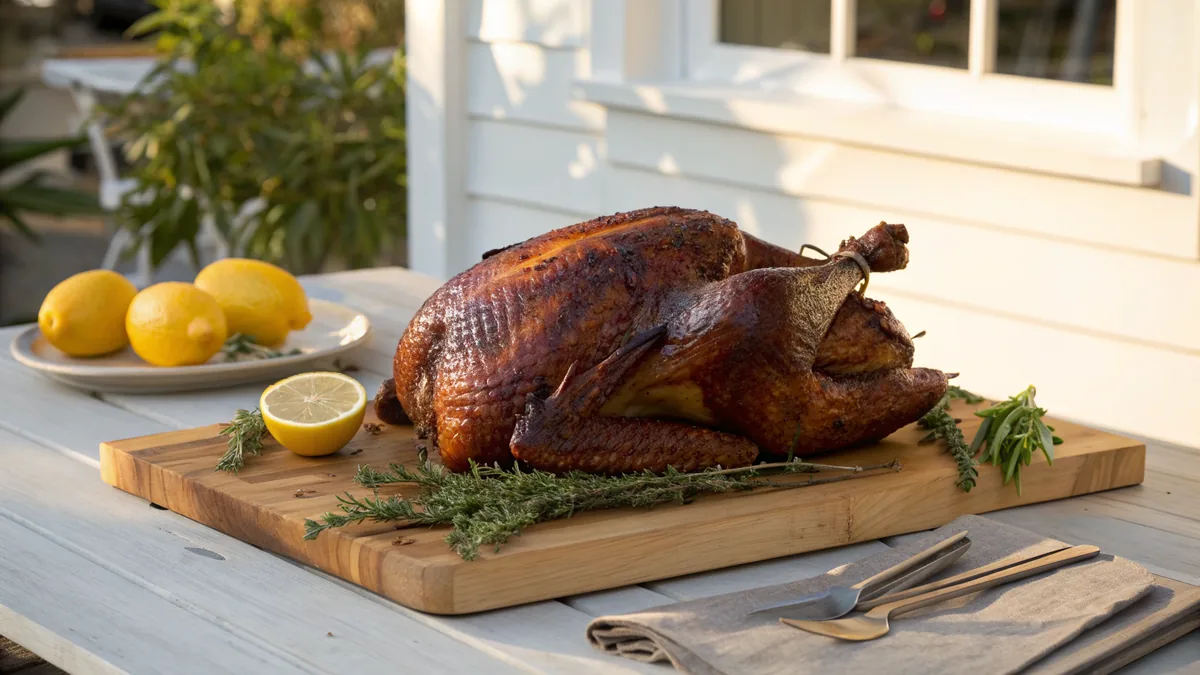
Quick answer: A deep fried turkey is a whole, fully thawed, completely dry turkey of 12 to 14 pounds, dry-brined for 24 hours and optionally injected with seasoned butter, lowered slowly with the burner off into peanut oil at 350F (175C) in a 30-quart pot outdoors, and fried 3 to 3.5 minutes per pound, about 40 to 42 minutes for a 12-pound bird, until the breast reads 160F (71C). It rests 20 to 30 minutes and carries over to 165F (74C). Oil volume is set the day before by the water displacement test: bird in the empty pot, water to cover by 1 to 2 inches, mark the line, dry the pot. Fourteen pounds is the ceiling, the bird is never stuffed, and the fryer never runs in a garage, on a deck, or within 10 feet of the house.
Forty-two minutes in peanut oil does what four hours in an oven cannot: it gives you a turkey whose skin shatters like a cracker over breast meat that never had time to dry out. That is the whole argument for the fryer, and it is a strong one. The oil surrounds the bird at 350F (175C) from every direction at once, so the skin renders and crisps in the first ten minutes while the meat underneath cooks fast enough that the breast is done before the moisture has a chance to leave it. Nothing in a conventional oven can match that combination, and no amount of basting will get you there.
The fryer is also the reason a lot of Texas backyards have a 30-quart aluminum pot and a propane burner sitting under a tarp eleven months of the year. Down on the Gulf Coast the tradition came in from Louisiana with the Cajun injection and the crawfish boiler, and it spread inland fast because it solves a real problem: the oven is full of cornbread dressing, sweet potatoes, and pies, and the turkey is the one thing that can be cooked somewhere else. Forty-five minutes on the patio, and the biggest item on the Thanksgiving table never touched the kitchen.
I want to be direct about the other half of this page. Deep frying a turkey is the single most dangerous thing most home cooks will do all year, and the injuries are not rare and they are not funny. Every one of them comes from a short list of avoidable mistakes: a bird that was still frozen, a pot that was overfilled, a burner that was left on while the turkey went in, a fryer that was set up on a wooden deck or in a garage. I have fried turkeys at our place outside Lockhart for fifteen falls without an incident, and that record is the result of a fixed routine that I do not vary, not luck. The routine is written out below in full, and it is the most important section on this page.
Forty-Five Minutes, a Free Oven, and Skin That Shatters
The three reasons to fry a turkey are time, space, and skin, and they are worth taking in that order because the first two are the ones that get people to buy the fryer and the third is the one that keeps them using it. A 12 lb bird is in and out of the oil in about 42 minutes. The same bird in a 325F oven takes 3 hours or more, and my smoked turkey over post oak takes closer to 4 hours at 275F. On a holiday when every burner and rack in the house is spoken for, moving the largest item to a propane burner on the patio is the difference between a relaxed cook and one that runs an hour late.
Skin is where the fryer earns its keep for good. Hot oil is a far more efficient conductor of heat than hot air, and it hits every square inch of the bird at once, top and bottom, inside the cavity and out. The skin renders its fat and dehydrates almost immediately, so it goes brittle and deep mahogany in the first ten to fifteen minutes and stays that way. Meanwhile the meat underneath cooks so quickly that it does not have the hours a roast does to lose moisture through evaporation. A fried breast, properly pulled at 160F, is noticeably juicier than the same breast roasted, and there is no basting, no foil tent, no rotating the pan.
What you give up is drippings. Everything that renders out of a fried turkey goes into three gallons of oil, and nothing comes out of it that you would want in a gravy. You also give up smoke, which the Central Texas side of my family considers a serious loss, and you take on a real hazard that a roasting pan never presents. Those are the trade-offs. If you have the outdoor space, a level patch of ground, and the discipline to follow the safety rules without exception, the fried bird is worth it. If any of those three is missing, roast or smoke, and be happy.
Fourteen Pounds Is the Ceiling, and the Bird Must Be Bone Dry
The right bird for a fryer is 12 to 14 lb (5.4 to 6.4 kg), and 14 is a hard ceiling for a standard 30-quart pot. Above that the turkey displaces so much oil that you cannot cover it with a safe margin below the rim, and the thighs take so long to reach a safe temperature that the breast overshoots. A 20 lb bird does not fry well; it fries dangerously. If you are feeding a crowd, use my turkey-per-person guide to size the meal, and when the answer comes back over 14 lb, fry two smaller birds back to back in the same oil. The second one goes in the moment the first comes out, and the oil is already at temperature.
Thawed means completely thawed, in the refrigerator, for 24 hours per 4 to 5 lb. A 12 lb bird needs three days and a 14 lb bird closer to four. Do not trust the outside; press the deepest part of the breast and reach into the cavity and feel the walls. Any firmness, any ice crystal, and it is not ready. The physics here is simple and unforgiving. Ice hitting 350F oil turns to steam instantly at roughly 1,700 times its volume, and a pocket of ice inside a bird lowered into a full pot throws boiling oil over the rim and onto the flame. Almost every turkey fryer fire that makes the news starts with a bird that was not fully thawed.
Dry means dry inside and out, and the 24-hour uncovered dry brine in the refrigerator is the best way to get there. After the salt goes on, the bird sits on a rack in the cold, moving air of the fridge, and the skin dries to a papery, slightly translucent finish. That dry skin is what crisps in the oil. It is also a safety measure: less surface water means less violent bubbling when the bird goes in. Right before frying, pat every surface again, including the cavity, and tip the bird to let any liquid drain out of the neck and body openings.
Take out the pop-up thermometer, which is a plastic plug that melts in oil. Cut off any plastic leg truss or hock lock; some birds have a metal one, which can stay. Pull the neck and giblets from both the body cavity and the neck flap and put them in a pot for stock, because you will need that stock for gravy. Never, under any circumstances, stuff a turkey that is going into a fryer. Stuffing holds moisture, blocks the oil from reaching the cavity, and keeps the interior cold long after the outside is done. The cavity of a fried bird stays empty and open so oil flows straight through it.
Peanut Oil, the Water Test, and Exactly 350F
Peanut oil is the fat, and it is not a preference so much as a specification. It has a smoke point around 450F, a neutral flavor that does not carry into the meat, and it stays stable through 45 minutes at 350F and through several reuses without breaking down. A 35 lb container is the standard size and it holds about 4.5 gallons, which is usually a little more than a 12 to 14 lb bird needs in a 30-quart pot. Canola and a high-oleic safflower or sunflower oil are acceptable substitutes with slightly lower smoke points. Vegetable shortening, lard, and anything labeled for salad use are not, and olive oil is out of the question at these volumes and temperatures. If anyone at the table has a peanut allergy, refined peanut oil is generally considered low-risk because the proteins are removed in refining, but that is a conversation to have with the allergic guest, not a decision to make for them; canola is the safe swap.
How much oil is the question that causes the most trouble, and the answer is never a number off a chart. It is the water displacement test, run the day before, with the bird you are actually frying. Set the thawed turkey, still in its wrapper or in a large bag, into the empty pot. Fill with water until it covers the bird by 1 to 2 inches. Lift the bird out and let it drain into the pot, then look at the water line. That line, marked on the inside of the pot, is exactly where your oil goes. Measure it: if the line sits less than 4 to 5 inches below the rim of the pot, the bird is too big for the pot and you need a smaller turkey. Pour off the water and dry the pot with towels until there is not a drop left, then leave it upside down to air dry overnight. Water hiding in a pot seam is the same hazard as ice in the bird.
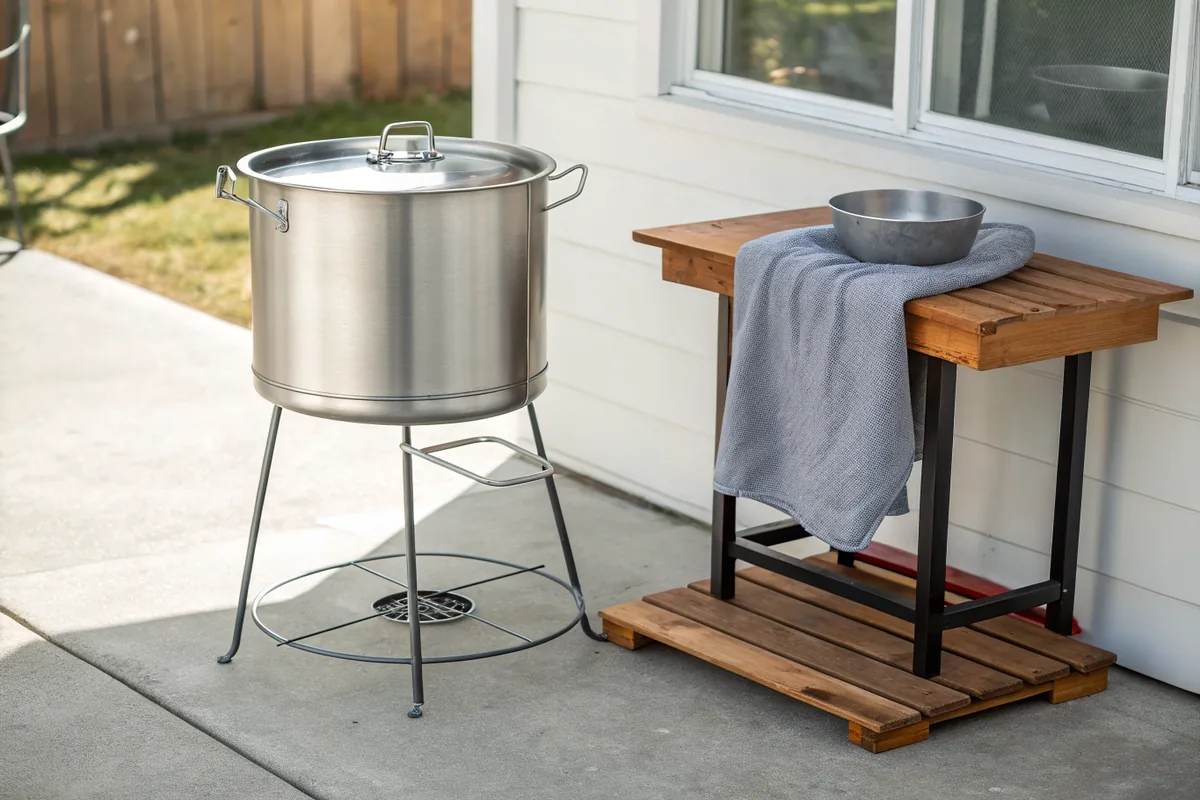
The oil goes to 350F (175C), measured with a clip-on fry thermometer whose tip is in the oil and not touching the pot. Heating 4 gallons from cold takes 30 to 45 minutes on a standard propane burner, and you should stand near it the whole time; most fryer burners have no thermostat and will happily take the oil to 400F and beyond if left alone. When the bird goes in, the oil temperature will drop 30 to 50 degrees, and the job for the first ten minutes is bringing it back to 350F and then holding it. Below 325F the skin absorbs oil instead of crisping and the bird comes out greasy; above 375F the outside darkens to near-black before the thighs are safe. A tight range of 340F to 350F is what you are managing for 45 minutes, and it means small adjustments to the burner valve, not big ones.
One more note on the pot itself. A 30-quart aluminum pot with a lift hook and a basket, on a low steel burner stand, is the standard turkey fryer kit and it is correct. Skip the tall, narrow pots and the tall burner stands sold as crawfish boilers; a high center of gravity is exactly what you do not want under four gallons of 350F oil. The lower the pot sits, the harder it is to tip over.
Dry Brine for 24 Hours, Then the Injection
Salt, black pepper, and garlic powder, rubbed on the skin and inside the cavity a full day ahead, is the seasoning this bird wants, and it is the same trinity that goes on a Central Texas brisket. A quarter cup of Diamond Crystal kosher salt (three tablespoons if you use Morton, which is denser) is right for a 12 to 14 lb bird. The salt draws moisture out of the skin in the first few hours, dissolves into it, and then that brine is pulled back into the meat over the following day, seasoning the breast a good inch deep and helping it hold on to its juices in the oil. The skin, meanwhile, dries in the open refrigerator air, which is the single biggest contributor to a crackling finish.
I want to be clear about the wet brine because a lot of people have a favorite one. My Thanksgiving turkey brine is a salt-sugar-aromatics soak that does beautiful things to a roasted bird. It is a poor match for a fryer, because a wet-brined turkey carries water in and under the skin, and water is the enemy of both crispness and safety in hot oil. If you insist on wet brining a bird you plan to fry, rinse it, then pat it dry with a whole roll of paper towels, then set it uncovered on a rack in the refrigerator for a full 24 hours to dry down before it goes anywhere near the pot. Skip the sugar in the brine entirely, since it scorches at 350F. The dry brine gets you the same seasoning with none of that trouble, and it is what I use.
The injection is the Louisiana side of the tradition and it is optional. A syringe-style marinade injector, the kind with a thick stainless needle, pushes seasoned liquid deep into the breast and thighs where a rub can never reach. My base is half a cup of melted butter whisked into half a cup of stock with a tablespoon each of hot sauce and Worcestershire and two teaspoons of Cajun seasoning. The butter must be warm and the mixture strained so nothing clogs the needle. Inject 1 to 2 tablespoons per site: five or six spots across each breast, three in each thigh, two in each drumstick, angling the needle in different directions from one entry hole so the liquid fans out rather than pooling. Do this two hours before frying, then pat the skin dry again, because the injection will weep a little.
Cajun versus Texas is a real fork in the road here. The Cajun bird gets the full injection plus a heavy dusting of cayenne-based seasoning on the skin, and it is what most people picture when they hear fried turkey. The Texas bird gets salt, pepper, and garlic, an injection that is mostly butter and stock with only a little heat, and it tastes like turkey. Both are excellent. I lean Texas because the fried skin already has so much going on that it does not need a spice crust, and because a plainer bird sits better next to a tart jalapeno cranberry sauce and a pan of dressing. Whichever you choose, keep sugar out of the injection and out of the rub; honey, brown sugar, and maple all burn in the oil and turn the skin bitter and black.
The Safety Rules I Will Not Bend: Ten Feet, Burner Off, No Water
Outdoors only. Not in a garage with the door open, not in a carport, not on a covered porch, not under a patio awning or a pop-up canopy. A fryer produces a column of heat and, if anything goes wrong, a column of flame that reaches several feet above the pot; any roof, overhang, or fabric above it will catch. The fryer sits under open sky. Set it on level dirt, gravel, or concrete at least 10 feet from the house, the fence, the propane tank, the cars, and anything else that can burn. Never on a wooden deck, which is a floor made of kindling. Never on grass, which is uneven and catches. If the ground is not perfectly level, find a spot that is, because a tilted pot of oil at 350F will find its own level over the rim.
The burner is OFF while the bird goes in and OFF while the bird comes out. This is the rule most often ignored and the one that causes the most fires. Even a fully thawed, well-dried turkey releases a burst of steam and bubbling oil in the first thirty seconds, and if the flame is lit beneath the pot, any oil that foams over the rim ignites. With the burner off, a boil-over is a mess on the concrete. With the burner on, it is a fire at your feet. Turn the valve off, wait for the flame to die, lower the bird, wait for the oil to settle, and only then relight. Same sequence in reverse when you lift it out.
Lower the bird slowly, and I mean over a full minute. Use the hook that came with the fryer, or the basket, never your hands and never a pair of tongs. Drop an inch, let the bubbling calm, drop another inch. The most violent bubbling happens as the breast, the largest and wettest surface, goes under; expect it, pause there, and let it settle before continuing. Stand as far back as the hook allows and keep your face turned away. If the oil is rising toward the rim at any point, stop, lift the bird back out a few inches, and wait. It will subside.
Dress for it. Long sleeves and long pants in cotton, not synthetics, which melt. Closed shoes. Eye protection, because oil spits. Heavy gloves rated for heat, the welding-style gauntlets that cover your forearms, not oven mitts and not the thin nitrile gloves from the kitchen drawer. Keep a dry chemical fire extinguisher rated Class B or Class K within arm's reach, know how to pull the pin, and check the gauge the week before. Never water. Water on an oil fire does not put it out; it turns into steam under the oil and blasts burning oil in every direction. If a fire starts in the pot, turn off the propane at the tank if you can safely reach it, and use the extinguisher. If the fire is beyond the pot, get everyone away and call for help. A ruined turkey is not worth a burn.
Keep children and pets inside or well away for the whole cook, from the moment the burner is lit until the oil is cold. Assign one sober adult to the fryer and nobody else touches it; this is not the job for the guest with a beer in one hand. That adult stays within a few feet of the pot for the entire 45 minutes and does not go inside to check the dressing. When the bird is out and resting, the oil in the pot is still at 300F and stays dangerous for hours. Leave the pot where it is, burner off, propane closed at the tank, until the oil is completely cold to the touch, which is usually 4 to 5 hours and often means the next morning. Do not try to move a pot of hot oil, ever.
Lowering Over a Full Minute and Cooking by the Pound
With the oil at 350F and the burner off, the turkey goes in legs up, which is how it sits on the hook or in the basket and which lets the cavity drain when it comes out. Over the next minute it descends in stages, and by the end the bubbling has settled to a steady simmer around the bird with the oil level a safe distance below the rim. Now relight. The oil will have dropped to somewhere around 300F to 320F from the cold mass of the bird, and the first ten minutes are spent bringing it back to 350F with the burner on medium-high. Once it is there, back the flame off to hold 340F to 350F, and adjust in small steps every few minutes for the rest of the cook.
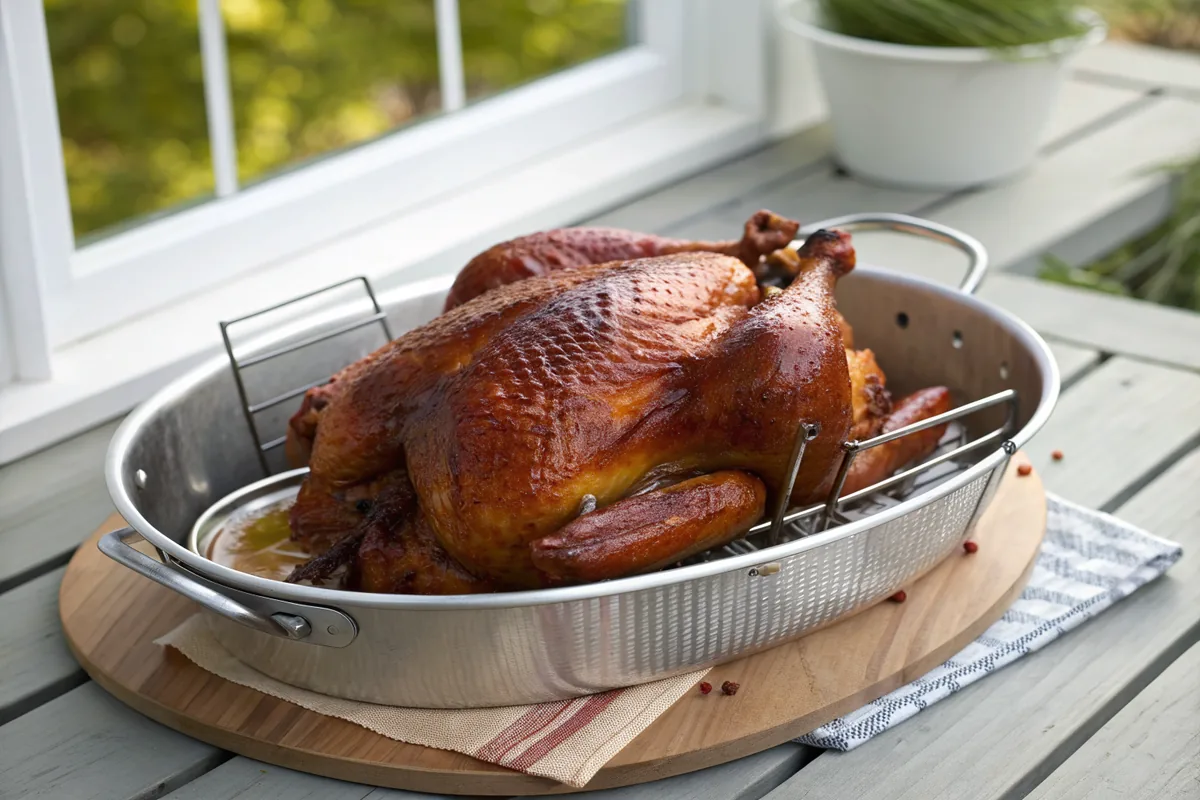
The time is 3 to 3.5 minutes per pound. A 12 lb bird takes 36 to 42 minutes, and in practice mine land right around 40 to 42 because the oil spends the first ten minutes climbing back to temperature. A 14 lb bird takes 42 to 49. Start checking at 3 minutes per pound rather than waiting for the top of the range, because a fried bird goes from perfect to overdone in a hurry. The skin is not your guide; it turns mahogany in the first fifteen minutes and stays that color, so a beautifully browned bird can still be raw in the thighs. Only a thermometer tells you anything.
Checking means turning the burner off, lifting the bird until the breast clears the oil, and reading the thickest part of the breast with an instant-read thermometer inserted from the side, away from the bone. You want 160F (71C). The thigh, read deep near the joint, should be 170F (77C) or a touch more; if the breast is at 160F and the thigh is well over, that is normal and correct, because the dark meat is happier at a higher temperature anyway. If the breast is short, lower the bird back in, relight, and check again in five minutes. If it is at 160F, it is done, and every additional minute in the oil is costing you juice.
Do not leave the fryer during any of this, and do not let the burner run away from you. One of the quiet failures is oil that creeps up to 380F while you are talking to someone, which darkens the skin toward black and starts the oil breaking down. The other is oil that sinks to 320F because the flame was set too low after the bird went in; the skin stays pale and soaks up fat, and the bird takes an extra fifteen minutes. A thermometer clipped to the rim and glanced at every two or three minutes prevents both.
Pull at 160F, Rest to 165F, Then Carve Against the Grain
Out of the oil the same way it went in: burner off, lifted slowly with the hook or basket, held over the pot for thirty seconds to drain, then set on a rack over a rimmed sheet pan. Tip it slightly to let the cavity drain, because oil collects in there. Tent it loosely with foil, and do not wrap it tight or the steam will soften the skin you just spent 45 minutes making. Rest 20 to 30 minutes. In that time the breast climbs from 160F to 165F (74C) on carryover heat, and the juices that were driven toward the center of the muscle by the heat redistribute back out toward the surface. A fried turkey carved at five minutes bleeds onto the board; one carved at twenty-five minutes stays wet inside the slice.
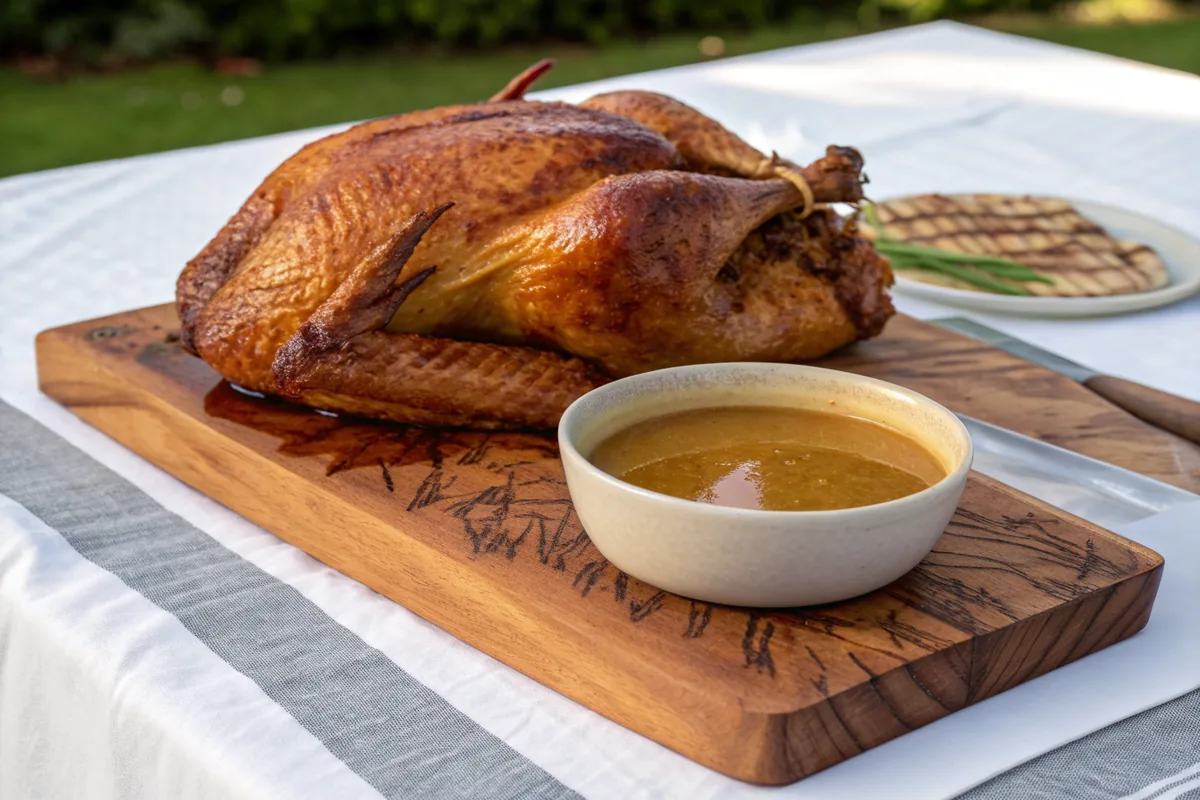
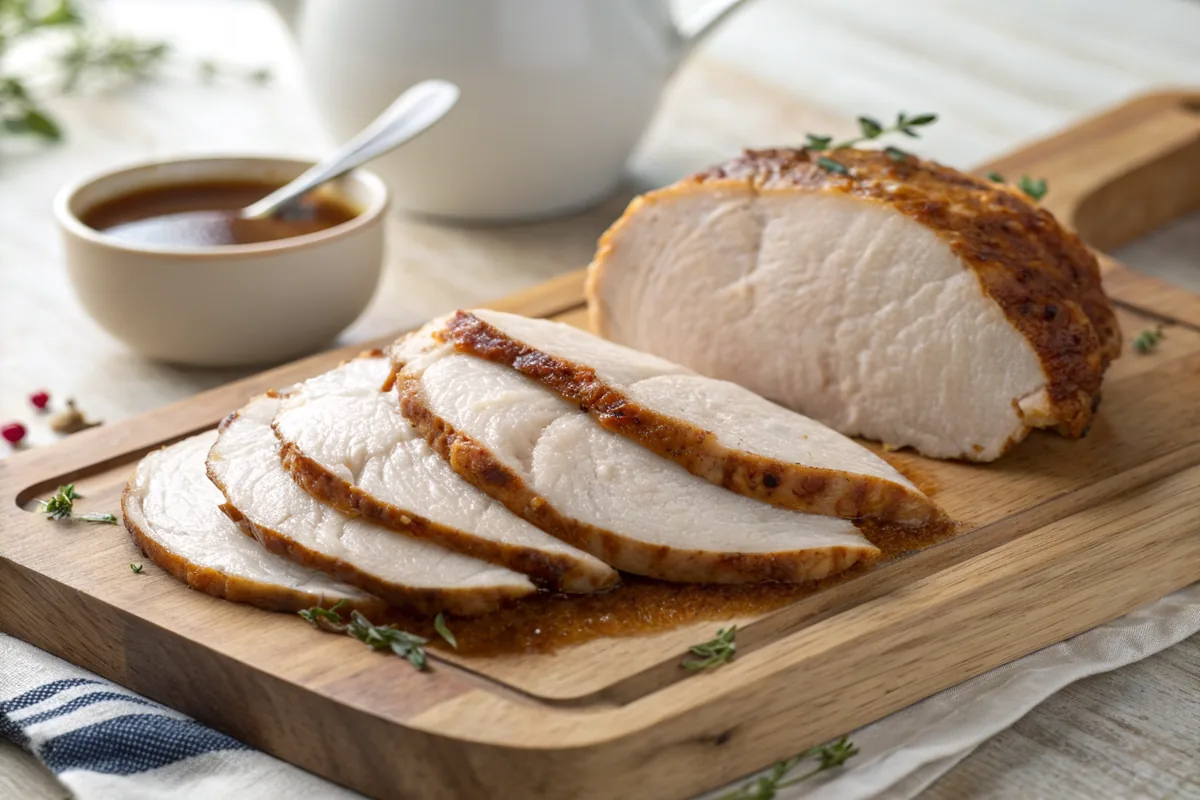
Carving a fried bird is easier than carving a roasted one, because the skin is brittle and comes away in clean shards rather than tearing. Take the legs first: pull each thigh away from the body until the joint pops, then cut through it, and separate the drumstick from the thigh at the joint. Slice the thigh meat off the bone. Then take each breast off whole, cutting down along one side of the breastbone and following the rib cage with the tip of the knife until the whole lobe comes free. Lay each breast skin side up on the board and slice across the grain, about 3/8 inch thick, so every slice carries its own strip of crackling skin on top. Slicing a fried breast on the bird, the old-fashioned way, wastes the skin and leaves the slices ragged.
Serve the skin. This sounds obvious, but a lot of people trim it and set it aside, and on a fried turkey the skin is half the point. Shingle the breast slices with skin up on a warm platter, arrange the dark meat around them, and set the wings out whole for whoever fights over them. What does not get eaten goes into the refrigerator within two hours, and it is worth planning for, because a fried bird makes some of the best leftovers of the year; the skin does not come back but the meat stays moister than roasted turkey does. My leftover turkey recipes are written with exactly this bird in mind.
Gravy Without a Single Drop of Drippings
There is no roasting pan under a fried turkey and therefore no drippings, no fond, and no pan to deglaze. Everything that renders goes into the oil and stays there. The gravy for a fried bird is made entirely from stock, and this is where the neck and giblets you pulled out the day before earn their keep. Cover them with water in a saucepan with half an onion, a carrot, a celery rib, and a few peppercorns, simmer them for 2 hours while the fryer heats and the bird cooks, and you have a quart of real turkey stock with more body than anything from a carton.
That stock goes into a roux-based gravy, and my turkey gravy page walks through it; the giblet-stock method on that page is the one to use here, because it was written for exactly this situation. Butter and flour cooked to a light tan, the hot stock whisked in a ladle at a time, the chopped giblet meat and neck meat stirred back in at the end, and a heavy hand with black pepper. Make it inside on the stove while the bird rests. If the gravy is a little pale next to a roasted bird's, a teaspoon of Worcestershire and a splash of the injection liquid, if you saved any, brings it up.
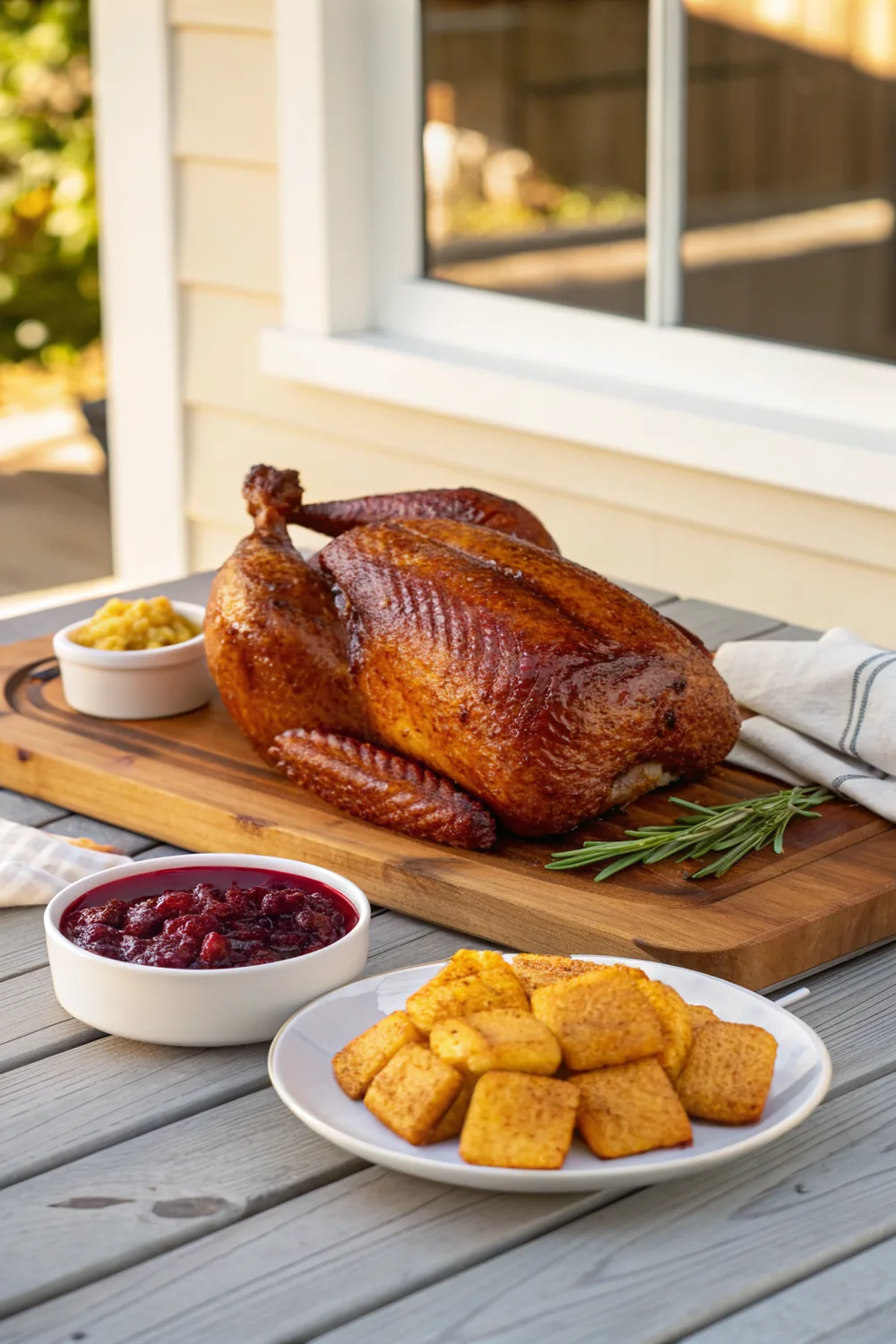
The rest of the plate is the standard Texas Thanksgiving spread, and the fried bird changes none of it. Cornbread dressing from the oven you just freed up, a green bean casserole that can bake alongside it, and a jalapeno cranberry sauce to cut the richness of all that skin. Mashed potatoes take the gravy. If the crowd is smaller and a whole bird is too much, a smoked turkey breast on the pit is the right-sized alternative and takes about the same total time once you count the fryer heating up.
Fryer, Smoker, or Oven: Which Turkey for Which Texas Table
The fried bird and the smoked bird are opposites, and choosing between them is the real Texas Thanksgiving decision. My Texas BBQ-style turkey spends about 4 hours over post oak at 275F (135C), picks up a deep smoke flavor and a bronze, slightly leathery skin, and produces meat that tastes like it came from a Lockhart pit. The fried bird spends 45 minutes in oil at 350F, picks up no smoke at all, and produces the crispest skin and the juiciest breast of any method. One is about flavor built slowly; the other is about texture built fast.
Choose the smoker when you have the morning free, when you own a pit and know how to hold it steady, when the people at the table are the kind who will notice post oak, and when you want a bird that tastes like Central Texas. Choose the fryer when the oven and the day are both overbooked, when the crowd wants that skin, when you are cooking two birds and need the second one done in under an hour, and when you have the safe outdoor space for it. Choose the oven when you have neither a pit nor a level patch of concrete, or when the weather is bad enough that standing outside for an hour is a miserable prospect; roasted turkey is not a consolation prize, and the Texas Thanksgiving hub has that method covered too.
The oil-less infrared fryer deserves its own paragraph because people ask. It is a propane-fired cylinder that surrounds the bird with radiant heat rather than oil, and it makes a good turkey with a crisp, deeply browned skin and none of the oil to buy, manage, or dispose of. It is also not the same cook. Timing runs closer to 10 minutes per pound, so a 12 lb bird takes about 2 hours, and the skin, while very good, has a roasted character rather than the brittle, glassy shell you get from oil. It is a safer, slower, cleaner appliance, and it is the right call for anyone who wants a crisp outdoor bird without the hazard of three gallons of 350F oil. Just do not follow this page's numbers for it; follow the manufacturer's.
Three Gallons of Oil: Straining, Reusing, and Getting Rid of It
Peanut oil is the most expensive ingredient in this recipe, and the good news is that it is good for 3 to 4 fries if you treat it well. The oil has to cool completely first, in the pot, burner off, for several hours; I leave mine overnight. Once it is cold, pour or ladle it through a fine mesh strainer lined with a coffee filter or a double layer of cheesecloth into the original container, which is the right size and already has a tight cap. The filter takes out the seasoning, the skin flakes, and the browned bits that would otherwise go rancid. Store it capped in a cool, dark place, the garage in winter or a pantry floor, and it keeps for a few months.
Retire the oil when it turns dark brown, smells sharp or fishy, foams at the surface while heating, or starts smoking below 350F. Any of those means it has broken down and it will make the next bird taste stale. A single turkey fry that was held at 350F and not overheated leaves the oil in good shape; a fry where the oil ran up to 400F for ten minutes ages it considerably. The oil also picks up flavor from whatever went into it, so a heavily Cajun-injected bird leaves oil that is fine for a second turkey and less fine for a batch of buttermilk fried chicken, though plenty of Gulf Coast households do exactly that with the leftover oil on Friday.
Disposal is not the sink. Four gallons of cooking oil down a drain congeals in the pipe and in the city's sewer line, and most Texas municipalities will fine you for it. Pour cooled, spent oil back into its original container, cap it, and take it to a recycling drop-off; many county household hazardous waste sites and some auto parts stores accept used cooking oil, and a number of Texas cities run a holiday cooking-oil collection in the week after Thanksgiving. If none of that is available, seal it in the container and put it in the trash. Never pour it on the ground or in the storm drain, and never pour it while it is still warm enough to soften the plastic.
Clean the pot with hot soapy water once the oil is out, dry it completely, and store it with the burner. Wipe down the patio where the fryer stood; even a careful cook leaves a faint ring of oil on the concrete, and a little dish soap and a stiff brush takes it up before it stains.
Fryer Mistakes That Cause Fires, and the Ones That Only Ruin Dinner
Frying a bird that is not fully thawed. Ice in the cavity flashes to steam and throws oil over the rim. Three days in the refrigerator for a 12 lb turkey, and press-test the breast and cavity before it goes anywhere near the pot.
Skipping the displacement test and guessing at the oil. An overfilled pot boils over the moment the bird goes in. Bird in the empty pot, water to cover by 1 to 2 inches, mark the line, dry the pot completely.
Leaving the burner lit while lowering or lifting. Any foam-over hits an open flame. Burner off, bird in over a full minute, oil settles, then relight. Same in reverse.
Frying under a roof, on a deck, or in a garage. Flames from a boil-over go straight up. Open sky, level concrete or dirt, 10 feet from anything that burns.
Water anywhere near the oil. A wet pot, a wet bird, a wet glove, a garden hose on a fire. Water and 350F oil are a small explosion. Dry everything, and keep a dry chemical extinguisher, not a hose, at hand.
Moving the pot while the oil is hot. Hot oil stays dangerous for hours after the burner goes off. The pot stays put until it is cold, usually the next morning.
Stuffing the bird. The cavity stays cold and the oil cannot reach it, so the thighs and the interior stay raw while the outside overcooks. The cavity of a fried turkey is always empty.
Trusting the skin color. It turns mahogany in fifteen minutes and tells you nothing after that. A thermometer in the breast at 160F is the only signal that matters.
Sugar in the rub or injection. Honey, brown sugar, and maple burn at 350F and turn the skin bitter. Salt, pepper, garlic, and heat; nothing sweet until the cranberry sauce.
Oil too cool. Below 325F the skin soaks instead of crisps, and the bird comes out greasy and pale. Bring the oil back to 350F in the first ten minutes and hold it between 340F and 350F, checking the clip-on thermometer every few minutes.
Carving right out of the oil. The juices are still at the center of the muscle and they run onto the board. Twenty minutes under a loose foil tent, and the breast climbs to 165F on its own.
Deep Fried Turkey Recipe
Ingredients
- 1 whole turkey, 12 to 14 lb (5.4 to 6.4 kg), fully thawed, neck and giblets removed, pop-up thermometer and plastic leg truss removed
- 3 to 5 gallons (11 to 19 L) peanut oil, exact volume set by the water displacement test
- For the dry brine:
- 1/4 cup Diamond Crystal kosher salt (use 3 tablespoons if Morton)
- 2 tablespoons coarsely ground black pepper
- 1 tablespoon garlic powder
- 1 teaspoon smoked paprika (optional, for color)
- For the injection (optional):
- 1/2 cup (4 oz / 113 g) unsalted butter, melted and kept warm
- 1/2 cup (4 oz / 120 ml) low-sodium chicken or turkey stock
- 1 tablespoon Louisiana-style hot sauce
- 1 tablespoon Worcestershire sauce
- 2 teaspoons Cajun seasoning (or 1 teaspoon each garlic powder and black pepper for a Texas bird)
- For the gravy, see the stock-based method linked in the gravy section
Instructions
- Thaw completely, 24 hours per 4 to 5 pounds. Thaw the turkey in the refrigerator on a rimmed sheet pan, allowing 24 hours for every 4 to 5 lb; a 12 lb bird needs 3 full days. Press the thickest part of the breast and the cavity walls: they must be soft with no firm or icy spots. A partly frozen bird is the number one cause of fryer boil-overs and cannot go in the oil.
- Run the water displacement test the day before. Set the thawed, wrapped or bagged turkey in the empty fryer pot. Add water until it covers the bird by 1 to 2 inches, then lift the bird out and mark the water line on the inside of the pot with a permanent marker or by measuring the depth. Pour the water out and dry the pot completely with towels, then let it air dry; any water left in the pot will erupt when the oil heats. That line is your oil level and it must sit at least 4 to 5 inches below the rim.
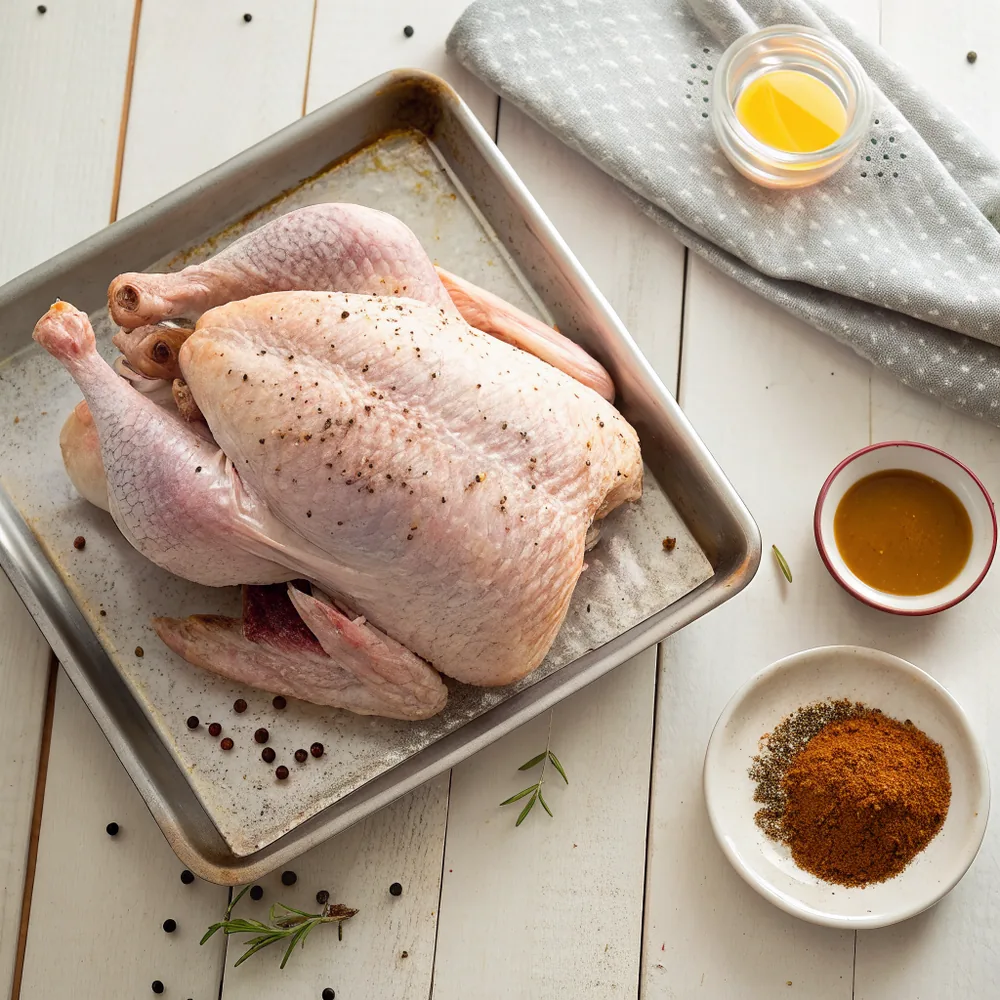
- Prep and dry-brine the bird for 24 hours. Remove the neck and giblets from both cavities and save them for stock. Pull out the pop-up thermometer and cut off any plastic leg truss. Pat the turkey completely dry inside and out with paper towels. Mix the salt, pepper, garlic powder, and paprika and rub it over the skin, inside the cavity, and under the breast skin where you can reach. Set the bird breast up on a rack over a sheet pan and refrigerate uncovered for 24 hours so the skin dries out and the salt works into the meat.
- Inject, if using, and dry again. Two hours before frying, whisk the warm melted butter, stock, hot sauce, Worcestershire, and Cajun seasoning together. Draw it into a marinade injector and inject about 1 to 2 tablespoons per site into each breast in 5 or 6 spots, each thigh in 3 spots, and each drumstick in 2 spots, angling the needle to spread it. Pat the outside dry again and let the bird sit at room temperature for 1 to 2 hours so it is not refrigerator-cold going into the oil.
- Set up outdoors and heat the oil to 350F. Set the burner on level dirt, gravel, or concrete at least 10 feet from the house, never on a deck or under a roof. Fill the pot with peanut oil to your marked line. Clip a fry thermometer to the rim with its tip in the oil, light the burner, and heat the oil to 350F (175C), which takes 30 to 45 minutes. Thread the bird onto the fryer hook or set it in the basket, legs up, and have your gloves, long sleeves, and extinguisher in place.
- Turn the burner OFF and lower slowly over a full minute. Kill the flame completely. Wearing welding-style gloves and standing back, lower the turkey into the oil an inch at a time over a full 60 seconds. The oil will bubble hard as surface moisture flashes off; pause every few inches to let it settle. When the bird is fully submerged and the bubbling has calmed, hang the hook or basket handle on the pot rim.
- Relight and fry 3 to 3.5 minutes per pound. Relight the burner and bring the oil back to 350F, then adjust the flame to hold it between 340F and 350F. Fry for 3 to 3.5 minutes per pound: about 40 to 42 minutes for a 12 lb bird, 45 to 49 minutes for 14 lb. Do not leave the fryer for any reason during the cook.
- Check for 160F in the breast. At the 35-minute mark for a 12 lb bird, turn the burner OFF, lift the turkey until the breast clears the oil, and check the thickest part of the breast with an instant-read thermometer. You want 160F (71C) in the breast and at least 170F (77C) in the thigh. If it is short, lower it back in, relight, and check again in 5 minutes.
- Lift, drain, and rest 20 to 30 minutes. With the burner off, lift the turkey out slowly and hold it over the pot for 30 seconds to drain, then set it on a rack over a sheet pan. Tent loosely with foil and rest 20 to 30 minutes; the breast will climb to 165F (74C) and the juices will settle back into the meat.
- Carve, and let the oil cool for hours. Carve the bird as you would a roasted turkey, taking the breasts off whole and slicing across the grain so every slice gets a strip of skin. Leave the pot of oil exactly where it is, burner off, until it is completely cold, which takes several hours; only then strain and store it or move the pot.
Frequently Asked Questions
How long do you deep fry a turkey per pound?
Deep fry a turkey for 3 to 3.5 minutes per pound in peanut oil held at 350F (175C). A 12 lb bird takes about 40 to 42 minutes and a 14 lb bird about 45 to 49, counting the ten minutes the oil spends climbing back to temperature after the cold bird goes in. Start checking at 3 minutes per pound by turning the burner off, lifting the bird until the breast clears the oil, and reading the thickest part of the breast with an instant-read thermometer. It is done at 160F (71C) in the breast and will carry over to 165F (74C) during a 20 to 30 minute rest. The skin browns in fifteen minutes and is no guide to doneness.
How much oil do I need to deep fry a turkey?
Enough to cover the bird by 1 to 2 inches while still sitting at least 4 to 5 inches below the rim of the pot, and the only way to know that number is the water displacement test. Set the thawed, wrapped turkey in the empty pot, add water to cover by 1 to 2 inches, lift the bird out, and mark the water line inside the pot. Pour the water out and dry the pot completely. For a 12 to 14 lb bird in a standard 30-quart pot that usually comes to 3 to 4 gallons, but never trust a chart over the test; an overfilled pot boils over the moment the turkey goes in.
What size turkey can you deep fry?
Twelve to fourteen pounds is the right range, and 14 lb (6.4 kg) is the ceiling for a standard 30-quart turkey fryer pot. Larger birds displace too much oil to keep a safe margin below the rim, and their thighs take so long to reach 170F that the breast dries out waiting. For a crowd that needs more than 14 lb of turkey, fry two smaller birds back to back in the same oil rather than one large one; the oil is already at 350F for the second, and each one takes under 50 minutes. A 10 lb bird fries beautifully in about 30 to 35 minutes if the group is small.
Do you have to thaw a turkey completely before frying it?
Yes, completely, and this is the most important safety rule on the page. Ice inside a turkey turns to steam the instant it hits 350F oil, expanding to many hundreds of times its volume, and that steam throws boiling oil over the rim of the pot and onto the burner; a partially frozen bird is the cause of most turkey fryer fires. Thaw in the refrigerator for 24 hours per 4 to 5 lb, so three full days for a 12 lb bird and closer to four for 14 lb. Before frying, press the thickest part of the breast and feel the cavity walls; any firmness or ice crystal means it needs more time.
Should I brine or inject a turkey before deep frying?
A 24-hour dry brine of kosher salt, black pepper, and garlic powder is the best choice, because it seasons the meat deeply while drying the skin so it crisps in the oil. An injection of melted butter, stock, hot sauce, Worcestershire, and Cajun seasoning is optional and adds flavor and moisture inside the breast; inject two hours before frying and pat the skin dry again. A wet brine works but carries water into and under the skin, which hurts both crispness and safety; a wet-brined bird must be rinsed, patted very dry, and air-dried uncovered in the refrigerator for 24 hours before frying. Keep sugar out of any brine or injection, since it burns at 350F.
Where is it safe to set up a turkey fryer?
Outdoors under open sky, on level dirt, gravel, or concrete, at least 10 feet from the house, fences, vehicles, and the propane tank. Never in a garage, carport, or covered porch, never under an awning or canopy, and never on a wooden deck. The ground must be level so the pot cannot tip. Keep a dry chemical extinguisher rated Class B or K within reach and never use water on an oil fire. Turn the burner off while lowering and lifting the bird, wear long sleeves, eye protection, and heavy gloves, keep children and pets away for the whole cook, and leave the pot where it is until the oil is completely cold, which takes several hours.
How do you make gravy for a deep fried turkey with no drippings?
From stock, because everything that renders out of a fried turkey stays in the oil. Simmer the neck and giblets you removed from the bird in water with onion, carrot, celery, and peppercorns for about 2 hours while the fryer heats and the bird cooks, which yields a quart of rich turkey stock. Make a roux of butter and flour, whisk the hot stock in gradually, and stir the chopped giblet and neck meat back in at the end with plenty of black pepper. The giblet-stock method on the turkey gravy page is written for exactly this and can be made on the stove while the bird rests.
Can I reuse the peanut oil after frying a turkey?
Yes, for 3 to 4 fries if it was held near 350F and not overheated. Let it cool completely in the pot, which takes several hours, then strain it through a coffee filter or doubled cheesecloth into its original container and cap it tightly. Store it in a cool, dark place for up to a few months. Retire the oil when it turns dark brown, smells sharp, foams while heating, or smokes below 350F. When it is spent, never pour it down a drain or on the ground; cap it in its container and take it to a recycling or household hazardous waste drop-off, or seal it and put it in the trash.